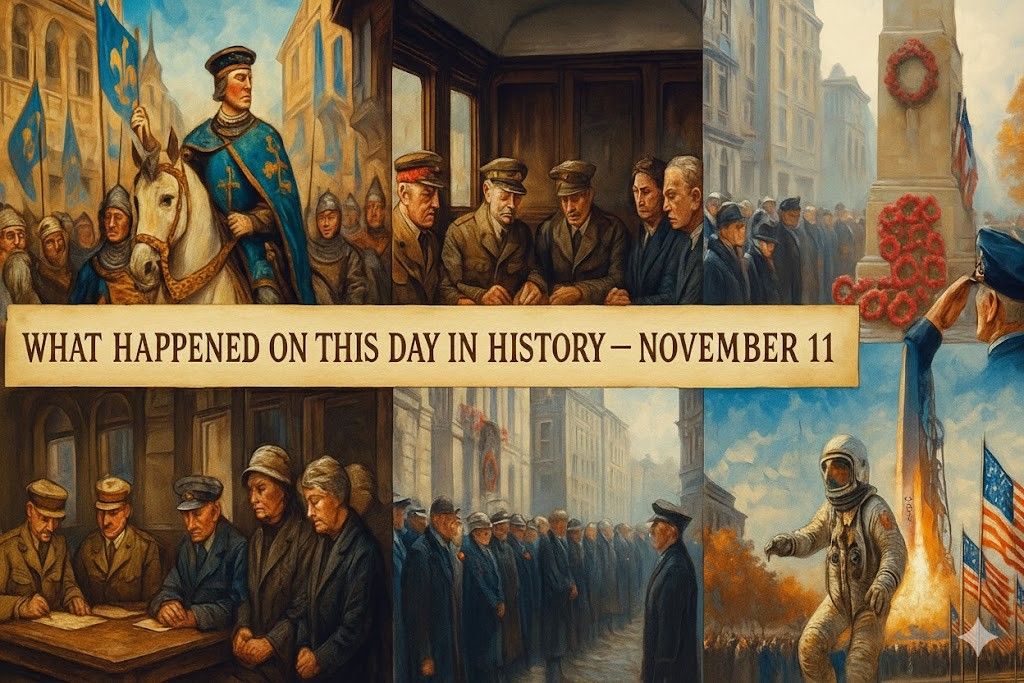
Moments of rupture, ceremony, and invention marked every era, shaping laws, politics, and public life around the world. What happened on this day in history November 11 stands as a record of turning points: imperial treaties, solemn assemblies, battlefield armistices, and human achievements that continue to echo through time.
Important Events That Happened on November 11 in History
308 — Tetrarchic council at Carnuntum
At Carnuntum, the retired emperor Diocletian met Galerius and the recently returned Maximianus in an attempt to repair the Tetrarchy. The conference aimed to realign imperial authority and settle rival claims, but personal ambitions and competing loyalties limited its lasting effect.
1028 — Death of Constantine VIII ends a long Byzantine reign
The death of Constantine VIII closed a remarkable 66-year stretch in which he had served as emperor or co-emperor under shifting regencies. His passing reopened questions of succession and court influence at a delicate moment for Byzantine governance.
Although not always in the spotlight, his lengthy presence shaped the ceremonial continuity of the imperial office and the rhythms of court politics.
1100 — Henry I marries Matilda of Scotland
On this day Henry I of England married Matilda of Scotland, a union that linked Norman rule with Anglo-Saxon royal lineage. Matilda—a descendant of Edmund Ironside—was crowned the same day, strengthening dynastic legitimacy and political alliances.
The marriage illustrates how royal marriages were used to consolidate claims, heal old divisions, and reinforce the monarchy’s image during a turbulent medieval era.
1215 — Fourth Lateran Council defines transubstantiation
The Fourth Lateran Council convened to clarify doctrine and church discipline; one key outcome was the formal definition of transubstantiation—the belief that bread and wine become the body and blood of Christ.
Its decrees tightened clerical regulation, shaped sacramental life, and set theological boundaries that deeply influenced medieval piety and institutional church authority across Europe.
1417 — Martin V elected, ending the Great Schism
The unanimous election of Martin V brought a formal end to the papal schism that had divided Latin Christendom. Restoring a single papal claimant helped reassert centralized ecclesiastical authority, though the political and reputational consequences of the schism continued to resonate.
The resolution allowed the papacy to focus again on internal reform and on the complex relationship between spiritual and temporal powers in Europe.
1493 — Christopher Columbus sights St. Martin
During his second voyage, Christopher Columbus recorded sighting the island later known as St. Martin. Encounters like this reshaped European maritime charts and accelerated transatlantic contact.
Such landfalls signaled new patterns of trade and colonization that would have profound and often tragic effects on indigenous societies across the hemisphere.
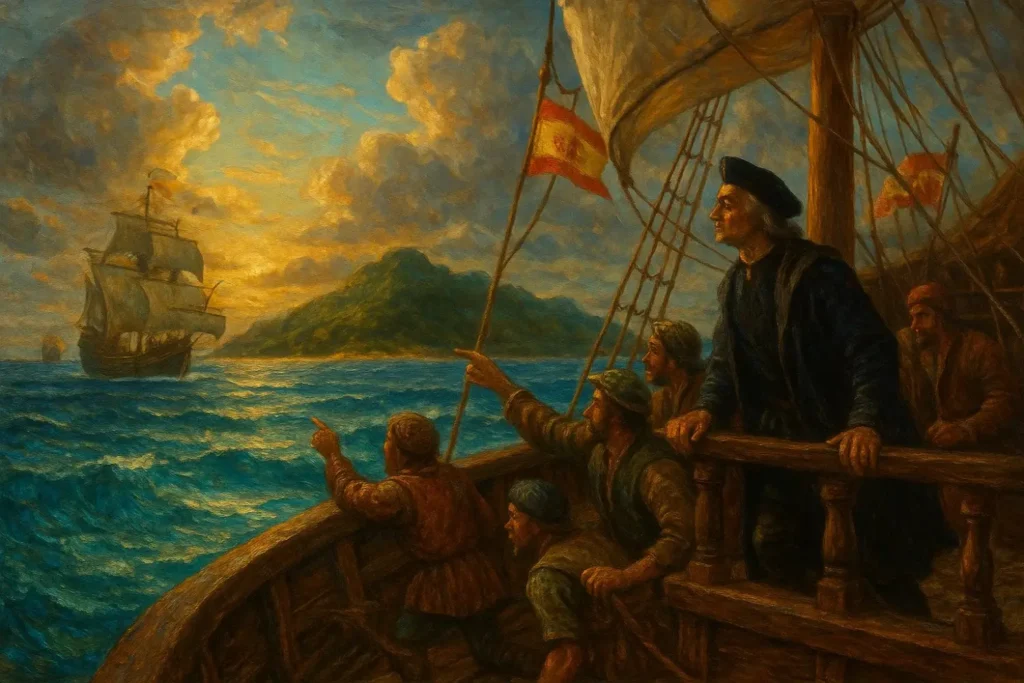
1500 – Treaty of Granada: Division of the Kingdom of Naples
On this day in 1500, the Treaty of Granada was signed between Louis XII of France and Ferdinand II of Aragon. The agreement divided the Kingdom of Naples into two zones of control—France taking the northern part and Spain the southern. Though intended to stabilize territorial claims, the treaty soon collapsed into renewed conflict, revealing the deep rivalry between the two crowns for dominance in Italy.
1572 — Tycho Brahe observes the supernova of 1572
Astronomer Tycho Brahe’s meticulous observations of the new star (SN 1572) challenged the Aristotelian idea of fixed, unchanging heavens. His records provided evidence that celestial change could occur beyond the atmosphere, fueling the shift toward empirical astronomy. Brahe’s work helped prepare the ground for later astronomers to revise cosmological models and deepen the scientific revolution.
1620 — Mayflower Compact signed near Cape Cod
Settlers aboard the Mayflower drafted and signed a compact to govern themselves after landing in what is now Provincetown Harbor. The Mayflower Compact set a practical precedent for local self-rule among English colonists in North America.
Though brief in scope, the agreement embodied early experiments in communal governance and consent that influenced later colonial political practice.
1634 – Irish Law Against “Vice of Buggery”
In 1634, the Irish House of Commons passed An Act for the Punishment for the Vice of Buggery, influenced by the Anglican bishop John Atherton. This harsh legislation criminalized same-sex relations under severe penalties, aligning Irish law with England’s earlier 1533 statute. Ironically, Atherton himself was later tried and executed under the very law he had championed, making the event a dark episode in Ireland’s legal and religious history.
1673 – Second Battle of Khotyn: Sobieski’s Victory and Early Rocket Use
The Second Battle of Khotyn took place on November 11, 1673, when the Polish–Lithuanian Commonwealth forces led by Jan Sobieski triumphed over the Ottoman army in Ukraine. The victory boosted morale and consolidated Sobieski’s reputation as a national hero. Notably, the battle featured the successful use of early military rockets designed by Kazimierz Siemienowicz, marking one of the earliest documented applications of rocketry in European warfare.
1675 — Gottfried Leibniz demonstrates integral calculus
Mathematician Gottfried Leibniz presented methods that form the basis of integral calculus, showing how to compute areas under curves and handle problems of accumulation. His notation and systematic approach provided a powerful tool for analysis.
Leibniz’s contribution—parallel to Newton’s work—became central to advances in physics, engineering and mathematics in the modern era.
1750 — Riots in Lhasa after the regent’s murder; Flat Hat Club formed
Riotous unrest in Lhasa followed the murder of the Tibetan regent, exposing fragile local power structures and contestations of authority. The disturbances highlighted regional tensions that would affect Tibetan governance and memory.
On the same date in colonial Virginia, the F.H.C. Society (the Flat Hat Club) formed at Raleigh Tavern in Williamsburg—the first college fraternity—illustrating how November 11 also marks quieter institutional beginnings in academic life.
1778 — Cherry Valley massacre
Loyalist and Seneca forces attacked the settlement at Cherry Valley, New York, producing heavy civilian casualties and escalating frontier brutality during the American Revolutionary War. The massacre intensified settler fears and provoked harsh reprisals.
The event exemplifies how the Revolution’s violence extended into contested borderlands, where civilians often bore a disproportionate burden.
1805 — Battle of Dürenstein in the Napoleonic Wars
French forces at Dürenstein sought to delay a superior Russian-Austrian column amid the War of the Third Coalition. The engagement demonstrated the tactical intensity of Napoleonic maneuvering and the high costs paid by both sides in the Central European campaigns.
Though not decisive strategically, it showed how local actions could shape the tempo of larger operations.
1813 — Battle of Crysler’s Farm halts Saint Lawrence campaign
At Crysler’s Farm British and Canadian troops defeated a larger American force, forcing the United States to abandon its Saint Lawrence campaign. The victory secured vital lines and demonstrated the resilience of British-Canadian defense during the War of 1812.
The battle influenced subsequent border security and military arrangements in the region.
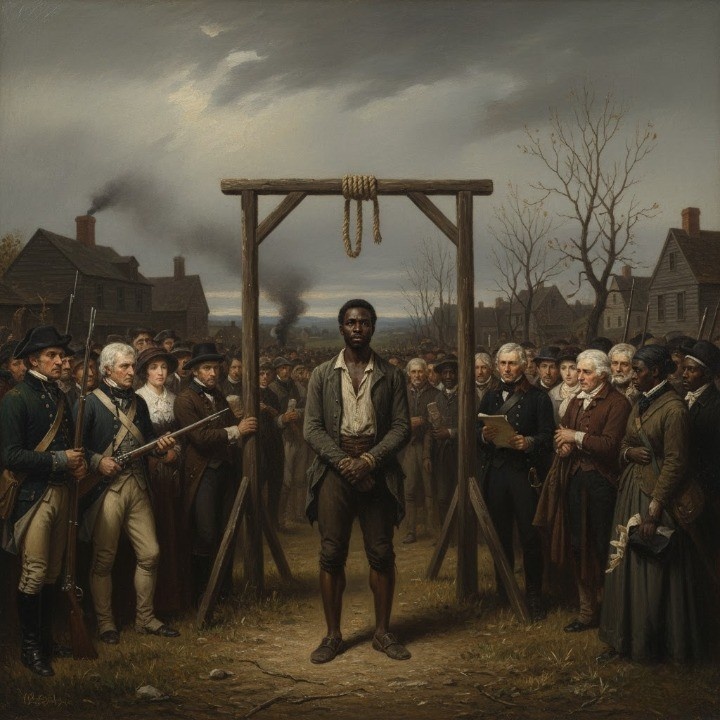
1831 — Nat Turner executed after slave rebellion
After leading a violent rebellion in Virginia, Nat Turner was captured and hanged. His uprising and the harsh reprisals that followed intensified fears across the slaveholding South and prompted new repressive laws restricting African American movement, assembly and education.
The episode deepened sectional tensions and revealed how the politics of slavery shaped social control and public policy.
1839 — Virginia Military Institute founded
The establishment of the Virginia Military Institute in Lexington created a distinctive model of military education in the United States, fusing classical instruction with practical military training. VMI would play a lasting role in American military and regional history.
1855 — Great Edo (Kantō) earthquake devastates Japan
A catastrophic earthquake struck Edo (modern Tokyo), producing widespread fires and massive casualties—estimates place deaths in the thousands. The disaster strained Tokugawa administrative capacities and accelerated urban rebuilding practices and disaster planning.
Its scale left a long imprint on Japanese approaches to urban design and emergency response.
1865 — Mary Edwards Walker granted Medal of Honor; Treaty of Sinchula
Physician Mary Edwards Walker—honored for surgical service during the American Civil War—was the first woman to receive the U.S. Medal of Honor (the award was later rescinded and reinstated). Her case highlights gendered tensions in military recognition.
Meanwhile, the Treaty of Sinchula formalized territorial cessions by Bhutan to the British East India Company, reflecting colonial territorial rearrangements in South Asia.
1869 — Victorian Aboriginal Protection Act enacted (Australia)
The act gave colonial authorities broad control over indigenous wages, residence and children—legal foundations that contributed to the Stolen Generations. Its provisions institutionalized coercive policies with deep social and cultural consequences that endured for generations.
1880 — Ned Kelly hanged in Melbourne
Bushranger Ned Kelly, a figure both vilified and romanticized, was executed in Melbourne after a highly publicized trial. Kelly’s life and death became powerful symbols in Australian cultural memory, raising questions about law, class and colonial authority.
1887 — Haymarket affair executions
Following the Chicago labor unrest, four convicted anarchists were executed—a flashpoint that crystallized tensions between labor movements, radical politics and state authorities. The affair resonated internationally, shaping debates on free speech, justice and worker rights.
1889 — Washington admitted as the 42nd U.S. state
The formal admission of the State of Washington completed another step in U.S. territorial organization and reflected westward population growth and the political incorporation of Pacific Northwest communities.
1918 — Armistice signed; World War I ends
At 5:00 a.m. Allied and German delegations signed the armistice in Marshal Ferdinand Foch’s railway carriage, and six hours later fighting ceased on the Western Front. The armistice precipitated the collapse of empires and profound political realignments across Europe.
The date has since become a global focal point for remembrance ceremonies honoring the war dead.
1919 — Centralia and Riga: labour violence and independence struggles
A violent clash in Centralia, Washington involving the Industrial Workers of the World left several dead, while Latvian forces defeated the West Russian Volunteer Army at Riga, securing important ground in Latvia’s war of independence. Both episodes show how the postwar year saw political violence and new national formations.
1921 — Tomb of the Unknowns dedicated at Arlington
Warren G. Harding dedicated the Tomb of the Unknowns as a national site of mourning for unidentified war dead. The monument institutionalized new rituals of remembrance and civic memory following the unprecedented casualties of World War I.
1923 — Adolf Hitler arrested after Beer Hall Putsch
Following the failed Munich coup, Adolf Hitler’s arrest and trial elevated his national profile and illustrated how a failed insurrection could be converted into political opportunity—setting the stage for later legal avenues to power.
1926 — U.S. Numbered Highway System established
The creation of the United States Numbered Highway System standardized long-distance road numbering and accelerated automobile travel, commerce and the gradual transformation of American mobility and infrastructure in the twentieth century.
1930 — Einstein & Szilárd patent the absorption refrigerator
Albert Einstein and Leó Szilárd were granted a U.S. patent (US1781541) for an absorption-type refrigerator design, an example of theoretical scientists working on practical inventions during the interwar years.
1934 — Shrine of Remembrance opens in Melbourne
The opening of the Shrine of Remembrance in Melbourne provided Australia with a national monument dedicated to citizens who served and died in wartime; it anchored public commemoration and national memory rituals.
1940 — Battle of Taranto and the Automedon capture
The Royal Navy’s carrier strike at Taranto marked the first large-scale ship-to-ship naval attack conducted primarily by aircraft, reshaping naval strategy during World War II.
Separately, the German auxiliary cruiser Atlantis captured top-secret mail from the British ship Automedon and sent it to Japan—an intelligence loss with diplomatic consequences.
1942 — Case Anton and Varlık Vergisi
German forces occupied Vichy France’s zone libre in Case Anton, eroding the last vestiges of French autonomy under occupation. In Turkey, the Varlık Vergisi—a capital tax—disproportionately targeted non-Muslim citizens, producing economic dislocation and lasting grievances.
1947 — Dir and Chitral accede to Pakistan
The princely states of Dir and Chitral acceded to Pakistan, part of the broader political consolidation and territorial integration following South Asia’s partition.
1949 — People’s Liberation Army Air Force founded
The foundation of the People’s Liberation Army Air Force (PLAAF) formalized China’s post-civil war military institutions and marked a key step in the new PRC’s state-building.
1966 — Gemini 12 launched (final Gemini flight)
Gemini 12 completed NASA’s Gemini program by demonstrating automated reentry and refining rendezvous and extravehicular techniques—critical preparatory steps for the upcoming Apollo lunar missions.
1961 — Kindu massacre of Italian airmen
Thirteen Italian air force personnel on a UN mission in the Congo were massacred by a mob in Kindu, highlighting the perilous conditions facing peacekeepers amid decolonization conflicts.
1965 — Southern Rhodesia’s Unilateral Declaration of Independence (UDI) moves
On this date political moves by Ian Smith would culminate in Unilateral Declaration of Independence (later in the month), formalizing a white minority regime that would be internationally unrecognized and lead to prolonged conflict.
1975 — Dismissal of the Whitlam government (Australia)
Governor-General Sir John Kerr dismissed Prime Minister Gough Whitlam and appointed Malcolm Fraser caretaker prime minister, provoking a constitutional crisis over reserve powers and executive authority in a Westminster system.
1977 — Iri train station munitions explosion (South Korea)
A munitions blast at a train station in Iri killed dozens and demonstrated the dangers of stored explosives in populated transport hubs, spurring safety reviews and changes in handling practices.
1982 — Space Shuttle Columbia launches STS-5 (first operational shuttle mission)
The flight of Columbia on STS-5 marked the operational start of the Space Shuttle program, opening a new chapter in reusable spacecraft and orbital operations.
1992 — Church of England votes to ordain women as priests
The General Synod approved a landmark change allowing the ordination of women, inaugurating a new chapter in Anglican practice and prompting institutional and theological adjustments over subsequent years.
2000 — Kaprun disaster in Austria
A cable car fire inside a tunnel at Kaprun killed 155 skiers and snowboarders; the catastrophe prompted inquiries into safety standards for alpine transport and emergency response for mountain tourism.
2002 — Grigori Perelman posts Poincaré proof
Mathematician Grigori Perelman published the first of three preprints claiming a proof of the Poincaré conjecture—one of mathematics’ most famous problems. His work eventually resolved a Millennium Prize Problem and drew global attention to geometric topology.
2004 — Death of Yasser Arafat; Mahmoud Abbas elected PLO chairman
The Palestine Liberation Organization confirmed the death of Yasser Arafat, after which Mahmoud Abbas was quickly elected PLO chairman—an inflection point in Palestinian leadership and peace-process politics.
2022 — Ukrainian forces enter Kherson after counteroffensive
Following a concentrated southern counteroffensive, Ukrainian forces reentered Kherson, marking a strategic and symbolic reversal in the Russo-Ukrainian conflict and underscoring the shifting battlefield dynamics.
Read Here: What Happened On This Day In History November 10
Famous People Born On November 11
Barbara Boxer — United States senator. (Nov 11, 1940 – )
Alger Hiss — United States official. (Nov 11, 1904 – Nov 15, 1996)
Robert Ryan — American actor. (Nov 11, 1909 – Jul 11, 1973)
Gustav VI Adolf — King of Sweden. (Nov 11, 1882 – Sep 15, 1973)
Philip John Schuyler — United States statesman. (Nov 11, 1733 – Nov 18, 1804)
Henry IV — Holy Roman emperor. (Nov 11, 1050 – Aug 7, 1106)
Gordon Allport — American psychologist. (Nov 11, 1897 – Oct 9, 1967)
Carlos Fuentes — Mexican writer and diplomat. (Nov 11, 1928 – May 15, 2012)
Paul Signac — French painter. (Nov 11, 1863 – Aug 15, 1935)
Erich von Falkenhayn — German general. (Nov 11, 1861 – Apr 8, 1922)
Bibi Andersson — Swedish actress. (Nov 11, 1935 – Apr 14, 2019)
Roy Jenkins — British politician. (Nov 11, 1920 – Jan 5, 2003)
George Blake — British diplomat and Soviet spy. (Nov 11, 1922 – Dec 26, 2020)
LaVern Baker — American singer. (Nov 11, 1929 – Mar 10, 1997)
Édouard Vuillard — French artist. (Nov 11, 1868 – Jun 21, 1940)
Maude Adams — American actress. (Nov 11, 1872 – Jul 17, 1953)
Roberto Matta — Chilean painter. (Nov 11, 1911 – Nov 23, 2002)
Louis-Antoine de Bougainville — French navigator. (Nov 11, 1729 – Aug 31, 1811)
Sam Spiegel — American film producer. (Nov 11, 1903 – Dec 31, 1985)
René Clair — French director. (Nov 11, 1898 – Mar 15, 1981)
Famous People Died On November 11
Liliuokalani — Queen of Hawaii. (Sep 2, 1838 – Nov 11, 1917)
Alexander Calder — American artist. (Jul 22, 1898 – Nov 11, 1976)
Dino De Laurentiis — Italian-American film producer. (Aug 8, 1919 – Nov 11, 2010)
Lucretia Mott — American social reformer. (Jan 3, 1793 – Nov 11, 1880)
Jerome Kern — American composer. (Jan 27, 1885 – Nov 11, 1945)
Peter V — King of Portugal. (Sep 16, 1837 – Nov 11, 1861)
Julien Offroy de La Mettrie — French physician and philosopher. (Dec 25, 1709 – Nov 11, 1751)
Peter III — King of Aragon and Sicily. (1239 – Nov 11, 1285)
Barbara Strozzi — Italian singer and composer. (1619 – Nov 11, 1677)
Delbert Mann — American director. (Jan 30, 1920 – Nov 11, 2007)
Thomas Willis — British physician. (Jan 27, 1621 – Nov 11, 1675)
Andrey Alekseyevich Amalrik — Soviet-born historian and dissident. (May 12, 1938 – Nov 11, 1980)
Vivian Fuchs — British explorer and geologist. (Feb 11, 1908 – Nov 11, 1999)
John Zoffany — English painter. (c.1733 – Nov 11, 1810)
Ilse Aichinger — Austrian author. (Nov 1, 1921 – Nov 11, 2016)
F. W. de Klerk — President of South Africa. (Mar 18, 1936 – Nov 11, 2021)
Peter F. Drucker — American economist and author. (Nov 19, 1909 – Nov 11, 2005)
Yasser Arafat — Palestinian leader. (Aug 24, 1929? – Nov 11, 2004)
Jay DeFeo — American painter and sculptor. (Mar 31, 1929 – Nov 11, 1989)
Victor Adler — Austrian politician. (Jun 24, 1852 – Nov 11, 1918)
Observances & Institutional Dates — November 11
- Remembrance Day — Marked in the United Kingdom and across the Commonwealth, including Australia and Canada, to honor those who served in wartime.
- Veterans Day (United States) — A national commemoration dedicated to American military service members, renamed from Armistice Day in 1954.
- Armistice Day — Observed in France, Belgium, and Serbia to remember the end of World War I.
- National Independence Day (Poland) — Celebrates the nation’s regained sovereignty in 1918 after years of partition.
- Independence Day (Angola) — Marks the country’s liberation from Portuguese rule in 1975.
- Lāčplēsis Day (Latvia) — Honors the 1919 victory over the Bermontians during the Battle of Riga.
- St. Martin’s Day (Sint Maarten) — A festive celebration in the Kingdom of the Netherlands dedicated to St. Martin of Tours.
- Independence of Cartagena (Colombia) — Commemorates Cartagena’s declaration of independence from Spain.
- Republic Day (Maldives) — Celebrates the establishment of the Maldivian Republic.
- National Education Day (India) — Recognizes the birth anniversary of Maulana Abul Kalam Azad, the nation’s first education minister.
- Birthday of King Jigme Singye Wangchuck (Bhutan) — A national holiday celebrating the former monarch’s birth.
- Children’s Day (Croatia) — Dedicated to promoting children’s welfare and rights.
- Women’s Day (Belgium) — Highlights the role and contributions of women in national life.
- Pepero Day (South Korea) — A popular cultural celebration where friends and couples exchange Pepero sticks as gifts.
- Singles’ Day (China) — A major social and shopping event for single individuals.
- Opening of Carnival (“Karneval” / “Fasching”) — Begins at 11:11 on 11/11 in Germany, the Netherlands, and surrounding regions.
Frequently Asked Questions
What happened on November 11 in history?
November 11 collects a wide range of turning points: medieval councils and coronations, naval and land battles, the 1918 armistice that ended World War I, and later scientific and political milestones—events that have shaped law, memory and international order.
Why is November 11 associated with the end of World War I?
An armistice signed on this day in 1918 halted hostilities on the Western Front. It marked the practical end of fighting, setting a date that would be commemorated as a remembrance of war dead and as a pivot in twentieth-century geopolitics.
How did the Tomb of the Unknowns become important?
Dedicated in 1921 at Arlington, the Tomb of the Unknowns offered a national locus for mourning unidentified casualties and a ritualized form of remembrance; it became a powerful symbol for veterans’ memory and public commemoration.
Why did the Taranto raid matter in naval history?
The 1940 carrier strike at Taranto showed how aircraft could neutralize battleships in harbor, reshaping naval strategy and presaging the carrier-centric warfare that would dominate later stages of World War II.