
History packs a wide range of moments into a single date: dynastic coronations, scientific firsts, political uprisings and cultural landmarks share the calendar on this day. What happened on this day in history, November 12 links medieval successions and early-modern treaties with modern protests, space achievements and legal changes.
Important Events That Happened on November 12 in History
954 — Lothair III crowned king of the West Frankish Kingdom
A 13-year-old Lothair III was crowned at the Abbey of Saint-Remi, an event reflecting the fragile dynastic politics of early medieval West Francia. The youthful kingship highlights how nobles, clerics and regents shaped authority in a realm still consolidating around regional magnates.
1028 — Zoe becomes Byzantine empress consort to Romanos III
Zoe’s rise to the throne as empress consort signalled the Byzantine court’s dynastic maneuvering and the influential role imperial women could exercise. Her accession helped shape early 11th-century imperial politics and the ceremonial life of Constantinople.
1330 — Battle of Posada: Wallachian ambush defeats Hungarian army
Basarab I’s forces routed the Hungarian army at Posada by ambush, securing Wallachian autonomy and demonstrating the potency of local leadership against larger feudal states. The victory reinforced Wallachian identity and altered regional power balances in the Balkans.
1439 — Plymouth incorporated by the English Parliament
Plymouth became the first town to receive incorporation by Parliament, formalizing its municipal status and legal privileges. The charter helped structure local governance and commerce for a port that would later grow in maritime importance.
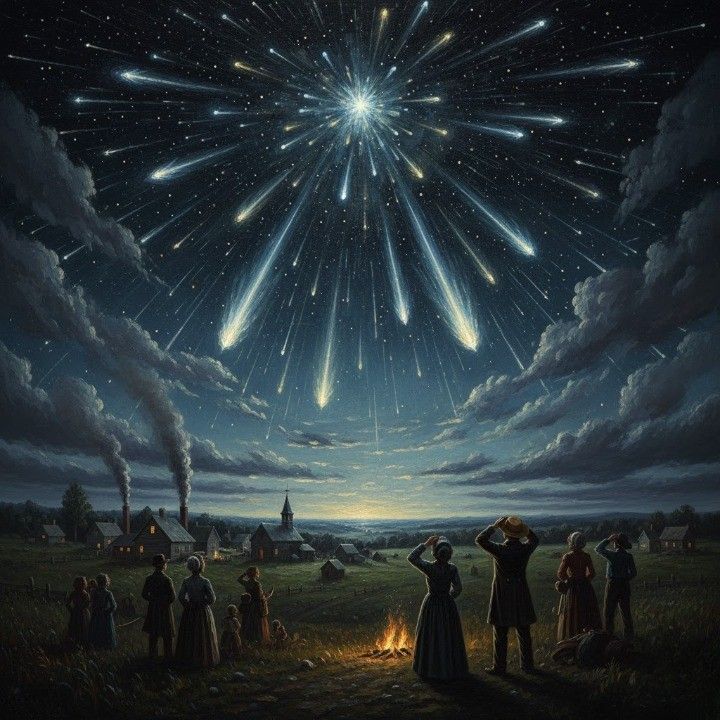
1833 — Great Leonid meteor shower observed across North America
An extraordinary Leonid display—hundreds of thousands of meteors in a single night—caught widespread attention and spurred early scientific interest in meteor showers, their periodicity, and their place in astronomical study.
1835 — Wilberforce Monument completed in Kingston upon Hull
The completion of the Wilberforce Monument celebrated William Wilberforce’s role in anti-slavery activism and provided a public site for memory and civic commemoration of reform causes in nineteenth-century Britain.
1859 — Jules Léotard performs the first flying trapeze act (no net)
Jules Léotard’s daring trapeze performance in Paris, performed without a net, became a defining moment in circus history and popular culture; his eponymous garment entered performance vocabulary while the act reshaped public appetite for aerial spectacle.
1892 — Pudge Heffelfinger first recorded paid professional American football player
Heffelfinger’s paid appearance for Allegheny Athletic Association is commonly cited as the first recorded professional contract in American football, marking the sport’s slow professionalization and the commercial turn in U.S. athletics.
1893 — Durand Line accepted by Abdur Rahman Khan
Afghan ruler Abdur Rahman Khan’s acceptance of the Durand Line established a colonial-era frontier between Afghanistan and British India; the boundary would shape geopolitics and continue to influence regional relations in later centuries.
1905 — Norway referendum authorizes offer of the throne in independent Norway
A national referendum ratified parliamentary steps toward an independent monarchy after the dissolution of the union with Sweden, enabling Norway’s constitutional path and the formal offer of the throne to a new sovereign.
1912 — King George I of Greece enters Thessaloniki after liberation
After centuries of Ottoman control, Thessaloniki’s liberation marked an important military and symbolic step in the Balkan Wars; the king’s triumphant entry underscored shifting control of former Ottoman territories in the region.
1912 — Scott expedition: frozen bodies of Robert Scott and companions found
The tragic discovery of Scott and his party on the Ross Ice Shelf ended one of polar exploration’s most famous narratives, prompting reflection on heroic endeavour, the human limits of exploration, and the costs of polar competition.
1912 — Spanish Prime Minister José Canalejas assassinated
Canalejas’s killing by an anarchist underscored the political violence and social tensions in early twentieth-century Spain, accelerating crises that would have longer-term political and social consequences.
1918 — Austria proclaimed a republic after Austro-Hungarian dissolution
With Austria’s proclamation, the multi-national Habsburg polity dissolved into successor states; a defeated empire gave way to new republican governance while internal revolutionary attempts—such as the brief Red Guard coup—were suppressed.
1920 — Cork hunger strike ends after three deaths
The 1920 Cork hunger strike by Irish republicans, which ended with three fatalities, became part of the larger Irish revolutionary period, reflecting tactics of protest, state repression and the human cost of the independence struggle.
1920 — Treaty of Rapallo between Italy and the Kingdom of Serbs, Croats and Slovenes
The Rapallo agreement adjusted borders and diplomatic relations in the post-World War I Balkans, part of the complex mapmaking and treaty-making that followed the collapse of empires.
1927 — Leon Trotsky expelled from the Soviet Communist Party
Trotsky’s formal ouster consolidated Joseph Stalin’s dominance and narrowed internal party debate; the move foreshadowed later purges and shifts in Soviet governance and policy.
1928 — SS Vestris sinks off Hampton Roads, heavy loss of life
The sinking of the Vestris, with large loss of women and children after abandonment, provoked inquiry into maritime safety and lifeboat procedures, contributing to later changes in passenger-ship regulation.
1930 — First Round Table Conference opens on India’s future constitution
The British-called conference convened key Indian political figures to debate constitutional reforms for British India—an early formal step in a long, contested constitutional transition toward eventual independence.
1933 — Nazi Germany ratifies withdrawal from the League of Nations by referendum
The plebiscite formalized Germany’s rejection of interwar multilateral constraints and signalled the regime’s break with the post-World War I diplomatic order, accelerating its isolation and bellicose posture.
1936 — San Francisco–Oakland Bay Bridge opens to traffic
The bridge’s opening linked major Bay Area communities and became an engineering landmark, demonstrating interwar civic investment in transportation infrastructure.
1938 — Nazi Decree on the Elimination of Jews from Economic Life issued
The decree barred Jews from participation in many economic activities, escalating the regime’s racial exclusion and dispossession policies that would culminate in far worse wartime atrocities.
1940 — Battle of Gabon ends with Free French taking Libreville
Free French forces seized control of Gabon from Vichy supporters, strengthening Free France’s territorial base in Equatorial Africa and affecting Allied strategy in the region.
1940 — Molotov arrives in Berlin amid diplomatic maneuvering
Soviet foreign minister Vyacheslav Molotov’s Berlin visit reflected complex Axis diplomacy and the shifting pre-war alignments that preceded broader conflict across Europe.
1941 — Soviet forces launch ski troops near Moscow as winter sets in
Temperatures plunged and Soviet formations experimented with winter warfare; ski troops were part of broader tactical adjustments as the Eastern Front entered a brutal winter phase.
1941 — Soviet cruiser Chervona Ukraina destroyed during the Battle of Sevastopol
The cruiser’s loss marked the severe naval and coastal fighting around Sevastopol, a hard-fought siege that inflicted major military and civilian casualties and shaped Black Sea operations.
1942 — Naval Battle of Guadalcanal begins (three-day fight; American victory)
The Guadalcanal naval engagements were crucial in the Pacific campaign, with fierce surface actions that helped secure American control and turn the campaign tide in the Solomons.
1944 — RAF Lancasters sink German battleship Tirpitz with Tallboy bombs
The RAF’s heavy-bomber raid using 12,000-lb Tallboy ordnance finally neutralized Tirpitz, removing a major German surface threat and demonstrating precision heavy bombing’s strategic impact.
1948 — Tokyo trials sentence seven Japanese officials, including Tojo
The International Military Tribunal for the Far East convicted several leaders for wartime crimes; sentences—including death for some—reflected post-war justice processes and accountability debates.
1954 — Ellis Island closes to immigrant processing
The closure of Ellis Island ended an era in U.S. immigration history, shifting immigration infrastructure and symbolizing changes in policy, demographics and national memory.
1956 — Morocco, Sudan and Tunisia join the United Nations
New UN members reflected decolonization’s expansion of international membership and the postwar world’s reordering as former colonies asserted diplomatic sovereignty.
1956 — Rafah killings during the Suez Crisis
In the Suez crisis’s violent fallout, Palestinian refugees were shot in Rafah, a grim episode among many that highlighted civilian vulnerability during interstate conflict and intervention.
1958 — First ascent of The Nose on El Capitan completed by Warren Harding’s team
The technical climb represented a milestone in rock-climbing history and the evolution of big-wall techniques, influencing mountaineering practice and adventure culture.
1961 — Terry Jo Duperrault survives Bluebelle murders as sole survivor
The Bluebelle tragedy and Terry Jo’s survival became a notorious maritime crime story, illustrating both criminal brutality and the survival of a lone child amid horrific circumstances.
1969 — Seymour Hersh breaks story of the My Lai Massacre
Hersh’s investigative reporting exposed mass civilian killings in Vietnam, prompting public outcry, legal inquiries and a major journalistic impact on perceptions of the war.
1970 — Oregon attempts to blow up a beached sperm whale (exploding whale incident)
A bungled attempt to dispose of a decomposing whale by explosives became a notorious example of ill-considered public policy and has since entered popular folklore and cautionary anecdote.
1970 — Bhola cyclone strikes East Pakistan, deadliest tropical cyclone in history
The Bhola cyclone caused catastrophic loss of life and destruction, precipitating humanitarian crisis and political consequences that helped catalyse unrest and later geopolitical change in South Asia.
1971 — Nixon sets troop withdrawal deadlines as part of Vietnamization; Aeroflot N-63 crash
As policy shifted toward Vietnamization, Nixon announced further troop reduction plans; at the same time Aeroflot N-63’s crash near Vinnytsia emphasised continuing aviation tragedies amid geopolitical change.
1975 — Comoros joins the United Nations
Comoros’ UN membership signalled a new sovereign state’s entry into the international system, part of the broader wave of postcolonial states joining multilateral institutions.
1977 — France conducts Oreste nuclear test (part of 1975–78 series)
The test was one element of France’s nuclear-test program, reflecting Cold War-era weapons development and national deterrence policy.
1979 — U.S. halts petroleum imports from Iran amid hostage crisis
President Carter’s embargo was an economic and political response to the Iran hostage crisis, signaling sanctions as a tool of statecraft and escalating economic tensions between the countries.
1980 — Voyager 1 close approach to Saturn and first ring images
Voyager’s Saturn encounter provided the first close images of the planet’s rings and moons, vastly expanding planetary science and public imagination about the outer solar system.
1981 — Space Shuttle Columbia’s STS-2: first crewed spacecraft to re-fly
Columbia’s second mission demonstrated reusability concepts for crewed spacecraft, a key chapter in the Shuttle era’s operational development.
1982 — Yuri Andropov becomes General Secretary of the CPSU
Andropov’s succession after Brezhnev’s death marked a leadership transition in the USSR during a period of internal strain and external Cold War tensions.
1990 — Crown Prince Akihito installed as Emperor Akihito of Japan
Akihito’s formal installation continued Japan’s imperial traditions while the accession marked a modern constitutional monarchy adapting ceremonial continuity to postwar political structures.
1990 — Tim Berners-Lee publishes proposal for the World Wide Web
Berners-Lee’s proposal laid the conceptual and technical groundwork for the web, a system that would transform communication, information access and global networks.
1991 — Santa Cruz massacre in East Timor: Indonesian forces open fire on student protesters
The massacre was a deadly episode in Indonesia’s occupation of East Timor, drawing international condemnation and intensifying calls for human-rights accountability.
1995 — Erdut Agreement reached for peaceful resolution in Croatian conflict
The Erdut Agreement provided a diplomatic route to settle aspects of the Croatian War of Independence, facilitating reintegration and a negotiated post-conflict process.
1995 — Space Shuttle Atlantis launches STS-74 to dock with Mir
The Atlantis mission delivered the Mir Docking Module, part of growing U.S.–Russian collaboration in space and the operational integration of orbital platforms.
1996 — Deadly mid-air collision near New Delhi kills 349
A Saudi Boeing 747 and a Kazakh Il-76 collided near New Delhi, producing the deadliest mid-air collision to date and prompting aviation safety investigations and reviews.
1997 — Ramzi Yousef convicted for the 1993 World Trade Center bombing
Yousef’s conviction marked an important terrorism prosecution in the U.S. legal response to international extremist violence and exposed transnational plotting networks.
1999 — Düzce earthquake (Mw 7.2) devastates northwestern Turkey
The Düzce quake caused massive casualties and damage, underscoring regional seismic risk and prompting emergency response and reconstruction measures.
2001 — American Airlines Flight 587 crashes minutes after JFK takeoff, huge loss of life
The crash with 265 fatalities (including five on the ground) became one of the deadliest U.S. aviation accidents, leading to investigations into pilot training, wake turbulence, and maintenance practices.
2001 — Taliban abandon Kabul ahead of Northern Alliance advance
As the Taliban retreated from Kabul, the Northern Alliance and shifting local forces reconfigured Afghanistan’s political map, presaging the post-2001 period of international intervention and domestic upheaval.
2003 — Suicide bombing kills at least 23 near Italian base in Nasiriyah, Iraq
The attack during the Iraq War killed coalition and Iraqi personnel, highlighting the insurgency’s lethal impact on stabilization efforts and the war’s human cost.
2003 — Shanghai Transrapid sets commercial railway speed record (501 km/h)
The Transrapid maglev’s record showcased high-speed rail technology potential and engineering achievements in non-conventional traction systems.
2011 — Silvio Berlusconi tenders resignation as Italy’s PM amid crisis
Facing political and financial crisis pressures, Berlusconi’s resignation marked a political turning point in Italian governance and European economic politics during the sovereign-debt era.
2011 — Blast at Iran missile base kills 17 including key missile program figure
An explosion at the Shahid Modarres base resulted in significant casualties and removed a prominent figure from Iran’s missile program, an event widely noted for its implications for regional military capabilities.
2014 — Philae lander reaches the surface of comet 67P — historic touchdown
The Rosetta mission’s Philae lander’s comet touchdown achieved a first in planetary exploration, returning unique data about comet composition and the early solar system.
2014 — Armenian Mi-24 helicopter shot down by Azerbaijani forces
The shootdown raised tensions on the Armenia–Azerbaijan front and underscored the fragility of ceasefire lines and the human cost of the protracted conflict.
2015 — Beirut suicide bombings kill 43 and injure hundreds
Twin attacks in Bourj el-Barajneh caused mass casualties, deepening Lebanon’s security crisis and reflecting the regional spillover of militant activity and sectarian tensions.
2017 — Kermanshah earthquake (Mw 7.3) on Iran–Iraq border kills hundreds
The powerful quake caused extensive fatalities and injuries, prompting cross-border humanitarian needs and highlighting regional seismic vulnerability.
2018 — Stan Lee, prolific American comic-writer, dies at 95
Stan Lee’s death marked the passing of a figure central to modern popular culture and comic-book storytelling, whose creations and editorial voice helped shape the Marvel universe and global entertainment.
2020 — PlayStation 5 released worldwide
Sony’s next-generation console launch represented a major commercial milestone in gaming hardware, driving consumer demand and platform competition in interactive entertainment.
2021 — Los Angeles court ends Britney Spears’ conservatorship after 14 years
The termination of a long-running conservatorship was a high-profile legal event, sparking debates about guardianship law, celebrity rights and the power of public advocacy movements.
2022 — Midair collision at Dallas airshow kills six
A vintage B-17 and P-63 collided during an airshow over Dallas Executive Airport, causing fatalities and prompting renewed scrutiny of airshow safety protocols and vintage-aircraft operations.
Read Also: What Happened On This Day In History November 11
Famous People Born On November 12
Sammy Sosa — Dominican baseball player. (Nov 12, 1968 – )
Bahāʾ Allāh — Iranian religious leader. (Nov 12, 1817 – May 29, 1892)
Kim Hunter — American actress. (Nov 12, 1922 – Sep 11, 2002)
Sor Juana Inés de la Cruz — Mexican poet and scholar. (Nov 12, 1651? – Apr 17, 1695)
Aleksandr Borodin — Russian composer and scientist. (Nov 12, 1833 – Feb 27, 1887)
Harry A. Blackmun — Associate Justice, U.S. Supreme Court. (Nov 12, 1908 – Mar 4, 1999)
Bert Williams — Bahamian-born American comedian. (Nov 12, 1874 – Mar 4, 1922)
Jacques Charles — French physicist. (Nov 12, 1746 – Apr 7, 1823)
Baaba Maal — Senegalese musician. (Nov 12, 1953 – )
Jack Reed — U.S. Senator. (Nov 12, 1949 – )
Lord Rayleigh — British scientist (physicist). (Nov 12, 1842 – Jun 30, 1919)
Richard Baxter — English minister. (Nov 12, 1615 – Dec 8, 1691)
Richard Quine — American director. (Nov 12, 1920 – Jun 10, 1989)
Jacques Tourneur — French-American director. (Nov 12, 1904 – Dec 19, 1977)
Piet Retief — Boer leader. (Nov 12, 1780 – Feb 6, 1838)
Gerhard von Scharnhorst — Prussian general. (Nov 12, 1755 – Jun 28, 1813)
Tadeusz Borowski — Polish author. (Nov 12, 1922 – Jul 3, 1951)
John McGahern — Irish author. (Nov 12, 1934 – Mar 30, 2006)
Letitia Tyler — American first lady. (Nov 12, 1790 – Sep 10, 1842)
Amelia Opie — British novelist and poet. (Nov 12, 1769 – Dec 2, 1853)
Famous People Died On November 12
Eve Arden — American actress. (Apr 30, 1908 or 1912 – Nov 12, 1990)
Elizabeth Cleghorn Gaskell — English writer. (Sep 29, 1810 – Nov 12, 1865)
Wilma Rudolph — American sprinter. (Jun 23, 1940 – Nov 12, 1994)
H. R. Haldeman — U.S. political adviser. (Oct 27, 1926 – Nov 12, 1993)
Percival Lowell — American astronomer. (Mar 13, 1855 – Nov 12, 1916)
Norman Bethune — Canadian surgeon and activist. (Mar 3, 1890 – Nov 12, 1939)
Sir John Tavener — British composer. (Jan 28, 1944 – Nov 12, 2013)
Masatoshi Koshiba — Japanese physicist. (Sep 19, 1926 – Nov 12, 2020)
Henryk Górecki — Polish composer. (Dec 6, 1933 – Nov 12, 2010)
Stephen Gardiner — English bishop and statesman. (c.1482 – Nov 12, 1555)
Dolores Ibárruri — Spanish political leader. (Dec 9, 1895 – Nov 12, 1989)
Abe Reles — American gangster. (c.1907 – Nov 12, 1941)
Blanche of Castile — Queen, wife of Louis VIII. (1188 – Nov 12, 1252)
Jean-Sylvain Bailly — French astronomer and statesman. (Sep 15, 1736 – Nov 12, 1793)
Thomas Fairfax, 3rd Baron Fairfax — English general. (Jan 17, 1612 – Nov 12, 1671)
Chester Himes — American writer. (Jul 29, 1909 – Nov 12, 1984)
Joseph Gurney Cannon — American politician. (May 7, 1836 – Nov 12, 1926)
Lyman Lemnitzer — U.S. general. (Aug 29, 1899 – Nov 12, 1988)
James Michael Curley — American politician. (Nov 20, 1874 – Nov 12, 1958)
Baroness Emmuska Orczy — Hungarian author. (Sep 23, 1865 – Nov 12, 1947)
Observances & institutional dates — November 12
National Health Day (Indonesia)
A public-health awareness day focused on raising attention to national healthcare issues, preventive measures and community wellness programs. It convenes clinics, public campaigns and government messaging to highlight health priorities.
National Youth Day (East Timor)
Commemorates youth participation in civic life and development efforts, often marked by educational events, youth assemblies and initiatives to strengthen opportunities for young people.
World Pneumonia Day
An international awareness day aimed at reducing pneumonia deaths, especially among children in low-income countries; the day highlights vaccination, treatment access and global public-health strategies.
Constitution Day (Azerbaijan)
Marks the adoption of the national constitution and often features formal ceremonies, civic education initiatives and reflection on democratic institutions and rule of law.
Father’s Day (Indonesia)
Observed with family gatherings and public tributes to paternal roles in family and community life; schools and civic groups sometimes stage events recognizing fathers’ contributions.
Frequently Asked Questions
Why is November 12 associated with the Leonid meteor shower?
The spectacular 1833 Leonid display—countless meteors seen across North America—occurred on this date and thrust meteor showers into scientific attention. Astronomers and the public alike noted the event’s intensity, which helped establish the Leonids as a recurring, studied phenomenon.
Who was Lothair III and why was his 954 coronation important?
Lothair III was a 13-year-old crowned king of the West Frankish realm at Saint-Remi; his early accession illustrates medieval succession practices and the role of clerical ritual in legitimizing young monarchs amid powerful noble factions.
What is the historical significance of the discovery of Scott’s expedition bodies?
Finding Robert Scott and his companions in 1912 closed one of polar exploration’s most famous tragedies, prompting reassessments of expedition planning and heroic narratives while deepening public interest in Antarctic exploration.
Why does the Durand Line (1893) still matter today?
The Durand Line, accepted by Afghan ruler Abdur Rahman Khan, established a colonial-era frontier between Afghanistan and British India; its legacy endures as a contested border influencing regional politics and cross-border dynamics.
What made the Bhola cyclone (1970) so consequential?
The Bhola cyclone caused massive loss of life and destruction in East Pakistan, creating an immense humanitarian crisis that contributed to political unrest and was one of the factors that eventually fed the region’s broader upheavals.
Why is the Philae lander’s 2014 touchdown remembered?
Philae’s successful landing on comet 67P was the first time a probe soft-landed on a comet, returning direct measurements of cometary material and proving complex rendezvous and landing techniques in deep-space missions.
What did Ellis Island’s 1954 closure signify?
Ellis Island’s closure as an immigration processing center marked the end of a major chapter in U.S. immigration history and reflected changing migration systems and policies in the post-war era.