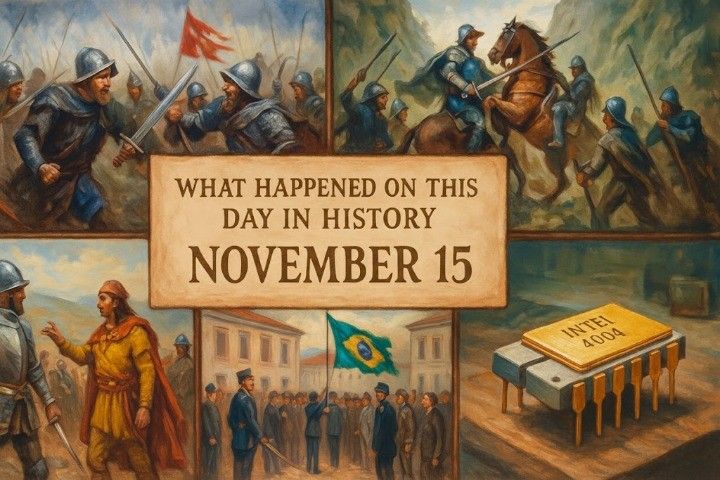
November 15 gathers episodes of conflict, invention and civic change that shaped law, science and public life. What happened on this day in history November 15 ties, early medieval battles and imperial shifts to modern breakthroughs in technology, protest and governance, showing how one calendar date can hold surprises across a sweep of human activity.
Important Events That Happened On November 15 In History
655 — Battle of the Winwaed: Penda of Mercia defeated
King Penda of Mercia led a large pagan coalition against Northumbrian forces but was routed at the Winwaed. The defeat handed Oswiu of Northumbria decisive dominance in northern England.
The battle accelerated the Christianisation of Anglo-Saxon England and shifted regional power toward Northumbria’s dynasty, reshaping early English politics and royal networks.
1315 — Battle of Morgarten: Swiss ambush Leopold’s army
Swiss confederates in the Schweizer Eidgenossenschaft ambushed Habsburg forces at Morgarten, inflicting a stinging defeat on Leopold I’s army. The victory became a founding legend for Swiss unity and autonomy.
Morgarten’s success reinforced mountain militia tactics, encouraged further confederation, and helped consolidate the Old Swiss Confederacy’s identity against external rulers.
1532 — Pizarro’s first meeting with Atahualpa outside Cajamarca
Spanish expeditionaries under Francisco Pizarro and captains including Hernando de Soto made initial contact with Inca ruler Atahualpa outside Cajamarca, setting the stage for the dramatic confrontation that followed.
Those first parleying moments revealed asymmetries of arms, disease and ambition that would soon lead to the capture of Atahualpa and the rapid Spanish dismantling of Inca political order.
1533 — Francisco Pizarro arrives in Cuzco
Pizarro’s entrance into Cuzco, the Inca capital, symbolized the collapse of imperial rule in the Andes and the consolidation of Spanish control.
The occupation of Cuzco opened the way for colonial administration, appropriation of wealth, and the imposition of European institutions across vast Andean territories.
1630 — Death of Johannes Kepler
The astronomer Johannes Kepler died in Regensburg, leaving his three laws of planetary motion as a durable legacy.
Kepler’s work provided the mathematical backbone for Newtonian gravitation and transformed astronomy from descriptive geometry to predictive celestial mechanics.
1705 — Battle of Zsibó: Habsburg-Danish victory in Rákóczi’s War
Habsburg and Danish forces defeated Hungarian Kuruc rebels at Zsibó, a bruising engagement in Rákóczi’s struggle for independence.
The battle weakened the insurgents’ strategic position, tightening Habsburg control and shaping Central European state consolidation in the early 18th century.
1760 — Castellania (Valletta) officially inaugurated
The newly rebuilt Castellania in Valletta, Malta, was formally opened, including the Chapel of Sorrows. The building served administrative and legal functions under the Knights and later governments.
Its inauguration marked a civic investment in urban architecture and the institutional governance of the island capital.
1777 — Articles of Confederation approved by Continental Congress
After protracted debate, the Continental Congress approved the Articles of Confederation, creating the first constitutional framework for the United States.
Although later superseded, the Articles established early federal structures, interstate cooperation, and a precedent for constitutional experimentation in the new republic.
1806 — Pike spots the peak that will bear his name
Lieutenant Zebulon Pike sighted a prominent mountain in the Rockies during his expedition, later christened Pikes Peak.
Pike’s reports fed westward maps and imagination, contributing to American geographic knowledge and the mythology of continental expansion.
1818 — Congress of Aix-la-Chapelle concludes
The Congress of Aix-la-Chapelle, a post-Napoleonic diplomatic meeting of the great powers, wrapped up its discussions, part of a series of congresses shaping nineteenth-century Europe.
Its conclusions helped fashion a conservative settlement and the diplomatic practices that would manage European crises for decades.
1842 — Slave revolt in the Cherokee Nation begins
A violent uprising against slavery erupted within the Cherokee Nation, reflecting the complex and contested place of slavery among Native polities in the American South.
The revolt underscored tensions over labor, sovereignty and the region’s legal order in an era of expanding cotton economies.
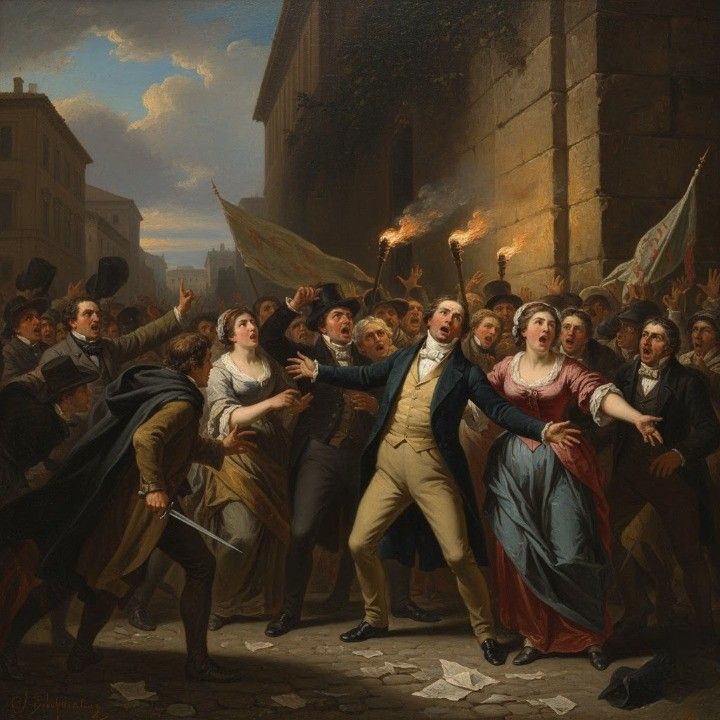
1848 — Assassination of Pellegrino Rossi in Rome
Italian politician Pellegrino Rossi, a former Carbonari associate turned government minister, was assassinated amid revolutionary ferment during 1848.
His death destabilized Roman governance and fed the revolutionary waves that swept Italian states in that year.
1849 — Steamboat Louisiana boiler explosions, New Orleans
The steamboat Louisiana suffered catastrophic boiler explosions as it pulled from a New Orleans dock, killing more than 150 people.
The disaster highlighted the persistent dangers of early steam technology and spurred calls for stricter maritime safety and engineering oversight.
1864 — Sherman begins his March to the Sea
Union General William Tecumseh Sherman initiated his famed March to the Sea, a campaign of manoeuvre and destructive logistics through Georgia toward Savannah.
Sherman’s strategy targeted Confederate infrastructure, undermining southern morale and accelerating the collapse of Confederate resistance late in the Civil War.
1884–85 — Berlin Conference convenes (New Imperialism)
European powers met at the Berlin Conference to regulate colonisation and trade in Africa; its General Act would be signed early in 1885.
The conference formalised imperial partitioning, with consequences that reshaped African polities, borders and economic extraction for a century.
1885 — Martyrdom of St. Joseph Mukasa in Buganda
St. Joseph Mukasa, one of the Uganda Martyrs, was executed by order of Mwanga II; his death later became a focal point of Catholic and Anglican memory in East Africa.
The episode illustrates the complex collision of local politics, religious conversion and imperial influence in late nineteenth-century Africa.
1889 — Brazil declared a republic; Pedro II deposed
Marshal Deodoro da Fonseca led a military coup that ended Emperor Pedro II’s reign and proclaimed the Brazilian Republic, inaugurating a republican political order.
The shift from monarchy to republic initiated campaigns of institutional reform, military influence and political realignment across the new Brazilian state.
1899 — Ambush at Chieveley, Second Boer War
A British armored train was ambushed near Chieveley; the British suffered prisoners taken and embarrassment, with correspondent Winston Churchill briefly involved as a captive.
The incident reflects the guerrilla and mobile warfare that made the Boer War a stern lesson in imperial logistics and counterinsurgency.
1904 — Gillette granted disposable razor patent
Inventor King Camp Gillette received a U.S. patent for a safety razor using disposable blades, a turning point for personal grooming and mass-market manufacture.
Gillette’s model shaped twentieth-century consumer culture and industrial production of everyday goods.
1917 — Eduskunta asserts Finnish sovereignty
Finland’s Eduskunta declared itself supreme state power, setting the institutional step toward independence from Russia.
The move crystallised national aspirations and legal foundations for Finland’s separation amid the collapse of imperial structures in 1917–18.
1920 — First Assembly of the League of Nations in Geneva
The nascent League of Nations convened its first assembly, embodying post-Great War hopes for collective security and diplomatic dispute resolution.
Although later judged imperfect, the League established procedures and ideals that would influence twentieth-century international governance.
1920 — Free City of Danzig established
The Treaty arrangements created a Free City of Danzig under League protection, a political compromise reflecting contested Polish-German claims.
Danzig’s status foreshadowed later tensions in interwar Europe and the difficulties of minority and territorial questions.
1922 — Massacre during Guayaquil general strike
A brutal suppression of unrest in Guayaquil, Ecuador, left at least 300 dead during a general strike, underlining labor tensions and state responses in early twentieth-century Latin America.
The massacre had lasting political impact on Ecuadorian labor movements and governance.
1928 — RNLI Mary Stanford disaster at Rye Harbour
The lifeboat Mary Stanford capsized at Rye Harbour; all 17 crew members were lost, a tragic reminder of maritime risk and volunteer rescue sacrifice.
The sinkings prompted local mourning and renewed attention to lifeboat safety and training.
1933 — Thailand’s first election
Thailand (Siam) held its first national election, a step in the political modernization and institutional reform of the kingdom in the early twentieth century.
The event marks a point on the path from absolutism toward participatory structures, even as Thai politics would remain turbulent.
1938 — Nazi Germany bans Jewish children from public schools after Kristallnacht
In the wake of Kristallnacht, the Nazi regime excluded Jewish children from public education, intensifying social isolation and persecution.
This administrative violence formed part of the systematic campaign of exclusion that culminated in the Holocaust.
1942 — Battle of Guadalcanal ends in Allied victory
Allied forces secured Guadalcanal after months of brutal fighting; the victory turned the strategic balance in the Solomons and checked Japanese expansion in the Pacific.
The campaign’s cost and lessons reshaped amphibious doctrine, logistics and combined operations for the remainder of World War II.
1943 — Himmler orders Gypsies placed on same level as Jews
SS leader Heinrich Himmler issued directives putting Roma and Sinti populations on the same genocidal footing as Jewish communities, intensifying the Nazi racial extermination policies.
The order expanded the scope of Nazi persecution and contributed to the genocide of Europe’s Romani peoples.
1951 — Nikos Beloyannis and comrades sentenced to death
Greek authorities sentenced Nikos Beloyannis and associates for alleged attempts to rebuild the banned Communist Party, in a politically charged trial that drew international attention.
The executions highlighted Cold War repression, contested justice and the fraught politics of post-civil-war Greece.
1955 — Opening of the first section of the Saint Petersburg Metro
The newly opened Saint Petersburg Metro began operations, showcasing large-scale Soviet engineering and urban transit ambitions.
The metro became a major urban artery and a symbol of postwar reconstruction in the USSR.
1957 — Short Solent 3 crash near Chessell
A Short Solent 3 flying boat crashed near Chessell, an aviation tragedy that added to mid-century concerns about air safety and flight operations.
Investigations into such accidents informed later improvements in civil aviation standards.
1959 — Clutter family murders in Holcomb, Kansas
The brutal killing of the Clutter family by Perry Smith and Richard Hickock shocked rural America and later inspired Truman Capote’s landmark true-crime book In Cold Blood.
The case highlighted the intersections of violent crime, media, and criminal justice in mid-twentieth-century United States.
1965 — Craig Breedlove sets 600+ mph land speed record
Driver Craig Breedlove drove the Spirit of America to a record 600.601 mph at the Bonneville Salt Flats, pushing the engineering limits of land speed machines.
Breedlove’s achievement fed public fascination with speed and aerodynamics during the jet-age era of performance records.
1966 — Gemini 12 completes the Gemini program
Project Gemini’s final mission, Gemini 12, splashed down successfully, wrapping up a program that advanced rendezvous, EVA and spacecraft techniques essential to Apollo.
The mission consolidated lessons that made lunar landing operations feasible within the following decade.
1967 — Fatal X-15 accident kills test pilot Michael J. Adams
Test pilot Michael J. Adams died when his X-15 lost control and disintegrated, the only fatality in the X-15 program, a sobering reminder of high-speed flight’s risks.
The tragedy prompted careful review of flight envelopes and pilot safety at the edge of atmosphere-capable research.
1968 — Cleveland Transit System inaugurates airport rapid service
The Cleveland Transit System became the first in the western hemisphere to offer direct rapid transit service linking a city downtown to its major airport.
This milestone influenced later airport-city transit planning and urban mobility design.
1969 — Cold War submarine collision in the Barents Sea
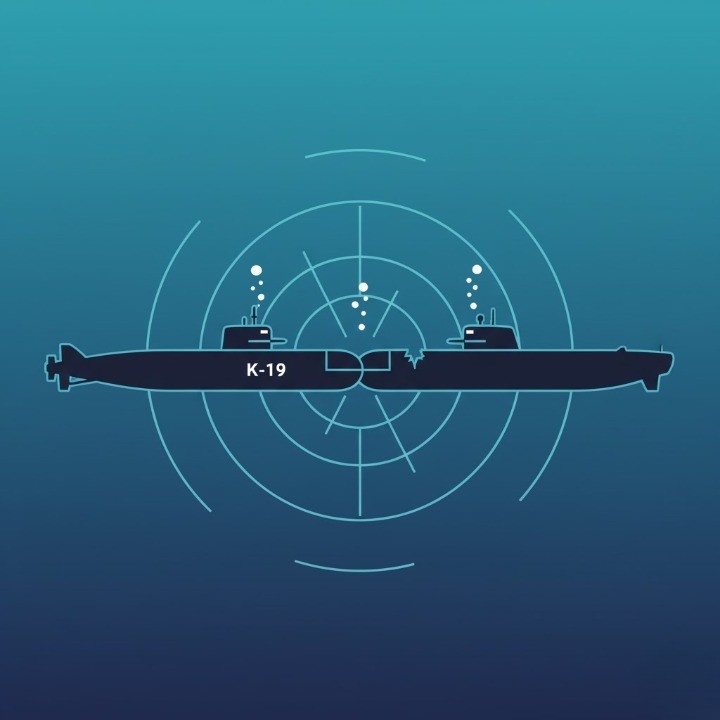
Soviet submarine K-19 collided with the US submarine USS Gato in the Barents Sea, an incident that underscored the collision hazards of underwater Cold War patrols.
Such close encounters risked escalation and highlighted the stealthy, dangerous cat-and-mouse nature of sub-sea deterrence.
1969 — March Against Death: massive anti-Vietnam War protest in Washington
Between 250,000–500,000 protesters gathered in Washington, D.C., in a powerful display of anti-war sentiment including a symbolic “March Against Death.”
The demonstration reflected deepening public opposition that would shape U.S. policy debates and political pressure on leaders.
1971 — Intel releases the 4004 microprocessor
Intel’s 4004 became the world’s first commercial single-chip microprocessor, initiating the microelectronics revolution that would power personal computing and embedded systems.
The 4004’s commercial success launched an industry that transformed communications, industry and leisure in subsequent decades.
1976 — Parti Québécois under René Lévesque takes office
René Lévesque led the Parti Québécois to power in Quebec, the first modern provincial government explicitly supportive of sovereignty, altering Canadian federal politics.
The PQ’s governance pushed constitutional debates, bilingualism, and questions of national identity to the Canadian center stage.
1978 — DC-8 crash near Colombo kills 183
A chartered Douglas DC-8 crashed near Colombo, Sri Lanka, in one of the deadliest civil air disasters of the period, highlighting ongoing aviation safety challenges in the developing world.
The crash prompted international investigation and reinforced calls for improved oversight of charter operations.
1979 — Unabomber package forces emergency landing
A package sent by the future Unabomber Ted Kaczynski began smoking aboard a flight from Chicago, forcing an emergency diversion; it was an early episode in a campaign of mailed explosive devices.
The incident presaged a long, unresolved domestic terror case that would only end after lengthy investigation and a later arrest.
1983 — Turkish Republic of Northern Cyprus declares independence
A Turkish-backed polity in northern Cyprus proclaimed itself an independent republic; it remains recognised only by Turkey and exemplifies frozen post-1974 geopolitical disputes.
The declaration complicated regional diplomacy and left the island divided politically and demographically.
1985 — Unabomber explosion injures a research assistant at Michigan
A parcel bomb addressed to a University of Michigan professor exploded, injuring a research assistant and continuing a campaign of mailed explosives that terrorized academic and commercial targets.
These attacks increased federal counterterrorism efforts and public anxieties about parcel safety.
1985 — Anglo-Irish Agreement signed at Hillsborough Castle
British Prime Minister Margaret Thatcher and Irish Taoiseach Garret FitzGerald signed the Anglo-Irish Agreement, introducing an institutional framework for cooperation on Northern Ireland.
The accord produced political controversy but opened new channels for diplomacy and later peacebuilding.
1987 — Brașov revolt: Romanian workers rise against Ceaușescu
Industrial workers in Brașov protested and briefly rebelled against Nicolae Ceaușescu’s regime, a courageous eruption that foreshadowed the larger 1989 overthrow of communist rule.
The uprising exposed economic grievances and the regime’s vulnerability to popular unrest.
1987 — Continental Airlines Flight 1713 crash in Denver
Flight 1713 crashed on takeoff from Stapleton International Airport, killing 25—one of a series of aviation tragedies that prompted renewed safety reviews.
The accident fed investigations into weather, ground handling and airline procedures.
1988 — Soviet uncrewed Shuttle Buran makes its only flight
The Soviet Buran orbiter completed a single uncrewed spaceflight, a technological response to the U.S. Shuttle program and a showcase of Soviet aerospace capability.
Despite its technical success, Buran’s program was curtailed by economic strains and shifting priorities at the USSR’s end.
1988 — Palestinian National Council proclaims an independent State of Palestine
The Palestinian National Council declared an independent State of Palestine, a symbolic move asserting national claims and contributing to diplomatic contestation in the Middle East.
The proclamation influenced subsequent negotiations, recognition debates and the politics of the Israeli-Palestinian conflict.
1988 — Max Havelaar launches the first Fairtrade label
The Max Havelaar label debuted in the Netherlands, establishing an early consumer certification for fair trade that sought to improve commodity terms for small producers.
Fairtrade’s growth reshaped ethical consumption, marketing and supply-chain debates in global trade.
1990 — Bulgaria transitions from communist rule to a republic
The Communist People’s Republic of Bulgaria was disestablished, inaugurating a new republican government and part of the broader Eastern European democratic transitions.
The change involved constitutional reform, economic restructuring, and the difficult politics of post-communist transformation.
1990 — Space Shuttle Atlantis launched on classified STS-38
Space Shuttle Atlantis launched on STS-38, a DoD classified mission underscoring the continuing military dimensions of spaceflight during the late Cold War/post-Cold War era.
The flight illustrated dual civil-military uses of shuttle technology and operational secrecy in space operations.
1994 — Mindoro earthquake and tsunami (Philippines)
A magnitude 7.1 quake struck Mindoro island, triggering a tsunami and killing dozens while injuring hundreds, revealing the fragility of coastal communities to seismic hazards.
Relief efforts and rebuilding highlighted the need for improved early warning and disaster resilience in archipelagic states.
2000 — Antonov An-24 crash after takeoff from Luanda
A chartered Antonov crashed after departing Luanda, Angola, killing more than 40 people in a tragedy amid challenging aviation conditions in the region.
The accident prompted safety scrutiny and reinforced concerns about aging fleets and operational oversight.
2000 — Jharkhand becomes India’s 28th state
Jharkhand was carved from southern Bihar to form India’s 28th state, recognizing distinct ethnic, economic and resource management claims in the mineral-rich plateau.
Statehood aimed to provide closer governance and development focus to a previously peripheral region.
2001 — Microsoft launches the Xbox in North America
Microsoft entered the console market with the Xbox, reshaping console competition and marking a major tech giant’s entry into interactive entertainment.
Xbox’s platform strategy would influence gaming ecosystems, online services and hardware competition in the 21st century.
2002 — Hu Jintao becomes General Secretary of the CCP
Hu Jintao assumed the Chinese Communist Party’s top post, inaugurating a leadership collective that would steer China through accelerated economic change and growing global engagement.
The new Politburo Standing Committee consolidated policy directions and set the stage for China’s next era of governance.
2003 — Istanbul bombings (first day)
A wave of car bombs struck synagogues in Istanbul, killing 25 and injuring hundreds in an attack that targeted minority and civic sites and shocked Turkey.
The bombings revealed the transnational reach of terrorism and deepened security and social anxieties in the region.
2006 — Launch of Al Jazeera English
Al Jazeera English began worldwide transmission, expanding an influential news network’s reach and diversifying global English-language media perspectives.
Its arrival introduced different editorial priorities and coverage angles, particularly on the Middle East and Global South.
2007 — Cyclone Sidr devastates Bangladesh
Cyclone Sidr struck Bangladesh with ferocious force, killing thousands and severely damaging the Sundarbans mangrove system and coastal communities.
The disaster prompted international relief, raised questions about climate vulnerability, and underscored the protective importance of coastal ecosystems.
2012 — Xi Jinping becomes General Secretary of the CCP
Xi Jinping rose to the CCP’s top leadership position, setting in motion a leadership era that would pursue institutional centralisation and assertive global policies.
Xi’s accession marked major continuity and change in China’s political evolution and international posture.
2016 — Hong Kong disqualifies two legislators; court bans pro-independence politicians
(If included earlier in your list as 2016 Hong Kong court items) — local political polarization and judiciary actions intensified debates over rule of law and electoral eligibility in Hong Kong.
(The event signalled tensions between localist movements, constitutional arrangements and central-local relations.)
2017 — Flood outside Athens kills 25
A sudden flood near Athens caused by intense rainfall killed at least 25 people, revealing the lethal impacts of flash floods on peri-urban communities and challenging regional disaster response.
Local and national agencies reviewed emergency planning and infrastructure resilience after the catastrophe.
2020 — Lewis Hamilton secures his seventh drivers’ title
Racing driver Lewis Hamilton won the Turkish Grand Prix and matched Michael Schumacher with seven Formula One world championships, cementing his place among the sport’s all-time greats.
Hamilton’s achievement was celebrated as a sporting milestone and a marker of modern F1’s global popularity.
2022 — World population reaches eight billion
Global population clocks crossed 8,000,000,000, a demographic milestone that sharpened attention to resource, health and sustainability challenges worldwide.
The milestone renewed debates on development, aging populations and regional growth disparities that will shape policies for decades.
2023 — Virat Kohli reaches 50 ODI centuries
Cricketer Virat Kohli scored his 50th ODI century, surpassing Sachin Tendulkar’s long-standing benchmark and marking a major achievement in international batting records.
Kohli’s accomplishment sparked wide celebration across cricket communities and underscored contemporary elite performance in the sport.
Read Also: What Happened On This Day In History November 14: Remarkable Moments
Famous People Born On November 15
- J. G. Ballard — British author known for dystopian and speculative fiction. (Nov 15, 1930 – Apr 19, 2009)
- Curtis E. LeMay — USAF general and major strategist of aerial warfare. (Nov 15, 1906 – Oct 1, 1990)
- Daniel Barenboim — Conductor and pianist noted for global musical leadership. (Nov 15, 1942 – )
- Wayne Thiebaud — American painter celebrated for vivid pop-inflected imagery. (Nov 15, 1920 – Dec 25, 2021)
- William Pitt, the Elder — British statesman and wartime prime minister. (Nov 15, 1708 – May 11, 1778)
- John I — King of France whose reign lasted only days. (Nov 15, 1316 – Nov 19/20, 1316)
- Bill Richardson — American politician and diplomat. (Nov 15, 1947 – Sep 1, 2023)
- David Stirling — British officer who founded the SAS. (Nov 15, 1915 – Nov 4, 1990)
- Aneurin Bevan — British politician and creator of the NHS. (Nov 15, 1897 – Jul 6, 1960)
- W. Averell Harriman — American diplomat, governor and statesman. (Nov 15, 1891 – Jul 26, 1986)
- Manuel II — Last king of Portugal before the republic. (Nov 15, 1889 – Jul 2, 1932)
- Felix Frankfurter — U.S. Supreme Court Justice and legal scholar. (Nov 15, 1882 – Feb 22, 1965)
- Osman II — Ottoman sultan known for reform ambitions. (Nov 15, 1603 – May 20, 1622)
- Clyde McPhatter — American R&B singer and group lead vocalist. (Nov 15, 1932 – Jun 13, 1972)
- Jérôme Bonaparte — King of Westphalia and Napoleonic-era figure. (Nov 15, 1784 – Jun 24, 1860)
- Aleksander Kwaśniewski — Polish president and political leader. (Nov 15, 1954 – )
- Nicholas V — Renaissance-era pope and patron of learning. (Nov 15, 1397 – Mar 24, 1455)
- Gerhart Hauptmann — German dramatist and Nobel laureate. (Nov 15, 1862 – Jun 6, 1946)
- Marianne Moore — American poet known for formal precision. (Nov 15, 1887 – Feb 5, 1972)
- Little Willie John — American soul singer with major early hits. (Nov 15, 1937 – May 26, 1968)
- Phog Allen — American basketball coach and pioneer of the sport. (Nov 15, 1885 – Sep 16, 1974)
- Jacques Hébert — French political journalist of the Revolution. (Nov 15, 1757 – Mar 24, 1794)
- Jonathan Cape — British publisher of influential authors. (Nov 15, 1879 – Feb 10, 1960)
- Piet Heyn — Dutch admiral noted for naval victories. (Nov 15, 1577 – Jun 18, 1629)
- Sara Josephine Baker — American physician and public-health innovator. (Nov 15, 1873 – Feb 22, 1945)
- Hamish Hamilton — British publisher and literary promoter. (Nov 15, 1900 – May 24, 1988)
- August Krogh — Danish physiologist and Nobel Prize winner. (Nov 15, 1874 – Sep 13, 1949)
- Mikhail V. Alekseyev — Russian general of the imperial army. (Nov 15, 1857 – Oct 8, 1918)
- Michel Chasles — French mathematician influential in geometry. (Nov 15, 1793 – Dec 18, 1880)
- Franklin Pierce Adams — American journalist and columnist. (Nov 15, 1881 – Mar 23, 1960)
Famous People Died On November 15
- Rudolf Abel — Soviet intelligence officer involved in Cold War espionage. (Jul 11, 1903 – Nov 15, 1971)
- Lionel Barrymore — American actor of stage and screen. (Apr 28, 1878 – Nov 15, 1954)
- Alger Hiss — American official central to Cold War controversy. (Nov 11, 1904 – Nov 15, 1996)
- Vinoba Bhave — Indian social reformer and Gandhian leader. (Sep 11, 1895 – Nov 15, 1982)
- Christoph Willibald Gluck — German composer who reformed opera. (Jul 2, 1714 – Nov 15, 1787)
- Henryk Sienkiewicz — Polish novelist and Nobel laureate. (May 5, 1846 – Nov 15, 1916)
- Jean Gabin — French film actor with iconic roles. (May 17, 1904 – Nov 15, 1976)
- J.-B. Say — French economist and theorist of markets. (Jan 5, 1767 – Nov 15, 1832)
- Maria II — Queen of Portugal noted for liberal reforms. (Apr 4, 1819 – Nov 15, 1853)
- Jean-Marie Roland — French political figure of the Revolution. (Feb 18, 1734 – Nov 15, 1793)
- Charles W. Chesnutt — American writer of race and society. (Jun 20, 1858 – Nov 15, 1932)
- George Romney — British portrait painter of the Georgian era. (Dec 15, 1734 – Nov 15, 1802)
- Penda — Anglo-Saxon king influential in Mercian power. (d. Nov 15, 655)
- Meret Oppenheim — Swiss artist associated with Surrealism. (Oct 6, 1913 – Nov 15, 1985)
- William Murdock — Scottish inventor and engineer. (Aug 21, 1754 – Nov 15, 1839)
- Fritz Reiner — Hungarian-American conductor and orchestral leader. (Dec 19, 1888 – Nov 15, 1963)
- C. T. R. Wilson — British physicist and cloud-chamber pioneer. (Feb 14, 1869 – Nov 15, 1959)
- Zhores Medvedev — Soviet biologist and dissident writer. (Nov 14, 1925 – Nov 15, 2018)
- Frank M. Chapman — American ornithologist and museum curator. (Jun 12, 1864 – Nov 15, 1945)
- Gábor Bethlen — Hungarian prince and statesman. (1580 – Nov 15, 1629)
- Luis Muñoz Rivera — Puerto Rican statesman and publisher. (Jul 17, 1859 – Nov 15, 1916)
- John W. Foster — American diplomat and statesman. (Mar 2, 1836 – Nov 15, 1917)
- Robert S. Brookings — American philanthropist and institution builder. (Jan 22, 1850 – Nov 15, 1932)
- Frank J. Goodnow — American educator and political scientist. (Jan 18, 1859 – Nov 15, 1939)
- Jorge de Lima — Brazilian poet, novelist and artist. (Apr 23, 1895 – Nov 15, 1953)
- Jacobus Revius — Dutch poet and theologian. (Nov 1586 – Nov 15, 1658)
- Charles Edward Cheney — American clergyman and church leader. (Feb 12, 1836 – Nov 15, 1916)
- Dawn Powell — American novelist and satirist. (Nov 28, 1896 – Nov 15, 1965)
- Károly Flesch — Hungarian violinist and teacher. (Oct 9, 1873 – Nov 15, 1944)
- André-Eugène Blondel — French physicist and electrical pioneer. (Aug 28, 1863 – Nov 15, 1938)
Observances & Institutional Dates — November 15
King’s Feast (Belgium) — Honors the Belgian monarchy and national unity.
Day of the German-speaking Community (Belgium) — Marks cultural identity and regional institutions.
Day of the Imprisoned Writer (International) — Recognizes persecuted writers and defends free expression.
National Tree Planting Day (Sri Lanka) — Promotes reforestation and environmental stewardship.
Peace Day (Ivory Coast) — Observance focused on reconciliation and social harmony.
America Recycles Day (United States) — Encourages recycling awareness and environmentally responsible practices.
Republic Proclamation Day (Brazil) — Commemorates the 1889 transition from empire to republic.
Shichi-Go-San (Japan) — Traditional celebration for children aged three, five, and seven.
Republic Day (Northern Cyprus) — Marks the 1983 declaration of the Turkish Republic of Northern Cyprus.
Independence Day (Palestine, 1988 declaration) — Commemorates the proclamation of Palestinian independence.
Frequently Asked Questions
What major political changes have been marked on November 15?
November 15 has hosted regime changes, declarations of republics and key diplomatic congresses — from Brazil’s republic proclamation (1889) to European postwar congresses — each reshaping national institutions and borders.
Which scientific or technological milestones occurred on November 15?
Important advances include Gillette’s disposable-blade patent (1904), Intel’s release of the 4004 microprocessor (1971) and engineering achievements in transport and space that expanded modern technical capacity.
Why is the 1884–85 Berlin Conference important historically?
The Berlin Conference regulated European colonization in Africa, formalising territorial claims and trade rules; it institutionalised partition and had long-term consequences for African political geography and colonial rule.
How have disasters on November 15 influenced safety or policy?
Tragedies—like the Louisiana steamboat explosion (1849), major air and maritime crashes, and Cyclone Sidr (2007)—have often led to regulatory reviews, improved safety standards and heightened disaster preparedness.