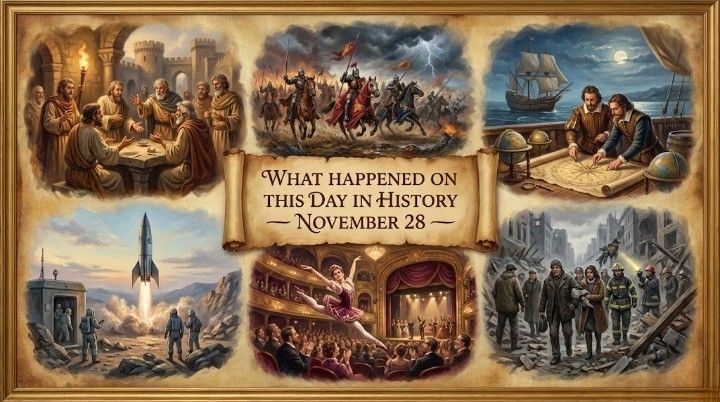
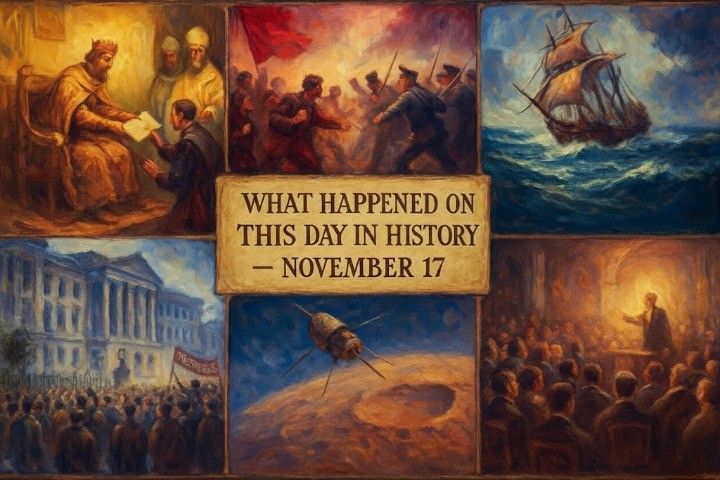
November 17 gathers a long sequence of political turns, courageous voyages and wrenching public moments. What happened on this day in history November 17 stretches from imperial claims to revolutionary uprisings, linking early polar sighting and space probes, legal experiments and bloodied streets — a compact chronicle of how institutions, science and popular politics repeatedly rewrite the possible.
Important Events That Happened On November 17 In History
284 — Diocletian Acclaimed Emperor
Roman soldiers proclaimed Diocletian as emperor after the death of Numerian, setting in motion a reign remembered for stabilizing the empire and reshaping its administration. His reforms later defined the structure of late Roman government and the division of the empire.
887 — Deposition of Charles the Fat
At Frankfurt, Frankish nobles removed Emperor Charles the Fat, ending his ineffective rule. His nephew Arnulf of Carinthia soon announced himself king of the East Frankish Kingdom, accelerating the fragmentation of Carolingian authority in Europe.
1183 — Battle of Mizushima
During the Genpei War, Minamoto no Yoshinaka’s naval force was halted and defeated by the Taira clan near Mizushima. The clash reinforced Taira control at sea and shaped the unfolding struggle for power in Japan.
1292 — John Balliol Becomes King of Scotland
The Scottish nobility selected John Balliol as king, supported by England’s Edward I. His reign, however, quickly fell into conflict and is often remembered for setting the stage for the Wars of Scottish Independence.
1405 — Sultanate of Sulu Founded
Sharif ul-Hāshim established the Sultanate of Sulu, a political and cultural institution that would remain influential in the southern Philippines for centuries. Its foundation anchored Islam’s growing presence in the region.
1494 — Charles VIII Occupies Florence
French forces under King Charles VIII entered and occupied Florence during his Italian campaign. The event destabilized local politics and hastened the wider Italian Wars.
1511 — Treaty of Westminster
Henry VIII of England and Ferdinand II of Aragon agreed to mutual support against France. The treaty strengthened early Tudor foreign policy and deepened England’s involvement in continental warfare.
1558 — Elizabeth I Becomes Queen
Queen Mary I died, and Elizabeth I ascended the throne. Her long reign launched what became known as the Elizabethan era, marked by cultural flourishing, naval expansion and political stability.
1603 — Sir Walter Raleigh Tried for Treason
Sir Walter Raleigh, courtier, writer and explorer, stood trial for alleged involvement in a plot against King James I. Though sentenced to death, he was imprisoned instead and later released for a final voyage.
1775 — Kuopio Founded
King Gustav III of Sweden established the city of Kuopio in what is now Finland. It later grew into a major cultural and administrative center of eastern Finland.
1777 — Articles of Confederation Submitted
The Continental Congress sent the Articles of Confederation to the states for approval. They became the first constitution of the United States and guided the nation through the final years of the Revolution.
1796 — Battle of Arcole
French forces under Napoleon Bonaparte defeated Austrian troops at the Bridge of Arcole in northern Italy. The victory strengthened French momentum in the Italian campaign.
1800 — First U.S. Congress Session in Washington
The U.S. Congress convened for the first time in the new capital city, Washington, D.C., beginning its long role as the center of American government.
1810 — Sweden Declares War on Britain
Sweden formally declared war on its ally, the United Kingdom, under pressure from Napoleonic France. The conflict remained bloodless and is remembered as a diplomatic formality.
1811 — José Miguel Carrera Takes Office
Chilean independence figure José Miguel Carrera became President of the executive Junta of Chile. His leadership played a role in the early movement toward national sovereignty.
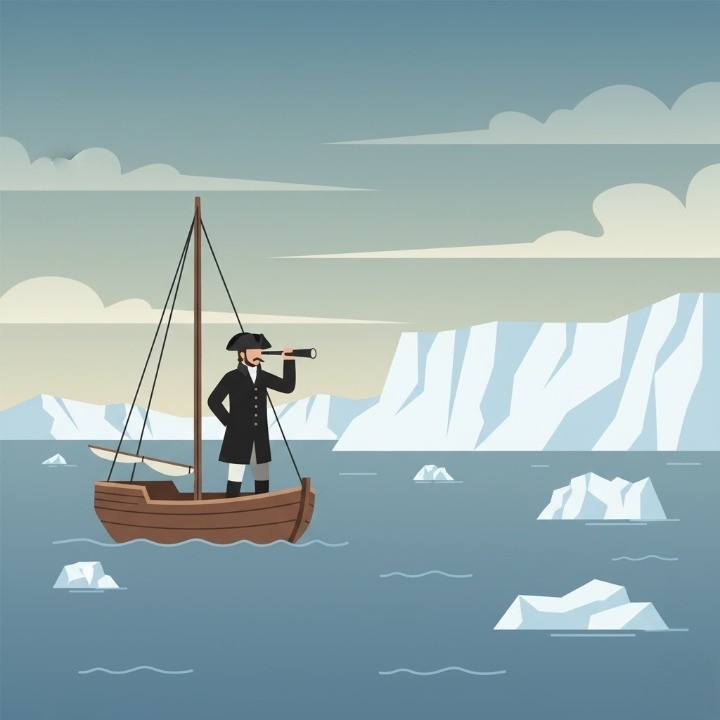
1820 — First American to See Antarctica
Captain Nathaniel Palmer sighted Antarctic land, becoming the first American known to do so. The Palmer Peninsula was later named in his honor.
1831 — Ecuador and Venezuela Separate From Gran Colombia
Political divisions led Ecuador and Venezuela to break away from Gran Colombia, marking a major step in the reorganization of northern South America.
1837 — Valdivia Earthquake and Japanese Tsunami
A strong earthquake near Valdivia, Chile triggered a Pacific-wide tsunami that caused severe damage along parts of Japan’s coast.
1856 — Fort Buchanan Established
The U.S. Army founded Fort Buchanan in present-day Arizona to secure land gained in the Gadsden Purchase. The fort later played a role in regional frontier conflicts.
1858 — Modified Julian Day Zero
This date marks the start of the Modified Julian Day system used in astronomy and scientific timekeeping.
1858 — City of Denver Founded
Denver, Colorado was established as a settlement during the Pike’s Peak Gold Rush. It would develop into a major American mountain metropolis.
1863 — Siege of Knoxville Begins
Confederate General James Longstreet began besieging Knoxville, Tennessee, defended by Union General Ambrose Burnside. The operation formed part of the wider Civil War campaigns in the western theater.
1869 — Suez Canal Opens
After a decade of construction, the Suez Canal officially opened in Egypt. The new passage transformed global trade by linking the Mediterranean and Red Seas.
1878 — Assassination Attempt on Umberto I
Italian anarchist Giovanni Passannante attempted to kill King Umberto I. The king survived with minor injuries, while Prime Minister Benedetto Cairoli was also wounded.
1885 — Battle of Slivnitsa Begins
The decisive clash of the Serbo-Bulgarian War began near Slivnitsa. Bulgaria’s victory preserved its unification and strengthened its regional standing.
1894 — H. H. Holmes Arrested
Serial killer H. H. Holmes was arrested in Boston. His crimes later became infamous in American criminal history.
1896 — Western Pennsylvania Hockey League Begins Play
The league opened its first season in Pittsburgh and later became known as the first ice hockey league to openly pay players.
1903 — Bolsheviks and Mensheviks Split
The Russian Social Democratic Labour Party divided into Bolshevik and Menshevik factions. The split shaped revolutionary politics leading into the 20th century.
1939 — Czech Students Executed
Nine Czech students were executed after anti-Nazi demonstrations. Universities were closed, and more than 1,200 students were deported to camps, leading to today’s International Students’ Day observance.
1940 — Tartu Art Museum Established
Tartu, Estonia became home to a new national art museum, which grew into a leading cultural institution.
1947 — SAG Loyalty Oath
The Screen Actors Guild introduced an anti-Communist loyalty oath during the early Cold War climate in the United States.
1947 — First Transistor Principles Observed
Physicists John Bardeen and Walter Brattain documented the basic behavior of what would become the transistor, a discovery that reshaped global technology.
1950 — Lhamo Dondrub Named 14th Dalai Lama
Lhamo Dondrub was formally recognized as the 14th Dalai Lama, a role that carried deep spiritual and political significance for Tibet.
1950 — UN Security Council Resolution 89
The UN adopted a resolution addressing aspects of the Palestine question during the tense early years of the Arab–Israeli conflict.
1953 — Evacuation of the Blasket Islands
The remaining residents of Ireland’s Blasket Islands were relocated to the mainland, ending centuries of traditional island life.
1957 — BEA Viscount Crash
A British European Airways Vickers Viscount crashed near Copenhagen after engine failures caused by anti-icing malfunction. Remarkably, no one was killed.
1962 — Dulles Airport Dedicated
President John F. Kennedy formally dedicated Dulles International Airport, which became a major aviation hub for the Washington region.
1967 — Johnson Says U.S. Is Making Progress in Vietnam
Relying on optimistic reports, President Lyndon B. Johnson told Americans that U.S. forces were inflicting greater losses than they were taking, reflecting wartime messaging of the era.
1968 — BAC One-Eleven Enters Service
British European Airways introduced the BAC One-Eleven jet into regular use, part of the modernization of European commercial aviation.
1968 — “Heidi Game” Broadcast Incident
NBC switched from a Raiders–Jets football game to air the film Heidi, causing viewers to miss the dramatic finish. The uproar led to major changes in sports broadcasting policies.
1969 — SALT I Negotiations Begin
U.S. and Soviet negotiators met in Helsinki to start talks on limiting strategic nuclear weapons, a cornerstone of later arms control agreements.
1970 — My Lai Trial Begins
Lieutenant William Calley went on trial for his role in the My Lai Massacre, one of the most infamous incidents of the Vietnam War.
1970 — Lunokhod 1 Lands on the Moon
The Soviet Union deployed Lunokhod 1, the first remote-controlled rover on another celestial body, marking a milestone in space exploration.
1973 — Nixon Says “I Am Not a Crook”
During a press meeting in Florida, President Richard Nixon defended himself amid the Watergate scandal with the now-famous phrase, “I am not a crook.”
1973 — Athens Polytechnic Uprising Ends
The student-led uprising in Athens against Greece’s military junta ended violently as security forces crushed the protest.
1983 — Zapatista Army Founded
The Zapatista Army of National Liberation was established in Mexico. It later became globally known for its indigenous rights movement.
1986 — JAL Flight 1628 UFO Incident
The crew of a Japan Airlines cargo plane reported a dramatic UFO encounter over Alaska, a case still widely discussed in aviation circles.
1989 — Velvet Revolution Begins
Police violently dispersed a student march in Prague, sparking the Velvet Revolution that toppled Czechoslovakia’s Communist government.
1990 — Mount Unzen Eruption
Fugendake, part of the Unzen volcano complex in Japan, erupted again, continuing a cycle of dangerous volcanic activity.
1993 — U.S. House Approves NAFTA
The U.S. House of Representatives passed legislation establishing the North American Free Trade Agreement, reshaping continental trade.
1993 — Coup in Nigeria
General Sani Abacha overthrew the interim government of Ernest Shonekan, beginning a period of military rule.
1997 — Luxor Massacre
Militants attacked visitors near the Temple of Hatshepsut in Luxor, Egypt, killing 62 people in one of the country’s deadliest acts of terrorism.
2000 — Slovenia Landslide
A massive landslide struck Log pod Mangartom in Slovenia, killing seven and causing extensive damage in one of the country’s worst natural disasters of the century.
2000 — Fujimori Removed From Office
Peru’s Congress removed President Alberto Fujimori from office after corruption scandals brought down his administration.
2003 — Schwarzenegger Becomes Governor
Arnold Schwarzenegger officially assumed the office of Governor of California following a recall election.
2008 — Twilight Film Premieres
The first movie in the Twilight saga premiered in Los Angeles, launching a major pop-culture phenomenon.
2012 — Egypt School Bus Tragedy
A horrific crash at a railway crossing near Manfalut killed more than 50 schoolchildren, prompting national outcry.
2013 — Tatarstan Flight 363 Crash
A Tatarstan Airlines Boeing 737 crashed while landing in Kazan, killing all 50 people onboard.
2013 — Major Midwest Tornado Outbreak
A rare late-season outbreak produced dozens of tornadoes across Illinois, Indiana and Michigan, including multiple EF3 and EF4 storms.
2018 — Ibrahim Mohamed Solih Sworn In
Ibrahim Mohamed Solih became President of the Maldives, marking a political shift after years of tension.
2019 — Earliest Traced COVID-19 Case
A 55-year-old man in Wuhan was identified as the earliest known COVID-19 case later uncovered in tracing efforts.
2023 — Heavy Gaza Operations Reported
Intense Israeli operations and evacuations unfolded across Gaza, with civilians urged to move from parts of Khan Yunis and the south.
2024 — Major Russian Strikes on Ukraine
Large-scale strikes on Ukraine’s infrastructure and energy systems were widely reported amid the ongoing war and its regional consequences.
Read Also: What Happened On This Day In History November 16: Unforgettable Facts
Famous People Born On November 17
Martin Scorsese — American director. (Nov 17, 1942 – )
Susan Rice — American public official and foreign-policy analyst. (Nov 17, 1964 – )
Lee Strasberg — American theatre director and teacher (method acting). (Nov 17, 1901 – Feb 17, 1982)
Rem Koolhaas — Dutch architect and writer. (Nov 17, 1944 – )
Isamu Noguchi — American sculptor and designer. (Nov 17, 1904 – Dec 30, 1988)
Mikhail Bakhtin — Russian philosopher and literary critic. (Nov 17, 1895 – Mar 7, 1975)
Tom Seaver — American baseball pitcher. (Nov 17, 1944 – Aug 31, 2020)
Honda Sōichirō — Japanese industrialist, founder of Honda. (Nov 17, 1906 – Aug 5, 1991)
Eugene Wigner — Hungarian-born American physicist, Nobel laureate. (Nov 17, 1902 – Jan 1, 1995)
Jean le Rond d’Alembert — French mathematician and philosopher. (Nov 17, 1717 – Oct 29, 1783)
August Ferdinand Möbius — German mathematician (Möbius strip). (Nov 17, 1790 – Sept 26, 1868)
Elvin Hayes — American basketball player. (Nov 17, 1945 – )
Dorgon — Manchu prince and regent (Qing dynasty). (Nov 17, 1612 – Dec 31, 1650)
Pierre Gaultier de Varennes de La Vérendrye — French-Canadian explorer. (Nov 17, 1685 – Dec 5, 1749)
Louis-Hubert-Gonzalve Lyautey — French statesman and marshal. (Nov 17, 1854 – Jul 21, 1934)
Joost van den Vondel — Dutch poet and dramatist. (Nov 17, 1587 – Feb 5, 1679)
Charles Walters — American dancer, choreographer, film director. (Nov 17, 1911 – Aug 13, 1982)
Bob Mathias — American decathlete and politician. (Nov 17, 1930 – Sept 2, 2006)
Stanley Cohen — American biochemist, Nobel laureate. (Nov 17, 1922 – Feb 5, 2020)
August Sander — German photographer. (Nov 17, 1876 – Apr 20, 1964)
Rachel de Queiroz — Brazilian novelist and journalist. (Nov 17, 1910 – Nov 4, 2003)
Roland Matthes — East German swimmer, world record holder. (Nov 17, 1950 – Dec 20, 2019)
Achille Fould — French statesman. (Nov 17, 1800 – Oct 5, 1867)
George Grote — British historian of ancient Greece. (Nov 17, 1794 – Jun 18, 1871)
Archibald Lampman — Canadian poet. (Nov 17, 1861 – Feb 10, 1899)
Sir Charles Lock Eastlake — British painter and museum director. (Nov 17, 1793 – Dec 24, 1865)
William Merriam Burton — American chemist (petroleum refining). (Nov 17, 1865 – Dec 29, 1954)
Burnett Hillman Streeter — British theologian and biblical scholar. (Nov 17, 1874 – Sept 10, 1937)
Anton Sailer — Austrian alpine skier. (Nov 17, 1935 – Aug 24, 2009)
Il Bronzino — Italian Mannerist painter and poet. (Nov 17, 1503 – Nov 23, 1572)
Famous People Died On November 17
Robert Owen — Welsh manufacturer and social reformer (utopian socialism). (May 14, 1771 – Nov 17, 1858)
Bal Thackeray — Indian journalist and politician, founder of Shiv Sena. (Jan 23, 1926 – Nov 17, 2012)
Dame Gladys Cooper — British actress and theatre manager. (Dec 18, 1888 – Nov 17, 1971)
Giovanni Pico della Mirandola — Italian Renaissance scholar. (Feb 24, 1463 – Nov 17, 1494)
Valentinian I — Roman emperor. (321 – Nov 17, 375)
Eric Gill — British sculptor, typographer and engraver. (Feb 22, 1882 – Nov 17, 1940)
Reginald Pole — Cardinal and Archbishop of Canterbury. (Mar 3, 1500 – Nov 17, 1558)
Heitor Villa-Lobos — Brazilian composer. (Mar 5, 1887 – Nov 17, 1959)
Abba Eban — Israeli diplomat and statesman. (Feb 2, 1915 – Nov 17, 2002)
Lon Nol — Cambodian general and president. (Nov 13, 1913 – Nov 17, 1985)
Ruth Brown — American R&B singer (“Miss Rhythm”). (Jan 12, 1928 – Nov 17, 2006)
Immanuel Velikovsky — Author of controversial historical/cosmogony works. (Jun 10, 1895 – Nov 17, 1979)
Mervyn Peake — English novelist, poet, and artist (Titus Groan). (Jul 9, 1911 – Nov 17, 1968)
Fred Brooks — American computer scientist (The Mythical Man-Month, Turing Award). (Apr 19, 1931 – Nov 17, 2022)
Anthony of Bourbon — King of Navarre. (Apr 22, 1518 – Nov 17, 1562)
Mustafa IV — Ottoman sultan. (Sept 8, 1779 – Nov 17, 1808)
John III — King of Sweden. (Dec 21, 1537 – Nov 17, 1592)
James P. Johnson — American composer and pianist (stride piano). (Feb 1, 1894 – Nov 17, 1955)
Saint Hilda of Whitby — Anglo-Saxon abbess and church leader. (c.614 – Nov 17, 680)
Adolf — Grand Duke of Luxembourg. (Jul 24, 1817 – Nov 17, 1905)
Thomas Pelham-Holles, 1st Duke of Newcastle — British prime minister. (Jul 21, 1693 – Nov 17, 1768)
Erskine H. Childers — President of Ireland. (Dec 11, 1905 – Nov 17, 1974)
Carl E. Akeley — American taxidermist, naturalist, explorer. (May 19, 1864 – Nov 17, 1926)
Alexander I — Prince of Bulgaria. (Apr 5, 1857 – Nov 17, 1893)
François-Joseph-Victor Broussais — French physician. (Dec 17, 1772 – Nov 17, 1838)
Johan August Brinell — Swedish metallurgist (Brinell hardness test). (Nov 21, 1849 – Nov 17, 1925)
David Ignatow — American poet. (Feb 7, 1914 – Nov 17, 1997)
Marguerite Young — American novelist. (Aug 28, 1908 – Nov 17, 1995)
Ninomiya Sontoku — Japanese agrarian reformer and moralist. (Sept 4, 1787 – Nov 17, 1856)
John Evershed — British astronomer (Evershed effect). (Feb 26, 1864 – Nov 17, 1956)
Observances & Institutional Dates — November 17
Martyrs’ Day (Odisha, India)
A regional remembrance honoring those who died in Odisha’s struggles and historic events; services and local commemorations often include civic speeches and religious rites.
Presidents’ Day (Marshall Islands)
A national observance marking the office and historical leaders of the republic; civic ceremonies and school programs recognize presidential contributions to governance and national development.
International Students’ Day (International)
Commemorates the 1939 repression of Czech students and recognizes student activism worldwide. The day is used for campus events, solidarity vigils and discussions about academic freedom.
World Prematurity Day (International)
A global health awareness day focused on premature births and neonatal care. Campaigns highlight prevention, better perinatal services, and support for affected families.
Frequently Asked Questions
What is the Velvet Revolution and why did it begin on November 17?
The Velvet Revolution was a largely nonviolent movement that began after riot-police action against student demonstrators on November 17, 1989. The harsh response sparked nationwide protests, uniting civic groups and dissidents and rapidly dismantling communist governance in Czechoslovakia.
Why is Lunokhod 1 important for space exploration?
Lunokhod 1 was the first remotely controlled rover to operate on another world; its cameras and instruments produced the first ground-level observations on the Moon. Its success demonstrated the potential and value of robotic surface exploration decades before modern planetary rovers.
How did the transistor demonstration in 1947 change everyday life?
The transistor allowed electronics to be made far smaller, more reliable and more energy-efficient than vacuum-tube technology. This breakthrough enabled modern computers, mobile phones and an immense array of electronic consumer and industrial devices that define contemporary life.