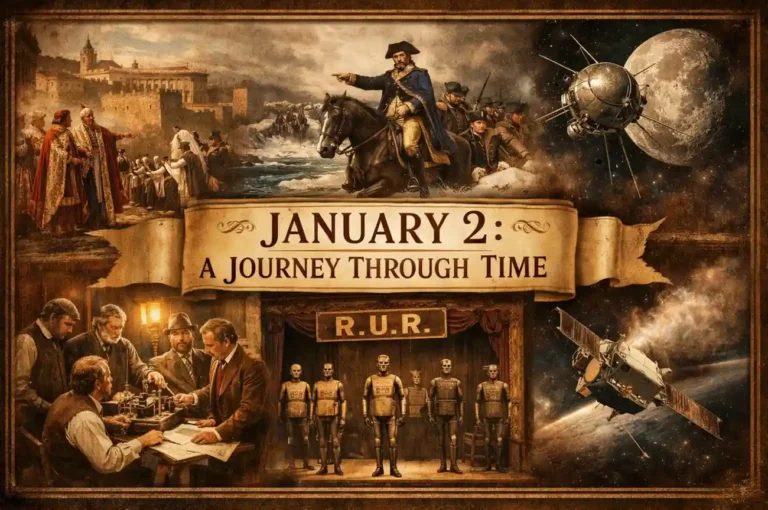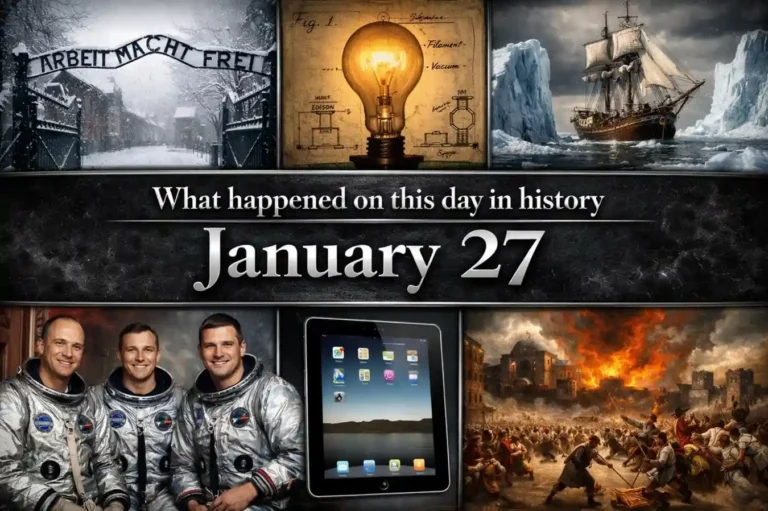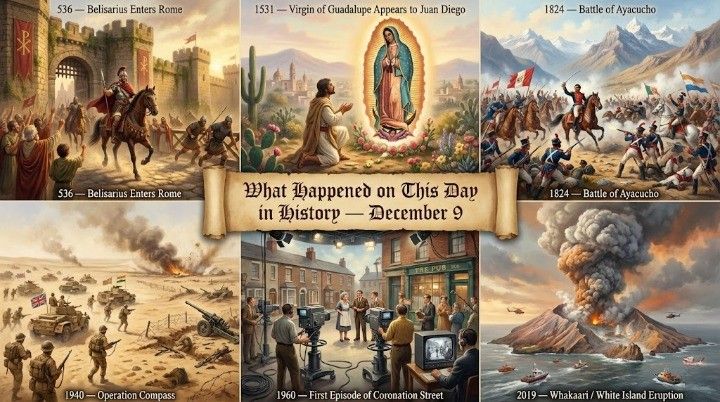
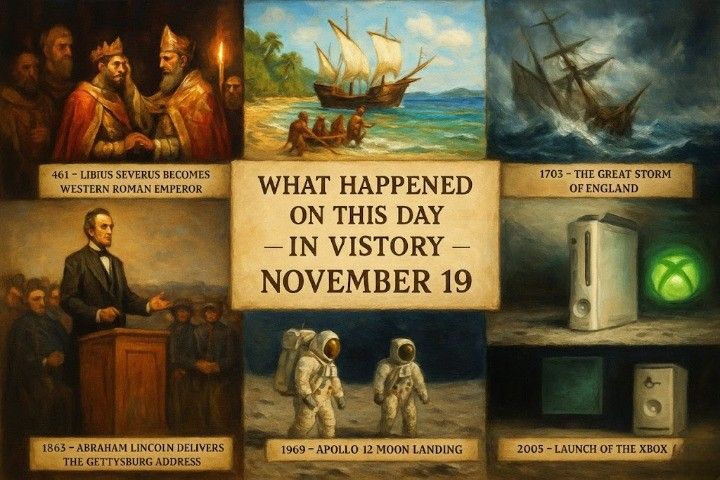
November 19 threads together speeches, battles, scientific firsts and wrenching disasters — a date when political decisions and public tragedies alike changed lives across continents. In the center of that sweep, what happened on this day in history November 19 appears as a mixture of diplomatic deals, daring sea and space ventures, and moments that reshaped national memory. Read on for the most important events recorded for this date.
Important Events That Happened On November 19 In History
461 — Libius Severus is declared emperor of the Western Roman Empire
Following a turbulent period of court intrigue, Libius Severus is proclaimed Western Roman emperor while real military and political control rests with the magister militum Ricimer. This arrangement highlights how military strongmen increasingly dominated imperial politics as the Western Empire weakened. Severus’ reign reflects the fragmentation of central authority that accelerated Rome’s decline.
636 — Rashidun Caliphate defeats the Sasanian Empire at al-Qādisiyyah
In a decisive encounter near al-Qādisiyyah, Arab forces of the Rashidun Caliphate beat Sasanian armies, opening the way for the conquest of the Sasanian heartlands. The victory accelerates the collapse of Sasanian rule in Mesopotamia and transforms the political map of the region. It also sets the stage for the rapid spread of new administrative and religious structures.
1493 — Christopher Columbus goes ashore at Borinquen (San Juan Bautista / Puerto Rico)
On his second voyage, Columbus lands on the island he called San Juan Bautista (later Puerto Rico), extending the Spanish presence in the Caribbean. This landing deepens European mapping and subsequent colonial activity in the region. The event is an early moment in the long and often tragic colonial encounter with indigenous Caribbean peoples.
1794 — United States and Great Britain sign Jay’s Treaty
Jay’s Treaty is concluded to settle lingering disputes after the American Revolutionary War and to normalise trade and relations between the U.S. and Great Britain. The agreement eases immediate tensions but provokes sharp partisan debate at home over its perceived concessions. Its diplomatic fallout shapes early American foreign policy and partisan politics.
1802 — Garinagu arrive at British Honduras (present-day Belize)
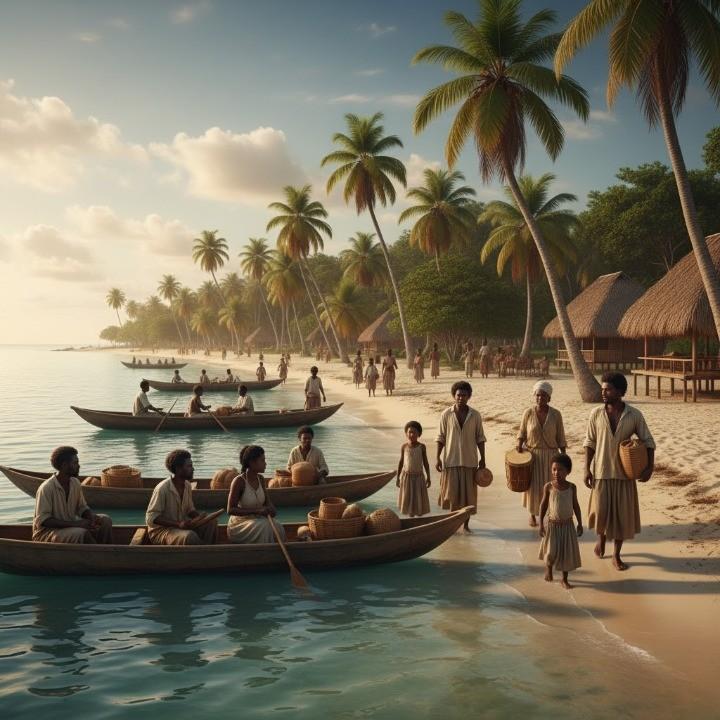
Members of the Garifuna (Garinagu) people arrive in what is now Belize, establishing communities whose language and culture persist to this day. Their settlement follows forced displacement and movement across the Caribbean and Central America. The Garinagu contribution profoundly influences the cultural and social fabric of Belize.
1808 — Finnish War: Convention of Olkijoki ends hostilities in Finland
The Convention of Olkijoki (in Raahe) marks the cessation of active hostilities in Finland during the Finnish War between Sweden and Russia. The agreement helps to stabilise the region temporarily as geopolitical control shifts. These events foreshadow the larger territorial changes that follow in the Napoleonic era.
1816 — Warsaw University is established
The founding of Warsaw University creates a centre for higher learning and scholarship in Poland during a turbulent political period. The institution becomes an important hub for education, national culture, and scientific exchange in the region. Over centuries it plays a significant role in Polish intellectual life.
1847 — Montreal and Lachine Railroad, the second Canadian railway line, opens
The Montreal and Lachine Railroad begins operation as Canada’s second railway line, improving local transport and commercial connections. Early rail links like this one help knit growing settler economies together and speed the movement of goods and people. Rail expansion becomes a key infrastructural driver of nineteenth-century economic growth.
1863 — Gettysburg Address delivered by Abraham Lincoln
At the dedication of the Soldiers’ National Cemetery in Gettysburg, President Abraham Lincoln delivers the Gettysburg Address, a brief but powerful speech that redefines the Civil War as a struggle for national unity and democratic ideals. Its compact rhetoric and moral clarity give it enduring place in American civic memory. The address reshapes public language about equality, nationhood, and sacrifice.
1881 — Meteorite lands near Grossliebenthal, southwest of Odesa
A meteorite fall is reported near the village of Grossliebenthal in the region southwest of Odesa, attracting scientific curiosity and local attention. Such events contribute to nineteenth-century meteorite studies and public fascination with celestial phenomena. They also occasionally enter local folklore and record.
1885 — Battle of Slivnitsa secures Bulgarian victory in Serbo-Bulgarian War
Bulgarian forces prevail at Slivnitsa, a turning point that consolidates the unification of the Principality of Bulgaria and Eastern Rumelia. The victory strengthens Bulgarian national cohesion and alters the balance of power on the Balkan peninsula. It becomes a celebrated episode in Bulgarian military history.
1911 — Doom Bar claims ships Island Maid and Angele off Cornwall
The notorious Doom Bar sandbank in Cornwall causes the wreck of the Island Maid and the Angele, with the latter’s loss of nearly the entire crew save for the captain. Maritime hazards like the Doom Bar have long shaped coastal navigation and local livelihoods. Such shipwrecks highlight the dangers of sea travel before modern navigation aids.
1912 — Serbian Army captures Bitola, ending centuries of Ottoman rule in Macedonia
During the First Balkan War, Serbian forces take Bitola, effectively ending roughly five centuries of Ottoman administration in parts of Macedonia. The capture reshapes regional control and fuels subsequent debates about territory, identity, and borders in the Balkans. It is one notable moment in the region’s dramatic political reconfiguration.
1916 — Samuel Goldwyn and Edgar Selwyn establish Goldwyn Pictures
Producers Samuel Goldwyn and Edgar Selwyn form Goldwyn Pictures, an early step in the consolidation of America’s motion picture industry. The company later becomes part of industry mergers that help found major Hollywood studios. Its formation reflects the rapid commercial development of cinema.
1941 — HMAS Sydney and HSK Kormoran sink each other off Western Australia
In a rare naval duel, the Australian cruiser HMAS Sydney and the German auxiliary cruiser Kormoran engage off Western Australia and end up sinking one another, with heavy loss of life. The battle is a painful episode in Australia’s wartime history and led to extensive searches and investigations afterward. The encounter underscores the global reach of naval warfare in World War II.
1942 — Operation Uranus launched at Stalingrad under Georgy Zhukov
Soviet forces begin Operation Uranus, a large counteroffensive at Stalingrad planned in part by General Georgy Zhukov that encircles Axis armies and shifts momentum on the Eastern Front. The operation proves decisive in turning the campaign in the USSR’s favour and marks a strategic turning point in the war. Its success contributes to the long series of Soviet offensives that follow.
1942 — Mutesa II crowned Kabaka (king) of Buganda
Mutesa II is crowned as the 35th Kabaka of Buganda, a major cultural and political milestone for the kingdom within the British protectorate framework. His reign becomes notable in Uganda’s modern history, and the monarchy remains an important symbol for Buganda identity. The kingship’s later restoration underscores its enduring significance.
1943 — Nazis liquidate Janowska concentration camp in Lemberg (Lviv) after an uprising
Following a failed uprising and mass escape attempt, Nazi forces liquidate the Janowska camp near Lemberg (Lviv), murdering thousands of Jewish prisoners in one of the many brutal actions of the Holocaust. The massacre is part of the systematic violence against Jewish communities in occupied Eastern Europe. It remains a grim testament to the camp system’s murderous excesses.
1944 — Franklin D. Roosevelt announces the sixth War Loan Drive
President Franklin D. Roosevelt launches the sixth U.S. War Loan Drive to raise funds—targeting $14 billion—for the Allied war effort, mobilising public support via bond sales and patriotic appeals. War loan drives were central to home-front financing and civic mobilisation during World War II. The campaigns also shaped wartime public rhetoric and savings patterns.
1944 — Battle of Vianden: Luxembourgish resistance defends Vianden
Thirty members of the Luxembourgish resistance mount a determined defence of Vianden against a larger Waffen-SS attack, symbolising local resistance efforts in occupied Europe. Though small in scale, such actions demonstrate the persistence of civilian and partisan opposition to occupation. They enter national memory as acts of courage and resistance.
1946 — Afghanistan, Iceland and Sweden join the United Nations
In a postwar expansion of international membership, Afghanistan, Iceland and Sweden become UN members, reflecting the organisation’s growing global reach. Their admission is part of broader postwar diplomatic realignment and institutionalisation of multilateral diplomacy. Joining the UN allows these states new venues for international engagement.
1950 — Dwight D. Eisenhower becomes Supreme Commander of NATO-Europe
U.S. General Dwight D. Eisenhower assumes the post of Supreme Commander in Europe for NATO, signalling allied coordination during the early Cold War. His leadership helps organise the alliance’s military structure and deterrence posture. The appointment underscores the U.S. role in European security.
1952 — Alexander Papagos becomes Prime Minister of Greece
Field Marshal Alexander Papagos assumes the office of Prime Minister as Greece navigates Cold War politics and domestic reconstruction after civil conflict. His government marks a shift toward conservative, anti-communist policies in a turbulent era. Papagos’ leadership affects Greece’s postwar political and security orientation.
1954 — Télé Monte Carlo, Europe’s oldest private TV channel, launches
Télé Monte Carlo begins broadcasting under the patronage of Prince Rainier III, emerging as one of Europe’s earliest private television channels. The station contributes to the diversification of media markets and cross-border broadcasting in the region. Its founding is part of postwar media expansion.
1955 — National Review publishes its first issue
The conservative magazine National Review publishes its inaugural issue, becoming an influential voice in American political and intellectual life. Founded to shape and define modern conservative thought, the magazine plays a long-running role in policy debates and party politics. Its launch marks a key step in postwar ideological organisation.
1967 — TVB, Hong Kong’s first wireless commercial television station, is established
Television Broadcasts Limited (TVB) begins as Hong Kong’s first commercial wireless broadcaster, rapidly shaping local popular culture and media industries. TVB becomes a major exporter of television formats, dramas, and talent across Chinese-language markets. Its founding transforms mass entertainment in the territory.
1969 — Apollo 12: Pete Conrad and Alan Bean land at Oceanus Procellarum on the Moon
Apollo 12 astronauts Pete Conrad and Alan Bean touch down at Oceanus Procellarum and conduct successful lunar surface operations as the third and fourth humans to walk on the Moon. Their precise landing and scientific work build on Apollo 11’s achievement and expand lunar exploration. The mission exemplifies rapid advances in crewed spaceflight.
1969 — Pelé scores his 1,000th career goal
Soccer great Pelé reaches the milestone of 1,000 career goals, a landmark in sporting achievement that attracts worldwide attention. The milestone cements his stature in global football history and becomes a celebrated moment in sports culture. It also highlights football’s growing international celebrity economy.
1977 — TAP Air Portugal Flight 425 crashes in the Madeira Islands
TAP Air Portugal Flight 425 crashes on approach to Madeira, causing 131 fatalities in one of the airline’s worst disasters. The accident prompts investigations into approach procedures and airport safety in difficult terrain. Its impact leads to changes aimed at preventing similar tragedies.
1977 — Anwar Sadat’s visit to Israel begins
Egyptian President Anwar Sadat makes a historic trip to Israel and addresses its parliament, offering initiatives toward peace after decades of conflict. The visit opens a new chapter in Arab-Israeli diplomacy and wins Sadat wide attention—both praise and critique—across the region and world. It eventually helps set the stage for the Camp David process.
1979 — Iran hostage crisis: Khomeini orders release of 13 female and black American hostages
Ayatollah Ruhollah Khomeini orders the release of 13 female and Black hostages held at the U.S. Embassy in Tehran, allowing some detainees to leave while others remain captive. The selective releases are a notable episode in the long-running hostage crisis that deeply affected U.S.–Iran relations. The crisis remains a defining moment in late twentieth-century Middle Eastern diplomacy.
1984 — San Juanico disaster: explosions and fire at Pemex storage facility in Mexico City
A catastrophic series of explosions at the Pemex petroleum storage site in San Juan Ixhuatepec (San Juanico) sparks a major fire that kills roughly 500 people and injures many more. The disaster exposes systemic safety failures around industrial storage and emergency response. It leads to national mourning and changes in safety regulations and planning.
1985 — Reagan and Gorbachev meet for the first time in Geneva
U.S. President Ronald Reagan and Soviet General Secretary Mikhail Gorbachev hold their first summit in Geneva, initiating a personal diplomacy that will help ease Cold War tensions. The meeting opens channels for arms-control dialogue and sets a tone of cautious engagement. It becomes an early landmark in the thaw that culminates later in deeper negotiations.
1985 — Pennzoil wins a $10.53 billion judgment against Texaco
In one of the largest civil verdicts in U.S. history at the time, Pennzoil obtains a $10.53 billion judgment against Texaco over competing claims to buy Getty Oil. The verdict shocks corporate America and has lasting implications for takeover tactics, contract law, and shareholder relations. It stands as a cautionary episode in high-stakes corporate litigation.
1985 — Police lay siege to houses of an Islamic sect in Baling, Malaysia
Malaysian authorities besiege homes occupied by roughly 400 followers of an Islamic sect led by Ibrahim Mahmud in Baling, reflecting tensions between the state and heterodox religious movements. The standoff highlights complex questions of security, religious plurality, and law enforcement in Malaysia. It remains a contested episode in the nation’s recent history.
1988 — Slobodan Milošević declares Serbia under attack from internal and external enemies
Serbian leader Slobodan Milošević publicly asserts that Serbia faces threats from Albanian separatists in Kosovo, internal betrayal and foreign conspiracies—rhetoric that fans nationalist sentiment. Such statements help consolidate his political base and shape the trajectory of Yugoslavia’s disintegration. The speech figures in the broader narrative of rising ethno-nationalist conflict.
1993 — Factory fire in Shenzhen kills 87 and injures 51
A devastating factory fire in Shenzhen results in 87 deaths and 51 injuries, underscoring dangerous working conditions amid China’s rapid industrial expansion. The tragedy spotlights the human costs of fast-paced manufacturing growth and prompts scrutiny of workplace safety. It feeds public and official conversations about labour and regulatory reforms.
1994 — First National Lottery draw held in the United Kingdom
The UK’s inaugural National Lottery draw is held, offering a new mass-market form of state-sanctioned gambling with large jackpot prizes. The lottery becomes a cultural phenomenon and a funding source for arts, heritage and community projects via lottery grants. It also stimulates debate about gambling policy and social impact.
1996 — Space Shuttle Columbia launches on STS-80, the program’s longest mission
Columbia lifts off on STS-80 for a mission that will last 17 days—the longest in the Space Shuttle era at that time—and carry a diverse crew and experiments. Onboard astronaut Story Musgrave becomes the only person to have flown on all five shuttle orbiters. The flight extends human endurance research and orbital experimentation.
1996 — Mid-air collision at Quincy Regional Airport kills 14
A Beechcraft 1900 and a Beechcraft King Air collide at Quincy Regional Airport in Illinois, resulting in 14 fatalities and a major aviation investigation. The accident leads to scrutiny of air traffic procedures, pilot training and regional flight safety. It is a sobering reminder of the risks of congested and complex airspace.
1997 — Space Shuttle Columbia launched on STS-87
Columbia is launched on the STS-87 mission, part of ongoing shuttle operations advancing science and technology in low Earth orbit. Each flight continues the program’s research agenda and contributes to the learning curve of human spaceflight. STS-87 adds to the shuttle era’s mixed record of achievement and challenge.
1998 — U.S. House Judiciary Committee begins impeachment hearings into President Bill Clinton
The House Judiciary Committee opens impeachment hearings in the Clinton–Lewinsky scandal, a major political and constitutional crisis in the United States. The proceedings divide public opinion and have long-lasting consequences for American politics and presidential accountability. The hearings culminate in an impeachment vote that becomes a defining moment of the era.
1999 — Shenzhou 1: China launches its first Shenzhou spacecraft
The People’s Republic of China lofts Shenzhou 1, the first in a new family of crewed spacecraft that will become central to the country’s human spaceflight ambitions. The launch marks a step in China’s growing capabilities in space technology and in national prestige projects. It inaugurates an era of expanded Chinese orbital activity.
1999 — John Carpenter wins top prize on “Who Wants to Be a Millionaire?”
John Carpenter becomes the first contestant to win the top prize on the U.S. version of the TV quiz show “Who Wants to Be a Millionaire?”, a cultural moment in television entertainment. His victory exemplifies the show’s intense format and mass appeal, sparking a wave of international adaptations. The episode becomes part of 1990s TV history.
2001 — Aviation and Transportation Security Act creates the TSA
In response to the September 11 attacks, the U.S. Congress passes the Aviation and Transportation Security Act, establishing the Transportation Security Administration (TSA) to oversee aviation security. The law reorganises checkpoint procedures, federalises airport security functions and reshapes travel norms. Its effects on air travel and civil liberties are debated in the decades that follow.
2002 — Greek oil tanker Prestige splits and sinks off Galicia, causing a large oil spill
The Greek tanker Prestige breaks in two and sinks off the coast of Galicia, Spain, releasing tens of thousands of tonnes of oil and producing one of the worst environmental disasters in Spanish and Portuguese history. The spill devastates coastal ecosystems, fisheries and local economies, and spurs legal and regulatory responses across Europe. Cleanup and litigation continue for years.
2004 — Massive brawl in an NBA game leads to multiple suspensions and charges
A notorious on-court and fan brawl—often cited as one of the worst in NBA history—results in suspensions for several players and criminal charges for participants and some spectators. The incident forces the league to tighten security and review conduct policies. It becomes a cautionary tale about violence in professional sports settings.
2007 — Amazon begins selling the Kindle e-reader
Amazon launches the Kindle, a wireless electronic reading device that plays a central role in popularising e-books and changing reading habits. The Kindle’s introduction accelerates digital publishing, affects bookstore markets and shifts how readers access texts. It is a watershed moment in the digital transformation of publishing.
2010 — Pike River Mine explosions in New Zealand kill 29 miners
A series of explosions at the Pike River coal mine kills 29 workers in one of New Zealand’s worst mining disasters since 1914. The catastrophe triggers major inquiries into mine safety, emergency response and regulatory oversight. It leaves lasting impact on communities and mining policy reforms.
2013 — Double suicide bombing at the Iranian embassy in Beirut kills 23 and injures 160
A coordinated double suicide attack on the Iranian embassy in Beirut kills dozens and injures many more, reflecting sectarian and regional violence rippling through Lebanon and the broader Middle East. The bombings deepen political tensions and elicit international condemnation. They underscore the vulnerability of diplomatic facilities to asymmetric attacks.
2022 — Mass shooting at Club Q in Colorado Springs kills five and wounds many
A gunman opens fire at Club Q, a gay nightclub in Colorado Springs, killing five people and wounding 17 in a hate-tinged attack that shocks the local community. The shooting prompts debates on hate crimes, gun policy and protections for LGBTQ+ spaces. The event becomes a painful marker in contemporary discussions about violence and minority safety.
2023 — 2023 Cricket World Cup final: India vs Australia at Narendra Modi Stadium, Ahmedabad
The Cricket World Cup final takes place at the Narendra Modi Stadium in Ahmedabad between host nation India and Australia, with Australia winning the tournament. The match is a major global sporting event with significant viewership and national significance for the teams involved. It closes a month-long tournament that captured wide international interest.
Read Also: What happened on this day in history November 18: Unforgettable Facts
Famous People Born On November 19
Calvin Klein — American designer. (Nov 19, 1942 – )
José Raúl Capablanca — Cuban chess player. (Nov 19, 1888 – Mar 8, 1942)
George Rogers Clark — American military leader and explorer. (Nov 19, 1752 – Feb 13, 1818)
Hiram Bingham — American archaeologist and U.S. senator (Machu Picchu). (Nov 19, 1875 – Jun 6, 1956)
Mikhail Lomonosov — Russian poet, scientist, and scholar. (Nov 19, 1711 – Apr 15, 1765)
Ferdinand, viscount de Lesseps — French diplomat and Suez Canal builder. (Nov 19, 1805 – Dec 7, 1894)
Savion Glover — American dancer and choreographer. (Nov 19, 1973 – )
Tommy Thompson — U.S. politician, governor of Wisconsin and HHS secretary. (Nov 19, 1941 – )
Eileen Collins — U.S. pilot and astronaut (first woman to pilot & command a shuttle). (Nov 19, 1956 – )
Bertel Thorvaldsen — Danish Neoclassical sculptor. (Nov 19, 1770 or Nov 13, 1768 – Mar 24, 1844)
William Sheldon — American psychologist (somatotypes theory). (Nov 19, 1898 – Sep 16, 1977)
Jeane Kirkpatrick — American political scientist and U.S. ambassador to the UN. (Nov 19, 1926 – Dec 7, 2006)
Wilhelm Dilthey — German philosopher and historian of the human sciences. (Nov 19, 1833 – Oct 1, 1911)
Sharon Olds — American poet. (Nov 19, 1942 – )
Mutesa II — Kabaka (king) of Buganda. (Nov 19, 1924 – Nov 21, 1969)
Paul W. Taylor — American environmental philosopher. (Nov 19, 1923 – Oct 14, 2015)
George E. Palade — Romanian-born American cell biologist, Nobel laureate. (Nov 19, 1912 – Oct 7, 2008)
Allen Tate — American poet and critic. (Nov 19, 1899 – Feb 9, 1979)
Gail Devers — American Olympic sprinter and hurdler. (Nov 19, 1966 – )
Holmes Rolston III — American philosopher and environmental ethicist. (Nov 19, 1932 – )
Robert Sidney, 1st earl of Leicester — British soldier and politician. (Nov 19, 1563 – Jul 13, 1626)
Mary Anna Hallock Foote — American writer and illustrator. (Nov 19, 1847 – Jun 25, 1938)
Charles Thomson Ritchie, 1st Baron Ritchie — British politician. (Nov 19, 1838 – Jan 9, 1906)
Leopold Auenbrugger von Auenbrugg — Austrian physician (percussion diagnostic). (Nov 19, 1722 – May 17, 1809)
Gabriel Hanotaux — French statesman and historian. (Nov 19, 1853 – Apr 11, 1944)
José Evaristo Uriburu — President of Argentina. (Nov 19, 1831 – Oct 23, 1914)
Stanley Keith Runcorn — British geophysicist (paleomagnetism). (Nov 19, 1922 – Dec 5, 1995)
Hjalmar Fredrik Elgérus Bergman — Swedish author. (Nov 19, 1883 – Jan 1, 1931)
Louis Golding — British novelist and essayist. (Nov 19, 1895 – Aug 9, 1958)
Fernand Crommelynck — Belgian dramatist. (Nov 19, 1886 – Mar 17, 1970)
Famous People Died On November 19
Erving Goffman — Canadian-American sociologist (interaction rituals). (Jun 11, 1922 – Nov 19, 1982)
Mel Tillis — American country songwriter and entertainer. (Aug 8, 1932 – Nov 19, 2017)
Joe Hill — Swedish-American songwriter and labor organizer (IWW martyr). (Oct 7, 1879 – Nov 19, 1915)
Giorgio de Chirico — Italian Metaphysical painter. (Jul 10, 1888 – Nov 19, 1978)
John I — King of France (died in infancy). (Nov 15, 1316 – Nov 19, 1316)
Nicolas Poussin — French classical painter. (Jun 1594 – Nov 19, 1665)
Frederick Sanger — British biochemist, two-time Nobel laureate. (Aug 13, 1918 – Nov 19, 2013)
Emma Lazarus — American poet (“The New Colossus”). (Jul 22, 1849 – Nov 19, 1887)
Thomas H. Ince — American film director and early studio system organizer. (Nov 16, 1882 – Nov 19, 1924)
James, Baron Ensor — Belgian painter and printmaker. (Apr 13, 1860 – Nov 19, 1949)
Richard M. Johnson — 9th Vice President of the United States. (Oct 17, 1780 – Nov 19, 1850)
Kenneth Burke — American literary critic and theorist. (May 5, 1897 – Nov 19, 1993)
Wolfe Tone — Irish republican leader. (Jun 20, 1763 – Nov 19, 1798)
Mal Whitfield — American Olympic middle-distance runner. (Oct 11, 1924 – Nov 19, 2015)
Don Carlos Buell — Union general (American Civil War). (Mar 23, 1818 – Nov 19, 1898)
Joseph F. Smith — President of the LDS Church. (Nov 13, 1838 – Nov 19, 1918)
Anastasius II — Pope (d. 498). (– Nov 19, 498)
Mihály Vörösmarty — Hungarian poet and dramatist. (Dec 1, 1800 – Nov 19, 1855)
Jacob Glatstein — Yiddish poet and critic. (Aug 20, 1896 – Nov 19, 1971)
Warren Rudman — U.S. senator from New Hampshire. (May 18, 1930 – Nov 19, 2012)
Charles Manson — American criminal and cult leader. (Nov 12, 1934 – Nov 19, 2017)
Mike Nichols — American director, EGOT winner. (Nov 6, 1931 – Nov 19, 2014)
Alan J. Pakula — American director and producer. (Apr 7, 1928 – Nov 19, 1998)
Xu Zhimo — Chinese modernist poet. (Jan 15, 1897 – Nov 19, 1931)
Elizabeth Taylor — British novelist (not the actress). (Jul 3, 1912 – Nov 19, 1975)
Sir William Siemens — Engineer and inventor. (Apr 4, 1823 – Nov 19, 1883)
Solomon Schechter — Rabbi and scholar. (Dec 7, 1847 – Nov 19, 1915)
Calvert Vaux — British-born architect (landscape & park design). (Dec 20, 1824 – Nov 19, 1895)
Tetsuya Fujita — Japanese-American meteorologist (Fujita scale). (Oct 23, 1920 – Nov 19, 1998)
Sir Basil Spence — British architect (Coventry Cathedral). (Aug 13, 1907 – Nov 19, 1976)
Observances & Institutional Dates — November 19
🇧🇷 Flag Day (Brazil)
Brazil celebrates the creation of its national flag after the 1889 proclamation of the republic.
The day honors national identity and the symbolism behind the flag’s design.
🌍 International Men’s Day
Observed globally to highlight men’s health, positive male role models, and gender relations.
It focuses on mental health, responsibility, and reducing social pressures on men.
🇲🇨 Monaco — National Day
Monaco celebrates its national holiday linked to the reign of Prince Albert II.
Events include ceremonies, fireworks, and cultural displays celebrating the principality’s heritage.
🔬 World Toilet Day (UN)
A United Nations day promoting sanitation awareness worldwide.
It highlights global challenges in access to safe toilets and clean water.
Frequently Asked Questions
What is the most famous event that happened on November 19?
The Gettysburg Address (1863) is considered the most iconic event, shaping American political history.
Why is November 19 International Men’s Day?
It was chosen to promote men’s well-being and raise awareness about issues like mental health, family roles, and positive masculinity.
What historic disaster is linked to this date?
The Great Storm of 1703, one of the worst storms in British history, struck on November 19.
Which famous leaders were born on November 19?
Notable leaders include Charles I of England, U.S. President James Garfield, and Indian Prime Minister Indira Gandhi.
What major space event happened on November 19?
Apollo 12 astronauts landed on the Moon on November 19, 1969.