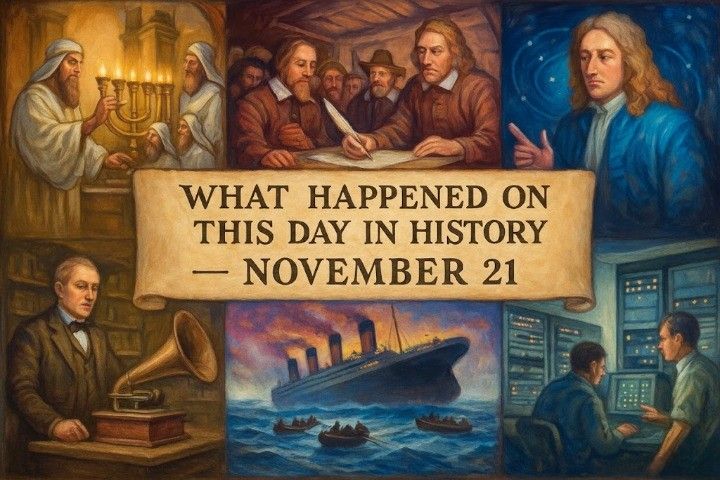
November 21 gathers together a mix of solemn rites, bold experiments and sudden public breaks. That’s why we pause to consider what happened on this day in history November 21, a date marked by everything from exploration to tragedy and hard-won change.
Important Events That Happened On November 21 In History
164 BCE — Judas Maccabeus rededicates the Temple in Jerusalem
Judas Maccabeus, son of Mattathias and leader of the Maccabean revolt, reconsecrated the Jerusalem Temple after driving out Seleucid forces. That rededication is remembered each year in the Jewish festival of Hanukkah and marks a pivotal moment in Jewish resistance and ritual renewal.
235 — Pope Anterus succeeds Pontian as pope
Following the death or resignation of Pontian, Anterus becomes the nineteenth bishop of Rome. His short papacy took place amid the early church’s trials and administrative consolidation in the third century.
1386 — Timur sacks Tbilisi and takes King Bagrat V captive
Timur of Samarkand (Tamerlane) captured and plundered the Georgian capital Tbilisi, seizing King Bagrat V. The assault was part of Timur’s wider campaigns that reshaped the Caucasus and surrounding regions in the late 14th century.
1620 — Forty-one male passengers sign the Mayflower Compact
Before landing at Plymouth, 41 adult men aboard the Mayflower agreed to a compact for self-government and order in the new settlement. The Mayflower Compact became an early example of colonial self-rule and communal consent.
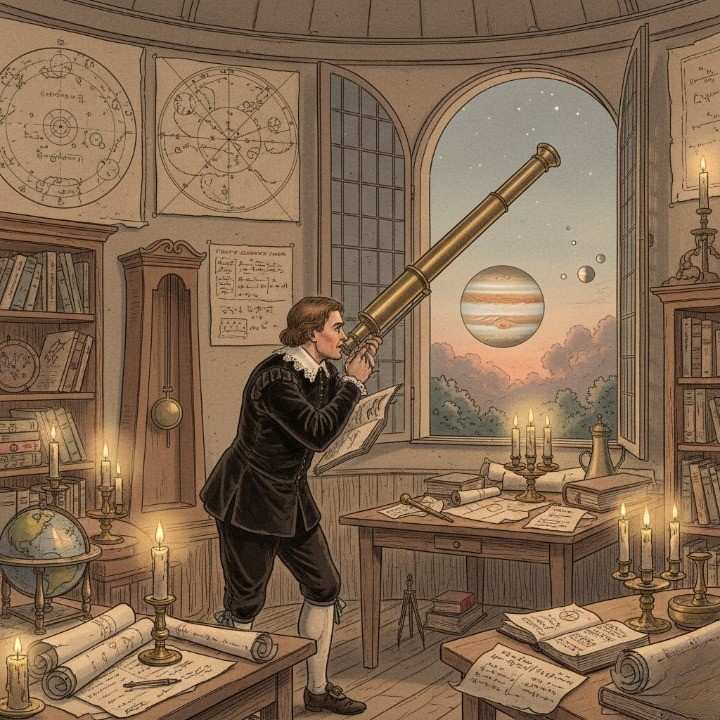
1676 — Ole Rømer gives the first quantitative measurement of light’s speed
Danish astronomer Ole Rømer presented observations that allowed a numerical estimate for the speed of light—an experimental step that turned a philosophical question into a measurable physical constant.
1783 — First untethered hot-air balloon flight in Paris
Jean-François Pilâtre de Rozier and François Laurent d’Arlandes took the first free manned hot-air balloon flight, demonstrating human flight’s earliest public success and igniting imaginations about aerial travel.
1789 — North Carolina ratifies the U.S. Constitution
North Carolina completed the process of joining the United States as the 12th state, ratifying the Constitution and cementing its place in the newly framed federal union.
1806 — (Listed) Lord Lytton launches the Second Anglo-Afghan War
(As you supplied) Lord Lytton’s administration is associated with the outbreak of the Second Anglo-Afghan War — a major imperial conflict with long regional consequences.
1851 — Mutiny seizes Chile’s Punta Arenas penal colony
Prisoners at the isolated penal settlement in the Strait of Magellan took control, an episode that exposed the harsh conditions and governance challenges of remote penal colonies.
1861 — Judah Benjamin appointed Confederate Secretary of War
Confederate President Jefferson Davis named Judah Benjamin to head the War Department, a wartime leadership appointment reflecting the Confederate government’s administrative evolution.
1877 — Thomas Edison announces the phonograph
Edison revealed a device capable of recording and reproducing sound, a transformational invention that launched recorded audio and reshaped entertainment, communication and business.
1878 — (Listed) Lord Lytton and the Second Anglo-Afghan War
(As provided) this date is again associated in your list with Lord Lytton’s policy and the Afghan conflict — a repeated entry preserved per your instruction.
1894 — Port Arthur falls to Japan in the First Sino-Japanese War
Japanese forces captured Port Arthur, a decisive victory that helped establish Japan’s rising regional power—and the aftermath sparked accusations of atrocities against civilians.
1900 — Claude Monet’s work shown at Durand-Ruel in Paris
Monet’s paintings were exhibited, reflecting the continued public and market appetite for Impressionism and the importance of Parisian galleries in an artist’s reputation.
1902 — First professional American football night game
The Philadelphia Football Athletics defeated Elmira’s Kanaweola Athletic Club under artificial lighting, an early experiment that presaged night sports as a mass entertainment form.
1905 — Einstein’s E = mc² paper published
Albert Einstein published the paper that led to the famous mass–energy equivalence relation in Annalen der Physik, a cornerstone result of modern physics with far-reaching theoretical and practical consequences.
1910 — Revolta da Chibata (Brazilian naval mutiny)
Sailors aboard Brazilian warships rebelled against harsh discipline and corporal punishment, an uprising that exposed social inequalities and prompted reform debates in Brazil.
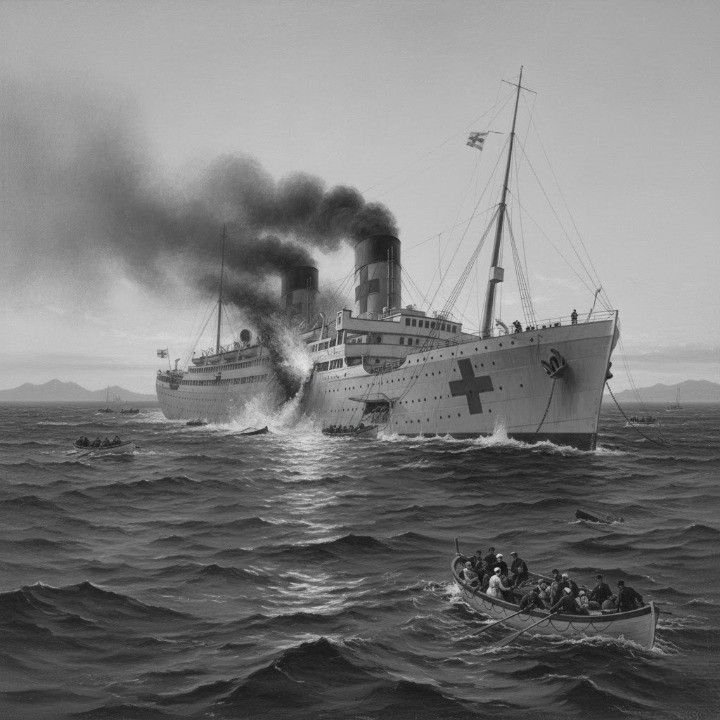
1916 — HMHS Britannic sunk by mines from SM U-73
The hospital ship Britannic, sister ship to the Titanic, struck mines and sank during World War I—one of the war’s largest maritime losses and a grim reminder of naval hazards even for noncombatant vessels.
1918 — Estonia adopts its national flag
Activists’ banner becomes the formal national flag of the newly independent Republic of Estonia, a symbolic step in the nation’s assertion of sovereignty during the post-war order.
1918 — Parliament (Qualification of Women) Act 1918 passes (UK)
The Act allowed women to stand for Parliament in the United Kingdom, opening a new formal avenue for women’s political participation after decades of suffrage campaigning.
1918 — Pogrom in Lwów (Lviv)
Over three days of violence in Lwów, at least 50 Jews and 270 Ukrainian Christians were killed in clashes involving multiple armed groups—an episode of intercommunal violence amid collapsing empires.
1920 — “Bloody Sunday” in Dublin: IRA assassinations and Croke Park killings
On a single, bloody day the IRA targeted British intelligence officers in Dublin; later British forces fired into a Gaelic football crowd at Croke Park, killing 14 civilians—an escalation in the Irish War of Independence.
1922 — Rebecca Latimer Felton becomes first female U.S. Senator (oath)
In Georgia, Rebecca Latimer Felton took the oath of office, becoming the first woman to serve in the United States Senate, a largely symbolic but historically notable milestone.
1927 — Columbine Mine massacre (striking miners attacked)
Striking coal miners who sought better conditions were attacked; the event reflects violent labor-era confrontations over industry, policing and workers’ rights.
1942 — Alaska Highway completion celebrated
Construction of the Alaska (Alcan) Highway was formally marked; the route proved crucial for wartime logistics and later regional connectivity, even though full civilian use followed in 1943.
1944 — USS Sealion sinks IJN Kongō and destroyer Urakaze
In a Formosa Strait action, the American submarine USS Sealion sank the Japanese battleship Kongō and destroyer Urakaze, striking a significant naval blow late in the Pacific war.
1945 — UAW strikes 92 GM plants for wage demands
The United Auto Workers mounted a broad strike across General Motors facilities to press for substantial raises—a key postwar labor action that shaped U.S. industrial relations.
1950 — Canoe River train collision kills 21 Canadian troops
Two Canadian National Railway trains collided in British Columbia; many of the dead were troops bound for the Korean War, a tragic peacetime transportation disaster.
1953 — Piltdown Man revealed as a hoax
The Natural History Museum in London announced that the famed Piltdown skull was fraudulent, upending decades of paleoanthropological assumptions and exposing scientific deception.
1954 — People’s Action Party established (Singapore)
The foundation of the People’s Action Party set the stage for the political formation that would come to dominate Singaporean politics and shape the city-state’s development.
1959 — DJ Alan Freed fired amid payola allegations
Alan Freed, a major promoter of rock and roll, lost his WABC position after payola investigations—an episode that exposed commercial pressures in early pop broadcasting.
1961 — “La Ronde” opens in Honolulu, the first U.S. revolving restaurant
The rotating dining room exemplified mid-century novelty architecture and new leisure experiences in American cities and tourist centers.
1962 — China declares unilateral ceasefire in Sino-Indian War
The Chinese People’s Liberation Army announced a ceasefire, effectively ending large-scale hostilities and shaping the contested Sino-Indian frontier’s status.
1964 — Verrazzano-Narrows Bridge opens; Second Vatican Council’s third session closes
The Verrazzano-Narrows Bridge, then the world’s longest span, opened to traffic, while the Third Session of Vatican II concluded—two very different institutional milestones in engineering and religion.
1967 — General Westmoreland’s public assessment of the Vietnam War
U.S. General William Westmoreland told reporters that the enemy was losing compared with earlier years; his optimistic public statements became part of the contested wartime narrative.
1969 — Nixon and Sato agree on Okinawa’s return; first permanent ARPANET link established
President Nixon and Prime Minister Eisaku Satō set terms for Okinawa’s return to Japan in 1972, while ARPANET established its first permanent UCLA–SRI link—both events foreshadowing changes in geopolitics and digital infrastructure.
1970 — Operation Ivory Coast: Sơn Tây raid attempts prisoner rescue
U.S. forces launched a daring raid on the Sơn Tây POW camp to free American prisoners thought to be held there; although no prisoners were found, the operation demonstrated complex joint-force capabilities.
1971 — Battle of Garibpur: Indian and Mukti Bahini victory
Indian units, with Mukti Bahini guerrillas, defeated the Pakistan army at Garibpur—an early engagement that presaged the larger 1971 South Asian conflict and Bangladesh’s independence.
1972 — South Korea approves a new constitution under Park Chung Hee
Voters overwhelmingly ratified a constitution that consolidated President Park Chung Hee’s power and legitimized the Fourth Republic, shaping South Korea’s political trajectory.
1974 — Birmingham pub bombings kill 21 (and later wrongful convictions)
Bomb attacks killed 21 people; the case produced the “Birmingham Six,” later wrongly convicted and eventually cleared—an emblematic miscarriage of justice and its long aftermath.
1977 — New Zealand announces its national anthems
Minister Allan Highet declared that New Zealand would use both “God Save the Queen” and “God Defend New Zealand,” formalizing the country’s dual-anthem practice.
1979 — U.S. Embassy in Islamabad attacked and set on fire
A mob assaulted the American diplomatic mission in Islamabad, killing four people—an outbreak of violence that reflected fraught U.S.–Pakistan relations in a turbulent regional moment.
1980 — MGM Grand Hotel fire kills 85 in Paradise, Nevada
A catastrophic blaze at the MGM Grand became Nevada’s deadliest hotel disaster—spurring changes in fire codes, safety design and emergency response in large public venues.
1985 — Jonathan Pollard arrested for espionage
U.S. Navy analyst Jonathan Pollard was detained for passing classified information to Israel, a case that reverberated through U.S.–Israeli intelligence relations and law enforcement.
1986 — Oliver North shredding documents during Iran–Contra investigations
As investigations unfolded, NSC staff—including Oliver North—took actions to remove or destroy documents, a contentious moment in the political scandal that followed.
1990 — Bangkok Airways Flight 125 crash kills 38
An air disaster on approach to Samui Airport ended in tragedy; aviation safety and accident investigation followed to determine causes and prevent recurrence.
1992 — Major November tornado outbreak centered on Houston, Texas
A powerful late-season tornado outbreak spawned over a hundred tornadoes and produced significant destruction across several states during an extraordinary meteorological episode.
1995 — Dayton Agreement initialed, ending major Bosnian fighting
Negotiators initialed accords at Wright-Patterson AFB that effectively ended large-scale warfare in Bosnia-Herzegovina and set the framework for post-war governance.
1996 — Humberto Vidal explosion in Río Piedras kills 33
A catastrophic blast at a shoe shop devastated the local community and exposed vulnerabilities in urban safety and hazardous materials regulation.
1998 — Hyvinkää ritual murder by Jarno Elg (listed)
A shocking homicide occurred in Finland with ritual-like elements; the crime drew intense media and judicial attention within Finland.
2002 — NATO invites seven Eastern European countries to join
Bulgaria, Estonia, Latvia, Lithuania, Romania, Slovakia and Slovenia received invitations, a major enlargement step reflecting post-Cold War geopolitical realignment.
2002 — Arturo Guzmán Decena killed in shoot-out
Arturo Guzmán Decena, founder of Los Zetas, was killed in an armed confrontation with Mexican security forces, marking a violent chapter in Mexico’s organized-crime history.
2004 — Ukraine’s contested presidential runoff sparks massive protests
The second round of the presidential election triggered widespread demonstration and political crisis, events that would culminate in the Orange Revolution.
2004 — Dominica hit by its worst recorded earthquake (listed)
A powerful tremor caused severe damage in northern Dominica and neighboring islands, highlighting the Caribbean’s seismic vulnerability.
2004 — Paris Club agrees to write off a major portion of Iraq’s debt
Creditor nations arranged substantial relief—up to 80%—to ease Iraq’s external financial burden during a period of post-conflict reconstruction.
2004 — China Eastern Airlines Flight 5210 crash kills 55
The plane crashed shortly after takeoff from Baotou, a tragic accident that prompted safety reviews and regulatory scrutiny.
2006 — Pierre Gemayel assassinated in Beirut suburbs
The killing of the anti-Syrian Lebanese politician sent shock waves through Lebanon’s fractious political scene and intensified domestic tensions.
2009 — Heilongjiang mine explosion kills 108
A catastrophic mine blast in northeastern China claimed many lives and drew attention to industrial safety and emergency response in the mining sector.
2012 — Bomb thrown onto Tel Aviv bus wounds dozens
An attack injured multiple passengers, reflecting persistent urban security risks and the cycle of violence in the region.
2013 — Shopping-centre roof collapse in Riga kills 54
A structural failure claimed 54 lives, triggering national mourning and investigations into building safety and oversight.
2013 — Massive protests begin in Ukraine over EU agreement suspension
President Yanukovych’s decision to halt an association agreement with the EU ignited large-scale protests that evolved into a broader political crisis and eventual governmental change.
2014 — Kwekwe stampede in Zimbabwe kills at least 11
A crowd panic following police use of tear gas caused multiple fatalities, illustrating how forceful crowd control can produce tragic outcomes.
2015 — Belgium institutes heavy security lockdown in Brussels
Authorities closed shops, schools and transport amid a terrorism threat—an intense security posture that reflected elevated counterterrorism concerns.
2017 — Robert Mugabe resigns as Zimbabwe’s president
After decades in power and mounting internal pressure, Mugabe formally stepped down—an abrupt end to one of Africa’s longest presidencies.
2019 — Benjamin Netanyahu indicted on corruption charges
Israel’s prime minister faced formal charges of bribery, fraud and breach of trust, starting a legal and political drama with wide national reverberations.
2019 — Tesla unveils the Cybertruck (windows crack during demo)
Tesla’s futuristic pickup vehicle debuted, but a live demonstration saw the supposedly shatter-resistant windows break—an embarrassing gaffe during a high-profile launch.
2021 — Waukesha SUV attack on a Christmas parade kills six
An SUV plowed into a holiday parade, causing multiple deaths and many injuries; the event prompted national shock and criminal investigations.
2022 — Java earthquake kills hundreds (magnitude 5.6)
A destructive quake in Indonesia’s Java island produced heavy casualties and extensive damage, underlining ongoing seismic risks in the region.
Read Also: What Happened On This Day In History November 20
Famous People Born On November 21
Björk — Icelandic musician. (Nov 21, 1965 – )
Ken Griffey, Jr. — American baseball player. (Nov 21, 1969 – )
Eleanor Powell — American dancer and actress. (Nov 21, 1912 – Feb 11, 1982)
Dick Durbin — United States senator. (Nov 21, 1944 – )
Benedict XV — Pope. (Nov 21, 1854 – Jan 22, 1922)
Coleman Hawkins — American jazz musician (tenor saxophonist). (Nov 21, 1904 – May 19, 1969)
Hetty Green — American financier. (Nov 21, 1834 – Jul 3, 1916)
Tina Brown — English-American magazine editor and writer. (Nov 21, 1953 – )
Lewis Henry Morgan — American anthropologist and ethnologist. (Nov 21, 1818 – Dec 17, 1881)
William Beaumont — U.S. Army surgeon (studies of digestion). (Nov 21, 1785 – Apr 25, 1853)
Jørgen Vig Knudstorp — Danish businessman (LEGO executive). (Nov 21, 1968 – )
Sid Luckman — American football quarterback. (Nov 21, 1916 – Jul 5, 1998)
Sir Harold Nicolson — British diplomat and author. (Nov 21, 1886 – May 1, 1968)
Beryl Bainbridge — English novelist. (Nov 21, 1932? – Jul 2, 2010)
Mikhail Andreyevich Suslov — Soviet Communist official and ideologue. (Nov 21, 1902 – Jan 25, 1982)
Carly Rae Jepsen — Canadian singer-songwriter. (Nov 21, 1985 – )
Alfred Henry Sturtevant — American geneticist (gene mapping). (Nov 21, 1891 – Apr 5, 1970)
Gert Fredriksson — Swedish kayaker and Olympic champion. (Nov 21, 1919 – Jul 5, 2006)
Olav Duun — Norwegian novelist. (Nov 21, 1876 – Sep 13, 1939)
Sigbjørn Obstfelder — Norwegian Symbolist poet. (Nov 21, 1866 – Jul 29, 1900)
Adolphe Blanqui — French economist and historian of economic thought. (Nov 21, 1798 – Jan 28, 1854)
Vladimir Nikolayevich Ipatieff — Russian-American chemist. (Nov 21, 1867 – Nov 29, 1952)
Sir Samuel Cunard, 1st Baronet — British merchant and steamship founder. (Nov 21, 1787 – Apr 28, 1865)
Frederick Weyerhaeuser — American lumber industrialist. (Nov 21, 1834 – Apr 4, 1914)
William Keith — Scottish-born American landscape painter. (Nov 21, 1839 – Apr 13, 1911)
Désiré-Joseph Mercier — Belgian cardinal and educator. (Nov 21, 1851 – Jan 23, 1926)
John Bale — English bishop, polemicist and playwright. (Nov 21, 1495 – Nov 1563)
Sigfrid Karg-Elert — German organ composer. (Nov 21, 1877 – Apr 9, 1933)
Qian Zhongshu — Chinese scholar and writer. (Nov 21, 1910 – Dec 19, 1998)
Count Kuroda Kiyotaka — Prime minister of Japan. (Nov 21, 1840 – Aug 25, 1900)
Famous People Died On November 21
Henry Purcell — English composer. (c.1659 – Nov 21, 1695)
Heinrich von Kleist — German dramatist and author. (Oct 18, 1777 – Nov 21, 1811)
Robert Benchley — American humorist, actor and writer. (Sep 15, 1889 – Nov 21, 1945)
Jakob Böhme — German mystical philosopher. (1575 – Nov 21, 1624)
Charles Francis Adams — American diplomat. (Aug 18, 1807 – Nov 21, 1886)
Garret A. Hobart — 24th Vice President of the United States. (Jun 3, 1844 – Nov 21, 1899)
Robert Bly — American poet and author. (Dec 23, 1926 – Nov 21, 2021)
Jacques de Vaucanson — French inventor (automatons). (Feb 24, 1709 – Nov 21, 1782)
Florence Harding — First Lady of the United States (wife of Warren G. Harding). (Aug 15, 1860 – Nov 21, 1924)
Mutesa II — Kabaka (king) of Buganda. (Nov 19, 1924 – Nov 21, 1969)
Mel Ott — American baseball Hall-of-Famer. (Mar 2, 1909 – Nov 21, 1958)
Ricardo Flores Magón — Mexican anarchist and social reformer. (Sep 16, 1873 – Nov 21, 1922)
Norman Lindsay — Australian artist and novelist. (Feb 23, 1879 – Nov 21, 1969)
Georgius Agricola — German scholar, “father of mineralogy.” (Mar 24, 1494 – Nov 21, 1555)
James Hogg — Scottish poet (“Ettrick Shepherd”). (Dec 9, 1770 – Nov 21, 1835)
Sir Thomas Gresham — English financier, founder of the Royal Exchange. (1518/19 – Nov 21, 1579)
J.B.M. Hertzog — Prime minister of South Africa. (Apr 3, 1866 – Nov 21, 1942)
Yoshida Shōin — Japanese intellectual and teacher. (Sep 20, 1830 – Nov 21, 1859)
Sir John McEwen — Prime minister of Australia (briefly, 1967–68). (Mar 29, 1900 – Nov 21, 1980)
Daniel Mann — American film director. (Aug 8, 1912 – Nov 21, 1991)
Antonin Raymond — Czech-born American architect (work in Japan). (May 10, 1888 – Nov 21, 1976)
Francis Burton Harrison — U.S. governor-general of the Philippines. (Dec 18, 1873 – Nov 21, 1957)
Kaysone Phomvihan — President of Laos. (Dec 13, 1920 – Nov 21, 1992)
Leopold, Graf von Berchtold — Austro-Hungarian foreign minister. (Apr 18, 1863 – Nov 21, 1942)
Meena Alexander — Indian poet and scholar. (Feb 17, 1951 – Nov 21, 2018)
Ellen Glasgow — American novelist. (Apr 22, 1873 – Nov 21, 1945)
William Green — U.S. labor leader (AFL president). (Mar 3, 1873 – Nov 21, 1952)
Joseph McKenna — Associate Justice, U.S. Supreme Court. (Aug 10, 1843 – Nov 21, 1926)
John Hill — British author and botanist. (c.1714 – Nov 21, 1775)
Carl Hubbell — American baseball pitcher. (Jun 22, 1903 – Nov 21, 1988)
Observances & Institutional Dates — November 21
World Philosophy Day (UN observance)
Established by UNESCO, the day highlights philosophy’s role in critical thinking, public debate and the defense of human rights around the globe. Institutions and educational programs often host talks and workshops to mark the occasion.
Armed Forces Day (Bangladesh)
A national day commemorating the country’s military and its role in national security and national service. Ceremonies typically honor veterans, active personnel, and Bangladesh’s military history.
World Television Day (United Nations observance)
Marked to recognize television’s impact on globalization, information exchange and cultural exchange; events and programming reflect TV’s role in shaping public opinion and awareness.
Frequently Asked Questions
Why is November 21 associated with Hanukkah’s rededication?
Hanukkah commemorates the Maccabean rededication of the Jerusalem Temple after the revolt against Seleucid rule—an event dated to 164 BCE and observed as a festival of lights and dedication.
What was the Mayflower Compact and why does it matter?
Signed by 41 male passengers on November 21, 1620 (before Plymouth landing), the Mayflower Compact created a rudimentary social contract for self-governance among the colonists and is often cited as an early colonial step toward democratic practice.
What was the significance of the “Piltdown Man” hoax?
The Piltdown forgery misled scientists for decades, slowing the correct understanding of human evolution; its exposure in 1953 underlined the need for rigorous scientific verification and peer review.
How did the Alaska Highway project affect World War II logistics?
Built rapidly during wartime, the Alaska (Alcan) Highway provided a strategic overland supply route linking the contiguous United States and Alaska—important for defense and transport in the North Pacific theater.