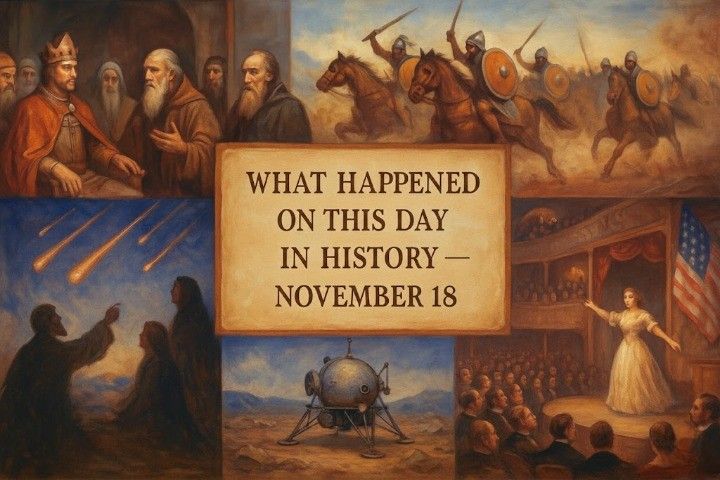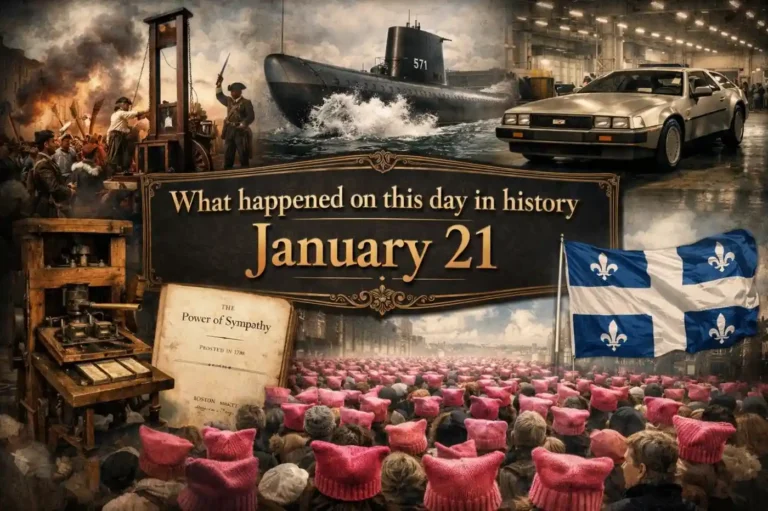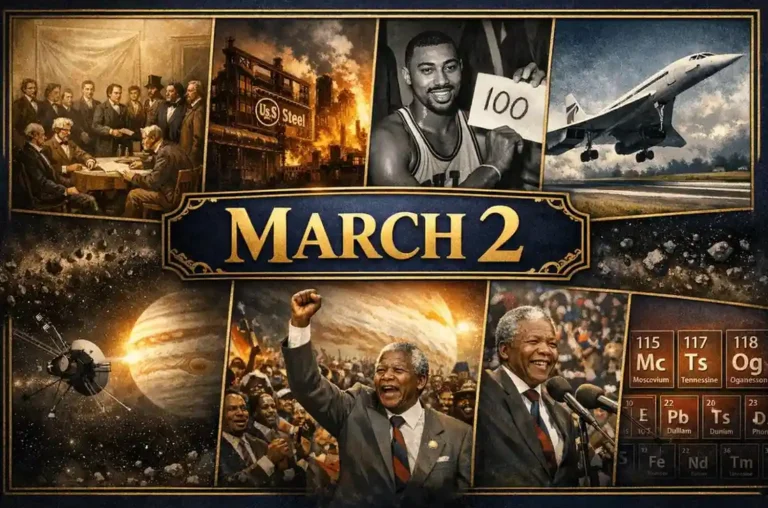
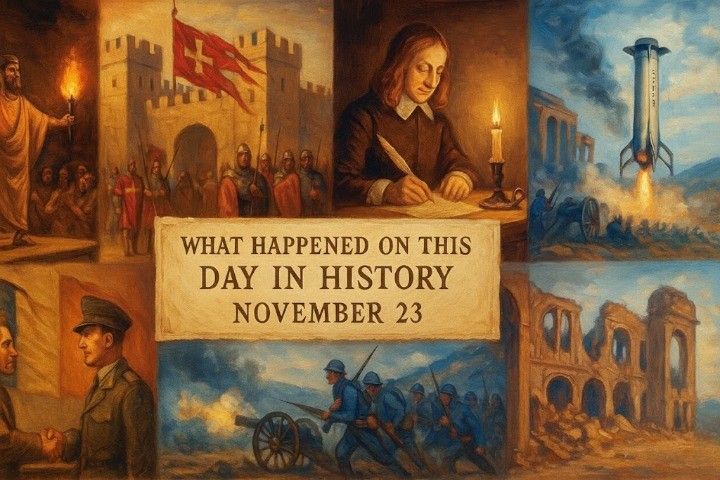
November 23 gathers an unusually broad sweep of history, from early theatre and medieval power struggles to scientific breakthroughs and modern geopolitical turning points.
What happened on this day in history November 23 emerges through moments of artistic innovation, intense conflict, exploration, reform and catastrophe.
Important Events That Happened On November 23 In History
534 BC — Thespis of Icaria performs as the first recorded actor
Thespis is credited in ancient sources as the earliest named performer to step out of chorus and portray a character on stage. This formal shift toward individual dramatic portrayal is remembered as a foundational moment in Western theatre.
1248 — Christian forces conquer Seville
King Ferdinand III of Castile completes the capture of Seville, a major step in the Reconquista that reshaped power, religion and administration across southern Iberia.
1407 — Assassination of Louis I, duc d’Orléans
Louis I is murdered in Paris during a bitter Burgundian–Orléans struggle for influence over the mentally ill King Charles VI; the killing intensified factional feuds that destabilised late-medieval France.
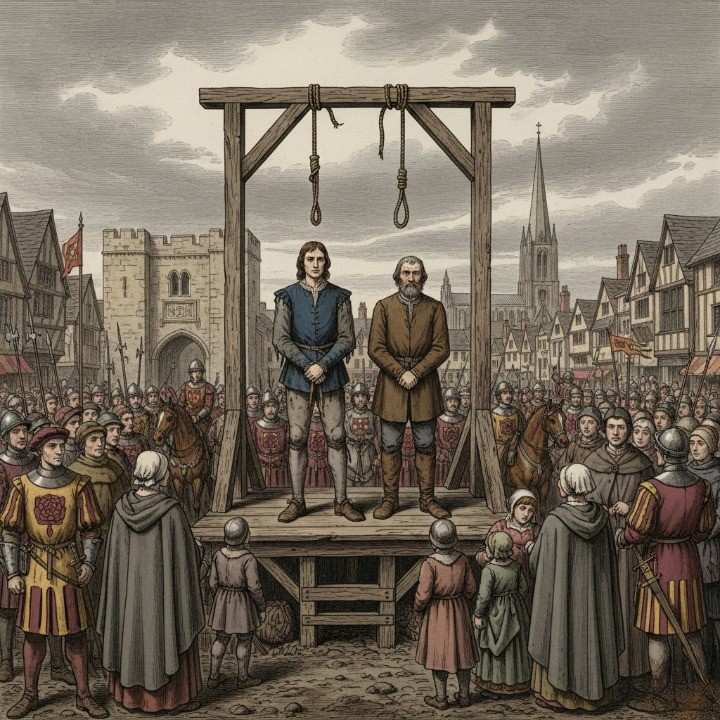
1499 — Execution of Perkin Warbeck and John Atwater
Perkin Warbeck, a pretender claiming the English throne, is hanged after his failed bid; his execution, alongside supporter John Atwater, closes a chapter of York–Lancaster pretensions and Tudor consolidation.
1644 — John Milton publishes Areopagitica
Milton’s pamphlet mounts a moral and political defence of free expression and argues strongly against prior censorship — a key text in the history of free-speech thought.
1733 — Slave insurrection begins on St. John (Danish West Indies)
Enslaved people on St. John rise up against colonial masters, an episode that became part of wider Atlantic resistance to slavery and colonial authority.
1808 — Battle of Tudela: French and Polish victory over Spain
At Tudela, French and allied Polish forces defeat Spanish armies in the Peninsular War, continuing Napoleon’s campaign across Iberia and altering the course of the Spanish resistance.
1863 — Battle of Chattanooga begins (American Civil War)
Union reinforcements under Ulysses S. Grant lift the siege of Chattanooga and begin counter-attacks that open the gateway to the Deep South for Federal advances.
1867 — Manchester Martyrs executed in England
Three men are hanged in Manchester for their role in a rescue attempt that cost a police officer’s life; the executions inflamed Irish nationalist sentiment and remain a contested memory in British–Irish history.
1876 — Boss Tweed captured and returned to U.S. custody
William “Boss” Tweed, the powerful Tammany Hall figure, is seized in Spain and brought back to face corruption charges — a striking moment in late-19th-century American reform politics.
1890 — Death of King William III (Netherlands); Wilhelmina’s succession arranged
With no male heir, the Dutch pass special legislation so Princess Wilhelmina can succeed, ensuring dynastic continuity and shaping the Dutch monarchy’s modern era.
1910 — Johan Alfred Ander executed (last execution in Sweden)
Ander’s execution marks Sweden’s final use of capital punishment; the event preceded later legal reforms that abolished the death penalty.
1914 — U.S. forces withdraw from Veracruz (Mexican Revolution)
After seven months of occupation, American troops leave Veracruz, a development within the wider and chaotic course of the Mexican Revolution and U.S.–Mexican relations.
1921 — Willis–Campbell Act signed into law (U.S.)
President Warren G. Harding signs legislation restricting physicians’ ability to prescribe alcoholic beverages, tightening federal control of alcohol distribution in the Prohibition era.
1923 — Irish hunger strikes end; four die
The 1923 hunger strikes by Irish republican prisoners conclude with four deaths, underscoring the bitter legacies of the Civil War and the fraught politics of detention and protest.
1924 — Edwin Hubble’s island-galaxy discovery published in the press
Hubble’s observational evidence, reported in wider outlets like The New York Times, begins to shift scientific and public understanding of the universe by establishing that the Andromeda “nebula” is in fact a separate galaxy.
1934 — Ogaden boundary incident: Italian garrison at Walwal discovered
An Anglo-Ethiopian boundary commission finds Italian forces inside Ethiopian territory at Walwal; the incident contributed to mounting tensions that fed the Abyssinia Crisis.
1939 — Sinking of HMS Rawalpindi by German battleships
The armed merchant cruiser Rawalpindi is overwhelmed by the German battleships Scharnhorst and Gneisenau, an early and dramatic naval loss for the Royal Navy in the Second World War.
1940 — Romania joins the Tripartite Pact (Axis alignment)
Romania signs the Tripartite Pact and formally associates with Axis powers, a strategic alignment with major wartime consequences in the Balkans and Eastern Europe.
1943 — Destruction of the Deutsche Opernhaus, Charlottenburg (Berlin)
Bombing destroys the Deutsche Opernhaus on Bismarckstraße; the loss is part of the wider cultural and human costs of bombing campaigns in wartime Germany.
1943 — Tarawa and Makin fall to American forces
U.S. marines secure the Gilbert Islands at Tarawa and Makin after fierce fighting, marking important steps in the Pacific island campaigns against Japan.
1944 — Disbanding of Lotta Svärd under armistice terms (Finland)
As part of the post-continuation-war settlement, Finland’s Lotta Svärd, a large women’s voluntary organisation, is dissolved — a consequence of wartime politics and the armistice’s restrictions.
1946 — Haiphong bombardment: thousands of Vietnamese civilians killed
A French naval bombardment of Haiphong causes mass civilian casualties and becomes a flashpoint in early postwar Vietnamese–French tensions.
1955 — Cocos (Keeling) Islands transferred from UK to Australia
Sovereignty over the Cocos Islands shifts to Australia, altering colonial administration and regional governance in the Indian Ocean.
1959 — Charles de Gaulle’s “Europe, from the Atlantic to the Urals” speech
In Strasbourg, President de Gaulle outlines a vision of a Europe stretching from Atlantic to Urals — an influential statement in Cold War geopolitics and French foreign policy.
1963 — First broadcast of Doctor Who (BBC)
BBC’s Doctor Who debuts with “An Unearthly Child”; the series will endure to become the world’s longest-running science-fiction drama.
1971 — People’s Republic of China gains representation at the United Nations
Representatives of the PRC take their place at the UN, including the Security Council, marking a major diplomatic realignment and recognition shift.
1972 — Final launch attempt of the Soviet N1 rocket
The USSR makes its last attempt to launch the N1 heavy booster; the repeated failures effectively end that rocket program and reshape Soviet lunar ambitions.
1974 — Mass executions by Ethiopia’s provisional military government
Sixty political figures and elites are executed in Ethiopia during revolutionary purges, a grim episode in the country’s revolutionary upheaval.
1976 — Jacques Mayol reaches 100 m freedive without breathing equipment
Mayol accomplishes a landmark deep freedive to 100 m, a milestone in human physiological limits and underwater performance.
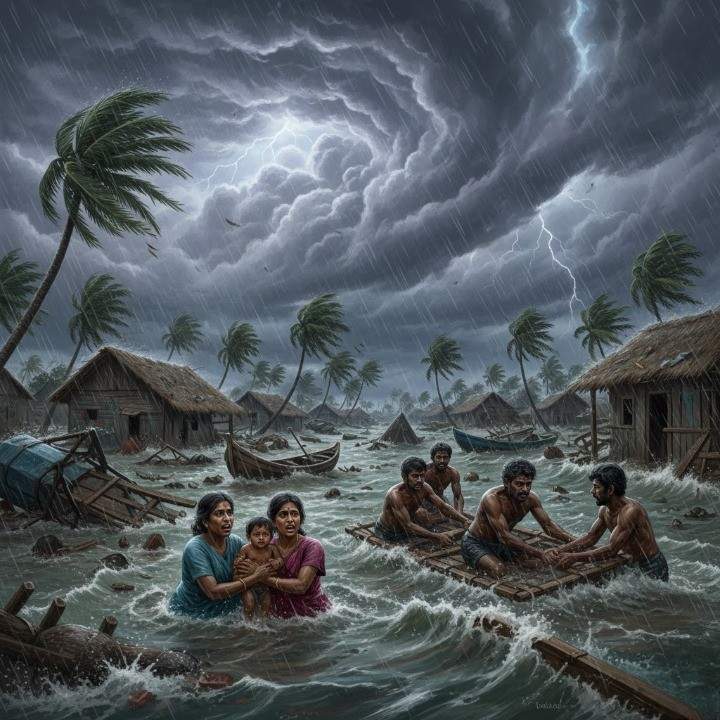
1978 — Deadly cyclone strikes eastern Sri Lanka
A powerful cyclone kills roughly 1,000 people in eastern Sri Lanka, a major humanitarian disaster with long-term local effects
1978 — Geneva Frequency Plan comes into effect (Europe)
The international frequency realignment reorganises many longwave and mediumwave broadcast bands across Europe, affecting radio service and regulation.
1980 — Irpinia earthquake devastates southern Italy
A strong quake in Irpinia causes catastrophic damage and a large death toll, prompting prolonged rescue and rebuilding efforts.
1981 — NSDD-17 signed (Iran–Contra context)
President Reagan signs a directive authorising covert activities related to anti-communist forces in Central America, later referenced in Iran–Contra investigations.
1985 — EgyptAir Flight 648 hijacked; raid leaves heavy casualties
After hijackers force the airliner to Malta, an attempted rescue by commandos results in about 60 deaths — one of the era’s deadlier aviation security incidents.
1991 — Freddie Mercury announces he is HIV-positive
Freddie Mercury publicly discloses his HIV diagnosis; he dies the next day, an event that intensified public attention to AIDS and to stigma surrounding the disease.
1992 — Debut of the IBM Simon (first smartphone)
IBM reveals the Simon Personal Communicator at COMDEX — an early convergence device that prefigures later smartphones combining telephony with PDA functions.
1996 — Ethiopian Airlines Flight 961 hijacked and crashes
After a hijacking, the airliner runs out of fuel and crashes into the Indian Ocean near the Comoros; 125 people are killed in the disaster.
2001 — Budapest Convention on Cybercrime signed
States sign the Budapest Convention to coordinate legal and technical responses to computer crime — an early effort at transnational cyber-law cooperation.
2002 — STS-113: Space Shuttle Endeavour launches to ISS
Endeavour flies to the International Space Station carrying Expedition 6 and the P1 truss, continuing ISS assembly and crew rotation.
2003 — Rose Revolution: Eduard Shevardnadze resigns (Georgia)
Mass protests over flawed elections lead to President Shevardnadze’s resignation, a pivotal moment in Georgia’s post-Soviet democratic struggles.
2004 — Holy Trinity Cathedral of Tbilisi consecrated (Georgia)
The new cathedral is consecrated as a major act of national and religious rebuilding following decades of Soviet secularisation.
2005 — Ellen Johnson Sirleaf elected president of Liberia
Sirleaf becomes the first woman to lead an African nation, a breakthrough for gender and postconflict politics on the continent.
2006 — Sadr City bombings (Iraq): mass casualties
A wave of coordinated attacks kills at least 215 and wounds hundreds in Baghdad’s Sadr City, one of the deadliest sectarian episodes of the post-2003 conflict.
2007 — MS Explorer sinks after iceberg collision (Antarctic)
The cruise ship strikes ice and sinks south of Argentina; miraculously there are no fatalities among the 154 aboard but the loss raises concern about polar tourism risks.
2009 — Maguindanao massacre (Philippines)
Gunmen kill 58 political opponents in an atrocity tied to local political violence, shocking the Philippines and prompting legal and political fallout.
2010 — Bombardment of Yeonpyeong (Korea): civilian and military losses
North Korean artillery fire on Yeonpyeong Island kills civilians and marines, escalating peninsula tensions and prompting international concern.
2011 — Power-transfer deal signed in Yemen (Ali Abdullah Saleh)
President Saleh agrees to hand over authority in exchange for legal immunity, a key step in a negotiated transfer amid the Arab Spring protests.
2015 — Blue Origin’s New Shepard achieves controlled vertical landing
Blue Origin demonstrates a reusable suborbital vehicle that returns to land vertically, marking technological progress in commercial rocket reusability.
2018 — Dolce & Gabbana apology after offensive ad campaign (China)
After a controversial promotion is widely condemned, the fashion house apologises and cancels a Shanghai show — a notable moment in brand-market relations and social media backlash.
2019 — Last Sumatran rhinoceros in Malaysia dies (Imam)
The death of Imam marks the functional extinction of the species in Malaysia, underscoring the conservation crisis facing Sumatran rhinos.
Read Here: November 22 Facts & Stories
Famous People Born On November 23
Miley Cyrus — American actress and singer. (Nov 23, 1992 – )
Chuck Schumer — United States senator. (Nov 23, 1950 – )
Krzysztof Penderecki — Polish composer. (Nov 23, 1933 – Mar 29, 2020)
Alfonso X — King of Castile and León. (Nov 23, 1221 – Apr 4, 1284)
Manuel de Falla — Spanish composer. (Nov 23, 1876 – Nov 14, 1946)
John Wallis — English mathematician. (Nov 23, 1616 – Oct 28, 1703)
Sir Peter Strawson — British philosopher. (Nov 23, 1919 – Feb 13, 2006)
Ernest Joseph King — U.S. admiral (C-in-C, WWII). (Nov 23, 1878 – Jun 25, 1956)
Klement Gottwald — Czechoslovak politician. (Nov 23, 1896 – Mar 14, 1953)
Vladislav N. Volkov — Soviet cosmonaut. (Nov 23, 1935 – Jun 29, 1971)
Jerry Bock — American composer. (Nov 23, 1928 – Nov 3, 2010)
Merv Hughes — Australian cricketer. (Nov 23, 1961 – )
Shane Gould — Australian swimmer. (Nov 23, 1956 – )
Jonas Basanavičius — Lithuanian physician & national leader. (Nov 23, 1851 – Feb 16, 1927)
Jean Mabillon — French scholar (paleography). (Nov 23, 1632 – Dec 27, 1707)
Aaron Bank — U.S. Army officer (OSS/WWII). (Nov 23, 1902 – Apr 1, 2004)
Christopher Logue — British poet. (Nov 23, 1926 – Dec 2, 2011)
Derek Mahon — Northern Irish poet. (Nov 23, 1941 – Oct 2, 2020)
Valdemar Poulsen — Danish engineer (radio pioneer). (Nov 23, 1869 – Jul 1942)
Billy Haughton — American harness-racing driver. (Nov 23, 1923 – Jul 15, 1986)
Donald Deskey — American industrial designer. (Nov 23, 1894 – Apr 29, 1989)
Charles Méryon — French printmaker. (Nov 23, 1821 – Feb 13, 1868)
Guy Bolton — American writer (musical librettos). (Nov 23, 1884 – Sep 5, 1979)
Ralph Tyler Flewelling — American philosopher. (Nov 23, 1871 – Mar 31, 1960)
Sait Faik Abasıyanık — Turkish author. (Nov 23, 1906 – May 11, 1954)
Famous People Died On November 23
Roald Dahl — British author. (Sep 13, 1916 – Nov 23, 1990)
Nicolas Roeg — English filmmaker. (Aug 15, 1928 – Nov 23, 2018)
Merle Oberon — British–American actress. (Feb 19, 1911 – Nov 23, 1979)
Elbridge Gerry — 5th U.S. Vice President (gave name to “gerrymander”). (Jul 17, 1744 – Nov 23, 1814)
Eadred — King of England. (d. Nov 23, 955)
Roy Acuff — American country musician. (Sep 15, 1903 – Nov 23, 1992)
André Malraux — French writer & statesman. (Nov 3, 1901 – Nov 23, 1976)
Claude Lorrain — French landscape painter. (1600 – Nov 23, 1682)
William III — King of the Netherlands. (Feb 19, 1817 – Nov 23, 1890)
Perkin Warbeck — English pretender. (c.1474 – Nov 23, 1499)
Douglass C. North — American economist, Nobel laureate. (Nov 5, 1920 – Nov 23, 2015)
Willie Pep — American boxer. (Sep 19, 1922 – Nov 23, 2006)
Robert L. Vesco — American financier and fugitive. (Dec 4, 1935 – Nov 23, 2007)
Manuela Sáenz — Latin American revolutionary. (Dec 27, 1797 – Nov 23, 1856)
Sophia Dorothea — German princess. (Sep 13, 1666 – Nov 23, 1726)
Richard Hakluyt — English geographer. (c.1552 – Nov 23, 1616)
Ladislas V — King of Hungary and Bohemia. (Feb 22, 1440 – Nov 23, 1457)
Roberto Matta — Chilean painter. (Nov 11, 1911 – Nov 23, 2002)
Octave Chanute — American engineer, aviation pioneer. (Feb 18, 1832 – Nov 23, 1910)
Alvin Langdon Coburn — Photographer. (Jun 11, 1882 – Nov 23, 1966)
Seán T. O’Kelly — President of Ireland. (Aug 25, 1882 – Nov 23, 1966)
Miguel Pro Juárez — Mexican priest, martyr. (Jan 13, 1891 – Nov 23, 1927)
Jean-Baptiste, Count Jourdan — French military commander. (Apr 29, 1762 – Nov 23, 1833)
Arthur G. Dove — American painter. (Aug 2, 1880 – Nov 23, 1946)
Chun Doo-Hwan — President of South Korea. (Jan 18, 1931 – Nov 23, 2021)
Janet Campbell Hale — Native American writer. (Jan 11, 1946 – Nov 23, 2021)
Observances & institutional dates — November 23
Rudolf Maister Day (Slovenia) — Commemorates General Rudolf Maister’s role in securing Slovenian territory after World War I.
Communities mark the day with ceremonies that recall national consolidation and local military history.
Labor Thanksgiving Day (Japan) — A public holiday expressing gratitude for labour and production, and celebrating human rights and community welfare.
Events often blend official ceremonies with grassroots acknowledgement of work and social contribution.
Repudiation Day (Frederick County, Maryland, U.S.) — Local observance tied to a regionally specific historical commemoration.
Markings are civic and community-focused, reflecting local tradition and memory.
St George’s Day (Georgia, Giorgoba) — A national and religious commemoration honouring Saint George, an important figure in Georgian culture and identity.
Public events include liturgical observance and civic remembrances that underscore national heritage.
Frequently Asked Questions
Why is November 23 associated with so many military and political events?
The date’s long historical record reflects the rhythm of campaigning seasons, political cycles and crisis moments; different eras simply concentrated decisive actions or announcements on that calendar day.
Did any scientific advances occur on November 23?
Yes — Edwin Hubble’s confirmation of Andromeda’s extra-galactic status was publicised on this date, and later technological milestones (for example, the 1992 IBM Simon debut) also fall here.
How should readers interpret tragic events listed alongside cultural firsts?
The purpose is chronological record: placing catastrophes, political ruptures and cultural achievements in the same brief account shows how any single date can carry both innovation and loss across different times and places.
Are these events exhaustive for November 23?
This list follows the facts you supplied exactly; it is not meant to be exhaustive of all global happenings on the date but preserves the specific items you provided.