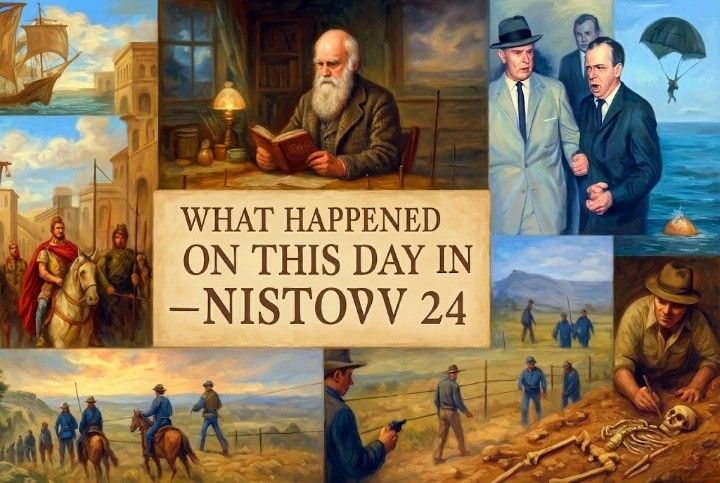
November 24 threads moments of empire and exploration, inventive leaps and public drama across continents and centuries. What happened on this day in history November 24 connects ancient statecraft with modern probes, legal shifts with cultural turning points.
Important Events That Happened On November 24 In History
380 — Theodosius I makes his formal entry into Constantinople
Emperor Theodosius I’s adventus into Constantinople marked an official assertion of imperial presence in the eastern capital, a ceremonial culmination of military and political authority. The ritual entry reinforced the ceremonial language of late Roman rulership and the emperor’s role as arbiter between civic and ecclesiastical elites. It also set a model of imperial spectacle that later medieval courts echoed.
847 — Earthquake strikes Syria (Antioch, Damascus, Mosul)
A powerful earthquake in 847 caused widespread destruction across major Syrian cities including Antioch, Damascus and Mosul, producing many casualties and long-term damage. Such seismic shocks repeatedly reshaped urban life and architecture in the medieval Middle East, prompting rebuilding efforts and affecting trade and demographics. The event sits among a long series of natural disasters that influenced regional history.
1190 — Conrad of Montferrat becomes King of Jerusalem
By marrying Isabella I, Conrad of Montferrat secured the crown of Jerusalem at a perilous moment for the Crusader states. His accession reflected the tangled politics of crusading leadership, marriage alliances and the struggle to preserve a shrinking Latin presence in the Levant. Conrad’s reign, brief and contested, exemplified the fragile dynastic solutions adopted under military pressure.
1221 — Genghis Khan defeats Jalal al-Din at the Battle of the Indus
Genghis Khan’s victory over the Khwarazmian prince Jalal al-Din at the Indus completed a decisive phase of Mongol conquest in Central Asia and Persia. The battle extinguished a principal source of organized resistance and opened former Khwarazmian territories to Mongol administration and further campaigns. Its consequences reshaped regional political geography for decades.
1227 — Gąsawa massacre; assassination attempt at Piast assembly
At a Piast assembly in Gąsawa assassins attacked ducal leaders, killing Polish Prince Leszek the White and wounding others—an episode that dramatically altered the shifting balance of power among Polish dukes. The massacre intensified rivalries, reconfigured alliances, and exemplified how violence at aristocratic gatherings could abruptly rewrite succession and control in medieval Poland.
1248 — Mont Granier landslide destroys five villages
An enormous overnight landslide on Mont Granier obliterated several villages and stands among Europe’s largest recorded rock-slope failures. The disaster reshaped local topography and displaced communities, and it entered regional memory as a catastrophic natural event that influenced settlement and agricultural patterns in the Alps.
1359 — Peter I ascends the throne of Cyprus
With Hugh IV’s abdication, Peter I became king of Cyprus, continuing a Lusignan dynasty that balanced Mediterranean trade, crusading legacy and island politics. Peter’s reign would be shaped by the island’s strategic position between East and West and the complex diplomacy of late medieval eastern Mediterranean realms.
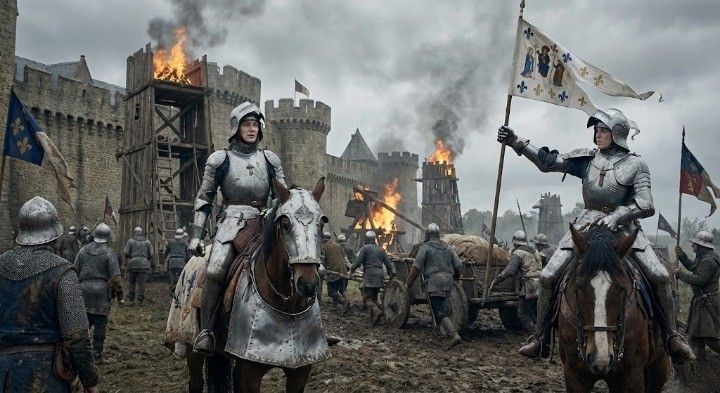
1429 — Joan of Arc’s unsuccessful siege of La Charité
Joan of Arc’s attempt to take La Charité failed, showing that even a figure associated with decisive lifts of morale could encounter limits on the battlefield. The unsuccessful siege highlighted logistical and political constraints facing the French campaign and foreshadowed the complex, precarious nature of her later fate. It rounded a season of both spectacular successes and sobering setbacks.
1531 — Second Peace of Kappel ends the Kappel Wars (Swiss Reformation)
The second Peace of Kappel brought a measure of settlement to religious conflict in Switzerland by balancing confessional claims between cantons. The agreement shaped the confessional map of the Swiss cantons and underlined how negotiated settlements—rather than decisive military victory—often determined the course of the Reformation in federated polities.
1542 — Battle of Solway Moss: English defeat larger Scottish force
At Solway Moss an English army routed a much larger Scottish force, producing political shockwaves in Scotland and contributing to the destabilisation that helped prompt future dynastic and succession crises. The battle’s outcome reinforced English pressure on the Scots and affected subsequent negotiations and claims.
1642 — Abel Tasman sighting of Van Diemen’s Land (Tasmania)
Abel Tasman’s European discovery of Van Diemen’s Land marked a new point in global navigation and mapping in the age of seafaring exploration. The sighting added to European geographic knowledge of the South Pacific while beginning a long arc of contact and eventual colonial encroachment on Indigenous lands.
1750 — Tarabai imprisons Rajaram II in Maratha court politics
In a sharp display of internal Maratha power politics, regent Tarabai imprisoned Rajaram II after he refused to remove Balaji Baji Rao as peshwa. The incident illustrates how courtly maneuvers and regency conflicts determined the practical distribution of power within the Maratha confederacy.
1832 — South Carolina’s Ordinance of Nullification begins a constitutional crisis
South Carolina’s declaration that the Tariffs of 1828 and 1832 were null within the state triggered the Nullification Crisis, testing federal authority and states’ rights doctrines. The confrontation produced a political showdown in Washington, prompted federal compromise legislation, and sharpened sectional tensions that would escalate later in the century.
1835 — Texas Legislature authorizes the Texas Rangers
The Texas Provincial Government’s authorization for a mounted police force established what became the Texas Rangers, a militia-police body integral to Republic and state policing, frontier warfare and later mythmaking. Their role in law enforcement and conflict with Indigenous peoples and settlers had enduring social and political consequences.
1850 — Danish forces defeat Schleswig-Holstein at Lottorf
A Danish victory at Lottorf formed part of the wider Schleswig-Holstein conflicts over sovereignty and national identity in northern Europe. Military skirmishes like Lottorf fed into broader diplomatic crises that culminated in larger wars over borders and nationality in the mid-19th century.
1859 — Charles Darwin publishes On the Origin of Species
Charles Darwin’s On the Origin of Species introduced a theory of natural selection that reworked scientific views of life’s diversity and provoked wide intellectual, religious and social debate. Its publication transformed biology, stimulated new scientific methods, and had reverberations across philosophy, theology and public life.

1863 — Battle of Lookout Mountain: Union forces seize Lookout Mountain (Chattanooga)
Union troops under Grant captured Lookout Mountain, helping to lift the Confederate siege of Chattanooga and opening supply and strategic lines for Union advances in the Western Theater. The action—sometimes called the “Battle Above the Clouds”—boosted Union morale and helped set conditions for the Chattanooga Campaign’s success.
1874 — Joseph F. Glidden patents commercially successful barbed wire
Glidden’s patent for a practical barbed wire design revolutionised frontier fencing and agriculture, enabling rapid enclosure of vast tracts of land and transforming ranching and settlement patterns across the American West. The invention altered property relations and intensified conflicts over land use and grazing rights.
1877 — Publication of Black Beauty by Anna Sewell
Anna Sewell’s Black Beauty became a landmark in animal-welfare literature, shaping Victorian attitudes toward humane treatment of horses and animals generally. Its sentimental and reforming message contributed to a broader 19th-century conversation about animal treatment and social responsibility.
1906 — Massillon–Canton scandal in early professional American football
Accusations of a fixed championship resolution following a Massillon Tigers–Canton Bulldogs series produced one of the first major scandals in professional American football, undermining public confidence and prompting organizational reform in the sport’s early era.
1917 — Bomb kills nine Milwaukee police officers (big single-event loss for U.S. police)
A bomb in Milwaukee killed nine officers, an event that remained one of the deadliest single attacks on U.S. police for decades. The bombing highlighted violent domestic tensions during World War I–era politics and had lasting effects on policing and public order debates.
1922 — Execution of nine Irish republicans, including Erskine Childers
Nine IRA members were executed by the Irish Free State; among them Erskine Childers, whose death underscored the ferocious divisions of the Irish Civil War era and the severe penalties exacted in the struggle over sovereignty and legitimacy.
1929 — Lapua Movement formally begins in Finland
The far-right Lapua Movement’s origins in 1929 marked the rise of a militant anti-communist force in Finland that would press authoritarian and anti-left measures, shaping Finnish politics in the interwar period and provoking later reactions that constrained its influence.
1932 — FBI Scientific Crime Detection Laboratory opens in Washington, D.C.
The FBI Crime Lab’s opening institutionalized scientific forensics in U.S. federal investigations, professionalizing evidence analysis and changing investigative procedures. Its impact on law enforcement techniques, prosecutions and public confidence in forensic evidence has been profound.
1935 — Senegalese Socialist Party holds second congress
The party’s congress signaled the development of organized political movements in French West Africa, intersecting debates about colonial policy, nationalist sentiment and social reform in the interwar decades.
1940 — First Slovak Republic signs Tripartite Pact (joins Axis)
Slovakia’s accession to the Tripartite Pact formalized its alignment with Axis powers during World War II, binding the new state to the alliance’s strategic commitments and affecting regional wartime politics and occupation policies.
1941 — United States grants Lend-Lease to Free French Forces
The U.S. decision to extend Lend-Lease support to Free French elements reinforced Allied logistical networks and recognized de Gaulle-led forces’ role in resisting Axis occupation, cementing an important practical partnership in the Atlantic alliance.
1943 — USS Liscome Bay torpedoed and sunk near Tarawa; ~650 killed
The torpedoing and rapid sinking of the escort carrier Liscome Bay off Makin cost some 650 lives and illuminated the lethal risks of Pacific island operations. The loss affected naval tactics and underscored the high human cost of the island-hopping campaign.
1944 — 73rd Bombardment Wing launches first attack on Tokyo from Northern Marianas
Launching strikes from the Northern Marianas brought U.S. air power within range of Japan’s home islands, intensifying strategic bombing campaigns that would shape the final phase of the Pacific war and raise profound questions about aerial warfare’s costs.
1962 — Socialist Unity Party of West Berlin splits off from East German party
The West Berlin branch’s separate formation reflected Cold War political fragmentation and the complexities of divided German governance, symbolizing how ideological schisms translated into institutional separations on the ground in Berlin.
1962 — That Was the Week That Was debuts, changing British satire on TV
The satirical program introduced a sharper, television-based critique of politics and culture, helping to redefine British broadcast satire and influencing public conversation through comedic but pointed scrutiny of leaders and institutions.
1963 — Jack Ruby kills Lee Harvey Oswald on live television
Jack Ruby’s shooting of Lee Harvey Oswald—broadcast and photographed—produced an immediate, traumatic media moment and intensified controversy and conspiracy discourse around the Kennedy assassination. The photograph and broadcast became defining images of a volatile public week.
1965 — Joseph-Désiré Mobutu seizes power in Congo (later Zaire)
Mobutu’s coup installed a long-running authoritarian regime that would remake Congo into Zaire, with pervasive personalist rule, centralised control, and significant implications for Cold War diplomacy and regional governance across decades.
1966 — TABSO Flight 101 crashes near Bratislava, all 82 killed
The crash of TABSO Flight 101 was a major aviation disaster with loss of all on board, prompting investigations into causes and contributing to aviation safety improvements and regulatory scrutiny in the region.
1969 — Apollo 12 command module splashes down safely (end of second crewed Moon landing)
Apollo 12’s safe splashdown concluded the second successful Moon landing mission, consolidating technical and operational lessons from Apollo 11 and extending scientific exploration of lunar geology and mission procedures.
1971 — D. B. Cooper parachutes from a Northwest Orient plane with ransom money; never found
The mysterious hijacker “D. B. Cooper” parachuted with $200,000 ransom and vanished—an unsolved case that captured public imagination and launched decades of investigation, speculation and folklore about aviation security and criminal audacity.
1973 — National Autobahn speed limit briefly instituted during oil crisis
A temporary speed limit on the Autobahn in response to the 1973 oil crisis marked an unusual, economy-driven intervention into a modern symbol of unrestricted driving—an example of how resource shocks can prompt rapid policy shifts even in established cultural practices.
1974 — Discovery of “Lucy” (Australopithecus afarensis) by Johanson and Gray
The discovery of Lucy provided an extraordinary, partially complete hominid skeleton that transformed understanding of human evolution, offering key anatomical evidence about bipedalism and early hominin morphology and spurring new fields of paleoanthropological study.
1976 — Çaldıran–Muradiye earthquake in eastern Turkey kills thousands
The catastrophic earthquake produced immense human loss and displacement, exposing vulnerabilities in building stock and emergency response and prompting international aid and long-term reconstruction in the affected provinces.
1989 — Politburo of the Czechoslovak Communist Party resigns amid Velvet Revolution
The mass resignation of the Politburo signalled the collapse of Communist rule in Czechoslovakia, concluding weeks of popular protest and beginning a rapid political transition that would culminate in democratic reforms and the end of one-party rule.
1991 — Space Shuttle Atlantis launches on STS-44
The STS-44 mission demonstrated continuing U.S. shuttle capabilities in carrying classified payloads and supporting Department of Defense tasks, illustrating the dual civilian-military uses of the space shuttle program during the post-Cold War era.
1992 — China Southern Airlines Flight 3943 crashes near Guilin, 141 killed
The crash added to aviation tragedy statistics and prompted safety investigations and airline and regulatory responses aimed at preventing similar accidents and improving approach procedures in challenging terrain.
2001 — Crossair Flight 3597 crashes near Zurich; 24 killed (incl. Melanie Thornton)
The disaster that claimed 24 lives—among them singer Melanie Thornton—prompted renewed focus on approach safety, crew resource management and airport approach procedures in European aviation circles.
2009 — Avdhela Project (Aromanian digital library & cultural initiative) founded
The Avdhela Project’s creation represented a modern cultural and digital effort to preserve Aromanian language and heritage, using online platforms to support minority-language literary and historical materials.
2012 — Dhaka clothing-factory fire kills at least 112 people
The factory fire in Dhaka was part of a rash of industrial accidents that spotlighted chronic safety failures in global garment supply chains, provoking international scrutiny, factory inspections and calls for better worker protections.
2013 — Iran signs interim agreement with P5+1 limiting parts of nuclear program
The interim deal marked a diplomatic thaw and temporary constraints on Iran’s enrichment activities in exchange for sanctions relief, setting the stage for subsequent negotiations toward a broader framework agreement.
2015 — Russian Su-24 shot down by Turkish Air Force near Syria–Turkey border
The shootdown escalated tensions between Russia and Turkey, prompted diplomatic crisis and military posturing, and underscored the risks of operating military aircraft over contested border regions during the Syrian conflict.
2016 — Revised Colombian peace deal signed with FARC
A revised peace agreement between Colombia and FARC rebels sought to end decades of civil war, offering demobilisation, transitional justice and rural reforms intended to integrate former combatants into political life.
2017 — Al-Rawda mosque attack (North Sinai) kills 311 and injures 128
One of Egypt’s deadliest terrorist attacks, the massacre at Al-Rawda mosque demonstrated the scale of extremist violence in the Sinai, provoking national mourning, security crackdowns and international condemnation.
2022 — Anwar Ibrahim named Malaysia’s 10th prime minister following hung parliament
After a tightly contested election result, Anwar Ibrahim’s appointment signalled a complex coalition negotiation and a new political chapter for Malaysia, reflecting fluid party alliances and the mechanics of parliamentary government in a hung parliament context.
2023 — “Hibiscus Rising” memorial for David Oluwale unveiled in Leeds
The unveiling commemorated David Oluwale and acknowledged historical injustice, using public art to highlight past policing failures and to foster dialogue about racism, memory and civic recognition.
Read Also: November 23 In History
Famous People Born On November 24
| Name | Role/Description | Dates |
|---|---|---|
| Erich von Manstein | German general | November 24, 1887 – June 11, 1973 |
| St. Junípero Serra | Spanish Franciscan missionary | November 24, 1713 – August 28, 1784 |
| Aleksandr Suvorov | Russian military commander | November 24, 1729 – May 18, 1800 |
| Frances Hodgson Burnett | American author (Little Lord Fauntleroy) | November 24, 1849 – October 29, 1924 |
| Tsung-Dao Lee | Chinese-American physicist, Nobel laureate | November 24, 1926 – August 4, 2024 |
| Alben W. Barkley | 35th Vice President of the United States | November 24, 1877 – April 30, 1956 |
| Laurence Sterne | British writer (Tristram Shandy) | November 24, 1713 – March 18, 1768 |
| Charles XI | King of Sweden | November 24, 1655 – April 5, 1697 |
| Alfred Schnittke | Russian composer | November 24, 1934 – August 3, 1998 |
| C. Collodi | Italian author (Pinocchio) | November 24, 1826 – October 26, 1890 |
| Garson Kanin | American writer and director | November 24, 1912 – March 13, 1999 |
| Teddy Wilson | American jazz pianist | November 24, 1912 – July 31, 1986 |
| Charles, duc d’Orléans | French duke and poet | November 24, 1394 – January 4, 1465 |
| Grace Darling | British heroine (lighthouse rescuer) | November 24, 1815 – October 20, 1842 |
| Hideyo Noguchi | Japanese bacteriologist | November 24, 1876 – May 21, 1928 |
| Ron Dellums | American politician | November 24, 1935 – July 30, 2018 |
| Itzhak Ben-Zvi | President of Israel | November 24, 1884 – April 23, 1963 |
| Cass Gilbert | American architect (Woolworth Building) | November 24, 1859 – May 17, 1934 |
| Yvonne Rainer | American choreographer and filmmaker | November 24, 1934 – |
| Walter Burley Griffin | American architect and city planner | November 24, 1876 – February 13, 1937 |
| Johann Ludwig Burckhardt | Swiss explorer (rediscovered Petra) | November 24, 1784 – October 15, 1817 |
| Morris Louis | American painter | November 24, 1912 – September 7, 1962 |
| Simon van der Meer | Dutch physicist, Nobel laureate | November 24, 1925 – March 4, 2011 |
| Charles-Hector, count d’Estaing | French naval commander (American Revolution) | November 24, 1729 – April 28, 1794 |
| E.R. Eddison | British author (influenced Tolkien) | November 24, 1882 – August 18, 1945 |
| António Oscar de Fragoso Carmona | President of Portugal | November 24, 1869 – April 18, 1951 |
| Ricardo Piglia | Argentine author and critic | November 24, 1941 – January 6, 2017 |
| Georgy Chicherin | Soviet diplomat | November 24, 1872 – July 7, 1936 |
| Ameen Rihani | Arab American author and political figure | November 24, 1876 – September 13, 1940 |
| John De Andrea | American Super-realist sculptor | November 24, 1941 – |
Famous People Died On November 24
| Name | Role/Description | Dates |
|---|---|---|
| Georges Clemenceau | Prime Minister of France (“The Tiger”) | September 28, 1841 – November 24, 1929 |
| Doris Miller | U.S. naval serviceman, Navy Cross recipient | October 12, 1919 – November 24, 1943 |
| Malcolm Muggeridge | British journalist and social critic | March 24, 1903 – November 24, 1990 |
| Joseph Brant | Mohawk chief and military leader | 1742 – November 24, 1807 |
| Ricky Jay | American magician and actor | 1948 – November 24, 2018 |
| László Moholy-Nagy | Hungarian-born American artist | July 20, 1895 – November 24, 1946 |
| Lord Melbourne | Prime Minister of Great Britain | March 15, 1779 – November 24, 1848 |
| Hiram Maxim | American inventor (Maxim machine gun) | February 5, 1840 – November 24, 1916 |
| Big Joe Turner | American blues singer | May 18, 1911 – November 24, 1985 |
| Warren Spahn | American baseball player | April 23, 1921 – November 24, 2003 |
| Robert Erskine Childers | Irish writer and nationalist | June 25, 1870 – November 24, 1922 |
| Ulrika Eleonora | Queen of Sweden | January 23, 1688 – November 24, 1741 |
| Comte de Lautréamont | French poet (influenced Surrealists) | April 4, 1846 – November 24, 1870 |
| Pauline Oliveros | American musician and composer | May 30, 1932 – November 24, 2016 |
| George Pendleton | American politician (Civil Service Act) | July 29, 1825 – November 24, 1889 |
| August Belmont | American banker and diplomat | December 8, 1816 – November 24, 1890 |
| Robert Gascoyne-Cecil, 1st Viscount Cecil | British statesman, Nobel Peace Prize | September 14, 1864 – November 24, 1958 |
| James Craig, 1st Viscount Craigavon | First Prime Minister of Northern Ireland | January 8, 1871 – November 24, 1940 |
| Sir Henry Havelock | British soldier (Indian Rebellion) | April 5, 1795 – November 24, 1857 |
| Christopher Dresser | British industrial designer | July 4, 1834 – November 24, 1904 |
| Breyten Breytenbach | South African author and anti-apartheid activist | September 16, 1939 – November 24, 2024 |
| Saionji Kimmochi | Prime Minister of Japan | December 7, 1849 – November 24, 1940 |
| Jean d’Orléans, comte de Dunois | French military commander (Hundred Years’ War) | 1403 – November 24, 1468 |
| Zheng Zhilong | Chinese pirate leader | 1604 – November 24, 1661 |
| Benjamin Silliman | American geologist and chemist | August 8, 1779 – November 24, 1864 |
| Samak Sundaravej | Prime Minister of Thailand | June 13, 1935 – November 24, 2009 |
| Nicolaes Maes | Dutch Baroque painter | 1634 – November 24, 1693 |
| Ionel Brătianu | Prime Minister of Romania | August 20, 1864 – November 24, 1927 |
| Lilli Lehmann | German operatic soprano | November 24, 1848 – May 17, 1929 |
| Joseph Hansen | American crime novelist | July 19, 1923 – November 24, 2004 |
Observances & Institutional Dates — November 24
Lachit Divas (Assam).
Commemorates Commander Lachit Borphukan’s victory at the Battle of Saraighat (1671), honoured for leadership in defending Assam; the day includes ceremonies, speeches and local cultural events.
Evolution Day (International observance).
Observed to mark Darwin’s On the Origin of Species (first published Nov 24, 1859); events typically include public talks, museum exhibits and educational programmes about evolutionary biology.
Martyrdom of Guru Tegh Bahadur (India).
Sikhs observe the execution of the ninth Guru for resisting forced conversions, a solemn day of remembrance, prayer and reflection on religious freedom and sacrifice.
Teachers’ Day (Turkey).
Honours educators and their contributions to society with official ceremonies and school-level events, recognising teaching as a public vocation central to civic life.
Frequently Asked Questions
Why is November 24 associated with Darwin and On the Origin of Species?
Charles Darwin’s On the Origin of Species was first published on 24 November 1859; the date is often used to promote public programmes and discussion of evolution and biology.
What was the Nullification Crisis (1832) and why does it matter?
South Carolina’s Ordinance of Nullification declared certain federal tariffs void in the state, sparking a constitutional showdown over federal authority versus state sovereignty—an episode that foreshadowed later sectional conflict.
Who was D. B. Cooper and why is the November 24 incident famous?
“D. B. Cooper” was a hijacker who parachuted from a Northwest Orient plane with ransom money on 24 November 1971 and was never found; the unsolved nature of the case captured public imagination and inspired changes in airline security.
How did the discovery of “Lucy” on November 24, 1974, change paleoanthropology?
Lucy—a 40% complete Australopithecus afarensis skeleton—provided critical evidence of early bipedalism and reshaped scientific narratives about human ancestry and evolution.