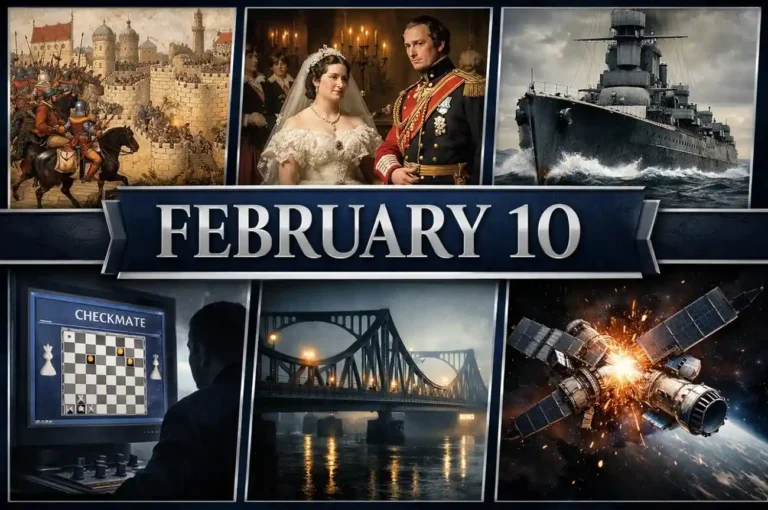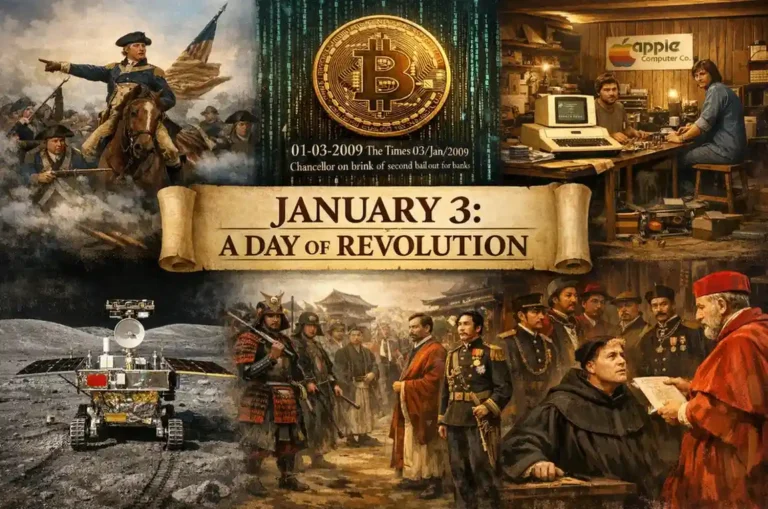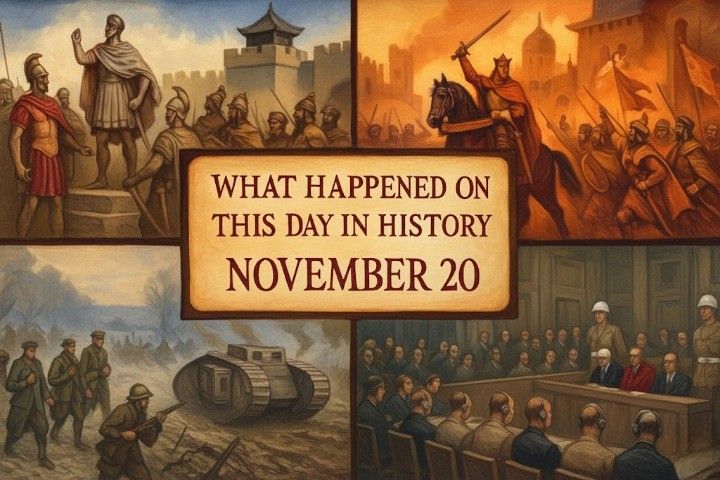
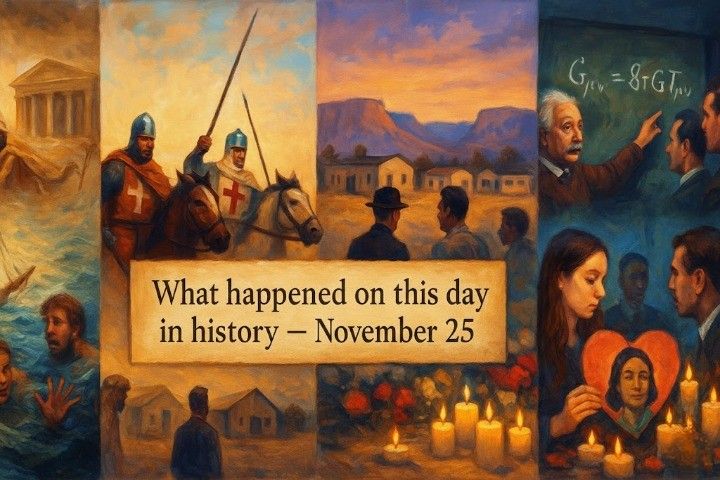
Across eras November 25 links ritual triumphs and shipwrecks, battlefield turning points and scientific breakthroughs, political purges and public tragedies — what happened on this day in history November 25 often marked moments when societies were forced to confront new limits.
Important Events That Happened On November 25 In History
571 BC — Servius Tullius celebrates a triumph
Servius Tullius marks one of his celebrated victories over the Etruscans with the first of three triumphal processions. These ceremonies reinforced royal authority in Rome and the ritual language of victory that future rulers would adopt.
1034 — Death of Máel Coluim mac Cináeda (Malcolm II)
Máel Coluim mac Cináeda, King of Scots, dies; succession passes through familial lines to Donnchad, reflecting the dynastic shifts that shaped early medieval Scotland’s politics and rival claims.
1120 — White Ship disaster; heir lost
The White Ship sinks in the English Channel, drowning William Adelin, sole legitimate son and heir of Henry I. The calamity triggered a dynastic crisis in England with long political consequences.
1177 — Montgisard: Baldwin IV and Raynald defeat Saladin
Baldwin IV of Jerusalem, with Raynald of Châtillon, beats Saladin at Montgisard — a rare crusader victory that briefly checked Saladin’s advance and bolstered the fragile Latin states in the Levant.
1277 — Nicholas III elected pope
Nicholas III is chosen as pope, an event tied to the complex papal politics of the late thirteenth century and the interplay of Roman, French and imperial factions.
1343 — Tyrrhenian tsunami devastates Italian coasts
A powerful earthquake in the Tyrrhenian Sea produces a tsunami that devastates Naples and the Maritime Republic of Amalfi, underlining the centuries-long vulnerability of Mediterranean port cities to seismic disasters.
1400 — Minkhaung I becomes king of Ava
Minkhaung I ascends in Ava, an episode in the patchwork of Burmese dynastic politics that shaped the region’s medieval state formation.
1487 — Elizabeth of York crowned Queen of England
Elizabeth of York’s coronation consolidates the Tudor claim after dynastic conflict and begins the era that will reshape English monarchy and government.
1491 — Treaty of Granada ends the siege; last Moorish stronghold falls
The siege of Granada ends with the Treaty of Granada, closing a long chapter of Reconquista and altering Iberia’s religious and political map.
1510 — Portuguese seize Goa under Afonso de Albuquerque
Portuguese forces, aided by local mercenaries, capture Goa — beginning 451 years of colonial presence that remade trade networks, governance and cultural life on India’s west coast.
1596 — Cudgel War begins in Finland
Peasant uprisings against noble taxation mark the start of the Cudgel War, a social and fiscal revolt within the Swedish realm that shows the pressures on rural communities.
1667 — Devastating earthquake in Shemakha
A catastrophic quake in the Caucasus at Shemakha kills tens of thousands, a reminder of the human toll exacted by sudden natural disasters in pre-modern societies.
1678 — Allied Mataram–Dutch assault on Kediri (Trunajaya rebellion)
After a long march allied forces capture the rebel stronghold of Kediri, a key moment in restoring central Javan authority during the rebellion.
1755 — Royal protection granted to Beaterio de la Compañia de Jesus (Philippines)
King Ferdinand VI grants protection to the Beaterio, an institutional move with long cultural and religious effects for Catholic institutions in the Philippines.
1758 — British capture Fort Duquesne (French & Indian War)
British control of Fort Duquesne paves the way for the future Fort Pitt and the eventual rise of Pittsburgh — a pivotal step in colonial North America’s territorial reconfiguration.
1759 — Mediterranean earthquake destroys Beirut and Damascus
A major Mediterranean earthquake devastates Beirut and Damascus with massive loss of life, showing the region’s exposure to wide-scale seismic catastrophe.
1783 — Last British troops leave New York City
British evacuation of New York marks the practical end of British occupation after the American Revolution and a symbolic moment in the new United States’ assertion of independence.
1795 — Abdication of King Stanisław August Poniatowski (Partitions of Poland)
Poland’s last king abdicates under pressure, deepening the partitions that erased Poland’s sovereignty for over a century.
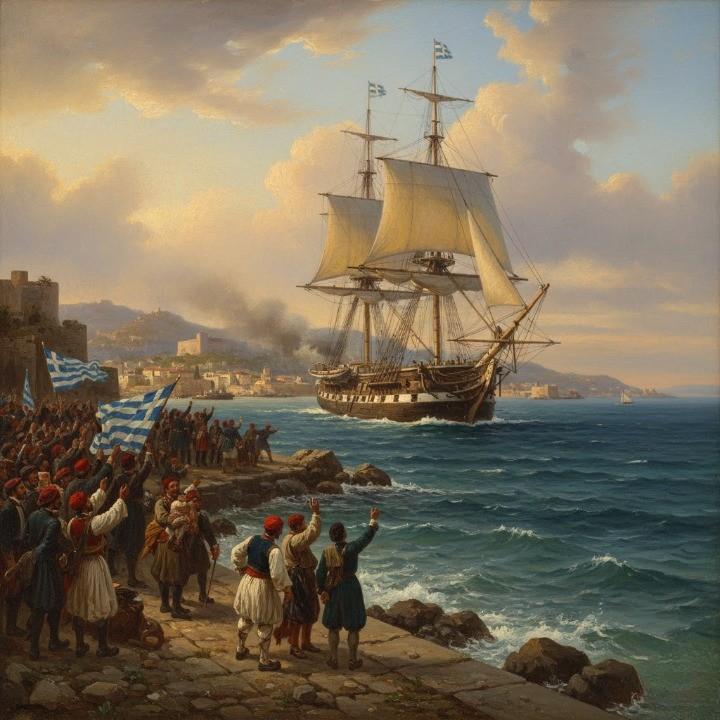
1826 — Greek frigate Hellas arrives in Nafplion
Hellas becomes the Hellenic Navy’s first flagship, a symbolic foundation for modern Greece’s naval tradition during its early nation-building.
1833 — Great Sumatra earthquake and tsunami
An enormous undersea earthquake produces a wide tsunami across Indonesia’s coasts — one of the largest recorded in the region and a major humanitarian catastrophe.
1839 — Deadly cyclone strikes southeastern India
A catastrophic cyclone kills an estimated 300,000 people, one of the deadliest single-event storms on record and a stark example of climatic vulnerability in the nineteenth century.
1863 — Battle of Missionary Ridge (American Civil War)
Union forces under Ulysses S. Grant break the Confederate siege of Chattanooga, routing Bragg’s army at Missionary Ridge and opening the Deep South to Union advances.
1864 — Confederate arson attempt on New York City
A group calling itself the Confederate Army of Manhattan sets fires across New York in a daring but unsuccessful attempt to create urban chaos and divert Union resources.
1874 — Greenback Party established in the United States
The Greenback Party forms to represent farmers and debtors hit by the Panic of 1873, an episode reflecting post-war monetary politics and rural grievance.
1876 — U.S. Army attack on Chief Dull Knife’s village
Following Little Bighorn, U.S. troops sack the village of Cheyenne leader Dull Knife, a punitive action that exemplified the brutal retaliation tactics of the Indian Wars.
1905 — Prince Carl arrives in Norway to become King Haakon VII
Prince Carl’s arrival marks the beginning of Haakon VII’s reign as Norway’s constitutional monarch during a formative period of Norwegian independence.
1908 — Fire aboard SS Sardinia kills at least 118
A deadly fire as SS Sardinia departs Malta’s harbour results in grounding and significant loss of life — a maritime tragedy of the age of steam.
1912 — Românul de la Pind ceases publication
The long-running Aromanian newspaper Românul de la Pind stops publishing, closing an important chapter in diasporic and minority print culture.
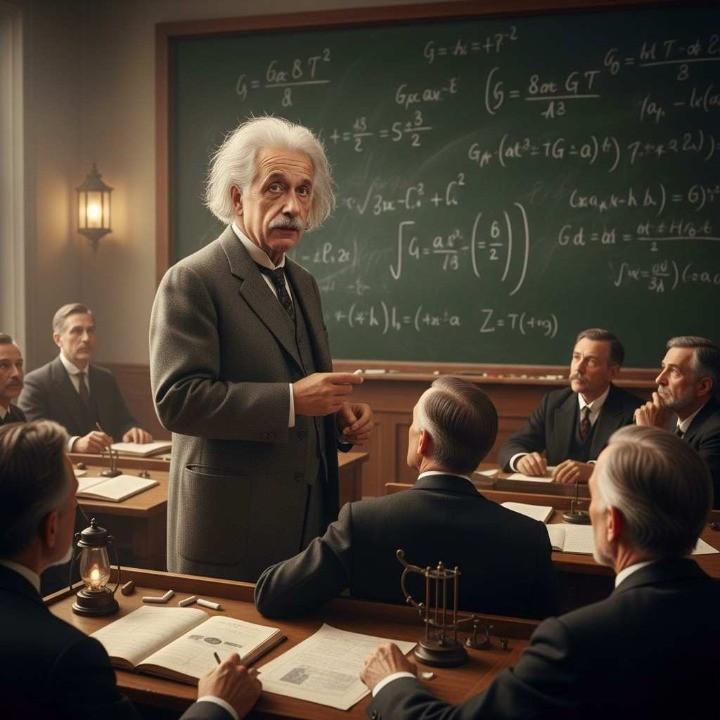
1915 — Einstein presents field equations of general relativity
Albert Einstein announces the field equations that form the core of general relativity, a theoretical revolution that transformed physics’ account of gravity and spacetime.
1917 — German victory at Negomano (World War I)
German forces defeat a Portuguese column at Negomano on the modern Mozambique–Tanzania border, an action in the East African campaign with regional strategic consequences.
1918 — Vojvodina proclaims secession from Austria-Hungary
Vojvodina’s declaration to join Serbia reflects the collapse of imperial structures and the remapping of Central and Southeast Europe at war’s end.
1926 — Deadly November tornado outbreak in the U.S.
The worst November tornado outbreak in U.S. history kills 76 and injures hundreds, a reminder that extreme weather can strike outside the typical tornado season.
1931 — Boxheim Documents handed to police (Wilhelm Schäfer)
Wilhelm Schäfer leaves the Nazi Party and turns the Boxheim Documents over to authorities — an episode in the turbulent politics of Weimar Germany.
1936 — Anti-Comintern Pact signed by Germany and Japan
Germany and Japan formalize a pact against Communist influence, a diplomatic realignment that presaged broader Axis cooperation.
1942 — Los Alamos chosen as Project Y site for the atomic bomb
Leslie Groves and J. Robert Oppenheimer select Los Alamos as Project Y’s site, a decisive step in the Manhattan Project and the wartime scientific effort to build nuclear weapons.
1943 — Bosnia and Herzegovina’s state re-established (AVNOJ)
The State Anti-Fascist Council re-establishes Bosnia and Herzegovina’s statehood during wartime partisan governance — a foundational moment for postwar federal arrangements in Yugoslavia.
1947 — Hollywood Ten blacklisted; Red Scare intensifies
Studios blacklist the Hollywood Ten, deepening anti-Communist pressure on American cultural life and careers in the entertainment industry.
1947 — New Zealand ratifies the Statute of Westminster
By ratifying the Statute of Westminster, New Zealand takes an important legal step toward full legislative independence from the United Kingdom.
1950 — Great Appalachian Storm kills hundreds
A massive late-season storm ravages the eastern United States, causing widespread fatalities, injuries and economic damage across 22 states.
1952 — The Mousetrap opens in London’s West End
Agatha Christie’s play premieres and later becomes the longest continuously running stage play in history — a durable phenomenon in popular theatre.
1952 — Battle of Triangle Hill ends (Korean War)
After intense fighting, Chinese forces hold Triangle Hill; the battle illustrates the costly, attritional nature of the Korean War’s static frontlines.
1958 — French Sudan gains autonomy
A political step in decolonization, French Sudan (Mali) becomes an autonomous member within the French Community on the path to full independence.
1960 — Mirabal sisters assassinated (Dominican Republic)
The murder of the Mirabal sisters becomes a symbol of resistance to the Trujillo dictatorship and later inspires global campaigns against gender-based political violence.
1963 — State funeral of John F. Kennedy
Following his assassination, President Kennedy’s state funeral and burial at Arlington mark a national ritual of mourning and a pivotal moment in American memory.
1968 — Occupation of Old Student House, Helsinki
Students occupy the Old Student House in Helsinki — part of wider student activism and social unrest in late-1960s Europe.
1970 — Yukio Mishima’s ritual suicide after failed coup attempt (Japan)
Author Yukio Mishima commits seppuku following an aborted attempt to inspire a military uprising — a dramatic act melding political protest and cultural symbolism.
1973 — Ousting of Georgios Papadopoulos in Greece
A hardliners’ coup removes Papadopoulos, further destabilizing the Greek junta and accelerating the regime’s internal breakdown.
1975 — Coup of 25 November (Portugal) fails
A failed far-left attempt to derail Portugal’s democratic transition underscores the turbulence of the post-Carnation Revolution period.
1975 — Suriname gains independence from the Netherlands
Suriname’s sovereignty is declared, a late chapter in Dutch decolonization with long-term political and social consequences.
1977 — Benigno Aquino Jr. sentenced by military tribunal (Philippines)
Aquino’s death sentence (later revoked) and subsequent exile become central to opposition politics that culminate in later events, including his assassination.
1980 — Coup in Upper Volta (Burkina Faso) ousts Sangoulé Lamizana
A military takeover topples President Lamizana, one in a series of post-colonial power shifts across West Africa.
1981 — Joseph Ratzinger appointed Prefect of the Congregation for the Doctrine of the Faith
Ratzinger’s appointment places him at the doctrinal helm of the Catholic Church, a role that shapes debates in theology and church governance for decades.
1984 — Band Aid records “Do They Know It’s Christmas?”
Top musicians record a charity single to raise funds for Ethiopian famine relief, creating a high-profile model for celebrity philanthropy.
1985 — Soviet Antonov An-12 shot down in Angola
The downing of a Soviet transport aircraft during regional conflict highlights Cold War proxy dimensions in southern Africa.
1986 — Iran–Contra revelations: diversion of arms-sale profits to Contras
U.S. officials acknowledge illegal diversion of funds to Nicaraguan Contra rebels, a defining scandal of the Reagan administration.
1986 — King Fahd Causeway officially opens
The causeway links Saudi Arabia and Bahrain, a major regional infrastructure project with economic and symbolic import.
1987 — Typhoon Nina devastates the Philippines
A violent typhoon and associated surge produce widespread destruction and over a thousand deaths, underlining the Philippines’ recurrent vulnerability to tropical cyclones.
1992 — Czechoslovakia votes to split into two states
The Federal Assembly approves a peaceful division of Czechoslovakia into the Czech Republic and Slovakia, a notable example of negotiated national separation.
1999 — Elián González rescued off Florida coast
A five-year-old Cuban boy is found at sea and becomes the focal point of an intense international custody and immigration dispute.
2000 — 2000 Baku earthquake kills 26 in Azerbaijan
A strong quake near Baku leaves dozens dead and is the region’s most powerful seismic event in over a century.
2008 — Cyclone Nisha strikes northern Sri Lanka
Heavy rains and flooding displace tens of thousands and cause significant human suffering and infrastructural damage.
2009 — Jeddah flash floods during Hajj season
Catastrophic flooding sweeps through Jeddah during pilgrimage season, causing hundreds of casualties and massive displacement.
2020 — Death of Diego Maradona
Argentine footballer Diego Maradona dies at 60, prompting worldwide mourning for one of the sport’s most electrifying and controversial figures.
2022 — Broad Russian strikes damage Ukraine’s infrastructure
Widespread missile attacks leave large parts of Ukraine’s power and energy networks damaged during the ongoing war.
2023 — Shopping-mall fire in Karachi kills and injures dozens
A deadly mall fire in Karachi becomes one of the day’s major humanitarian stories with many casualties.
2024 — Islamabad placed under lockdown amid mass-rally security operation
Authorities impose a tight lockdown to block a mass rally by supporters of a former prime minister, marking a major national security and political moment.
Read Also: What happened on this day in history November 24: Shocking Stories
Famous People Born On November 25
| Name | Role / short note | Dates |
|---|---|---|
| Karl Benz | German engineer; built the first practical automobile | Nov 25, 1844 – Apr 4, 1929 |
| Henrietta Maria | Queen consort of England (wife of Charles I) | Nov 25, 1609 – Sep 10, 1669 |
| Lope de Vega | Spanish dramatist of the Golden Age | Nov 25, 1562 – Aug 27, 1635 |
| Poul Anderson | American science-fiction & fantasy writer | Nov 25, 1926 – Jul 31, 2001 |
| Carry Nation | American temperance leader (hatchet activist) | Nov 25, 1846 – Jun 9, 1911 |
| Percy Sledge | American soul singer (“When a Man Loves a Woman”) | Nov 25, 1940 – Apr 14, 2015 |
| Charles Kennedy | Scottish politician; former Liberal Democrat leader | Nov 25, 1959 – Jun 1, 2015 |
| Anastas I. Mikoyan | Soviet statesman and Old Bolshevik | Nov 25, 1895 – Oct 21, 1978 |
| Leonard Woolf | British writer, publisher and political activist | Nov 25, 1880 – Aug 14, 1969 |
| Ernest Louis | Grand Duke of Hesse-Darmstadt | Nov 25, 1868 – Oct 9, 1937 |
| Wilhelm Kempff | German pianist (Beethoven interpreter) | Nov 25, 1895 – May 23, 1991 |
| Marc Brown | American children’s author & illustrator (Arthur) | Nov 25, 1946 – |
| Maurice Denis | French Symbolist painter & theorist | Nov 25, 1870 – Nov 13, 1943 |
| Nat Adderley | American cornetist & composer (soul jazz) | Nov 25, 1931 – Jan 2, 2000 |
| Virgil Thomson | American composer, conductor and critic | Nov 25, 1896 – Sep 30, 1989 |
| Lewis Thomas | American physician, essayist and science writer | Nov 25, 1913 – Dec 3, 1993 |
| Ahmed Shafiq | Egyptian politician; former prime minister | Nov 25, 1941 – |
| Trisha Brown | American choreographer and postmodern dancer | Nov 25, 1936 – Mar 18, 2017 |
| Ba Jin | Chinese novelist and anarchist writer | Nov 25, 1904 – Oct 17, 2005 |
| Ludvík Svoboda | President of Czechoslovakia; WWII general | Nov 25, 1895 – Sep 20, 1979 |
| Joe Gans | American lightweight boxing champion (“Old Master”) | Nov 25, 1874 – Aug 10, 1910 |
| Morris Lapidus | American architect (Miami Modern / hotel design) | Nov 25, 1902 – Jan 18, 2001 |
| José Maria de Eça de Queirós | Portuguese novelist (realist) | Nov 25, 1845 – Aug 16, 1900 |
| Reşat Nuri Güntekin | Turkish novelist and playwright | Nov 25, 1889 – Dec 6, 1956 |
| Joseph Lancaster | British educator; founder of the Lancasterian system | Nov 25, 1778 – Oct 24, 1838 |
| Ethelbert Nevin | American composer & pianist | Nov 25, 1862 – Feb 17, 1901 |
| Henry Brockholst Livingston | Associate Justice, U.S. Supreme Court | Nov 25, 1757 – Mar 18, 1823 |
| Charles Kemble | British actor and theatrical manager | Nov 25, 1775 – Nov 12, 1854 |
| Kate Gleason | American engineer and businesswoman | Nov 25, 1865 – Jan 9, 1933 |
| Jean-Germain Drouais | French Neoclassical painter | Nov 25, 1763 – Feb 13, 1788 |
Famous People Died On November 25
| Name | Role / short note | Dates |
|---|---|---|
| Kenesaw Mountain Landis | First MLB Commissioner; federal judge | Nov 20, 1866 – Nov 25, 1944 |
| Bill “Bojangles” Robinson | American tap dancer and entertainer | May 25, 1878 – Nov 25, 1949 |
| U Thant | Myanmar diplomat; 3rd Secretary-General of the UN | Jan 22, 1909 – Nov 25, 1974 |
| Isaac Watts | English Nonconformist minister; hymnwriter | Jul 17, 1674 – Nov 25, 1748 |
| Alfonso XII | King of Spain (restored monarchy) | Nov 28, 1857 – Nov 25, 1885 |
| Sidney Reilly | Notorious British secret agent / spy | Mar 24, 1874 – Nov 25, 1925 |
| Harold Washington | First African-American mayor of Chicago | Apr 15, 1922 – Nov 25, 1987 |
| Yashwantrao Chavan | Indian politician and statesman | Mar 12, 1913 – Nov 25, 1984 |
| Malcolm II | King of Scotland (early medieval ruler) | c.954 – Nov 25, 1034 |
| Charles F. Kettering | American inventor and engineer | Aug 29, 1876 – Nov 25, 1958 |
| Sir Ernest Oppenheimer | Mining magnate and financier (South Africa) | May 22, 1880 – Nov 25, 1957 |
| Vasily Alekseyev | Soviet super-heavyweight weightlifter | Jan 7, 1942 – Nov 25, 2011 |
| Andrea Doria | Genoese admiral and statesman | Nov 30, 1466 – Nov 25, 1560 |
| Hastings Kamuzu Banda | First President of Malawi | c.1898 – Nov 25, 1997 |
| James D. Wolfensohn | President of the World Bank (1995–2005) | Dec 1, 1933 – Nov 25, 2020 |
| Thomas A. Hendricks | 21st Vice President of the United States | Sep 7, 1819 – Nov 25, 1885 |
| Gérard Philipe | French actor (postwar star of stage & screen) | Dec 4, 1922 – Nov 25, 1959 |
| Dame Myra Hess | British concert pianist | Feb 25, 1890 – Nov 25, 1965 |
| Joseph Rheinberger | German composer (organ sonatas) | Mar 17, 1839 – Nov 25, 1901 |
| Elsa Morante | Italian novelist and poet | Aug 18, 1912 – Nov 25, 1985 |
| Ossip Zadkine | Russian-French sculptor (expressionist) | Jul 14, 1890 – Nov 25, 1967 |
| Theobald Boehm | German flutist and inventor (Boehm system) | Apr 9, 1794 – Nov 25, 1881 |
| Johannes V. Jensen | Danish novelist; Nobel laureate (1944) | Jan 20, 1873 – Nov 25, 1950 |
| Lars V. Hörmander | Swedish mathematician; Fields Medalist | Jan 24, 1931 – Nov 25, 2012 |
| Hans Scharoun | German architect (Berlin Philharmonie) | Sep 20, 1893 – Nov 25, 1972 |
| Philippe de Broca | French film director (adventure/comedy) | Mar 15, 1933 – Nov 25, 2004 |
| James Gillespie Birney | American abolitionist & presidential candidate | Feb 4, 1792 – Nov 25, 1857 |
| Léon-Paul Fargue | French poet and essayist | Mar 4, 1876 – Nov 25, 1947 |
| Lilian Mary Baylis | Founder/manager of the Old Vic and Sadler’s Wells | May 9, 1874 – Nov 25, 1937 |
| Jacques Cœur | 15th-century French merchant and royal adviser | c.1395 – Nov 25, 1456 |
Observances & Institutional Dates
Roses Revolution Day — An annual action in which people place roses at hospitals to draw attention to obstetric violence and advocate respectful maternity care. It highlights personal testimony and calls for institutional reforms in childbirth practices.
International Day for the Elimination of Violence against Women — A United Nations–designated day raising global awareness of gender-based violence. It promotes prevention efforts, survivor support, and national commitments to safer legal and social frameworks.
Frequently Asked Questions
What significant events happened on November 25th throughout history?
Many major moments occurred on this date, including ancient triumphs, royal successions, shipwrecks, battles, political shifts, scientific breakthroughs, devastating natural disasters, and milestones in civil rights and global diplomacy.
What achievements are associated with Fidel Castro’s leadership in Cuba?
Castro oversaw major political and economic restructuring, expanded state-led healthcare and education, and positioned Cuba as a prominent player in Cold War geopolitics.
Which celebrity birthday is on 25 November?
Several public figures were born on this date, with U.S. President John F. Kennedy Jr. being among the most recognized.
What were some notable events involving Diego Maradona’s soccer career?
Maradona’s career included legendary performances such as the iconic “Hand of God” and “Goal of the Century” at the 1986 World Cup, cementing his status as one of football’s greatest players.
Tell me more about the International Day for the Elimination of Violence Against Women.
Observed annually on 25 November, it raises global awareness about gender-based violence and supports efforts to protect women’s rights and safety worldwide.