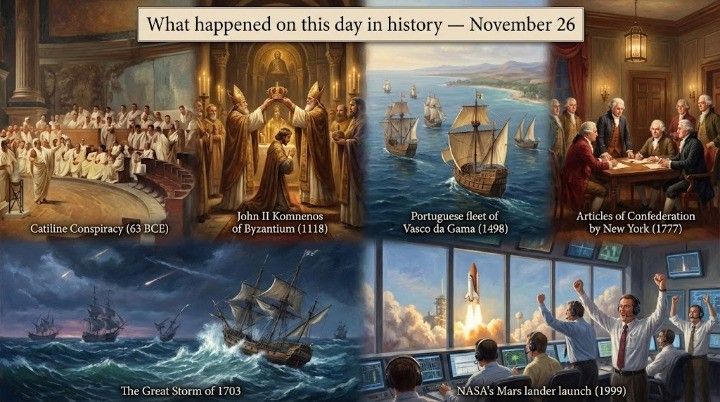
Across eras, this date gathers moments of upheaval, discovery, conflict and renewal — a brief ledger of how events reshaped societies and their sense of possibility. What happened on this day in history November 26 stands as the question that links these turning points together.
Important Events That Happened On November 26 In History
579 — Pelagius II succeeds Benedict I as pope
Pelagius II is chosen pope amid ongoing tensions with the Lombards and the continuing challenges of rebuilding Rome after the Gothic Wars. His pontificate faces the twin pressures of a weakened papal treasury and mounting religious disputes.
783 — Queen Adosinda confined to a monastery
To prevent a dynastic comeback, Asturian nobles detain Adosinda in a convent, blocking her nephew’s bid to reclaim the throne from Mauregatus. The episode illustrates how monastic confinement functioned as political neutralization in early medieval courts.
1161 — Battle of Caishi (Jin–Song Wars)
A Song navy defeats Jin forces on the Yangtze in a decisive river engagement, using paddle-wheel ships and heavy artillery to blunt the invasion. The victory preserves Song control of the lower Yangtze and marks a high point in Chinese naval innovation.
1346 — Charles IV crowned King of Germany at Bonn
Charles IV receives the German kingship coronation by the bishop of Cologne after earlier election at Rhens, strengthening his claim within the Holy Roman electoral politics. The ceremony consolidates his position during a turbulent mid-14th-century Europe.
1476 — Vlad the Impaler reclaims Wallachia
With support from Stephen the Great and others, Vlad returns to power after defeating Basarab Laiota, marking his third accession to the Wallachian throne. The struggle highlights the volatile dynastic and regional alliances of late medieval Eastern Europe.
1778 — Captain James Cook visits Maui
On his Pacific voyages, Cook becomes the first recorded European to set foot on Maui, entering local histories of contact and exchange. These landfalls intensified later patterns of European navigation and colonial interest in the Hawaiian Islands.
1789 — National Thanksgiving Day proclaimed in the United States
President George Washington proclaims a day of national thanksgiving, reflecting the new republic’s attempts to forge civic rituals and a shared calendar. The observance signals how early national leaders used public ceremonies to shape identity.
1805 — Pontcysyllte Aqueduct officially opens
Thomas Telford’s engineering work is inaugurated, linking canal networks across the Dee valley and showcasing the Industrial Age’s scale and ambition. The aqueduct becomes a lasting symbol of British civil-engineering prowess.
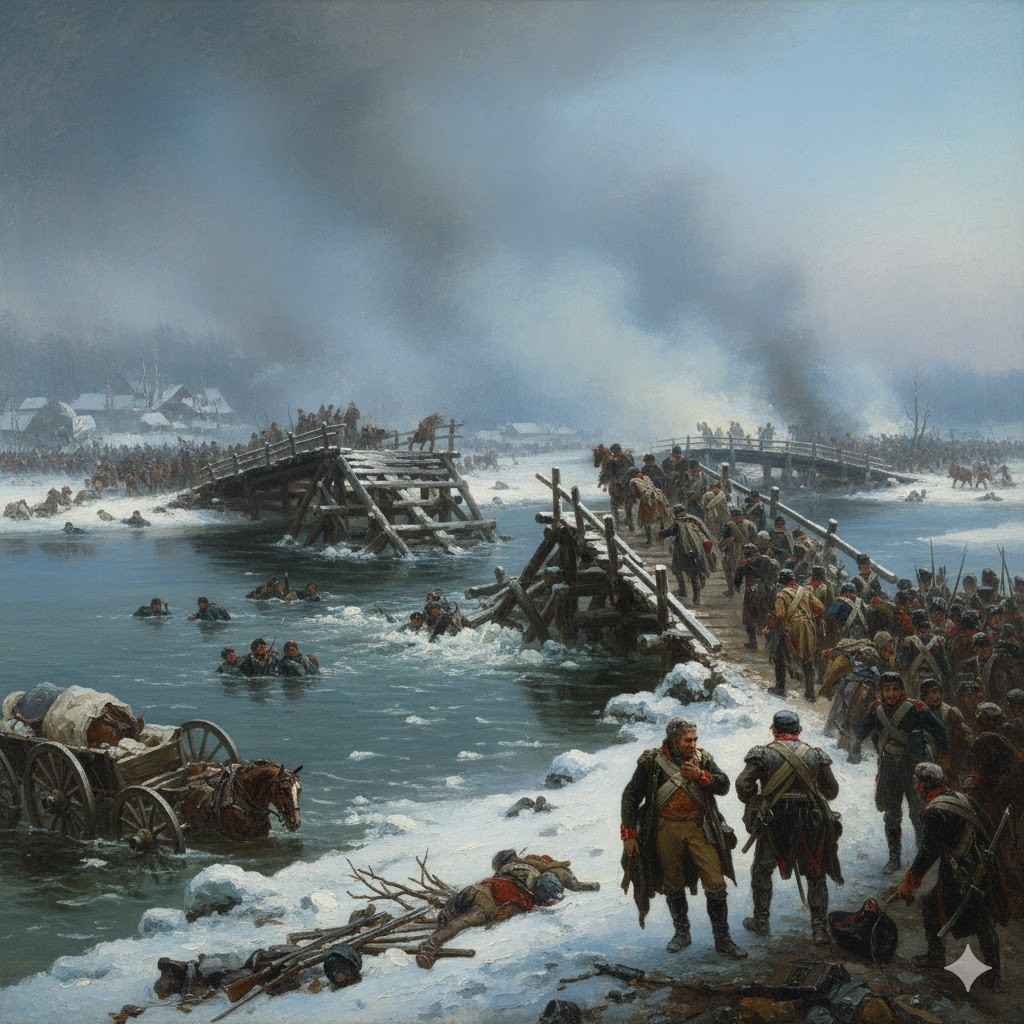
1812 — Battle of the Berezina begins
As Napoleon’s army retreats from Russia, the crossing at the Berezina turns into a chaotic struggle that decimates French forces and marks a decisive phase of the retreat. The action deepens the catastrophe of the Russian campaign.
1852 — Banda Sea earthquake and tsunami
A massive offshore quake triggers a tsunami that devastates coastal communities in the Dutch East Indies, causing scores of deaths and widespread damage. The disaster underlines the region’s seismic vulnerability.
1863 — Lincoln proclaims Thanksgiving as an annual national day
President Abraham Lincoln designates the last Thursday of November for national thanksgiving, institutionalizing a ritual that would evolve into the modern American holiday. The proclamation aimed to foster unity during the Civil War.
1865 — Battle of Papudo (naval action off Valparaíso)
A Chilean corvette defeats a Spanish schooner north of Valparaíso, part of the era’s maritime contests in the Pacific. The clash reflects shifting 19th-century naval balances in South America.
1914 — HMS Bulwark explodes at anchor
A catastrophic internal explosion destroys the British battleship Bulwark near Sheerness, killing hundreds and delivering a sobering blow to the Royal Navy. The loss prompts inquiries into naval ammunition handling and ship safety.
1917 — Manchester Guardian publishes the Sykes–Picot secret agreement
The paper reveals the wartime Anglo-French plan to divide Ottoman territories, exposing diplomatic bargaining and shaping later Middle Eastern politics. The disclosure fuels debates over imperial promises and postwar settlement.
1917 — National Hockey League (NHL) formed
The NHL is established with five founding clubs, setting the institutional foundations for modern professional ice hockey in North America. The league’s creation marks the formal organization of the sport at elite level.
1918 — Podgorica Assembly votes to unite with Serbia
Montenegro’s assembly endorses union with the Kingdom of Serbia, a pivotal step in Balkan post-war rearrangements that would reshape the region’s state map. The decision contributes to the complex legacy of state-building after WWI.
1920 — Red Army surprise attack in the Ukrainian–Makhnovist conflict
Soviet forces launch a sudden offensive against Makhnovist units, intensifying the chaos of the Ukrainian civil war theatre. The action underlines the violent fragmentation and shifting alliances of the Russian Civil War period.
1922 — Howard Carter and Lord Carnarvon enter Tutankhamun’s tomb
Carter’s entry into the nearly intact tomb marks an epochal moment in Egyptology, unveiling a wealth of artifacts and reigniting global interest in ancient Egypt. The discovery transforms museum collections and public imagination about pharaonic civilization.
1922 — The Toll of the Sea debuts using two-tone Technicolor
The film becomes the first general-release feature to use two-tone Technicolor, advancing early color cinema technology and changing cinematic aesthetics. It represents a commercial step toward broader color adoption in film.
1924 — Mongolian People’s Republic proclaimed
A new constitution abolishes the monarchy and establishes a Soviet-aligned Mongolian republic, reshaping the country’s political framework. The move institutionalizes Mongolia’s 20th-century political reorientation.
1939 — Shelling of Mainila (False-flag incident)
An orchestrated border incident gives the Soviet Union a pretext to open hostilities with Finland, leading to the Winter War days later. The episode exemplifies how manufactured incidents can precipitate interstate conflict.
1941 — The Hull note and Japan’s 1st Air Fleet depart for Hawaii
The U.S. submits a hard diplomatic note to Tokyo while Japan’s fleet sails for operations that will culminate in Pearl Harbor, signaling the last diplomatic ruptures before full-scale war in the Pacific. The day marks a grim turning point toward global conflict.
1942 — Yugoslav Partisans convene at Bihać
Partisan leaders meet to organize antifascist resistance and lay groundwork for postwar federal institutions, strengthening the movement that will govern postwar Yugoslavia. The council is a milestone in wartime political consolidation.
1942 — Casablanca premieres in New York
The Humphrey Bogart–Ingrid Bergman film opens to audiences, later becoming an enduring classic of Hollywood’s wartime cinema. Its themes of sacrifice and exile resonate with contemporary wartime audiences.
1942 — Riot in Phoenix, Arizona
Clashes among infantrymen, military police and local law enforcement in Phoenix lead to multiple deaths, illustrating wartime tensions on the home front. The disturbance underscores strains in civil-military relations during WWII.
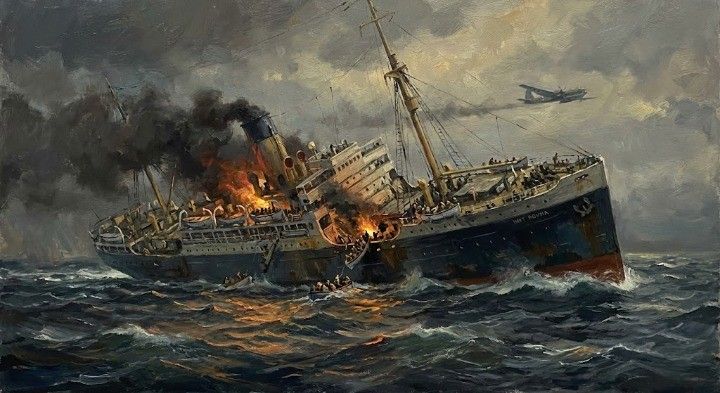
1943 — HMT Rohna sunk by Luftwaffe attack
The troopship Rohna is hit in the Mediterranean, producing a large loss of life and highlighting the airborne missile threat to shipping. The sinking remains one of the less widely known but severe maritime disasters of the war.
1944 — V-2 rocket strikes Woolworth’s in New Cross, London
A German V-2 missile hits a crowded store area, killing 168 people in one of the war’s deadliest single-strike civilian attacks on London. The blast exemplifies the terror of late-war rocket bombardment.
1944 — V-1 and V-2 campaign begins against Antwerp
Germany launches missile attacks aimed at disrupting Allied logistics in the liberated port city, causing civilian casualties and port damage. The bombardment highlights the strategic importance of Antwerp to Allied supply lines.
1949 — India’s Constituent Assembly adopts the constitution
After prolonged deliberation, India’s assembly formally approves Dr. B. R. Ambedkar’s constitutional text, setting the legal foundations of the independent republic. The adoption codifies civil liberties and institutional design for the new nation.
1950 — Chinese counterattacks in the Korean War
People’s Liberation Army forces launch massive offensives that push UN and South Korean troops into difficult retreats at Chosin and along the Ch’ongch’on River. The intervention dramatically alters the war’s military and political trajectory.
1965 — France launches Astérix satellite
France becomes the third country to orbit an object using its own launcher, signaling an independent national entry into space capability. The achievement expands the global space-race beyond the superpowers.
1968 — James P. Fleming’s Medal of Honor rescue
Air Force pilot Fleming conducts a daring helicopter rescue under fire to save pinned-down Special Forces, later receiving the Medal of Honor. The action exemplifies individual gallantry in Vietnam’s difficult fighting.
1970 — Record rainfall in Basse-Terre, Guadeloupe
An extreme one-minute rainfall of 38 millimetres is recorded, one of the heaviest short-duration downpours on record there, causing flash flood risks. The event underscores local meteorological extremes in the Caribbean.
1977 — “Vrillon” Southern Television hijack incident
An unknown intruder interrupts Southern Television broadcasts with a short, eerie message claiming to represent the “Ashtar Galactic Command.” The six-minute hijack remains an infamous instance of broadcast intrusion.
1979 — Pakistan International Airlines Flight 740 crashes near Taif
The passenger aircraft crashes in Saudi Arabia, killing all 156 on board and prompting investigations into aviation safety. The disaster is a tragic moment in civil-aviation history.
1983 — Brink’s-Mat robbery at Heathrow
Armed thieves steal gold bullion and other valuables worth nearly £26 million, sparking a massive criminal investigation and long-running legend about the stolen goods. The heist has far-reaching criminal and financial aftershocks.
1986 — Reagan announces members of the Tower Commission
In response to the Iran–Contra scandal, President Reagan names the commission to investigate covert operations and executive oversight failures. The announcement begins a process of political accountability at the highest level.
1986 — John Demjanjuk trial begins in Jerusalem
The trial of a man accused of serving as a Treblinka guard opens, raising difficult questions of individual responsibility and the prosecution of wartime atrocities decades later. The proceedings contribute to broader legal reckoning with the Holocaust.
1991 — Azerbaijan abolishes Nagorno-Karabakh’s autonomous status
The Soviet-era region’s autonomy is revoked and place-names are altered, escalating tensions that feed the later armed conflict over the territory. The move intensifies a complex ethno-territorial dispute.
1998 — Tony Blair addresses the Oireachtas
The UK prime minister becomes the first serving British PM to speak to Ireland’s parliament, symbolizing rapprochement after a fraught history and supporting the Northern Ireland peace process. The address marks a diplomatic milestone.
1998 — Khanna rail disaster kills 212
A catastrophic passenger train derailment in Punjab results in a high death toll and national mourning, prompting scrutiny of rail safety and infrastructure maintenance. The disaster highlights the human cost of transport failures.
1999 — Ambrym earthquake and tsunami (Vanuatu)
A strong quake triggers a destructive tsunami that kills and injures dozens on the island chain, revealing the Pacific’s seismic hazards and community vulnerability. The event spurs regional disaster response efforts.
2000 — Florida’s electoral votes certified for George W. Bush
Katherine Harris certifies the contested Florida results, a pivotal administrative act in a razor-thin U.S. presidential dispute that will be decided by the Supreme Court. The certification is a key procedural moment in the 2000 election crisis.
2003 — Concorde makes its final flight over Bristol
The supersonic ocean-liner Concorde completes its farewell flight, closing a chapter on supersonic passenger travel and high-technology glamour. The retirement marks changes in aviation economics and safety expectations.
2004 — Ruzhou School massacre
A deadly stabbing at a school dormitory in China kills and wounds multiple students, shocking the public and prompting debate about safety and social pressures. The massacre led to tightened campus security and public soul-searching.
2004 — Last Poʻouli (Black-faced honeycreeper) dies
The final known individual of the Hawaiian Poʻouli species dies in captivity, leaving the species functionally extinct and underscoring the vulnerability of island endemics. The loss highlights the urgent stakes of conservation.
2008 — Mumbai terrorist attacks
Coordinated assaults by Lashkar-e-Taiba gunmen kill around 175 people across the city and produce a weeks-long security and political crisis. The strikes have profound impacts on India-Pakistan relations and urban counterterrorism policy.
2008 — RMS Queen Elizabeth 2 docks in Dubai (post-service)
The famous ocean liner makes a notable port call in its new life after retirement, symbolizing the changing era of ocean travel and cruise-industry repurposing. The ship’s movements draw attention from maritime and heritage communities.
2011 — NATO friendly-fire attack kills Pakistani soldiers
NATO aircraft strike a Pakistani checkpoint, killing 24 soldiers and triggering a diplomatic rupture between Pakistan and coalition forces. The incident strains alliance relations and Afghan-Pakistan cooperation.
2011 — Mars Science Laboratory (Curiosity) launches to Mars
NASA sends the Curiosity rover on a long voyage to investigate Martian habitability, marking a major step in modern robotic planetary science. The mission will reshape understanding of Mars’ climate and geology.
2018 — InSight lands on Elysium Planitia, Mars
The lander touches down to study the planet’s interior with seismometers and heat probes, providing unprecedented data about Mars’ internal structure. InSight advances comparative planetology and planetary seismology.
2019 — Western Albania earthquake (magnitude 6.4)
A powerful quake devastates parts of Albania, killing dozens and injuring many more in the deadliest regional earthquake of 2019. The disaster triggers domestic emergency responses and international assistance.
2021 — WHO identifies the Omicron SARS-CoV-2 variant
Health authorities classify a new, highly mutated variant as a variant of concern, prompting global travel and public-health reactions. The announcement underscores the continuing evolutionary risks of the pandemic.
Read Also: What Happened On This Day In History November 25: Shocking Moments
Famous People Born On November 26
| Name | Role / short note | Dates |
|---|---|---|
| Samuel Herman Reshevsky | American chess prodigy and grandmaster | Nov 26, 1911 – Apr 4, 1992 |
| Ferdinand de Saussure | Swiss linguist; father of structural linguistics | Nov 26, 1857 – Feb 22, 1913 |
| Norbert Wiener | American mathematician; founder of cybernetics | Nov 26, 1894 – Mar 18, 1964 |
| Eugène Ionesco | Romanian-born French dramatist (The Bald Soprano) | Nov 26, 1909 – Mar 28, 1994 |
| John Newlands | English chemist; early periodicity (law of octaves) | Nov 26, 1837 – Jul 29, 1898 |
| Abdullah Ahmad Badawi | Prime minister of Malaysia (2003–09) | Nov 26, 1939 – Apr 14, 2025 |
| Frederik Pohl | American science-fiction author & editor | Nov 26, 1919 – Sep 2, 2013 |
| William Cowper | British poet (The Task, lyrical verse) | Nov 26, 1731 – Apr 25, 1800 |
| Elizabeth Blackburn | Molecular biologist; 2009 Nobel laureate (Physiology/Medicine) | Nov 26, 1948 – |
| Heinrich Brüning | German chancellor (1930–32) and statesman | Nov 26, 1885 – Mar 30, 1970 |
| Willis Carrier | American inventor; pioneer of modern air conditioning | Nov 26, 1876 – Oct 7, 1950 |
| Felix Gonzalez-Torres | Cuban-born American conceptual artist | Nov 26, 1957 – Jan 9, 1996 |
| Porter Goss | U.S. congressman; former CIA director | Nov 26, 1938 – |
| George Segal | American sculptor (life-size plaster figures) | Nov 26, 1924 – Jun 9, 2000 |
| Zeng Guofan | Chinese statesman & military leader (Taiping suppression) | Nov 26, 1811 – Mar 12, 1872 |
| Roz Chast | American cartoonist (The New Yorker) | Nov 26, 1954 – |
| Herman Gorter | Dutch poet of the 1880s literary revival | Nov 26, 1864 – Sep 15, 1927 |
| Enrico Bombieri | Italian mathematician; Fields Medalist (1974) | Nov 26, 1940 – |
| Adolfo Pérez Esquivel | Argentine human-rights activist; Nobel Peace laureate | Nov 26, 1931 – |
| Sir Aurel Stein | Archaeologist/explorer (Central Asia, Silk Road finds) | Nov 26, 1862 – Oct 26, 1943 |
| Belle da Costa Greene | Librarian & bibliographer; Morgan Library curator | Nov 26, 1879 – May 10, 1950 |
| Charles-Adolphe Wurtz | French chemist; organic chemistry contributions | Nov 26, 1817 – May 12, 1884 |
| Vreni Schneider | Swiss alpine skiing champion | Nov 26, 1964 – |
| Boris B. Yegorov | Soviet physician-cosmonaut (Voskhod 1) | Nov 26, 1937 – Sep 12, 1994 |
| Manuel A. Odría | President of Peru (1948–56) | Nov 26, 1897 – Feb 18, 1974 |
| Karl Ziegler | German chemist; Nobel Prize in Chemistry (1963) | Nov 26, 1898 – Aug 12, 1973 |
| Emlyn Williams | Welsh actor and playwright | Nov 26, 1905 – Sep 25, 1987 |
| Georg Forster | German naturalist, explorer and travel writer | Nov 26, 1754 – Jan 12, 1794 |
| Theophilus Cibber | English actor and dramatist | Nov 26, 1703 – 1758 |
| Luis Batlle Berres | President of Uruguay | Nov 26, 1897 – Jul 15, 1964 |
Famous People Died On November 26
| Name | Role / short note | Dates |
|---|---|---|
| John Moses Browning | American firearms designer (Browning family of arms) | Jan 23, 1855 – Nov 26, 1926 |
| Paul Rand | Influential American graphic designer (logos, modernist) | Aug 15, 1914 – Nov 26, 1996 |
| Tommy Dorsey | American bandleader & trombonist (swing era) | Nov 27, 1905 – Nov 26, 1956 |
| Vajiravudh (Rama VI) | King of Siam; modernizing monarch and writer | Jan 1, 1881 – Nov 26, 1925 |
| Joe Adonis | American organized-crime figure (New York syndicate) | Nov 22, 1902 – Nov 26, 1971 |
| Bushrod Washington | U.S. Supreme Court Associate Justice; nephew of George Washington | Jun 5, 1762 – Nov 26, 1829 |
| Nicolas-Jean de Dieu Soult, duc de Dalmatie | French marshal and statesman (Napoleonic era) | Mar 29, 1769 – Nov 26, 1851 |
| John Loudon McAdam | Scottish engineer; inventor of macadam road surface | Sep 21, 1756 – Nov 26, 1836 |
| Max Euwe | Dutch chess champion and mathematician | May 20, 1901 – Nov 26, 1981 |
| Joseph E. Murray | American surgeon; Nobel laureate (transplantation pioneer) | Apr 1, 1919 – Nov 26, 2012 |
| Oliver Ellsworth | 3rd Chief Justice of the United States; federal court architect | Apr 29, 1745 – Nov 26, 1807 |
| Odumegwu Ojukwu | Nigerian military leader; Biafra head of state | Nov 4, 1933 – Nov 26, 2011 |
| Reinhard Scheer | German admiral; commanded at the Battle of Jutland | Sep 30, 1863 – Nov 26, 1928 |
| Arnold Zweig | German novelist (Weimar & exile literature) | Nov 10, 1887 – Nov 26, 1968 |
| F.C. Kohli | Pioneer of India’s IT industry (Tata Consultancy roots) | Feb 28, 1924 – Nov 26, 2020 |
| Karl August von Hardenberg | Prussian statesman and reformer | May 31, 1750 – Nov 26, 1822 |
| Charles E. Whittaker | Associate Justice, U.S. Supreme Court | Feb 22, 1901 – Nov 26, 1973 |
| Styles Bridges | U.S. senator and Republican leader from New Hampshire | Sep 9, 1898 – Nov 26, 1961 |
| Amelita Galli-Curci | Italian-American operatic soprano | Nov 18, 1882 – Nov 26, 1963 |
| Coventry Patmore | English poet and essayist | Jul 23, 1823 – Nov 26, 1896 |
| Bill Hartack | American jockey; multiple Kentucky Derby wins | Dec 9, 1932 – Nov 26, 2007 |
| John Rich | English theatrical manager; popularized pantomime | c.1682 – Nov 26, 1761 |
| Vincenzo Gioberti | Italian philosopher and statesman (Risorgimento thinker) | Apr 5, 1801 – Nov 26, 1852 |
| Benjamin Apthorp Gould | American astronomer; southern-hemisphere catalogs | Sep 27, 1824 – Nov 26, 1896 |
| Dieudonné Dolomieu | French geologist; namesake of the mineral dolomite | Jun 23, 1750 – Nov 26, 1801 |
| Roger of Pont l’Évêque | Archbishop of York (12th century) | – Nov 26, 1181 |
| H. H. Price | British philosopher (perception, philosophy of mind) | 1899 – Nov 26, 1985 |
| Aleksey M. Remizov | Russian modernist writer | Jul 6, 1877 – Nov 26, 1957 |
| Jonathan Odell | Loyalist poet and clergyman in the American Revolution | Sep 25, 1737 – Nov 26, 1818 |
| Murano Tōgo | Japanese architect (department store design) | May 15, 1891 – November 26, 1984 |
Observances & Institutional Dates — November 26
Constitution Day (India)
Marks the adoption of India’s constitution by the Constituent Assembly in 1949 and is observed to celebrate the nation’s legal foundations and democratic ideals. It is a day for reflection on rights, duties and civic institutions.
Constitution Day (Abkhazia, Georgia)
Commemorates the adoption of Abkhazia’s constitutional framework; observances emphasize local political identity and the structures that govern civic life. Events typically include official ceremonies and public remembrances.
Republic Day (Mongolia)
Recognizes the establishment of the Mongolian People’s Republic under the 1924 constitution, marking the country’s 20th-century political transformation. The day involves civic ceremonies that reflect on national sovereignty and historical change.
Frequently Asked Questions
What happened on November 26th in history?
Several major events occurred on November 26, including early moments in the Catiline Conspiracy, Vasco da Gama’s voyage along East Africa, the Great Storm of 1703, New York adopting the Articles of Confederation, and the world premiere of Casablanca in 1942.
What special day is on November 26?
Depending on the year, November 26 is often observed as Thanksgiving Day in the United States, as it falls on the fourth Thursday of November. Other yearly observances may vary by region.
Whose birthday is on 26 November?
Many notable figures were born on this date, including writer Eugene Ionesco, singer Tina Turner, and various leaders, artists, and athletes across different eras.
Which scientist was born on 26 November?
Physicist Norbert Wiener, founder of cybernetics and a major contributor to mathematics, was born on November 26, 1894.
What details are known about the world premiere of Casablanca?
Casablanca premiered on November 26, 1942, in New York City, timed to capitalize on the Allied invasion of North Africa, giving the film strong political relevance during World War II.
What led to the US abandonment of Clark Air Base in the Philippines?
The U.S. withdrew after the catastrophic 1991 eruption of Mount Pinatubo severely damaged the base, followed by the Philippine Senate’s rejection of a treaty to extend U.S. military presence.