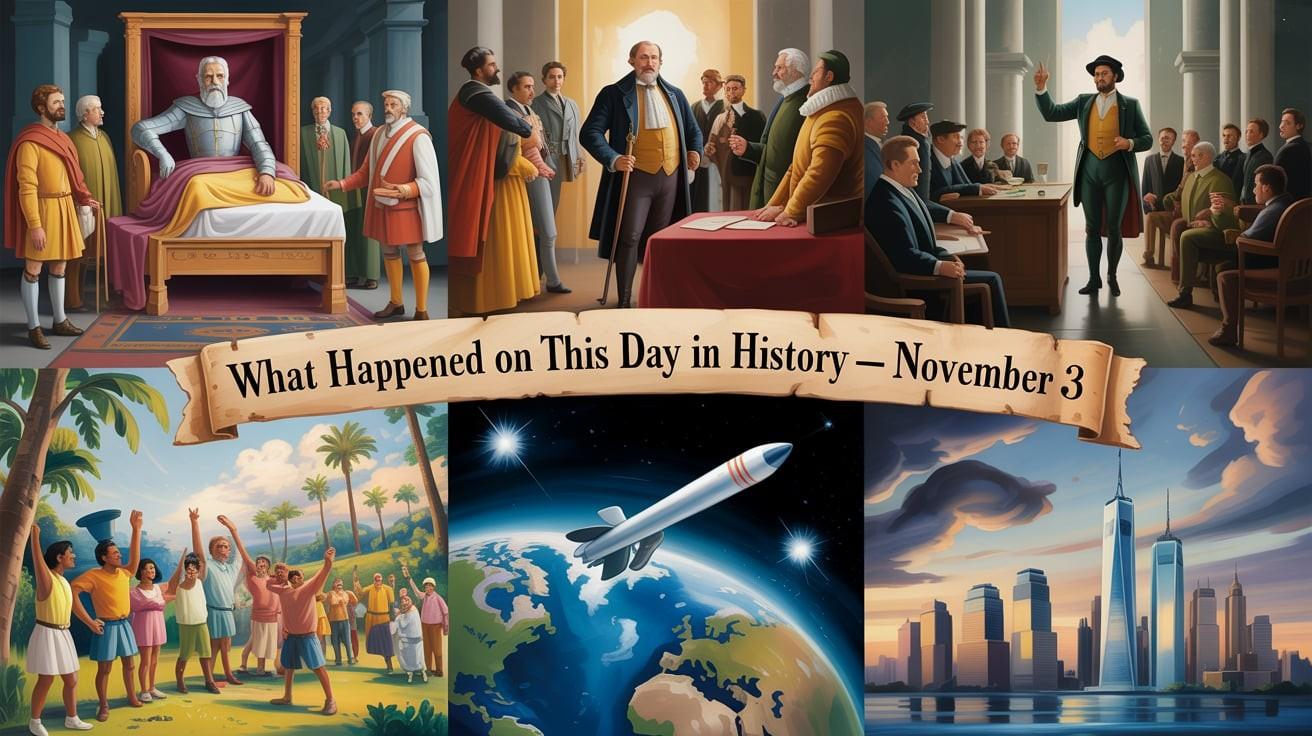
November 3 stands at a crossroads of empires, revolts, and discoveries. What happened on this day in history November 3, connects ancient power shifts with modern revolutions, linking battles, independence movements, and space milestones—proof that one date can hold centuries of change.
Major Events on November 3
361 — Constantius II dies at Mopsuestia
Emperor Constantius II died of fever at Mopsuestia in Cilicia on this date; on his deathbed he received baptism and acknowledged his cousin Julian as successor. The sudden end of his rule brought a swift transfer of imperial authority and set the stage for Julian’s short reign, which shifted imperial religious and military priorities.
1090 — The Rouen Riot and William Rufus’s failed attempt
An attempt by William II (Rufus) of England to seize Rouen, then the capital of his brother Robert of Normandy, failed amid urban resistance. The episode highlights the volatile relations among Norman ruling family members and the limits of martial pressure when local elites and townspeople resist outside imposition.
1295 — Ghazan enthroned as Il-Khan
Maḥmūd Ghāzān (Ghazan) was formally enthroned as the Il-Khan of Persia. His reign marked a cultural and administrative turning point: Ghazan converted to Islam, reformed fiscal systems, and promoted Persianate court culture, shaping the Il-Khanate’s political identity and its relationship with neighboring Islamic polities.
1333 — Flooding of the Arno in Florence
A major flood of the River Arno severely damaged Florence; chroniclers like Giovanni Villani recorded the event’s economic and social impact. Beyond immediate destruction to buildings and harvests, such floods influenced civic responses to urban planning and highlighted the vulnerability of medieval riverine cities to extreme weather.
1468 — Sack of Liège by Burgundian forces
Charles the Bold’s troops sacked Liège, punishing a city that resisted Burgundian control. The sack devastated civic life, undermined local autonomy, and reinforced the period’s harsh methods of consolidating territorial power in late medieval Europe, accelerating political centralization by force in the region.
1492 — Peace of Étaples between England and France
The Peace of Étaples temporarily eased Anglo-French hostilities when Henry VII secured concessions from Charles VIII. The agreement improved England’s continental position and produced short-term stability while illustrating how dynastic diplomacy and monetary settlements were used to manage rivalries without long campaigns.
1493 — Columbus first sights Dominica
On his second voyage, Christopher Columbus sighted the island now called Dominica. The encounter became part of the early European mapping and colonization of the Caribbean, initiating the island’s long history of contact, contestation and eventual colonial settlement — with deep and lasting effects on indigenous societies.
1534 — English Parliament passes the Act of Supremacy
The Act of Supremacy declared Henry VIII the Supreme Head of the Church of England, formally breaking with papal authority. The statute reconfigured religious governance, affected property and ecclesiastical law, and set in motion institutional changes that reshaped English religion and politics for generations.
1783 — Continental Army disbanded after the Revolutionary War
Following victory in the American Revolution, the Continental Army was formally disbanded in 1783. The decision reflected a republican suspicion of standing armies, ushered a difficult demobilization for veterans, and left unresolved questions about federal responsibility for pensions and security that the new United States had to address.
1791 — University of Vermont chartered
The University of Vermont received its charter, becoming the state’s oldest university and one of New England’s early colleges. Its foundation expanded educational access in the post-revolutionary republic and contributed to the region’s civic and intellectual institutions across the nineteenth century.
1793 — Olympe de Gouges guillotined
Playwright, pamphleteer and early feminist Olympe de Gouges was executed during the French Revolution after denouncing extremist measures and defending rights for women. Her death underscores the Revolution’s internal strife and the peril faced by those who criticized revolutionary leaders while advocating for wider political inclusion.
1812 — Defeat at the Battle of Vyazma
Napoleon’s forces suffered a significant reverse at Vyazma during the 1812 Russian campaign, one more blow among many in the disastrous retreat from Moscow. The engagement contributed to the gradual collapse of the Grande Armée’s cohesion and presaged the catastrophic losses that would reshape European geopolitics.
1817 — Bank of Montreal opens
Canada’s Bank of Montreal opened its doors, later becoming the country’s oldest chartered bank. Its founding signaled the institutional development of North American finance, supporting commerce, infrastructure and the growing economy of British North America throughout the nineteenth century.
1838 — The Bombay Times (The Times of India) founded
The Bombay Times and Journal of Commerce, which evolved into The Times of India, began publication. As a major English-language daily, the paper later shaped public discourse in colonial and post-colonial India, influencing political debate, commercial news and the emergence of a mass press.
1848 — Dutch constitution revised to limit royal power
A substantially revised Dutch constitution transferred significant authority from the monarch to parliament and ministers. The reform advanced constitutional governance, parliamentary responsibility, and the modernization of Dutch political institutions, reflecting 19th-century liberal constitutional trends in Europe.
1867 — Garibaldi defeated at Mentana
Giuseppe Garibaldi’s forces were defeated at the Battle of Mentana, failing to end the Pope’s temporal rule in Rome that year. While the attempt did not immediately achieve unification goals, it remained part of the longer Risorgimento struggle that would eventually integrate Rome into unified Italy in 1870.
1868 — John Willis Menard elected to U.S. Congress (not seated)
John Willis Menard became the first African American elected to the U.S. Congress (from Louisiana), but due to a contested election he was not seated. The episode reveals Reconstruction’s limits, racialized political contestation, and the fraught path toward black representation in national institutions after the Civil War.
1881 — Mapuche uprising begins in Chile
The Mapuche uprising of 1881 marked armed resistance to Chilean expansion into indigenous territories. The conflict reflects the wider pattern of state consolidation and indigenous dispossession in nineteenth-century Latin America, producing long-term impacts on land, culture and regional politics.
1898 — France withdraws from Fashoda, ending Fashoda Incident
French forces withdrew from Fashoda in Sudan, defusing a tense colonial confrontation with Britain. The resolution averted war and clarified spheres of influence in Africa, illustrating the imperial rivalry that shaped late-nineteenth-century diplomacy and colonial partition.
1903 — Panama separates from Colombia (U.S. encouragement)
With encouragement and political backing from the United States, Panama broke away from Colombia, opening the way for a U.S.-controlled canal zone. The separation altered Central American geopolitics, advanced U.S. strategic and commercial interests, and set patterns of intervention and regional politics in the twentieth century.
1908 — William Howard Taft elected U.S. president
William Howard Taft won the U.S. presidency, succeeding Theodore Roosevelt. Taft’s election began a presidency that would emphasize judicial temper and administrative reform, and it preceded the Roosevelt–Taft split that reorganized the U.S. party system and Progressive politics.
1911 — Chevrolet enters the automobile market
Chevrolet officially launched as a competitor in the growing U.S. auto market, challenging Ford’s Model T dominance. The entry intensified industrial competition, encouraged innovation in mass production and marketing, and contributed to the broadening availability of automobiles in the twentieth century.
1912 — Bulgarian siege of Adrianople begins
Bulgarian forces began the siege of Adrianople (Edirne) during the First Balkan War, a major operation that demonstrated Balkan states’ ambitions against Ottoman holdings. The siege’s strategic and symbolic significance helped determine wartime settlement and the redrawing of borders in Southeast Europe.
1918 — German Revolution begins with Kiel mutiny
The German Revolution of 1918–19 began when sailors in Kiel mutinied and effectively seized control of the port. The mutiny quickly spread, forcing the Kaiser’s abdication and leading to the proclamation of a republic — a pivotal collapse of imperial structures at World War I’s end.
1920 — Russian Army retreats to Crimea in civil-war phase
During the Russian Civil War, anti-Bolshevik White forces retreated to Crimea after Red Army offensives and the actions of the Revolutionary Insurgent Army of Ukraine. The withdrawal presaged further collapse of organized White resistance and foreshadowed eventual Bolshevik consolidation.
1929 — Gwangju Student Independence Movement
Students in Gwangju launched protests demanding Korean independence and resisting Japanese colonial rule; their actions became an important episode in Korean nationalist resistance, energizing anti-colonial sentiment and later historical memory of resistance against imperial domination.
1930 — Getúlio Vargas heads Brazil’s provisional government
Following political upheaval, Getúlio Vargas assumed leadership of Brazil’s provisional government after a bloodless coup, beginning a long, transformative era in Brazilian politics. Vargas’s rule reoriented the state toward industrialization, centralized authority, and expansive social policies that reshaped the country’s political economy.
1936 — Franklin D. Roosevelt elected to third term
Franklin D. Roosevelt won an unprecedented third term as U.S. president, reflecting both his political dominance amid the Great Depression and wartime anxieties. The election affirmed broad support for New Deal policies while later prompting debates about term limits and presidential power.
1942 — Koli Point action opens in Guadalcanal campaign
Allied forces launched the Koli Point operation during the Guadalcanal campaign, a crucial series of engagements for control of the island. The action helped secure perimeter defense, tested joint operations in jungle conditions, and contributed to the broader strategic shift in the Pacific in favor of Allied forces.
1943 — U.S. 8th Air Force raids Wilhelmshaven
Five hundred aircraft of the U.S. 8th Air Force attacked Wilhelmshaven harbor, striking at German naval installations and shipping. The raid was part of the strategic air campaign aiming to degrade Germany’s maritime capacity and industrial infrastructure, with significant operational and civilian consequences.
1944 — Slovak National Uprising leaders captured
Generals Ján Golian and Rudolf Viest, two principal commanders of the Slovak National Uprising, were captured by German forces; they were later tortured and executed. Their capture signalled the uprising’s failure in the short term and the brutal methods the occupying forces used to suppress resistance movements.
1946 — Japan’s postwar constitution adopted
Japan’s new constitution received the Emperor’s assent, formally inaugurating a democratic constitutional framework that included a pacifist clause and expanded civil rights. The constitution reshaped Japan’s political system under Allied occupation and set the legal basis for post-war reconstruction and governance.
1950 — Air India Flight 245 crashes on Mont Blanc
Air India Flight 245 crashed into Mont Blanc while approaching Geneva, killing all 48 aboard. The disaster drew attention to aviation safety, mountain flying hazards, and the need for better navigational aids and procedures in difficult terrain.
1956 — Khan Yunis killings and Hungarian Revolution developments
During the Suez crisis, Israeli forces were reported to have killed hundreds of Palestinians in Khan Yunis, an event that inflamed regional tensions and human-rights concerns. On the same year’s Hungarian front, a new government briefly formed amid revolution while Soviet-backed leaders prepared a countergovernment in Moscow — events that illustrate Cold War instability.
1956 — The Wizard of Oz first major TV airing (cultural milestone)
The Wizard of Oz was televised to an enormous audience for the first time, an event estimated at tens of millions of viewers. Its repeated broadcasts established the film as a perennial cultural staple and showed how television could resurrect and canonize motion pictures for new mass audiences.
1957 — Sputnik 2 launches with Laika, the first animal in orbit
The Soviet Union launched Sputnik 2 carrying Laika, the first animal to enter orbit. The mission demonstrated human capacity for orbital flight and raised scientific and ethical debates about animal testing; it also intensified the Cold War space race and accelerated subsequent crewed flight efforts.
1960 — Great Swamp National Wildlife Refuge land protected
After a prolonged legal campaign, Congress protected the land that became the Great Swamp National Wildlife Refuge, blocking plans for a major regional airport. The decision preserved critical habitat, highlighted the rise of modern environmental advocacy, and set precedents for citizen-driven conservation victories.
1961 — U Thant becomes UN Secretary-General
U Thant was unanimously appointed as the United Nations’ third Secretary-General and the first non-European in the post. His tenure covered critical Cold War crises and reflected a shift toward more geographically diverse leadership in international organizations.
1964 — Lyndon B. Johnson elected to a full term
Lyndon B. Johnson convincingly won the U.S. presidential election, carrying 44 states and more than 60% of the popular vote. The victory validated his Great Society agenda and occurred the first year Washington, D.C., residents could vote in a presidential election — a small but significant expansion of democratic participation.
1967 — Battle of Đắk Tô begins (Vietnam War)
Fierce fighting opened at Đắk Tô as U.S. and South Vietnamese forces clashed with North Vietnamese units. The battle, part of larger highland campaigns, underscored the war’s brutal mountain combat, heavy casualties and the intensifying American ground commitment in Vietnam.
1969 — Nixon appeals to the “silent majority”
President Richard Nixon addressed the nation asking the “silent majority” to support his Vietnam policies, framing public opinion in terms that sought broad backing for difficult policy choices. The speech became emblematic of Nixon’s political strategy and his attempt to mobilize domestic support during a divisive war.
1973 — Mariner 10 launched toward Mercury
NASA launched Mariner 10, a pioneering mission that would use gravity assist and later become the first spacecraft to visit Mercury. The probe delivered critical early data about the planet’s environment and magnetic field, advancing planetary science and mission-design techniques.
1978 — Dominica gains independence from the UK
Dominica achieved full independence on November 3, 1978, joining a wave of Caribbean decolonization. Sovereignty reshaped national identity and political institutions while linking the island to regional and international organizations as a newly independent state.
1979 — Greensboro massacre shocks U.S. politics
A white supremacist attack on a “Death to the Klan” rally in Greensboro, North Carolina, left five people dead and others wounded. The massacre exposed violent political extremism at home, prompted legal battles over accountability, and reverberated through civil-rights and labor movements.
1982 — Salang Tunnel disaster in Afghanistan
A catastrophic fire and collapse in the Salang Tunnel caused a large number of deaths during one of Afghanistan’s few major east-west transport arteries. The tragedy highlighted the dangers of poorly maintained infrastructure in harsh terrain and the severe human costs when emergency systems fail.
1986 — Iran–Contra revelations and Compact of Free Association
A Lebanese magazine reported U.S. arms sales to Iran tied to hostage negotiations, launching the Iran–Contra scandal that would dominate U.S. political controversy. In the same year, the Compact of Free Association established new constitutional relationships, granting the Federated States of Micronesia and the Marshall Islands political independence with special U.S. ties.
1988 — Maldivian coup attempt foiled with Indian help
Sri Lankan Tamil mercenaries tried to overthrow the Maldivian government; at the Maldivian president’s request, India intervened and suppressed the attempt within a day. The rapid response underscored India’s regional security role and set an example of swift multinational intervention to protect small states’ sovereignty.
1992 — Bill Clinton elected U.S. president
Democratic Governor Bill Clinton defeated incumbent George H. W. Bush and independent Ross Perot, marking a generational political change. Clinton’s victory reflected economic concerns and centrist policy appeals, shaping the U.S. political and policy landscape through the 1990s.
1996 — Susurluk car crash exposes Turkish state networks
The Susurluk car crash killed several figures, including Abdullah Çatlı, revealing links among politicians, security services and organized crime. The scandal triggered public outcry and the resignation of senior officials, forcing scrutiny of clandestine state networks and accountability in Turkey.
1997 — U.S. imposes sanctions on Sudan
In response to human-rights abuses and support for extremist groups, the United States placed economic sanctions on Sudan. The measure signaled international displeasure and affected Sudan’s diplomatic and economic relations while linking human-rights concerns to foreign-policy tools.
2014 — One World Trade Center officially opens
One World Trade Center was officially opened in New York City as the principal office tower on the rebuilt World Trade Center site. The building symbolized post-9/11 recovery, architectural resilience, and the contested meanings of memorialization, commerce and urban renewal.
2020 — United States presidential election held
U.S. voters went to the polls in a high-stakes election pitting Joseph R. Biden Jr. against incumbent Donald J. Trump. The election, held under pandemic conditions and unprecedented turnout, triggered intense political debate; officials declared Biden the winner on November 7 after counting and certification processes.
2022 — Assassination attempt on Imran Khan in Pakistan
Former Prime Minister Imran Khan was shot and wounded while leading a political march, an attack that provoked national crisis, widespread protests and international condemnation. The incident intensified Pakistan’s volatile domestic politics and raised urgent concerns about political violence.
2023 — Israel–Hamas war developments dominate regional reporting
On and around this date major developments in the Israel–Hamas conflict—reports of encirclement operations, humanitarian alarms and shifting front-line positions—dominated international coverage, reflecting how rapidly evolving military campaigns shape humanitarian and diplomatic responses.
2024 — Global roundups: floods, conflicts, and election campaigning (coverage note)
On November 3, 2024, media roundups emphasized several major stories—severe floods in parts of Spain, ongoing conflicts in Gaza and Ukraine, and intensive international election campaigning—showing how contemporary global news cycles combine natural disasters, wars, and political contests into concentrated reporting days.
Read Also: What Happened On This Day In History November 2: Important Moments
Famous People Born On November 3
Stephen Austin — American pioneer; “Father of Texas” — 1793.
John Barry — Film composer (James Bond scores) — 1933.
Vincenzo Bellini — Italian opera composer — 1801.
Bert Jansch — Scottish folk guitarist — 1943.
Yevgeny Plushchenko — Russian Olympic figure skater — 1982.
Walker Evans — American documentary photographer — 1903.
André Malraux — French novelist and statesman — 1901.
William Cullen Bryant — American poet and editor — 1794.
Mazie Hirono — U.S. Senator (Hawaii) — 1947.
Bronko Nagurski — American football legend — 1908.
Eike Batista — Brazilian businessman — 1956.
Annibale Carracci — Italian Baroque painter — 1560.
Bob Feller — Baseball Hall of Famer — 1918.
Jubal A. Early — Confederate general — 1816.
Edward Douglass White — U.S. Chief Justice — 1845.
Terrence McNally — American playwright — 1939.
Vilhjalmur Stefansson — Arctic explorer — 1879.
Nick Holonyak Jr. — Inventor (visible LED) — 1928.
Valdas Adamkus — President of Lithuania — 1926.
Joseph W. Martin Jr. — U.S. House leader and Speaker — 1884.
Famous People Died On November 3
Jean-Bédel Bokassa — Central African ruler, president/emperor — died 1996.
Wilhelm Reich — Psychoanalyst, controversial theorist — died 1957.
Mary Martin — Broadway star and actress — died 1990.
Constantius II — Roman emperor — died 361.
Lewis Hine — Photographer and child-labor investigator — died 1940.
Peter II — Last king of Yugoslavia (in exile) — died 1970.
E. H. Carr — Historian and scholar — died 1982.
Solomon Guggenheim — Art collector, museum founder — died 1949.
John III Ducas Vatatzes — Emperor of Nicaea — died c.1254.
Georg Trakl — Austrian poet — died 1914.
Viktor Chernomyrdin — Russian prime minister — died 2010.
Jerry Bock — Musical theatre composer — died 2010.
Koiso Kuniaki — Japanese prime minister (WWII era) — died 1950.
Isang Yun — Composer and cultural figure — died 1995.
Émile Roux — Bacteriologist, Pasteur collaborator — died 1933.
Robert Lowth — Bishop and scholar — died 1787.
Jean-Baptiste Colbert, marquis de Seignelay — French official — died 1690.
José Patiño — Spanish statesman — died 1736.
Andréas Kálvos — Greek Neoclassical poet — died 1869.
Hanya Holm — Choreographer and educator — died 1992.
Observances & institutional dates — November 3
- Christian feast day: Acepsimas of Hnaita and companions (Orthodox commemorations).
- Culture Day (Japan).
- Flag Day (United Arab Emirates).
- Independence / Separation Day — Panama (1903).
- Independence Day — Dominica (1978).
- Independence Day — Federated States of Micronesia (1986).
- Independence of Cuenca (Ecuador).
- Mother’s Day (East Timor).
- Victory Day (Maldives).
Frequently Asked Questions
What major political changes are linked to November 3?
November 3 has hosted several shifts: imperial successions (Constantius II), 19th- and 20th-century independence and statehood events (Panama, Dominica, Micronesia), and pivotal modern elections (e.g., U.S. contests). The date’s variety shows how single calendar days can collect unrelated but consequential political milestones.
Why is Sputnik 2 (1957) significant?
Sputnik 2 carried the first animal to orbit (Laika), proving sustained life support and orbital insertion were possible. Scientifically, it advanced spaceflight capability; politically, it intensified Cold War rivalry. Ethically it also sparked debate over animal welfare in experimental programs.
How did events on November 3 affect decolonization?
Multiple November 3 entries relate to decolonization: Panama’s 1903 separation, Dominica’s 1978 independence, and Micronesia’s 1986 political reconfiguration show different forms of colonial breakaway, international involvement, and negotiated post-colonial arrangements.
Are there recurring themes on November 3 across centuries?
Yes — the day repeats patterns of political change (successions, independence), violent upheaval (uprisings, massacres, wartime actions), and technological or cultural firsts (space missions, mass media moments). These recurring types reflect how calendars collect diverse events that nonetheless echo common historical processes.