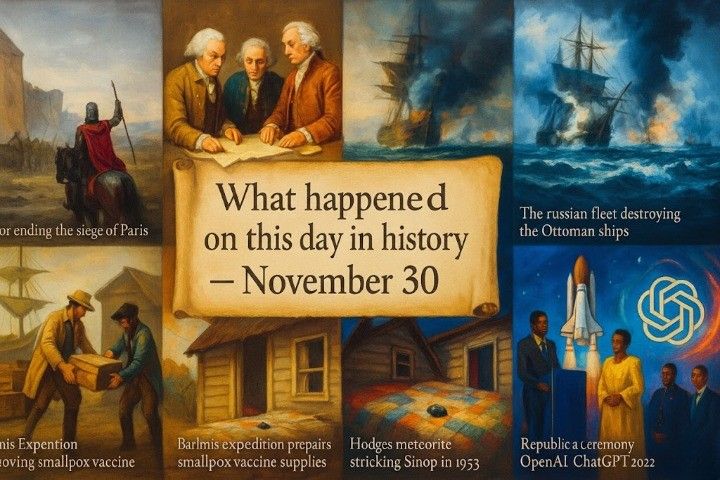
A concise sweep through history, this date gathers moments from medieval clashes to scientific breakthroughs. What happened on this day in history November 30 fits naturally into the story, connecting centuries of conflict, reform, and discovery that helped shape public life.
Important Events That Happened On November 30 In History
978 — Otto II lifts the siege of Paris
Holy Roman Emperor Otto II abandons the siege of Paris, ending a costly Franco-German campaign of 978–980. The withdrawal marked a temporary halt to imperial pressure on West Francia and left the region to recover from the strain of war.
1707 — Second Siege of Pensacola ends
British forces and Creek allies fail to take Spanish Pensacola during Queen Anne’s War. The defeat preserved Spanish control of West Florida and underscored the fluid colonial contest in North America.
1718 — Death of King Charles XII of Sweden
Charles XII dies during the siege of Fredriksten in Norway, ending an era of Swedish military adventurism. His death precipitated shifts in Scandinavian power and the close of Sweden’s great-power phase.
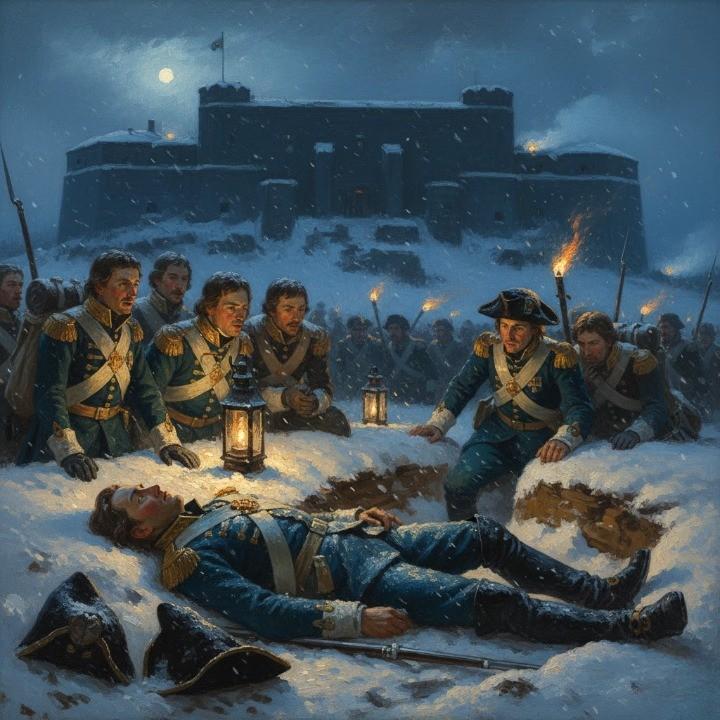
1782 — Preliminary Articles of the Treaty of Paris signed
Britain and the United States agree preliminary peace terms, formally beginning the diplomatic end of the American Revolution. These articles paved the way for the 1783 Treaty of Paris and international recognition of American independence.
1786 — Tuscany abolishes the death penalty
Under Grand Duke Pietro Leopoldo I, Tuscany becomes the first modern state to abolish capital punishment. The reform marked an early liberal turn in criminal justice that inspired later humanitarian debates.
1803 — Balmis Expedition departs Spain
A major public-health mission launches to carry smallpox vaccination to Spanish America and the Philippines. The Balmis Expedition combined medical logistics and colonial administration in an unprecedented humanitarian campaign.
1803 — Louisiana formally transferred to France (New Orleans)
Spanish officials in New Orleans hand the Louisiana Territory back to French representatives, a diplomatic moment part of the larger Napoleonic realignment that would soon lead to the Louisiana Purchase.
1853 — Battle of Sinop
The Imperial Russian Navy destroys an Ottoman squadron at Sinop, a dramatic naval action that exacerbates tensions and helped trigger wider involvement in the Crimean War. The slaughter at Sinop highlighted evolving naval firepower and European rivalries.
1864 — Battle of Franklin (American Civil War)
Confederate attacks under John Bell Hood suffer devastating losses at Franklin, Tennessee, weakening the Army of Tennessee. The costly assault foreshadowed the collapse of Confederate field forces in the western theatre.
1872 — First international football match
Scotland and England meet at Hamilton Crescent in what is widely remembered as the first international association football match. The fixture helped codify international competition and the sport’s expanding cultural reach.
1916 — Costa Rica signs the Buenos Aires Convention
Costa Rica joins a regional copyright treaty, part of early twentieth-century steps to coordinate intellectual-property law across the Americas.
1936 — Crystal Palace destroyed by fire
London’s famous exhibition structure is lost to a catastrophic blaze, removing a landmark of Victorian display culture and prompting debates about heritage and reconstruction.
1939 — Russo-Finnish War begins (Soviet invasion)
Following diplomatic tensions, Soviet forces launch a large offensive against Finland, opening the Winter War. The campaign exposed geopolitical fragilities on the Soviet Union’s northwestern frontiers.
1940 — Sino–Japanese Treaty signed (Wang Jingwei regime)
Japan secures a treaty with the Japanese-backed Reorganized National Government of China, a pact criticised as heavily biased and part of the wider wartime rearrangement of East Asia.
1941 — Rumbula massacre (Riga)
The SS-Einsatzgruppen carry out mass killings of roughly 25,000 Jews from the Riga Ghetto at Rumbula, a grim episode in the Holocaust’s systematic extermination in Eastern Europe.
1942 — Battle of Tassafaronga
Japanese destroyers under Raizō Tanaka score a tactical victory against a larger U.S. cruiser force, demonstrating night-combat skill and complicating Allied naval control in the Solomons campaign.
1947 — Civil conflict in Mandatory Palestine intensifies
Open civil fighting escalates as the British withdrawal and partition plans accelerate the path toward the 1948 Arab–Israeli War.
1953 — Kabaka Edward Mutesa II deposed (Buganda)
Ugandan traditional leadership is removed and the kabaka exiled to London, an event that signalled tensions in late-colonial governance and the shaping of post-colonial politics.
1954 — Hodges meteorite strikes a woman in Sylacauga
A meteorite crashes through a house roof and hits a resting woman — the only well-documented case in the Western Hemisphere of a human struck by a space rock, prompting medical and meteorite-ownership questions.
1962 — Eastern Air Lines Flight 512 crashes
A fatal accident at Idlewild (now JFK) kills 25 people and adds to scrutiny of airline safety and airport procedures during a period of rapid commercial aviation growth.
1966 — Barbados independent from the United Kingdom
Barbados achieves independence, a key moment in the mid-twentieth-century decolonization of the Caribbean and a step toward later constitutional evolution.
1967 — People’s Republic of Southern Yemen independence
The former Aden Protectorate region becomes independent as the People’s Republic of South Yemen, later the People’s Democratic Republic of Yemen — part of wider post-colonial reordering in the Arabian peninsula.
1967 — Pakistan Peoples Party founded
Zulfikar Ali Bhutto establishes the PPP, a major political movement that would shape Pakistan’s politics for decades.
1971 — Iran seizes Greater and Lesser Tunbs
Iran takes control of the strategically placed Tunb islands, altering control in the Persian Gulf and complicating relations with the Trucial States.
1972 — U.S. troop-level statement in Vietnam
White House notes there will be no further public announcements about troop withdrawals; the statement reflects tight political management of war messaging during the conflict’s drawdown.
1979 — Pink Floyd releases The Wall
A landmark concept album that became a cultural phenomenon, The Wall mixed rock theatre, social critique and widespread commercial success.
1981 — U.S.–Soviet INF negotiations begin in Geneva
Talks on intermediate-range nuclear forces start, an early step in late-Cold War arms diplomacy that would later yield major treaties.
1995 — Official end of Operation Desert Storm
Formal closure of the Gulf War combat phase underscores shifting post-Cold War security dynamics in the Persian Gulf.
1995 — Clinton in Northern Ireland
President Clinton visits Belfast and endorses peace efforts, using American political weight to encourage reconciliation after decades of conflict.
1996 — Stone of Scone returned to Scotland
A historic relic is transported back to Scotland after centuries, symbolically restoring a piece of ritual kingship and national heritage.
1999 — Exxon-Mobil merger agreed; WTO protests in Seattle
Two major economic moments: a mega-merger reshapes global oil markets, and mass protests in Seattle mark a new phase of anti-globalization activism.
1999 — BAE Systems formed by merger
British Aerospace and Marconi Electronic Systems combine to create Europe’s largest defence firm, consolidating major defence industrial capabilities.
2000 — STS-97 Space Shuttle launch (NASA)
A Space Shuttle mission continues ISS assembly and international cooperation in orbit; part of the broader Shuttle era.
2001 — Gary Ridgway arrested (Green River Killer)
A long-running serial-murder investigation ends with Ridgway’s arrest; his later guilty pleas made him one of the most notorious convicted serial killers in U.S. history.
2004 — Lion Air Flight 538 crash
A runway overrun kills 25 and raises questions about Indonesian aviation safety and operational standards.
2005 — John Sentamu enthroned as Archbishop of York
Sentamu becomes the Church of England’s first black archbishop, a milestone in clergy diversity and national religious life.
2007 — Atlasjet Flight 4203 crash
A deadly approach accident in Turkey kills 57 and adds to global concerns about regional air safety.
2018 — Anchorage earthquake (M7.1)
A strong quake near Alaska’s largest city causes significant property damage but, fortunately, no reported fatalities — a reminder of seismic risk in the north Pacific.
2021 — Barbados becomes a republic
Barbados removes the British monarch as head of state and inaugurates a republican constitution — a constitutional milestone following independence decades earlier.
2021 — Oxford High School shooting
A mass-shooting tragedy in Michigan leaves four students dead and prompts renewed debate about school safety and gun policy in the U.S.
2022 — ChatGPT launched by OpenAI
A major advance in public-facing AI arrives, rapidly influencing public discourse about language models, automation and responsible AI deployment.
Curious about what came before? Take a look at November 29
Famous People Born On November 30
| Name | Role / short note | Dates |
|---|---|---|
| Woody Allen | American director, actor, writer | Nov 30, 1935 – |
| Bill Walsh | American football coach (West Coast offense) | Nov 30, 1931 – Jul 30, 2007 |
| William-Adolphe Bouguereau | French academic painter | Nov 30, 1825 – Aug 19, 1905 |
| Lucy Maud Montgomery | Canadian author (Anne of Green Gables) | Nov 30, 1874 – Apr 24, 1942 |
| Gordon Parks | American photographer, filmmaker, author | Nov 30, 1912 – Mar 7, 2006 |
| Sir Philip Sidney | English poet, courtier, soldier | Nov 30, 1554 – Oct 17, 1586 |
| Valentin Alkan | French pianist & composer | Nov 30, 1813 – Mar 29, 1888 |
| St. Gregory of Tours | Frankish bishop & historian | Nov 30, 538? or Nov 30, 539? – Nov 17, 594? |
| Theodor Mommsen | German historian & Nobel laureate | Nov 30, 1817 – Nov 1, 1903 |
| Brownie McGhee | American blues musician | Nov 30, 1915 – Feb 16, 1996 |
| Casimir IV | King of Poland & Grand Duke of Lithuania | Nov 30, 1427 – Jun 7, 1492 |
| Joan Ganz Cooney | American television producer (children’s TV) | Nov 30, 1929 – |
| Andrea Doria | Genoese statesman & admiral | Nov 30, 1466 – Nov 25, 1560 |
| John Dickson Carr | American detective-fiction author | Nov 30, 1906 – Feb 27, 1977 |
| Clyfford Still | American abstract painter (New York School) | Nov 30, 1904 – Jun 23, 1980 |
| Christian VI | King of Denmark and Norway | Nov 30, 1699 – Aug 6, 1746 |
| Henry Taube | Chemist; Nobel laureate | Nov 30, 1915 – Nov 16, 2005 |
| Donald Ogden Stewart | American writer & screenwriter | Nov 30, 1894 – Aug 2, 1980 |
| Carl Loewe | German composer & singer | Nov 30, 1796 – Apr 20, 1869 |
| Frederick Temple | Archbishop of Canterbury | Nov 30, 1821 – Dec 23, 1902 |
| Lord Frederick C. Cavendish | British politician | Nov 30, 1836 – May 6, 1882 |
| Andrew V. Schally | Endocrinologist; Nobel laureate | Nov 30, 1926 – Oct 17, 2024 |
| Sir Paul Vinogradoff | Legal scholar & medievalist | Nov 30, 1854 – Dec 19, 1925 |
| Geoffrey Household | British novelist (Rogue Male) | Nov 30, 1900 – Oct 4, 1988 |
| Edgar D. Adrian | Electrophysiologist; Nobel laureate | Nov 30, 1889 – Aug 4, 1977 |
| I. J. Singer | Yiddish novelist | Nov 30, 1893 – Feb 10, 1944 |
| St. George J. Mivart | British biologist & critic of Darwin | Nov 30, 1827 – Apr 1, 1900 |
| John Maurice Clark | American economist | Nov 30, 1884 – Jun 27, 1963 |
| Adriaen van de Velde | Dutch landscape painter | Nov 30, 1636 – Jan 21, 1672 |
| Doi Takako | Japanese politician; JSP leader | Nov 30, 1928 – Sep 20, 2014 |
Famous People Died On November 30
| Name | Role / short note | Dates |
|---|---|---|
| Mariss Jansons | Latvian-born conductor | Jan 14, 1943 – Nov 30, 2019 |
| Ernst Lubitsch | Film director (sophisticated comedies) | Jan 28, 1892 – Nov 30, 1947 |
| Fernando Pessoa | Portuguese poet & modernist | Jun 13, 1888 – Nov 30, 1935 |
| Wilhelm Furtwängler | German conductor | Jan 25, 1886 – Nov 30, 1954 |
| Francis Picabia | French painter (Dada, Surrealism) | Jan 22, 1879 – Nov 30, 1953 |
| Gertrude Ederle | American swimmer; first woman across English Channel | Oct 23, 1906 – Nov 30, 2003 |
| Béla Kun | Hungarian communist leader | Feb 20, 1886 – Nov 30, 1939? |
| Corneliu Codreanu | Romanian fascist leader (Iron Guard) | Sep 13, 1899 – Nov 30, 1938 |
| Paula Modersohn-Becker | German painter (early Expressionist) | Feb 8, 1876 – Nov 30, 1907 |
| Sir Terence Rattigan | English playwright | Jun 10, 1911 – Nov 30, 1977 |
| Pius VIII | Pope | Nov 20, 1761 – Nov 30, 1830 |
| Norman Cousins | American editor & essayist | Jun 24, 1912 – Nov 30, 1990 |
| Marcello Malpighi | Italian physician & microscopist | Mar 10, 1628 – Nov 30, 1694 |
| Patrick Kavanagh | Irish poet | Oct 21, 1904 – Nov 30, 1967 |
| Kamehameha IV | King of Hawaii | Feb 9, 1834 – Nov 30, 1863 |
| Albert Bacon Fall | U.S. Secretary of the Interior | Nov 26, 1861 – Nov 30, 1944 |
| Compton Mackenzie | Scottish novelist & broadcaster | Jan 17, 1883 – Nov 30, 1972 |
| Beniamino Gigli | Italian operatic tenor | Mar 20, 1890 – Nov 30, 1957 |
| Cecilius Calvert, 2nd Baron Baltimore | Colonial proprietor of Maryland | 1605 – Nov 30, 1675 |
| Maurice, count de Saxe | French marshal & military theorist | Oct 28, 1696 – Nov 30, 1750 |
| Samuel Zemurray | Entrepreneur (United Fruit) | Jul 18, 1877 – Nov 30, 1961 |
| Eoin O’Duffy | Irish military & political leader | Jan 28, 1890 – Nov 30, 1944 |
| Marjorie Tallchief | American ballerina | Oct 19, 1927 – Nov 30, 2021 |
| Vincent Scully | Architectural historian & critic | Aug 21, 1920 – Nov 30, 2017 |
| August Bournonville | Danish dancer & choreographer | Aug 21, 1805 – Nov 30, 1879 |
| Laura Gilpin | American photographer | Apr 22, 1891 – Nov 30, 1979 |
| Bonaventura Cavalieri | Italian mathematician (Cavalieri’s principle) | 1598 – Nov 30, 1647 |
| Edward John Eyre | Explorer & colonial official | Aug 5, 1815 – Nov 30, 1901 |
| Alfred Herrhausen | German banker (assassinated) | Jan 30, 1930 – Nov 30, 1989 |
| Gustav Noske | German politician (Weimar era) | Jul 9, 1868 – Nov 30, 1946 |
Observances & Institutional Dates — November 30
Day to Mark the Departure and Expulsion of Jews from the Arab Countries and Iran (Israel) — A memorial day observing the forcible migration and loss of property suffered by Jews forced to leave Arab lands and Iran in the mid-twentieth century; it highlights questions of refugee justice and historical memory.
Commemoration Day (United Arab Emirates) — A national remembrance for Emirati martyrs and those who served the nation, observed with official ceremonies and public reflection.
Independence Day (Barbados) — Marks Barbados’ 1966 independence from the UK; commemorations celebrate national culture, political sovereignty and the island’s democratic traditions.
Regina Mundi Day (South Africa) — Observed at the Regina Mundi church and linked to anti-apartheid memory and community resilience.
Saint Andrew’s Day (Scotland) — Scotland’s national day, celebrated with cultural events, civic ceremonies and a focus on national heritage.
Bonifacio Day (Philippines) — Honors the revolutionary leader Andrés Bonifacio; civic events recall the struggle for independence and national identity.
National Day (Benin) — Celebrates Benin’s national founding and post-colonial identity with official parades and cultural programs.
Day of Remembrance for All Victims of Chemical Warfare (United Nations) — An international observance to remember victims of chemical weapons and to reaffirm commitments to the Chemical Weapons Convention and non-proliferation.
Frequently Asked Questions
What are the most significant events tied to November 30?
Major moments include decisive military actions (Sinop, Franklin), diplomatic milestones (preliminary Treaty of Paris), pioneering public-health and space efforts (Balmis Expedition, STS-97), and modern political changes (Barbados republic, ChatGPT launch).
Why does the Hodges meteorite case matter?
Because it is the only well-documented Western-Hemisphere instance of a meteorite striking a person, raising medical, scientific and legal interest in meteorite falls.
How did the Battle of Sinop influence the Crimean War?
The Russian victory and the massacre of Ottoman sailors and crews alarmed Britain and France and hastened their entry on the Ottoman side, expanding the conflict.
What was the Balmis Expedition’s achievement?
It organized mass smallpox vaccination across Spanish colonies — an early example of state-level international public-health intervention.
Why is Barbados’s 2021 republic status notable?
It represents a constitutional step beyond independence — replacing the British monarch as head of state and symbolizing full ceremonial sovereignty.