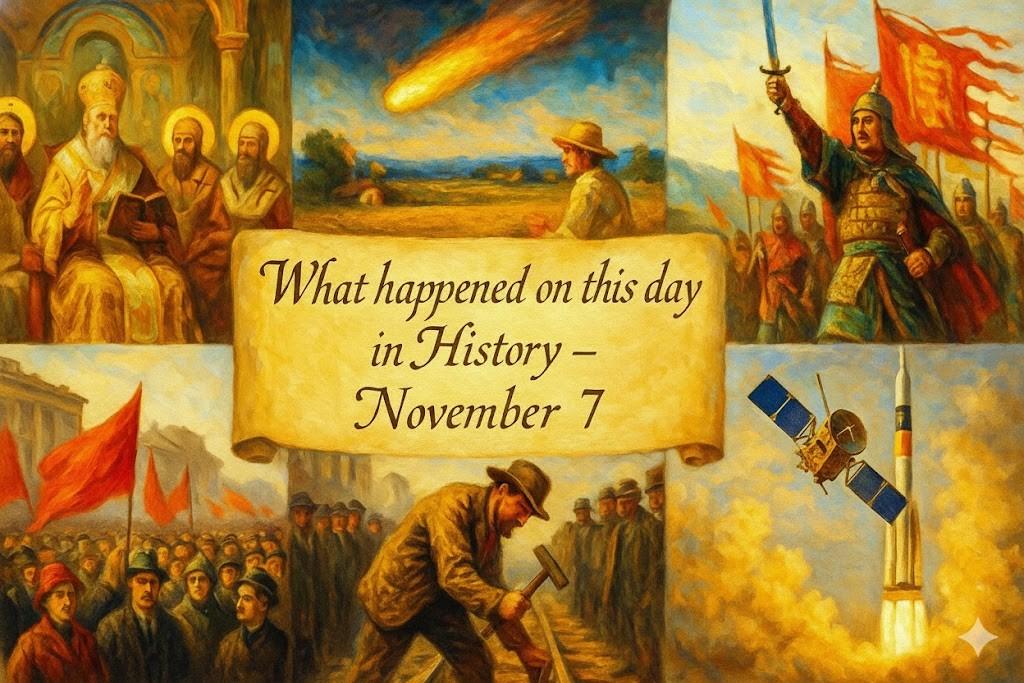
Through centuries, what happened on this day in history November 7 reflects moments of power, faith, and change — councils that met, empires that shifted, and voices that reshaped nations. The date continues to mark a pattern of struggle and renewal.
Important Events That Happened on November 7 in History
335 — Athanasius banished to Trier
Pope Athanasius, a leading defender of Nicene orthodoxy, was expelled to Trier amid doctrinal and political conflict. His banishment reflects the volatile intersection of theology and imperial power in the fourth century and the contested authority surrounding the Christian church’s leadership during a period of doctrinal consolidation.
680 — Sixth Ecumenical Council opens in Constantinople
The Sixth Ecumenical Council convened to confront doctrinal disputes about Christology and church order. The council’s proceedings shaped imperial-church relations and theological orthodoxy across the Byzantine world, illustrating how ecumenical gatherings served as instruments of both spiritual definition and political influence.
921 — Treaty of Bonn secures Rhine borders
Frankish kings Charles the Simple and Henry the Fowler agreed a pact of friendship that recognized borders along the Rhine. The Treaty of Bonn exemplified early medieval diplomacy: negotiated frontiers and mutual recognition provided fragile stability in a fragmented political landscape of competing regional rulers.
1426 — Lam Sơn rebels win at Tốt Động–Chúc Động
Vietnamese Lam Sơn forces routed the Ming army in a decisive victory near Đông Quan (now Hanoi). The triumph strengthened the uprising led by Lê Lợi, helped expel Chinese occupation, and proved pivotal in the eventual establishment of an independent Vietnamese polity after years of resistance.
1492 — Ensisheim meteorite falls in Alsace
A meteorite struck a wheat field at Ensisheim, leaving one of the earliest precisely dated impact records. The event fascinated contemporary observers and rulers, who read celestial phenomena as portentous; modern historians note Ensisheim as an early case where natural events were documented with civic and scientific attention.
1504 — Christopher Columbus returns from his fourth voyage
Columbus’s final return to Spain marked the end of his transatlantic expeditions. While the voyages expanded European geographic knowledge and colonial ambitions, they also accelerated contact that brought dramatic demographic and cultural consequences to Atlantic world societies.
1619 — Elizabeth Stuart crowned Queen of Bohemia
Elizabeth Stuart’s coronation as Queen of Bohemia mirrored dynastic claims at the heart of early modern Europe. Her short-lived reign and family ties later fed into broader conflicts of succession and confessional warfare that would reverberate through the Thirty Years’ War era.
1665 — The London Gazette begins publication
The London Gazette — the oldest surviving English journal — issued its first number, inaugurating an enduring official organ for public notices and news. Its foundation reflects growth in print culture and the increasing institutionalization of public communication in early modern Britain.
1775 — Lord Dunmore’s Offer of Emancipation issued in Virginia
Facing rebellion, the Royal Governor Lord Dunmore promised freedom to enslaved people who fled to fight for the Crown. The proclamation accelerated wartime dynamics around slavery, undermined colonial planter control in some areas, and highlighted how the American Revolution intensified debates over liberty and bondage.
1786 — Stoughton Musical Society founded
The Stoughton Musical Society formed as a community choir, becoming the oldest musical organization in the United States. Its establishment reflects the growth of civic cultural life in early America, where local societies preserved musical traditions, trained singers, and helped make public performance a regular part of town life and communal celebration.
1811 — Battle of Tippecanoe fought
U.S. forces clashed with Native American confederates near present-day Battle Ground, Indiana, in a confrontation tied to Tecumseh’s resistance. The engagement weakened Native political cohesion in the Old Northwest and became a touchstone in American frontier expansion narratives and military memory.
1837 — Elijah P. Lovejoy killed defending his press
Abolitionist printer Elijah P. Lovejoy was murdered by a mob while protecting his press in Alton, Illinois, an event that galvanized northern anti-slavery sentiment. His death highlighted the lethal stakes of free-press struggles and the violent resistance abolitionists faced on the antebellum frontier.
1861 — Battle of Belmont (American Civil War)
At Belmont, Missouri, Union forces under Ulysses S. Grant overran a Confederate camp but were later pushed back when reinforcements arrived. The engagement was a small but sharp early test of Grant’s leadership, demonstrating the chaotic, fluid nature of frontier campaigns and the heavy toll even limited battles could impose on inexperienced volunteer armies.
1861 — First Melbourne Cup horse race
Australia held its inaugural Melbourne Cup, establishing what would become the nation’s most famous horse race and a defining event in Australian sporting and social calendars. The race quickly grew into a major public spectacle, shaping leisure culture, wagering traditions and a shared national pastime that endures across generations.
1874 — Thomas Nast’s elephant becomes a Republican symbol
A Harper’s Weekly cartoon by Thomas Nast popularized the elephant as a Republican emblem, an image that would endure in American political iconography. The cartoon’s visual shorthand captured partisan identity and helped make political branding through imagery a potent tool in public persuasion and party politics.
1881 — Mapuche rebels destroy Nueva Imperial
Mapuche insurgents attacked and razed the Chilean settlement of Nueva Imperial after defenders fled, part of wider indigenous resistance to state expansion. The episode underscores the violent displacements and local upheavals that accompanied nineteenth-century nation building in South America, with long-term consequences for land, culture and regional relations.
1885 — Canada’s Last Spike at Craigellachie
The ceremonial Last Spike completed Canada’s first transcontinental railway at Craigellachie, symbolizing national connectivity and economic ambition. The railroad transformed settlement, resource extraction and political integration across British North America, while also raising Indigenous dispossession and environmental change issues.
1893 — Colorado grants women the vote
Colorado became the second U.S. state to extend suffrage to women, a decisive step in the broader suffrage movement. The victory reflected sustained organizing by activists and provided a working-state model for enfranchisement that advocates used in campaigns elsewhere across the country.
1893 — Bombing at Barcelona’s Liceu opera house
An anarchist attack at the Liceu opera house in Barcelona killed twenty people and shocked European audiences. The bombing revealed late-nineteenth-century political radicalism’s violent edge and hardened state and public responses to anarchist movements, affecting security and public assembly debates across the continent.
1900 — Battle of Leliefontein (Second Boer War)
At Leliefontein, the Royal Canadian Dragoons distinguished themselves, earning three Victoria Crosses for gallantry. The action highlighted the contributions of colonial troops in imperial conflicts and became a notable chapter in Canada’s emergent military history and national remembrance.
1907 — Jesús García’s heroic run in Nacozari
Jesús García drove a burning, dynamite-laden train away from Nacozari de García, sacrificing his safety to save the town. Celebrated as a local and national hero in Mexico, his action became legendary — an example of individual courage preventing catastrophe and earning widespread civic gratitude.
1910 — First air freight shipment undertaken
The Wright brothers and a department-store owner completed the first recorded commercial air freight run, moving goods between Dayton and Columbus, Ohio. The modest experiment foreshadowed the explosive growth of air logistics and the transformation of commerce by faster, airborne transport networks.
1912 — Deutsche Opernhaus opens in Berlin
The Deutsche Opernhaus (now Deutsche Oper Berlin) opened with a production of Beethoven’s Fidelio, establishing a major cultural institution for Germany’s capital. Its inauguration signaled a lively operatic tradition in Berlin and reinforced public opera as a central form of cultural life in early twentieth-century Europe.
1913 — First day of the Great Lakes Storm of 1913
A catastrophic blizzard struck the Great Lakes region with hurricane-force winds, producing tremendous loss of life and shipping disasters. The storm exposed the dangers of late-season gales on inland sea routes and led to major changes in weather forecasting, marine safety and regional disaster preparedness.
1914 — Japan captures Kiaochow Bay (Tsingtao)
Japanese forces seized the German-held port of Tsingtao (Kiaochow Bay), reflecting Japan’s rising regional power during World War I. The capture reshaped colonial holdings in East Asia and demonstrated how global conflict quickly redrew imperial possessions far from European battlefields.
1916 — Jeannette Rankin elected to U.S. Congress
Montana’s Jeannette Rankin became the first woman elected to the United States Congress, breaking a major political barrier and signaling new opportunities for women’s civic participation. Her election foreshadowed the gradual integration of women into national political life and legislative institutions.
1916 — Woodrow Wilson reelected president
Incumbent Woodrow Wilson secured a second term as U.S. president during a fraught international environment. The election outcome shaped the United States’ evolving wartime posture and domestic policy debates amid the turbulent context of World War I.
1916 — Summer Street drawbridge disaster in Boston
A Boston streetcar plunged through an open drawbridge into Fort Point Channel, killing 46 people in a tragic accident. The disaster spurred scrutiny of urban transit safety, bridge operation procedures, and the need for stricter oversight of rapidly expanding public-transport systems.
1917 — Bolsheviks seize key sites in Petrograd (October Revolution)
On this date (October 25 Old Style), Bolshevik forces took control of government buildings in Petrograd, initiating the revolution’s decisive phase. The takeover dismantled provisional authority, opened the way to Soviet rule, and reshaped twentieth-century geopolitics through civil war and ideological contest.
1917 — Third Battle of Gaza ends with British capture of Gaza
The British army’s capture of Gaza after sustained operations reshaped the Sinai-Palestine front in World War I. Securing Gaza advanced British strategic aims in the region and contributed to later territorial arrangements as the Ottoman Empire collapsed.
1918 — Influenza devastates Western Samoa
The 1918 influenza pandemic swept into Western Samoa, ultimately killing roughly one-fifth of the population. The calamity exposed colonial public-health failures and the catastrophic vulnerability of remote island communities to global disease outbreaks.
1918 — Kurt Eisner overthrows the Wittelsbach dynasty in Bavaria
Revolutionary ferment in Germany led Kurt Eisner to topple the Wittelsbach monarchy in Bavaria, creating a short-lived socialist republic. The upheaval was part of wider postwar collapses that remade German politics and contributed to the turbulent interwar period.
1919 — First Palmer Raids conducted in U.S. cities
U.S. authorities arrested over 10,000 suspected radicals in coordinated raids across the country during the early Red Scare. The Palmer Raids exemplified postwar fears of subversion, civil liberties tensions, and the reach of wartime security measures into peacetime political life.
1920 — Patriarch Tikhon’s decree and the Russian Orthodox diaspora
Patriarch Tikhon issued directives that led to the formation of the Russian Orthodox Church Outside Russia, a response to revolutionary dislocations and church-state ruptures. The measure reflected the institutional fragmentation that accompanied political exile and transnational religious reorganization.
1929 — Museum of Modern Art opens in New York
MoMA opened its doors in Manhattan, providing a dedicated public space for contemporary art. The museum’s founding helped institutionalize modern art appreciation in the United States and became a major platform for avant-garde artists and public cultural education.
1931 — Chinese Soviet Republic proclaimed
On the anniversary of the October Revolution, Chinese communists proclaimed a Soviet republic in parts of rural China, signaling early revolutionary state-building experiments. The declaration was part of broader insurgent strategies that would later feed into the long civil war and eventual communist victory.
1933 — Fiorello La Guardia elected mayor of New York City
La Guardia’s election inaugurated a reformist mayoralty that reshaped New York’s municipal governance. His leadership combined vigorous public works, fiscal reform and political coalition-building, leaving a durable imprint on the city’s civic institutions.
1936 — Madrid Defense Council formed (Spanish Civil War)
As nationalist forces pressed toward Madrid, the Republican side created a Defense Council to organize the city’s resistance. The arrangement illustrated the chaotic, multiparty pressures inside the Republican camp and the desperate measures taken to hold the capital.
1939 — Neutrality Act “cash-and-carry” implemented by Roosevelt
President Franklin D. Roosevelt directed implementation of the Neutrality Act provisions permitting belligerent nations to buy weapons on a cash-and-carry basis. The policy sought to aid allied efforts in Europe while preserving formal U.S. neutrality, reflecting the tightrope of prewar American diplomacy.
1940 — Tacoma Narrows Bridge collapses
The Tacoma Narrows Bridge dramatically failed in high winds only months after opening, providing a stark engineering lesson about aeroelastic flutter. The collapse influenced bridge design standards and deepened scientific understanding of wind-structure interactions.
1941 — Soviet hospital ship Armenia sunk
German aircraft sank the Soviet hospital ship Armenia while it was evacuating refugees and wounded from Crimea, with catastrophic loss of life estimated in the thousands. The tragedy stands among World War II’s vast civilian maritime disasters and underlines wartime risks facing noncombatant vessels.
1944 — Richard Sorge executed in Japan
Soviet spy Richard Sorge was hanged by Japanese authorities along with members of his network after being exposed. Sorge’s espionage had provided Moscow with timely intelligence in the 1930s and his execution marked a dramatic episode in wartime intelligence history.
1944 — Franklin D. Roosevelt elected to a fourth term
FDR won an unprecedented fourth presidential term, reflecting extraordinary public trust during wartime and economic recovery. The election reinforced the executive’s wartime leadership role, later fueling debates that produced the 22nd Amendment limiting presidential terms.
1949 — First oil pumped at Oil Rocks (Neft Daşları)
The offshore platform complex at Oil Rocks in the Caspian Sea began oil production, pioneering industrial extraction from the sea. The project represented early large-scale offshore engineering and shaped regional energy development in the Soviet sphere.
1956 — UN demands withdrawal of invading forces in Suez Crisis
The UN General Assembly passed a resolution calling for immediate withdrawal of British, French and Israeli forces from Egypt, underscoring postwar limits on colonial military intervention. The diplomatic outcome signaled emergent international authority and shifted imperial calculations in the Middle East.
1967 — Carl B. Stokes elected mayor of Cleveland
Carl Stokes won election as mayor, becoming the first African American mayor of a major U.S. city. His victory represented a breakthrough in urban electoral politics and a milestone in African American political representation during a period of civil-rights transformation.
1967 — Public Broadcasting Act establishes CPB
President Lyndon B. Johnson signed the Public Broadcasting Act, creating the Corporation for Public Broadcasting and laying the foundation for PBS and NPR. The legislation aimed to support educational broadcasting and expand noncommercial media for public-service programming.
1972 — Richard Nixon re-elected president
Richard Nixon won a second presidential term in a landslide victory, consolidating political support for his administration’s policies. The election affirmed Nixon’s domestic and foreign-policy agenda at the time, even as later revelations would complicate his legacy.
1973 — U.S. Congress overrides Nixon’s War Powers veto
Congress overrode President Nixon’s veto to pass the War Powers Resolution, asserting legislative checks on presidential military commitments. The law aimed to re-balance war-making authority after Vietnam and remains a focal point in debates about executive power and congressional oversight.
1975 — Bangladesh coup and Abu Taher uprising
A combined civilian and military uprising led by Colonel Abu Taher toppled a factional regime, resulted in the killing of Brigadier Khaled Mosharraf, and helped free Ziaur Rahman from house arrest. The events were part of Bangladesh’s turbulent post-independence politics and power struggles.
1982 — Coup ousts Colonel Saye Zerbo in Upper Volta
Colonel Gabriel Yoryan Somé led a coup that removed President Saye Zerbo in Upper Volta (now Burkina Faso), reflecting the era’s frequent military turnovers in West Africa and the instability of post-colonial governance structures.
1983 — United States Senate bombing and Able Archer exercise begin
A bomb exploded inside the U.S. Capitol Senate chamber, causing significant damage though no injuries; in the same period NATO’s Able Archer 83 command-post exercise began, an alerting event that later prompted Soviet concern about allied intentions. Both incidents underscored Cold War tensions and domestic security anxieties.
1987 — Habib Bourguiba overthrown in Tunisia; Singapore MRT opens
In Tunisia, longtime president Habib Bourguiba was removed and replaced by Prime Minister Zine El Abidine Ben Ali, marking a decisive leadership change. That year Singapore also opened its Mass Rapid Transit system, a landmark in urban public transport that reshaped commuting and city development.
1989 — Breakthroughs in U.S. and New York state African American leadership
In a historic election year, Douglas Wilder won Virginia’s governorship and David Dinkins became mayor of New York City — both firsts for African American leaders in those high offices. The victories signaled shifting political coalitions and expanding representation in U.S. electoral politics.
1996 — Mars Global Surveyor launched by NASA
NASA’s Mars Global Surveyor lifted off to map the Red Planet with unprecedented resolution. The mission produced durable datasets on martian topography and geology, advancing planetary science and setting the stage for later robotic exploration.
1990 — Mary Robinson elected President of Ireland
Mary Robinson’s victory as Ireland’s first woman president signaled a social and political shift, representing a more modern, civic-facing Ireland. Her presidency emphasized human-rights issues and symbolized changing public attitudes toward leadership and representation.
1991 — Magic Johnson announces HIV status and retires
Basketball star Magic Johnson disclosed his HIV-positive diagnosis and retired from the NBA, an announcement that transformed public discourse on HIV/AIDS and challenged stigmas, prompting greater awareness and advocacy around testing and public health responses.
1994 — First internet radio broadcast launched by WXYC
WXYC, the student-run radio at UNC Chapel Hill, streamed a continuous broadcast online, effectively creating the world’s first internet radio station. The experiment anticipated the future of digital audio distribution and foreshadowed wide shifts in media consumption.
1996 — Mars Global Surveyor launches
NASA launched Mars Global Surveyor to map the Red Planet with unprecedented detail. The spacecraft delivered sustained scientific returns on martian geology and atmosphere, significantly advancing planetary science and informing subsequent missions.
1996 — ADC Airlines Flight 086 crashes near Lagos
A passenger flight crashed into the Lagos Lagoon near Epe, killing all 144 on board and prompting investigations into airline safety, air-traffic procedures and the regulatory conditions affecting Nigerian aviation.
2000 — Contested U.S. presidential election (Bush v. Gore)
The disputed 2000 election culminated in legal battles over vote counts that ultimately reached the U.S. Supreme Court. The controversy raised enduring questions about electoral systems, judicial intervention in politics, and the mechanics of American democracy.
2000 — Hillary Clinton elected to the U.S. Senate
Hillary Clinton won a U.S. Senate seat in New York, the first former first lady to hold elective office, marking a notable step in the political careers of prominent national figures and expanding her public role in governance.
2004 — Fallujah offensive and state of emergency in Iraq
Iraq’s interim government declared a 60-day state of emergency as U.S. forces launched operations in Fallujah against entrenched insurgents. The campaign illustrated the intense urban combat and humanitarian strains that characterized the Iraq conflict’s later phases.
2007 — Jokela school shooting in Finland
A gunman attacked Jokela Comprehensive School, killing nine people and injuring others, sparking national grief and wide debate about school safety, mental-health services and gun-control policies in Finland and beyond.
2012 — Guatemala earthquake kills scores
A powerful offshore earthquake struck the Pacific coast of Guatemala, killing at least 52 people and causing extensive damage. The disaster highlighted seismic vulnerability in Central America and the urgent need for preparedness and rapid humanitarian response.
2017 — Shamshad TV attack claimed by ISIS
Gunmen and suicide bombers attacked Shamshad TV in Kabul, wounding dozens and killing at least one security guard; ISIS claimed responsibility. The assault illustrated ongoing threats to media outlets and civilian targets amid Afghanistan’s protracted conflict.
2020 — Joe Biden confirmed as U.S. president-elect
After extended counting and legal challenges, Joe Biden was confirmed as the winner of the 2020 U.S. presidential contest. The outcome occurred amid a pandemic and intense political polarization, shaping debates about governance, pandemic response and democratic resilience.
2022 — Ukraine receives NASAMS air-defence systems
Ukraine confirmed receipt of initial NASAMS surface-to-air missile systems, a material boost to its air-defence capabilities. The deliveries formed part of sustained international military assistance aimed at bolstering Ukrainian defenses amid ongoing hostilities.
2023 — Heavy fighting in Israel–Hamas war and regional damage reported
Reports on this date in 2023 described intense fighting in Gaza with significant civilian harm, including damage to hospitals and bakeries that compounded humanitarian concerns. The day’s accounts reflected the war’s acute civilian costs and mounting international alarm.
If You Want To Read November 6 Stories Click here: November 6 Facts
Famous People Born On November 7
- Ibn Ḥazm — Spanish Muslim scholar and jurist. (Nov 7, 994 – Aug 15, 1064)
- Constans II Pogonatus — Byzantine emperor. (Nov 7, 630 – Sep 15, 668)
- Robert Rogers — American frontier soldier, leader of Rogers’s Rangers. (Nov 7, 1731 – May 18, 1795)
- Auguste, comte de Villiers de L’Isle-Adam — French author. (Nov 7, 1838 – Aug 19, 1889)
- Ferenc Erkel — Hungarian composer, author of the national anthem. (Nov 7, 1810 – Jun 15, 1893)
- Fritz Reuter — German novelist (Plattdeutsch). (Nov 7, 1810 – Jul 12, 1874)
- Frank Hyneman Knight — American economist. (Nov 7, 1885 – Apr 15, 1972)
- Aron Nimzowitsch — Latvian chess master and theorist. (Nov 7, 1886 – Mar 16, 1935)
- Chester Irving Barnard — American business theorist and sociologist. (Nov 7, 1886 – Jun 7, 1961)
- Lise Meitner — Austrian physicist. (Nov 7, 1878 – Oct 27, 1968)
- Totò — Italian comic actor. (Nov 7, 1898 – Apr 15, 1967)
- Ellen Stewart — American theatre director, founder of La MaMa. (Nov 7, 1919 – Jan 13, 2011)
- Joan Sutherland — Australian operatic soprano. (Nov 7, 1926 – Oct 10, 2010)
- Eric Kandel — Austrian-American neurobiologist, Nobel laureate. (Nov 7, 1929 – )
- Barbara Liskov — American computer scientist, Turing Award winner. (Nov 7, 1939 – )
- Stephen Greenblatt — American literary scholar, founder of New Historicism. (Nov 7, 1943 – )
- David Petraeus — U.S. Army general and Centcom commander. (Nov 7, 1952 – )
- Kamal Haasan — Indian actor, filmmaker and politician. (Nov 7, 1954 – )
- Paul Romer — American economist, Nobel laureate. (Nov 7, 1955 – )
Famous People Died On November 7
Cornelis Drebbel — Dutch inventor, early navigable submarine builder. (1572 – Nov 7, 1633)
Elijah P. Lovejoy — American abolitionist newspaperman, killed defending his press. (Nov 9, 1802 – Nov 7, 1837)
Li Hongzhang — Chinese statesman and reformer. (Feb 15, 1823 – Nov 7, 1901)
Bahadur Shah II — Last Mughal emperor of India. (Oct 24, 1775 – Nov 7, 1862)
Alfred Russel Wallace — British naturalist and explorer. (Jan 8, 1823 – Nov 7, 1913)
Victor McLaglen — American actor. (Dec 10, 1886 – Nov 7, 1959)
Gene Tunney — American heavyweight boxing champion. (May 25, 1898 – Nov 7, 1978)
Carmen Basilio — American boxing champion. (Apr 2, 1927 – Nov 7, 2012)
Alexander Dubček — Czechoslovak reformist statesman. (Nov 27, 1921 – Nov 7, 1992)
Lawrence Durrell — British novelist. (Feb 27, 1912 – Nov 7, 1990)
Adelaide Hall — Jazz singer and scat innovator. (Oct 20, 1901 – Nov 7, 1993)
Richard Sorge — German journalist and Soviet spy (hanged). (Oct 4, 1895 – Nov 7, 1944)
Morris Janowitz — American sociologist and political scientist. (Oct 22, 1919 – Nov 7, 1988)
John Nance Garner — 32nd Vice President of the United States. (Nov 22, 1868 – Nov 7, 1967)
Jean-Jacques Servan-Schreiber — French journalist and politician. (Feb 13, 1924 – Nov 7, 2006)
John Hunt, Baron Hunt — Everest expedition leader. (Jun 22, 1910 – Nov 7/8, 1998)
Janet Reno — U.S. Attorney General, first woman in the post. (Jul 21, 1938 – Nov 7, 2016)
Jonathan Sacks — British rabbi, educator and author. (Mar 8, 1948 – Nov 7, 2020)
Roy Halladay — American baseball pitcher, two-time Cy Young winner. (May 14, 1977 – Nov 7, 2017)
Frank Borman — American astronaut (Apollo 8). (Mar 14, 1928 – Nov 7, 2023)
Holidays and observances — November 7
- Christian feast day (various saints).
- Students’ Day (anniversary of B. R. Ambedkar’s school entry — Maharashtra, India).
- Commemoration Day (anniversary of Ben Ali’s succession — Tunisia).
- Hungarian Opera Day (Hungary).
- International Inuit Day.
- National Day (Northern Catalonia, commemorating Treaty of the Pyrenees).
- National Revolution and Solidarity Day (Bangladesh).
- October Revolution Day / Anniversary observances (Belarus, Kyrgyzstan, former Soviet contexts).
- Tokhu Emong (festival of the Lotha Naga people, India).
Frequently Asked Questions
Why is November 7 associated with revolutionary politics?
Because pivotal uprisings and political turnovers—most notably the Bolshevik seizure in 1917—occurred on this date (Old Style), November 7 thus holds symbolic weight in revolutionary calendars and commemorations across different states and eras.
What was the significance of the Ensisheim meteorite (1492)?
As one of the earliest meteorites with a known fall date, Ensisheim provided a rare medieval instance of detailed civic recording of a celestial event, bridging popular portent-taking and emerging scientific curiosity about the heavens.
How did the 1917 events redefine Russia?
The Bolsheviks’ takeover dismantled the provisional government, concentrated power in revolutionary hands and initiated civil war. The consequences were profound: monarchy ended, Soviet institutions formed, and global politics were reshaped by the emergence of a communist state.
Which November 7 events had lasting cultural impacts?
Cultural milestones include the opening of the Museum of Modern Art (1929), the first public performances and publications that shaped musical and print culture, and births or deaths of influential artists and thinkers whose work continued to shape artistic, scientific and political life.