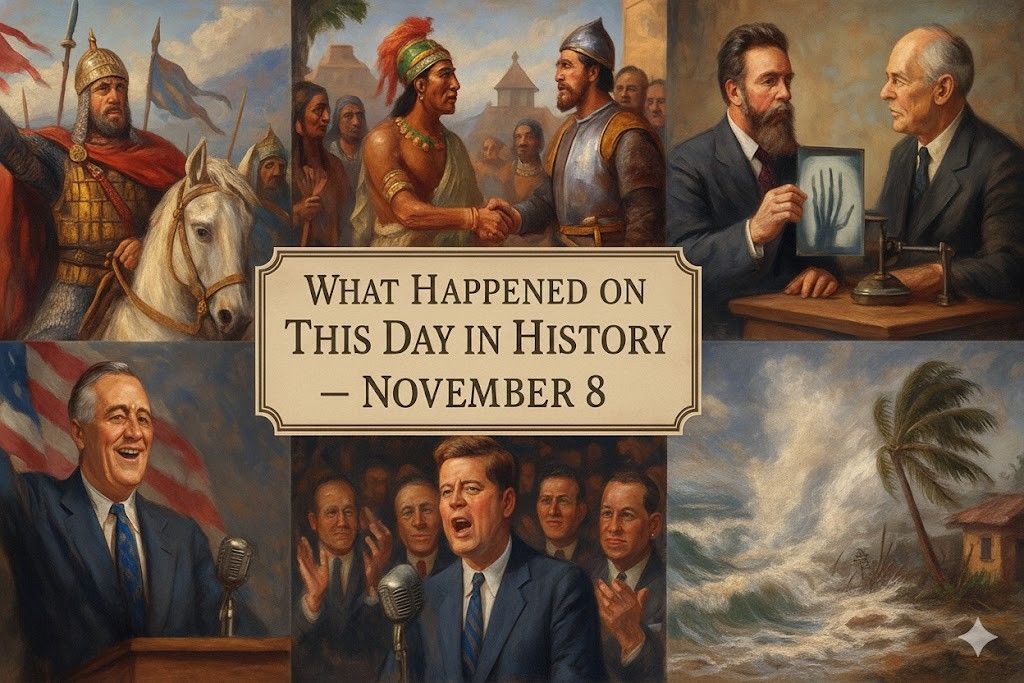
Empires clashed, new ideas emerged, and nations reshaped their paths through moments of power and change. What happened on this day in history November 8 ties together battles, discoveries, and turning points that defined eras. From royal courts to modern elections, the day reflects how history moves in cycles. Each event adds another note to the world’s unfolding story.
Important Events That Happened on November 8 in History
960 — Battle of Andrassos: Byzantine victory over the Hamdanids
Byzantine forces under Leo Phokas the Younger routed Sayf al-Dawla’s Hamdanid army at Andrassos, delivering a decisive blow to Muslim power in the region. The victory helped secure Byzantine frontiers in Asia Minor and underlined the tactical competence of the empire’s provincial generals at a moment of shifting regional balance.
1278 — Trần Thánh Tông retires in favour of his crown prince
The Trần dynasty’s second emperor, Trần Thánh Tông, formally passed the throne to Crown Prince Trần Khâm and assumed the role of Retired Emperor. This dynastic transition exemplified East Asian patterns of retired-monarch influence and demonstrated how senior sovereigns could shape policy beyond formal abdication in pursuit of continuity and stability.
1291 — Murano glassmaking confined to the island of Murano (Venice)
Venice restricted much of its glass industry to Murano, both to protect trade secrets and to reduce fire risk in the wooden city. The law fostered Murano’s long-standing artisan reputation while illustrating how early modern states regulated industry and urban hazards through localized economic policy.
1519 — Hernán Cortés enters Tenochtitlán
Hernán Cortés was received in Tenochtitlán by Aztec ruler Moctezuma II, an encounter that foreshadowed the dramatic collision of Spanish colonial ambitions and indigenous polities. The meeting opened a period of tension, negotiation and eventual conquest that would transform Mesoamerican political and demographic landscapes.
1520 — Stockholm Bloodbath begins after Danish invasion
Following a Danish conquest, the Stockholm Bloodbath saw the execution of many Swedish nobles and opponents, consolidating Danish King Christian II’s brief hold on Sweden. The massacre intensified Swedish resistance and became a galvanizing grievance in the long process of Swedish independence from the Kalmar Union.
1576 — Pacification of Ghent unites the Netherlands against Spain
The States General adopted the Pacification of Ghent, a pragmatic pact of provinces to resist Spanish presence while seeking religious peace. The agreement demonstrated early modern coalition-building across confessional lines and framed the Dutch struggle for autonomy during the revolt against Habsburg rule.
1602 — Bodleian Library opens to the public at Oxford
The Bodleian Library began public service as a major repository of books and manuscripts, marking a milestone in institutional scholarship. Its opening reflected growing public access to knowledge and the consolidation of learned archives that would fuel early modern learning and research.
1605 — Death of Robert Catesby, leader of the Gunpowder Plot
Robert Catesby, ringleader of the Gunpowder Plot intended to blow up Parliament, was killed while resisting capture. The plot’s failure and Catesby’s end hardened English state security and anti-Catholic legislation, shaping the political and religious atmosphere of early seventeenth-century England.
1620 — Battle of White Mountain ends Bohemian revolt quickly
In a brief but decisive clash near Prague, Catholic imperial forces crushed the Bohemian Protestant army, crushing hopes for Czech autonomy and triggering Habsburg reassertion. The result accelerated the Counter-Reformation in central Europe and foreshadowed broader continental conflict in the Thirty Years’ War.
1644 — Shunzhi Emperor enthroned as Qing rule consolidated in Beijing
Following Ming collapse, the Shunzhi Emperor’s enthronement established Qing rule over China, inaugurating a dynasty that would govern for centuries. The accession represented both conquest and administrative adaptation, as Manchu rulers worked to legitimize authority over a vast sedentary population.
1837 — Mount Holyoke Female Seminary founded by Mary Lyon
Mary Lyon established Mount Holyoke to provide rigorous higher education to women, pioneering institutional avenues for female learning in the United States. The seminary’s founding advanced women’s educational access and influenced the wider emergence of women’s colleges in the nineteenth century.
1861 — Trent Affair escalates Anglo-American tensions
The USS San Jacinto intercepted the British mail ship Trent and removed Confederate envoys, provoking a diplomatic crisis with Britain. The incident tested Union foreign policy in the Civil War era and underscored how naval actions could have immediate international ramifications for wartime diplomacy.
1861 — Trent Affair sparks Anglo-American diplomatic crisis
When the USS San Jacinto intercepted the British mail ship Trent and removed two Confederate envoys, London protested fiercely and diplomatic tempers flared. The incident tested U.S.–British relations during the American Civil War, forcing Washington to manage a dangerous standoff while maintaining its wartime strategy. The episode highlights how naval actions can produce immediate international consequences.
1889 — Montana becomes the 41st U.S. state
Montana’s admission to the Union symbolized the continuing integration of the American West into national political structures, accelerating territorial settlement and resource development. Statehood formalized local governance institutions while raising questions about Indigenous dispossession and resource control.
1892 — New Orleans general strike unites Black and white workers
A broad labor stoppage in New Orleans brought together Black and white trade unionists in a rare, effective four-day general strike. The action demonstrated the potential power of interracial labor coalitions and produced concrete workplace gains, even as it took place within a segregated and contentious social order. The strike remains a notable example of cross-racial labor solidarity in U.S. history.
1895 — Wilhelm Röntgen discovers the X-ray
Röntgen’s experiments produced a new form of invisible radiation that revealed internal structures without dissection. The discovery revolutionized medicine, imaging and physics, opening practical diagnostic techniques and prompting rapid technological and scientific innovation worldwide.
1917 — Council of People’s Commissars formed under Lenin
The Bolshevik leadership, including Lenin, Trotsky and Stalin, established the Council of People’s Commissars to govern revolutionary Russia. The new authority institutionalized Bolshevik rule, marshalled state resources for war and transformation, and set the administrative architecture for the Soviet state.
1923 — Beer Hall Putsch: Hitler’s failed coup in Munich
Adolf Hitler’s attempt to seize power in Munich collapsed, landing him in prison but providing a platform for future political strategy. The putsch’s failure and Hitler’s subsequent trial paradoxically elevated his national profile and shaped the evolution of the Nazi movement toward electoral politics.
1932 — Franklin D. Roosevelt elected U.S. president
FDR’s victory over Herbert Hoover heralded a major policy shift in response to the Great Depression. His election empowered New Deal experiments in economic relief and regulation, transforming federal-state relations and expectations for government intervention in crisis.
1942 — Resistance coup in Algiers aids Allied Operation Torch
French patriots in Algiers neutralized Vichyist forces, paving the way for Allied landings in North Africa. The local uprising smoothed the transition of control and exemplified coordinated resistance that could decisively affect large-scale amphibious operations.
1956 — Comet Arend–Roland observed with an unusual second tail
Comet Arend–Roland was noted for an anomalous second tail that pointed toward the Sun rather than away from it, an oddity that intrigued astronomers. The observation enriched contemporary study of cometary physics and dust-plasma interactions, reminding observers that small bodies can produce surprising phenomena that challenge simple expectations about solar effects.
1957 — Pan Am Flight 7 disappears over Pacific; Operation Grapple H-bomb test
In a single year November 8 saw both the mysterious loss of Pan Am Flight 7 and the UK’s successful hydrogen-bomb test over Kiritimati. The air disappearance highlighted aviation risks of long-range routes; the test underscored Cold War nuclear consolidation and the era’s strategic escalation.
1960 — John F. Kennedy elected President of the United States
Kennedy’s narrow victory marked a generational and media-savvy turn in American politics. His election energized Cold War-era policies, space ambitions and domestic reform agendas, while TV-era campaigning and close vote counts exposed the increasingly mediated nature of democratic contests.
1965 — British Indian Ocean Territory established
The United Kingdom created the British Indian Ocean Territory, grouping the Chagos Archipelago with nearby islands into a new colonial administrative unit. The move had long-term strategic and geopolitical implications, affecting regional sovereignty debates and the lives of island inhabitants as the territory became linked to defense and diplomatic considerations.
1965 — Murder (Abolition of Death Penalty) Act receives Royal Assent
The U.K. Parliament passed the Murder (Abolition of Death Penalty) Act, removing capital punishment for most crimes and marking a major legal and moral shift in British criminal justice. The law reflected changing public attitudes about state-sanctioned execution and inaugurated a new era of penal reform and human-rights debate in Britain.
1987 — Enniskillen Remembrance Day bombing shocks Northern Ireland
A Provisional IRA bomb killed a dozen civilians at a Remembrance Day ceremony in Enniskillen, provoking public outrage and broad condemnation. The atrocity deepened the moral and political fractures of the Troubles and influenced subsequent peace and security dialogues in Northern Ireland.
1988 — George H. W. Bush elected U.S. president
Vice President George H. W. Bush won the 1988 U.S. presidential election, succeeding Ronald Reagan and pledging continuity on many foreign-policy and domestic themes. The campaign and outcome reshaped leadership priorities for the end of the Cold War era and set the agenda for U.S. engagement into the early 1990s.
1994 — Republican Revolution reshapes U.S. Congress
Republicans made sweeping midterm gains, securing control of both House and Senate and shaping the agenda for the remainder of the decade. The electoral shift reconfigured legislative priorities, set the stage for contention with the Clinton administration, and reflected wider political realignments.
2006 — Civilian deaths reported in Beit Hanoun during Israeli operations
Israeli Defence Forces operations in Beit Hanoun resulted in the deaths of Palestinian civilians in their homes, provoking condemnation and calls for investigation. The incident exemplified the severe humanitarian toll of the Israeli–Palestinian conflict and intensified international scrutiny of military tactics and civilian protection standards.
2013 — Typhoon Haiyan devastates the Philippines
One of the most powerful tropical cyclones on record struck the Visayas, causing catastrophic loss of life and extensive infrastructure damage. The disaster prompted large-scale international relief, highlighted climate-related vulnerabilities, and spurred debates on disaster preparedness and resilience.
2016 — Major political shocks: demonetization in India and U.S. election outcomes
India’s government abruptly withdrew high-value banknotes, triggering widespread economic disruption and controversy, while in the United States Donald Trump’s election signaled a dramatic political realignment. Both events underlined the capacity of sudden policy or electoral outcomes to reshape national discourse and governance.
2020 — Myanmar election followed by a military coup the next year
Elections held on this date returned significant mandates to the National League for Democracy, only for the result to be overturned by a military coup months later. The sequence exposed the fragility of democratic gains in certain contexts and the ongoing contest between civilian rule and military power.
Read Also: What Happened On This Day In History November 7
Famous People Born On November 8
Dorothy Day — American journalist. (Nov 8, 1897 – Nov 29, 1980)
Christiaan Barnard — South African surgeon. (Nov 8, 1922 – Sep 2, 2001)
Edmond Halley — British scientist. (Nov 8, 1656 – Jan 14, 1742)
Patti Page — American singer. (Nov 8, 1927 – Jan 1, 2013)
Yamashita Tomoyuki — Japanese general. (Nov 8, 1885 – Feb 23, 1946)
Bill Joy — American software developer and entrepreneur. (Nov 8, 1954 – )
Jack Kilby — American engineer, co-inventor of the integrated circuit. (Nov 8, 1923 – Jun 20, 2005)
John Dickinson — United States statesman (“penman of the Revolution”). (Nov 8, 1732 – Feb 14, 1808)
Prajadhipok — King of Siam. (Nov 8, 1893 – May 30, 1941)
Oliver O. Howard — U.S. military officer and Freedmen’s Bureau head. (Nov 8, 1830 – Oct 26, 1909)
Gheorghe Gheorghiu-Dej — Romanian communist leader. (Nov 8, 1901 – Mar 19, 1965)
Hermann Rorschach — Swiss psychiatrist, developer of the Rorschach test. (Nov 8, 1884 – Apr 2, 1922)
Sir Arnold Bax — British composer. (Nov 8, 1883 – Oct 3, 1953)
Charles Demuth — American painter (Precisionism). (Nov 8, 1883 – Oct 23, 1935)
Raja Rao — Indian writer. (Nov 8, 1908 – Jul 8, 2006)
Patricia Barber — American jazz musician. (Nov 8, 1955 – )
Peter Weiss — German writer and dramatist. (Nov 8, 1916 – May 10, 1982)
John Sigismund — Elector of Brandenburg. (Nov 8, 1572 – Jan 2, 1620)
Edward Gibson — American astronaut (Skylab 4 science pilot). (Nov 8, 1936 – )
Johannes Rydberg — Swedish physicist (Rydberg constant). (Nov 8, 1854 – Dec 28, 1919)
Famous People Died On November 8
Blessed John Duns Scotus — Scottish philosopher and theologian. (c.1266 – Nov 8, 1308)
Louis VIII — King of France. (Sep 5, 1187 – Nov 8, 1226)
César Franck — Belgian-French composer and organist. (Dec 10, 1822 – Nov 8, 1890)
Jean Marais — French actor. (Dec 11, 1913 – Nov 8, 1998)
Ivan Bunin — Russian author, Nobel laureate. (Oct 22, 1870 – Nov 8, 1953)
Francis Parkman — American historian. (Sep 16, 1823 – Nov 8, 1893)
Jeanne-Marie Roland — French Girondin political figure. (Mar 17, 1754 – Nov 8, 1793)
Abraham Kuyper — Dutch theologian and statesman. (Oct 29, 1837 – Nov 8, 1920)
Francisco Jiménez de Cisneros — Spanish cardinal and reformer. (1436 – Nov 8, 1517)
Sir Charles Edward Kingsford Smith — Australian aviator. (Feb 9, 1897 – Nov 8, 1935)
Elisabeth Förster-Nietzsche — German editor and sister/executor of Nietzsche’s works. (Jul 10, 1846 – Nov 8, 1935)
Vitaly Ginzburg — Russian physicist, Nobel laureate. (Oct 4, 1916 – Nov 8, 2009)
Rumer Godden — British novelist and children’s author. (Dec 10, 1907 – Nov 8, 1998)
Anya Seton — American historical novelist. (c.1904 – Nov 8, 1990)
Mauritz Stiller — Swedish film director. (1883 – Nov 8, 1928)
Charles Francis Hall — American Arctic explorer. (1821 – Nov 8, 1871)
Mary Ann Bickerdyke — American Civil War nurse and hospital organizer. (Jul 19, 1817 – Nov 8, 1901)
Vesto Slipher — American astronomer. (Nov 11, 1875 – Nov 8, 1969)
Gaetano Mosca — Italian political scientist and jurist. (Apr 1, 1858 – Nov 8, 1941)
Jack Levine — American social-realist painter. (Jan 3, 1915 – Nov 8, 2010)
Observances & institutional dates — November 8
- Intersex Day of Remembrance (New South Wales, Australia).
- International Day of Radiology (European Society of Radiology).
- National Aboriginal Veterans Day (Canada).
- Synaxis of the Archangel Michael and the other Bodiless Powers of Heaven (Eastern Orthodox).
- World Urbanism Day.
- Victory Day (Azerbaijan).
Frequently Asked Questions
Why does November 8 appear in both cultural and military histories?
Because calendar days aggregate many independent events over centuries, November 8 includes military clashes and cultural inaugurations; together they show how war, science and civic life often evolve alongside one another.
Which November 8 event changed medical practice?
Wilhelm Röntgen’s 1895 discovery of X-rays transformed diagnosis and medicine, enabling non-invasive internal imaging and launching a new era of medical technology and radiology.
How did the Beer Hall Putsch matter despite its failure?
Though it failed, the putsch gave Adolf Hitler a national platform during his trial and informed his later pivot to legalistic, electoral strategies that ultimately facilitated the Nazi rise to power.
What are some November 8 anniversaries still observed today?
Modern observances include the International Day of Radiology and National Aboriginal Veterans Day; politically resonant anniversaries like the 1917 Bolshevik actions also survive in some national calendars as October Revolution commemorations.