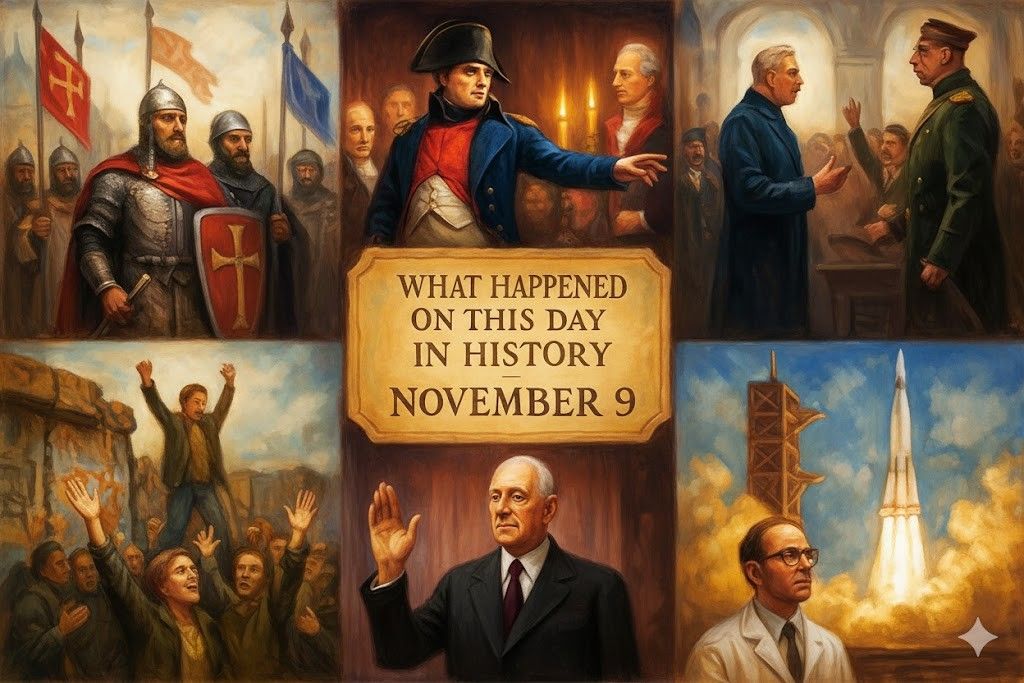
History brings striking contrasts to this date — wars, empires, discoveries, and declarations all leaving their mark. What happened on this day in history November 9 reveals how upheaval and innovation have often shared the same sunrise. From royal abdications and revolutions to scientific triumphs and cultural milestones, the pattern of change endures. Each event adds another thread to a day shaped by conflict, creativity, and transformation.
Important Events That Happened on November 9 in History
694 — Seventeenth Council of Toledo condemns Jews
At the Seventeenth Council of Toledo King Egica accused Jewish communities of aiding Muslim forces and instituted draconian penalties, including enslavement. The synod’s measures reflect the period’s volatile mix of royal power and ecclesiastical sanction, and they illustrate how minority communities could be targeted during episodes of political insecurity and religious policing.
1180 — Battle of Fujigawa: Minamoto night attack
Minamoto no Yoritomo’s forces struck Taira contingents near the Fuji River in a daring night engagement that routed much of Taira leadership. The clash is an early example of the Genpei War’s tumult, helping shift the balance toward warrior clans whose ascendancy would reshape Japan’s political order in the late twelfth century.
1277 — Treaty of Aberconwy curtails Welsh power
Under pressure from King Edward I, Llywelyn ap Gruffudd accepted a humiliating settlement that curtailed Welsh autonomy and imposed English overlordship. The treaty bought a fragile peace but foreshadowed further military pressure that ultimately eroded native Welsh authority and extended English royal control into Wales.
1307 — Knights Templar confessions after arrests
Hugues de Pairaud and other Templar officers were coerced into confessing crimes during the harsh proceedings against the Knights Templar. The trials reveal the lethal combination of royal ambition, financial motives and ecclesiastical power that dismantled one of medieval Christendom’s most powerful orders.
1313 — Battle of Gammelsdorf shapes Bavarian power politics
Louis the Bavarian defeated his cousin Frederick I of Austria at Gammelsdorf, a clash in the ongoing contest for influence among German princes. The result strengthened Louis’s regional position and illustrated how dynastic rivalry and military force determined medieval German territorial order.
1323 — Siege of Warangal ends Kakatiya rule
Muhammad bin Tughlaq’s campaign forced Prataparudra’s surrender at Warangal, terminating the Kakatiya dynasty’s rule in the Deccan. The siege exemplifies the era’s shifting imperial frontiers and the incorporation of regional polities into growing Sultanate structures on the subcontinent.
1330 — Battle of Posada secures Wallachian independence
Basarab I routed the Hungarian army under Charles I Robert in a rugged mountain ambush, an event credited with hardening Wallachian autonomy. The victory enhanced Basarab’s stature and stands as an early assertion of local resistance to external feudal pressures in southeastern Europe.
1431 — Battle of Ilava: Hungarians defeat the Hussite army
Hungarian forces routed a Hussite contingent at Ilava, delivering a tactical setback to the Hussite movement’s military reach in the region. The engagement reflected the wider fragmentation of Central European conflict in the fifteenth century and the shifting alliances that shaped late-medieval warfare and political settlement across the Carpathian frontier.
1456 — Assassination of Ulrich II, Count of Celje
Ulrich II, the last Count of Cilli, was assassinated in Belgrade, abruptly ending a dynastic line whose members had played significant roles in Central European politics. His death altered local power balances, contributing to the reordering of noble influence in the region and underscoring the period’s violent contests over territory and succession.
1520 — Stockholm Bloodbath executions consolidate Danish rule
After a Danish conquest, the Stockholm Bloodbath saw scores of Swedish nobles executed on political charges to secure Danish dominance. The massacre deepened resentment, fueling resistance that would eventually lead to Swedish independence from union with Denmark.
1580 — Siege and massacre at Smerwick
Following the surrender of a Catholic garrison at Smerwick, English commanders ordered the massacre of most prisoners, an episode that underscored the brutal sectarian and colonial dimensions of the Tudor reconquest of Ireland and the wider conflict between English authority and continental Catholic powers.
1602 — Bodleian Library opens to scholars
The Bodleian Library at Oxford formally opened, becoming a major repository of manuscripts and books for scholars. Its establishment signaled expanding institutional support for learning and the centrality of printed and manuscript culture to early modern intellectual life.
1620 — Flight of Frederick I after White Mountain defeat
One day after the decisive Battle of White Mountain, the Bohemian king Frederick I fled Prague for Wroclaw as imperial forces consolidated victory. The rout crushed hopes for a Protestant Czech polity and accelerated Habsburg reassertion in central Europe.
1720 — Burning of Judah HeHasid synagogue and Ashkenazi expulsion
The synagogue built by Judah HeHasid was burned amid creditor unrest, prompting the departure of Ashkenazi Jews from Jerusalem. The episode highlights early-modern tensions in Ottoman Jerusalem’s social and economic life and the precarious position of immigrant communities.
1729 — Treaty of Seville signed by Spain, France and Great Britain
The Treaty of Seville settled several commercial and colonial disputes among the three powers, temporarily easing tensions born of earlier wars and trade rivalry. While not a lasting peace, the agreement reconfigured diplomatic alignments and commercial arrangements in eighteenth-century Europe, illustrating how treaty-making shaped imperial interaction and mercantile competition.
1780 — Battle of Fishdam Ford repels British surprise attack
At Fishdam Ford in South Carolina, Patriot militia under Brigadier General Thomas Sumter successfully repelled a surprise assault by British and Loyalist forces. The encounter demonstrated the resilience of localized American resistance during the Revolutionary War and the importance of militia leadership in sustaining colonial opposition across the southern theater.
1791 — Dublin Society of United Irishmen founded
Reform-minded activists established the Society of United Irishmen to press for parliamentary reform and greater political rights, initially seeking nonsectarian civic change. The organization later radicalized, becoming a central actor in the 1798 uprising; its founding signals the complex interplay of reform, nationalism and revolutionary currents in late-eighteenth-century Ireland.
1799 — Napoleon’s Coup of 18 Brumaire ends the Directory
Napoleon Bonaparte’s seizure of power replaced the Directory with the Consulate, elevating him as First Consul and beginning a new authoritarian phase in French politics. The coup ended revolutionary turmoil and began Bonaparte’s path from military leader to imperial ruler.
1837 — Mount Holyoke Female Seminary founded
Educator Mary Lyon opened Mount Holyoke to give women serious higher education at a time when such opportunities were limited. The seminary pioneered curricular standards for women’s education and became a model for subsequent women’s colleges in the United States.
1888 — Final canonical Jack the Ripper murder (Mary Jane Kelly)
The brutal slaying of Mary Jane Kelly marked the last of the canonical Whitechapel murders attributed to Jack the Ripper. The case intensified public anxieties about urban poverty, policing and violent crime in rapidly industrializing London.
1913 — Great Lakes Storm reaches peak devastation
The Great Lakes Storm produced hurricane-force winds and catastrophic shipping losses, destroying vessels and killing more than 250 people. The disaster exposed vulnerabilities in maritime forecasting and prompted advances in weather warning systems for inland shipping.
1917 — Balfour Declaration published in The Times
The British government’s support for a Jewish “national home” in Palestine was formalized in the Balfour Declaration, a policy note with long-range repercussions for Middle Eastern politics and conflicting national aspirations.
1923 — Nazi Beer Hall Putsch crushed in Munich
Police and government troops suppressed Adolf Hitler’s abortive putsch, imprisoning leaders and temporarily halting a direct seizure of power. The failure forced the movement to refine its strategy toward legal and electoral paths that later proved consequential.
1938 — Kristallnacht: antisemitic pogrom launched by Nazi authorities
A coordinated campaign of violence and destruction targeted Jewish businesses, synagogues and citizens across Nazi Germany in what became known as Kristallnacht. The pogrom marked a stark escalation in state-directed persecution and presaged the genocidal policies that followed.
1942 — Axis forces reach Volga bank in Stalingrad operations
German units under Friedrich Paulus pressed to the Volga, capturing much of ruined Stalingrad and isolating Soviet defenders into narrow pockets. The brutal fighting around the city presaged an extended siege that would become pivotal to the Eastern Front’s ultimate turning point.
1945 — UNRRA founded to coordinate relief after World War II
Forty-four nations signed an agreement to create the United Nations Relief and Rehabilitation Administration, committing to coordinated postwar relief for displaced populations and war-ravaged communities—an early example of large-scale multilateral humanitarian organization.
1953 — Cambodia gains independence from France
Cambodia achieved full independence from French colonial rule, inaugurating a new national sovereignty under King Norodom Sihanouk. The transfer of power reshaped Southeast Asian geopolitics, launching Cambodia into a complex postcolonial era marked by state-building challenges and regional tensions during the Cold War.
1965 — Northeast blackout and political protest shockwaves
A massive blackout struck parts of the U.S. and Canada, exposing infrastructural vulnerabilities, while the same year saw Roger LaPorte’s dramatic self-immolation in protest against the Vietnam War—events that reflected both technical fragility and potent political dissent in the 1960s.
1967 — NASA launches Apollo 4 atop the first Saturn V
The unmanned Apollo 4 test marked a major engineering milestone: the Saturn V rocket’s successful lift-off validated systems crucial for later crewed lunar missions. The launch advanced the U.S. space program toward its Apollo objectives.
1979 — NORAD nuclear false alarm triggers Cold War alarm
A major false alarm at NORAD and an alternate command center in Maryland briefly signaled a purported large-scale Soviet strike before human review and multiple sensors cancelled the alert. The episode highlighted the fragility and risks of early-warning systems during heightened superpower tensions, and it informed later reforms in command-and-control safeguards.
1985 — Garry Kasparov becomes youngest World Chess Champion
At twenty-two, Garry Kasparov defeated Anatoly Karpov to become the youngest World Chess Champion, launching a dominant and influential career. His victory symbolized a generational shift in elite chess and carried cultural weight in the Soviet chess establishment, where the game was both an intellectual pursuit and a field of national prestige.
1989 — Berlin Wall openings accelerate German reunification
Mass protests and political shifts culminated in East Germany opening checkpoints in the Berlin Wall, allowing citizens to travel freely to West Berlin. The moment symbolized the collapse of Communist control in Eastern Europe and set a rapid course toward reunification.
1994 — Discovery of element darmstadtium announced
Scientists reported the synthesis of darmstadtium, adding a new heavy element to the periodic table and underscoring the continuing frontiers of nuclear chemistry and particle physics in laboratories seeking ever-heavier atoms.
1996 — Evander Holyfield regains heavyweight title by TKO of Mike Tyson
Evander Holyfield scored a technical knockout over Mike Tyson to claim the heavyweight championship for a third time, a high-profile moment in 1990s boxing. The result renewed Holyfield’s standing at the top of the division and became part of a widely watched era of heavyweight rivalries and commercialized sporting spectacle.
1998 — Historic NASDAQ settlement orders $1.03 billion restitution
A U.S. federal judge approved a record civil settlement requiring 37 brokerage firms to pay $1.03 billion to investors harmed by NASDAQ price-fixing. The ruling represented a significant accountability moment for financial markets, provoking regulatory scrutiny and reforms aimed at restoring investor confidence in market fairness.
1998 — United Kingdom abolishes remaining capital punishment offences
The U.K. completed the legal abolition of capital punishment by removing it from the statute books for the few remaining offences, finalizing a decades-long shift away from execution. The change reflected evolving legal norms and public attitudes about punishment and human rights following earlier moratoria and partial reforms.
1999 — TAESA Flight 725 crashes after takeoff from Uruapan, Mexico
TAESA Flight 725 crashed shortly after departing Uruapan, Michoacán, killing all 18 people on board. The accident prompted aviation investigations into safety procedures, oversight and operational standards, underscoring persistent risks in regional air travel and the need for strengthened regulatory measures.
2000 — Uttarakhand created as India’s 27th state
Uttarakhand was officially carved from northwestern Uttar Pradesh, becoming India’s 27th state to provide regional governance better aligned with local geographic, cultural and administrative needs. Statehood reflected longer-running demands for administrative autonomy and aimed to improve development and political representation for the Himalayan region.
2014 — Catalonia votes in a non-binding consultation on self-determination
A consultative vote asked Catalans whether they wished to become a state and, if so, an independent one—sparking intense political debate in Spain about autonomy, identity and constitutional law, even as the consultation lacked legal force.
2020 — Armenia, Azerbaijan, and Russia sign Nagorno-Karabakh armistice
After weeks of fighting, the three parties agreed to a ceasefire that reshaped control in the disputed region, involving territorial concessions and Russian peacekeeper deployments—an agreement that altered regional balances and long-standing lines of contention.
2023 — World’s first whole eye transplant announced by NYU surgeons
Surgeons at NYU Langone Health reported the successful performance of a whole eye transplant, described as a pioneering surgical milestone. The announcement marked a potential advance in reconstructive ophthalmology, provoking both scientific interest and careful ethical and clinical scrutiny as the medical community assesses long-term outcomes and feasibility.
Read Here: What Happened On This Day In History November 8 — Powerful Facts
Famous People Born On November 9
Ed Wynn — American actor. (Nov 9, 1886 – Jun 19, 1966)
Anne Sexton — American poet. (Nov 9, 1928 – Oct 4, 1974)
R. Sargent Shriver — American politician and public servant. (Nov 9, 1915 – Jan 18, 2011)
Mikhail Tal — Latvian chess grandmaster. (Nov 9, 1936 – Jun 28, 1992)
Ivan Turgenev — Russian novelist. (Nov 9, 1818 – Sep 3, 1883)
Robert Frank — American photographer. (Nov 9, 1924 – Sep 9, 2019)
Stanford White — American architect. (Nov 9, 1853 – Jun 25, 1906)
Jean Monnet — French political economist and founding figure of European integration. (Nov 9, 1888 – Mar 16, 1979)
Mabel Normand — American actress and early film star. (Nov 9, 1892? – Feb 23, 1930)
Dietrich von Choltitz — German general, last commander of Nazi-occupied Paris. (Nov 9, 1894 – Nov 4, 1966)
Hermann Weyl — Mathematician and theoretical physicist. (Nov 9, 1885 – Dec 8, 1955)
Bryn Terfel — Welsh bass-baritone singer. (Nov 9, 1965 – )
Marie Dressler — Canadian-born actress. (Nov 9, 1868 – Jul 28, 1934)
A. P. Hill — Confederate general. (Nov 9, 1825 – Apr 2, 1865)
Imre Kertész — Hungarian writer, Nobel laureate. (Nov 9, 1929 – Mar 31, 2016)
Sir Giles Gilbert Scott — British architect. (Nov 9, 1880 – Feb 8, 1960)
Fritz Thyssen — German industrialist. (Nov 9, 1873 – Feb 8, 1951)
Jack W. Szostak — Biochemist and geneticist. (Nov 9, 1952 – )
Erich Auerbach — Literary scholar. (Nov 9, 1892 – Oct 13, 1957)
Gail Borden — Inventor and philanthropist. (Nov 9, 1801 – Jan 11, 1874)
Famous People Died On November 9
Ramsay MacDonald — Prime Minister of the United Kingdom. (Oct 12, 1866 – Nov 9, 1937)
Yves Montand — French actor and singer. (Oct 13, 1921 – Nov 9, 1991)
Chaim Weizmann — First President of Israel, chemist and statesman. (Nov 27, 1874 – Nov 9, 1952)
Henry Cabot Lodge — U.S. Senator and diplomat. (May 12, 1850 – Nov 9, 1924)
K. R. Narayanan (Kocheril Raman Narayanan) — President of India. (Oct 27, 1920 – Nov 9, 2005)
Har Gobind Khorana — Biochemist and Nobel laureate. (Jan 9, 1922 – Nov 9, 2011)
Guillaume Apollinaire — Poet and critic. (Aug 26, 1880 – Nov 9, 1918)
Bobby Allison — American stock-car racer. (Dec 3, 1937 – Nov 9, 2024)
Riccardo Giacconi — Physicist and Nobel laureate. (Oct 6, 1931 – Nov 9, 2018)
John N. Mitchell — U.S. Attorney General. (Sep 15, 1913 – Nov 9, 1988)
Ed Bradley — Journalist and correspondent. (Jun 22, 1941 – Nov 9, 2006)
Constantine VII Porphyrogenitus — Byzantine emperor and scholar. (c.905 – Nov 9, 959)
Judith Jamison — Dancer and artistic director. (May 10, 1943 – Nov 9, 2024)
Sigmund Romberg — Composer of operetta. (Jul 29, 1887 – Nov 9, 1951)
William Camden — Historian and antiquarian. (May 2, 1551 – Nov 9, 1623)
Stieg Larsson — Writer and activist. (Aug 15, 1954 – Nov 9, 2004)
Art Carney — Actor and comedian. (Nov 4, 1918 – Nov 9, 2003)
Louise Thaden — Aviator and record-setter. (Nov 12, 1905 – Nov 9, 1979)
Charles de Gaulle — French general and statesman. (Nov 22, 1890 – Nov 9, 1970)
Harriot Kezia Hunt — Physician and medical pioneer. (Nov 9, 1805 – Jan 2, 1875)
Observances & institutional dates — November 9
- Birthday of Muhammad Iqbal (Pakistan).
- Day of the Skulls / Día de los Ñatitas (Bolivia).
- Flag Day (Azerbaijan).
- Independence Day (Cambodia — from France, 1953).
- Inventors’ Day (Germany, Austria, Switzerland).
- Uttarakhand Day (Uttarakhand, India).
- World Freedom Day (United States).
Frequently Asked Questions
Why does November 9 feature so many political ruptures?
November 9’s long record reflects contingency: multiple unrelated crises, coups and symbolic moments happened to fall on the same calendar day. Over centuries, the date accumulated political significance through repetition—each event shaped local memory, and some anniversaries later acquired ritual or propagandistic weight.
What made Kristallnacht on November 9, 1938, particularly consequential?
Kristallnacht was a state-sponsored wave of arson, vandalism and arrests aimed at Jewish communities across Nazi Germany. It marked a sharp escalation from discriminatory policy to widespread violence, foreshadowing the regime’s later genocidal program.
Which November 9 scientific event had the widest practical impact?
Wilhelm Röntgen’s discovery of X-rays in 1895 (announced publicly the following year) transformed medicine by enabling non-invasive imaging, rapidly spawning new diagnostic practices and technological innovation in medical care.