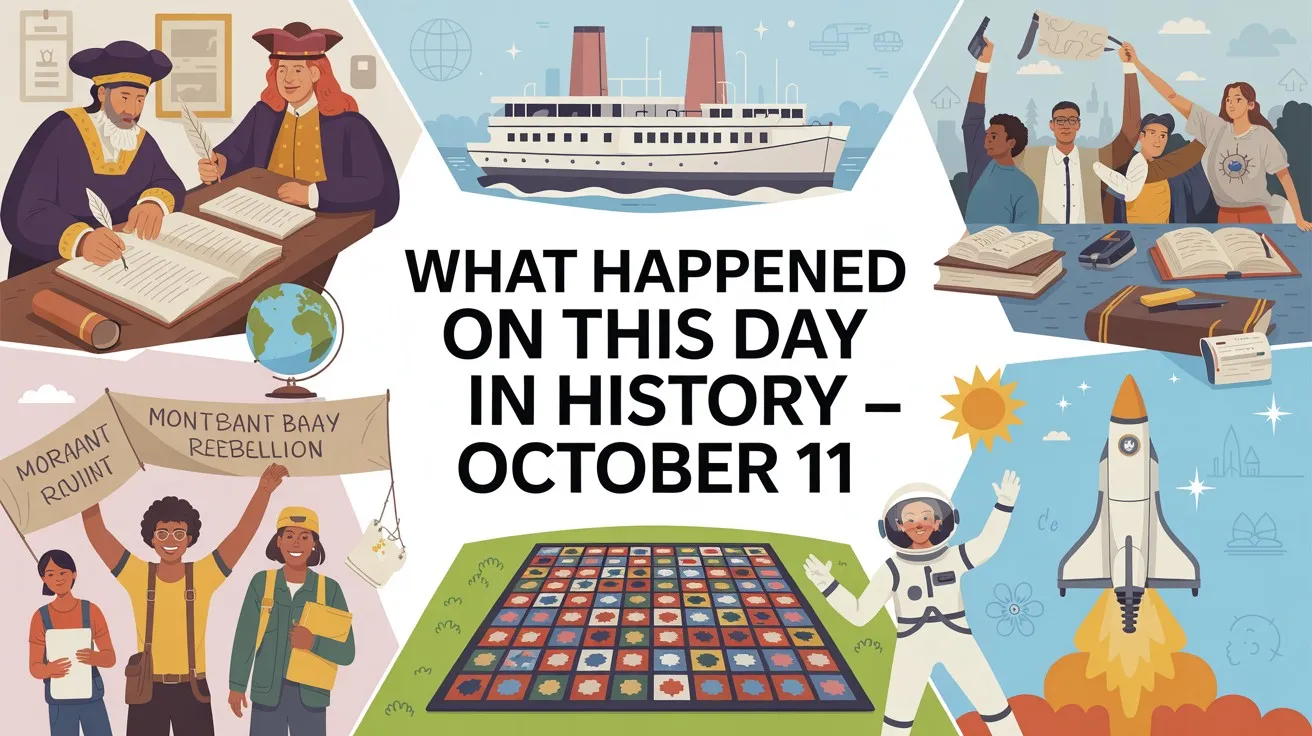
From medieval councils and colonial treaties to pioneering steam ferries, twentieth-century revolutions, and modern space launches, What happened on this day in history October 11 reveals a chain of political shifts and technological breakthroughs.
These episodes — some solemn, others celebratory — show how the date has repeatedly served as a turning point, linking innovation, reform, and remembrance across centuries.
Major Events on October 11
1138 — Aleppo earthquake devastates northern Syria
A catastrophic quake struck Aleppo and surrounding regions in 1138, often counted among the most destructive medieval earthquakes. Contemporary accounts describe massive urban collapse, widespread fires and a very high death toll in cities and villages across northern Syria. The disaster reshaped local settlements, compromised fortifications and intensified humanitarian pressures in a region already marked by political contest. Its memory remained part of medieval Levantine chronicles and urban rebuilding efforts.
1142 — Peace treaty ends the Jin–Song wars (China)
A negotiated settlement brought an end, for the moment, to a phase of conflict between the Jurchen Jin dynasty and the Southern Song dynasty. Treaties and truces in this era frequently involved large tribute payments, territorial adjustments and recognition of spheres of control. The agreement stabilized borders briefly and allowed both polities to direct resources inward toward reconstruction and administrative consolidation. The peace is one chapter in a long series of Northern–Southern dynamics in medieval China.
1311 — Ordinances of 1311 curb royal authority in England
The Ordinances, imposed by barons and clergy, restricted King Edward II’s powers and demanded reforms in royal administration and finances. Driven by elite grievances about favorites and fiscal mismanagement, the measures represented a recurring medieval pattern of magnates forcing constitutional concessions. Though enforcement waxed and waned, the Ordinances shaped political bargaining and established precedents for collective oversight of royal policy. They are an early episode in England’s episodic efforts to check monarchical excess.
1531 — Battle of Kappel — Protestant defeat in Swiss Reformation
At a clash near Kappel, forces aligned with the Reformation suffered defeat at the hands of Catholic troops, a setback in Switzerland’s confessional conflicts. The engagement underscored regional divisions within the Swiss cantons and the often-localized nature of Reformation-era warfare. Military setbacks and negotiated settlements alternately advanced and stalled religious change across the region. The battle fed later attempts to mediate theological and civic differences among the cantons.
1614 — New Netherland Company seeks trade monopoly in North America
Dutch merchants pressed the States General for exclusive rights in the region that would become the northeastern United States, signaling growing commercial interest in North American trade routes and natural resources. Such corporate petitions foreshadowed the chartered-company model that would shape early colonial governance and mercantile expansion. The move contributed to patterns of Dutch settlement and competition with other European powers for coastal trade and furs. It’s an early instance of corporate-state collaboration in colonial enterprise.
1634 — Burchardi flood kills thousands in North Friesland
A storm surge inundated low-lying North Frisian lands, with contemporary estimates of roughly 15,000 dead and massive agricultural losses. The catastrophe demonstrated the vulnerability of coastal communities in the North Sea region and stimulated long-term investments in dike building and communal flood management. Social and demographic impacts were profound as villages were destroyed and resettlement followed. The Burchardi flood is one of the North Sea’s major medieval-early modern environmental shocks.
1649 — Cromwell’s New Model Army sacks Wexford (Ireland)
Parliamentarian forces captured and sacked Wexford during campaigns against Irish Confederate troops; contemporary reports note heavy military and civilian casualties. The operation fits a broader pattern of brutal siege warfare and reprisals during the Cromwellian conquest of Ireland, with lasting consequences for landholding, sectarian memory and demographic change. Such episodes hardened divisions and became touchstones in subsequent Irish political narratives. Wexford’s suffering is often remembered in depictions of seventeenth-century wartime atrocities.
1776 — Lake Champlain naval defeat delays British advance
An American flotilla was defeated on Lake Champlain by the Royal Navy but managed to delay British operations long enough to influence campaigns the following year. Tactical defeats at sea or on inland waters sometimes yielded strategic benefits by buying time for reinforcement and defensive preparations. The engagement illustrates how control of waterways could shape Revolutionary War maneuvers in the northern theater. The delay contributed to later American fortifications and command decisions.
1797 — Battle of Camperdown — Royal Navy routs Batavian fleet
The British fleet won a decisive engagement against the Batavian Navy (Dutch allies of Revolutionary France), weakening French-aligned naval power in the North Sea. The victory secured British maritime lines, boosted public morale at home and underlined naval dominance as a strategic asset in the era’s coalition wars. Camperdown affected subsequent convoy protection, trade security and the distribution of naval forces. It remains a notable British triumph of the French Revolutionary Wars.
1811 — Juliana begins service as New York’s first steam ferry
The Juliana’s operation marked an early step in steam-powered passenger transport on American waterways, foreshadowing wider steam adoption for riverine and coastal movement. Steam ferries increased reliability and frequency of crossings, reshaping urban connections and commuting patterns. The technological shift accelerated commercial and social integration in port cities like New York, underpinning later transport networks. Juliana’s launch is a small but telling milestone in transportation history.
1840 — Bashir Shihab II surrenders and is exiled to Malta
The Maronite leader’s capitulation to Ottoman forces and subsequent exile altered local leadership structures in Mount Lebanon and reflected Ottoman efforts to reassert central control. Exile of regional potentates was a common imperial tactic to neutralize rivals while reorganizing provincial governance. The episode had ramifications for local communal arrangements and for subsequent Ottoman administrative reforms in the Levant. It was part of the broader nineteenth-century struggle between local autonomy and imperial centralization.
1852 — University of Sydney inaugurated (Australia’s oldest university)
The University of Sydney opened as the colony’s first degree-granting institution, signaling a push toward formal higher education in Australia. Its foundation reflected growing settler societies’ demands for trained professionals and intellectual life modeled on European universities. Over time the university contributed to public administration, legal and scientific professions across Australia. The inauguration marked a cultural maturation in colonial institutions and civic identity.
1862 — Confederate raid on Chambersburg, Pennsylvania (Civil War)
Confederate cavalry conducted an incursion into Pennsylvania, temporarily disrupting local order and seizing supplies — part of a pattern of raids that tested Union rear areas. Such cavalry actions exposed the vulnerability of border regions and pressured both military logistics and civilian morale. Raids fed debates about defense, reprisals and the conduct of warfare on contested terrains. Chambersburg’s experience is one episode in the Civil War’s broader theatre of maneuver and counter-maneuver.
1865 — Morant Bay rebellion begins in Jamaica with mass march
Hundreds of black men and women marched in Morant Bay protesting injustice and economic hardship; the protests escalated into wider unrest and a severe colonial crackdown. The rebellion highlighted post-emancipation social tensions, failures of legal redress and conflicts over land and labor in the Caribbean. The harsh British response provoked debate about colonial governance and eventually spurred administrative reforms in Jamaica. The event remains a key moment in Caribbean post-slavery history.
1890 — Founding of the Daughters of the American Revolution (DAR) in Washington, D.C.
The DAR organized as a lineage-based society devoted to historic preservation, patriotic education and commemoration of Revolutionary War ancestry. The organization reflected late-nineteenth-century interest in nation-building rituals, civic association and defining public memory. Over time DAR chapters sponsored local memorials, educational activities and genealogical research, while sometimes generating controversy over membership and inclusion. Its founding shows how private societies helped shape national remembrance.
1899 — Second Boer War erupts in South Africa
War flared between British imperial forces and Boer republics (Transvaal and Orange Free State) over sovereignty, mining wealth and political rights. The conflict combined conventional campaigns with guerrilla warfare, scorched-earth tactics and concentration camps, provoking international criticism and major regional upheaval. The war reorganized South African politics and accelerated British imperial reforms, eventually leading to a new political settlement and union. Its legacies include contested memories of imperialism and national formation.
1906 — U.S.–Japan tensions rise over segregated schools in San Francisco
San Francisco’s decision to segregate Japanese students into separate schools sparked a diplomatic dispute with Japan and tested American local practices against international relations. The episode illustrated how municipal policies could have outsized foreign-policy consequences, especially amid rising Asian immigration and shifting power balances in the Pacific. Negotiated remedies and federal interventions followed, seeking to defuse bilateral tensions. The case prefigured recurring frictions in Pacific diplomacy.
1910 — Theodore Roosevelt becomes first U.S. president to fly in an airplane
Piloted by aviator Arch Hoxsey, former President Roosevelt took a brief flight, marking a public milestone connecting political leadership and emerging aviation. Though a short hop by later standards, the flight symbolized rapid cultural interest in heavier-than-air travel and the celebrity role of early aviators. The event helped normalize flight as a facet of modern life and demonstrated political endorsement of technological progress. It remains a symbolic presidential aviation first.
1912 — First Balkan War: Greek troops liberate Kozani after Sarantaporo
In the wake of fighting at Sarantaporo, Greek forces pushed Ottoman garrisons out of Kozani, part of a sequence of Balkan campaigns that reconfigured Ottoman rule in Europe. The military advances contributed to nationalist state formation across the Balkans and to new territorial alignments preluding later twentieth-century conflicts. Liberation narratives were intertwined with ethnic politics and wartime civilian displacement. The operation illustrates the localized battlefield dynamics of the Balkan Wars.
1918 — San Fermín earthquake (Puerto Rico) triggers tsunami and casualties
A powerful quake (≈7.1 Mw) struck Puerto Rico, producing damage and a tsunami that together killed scores — estimates vary up to about 116 deaths. The disaster highlighted the island’s seismic risk and the vulnerability of coastal settlements to combined earthquake-tsunami events. Local relief, reconstruction and hazard awareness efforts followed in the quake’s aftermath. The event is remembered in Puerto Rican disaster history and planning.
1937 — Duke and Duchess of Windsor tour Nazi Germany, meet Hitler (22 Oct)
The former king and his consort toured Germany and had contacts with the Nazi leadership during a controversial visit later in October; the trip has been scrutinized for its political optics and alleged sympathies. The tour complicated the Windsors’ post-abdication reputation and fed diplomatic gossip about royal attitudes toward fascist regimes. Historians debate motives and consequences, but the visit remains a potent example of how high-profile travel intersected with interwar politics and propaganda.
1941 — Launch of the National Liberation War of Macedonia
Part of the wider partisan and anti-occupation struggles in the Balkans during World War II, Macedonian resistance activities intensified in 1941, contributing to later partisan governance claims and postwar federal arrangements. The partisan movement mobilized local populations, engaged Axis occupation forces and tied into Yugoslavia’s complex wartime politics. The uprising period fed postwar narratives about liberation and national identity in the region.
1942 — Naval action off Guadalcanal — U.S. defeats Japanese force
In a night battle near Guadalcanal, U.S. Navy ships intercepted and routed a Japanese force, contributing to the grinding struggle for control of the Solomons. Naval engagements around Guadalcanal were crucial to Allied efforts to halt Japanese expansion and to secure sea lines for further offensives. The action exemplifies the high stakes and intense ship-to-ship combat of the Pacific campaign. Guadalcanal remained a turning point in the island war.
1944 — Tuvan People’s Republic annexed by the Soviet Union
The short-lived Tuvan state was incorporated into the Soviet Union, ending an era of contested sovereignty in the region and expanding Soviet territory. Incorporation reflected wartime geopolitical consolidation and Soviet policy toward autonomous republics on its periphery. The absorption altered local governance, cultural policy and economic integration within the Soviet system. It is one episode in the mid-twentieth-century border and state reconfigurations of Eurasia.
1950 — FCC licenses CBS field-sequential color TV system (U.S.)
The Federal Communications Commission granted a license for one of the early color-television systems, signaling technological competition over color broadcasting standards. Multiple rival systems competed until later standards (NTSC and successors) prevailed; the licensing episode reflects broadcast industry struggles to commercialize color TV. The development shaped programming, consumer electronics markets and how viewers experienced television as a mass medium. It’s part of mid-century media history.
1954 — French troops complete withdrawal from North Vietnam (Geneva accords)
Following the 1954 Geneva Conference, French military forces evacuated Vietnam, ending a major colonial presence after Dien Bien Phu and ushering in a divided Vietnam under competing regimes. The withdrawal reconfigured Southeast Asia, prompted new alignments and set the stage for later Cold War interventions. Decolonization’s diplomatic settlements reshaped regional sovereignty and superpower engagement. The event is central to twentieth-century Vietnamese and global Cold War histories.
1958 — NASA launches Pioneer 1 (first U.S. space probe attempt)
Pioneer 1 was launched as the United States’ first attempt at a lunar probe; it failed to reach stable lunar orbit but gathered early data and helped engineers refine deep-space techniques. The mission represented a nascent American space program responding to Soviet accomplishments and contributed technical lessons for later successes. Early probe attempts like Pioneer 1 marked the trial-and-error phase of planetary and lunar exploration. They are foundational in U.S. space history.
1962 — Second Vatican Council convenes (first ecumenical council in 92 years)
Pope John XXIII opened Vatican II, launching a major program of liturgical, theological and pastoral reform within the Roman Catholic Church. The council’s decisions promoted liturgical vernaculars, increased lay participation and adjusted church relations with the modern world and other Christian denominations. Vatican II reshaped Catholic practice and identity across the globe and remains a defining moment in modern church history. Its effects continue to reverberate in ecclesial debates.
1968 — NASA launches Apollo 7 (first successful crewed Apollo mission)
Apollo 7 completed the first full-scale crewed test flight of the Apollo command and service module after earlier setbacks, restoring confidence in the U.S. lunar program. The mission’s success paved the way for subsequent missions culminating in Apollo 11’s lunar landing the following year. Apollo 7 showcased crewed orbital operations, life-support systems and spacecraft reliability under real mission conditions. It was a vital step in the race to the Moon.
1971 — John Lennon’s “Imagine” released as a single (song of peace and hope)
Lennon’s “Imagine” became an enduring anthem of idealism and peace, blending simple melody with utopian lyrics that resonated internationally. The song’s cultural impact extended beyond pop charts into public rituals, benefit concerts and political imagination. While debated for its political simplicity by critics, “Imagine” remains a touchstone for musical activism and aspirational protest. Its release cemented Lennon’s post-Beatles public stature.
1974 — Nuclear Regulatory Commission (NRC) established in U.S.
President Gerald Ford signed legislation creating the NRC to oversee civilian nuclear energy, separating regulatory functions from promotional agencies. The NRC’s formation centralized safety oversight, licensing and enforcement in response to growing nuclear commercial activity and public concerns about safety. The commission shaped standards for reactor operations, waste handling and emergency preparedness. Its creation reflects post-war tensions between energy expansion and regulatory control.
1976 — George Washington posthumously promoted to General of the Armies
In a ceremonial act recognizing his preeminence in American military history, Washington was elevated to the rank of General of the Armies, a symbolic reaffirmation of his status above all other U.S. military officers. The posthumous promotion consolidated ceremonial precedence and underscored national reverence for founding figures. While largely honorific, the move reflects how states use rank and ritual to express historical continuity and political memory.
1984 — Kathryn D. Sullivan becomes first American woman to walk in space (STS-41-G)
A member of Space Shuttle Challenger’s crew, Sullivan performed an EVA that made her the first U.S. woman to conduct a spacewalk, marking a milestone in gender inclusion in astronautics. Her achievement exemplified how space programs gradually diversified their crews and expanded opportunities for women in STEM professions. Spacewalks like Sullivan’s also advanced extravehicular techniques and human performance research. The EVA remains a notable pioneer moment in NASA history.
1986 — Reagan and Gorbachev meet in Iceland for summit discussions
U.S. President Ronald Reagan and Soviet leader Mikhail Gorbachev convened in Reykjavík as part of an intensified dialogue on arms control, including limits on intermediate-range missiles. The summit advanced mutual understanding and set conditions for later treaties even as it revealed substantive gaps. Reykjavik is often cited as a turning point in late Cold War diplomacy, illustrating both rapprochement possibilities and the technical complexities of nuclear reductions. It paved the way for subsequent accords.
1987 — AIDS Memorial Quilt first displayed during Second National March on Washington
The Quilt’s public showing assembled thousands of panels commemorating people who died of AIDS, transforming private grief into a powerful visual advocacy for recognition, research funding and compassionate public policy. The project helped humanize the epidemic, challenged stigma, and pressured policymakers for medical and social responses. The Quilt became a central artifact in activist culture and community memorialization. Its public impact reshaped national conversations about disease and rights.
1987 — Start of Operation Pawan (Indian forces in Sri Lanka)
Operation Pawan marked India’s large-scale military intervention in Sri Lanka’s civil conflict, with major troop deployments and urban operations that produced heavy casualties among combatants and civilians. The operation reflected India’s complex regional security concerns and the difficult dynamics of peacekeeping versus counter-insurgency. Outcomes were contested, contributing to strained bilateral relations and difficult legacies for interveners and local populations. The intervention remains controversial in South Asian strategic memory.
1991 — Anita Hill testifies during Clarence Thomas confirmation hearings
Attorney Anita Hill’s televised testimony of sexual-harassment allegations against nominee Clarence Thomas electrified national debate over workplace harassment, gender, and judicial fitness. The hearings polarized public opinion, prompted changes in congressional hearing procedures and helped catalyze later legal and cultural shifts around sexual-harassment awareness. Hill’s testimony affected recruitment of women to public office and influenced subsequent reforms in harassment law and organizational practice. The episode remains a watershed in American gender politics.
1999 — Air Botswana pilot steals ATR-42 and crashes at Sir Seretse Khama International Airport
A pilot deliberately taxied a passenger aircraft, took off without clearance and subsequently crashed into other planes on the ground, killing himself and damaging airport assets. The incident exposed gaps in airport security, mental-health screening and crew oversight, leading to investigations and procedural reviews. Aviation security measures and cockpit access policies were among areas reconsidered in response to such insider threats. The event is an unusual and tragic case of deliberate aircraft misuse.
2000 — NASA launches STS-92 (100th Space Shuttle mission)
STS-92 marked the 100th flight of the Space Shuttle program, contributing further assembly and logistics support to the International Space Station. The mission underscored the Shuttle’s central role in constructing and sustaining low-Earth orbital infrastructure. As the program maturely balanced scientific, commercial and station-support objectives, milestones like STS-92 celebrated accumulated capability and highlighted debates about Shuttle costs and future launch architectures. It’s a symbolic threshold in human spaceflight operations.
2001 — Polaroid files for federal bankruptcy protection
Long a household name in instant photography, Polaroid’s bankruptcy filing reflected technological disruption from digital imaging and shifting consumer preferences. The case illustrates how once-dominant technology firms struggled to adapt to rapid digital transitions and changing market structures. Corporate reorganization sought to salvage brand value and intellectual property. Polaroid’s decline is often cited in studies of technological obsolescence and corporate adaptation.
2002 — U.S. Congress passes AUMF on Iraq (authorization for force)
Congress approved broad authority to use military force against Iraq, forming the legal basis cited by the Bush administration for subsequent military intervention. The resolution provoked intense domestic and international debate over evidence, preventive war doctrines and congressional oversight of major uses of force. Its passage remains central to controversies about the Iraq War’s origins, accountability and lessons for legislative deliberation on war powers. The AUMF had long-running implications for U.S. foreign policy.
2002 — Myyrmanni shopping mall bombing in Vantaa, Finland kills seven
A suicide bombing at the mall shocked Finnish society, prompting national investigations into motives, lone-actor threats and public-space security. The attack prompted reflections on domestic extremism, emergency response coordination and victim assistance. It remains a rare but consequential example of violent crime in Finland’s modern history. The incident influenced later policy discussions on prevention and social integration.
2005 — U.S. Army Corps pumps last floodwaters from New Orleans after Katrina
Approximately 43 days after Hurricane Katrina’s catastrophic landfall, engineers completed water removal operations that allowed staged reentry and recovery efforts to begin. The slow drainage and subsequent rebuilding highlighted vulnerabilities in levee systems, urban planning and social inequality exposed by the disaster. Katrina’s aftermath prompted wide debates on resilience, federal-local coordination and long-term reconstruction policy. The pumping milestone was a practical turning point in recovery operations.
2013 — Migrant boat sinks off Sicily; at least 359 drown
A rickety vessel carrying migrants capsized in the Mediterranean, producing one of the deadliest tragedies in recent migration history and renewing international attention on search-and-rescue responsibilities, smuggling networks and humanitarian responses.
The mass loss of life intensified calls for regional cooperation, safe-route policies and broader migration governance. The incident remains a stark reminder of migration’s human costs and the limits of ad-hoc rescue measures. It spurred limited policy initiatives and public outcry.
2018 — Soyuz MS-10 abort: crew returns safely after launch failure
A Soyuz rocket suffered a booster separation anomaly shortly after liftoff, triggering an automatic abort and ballistic return that brought the crew safely back to Earth — a dramatic demonstration of launch-escape systems. The successful emergency sequence reassured partners about crew safety procedures and prompted technical review of the rocket stages. The event highlighted both the risks of human spaceflight and the robustness of engineered contingencies. It was closely watched by international space agencies.
2018 — Hurricane Michael makes catastrophic landfall in Florida (Category 4)
Michael struck the Florida Panhandle with extreme winds and storm surge, causing widespread destruction, dozens of deaths and multi-billion-dollar losses. The hurricane exposed evacuation, building-code and infrastructure vulnerabilities in coastal communities and triggered long recovery processes. Michael became a central example in discussions of climate impacts on storm intensity, coastal resilience and disaster insurance. The storm’s consequences continue to inform disaster planning in the region.
2020 — Bus-train collision in Thailand kills and injures dozens
A tragic rail crossing collision resulted in significant loss of life and injuries, underscoring persistent challenges in grade-crossing safety and public transport governance. Such accidents prompt inquiries into signaling, road design, enforcement and public awareness to prevent repeat tragedies. The event joined a global set of transportation safety concerns that national authorities address through infrastructure and regulatory reforms. Victims’ families and communities faced extended recovery and legal processes.
2021 — Lakhimpur Kheri case developments in India (custody of minister’s son)
Following violent incidents tied to a high-profile protest and convoy attack, authorities detained individuals including a politician’s son in connection with deaths during clashes, fueling intense political debate and legal scrutiny. The case highlighted tensions over farm protests, law enforcement responses and political accountability in India. It generated protests, legal challenges and calls for impartial investigation, reflecting how localized violence can escalate into national controversy. The matter remained legally and politically contested.
2021 — Nobel Prize in Economics awarded for natural-experiment methods (Card, Angrist, Imbens)
David Card, Joshua Angrist and Guido Imbens were recognized for methodological contributions that improved empirical identification in applied economics, affecting labor economics, econometrics and policy evaluation. Their work underpins robust causal claims in fields ranging from minimum-wage effects to education interventions. The award showcased the growing influence of micro-empirical techniques and the policy relevance of rigorous identification strategies. It stimulated further academic and policy uptake of these methods.
2022 — Russia carries out missile strikes across Ukraine on October 11–12
A wave of missile attacks struck multiple Ukrainian cities, producing civilian casualties and infrastructure damage as part of the ongoing 2022 invasion. The strikes intensified humanitarian needs, damaged energy systems ahead of winter, and reinforced international condemnation and aid flows. The attacks exemplified the conflict’s toll on civilians and urban systems and shaped diplomatic and military responses by external states. The campaign remained a major dynamic of the war.
2022 — India inaugurates Mahakal Lok Corridor at Shri Mahakaleshwar Temple
Prime Minister Narendra Modi opened a renovated temple precinct project aimed at enhancing pilgrimage infrastructure and cultural tourism, reflecting the intersection of heritage, development and political symbolism. The project combined religious heritage presentation with urban redevelopment investments and stirred discussions about heritage conservation and public spending. Large inaugurations of temple projects often carry political resonance in India’s civic culture. The corridor is now part of local pilgrimage routes.
2022 — India launches flex-fuel Toyota Corolla Altis capable of higher ethanol blends
The ministerial launch signalled government efforts to promote biofuel blends and reduce fossil-fuel dependence through vehicle compatibility and fuel-policy measures. Flex-fuel vehicles enable higher ethanol mixtures, potentially lowering carbon intensity if feedstocks are sustainably produced. The move reflects industrial policy linking automotive technology, energy security and environmental goals. Such launches also spur debates about food-fuel tradeoffs, supply chains and rural economic impacts.
2022 — Large protest in Swat Valley after school-van driver shot; students wounded
A mass demonstration erupted demanding justice after the killing of a school-van driver, reflecting local outrage and broader concerns about security, insurgency spillover and protection of civilians. Such protests can catalyze government responses, policing changes and community mobilization for safety reforms. The incident highlighted vulnerabilities of education logistics and the social impacts of localized violence. It prompted appeals for improved law-and-order measures and compensation.
Check Here: What Happened On this Day in History October 10: Gripping Moments in History
Quick sections
Earlier history
Medieval earthquakes, Karbala-era martyrdoms and early modern treaties illustrate how natural disaster and institutional bargaining shaped pre-modern polities.
States & Revolutions
Wuchang (1911), the Ten Years’ War in Cuba (1868) and Balkan and decolonization episodes show October 11 as a date for uprisings, independence and constitutional change.
Science, Tech & Exploration
From Triton’s discovery to early steam ferries and space probes (Pioneer 1, Apollo 7), October 11 links astronomy, transport and the space age.
Culture & Media
Gershwin’s Porgy and Bess, Lennon’s “Imagine” and broadcast milestones (first satellite relay of Tokyo Olympics on other Octobers; early color-TV licensing) reflect cultural shifts that reshaped mass audiences.
Disasters & Human Rights
Large earthquakes, Hurricane Michael, the Morant Bay rebellion and maritime sinkings (migrant tragedies, wartime losses) underscore recurrent themes of vulnerability, justice and recovery.
Notable births — October 11
Art Blakey — American drummer & bandleader — born 1919.
Jerome Robbins — American choreographer — born 1918.
Patty Murray — U.S. senator — born 1950.
Rei Kawakubo — Japanese fashion designer (Comme des Garçons) — born 1942.
Orlando Hernández — Cuban baseball player — born 1965.
Roman Jakobson — Russian-born linguist (Prague School) — born 1896.
Henry John Heinz — American manufacturer (H.J. Heinz Co.) — born 1844.
Charles H. Revson — American businessman (Revlon founder) — born 1906.
Harlan Fiske Stone — 12th Chief Justice, U.S. Supreme Court — born 1872.
Dana Scott — American mathematician & computer scientist — born 1932.
Lewis Fry Richardson — British mathematician & meteorologist — born 1881.
William Knox D’Arcy — British entrepreneur (Iranian oil pioneer) — born 1849.
Lucas Papademos — Greek economist & prime minister — born 1947.
Maria Bueno — Brazilian tennis champion — born 1939.
Mal Whitfield — American Olympic middle-distance runner — born 1924.
François Mauriac — French novelist, Nobel Prize laureate — born 1885.
Friedrich Bergius — German chemist, Nobel laureate — born 1884.
Wilhelm Olbers — German astronomer — born 1758.
Willie Hoppe — American billiards world champion — born 1887.
Samuel Clarke — English theologian & philosopher — born 1675.
Notable deaths — October 11
Dorothea Lange — American documentary photographer — died 1965.
Meriwether Lewis — American explorer (Lewis & Clark) — died 1809.
Jean Cocteau — French poet, artist, filmmaker — died 1963.
James Prescott Joule — English physicist (energy/heat) — died 1889.
Boniface VIII — pope — died 1303.
Huldrych Zwingli — Swiss Reformation leader — died 1531.
Anton Bruckner — Austrian composer — died 1896.
Aleksei Leonov — Soviet cosmonaut (first spacewalk) — died 2019.
Jörg Haider — Austrian politician — died 2008.
Kazimierz Pułaski — Polish patriot & U.S. Revolutionary officer — died 1779.
Joe Morgan — American baseball Hall-of-Fame & broadcaster — died in 2020.
Jan, Count Žižka — Bohemian military leader (Hussite) — died 1424.
Edwin Sutherland — American criminologist — died 1950.
Marion King Hubbert — American geophysicist — died 1989.
William Vickrey — Nobel Prize economist — died 1996.
Jean Henri Fabre — French entomologist — died 1915.
Vito Volterra — Italian mathematician — died 1940.
Albert Robida — French illustrator & SF pioneer — died 1926.
Maurice de Vlaminck — French Fauvist painter — died 1958.
Stanley Morison — English typographer (Times New Roman) — died 1967.
Observances & institutional dates
October 11 (Eastern Orthodox liturgics).
General Pulaski Memorial Day (United States).
International Day of the Girl Child.
International Newspaper Carrier Day.
National Coming Out Day.
Revolution Day (North Macedonia / anniversary of 1941 events).
Frequently asked questions (FAQs)
What happened on October 11th in history?
On October 11, 1776, a British squadron led by Sir Guy Carleton defeated a flotilla of 15 American gunboats commanded by Brig. Gen. Benedict Arnold during the Battle of Valcour Island on Lake Champlain (present-day Clinton County, New York).
Which special day is today, 11 October?
October 11 is observed as the International Day of the Girl Child, a day dedicated to raising awareness of the challenges girls face and promoting their rights and empowerment.
Who was born on 11 October?
Amitabh Bachchan, the renowned Indian film actor, was born on October 11, 1942, in Allahabad (now Prayagraj), then part of British India.
What happened on October 11, 2001?
On October 11, 2001, the United States launched one of its largest military strikes in Afghanistan — a major escalation that came nearly a month after the September 11 attacks.
Why is October 11 so special?
October 11 marks several notable events, including the opening of the Second Vatican Council on October 11, 1962 — an important moment in modern Roman Catholic history that signaled engagement with the contemporary world.
What is the importance of October 11th?
October 11 was declared the International Day of the Girl Child by the UN (via Resolution 66/170 on December 19, 2011) to recognize girls’ rights and the specific obstacles they face worldwide.
What is Oct 11 National day?
October 11 is also observed as National Coming Out Day, which promotes visibility, support, and awareness for people in LGBTQ+ communities.
What happened on 11 October 1999?
On October 11, 1999, Peter Jackson and the film crew began principal photography for The Lord of the Rings, officially launching production on the epic trilogy.
Which cricketer was born on October 11?
Hardik Himanshu Pandya, the Indian international cricketer, was born on October 11, 1993.