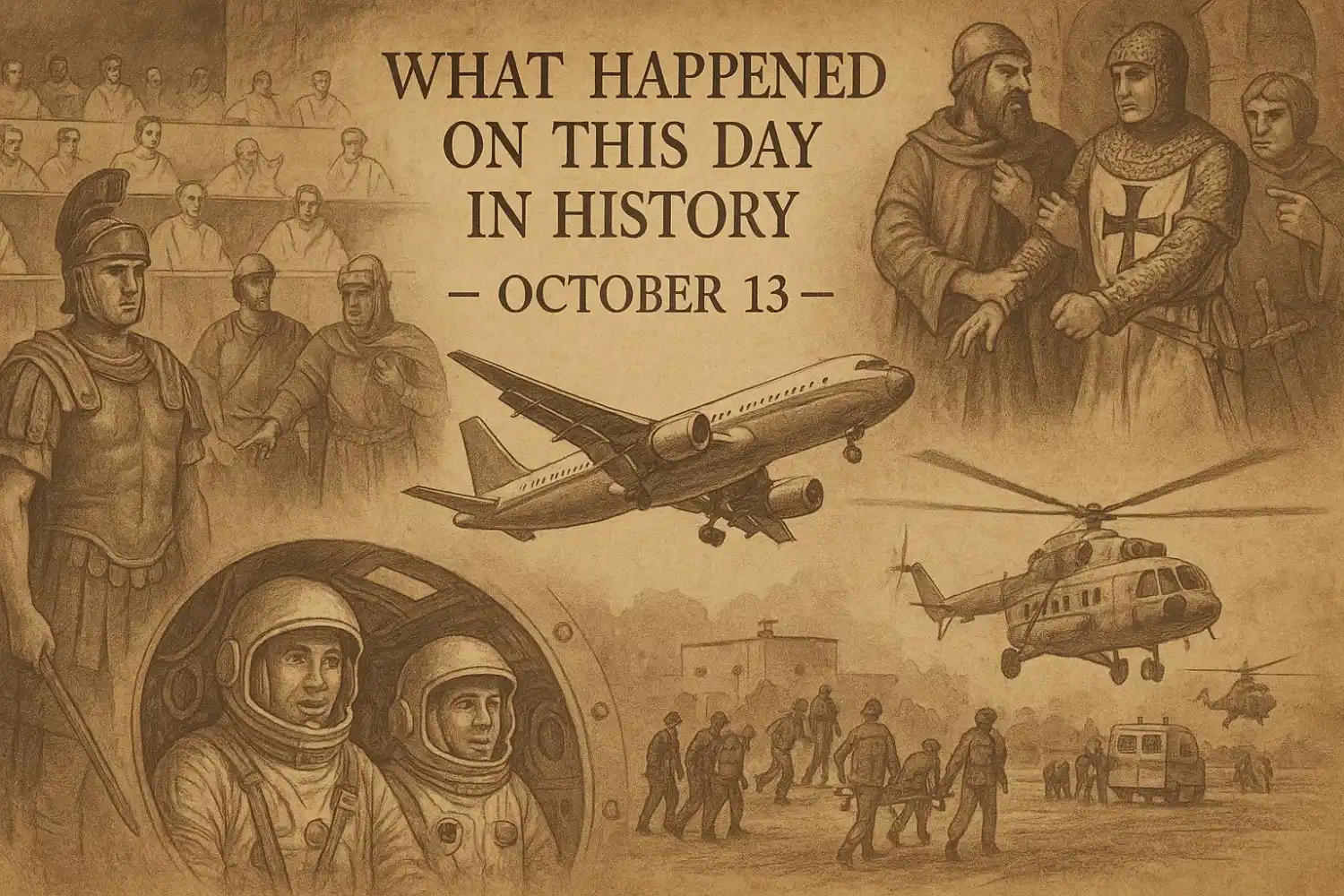
From imperial conspiracies and medieval crackdowns to modern triumphs in science, sport, and survival, what happened on this day in history October 13 highlights humanity’s recurring dance with power, risk, and resilience — moments that reshaped empires, tested courage, and captured the world’s attention.
Major Events on October 13
54 — Roman emperor Claudius dies (mysterious poisoning)
Emperor Claudius died amid palace intrigue and suspicion of poisoning, and the throne passed to his adoptive son Nero instead of his biological son Britannicus. The succession intensified imperial factionalism, altered court politics and ushered in Nero’s reign, a period later remembered for controversial fiscal policies, dramatic public spectacles and centralization of power.
409 — Vandals and Alans cross into Hispania
Groups of Vandals and Alans crossed the Pyrenees and moved into the Iberian Peninsula, accelerating the breakdown of Roman authority in the West. Their movements contributed to the era’s population displacements, new settlement patterns, and contests with local Roman and Visigothic forces, shaping the political geography of early medieval Iberia.
1269 — Present Westminster Abbey church building consecrated
The present structure of Westminster Abbey was consecrated, marking a major moment in English religious and royal architecture. The building would serve as the site of coronations, royal burials and national ceremonies for centuries, shaping England’s ceremonial landscape and acting as a physical witness to shifting dynasties and national identity.
1307 — Mass arrests of the Knights Templar in France
King Philip IV ordered coordinated dawn arrests of hundreds of Knights Templar across France; many later confessed under torture to charges of heresy. The suppression dismantled a wealthy transnational order, redistributed its assets, and transformed medieval ideas about military–religious institutions and royal authority.
1332 — Rinchinbal Khan briefly becomes Yuan emperor (53 days)
Rinchinbal Khan ascended as Khagan and Emperor of the Yuan dynasty but reigned only 53 days before his death. His brief rule revealed the fragility of succession politics in the Yuan court and foreshadowed the internal divisions and administrative stresses that would trouble the dynasty in subsequent decades.
1399 — Coronation of Henry IV of England at Westminster Abbey
Henry Bolingbroke was crowned Henry IV after deposing Richard II, inaugurating the Lancastrian line. The coronation marked a dynastic rupture that produced long-term political rivalries, questions of legitimacy, and a chain of events that helped precipitate the Wars of the Roses and decades of aristocratic conflict.
1644 — Swedish–Dutch fleet routs Danish fleet at Fehmarn
A combined Swedish and Dutch naval force defeated the Danish fleet near Fehmarn, capturing roughly 1,000 prisoners. This action formed part of broader seventeenth-century maritime contests in the Baltic and North Seas, shaping trade routes, regional power balances and the naval strategies of Northern European states.
1710 — British capture Port Royal, capital of French Acadia
British forces seized Port Royal after a siege, undermining French control in Acadia and altering colonial power in northeastern North America. The capture influenced patterns of settlement, trade and military rivalry in the region and was an early step in the long Anglo-French competition for control of Atlantic colonies.
1775 — Continental Congress establishes the Continental Navy
The Continental Congress authorized a naval force to challenge British shipping and support the Revolutionary cause at sea. The Continental Navy’s privateering and engagements with British vessels provided an important maritime strategy for the colonies and became the institutional ancestor of the United States Navy.
1792 — Cornerstone of the United States Executive Mansion laid (future White House)
In Washington, D.C., the cornerstone of the Executive Mansion was laid, beginning the construction of the building later commonly called the White House. The structure would come to symbolize the presidential office and the physical seat of the emerging U.S. federal government.
1793 — First Battle of Wissembourg: Austro-Prussian victory
Austro-Prussian forces defeated Republican French armies at the First Battle of Wissembourg, an engagement in the early Revolutionary Wars. The action affected the strategic situation on France’s frontiers, illustrated coalition pressures facing revolutionary France, and shaped subsequent campaigns in 1793–1794.
1812 — Sir Isaac Brock repels Rensselaer’s invasion (War of 1812)
British and Indigenous forces under Sir Isaac Brock repelled an American invasion led by General Rensselaer, securing Upper Canada’s defenses. Brock’s leadership became a key element of Canadian wartime memory; the action helped preserve British control in parts of North America and intensified loyalties among allied Indigenous groups.
1821 — Declaration of Independence of the Mexican Empire publicly proclaimed
The Declaration of Independence of the Mexican Empire was publicly read, formalizing Mexico’s break from Spanish colonial rule after prolonged insurgency. The proclamation inaugurated the new empire’s political structures and set in motion the difficult processes of governance, land reform and regional order in the post-colonial era.
1843 — B’nai B’rith founded in New York City
B’nai B’rith was founded in New York as a mutual-aid and service organization for Jewish immigrants, providing charitable support, social networking, and civic advocacy. Its foundation reflected the growing institutional life of Jewish communities in the United States and contributed to organized communal responses to social needs.
1881 — First recorded modern Hebrew conversation by Eliezer Ben-Yehuda
Eliezer Ben-Yehuda and companions conducted what is recorded as the first modern conversation in revived Hebrew, a symbolic moment for the Hebrew language revival. This linguistic experiment laid social groundwork for Hebrew’s transformation from liturgical language to living modern speech in subsequent Zionist and cultural movements.
1885 — Georgia Institute of Technology founded (Atlanta)
Georgia Tech opened in Atlanta as a technical school designed to serve industrializing needs in the American South. The institute’s founding reflected broader trends in technical education, industrial development and regional modernization that would shape economic and scientific growth in the 20th century.
1892 — Edward Emerson Barnard discovers a comet photographically
Astronomer Edward Emerson Barnard became the first to discover a comet using photographic plates, demonstrating the power of photography in astronomical discovery. This innovation advanced observational astronomy by enabling detection of faint objects and systematic sky surveys beyond the limits of direct visual observation.
1903 — Boston Red Sox win the first modern World Series
The Boston Americans (later the Red Sox) defeated the Pittsburgh Pirates in an eight-game series to win the first modern World Series, shaping baseball’s championship tradition. The event helped institutionalize professional baseball’s postseason format and deepened regional sporting rivalries across the United States.
1908 — Margaret Travers Symons speaks in UK Parliament (first woman)
Margaret Travers Symons burst into the House of Commons and spoke, becoming the first woman recorded to address the UK Parliament chamber. Her action was tied to suffrage militancy and public protest, highlighting the pressure for women’s political rights and the symbolic disruption of parliamentary exclusivity.
1911 — Prince Arthur becomes first royal Governor General of Canada
Prince Arthur, Duke of Connaught and Strathearn, became the first Governor General of Canada of royal descent, symbolizing imperial connections and the ceremonial representation of the Crown in dominion governance. His appointment reflected the ties binding Canada and Britain’s monarchy in the early 20th century.
1915 — Battle of the Hohenzollern Redoubt ends the Battle of Loos (WWI)
Fighting at the Hohenzollern Redoubt brought a close to the Battle of Loos, a costly World War I engagement marked by heavy casualties and limited territorial gains. The battle illustrated the brutal stalemate and grinding attrition characteristic of trench warfare on the Western Front.
1917 — “Miracle of the Sun” witnessed at Fátima, Portugal
An estimated 70,000 people gathered in Fátima to see the so-called “Miracle of the Sun,” described by observers as unusual solar behavior after a series of Marian apparitions. The event dramatically increased the scope of the Fátima pilgrimage and became a defining moment in 20th-century Catholic devotional practice.
1921 — Treaty of Kars formalizes borders in the South Caucasus
Soviet republics and Turkey signed the Treaty of Kars, settling borders between Turkey and the South Caucasus states and formalizing spheres of control in the volatile post-imperial region. The treaty had long-running consequences for minority populations and regional diplomacy in the Transcaucasus.
1923 — Ankara declared the capital of Turkey
The Turkish Grand National Assembly designated Ankara as the new capital, shifting the republican center away from Istanbul. The move embodied the Turkish Republic’s project of modernization, administrative centralization, and symbolic break with the Ottoman imperial past.
1943 — Marshal Badoglio announces Italy has declared war on Germany
Marshal Pietro Badoglio publicly announced Italy’s declaration of war on Germany following Mussolini’s fall, formally aligning Italian forces with the Allies. The announcement complicated military and political dynamics on the Italian peninsula and accelerated the country’s wartime fragmentation and liberation sequence.
1944 — Soviet Riga Offensive captures the city
Soviet troops captured Riga in an offensive that expelled German occupation forces from the Latvian capital. The operation was part of the Red Army’s late-war Baltic advances and contributed to postwar Soviet control and political realignment in the region.
1946 — Constitution of the French Fourth Republic adopted after referendum
French voters approved a new constitution, inaugurating the Fourth Republic and a parliamentary political arrangement in postwar France. The constitution attempted to stabilize governance after liberation but faced persistent political fragmentation that later led to institutional reform.
1950 — Premiere of All About Eve in Paris and New York
The film All About Eve premiered to critical acclaim in Paris and New York, later winning six Academy Awards including Best Picture. The film’s sharp industry satire and memorable performances reinforced Hollywood’s self-critique and left a lasting mark on cinematic portraiture of fame.
1962 — Pacific Northwest cyclone (Columbus Day Storm) causes widespread damage
The Pacific Northwest was hit by a cyclone with hurricane-force winds—later called the Columbus Day Storm—resulting in 46 deaths and massive destruction. The storm dramatically affected forestry, infrastructure and disaster planning and remains a benchmark event in regional meteorological history.
1972 — Aeroflot Flight 217 crashes outside Moscow, killing 174
Aeroflot Flight 217 crashed on approach to Moscow, producing a major aviation disaster with 174 fatalities. The accident raised questions about aviation safety procedures, air traffic control, and aircraft operation in the Soviet civil aviation system.
1972 — Uruguayan Air Force Flight 571 crashes in the Andes (survival and rescue)
A chartered flight carrying a Uruguayan rugby team crashed in the Andes; initially 28 survived the impact but only 16 endured until their rescue on December 23. The prolonged ordeal, acts of survival under extreme conditions and eventual rescue captured worldwide attention and provoked ethical and cultural debate.
1972 — Flag of Okinawa Prefecture officially adopted
Okinawa Prefecture formally adopted its official flag, a symbol that contributed to local identity amid U.S. administrative control and later reversion to Japanese sovereignty. The flag’s adoption reflected regional civic expression and postwar political developments.
1976 — First electron micrograph of Ebola virus taken at the CDC
Researchers at the U.S. Centers for Disease Control and Prevention produced the first electron micrograph images of the Ebola virus, enabling direct visualization of the pathogen and advancing virology. The imagery supported diagnostic research and epidemiological understanding of a then-emerging virus.
1976 — Lloyd Aéreo Boliviano Boeing 707 crash kills 91
A Lloyd Aéreo Boliviano Boeing 707 crashed shortly after takeoff from El Trompillo Airport in Santa Cruz de la Sierra, killing 91 people. The tragedy highlighted aviation safety challenges in Bolivia and the region and prompted investigations into aircraft maintenance and operational protocols.
1977 — Hijacking of Lufthansa Flight 181 by the PFLP
Lufthansa Flight 181 was hijacked by the Popular Front for the Liberation of Palestine in a dramatic hostage crisis that crossed several countries. The incident intensified international counterterrorism cooperation and exposed the vulnerabilities of civil aviation to politically motivated violence.
1981 — Hosni Mubarak approved as Egypt’s new president (after Sadat’s assassination)
One week after Anwar Sadat’s assassination, Egyptian voters approved Hosni Mubarak as president, beginning a long tenure that would shape Egypt’s domestic politics and regional role. The approval reflected a rapid attempt at political stabilization following a violent rupture.
1983 — Ameritech launches first U.S. commercial cellular network (Chicago)
Ameritech activated the first commercial cellular network in the United States in Chicago, marking a decisive step toward mass mobile telephony. The network’s launch paved the way for rapid expansion of wireless services and subsequent social and technological change in communication.
1988 — Carbon-14 tests date the Shroud of Turin to the Middle Ages (announcement)
Carbon-14 dating results announced that the Shroud of Turin likely dated to the Middle Ages, challenging claims of ancient origin while sparking ongoing debate about methodology and provenance. The finding drew widespread public interest across scientific and religious communities.
1990 — Syrian forces attack areas of Lebanon and remove General Michel Aoun
Syrian military operations in Lebanon forced General Michel Aoun out of the presidential palace, altering the balance of power and deepening Syria’s influence in Lebanese politics. The intervention highlighted the complexity of Lebanon’s civil conflict and the role of regional actors.
1993 — Earthquakes in Papua New Guinea trigger deadly landslides
A sequence of earthquakes in the Finisterre Range produced massive landslides that killed at least 60 people in eastern Papua New Guinea. The catastrophe exposed the vulnerability of remote, mountainous communities to seismic hazards and complicated relief delivery due to terrain and infrastructure limits.
2010 — Chilean miners rescued after 69 days underground (Copiapó)
Thirty-three miners trapped in the Atacama Desert were rescued after a 69-day operation that drew global attention. The successful extraction combined international engineering, sustained coordination and public solidarity, becoming an emblem of technological problem-solving and collective endurance.
2013 — Crowd crush during Navratri festival in India kills 115
A stampede during Navratri festivities resulted in at least 115 deaths and over 110 injuries, underscoring perils of crowd management at large religious events and prompting scrutiny of safety planning, municipal oversight and emergency response in mass gatherings.
2016 — Maldives announces withdrawal from the Commonwealth of Nations
The Maldives government declared its intention to withdraw from the Commonwealth, citing sovereignty and diplomatic disagreements. The decision reflected tensions between domestic policy choices and multilateral norms concerning governance and human rights.
2018 — Himalayan snowstorm kills climbers and guides; Pope Francis defrocks two Chilean bishops
A severe Himalayan snowstorm destroyed a camp and killed five South Korean climbers and four Nepali guides, highlighting the lethal risks of high-altitude expeditions. Separately that year, Pope Francis removed two Chilean bishops from clerical status amid a major sexual-abuse scandal, reflecting institutional accountability pressures within the Church.
2019 — Brigid Kosgei sets women’s marathon world record at Chicago Marathon
Kenyan runner Brigid Kosgei set a new women’s world record with a time of 2:14:04 in Chicago, a performance that reset expectations in elite long-distance running and spotlighted advances in training, pacing and race conditions for women’s athletics.
2019 — Turkish offensive in northeast Syria sparks local territorial arrangements; Pakistan-Iran diplomacy
As Turkish operations proceeded in northeast Syria, local forces adjusted arrangements to deter further incursion; the dynamics illustrated fluid territorial responses in conflict zones. That same year, Pakistan’s prime minister visited Tehran to pursue mediation between Iran and Saudi Arabia, reflecting regional diplomatic activity.
2019 — Pakistan’s Prime Minister Imran Khan visits Tehran to mediate regional tensions
Pakistan’s leader visited Tehran to explore mediation between Iran and Saudi Arabia, meeting senior Iranian officials as part of diplomatic efforts to ease regional frictions. The trip reflected Pakistan’s regional diplomatic balancing and attempts at back-channel conflict management.
2020 — Arrest of main suspect in high-profile motorway gang-rape case sparks national debates
Authorities arrested a primary suspect in a widely publicized motorway gang-rape case that had provoked national outrage and calls for tougher penalties. The arrest fed ongoing public discourse on sexual violence, legal response and societal demands for accountability.
2020 — Jihadist attacks in central Mali; arrests in high-profile rape case; U.S. Supreme Court hearings begin
Multiple militant attacks in central Mali killed around 25 people, underscoring Sahel insecurity. In the same period, police arrested a principal suspect in a widely reported motorway gang-rape case that had sparked national outrage in another country, and U.S. Senate hearings for Supreme Court nominee Amy Coney Barrett opened amid intense partisan scrutiny.
2021 — William Shatner travels to space on Blue Origin’s New Shepard
Actor William Shatner flew on Blue Origin’s suborbital New Shepard flight, becoming the oldest person to travel to space. The flight highlighted emerging commercial space tourism, public fascination with civilian astronauts and debates about the meaning and access to spaceflight.
2022 — Jury orders Alex Jones to pay nearly $1 billion to Sandy Hook families
A court ordered conspiracy theorist Alex Jones to pay nearly $1 billion in damages to families of Sandy Hook victims for defamation and emotional harm, a landmark ruling on online misinformation, accountability and the legal limits of public speech in the digital era.
2023 — Israel issues evacuation orders amid Israel–Hamas war; regional humanitarian concerns
Amid the Israel–Hamas war, Israeli authorities issued evacuation orders and prepared for potential ground operations, heightening humanitarian concerns and displacement. The developments underscored the conflict’s regional ramifications and the civilian costs of intensified hostilities.
2024 — Israel–Lebanon/Gaza regional escalation produces strikes and cross-border incidents
Fighting and attacks tied to the Israel–Lebanon/Gaza escalation produced strikes and clashes across the front, including reported incidents affecting UNIFIL sites. The events contributed to regional instability, humanitarian distress and international diplomatic alarm.
You can Check Here: What Happened On this Day in History October 12- Exclusive Insights
Quick sections
Earlier History
Claudius’s death, the Templars’ arrests and Westminster’s consecration—October 13 repeatedly marks power shifts, court intrigue and institutional foundations across medieval and ancient eras.
States & Revolutions
From Mexico’s independence proclamation and Ankara’s selection as capital to the Treaty of Kars and wartime realignments, the date hosts key acts of state formation and diplomatic settlement.
Science, Tech & Media
Events include early astrophotography, the first electron micrograph of Ebola, the commercialization of cellular networks, and cinematic milestones—showing the date’s footprint in science and media history.
Arts & Culture
Premieres, language revivals and significant births and deaths link October 13 to artistic innovation—from All About Eve and revived Hebrew to musicians, writers and sculptors on this date.
Disasters & Human Rights
Air crashes, earthquakes, crowd disasters, wartime losses and rescue dramas on October 13 highlight human vulnerability and the policy, legal and humanitarian responses they often trigger.
Notable births — October 13
Chris Carter — American writer & producer (The X-Files) — born 1956.
Yves Montand — French actor & singer — born 1921.
Art Tatum — American jazz pianist — born 1909.
Maria Cantwell — U.S. senator (Washington) — born 1958.
Turgut Özal — President & Prime Minister of Turkey — born 1927.
Charles Frederick Worth — pioneer of haute couture — born 1825.
Jozef Tiso — Slovak priest and statesman — born 1887.
Eddie Mathews — American baseball player — born 1931.
John Griggs Thompson — mathematician, Fields Medalist — born 1932.
Kurt Schumacher — German politician (SPD leader) — born 1895.
Arna Bontemps — American writer (Harlem Renaissance) — born 1902.
John R. Commons — American economist (labor history) — born 1862.
Kid McCoy — American boxer — born 1873.
Hugo Weisgall — American composer & educator — born 1912.
Charles Curran — British broadcasting administrator (BBC) — born 1921.
Louise Closser Hale — American actress & author — born 1872.
Peter Barlow — English optician & mathematician — born 1776.
Edward Blake — Canadian statesman — born 1833.
William Kirby — Canadian writer — born 1817.
Moritz Hauptmann — German composer & theorist — born 1792.
Notable deaths — October 13
Milton S. Hershey — Hershey Chocolate founder & philanthropist — died 1945.
Joachim Murat — Marshal of France; King of Naples — died 1815.
Antonio Canova — Italian Neoclassical sculptor — died 1822.
Sir Isaac Brock — British soldier, “Hero of Upper Canada” — died 1812.
Dario Fo — Italian playwright, Nobel laureate — died 2016.
Maya Deren — American avant-garde filmmaker — died 1961.
Le Duc Tho — Vietnamese negotiator (Nobel related) — died 1990.
Sir Henry Irving — English actor & theatrical manager — died 1905.
Elzie Segar — American cartoonist (Popeye) — died 1938.
Louise Glück — American poet, Nobel laureate — died 2023.
Walter H. Brattain — Nobel laureate physicist (transistor co-discoverer) — died 1987.
Bertram N. Brockhouse — Canadian Nobel laureate physicist — died 2003.
Alice Neel — American portrait painter — died 1984.
Gertrude Käsebier — American photographer — died 1934.
Bhumibol Adulyadej — King of Thailand — died 2016.
Cesare Zavattini — Italian screenwriter & neorealism advocate — died 1989.
Manuel Ávila Camacho — President of Mexico — died 1955.
Pedro de Mena — Spanish Baroque sculptor — died 1688.
Vincenzo Monti — Italian Neoclassical poet & translator — died 1828.
Nicolas Malebranche — French Cartesian philosopher & priest — died 1715.
Observances & institutional dates — October 13
Azerbaijani Railway Day (Azerbaijan).
Christian feast day: Blessed Alexandrina of Balasar; Daniel and companions (of Ceuta); Edward the Confessor (translation); Gerald of Aurillac; Blessed Maddalena Panattieri (OP); Theophilus of Antioch.
October 13 (Eastern Orthodox liturgics).
Doi taikomatsuri (October 13–15, Shikokuchūō, Ehime, Japan).
International Day for Disaster Risk Reduction (UN international observance).
Paramedics’ Day (Poland).
Rwagasore Day (Burundi).
Frequently asked questions (FAQs)
What was the “Miracle of the Sun” at Fátima on October 13, 1917?
Witnesses reported unusual solar behavior—described as the sun “dancing” or appearing to spin—following a series of Marian apparitions at Fátima. The large crowd reaction turned the site into a major pilgrimage destination and heightened the international profile of the Fátima devotion.
Why are the Chilean miners’ rescue (2010) and the Andes plane crash (1972) both associated with October 13?
Both events involve dramatic survival and rescue narratives: the 1972 Andes crash produced a prolonged survival story culminating in rescue months later, while the 2010 Copiapó rescue ended a 69-day entrapment. Each drew sustained international attention to human endurance and rescue engineering.
What did Ankara’s designation as capital on October 13, 1923, signify?
Choosing Ankara symbolized the new Turkish Republic’s political and geographic reorientation away from the Ottoman imperial center in Istanbul. It enabled centralized administration and was part of broader modernization and nation-building policies.
Who was Sir Isaac Brock and why is his action on October 13, 1812, remembered?
Sir Isaac Brock was a British commander who helped repel an American invasion during the War of 1812. His leadership secured British positions in Upper Canada and he is commemorated as a national military hero in Canada, especially after his death later in the war.
How did the first commercial U.S. cellular network (Chicago, 1983) change communications?
The Ameritech network launched large-scale mobile telephony in the U.S., initiating rapid adoption of mobile phones, new business models for carriers, and profound changes in personal and commercial communication over the following decades.