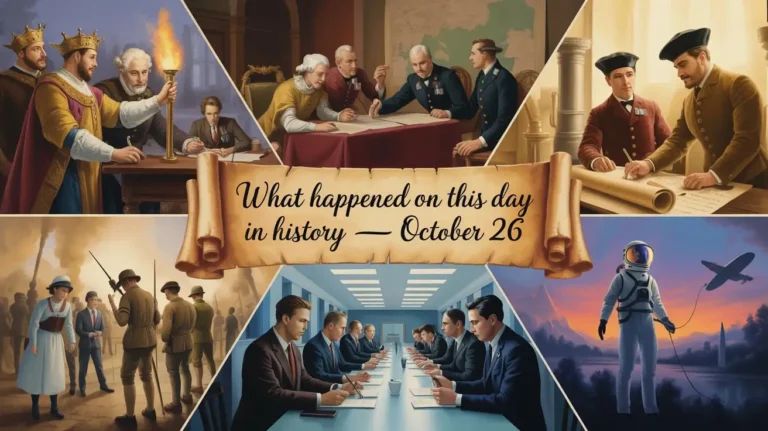
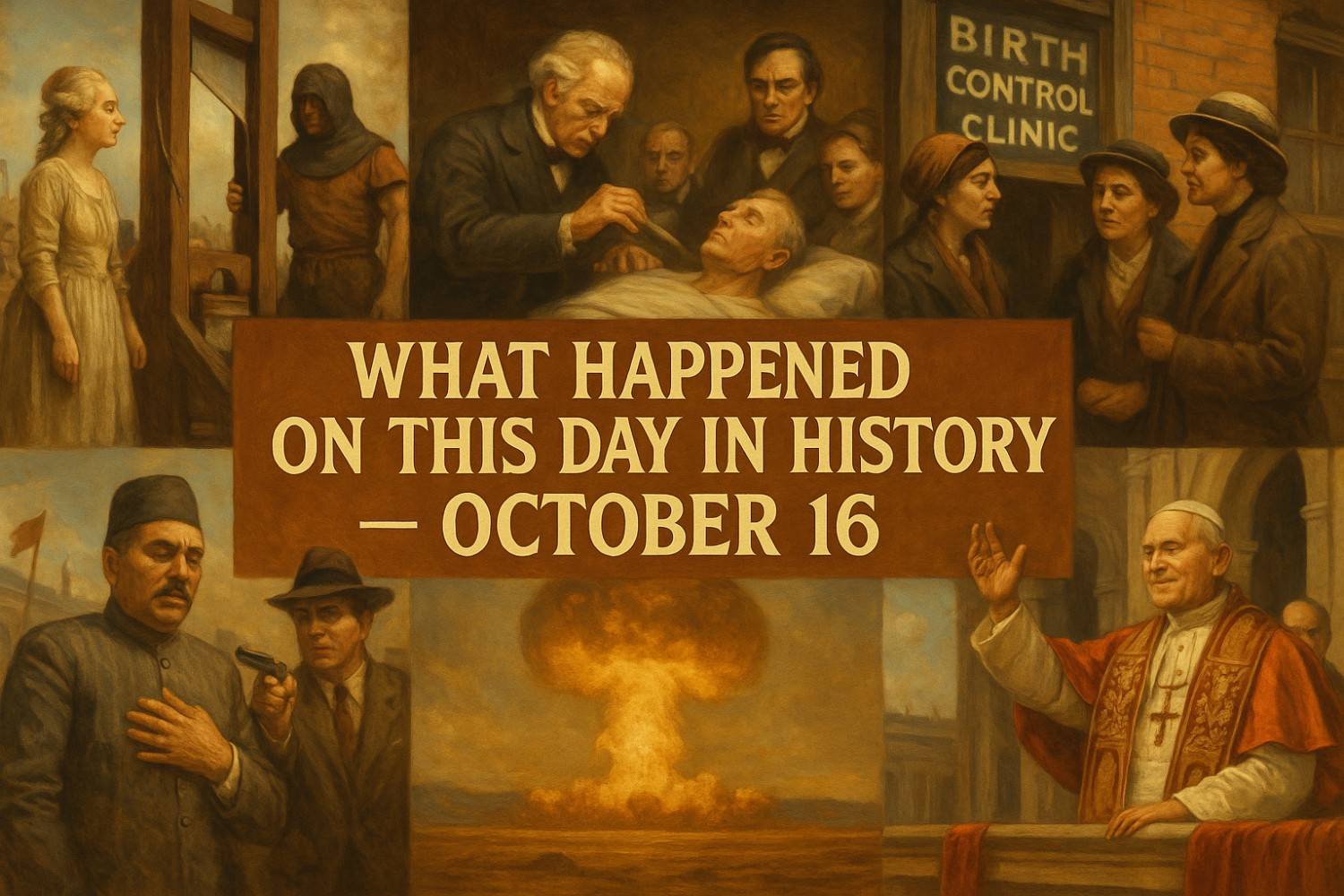
From ancient power struggles and maritime raids to modern coups, scientific firsts and space probes, What happened on this day in history October 16 threads a long list of turning points that reshaped nations, culture and technology. Across centuries the date records poets and prisoners, explorers and inventors, protests and tragedies—each moment adding a layer to the story we still read today.
Quick sections
Earlier history
456 — Ricimer’s victory and shifting late-Roman power; 690 — Wu Zetian’s imperial ascent; 912 — Abd ar-Rahman III’s rule; 955 — Otto I’s suppression of revolts map long-term state formation and dynastic flux.
Exploration & foundations
1817 — Belzoni’s tomb discovery; 1841 — Queen’s University founded; 1875 — Brigham Young University established; 1923 — Disney Brothers Cartoon Studio launched reflect institutional and exploratory foundations.
Wars & politics
1780 — Royalton raid and Great Hurricane; 1793 — Marie Antoinette’s trial; 1934 — Long March; 1970 — Canada’s War Measures Act; 1998 — Pinochet’s arrest show political rupture, revolution and accountability.
Arts & culture
70s–1800s births and creations (Virgil, Belzoni finds, Disney, Girton College foundation, Cardiff Giant hoax) and later cultural milestones (Walt Disney founding, Kawabata Nobel) mark ongoing cultural production.
Science, technology & media
Hamilton’s quaternions (1843), Morton’s ether anesthesia (1846), Edison’s electric company (1878), FORTRAN (1956), Cassini launch (1997) and Shenzhou 5 (2003) illustrate scientific and technological progression.
Disasters & human rights
1780 hurricane, 1834 Westminster fire, 1970 West Gate Bridge collapse, 1996 Guatemala stadium crush, Holocaust measures in 1940s and 2022 West Africa floods emphasize recurring human vulnerabilities and policy consequences.
Also Read: What Happened On This Day In History October 15: Surprising Events of October 15
Major Events on October 16
456 — Ricimer defeats Avitus at Piacenza and becomes master of the Western Roman Empire
A pivotal battle near Piacenza left the Western Roman Empire dominated by the powerful general Ricimer after he defeated Emperor Avitus. The victory illustrated the era’s military-politics mixing, where powerful barbarian generals often controlled imperial succession, accelerating the fragmentation of imperial authority in the West and foreshadowing later rulers’ dependence on military power.
690 — Empress Wu Zetian proclaims herself ruler of the Chinese Empire
Wu Zetian formally ascended to imperial power, becoming China’s sole female emperor and establishing an unprecedented personal rule during the Tang dynasty. Her reign reorganized bureaucracy, promoted meritocratic examinations and patronized Buddhism, leaving a contentious legacy debated for its administrative reforms and authoritarian methods in contemporary and later historical accounts.
912 — Abd ar-Rahman III becomes Emir of Córdoba
Abd ar-Rahman III assumed rulership in Al-Andalus and later styled himself Caliph, inaugurating a period of political consolidation and cultural florescence in Muslim Iberia. His reign strengthened Córdoba’s institutions and built a court renowned for learning, urban development and cross-cultural exchange between Muslim, Christian and Jewish communities.
955 — King Otto I defeats a Slavic revolt in Mecklenburg-Vorpommern
Otto I suppressed a Slavic uprising in the region now known as Mecklenburg-Vorpommern, reinforcing Germanic influence over Baltic frontiers. The campaign exemplified tenth-century consolidation of royal authority in east-central Europe and the complex interactions—military, political and religious—between Germans and Slavic populations during expansion of medieval polities.
1311 — Council of Vienne convenes for the first time
The papal Council of Vienne opened to address a range of ecclesiastical reforms, mendicant orders and the fate of the Knights Templar. The assembly’s deliberations would shape church policy in the early 14th century, including measures on monastic life, clerical discipline and contentious relations between papal and secular authorities.
1384 — Jadwiga crowned King of Poland
Jadwiga was crowned as King of Poland — a title reflecting the political and legal structures of the Polish crown — even though she was female. Her reign involved dynastic maneuvering and union with Lithuania through marriage, shaping Central European politics and laying foundations for the Polish–Lithuanian relationship that would alter the region’s balance for centuries.
1590 — Prince Gesualdo murders his wife and her lover
Prince Carlo Gesualdo of Venosa killed his wife and her alleged lover in a notorious crime that shocked Italian aristocratic circles. The episode blended personal scandal with legal and cultural responses to honor and reputation in Renaissance courts and later provoked enduring fascination because of Gesualdo’s prominence as a composer.
1736 — William Whiston’s predicted comet fails to strike the Earth
Mathematician William Whiston’s bold prediction of a cometary collision failed to materialize, undercutting his apocalyptic forecast and highlighting how early modern print culture amplified scientific claims and public anxieties about celestial events. The episode illustrates the era’s interplay between scientific reasoning, popular belief and sensational expectation.
1780 — Royalton raid: last Native American raid on New England (American Revolutionary War)
The British-led Royalton raid marked one of the final Native American incursions into New England during the Revolutionary War, reflecting the fraught alliances and frontier violence that accompanied the larger conflict. The raid’s local impacts—loss, displacement and retaliation—underscore the war’s complex regional dimensions beyond principal battlefields.
1780 — The Great Hurricane of 1780 ends after its sixth day, massive Caribbean fatalities
The Great Hurricane of 1780 concluded after days of devastation in the Lesser Antilles, with mortality estimated between 20,000 and 24,000. The storm remains the deadliest Atlantic hurricane on record, reshaping Caribbean settlements, shipping routes, plantation economies and colonial disaster responses in the late eighteenth century.
1793 — Marie Antoinette tried and guillotined during the French Revolution
Marie Antoinette was placed on trial, convicted of treason and executed, a dramatic emblem of revolutionary justice and political violence. Her death reflected the Revolution’s radical phase, the redefinition of royal culpability in public law, and the symbolic break with ancien régime authority.
1793 — Battle of Wattignies forces Austria to lift Maubeuge siege (War of the First Coalition)
French forces won at Wattignies, compelling Austrians to raise their siege of Maubeuge and shifting local initiative in the Revolutionary Wars. The victory bolstered French republican morale and demonstrated how citizen armies and reorganized command structures could contest traditional coalition forces in late-eighteenth-century Europe.
1805 — Napoleon surrounds the Austrian army at Ulm (War of the Third Coalition)
Napoleon’s Ulm campaign trapped Austrian forces in a strategic maneuver that preceded the decisive Austerlitz campaign, demonstrating the French emperor’s operational mastery and the effectiveness of rapid maneuver warfare. The Ulm operation contributed to the collapse of coalition coordination and reshaped continental diplomacy.
1813 — Battle of Leipzig: Napoleon faces allied Austrian, Prussian, Russian and Swedish troops
At Leipzig, Napoleon confronted a vast allied force in what became one of the largest Napoleonic battles, signaling a turning point as coalition armies pushed back French dominance. The battle’s scale and outcome accelerated the retreat of French forces into France and presaged the eventual collapse of Napoleonic hegemony.
1817 — Giovanni Belzoni uncovers the Tomb of Seti I in the Valley of the Kings
Explorer and archaeologist Giovanni Belzoni uncovered Seti I’s tomb, a major find in Egyptology that revealed richly decorated burial chambers and stimulated European interest in ancient Egyptian monuments. Belzoni’s ventures combined showmanship and scholarship, shaping early nineteenth-century antiquarian exploration practices.
1817 — Simón Bolívar sentences Manuel Piar to death for challenging racial caste systems in Venezuela
Simón Bolívar ordered the execution of Manuel Piar after charges of insubordination and political rivalry tied to Piar’s challenge to racial hierarchies. The episode illuminated tensions within independence movements over leadership, race and social order in the liberation-era societies of Latin America.
1834 — Palace of Westminster largely destroyed by fire
A devastating blaze consumed much of the ancient Palace of Westminster, prompting later debates over architectural restoration, parliamentary accommodation and Gothic revival design. The destruction led to the 19th-century rebuilding that produced the present Houses of Parliament and redefined London’s civic silhouette.
1836 — Great Trek: Voortrekkers repel a Matabele attack but lose livestock
During the Great Trek, Afrikaner voortrekkers defended against Matabele forces, managing to drive the attackers off while suffering livestock losses. These frontier confrontations reflect the contested territorial expansion in southern Africa, indigenous resistance and the settler community’s survival strategies.
1841 — Queen’s University founded in the Province of Canada
Queen’s University opened, joining the expanding network of colonial-era higher education institutions in British North America. The college contributed to local professional training, civic leadership and the intellectual life of Canada’s emerging political communities.
1843 — William Rowan Hamilton invents quaternions
Hamilton’s formulation of quaternions introduced a three-dimensional system of complex numbers, creating a new algebraic framework with later applications in physics, rotations and modern vector analysis. The discovery represents a key milestone in nineteenth-century mathematics and mathematical physics.
1846 — Ether anesthesia used by William T. G. Morton during surgery
William T. G. Morton’s administration of ether marked a watershed in surgical practice by demonstrating effective general anesthesia, transforming operative possibilities and dramatically improving pain management and surgical scope in medicine.
1859 — John Brown’s Harpers Ferry raid—early flashpoint toward the American Civil War
Abolitionist John Brown led an armed raid on Harpers Ferry, intending to seize arms and incite a slave rebellion. The raid intensified national polarization over slavery and hastened the sectional crisis that would culminate in the American Civil War.
1869 — Cardiff Giant “discovered” in an infamous American hoax
The Cardiff Giant—an erected stone figure presented as a petrified man—captured public fascination as a celebrated hoax, illustrating nineteenth-century sensationalism, the business of curiosity shows and debates about science, authenticity and popular credulity.
1869 — Girton College, Cambridge opens as England’s first residential college for women
Girton College was founded as a pioneering residential college for women at Cambridge, advancing higher education access and women’s academic rights in Britain and marking an early institutional step toward gender equality in university study.
1875 — Brigham Young University founded in Provo, Utah
Brigham Young University began as an institution tied to the Latter-day Saint community, providing regionally significant education and later developing research programs and cultural influence in the American West.
1882 — Nickel Plate Railroad opens for business
The Nickel Plate Railroad commenced operations, contributing to late-nineteenth-century U.S. railroad expansion and facilitating freight movement that connected industrial and agricultural regions in a rapidly growing national market.
1891 — Diplomatic incident in Valparaíso nearly sparks war between U.S. and Chile
After U.S. sailors were attacked in Valparaíso, Chile, a severe diplomatic crisis nearly escalated to war; the dispute underscores late-nineteenth-century imperial tensions, naval presences abroad and the fragility of hemispheric relations.
1905 — The Partition of Bengal takes place in India
British colonial authorities implemented the Partition of Bengal, a move that provoked widespread political protest and nationalist agitation, catalyzing reform movements and debates about colonial governance, communal identities and eventual reversal.
1909 — Taft and Díaz hold first U.S.–Mexican presidential summit; an assassination attempt narrowly avoided
President William Howard Taft and Mexican President Porfirio Díaz met in a rare summit, narrowly escaping an assassination attempt. The meeting symbolized early twentieth-century diplomatic engagement between the neighboring republics amid domestic instability in Mexico.
1916 — Margaret Sanger opens the first U.S. birth control clinic in Brooklyn
Margaret Sanger established America’s first birth control clinic, an impulsive and controversial move that catalyzed the reproductive rights movement and sparked long debates over public health, contraception access and women’s bodily autonomy in the United States.
1919 — Adolf Hitler’s first public address at German Workers’ Party meeting
Adolf Hitler delivered his first public speech to the German Workers’ Party, marking an early public emergence that preceded the party’s transformation into the National Socialist movement. The moment foreshadowed the political trajectory that would devastate Europe in the following decades.
1923 — Walt and Roy Disney found the Disney Brothers Cartoon Studio
The Disney brothers opened their cartoon studio, a modest entrepreneurial start that would expand into a global entertainment empire, transform animated filmmaking, and create cultural icons that shaped twentieth-century popular imagination.
1934 — Chinese Communists begin the Long March
Communist forces set out on the Long March, a strategic retreat across vast distances that preserved core units, established revolutionary legend and elevated Mao Zedong to leadership—making the journey central to Communist Party mythology and later political legitimacy.
1939 — No. 603 Squadron intercepts the first Luftwaffe raid on Britain (WWII)
Britain’s No. 603 Squadron engaged the first Luftwaffe raid on British soil in World War II, part of early defensive operations that would become central to the Battle of Britain and the nation’s wartime air defense narrative.
1940 — Warsaw Ghetto established in Nazi-occupied Poland
Nazi authorities formalized the Warsaw Ghetto, concentrating Jewish populations under brutal conditions that foreshadowed mass deportations and extermination policies. The ghettoization marked a catastrophic phase in the Holocaust and shaped later resistance and memory.
1943 — Raid on the Roman Ghetto (Holocaust in Italy)
Axis and collaborationist forces conducted a roundup and deportation from Rome’s Jewish quarter, an episode in the broader machinery of the Holocaust that extended into occupied and allied European territories during World War II.
1946 — Nuremberg executions: ten defendants executed by hanging after convictions
Ten high-profile defendants convicted at the International Military Tribunal were executed, culminating one of the first major international war-crimes trials. The executions underscored evolving norms of accountability, legal procedure for crimes against humanity, and the contested legacies of postwar justice.
1947 — Philippines assumes administration of the Turtle and Mangsee Islands from the UK
The Philippines took over administration of small island groups from Britain, an example of the mid-century territorial adjustments and decolonization processes as newly independent states assumed sovereignty over outlying territories.
1949 — Greek Communist Party announces “temporary cease-fire,” ending Greek Civil War
The announcement of a cease-fire by the Greek Communists signified the effective end of Greece’s civil conflict, leading to Nationalist consolidation and long postwar recovery and political realignment amid Cold War tensions in the Eastern Mediterranean.
1951 — Assassination of Pakistan’s first Prime Minister, Liaquat Ali Khan, in Rawalpindi
Liaquat Ali Khan, Pakistan’s first prime minister, was assassinated during a political rally, a traumatic event for the fledgling state that produced long-term political repercussions and prompted debates about security and political culture in South Asia.
1953 — Fidel Castro’s “History Will Absolve Me” speech after Moncada attack sentencing
Fidel Castro used his courtroom speech to frame his political justification following the failed Moncada attack, a declaration that became foundational to his revolutionary identity and rhetoric as he later led Cuba’s insurgency and eventual government.
1962 — Cuban Missile Crisis begins after U-2 photos show Soviet missiles in Cuba
President Kennedy was briefed on U-2 reconnaissance photos revealing Soviet missile deployments in Cuba, initiating a thirteen-day superpower standoff that became the Cold War’s closest brush with nuclear confrontation and reshaped international crisis management.
1964 — China successfully detonates its first atomic bomb
China conducted its first successful nuclear test, establishing itself as a nuclear-armed state and altering regional strategic calculations; the test also initiated a new phase in the global nuclear order and proliferation debates.
1964 — Leonid Brezhnev becomes leader of the Soviet Communist Party; Kosygin head of government
Soviet political shifts saw Leonid Brezhnev rise as party general secretary while Alexei Kosygin served as head of government, initiating a management arrangement that would shape Soviet policy through the Brezhnev era and impact Cold War dynamics.
1968 — Tommie Smith and John Carlos expelled from the U.S. Olympic team after Black Power salute
Sprinters Tommie Smith and John Carlos were expelled from the U.S. Olympic team after their Black Power salute during the medal ceremony, a protest that became an iconic moment in civil rights history and provoked debates over athlete activism and political expression in sport.
1968 — Rodney riots in Kingston, Jamaica triggered by ban on Walter Rodney
Kingston erupted in riots after the government barred scholar-activist Walter Rodney, sparking violent protests with significant social and political consequences for Jamaica and highlighting tensions over academic dissent and state repression.
1968 — Yasunari Kawabata wins Nobel Prize in Literature, first Japanese laureate
Japanese novelist Yasunari Kawabata became the first Japanese recipient of the Nobel Prize in Literature, recognition that highlighted modern Japanese letters’ international stature and influenced global appreciation of Japanese modernism.
1970 — Pierre Trudeau invokes the War Measures Act during the October Crisis (Canada)
Faced with domestic terrorism events in Quebec, Prime Minister Pierre Trudeau invoked emergency powers under the War Measures Act, authorizing extraordinary police measures and detentions that generated lasting debates about civil liberties and state authority in times of crisis.
1973 — Henry Kissinger and Lê Đức Thọ awarded the Nobel Peace Prize (controversial)
Kissinger and Lê Đức Thọ were jointly awarded the Nobel Peace Prize for their negotiations in Vietnam; Thọ declined the prize, and the award became controversial amid ongoing conflict in Southeast Asia and questions about peace settlement durability.
1975 — Balibo Five killed by Indonesian troops in Portuguese Timor
Five Australian journalists known as the Balibo Five were killed during Indonesia’s invasion of East Timor, an event that raised international outcry over press safety, military conduct and the murky conditions of reporting in wartime zones.
1975 — Rahima Banu, last known naturally occurring case of smallpox, reported in Bangladesh
Three-year-old Rahima Banu was the last documented case of naturally occurring smallpox, an epidemiological milestone preceding global eradication declared by WHO and representing the culmination of intensive public-health campaigns.
1975 — Australian constitutional crisis: Coalition delays budget, provoking instability
Australia’s Coalition voted to defer supply, creating a constitutional impasse that presaged the 1975 constitutional crisis, demonstrating how parliamentary supply mechanisms can precipitate executive-legislative standoffs and broader political crises.
1978 — Karol Wojtyła elected Pope John Paul II, the first non-Italian pontiff since 1523
Cardinal Karol Wojtyła’s election as Pope John Paul II broke a five-century pattern of Italian popes and brought a global, charismatic figure to the papacy whose travels, conservative theology and political presence would have substantial international influence.
1984 — Desmond Tutu awarded the Nobel Peace Prize
South African Anglican cleric Desmond Tutu received the Nobel Peace Prize in recognition of his nonviolent struggle against apartheid, amplifying international pressure on the South African regime and symbolizing moral leadership in anti-racist activism.
1991 — Killeen, Texas spree killing by George Hennard leaves 23 dead
A mass shooting in Killeen, Texas by George Hennard resulted in 23 deaths and 20 wounded, becoming an infamous instance of mass gun violence in the United States and prompting discussion on firearms policy, public safety and emergency response.
1995 — Million Man March in Washington, D.C., draws roughly 837,000 participants
The Million Man March convened a large assembly of Black men in Washington to promote unity, personal responsibility and civic engagement; the mobilization had notable cultural resonance and generated debate about its political and social aims.
1995 — Skye Bridge opens in Scotland
The Skye Bridge was inaugurated, connecting the Isle of Skye to mainland Scotland and transforming transport, tourism and local economies through improved roads and infrastructure—though the bridge’s tolling policy later sparked controversy and protests.
1996 — Deadly crush at a Guatemala City football match kills 84, injures 180
A catastrophic crowd crush at a football match resulted in mass casualties, highlighting stadium safety failures, emergency preparedness deficits and the human costs of inadequate crowd control in major sporting venues.
1998 — Augusto Pinochet arrested in London on an extradition warrant
Former Chilean dictator Augusto Pinochet was detained in London under an international warrant alleging human-rights crimes, a landmark moment in international justice and accountability that tested diplomatic and legal norms around immunity and universal jurisdiction.
1999 — Hector Mine earthquake (magnitude 7.1) strikes Southern California
A large earthquake near Hector Mine caused ground rupture, infrastructure damage and served as a test for seismic building codes, emergency response and scientific monitoring in an earthquake-prone region of the United States.
2002 — Bibliotheca Alexandrina opens in Alexandria, Egypt
The modern Bibliotheca Alexandrina opened as a cultural and scholarly center commemorating the ancient library, aiming to revive Alexandria as a site for learning, digitization and cross-cultural exchange in the twenty-first century.
2013 — Lao Airlines Flight 301 crashes on approach to Pakse, killing 49
A Lao Airlines passenger flight crashed while approaching Pakse International Airport, causing 49 fatalities and prompting investigations into flight safety, air traffic procedures and regional aviation oversight in Southeast Asia.
2017 — Storm Ophelia strikes U.K. and Ireland, causing damage and power loss
Storm Ophelia brought exceptional winds, power outages and widespread damage across parts of Ireland and the U.K., testing infrastructure resilience and emergency preparedness in regions still adapting to shifting climate-related storm patterns.
2019 — Global takedown of “Welcome to Video” dark-web child-porn marketplace announced
Authorities coordinated an international operation targeting a notorious dark-web platform, arresting hundreds and seizing servers—an example of transnational law enforcement cooperation against online child abuse and cybercriminal marketplaces.
2020 — Militant attacks in Balochistan and northwest Pakistan kill many security personnel
A sequence of militant assaults in Pakistani provinces including Balochistan resulted in multiple security-force fatalities, underscoring ongoing insurgent threats, local instability and the challenges of counterinsurgency in the region.
2020 — Murder of French teacher Samuel Paty sparks nationwide reaction and counter-extremism measures
The killing of teacher Samuel Paty prompted mass demonstrations across France, reinforced debates on secularism, free speech and radicalization, and motivated intensified policies aimed at countering violent extremism and protecting civic institutions.
2021 — Continued violent attacks in Afghanistan and other conflict incidents dominate coverage around Oct 16
Violent incidents, including mosque bombings and insurgent operations, kept Afghanistan in international headlines as the country faced ongoing instability, humanitarian consequences and complex regional responses following the 2021 political shifts.
2022 — Catastrophic seasonal flooding in Nigeria and West Africa causes mass displacement and deaths
Severe seasonal floods in parts of Nigeria and West Africa produced large-scale displacement, fatalities and infrastructure damage, highlighting climate vulnerability, disaster response gaps and urgent needs for resilience and humanitarian support.
2024 — Yahya Sinwar, Hamas leader, reported killed in Gaza war firefight
Reports indicated Yahya Sinwar, a senior Hamas leader, was killed in a firefight amid the Gaza war—an event that, if confirmed, would affect militant command structures and provoke further regional reactions in an already volatile conflict environment.
Notable births — October 16
Noah Webster — American lexicographer — born 1758.
George Washington Williams — American historian & politician — born 1849.
Günter Grass — German writer & artist — born 1927.
Bryce Harper — American baseball player — born 1992.
William O. Douglas — U.S. Supreme Court justice — born 1898.
James II — king of Scotland — born 1430.
Charles Colson — American political/religious figure — born 1931.
Robert Stephenson — British civil engineer — born 1803.
Fernanda Montenegro — Brazilian actress — born 1929.
Arnold Böcklin — Swiss painter — born 1827.
James Thomas Brudenell, 7th Earl of Cardigan — British general — born 1797.
Berthold Kaempfert — German composer & bandleader — born 1923.
Sir Austen Chamberlain — British statesman — born 1863.
John Polkinghorne — English physicist & priest — born 1930.
Dave DeBusschere — American basketball player — born 1940.
Paul Strand — American photographer — born 1890.
Mary Daly — American theologian & philosopher — born 1928.
Marin Alsop — American conductor — born 1956.
Naomi Osaka — Japanese tennis player — born 1997.
John Mayer — American singer-songwriter — born 1977.
Notable deaths — October 16
Shirley Booth — American actress — died 1992.
Gene Krupa — American jazz drummer — died 1973.
Ahmad Shah Durrani — founder and ruler of Afghanistan — died 1772.
Arthur Seyss-Inquart — Austrian Nazi politician — died 1946.
James Michener — American author — died 1997.
Art Blakey — American jazz drummer & bandleader — died 1990.
Cornel Wilde — American actor & director — died 1989.
Wilhelm Frick — German Nazi official — died 1946.
Hans Selye — endocrinologist (stress research) — died 1982.
Leonard Chess — record producer — died 1969.
Fritz Sauckel — Nazi official — died 1946.
Martti Ahtisaari — President of Finland — died 2023.
Hugh Latimer — English Protestant martyr — died 1555.
Nicholas Ridley — English bishop & martyr — died 1555.
Luca Signorelli — Italian Renaissance painter — died 1523.
John Tate — American mathematician — died 2019.
Moshe Dayan — Israeli military leader & statesman — died 1981.
Deborah Kerr — British actress — died 2007.
Liaquat Ali Khan — Pakistani statesman & first Prime Minister — died 1951.
Pierre Salinger — American journalist & political figure — died 2004.
László Papp — Hungarian boxer — died 2003.
Observances & institutional dates — October 16
Air Force Day (Bulgaria).
Boss’s Day (United States).
Pope John Paul II Day (Poland).
Death anniversary of Liaquat Ali Khan (Pakistan).
Teachers’ Day (Chile).
World Food Day (International).
Bu-Ma Democratic Protests Commemoration Day (South Korea).
Frequently asked questions (FAQs)
What is the special day of October 16?
Internationally, October 16 is World Food Day, observed to raise awareness about hunger, food security and sustainable agriculture. Several national observances also fall on this date: Boss’s Day (United States), Air Force Day (Bulgaria), Pope John Paul II Day (Poland), Teachers’ Day (Chile), the death anniversary of Liaquat Ali Khan (Pakistan), and Bu-Ma Democratic Protests Commemoration Day (South Korea).
Why is the Long March (1934) important?
The Long March preserved core Communist forces, enabled leadership reorganization—most notably elevating Mao Zedong—and became the founding myth of the Chinese Communist Party, shaping revolutionary identity and propaganda for decades.
What was the outcome of Marie Antoinette’s trial on October 16, 1793?
Marie Antoinette was convicted of treason and executed by guillotine; the trial and execution symbolized the radical turn of the French Revolution, the collapse of royal privilege and the Revolution’s use of public legal theater.
What happened on October 16th in history?
October 16th stitches together centuries of turning points: early power shifts like Ricimer’s 456 victory, Wu Zetian’s 690 ascent and Abd ar-Rahman III’s rule sit beside dramatic episodes such as Marie Antoinette’s 1793 trial and Napoleon’s exile. The date also marks scientific and cultural milestones—Hamilton’s quaternions, Morton’s first public use of ether, and the founding of the Disney studio—along with major 20th-century ruptures (the Long March, the Warsaw Ghetto, Nuremberg executions) and Cold War crises beginning with the Cuban Missile Crisis.