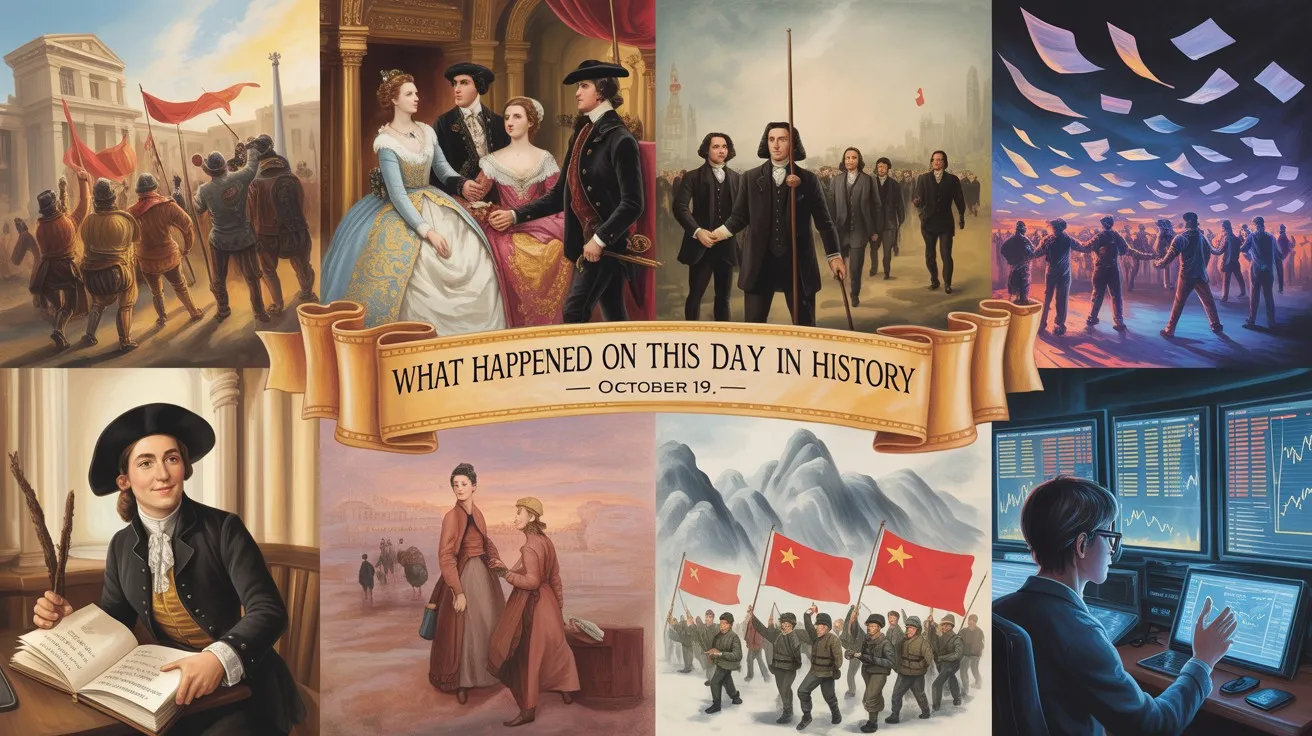
From decisive battlefield victories and dynastic unions to scientific breakthroughs and modern political shocks, What happened on this day in history October 19 gathers moments that redirected wars, built institutions, and altered everyday life. The date links ancient triumphs and modern crises—conquests and protests, artistic firsts and technological advances—which together map the ebb and flow of power, culture and knowledge.
Quick sections
Earlier history
202 BC — Zama; 439 — Vandals take Carthage; 1386 — Heidelberg lecture; 1469 — Ferdinand and Isabella marry: patterns of empire, foundation and dynastic change appear across millennia.
Exploration & foundations
1386 — Heidelberg University; 1811 — Agua Amarga silver discovery; 1912 — Italy seizes Libyan territories; 1923-era cultural foundations link institutions and overseas expansion.
Wars & politics
1781 — Yorktown surrender; 1805 — Ulm capitulation; 1812–1813 — Napoleonic retreats; 1973–1989 Cold War and late-20th-century crises (OPEC, sanctions, broadcasts bans) reflect shifting international conflict dynamics.
Arts & culture
1847 — Jane Eyre published; 1953 — Fahrenheit 451 published; artistic thefts and cultural milestones (Caravaggio theft in related lists) show intersections of culture and public life.
Science, technology & media
1900 — Planck’s law; 1907 — Marconi’s transatlantic wireless; 1943 — streptomycin isolated; 1955 — Eurovision approved; scientific advances and media institutions track modern change.
Disasters & human rights
1814 — London Beer Flood; 1943 — Sinfra sinking/Burma Railway completion; 1987 — Black Monday market crash; 2001 — SIEV X sinking; recurring human cost in war, disasters and economic shocks.
Check Also: What Happened On This Day In History October 18: Inspiring Events
Major Events on October 19
202 BC — Battle of Zama: Scipio defeats Hannibal
At Zama Roman legions under Scipio Africanus routed Hannibal’s Carthaginian forces, ending the Second Punic War and marking Rome’s decisive ascendancy in the western Mediterranean. The victory dismantled Carthage’s military threat, reshaped power balances in the region, and accelerated Rome’s transformation from a regional power into a Mediterranean hegemon.
439 — Vandals under Gaiseric capture Carthage
King Gaiseric’s Vandal fleet seized Carthage, establishing a powerful North African kingdom and naval base that disrupted Mediterranean trade and challenged Roman authority. The conquest reconfigured late-antique geopolitics, contributed to the Western Roman world’s fragmentation, and allowed the Vandals to project power across sea lanes for decades.
1386 — Heidelberg University holds its first lecture
The Universität Heidelberg opened with its first lecture, becoming the oldest university in Germany still in existence. As a medieval center of learning, it fostered scholarship, trained clergy and officials, and later took part in intellectual movements from Renaissance humanism to modern research traditions that shaped German and European education.
1453 — England loses its last possessions in southern France (post-Castillon)
Following the Battle of Castillon and subsequent operations, English territorial presence in southern France effectively ended, closing the chapter on centuries of English claims on French soil. The loss marked a major shift in Hundred Years’ War outcomes and accelerated political consolidation within France.
1466 — Second Treaty of Thorn ends the Thirteen Years’ War
The treaty concluded prolonged conflict between Poland and the Teutonic Order, resolving contested sovereignty claims and territorial disputes in the Baltic region. The settlement reordered regional authority and contributed to the political stabilization of Central and Eastern Europe in the late fifteenth century.
1469 — Marriage of Ferdinand of Aragon and Isabella of Castile
The dynastic union of Ferdinand and Isabella joined two major Iberian crowns and laid political foundations for what would become a unified Spain. Their marriage enabled coordinated policies—military, religious and administrative—that reshaped the peninsula and propelled overseas exploration in the decades to follow.
1512 — Martin Luther awarded Doctor of Theology
Martin Luther received a doctorate in theology, a credential that strengthened his academic standing and helped legitimize his later critiques of church practices. This scholarly authority was a key component in how his Protestant arguments gained traction within university and ecclesiastical debates of the sixteenth century.
1579 — James VI celebrated as adult ruler in Edinburgh festival
A public festival in Edinburgh marked James VI’s recognition as an adult ruler, formalizing his authority and performing monarchical legitimacy in the Scottish capital. Such ceremonial affirmations were central to early-modern statecraft as rulers sought to consolidate domestic power and public recognition.
1596 — Spanish ship San Felipe runs aground in Japan; cargo seized
The shipwreck of the San Felipe and seizure of its cargo by Japanese authorities had diplomatic and commercial consequences for Iberian–Japanese relations, illustrating early encounters and frictions between European maritime powers and Tokugawa-era Japanese governance and local officials.
1649 — New Ross surrenders to Cromwellian forces (Ireland)
New Ross yielded to Oliver Cromwell’s campaign in Ireland, part of a wider series of operations that crushed Irish resistance and reconfigured landholding, political authority and colonial relations on the island, leaving long-term social and demographic consequences.
1781 — Surrender at Yorktown effectively ends major combat in the American Revolution
General Cornwallis’s capitulation at Yorktown delivered a decisive blow to British strategy in North America, prompting diplomatic negotiations that eventually recognized U.S. independence. The defeat demonstrated the strategic value of allied French assistance and shifted global perceptions of colonial revolt and empire.
1789 — John Jay sworn as the first Chief Justice of the U.S. Supreme Court
John Jay’s swearing-in established the role of the Supreme Court under the new Constitution, setting early precedents for the federal judiciary and helping define the separation of powers in the United States’ formative institutional settlement.
1791 — Treaty of Drottningholm between Sweden and Russia
The Treaty of Drottningholm formalized agreements between Sweden and Russia, adjusting diplomatic relations and territorial understandings in the Baltic theatre and contributing to a pattern of negotiated settlements that shaped northern European balance-of-power politics.
1805 — Austrian General Mack surrenders at Ulm to Napoleon
At Ulm Napoleon executed an operational encirclement that forced General Mack to surrender, a maneuver that revealed French operational mobility and set conditions for further campaigns, underlining the innovation in Napoleonic warfare that overhauled European military competition.
1812 — Napoleon begins retreat from Moscow after failed invasion of Russia
Napoleon’s withdrawal from Moscow following the failed invasion marked a catastrophic reversal for the Grande Armée, triggering heavy losses and changing the trajectory of Napoleonic dominance in Europe. The retreat exposed logistical limits and climatic hazards that reshaped coalition warfare.
1813 — After Leipzig, Napoleon forced to retreat from Germany (War of the Sixth Coalition)
The Allied victory at Leipzig and subsequent operations compelled the French withdrawal from German territories, signaling a decisive turn against Napoleon and opening the path toward the eventual invasion of France and his first abdication.
1847 — Jane Eyre is published in London
Charlotte Brontë’s Jane Eyre appeared in print and quickly became influential in Victorian literature, notable for its psychological depth, narrative voice and exploration of gender, class and conscience. The novel shaped later realist and feminist literary trajectories.
1864 — Battle of Cedar Creek ends last Confederate threat to Washington, D.C.
Union victory at Cedar Creek in the Shenandoah Valley neutralized a significant Confederate offensive threat to the capital and helped secure Federal control in the region, affecting morale and military resources in the closing campaigns of the American Civil War.
1864 — St. Albans bank raids by Confederate agents based in Canada
Confederate operatives launched raids into Vermont, robbing banks in St. Albans to stir Northern anxieties and divert Union resources. The cross-border actions underscored the transnational dimensions of Civil War irregular warfare and diplomatic complications with British North America.
1866 — Treaty of Vienna cedes Veneto and Mantua, reconfiguring Italian territories
Under the treaty Austria ceded Veneto and Mantua as part of negotiated territorial adjustments that advanced Italian unification and shifted the map of the Italian peninsula amid nineteenth-century nationalist and diplomatic realignments.
1900 — Max Planck formulates Planck’s law of black-body radiation
Planck’s discovery provided a quantitative description of black-body emission and laid the foundation for quantum theory, a fundamental transformation in physics that later revolutionized understanding of atomic and subatomic processes.
1912 — Italy seizes Ottoman territories in North Africa (Italo-Turkish War)
Italy’s occupation of territories that would become Libya marked European imperial expansion in North Africa and precipitated Ottoman territorial contraction, influencing postwar colonial arrangements and local resistance to European rule.
1914 — First Battle of Ypres begins; trench warfare hardens on Western Front
Fighting around Ypres set in place the defensive stalemate and trench networks that characterized much of World War I’s Western Front, producing prolonged casualties and inventing wartime technologies and tactics attuned to attritional industrialized combat.
1921 — Portugal’s “Bloody Night” coup: assassination of political figures
Political violence during the Bloody Night reflected Portuguese instability in the First Republic period, with assassinations of prime ministers and officials precipitating longer-term political upheaval and authoritarian reactions in interwar Portugal.
1922 — British Conservative MPs vote to end coalition with the Liberals
Conservative withdrawal from the coalition government reshaped postwar British party politics, contributing to a reconfiguration of parliamentary alignments and the stabilization of party competition leading into the interwar period.
1935 — League of Nations imposes sanctions on Italy for invading Ethiopia
Economic sanctions signaled international condemnation but proved limited in preventing aggression; the episode exposed League weaknesses, emboldened revisionist powers and foreshadowed the collective-security failures leading to World War II.
1936 — Herbert Ekins completes a globe-circling journalist race in 18½ days
Reporter Herbert Ekins won a commercial-flight-based race around the world, demonstrating the interwar era’s rapid aviation advances and the growing speed of global communication and transport even in the 1930s.
1943 — Cargo vessel Sinfra attacked and sunk at Crete; many POWs drown
Allied air attack sank Sinfra with catastrophic loss of Italian POW lives aboard, an event that underlined the perils of wartime maritime transport, the costs borne by prisoners and the brutalities of Mediterranean theatre operations.
1943 — Streptomycin isolated as first anti-tuberculosis antibiotic at Rutgers
The isolation of streptomycin marked a major medical breakthrough in treating tuberculosis and infectious diseases, inaugurating an antibiotic era that transformed public health, clinical practice and mortality from bacterial illnesses.
1944 — U.S. forces land in the Philippines (campaign to retake islands)
American landings and operations in the Philippines began a major campaign to liberate the archipelago from Japanese occupation, reclaiming strategic territory and restoring sovereignty processes that would be central to postwar regional politics.
1944 — Coup against Juan Federico Ponce Vaides begins Guatemalan Revolution
A coup initiated a decade-long revolutionary period in Guatemala that altered land, political and social structures in the country, setting in motion reforms, counter-reactions and Cold War entanglements that shaped Guatemalan history.
1950 — China defeats Tibetan Army at Chambo (Tibetan resistance context)
Chinese military actions including the engagement at Chambo reflected consolidation of control over Tibetan areas during the early People’s Republic campaigns, reshaping local governance, social order and long-term Sino-Tibetan relations.
1950 — Battle of Pyongyang ends in UN victory; Chinese forces begin crossing into Korea
UN forces captured Pyongyang, but the subsequent Chinese intervention shifted the Korean War’s dynamics, triggering large-scale counteroffensives and prolonged fighting that would define the peninsula’s mid-century division.
1950 — Iran accepts technical assistance under Point Four Program (U.S.)
Iran’s acceptance of U.S. technical aid under the Point Four program signalled Cold War-era development diplomacy, embedding modernization projects within larger geopolitical competition and U.S.-Iran cooperation before later political ruptures.
1953 — Ray Bradbury’s Fahrenheit 451 published
Bradbury’s dystopian novel about censorship and conformity entered American letters and later became a touchstone for debates about free expression, mass media, and the social implications of technological change in mid-twentieth-century culture.
1955 — European Broadcasting Union approves staging the first Eurovision Song Contest
The EBU’s decision laid institutional groundwork for the Eurovision Song Contest, which would become a major pan-European cultural event linking broadcasting networks, popular music and postwar cultural integration.
1956 — Soviet Union and Japan sign Joint Declaration ending their state of war
The declaration formally terminated wartime legal state between the USSR and Japan after 1945 hostilities, facilitating normalized relations and diplomatic reopening between the two states in the Cold War context.
1960 — United States imposes near-total trade embargo against Cuba
The embargo represented a major escalation in U.S.-Cuban relations following the revolution, shaping economic, political and diplomatic isolation that would become a long-standing pillar of U.S. policy toward Havana.
1973 — President Nixon refuses to turn over Watergate tapes (appeals decision)
Nixon’s rejection of an appeals court order to hand over taped recordings intensified the constitutional confrontation over executive privilege and evidence in the Watergate scandal, setting the stage for later judicial and congressional actions.
1974 — Niue becomes self-governing in free association with New Zealand
Niue’s new constitutional status recognized local self-government while maintaining formal association with New Zealand, an example of postcolonial constitutional arrangements that balanced autonomy with external ties.
1986 — Mozambique president and FRELIMO leader die in Lebombo Mountains crash
The fatal crash that killed President Samora Machel and other leaders created a leadership vacuum in Mozambique, triggering political uncertainty and international scrutiny during a complex period of Cold War–era insurgency and regional tensions.
1987 — U.S. Navy conducts Operation Nimble Archer against Iranian oil platforms
The naval strikes targeted Iranian offshore facilities in retaliation for attacks on shipping, illustrating Persian Gulf conflict dynamics and the U.S. military’s willingness to use limited strikes in protection of maritime commerce during the Iran–Iraq War spillover.
1987 — Dow Jones plunges nearly 23% in largest one-day percentage drop (Black Monday)
A dramatic market collapse marked global financial instability, provoking new regulatory and risk-management initiatives, and revealing vulnerabilities in computerized trading, portfolio structures and international financial interdependence.
1988 — UK broadcasting ban imposed on Sinn Féin and other groups
The British government’s ban on broadcasting interviews with Sinn Féin and certain paramilitary-linked organizations reflected security-policy choices during the Troubles and provoked debate about media freedom and counterterrorism measures in Northern Ireland.
1989 — Guildford Four convictions quashed after 15 years in prison
The Court of Appeal overturned wrongful convictions, exposing serious miscarriages of justice in anti-terrorism prosecutions and prompting public inquiry, legal reforms, and efforts to restore rights for those wrongfully imprisoned.
2001 — SIEV X sinks en route to Christmas Island; ~353 people perish
The Indonesian vessel carrying migrants sank in international waters with huge loss of life, drawing international humanitarian attention to boat people, asylum policies, and the dangers faced by irregular maritime migration in the region.
2003 — Mother Teresa beatified by Pope John Paul II
The beatification recognized Mother Teresa’s philanthropic work and elevated her veneration within the Catholic Church, while also stimulating debates about her legacy, methods and public perception of charity in global contexts.
2004 — Corporate Airlines Flight 5966 crashes in Missouri killing 13
The crash during approach to Kirksville Regional Airport caused multiple fatalities and prompted safety investigations into regional airline operations, procedures and oversight in small-carrier aviation.
2005 — Saddam Hussein was put on trial in Baghdad for crimes against humanity
Iraqi authorities brought Saddam Hussein to trial for abuses during his rule, a high-profile legal event that raised complex questions about transitional justice, tribunal procedures, and national reconciliation in post-invasion Iraq.
2005 — Hurricane Wilma becomes the most intense Atlantic hurricane on record (882 mb)
Wilma’s extreme intensity represented a milestone in meteorological records, causing extensive damage across the Caribbean and North America and prompting discussions about climate variability, insurance exposure and disaster preparedness.
2012 — Bomb explosion in Lebanon kills 8 and injures 110
A violent blast struck Lebanon causing casualties and reflecting the country’s ongoing vulnerabilities to political violence, sectarian tensions and spillover from regional conflicts.
2013 — Buenos Aires train crash injures 105
A high-casualty rail accident near Buenos Aires underscored infrastructure and safety challenges in urban rail systems and prompted scrutiny of operational standards and regulatory oversight.
2018 — Barcelona’s Sagrada Família receives building permit toward completion after 136 years
Authorities approved a permit enabling further work toward completing Gaudí’s Sagrada Família, a long-running architectural project whose permitted progress marked a major procedural and symbolic milestone for heritage, tourism and urban planning.
2019 — Widespread unrest in Chile; state of emergency declared in Santiago
Large-scale protests over fares and broader social grievances erupted into a national crisis, provoking emergency measures, national dialogue over inequality, and sustained debates about constitutional and economic reform.
2019 — U.K. Parliament holds Saturday sitting to debate Brexit (first since 1982)
A rare Saturday parliamentary session convened to discuss the government’s Brexit deal, reflecting the intensity and constitutional strain of the Brexit process and the extraordinary scheduling steps taken in a high-stakes political moment.
2020 — ~7.5 magnitude earthquake strikes Alaska Peninsula; tsunami warnings issued
A strong quake near the Alaska Peninsula triggered tsunami advisories and highlighted the seismic and tsunami risk profile of the North Pacific, testing early-warning systems and coastal preparedness protocols.
2021 — Ongoing armed conflicts and regional attacks continue to dominate daily coverage
Multiple conflict zones, including Yemen, Mali and parts of Afghanistan, generated continuing reports of armed clashes and civilian impacts, illustrating the persistent global pattern of localized wars and humanitarian crises.
2022 — Continued fallout from Russia–Ukraine war shapes major news agendas
The war’s military, economic and diplomatic consequences—sanctions, supply disruptions, and shifts in security alignments—continued to dominate reporting and influence global geopolitics during this period.
2023 — Israel–Hamas war and related regional incidents dominate headlines on Oct 19
The conflict generated widespread humanitarian crises, large-scale military operations and acute diplomatic fallout across the region, with major consequences for civilian populations and international responses.
2024 — Heavy strikes in Gaza and related escalations including reports of drone attack on Israeli PM’s residence
Reports of heavy strikes, civilian casualties and high-profile incidents continued to mark the ongoing conflict dynamics into 2024, with significant regional humanitarian and diplomatic implications.
Notable births — October 19
Subrahmanyan Chandrasekhar — astronomer & Nobel laureate — born 1910.
Philip Pullman — British writer (His Dark Materials) — born 1946.
Angus Deaton — economist & Nobel laureate — born 1945.
Jean Dausset — hematologist & Nobel laureate — born 1916.
Walter Munk — oceanographer & geophysicist — born 1917.
Jon Favreau — director & actor — born 1966.
Trey Parker — writer & producer (South Park) — born 1969.
Evander Holyfield — boxer — born 1962.
John Lithgow — actor — born 1945.
Hema Malini — Indian actress & politician — born 1948.
Rebecca Ferguson — Swedish actress — born 1983.
Yakubu Gowon — head of state of Nigeria — born 1934.
Miguel Ángel Asturias — Guatemalan writer & Nobel laureate — born 1899.
Vinícius de Moraes — Brazilian poet & lyricist — born 1913.
Emil Gilels — Soviet pianist — born 1916.
Annie Smith Peck — mountaineer — born 1850.
Edmund Beecher Wilson — biologist (embryology/cytology) — born 1856.
Umberto Boccioni — Futurist painter & sculptor — born 1882.
Lewis Mumford — historian of cities & critic — born 1895.
Grover Norquist — political activist/strategist — born 1956.
Notable deaths — October 19
Ernest Rutherford — physicist — died 1937.
Lu Xun — Chinese writer — died 1936.
Lázaro Cárdenas — president of Mexico — died 1970.
Samora Machel — president of Mozambique — died 1986.
Benjamin Banneker — scientist & almanac author — died 1806.
Camille Claudel — sculptor — died 1943.
Edna St. Vincent Millay — poet & dramatist — died 1950.
Cesare Lombroso — criminologist — died 1909.
John Reed — journalist & radical writer — died 1920.
Sir Charles Wheatstone — physicist & inventor — died 1875.
George M. Pullman — industrialist — died 1897.
Pius III — pope — died 1503.
Sir Thomas Browne — physician & author — died 1682.
Plutarco Elías Calles — president of Mexico — died 1945.
N. C. Wyeth — illustrator & painter — died 1945.
Osamu Shimomura — chemist & Nobel laureate — died 2018.
Jacqueline du Pré — cellist — died 1987.
Manuel Álvarez Bravo — photographer — died 2002.
Nathalie Sarraute — novelist & theorist — died 1999.
Margaret Murie — naturalist & conservationist — died 2003.
Observances & institutional dates — October 19
William Carey (Episcopal Church).
October 19 (Eastern Orthodox liturgics).
International Day for the Eradication of Poverty (listed previously on Oct 17; regional observances vary).
Constitution Day (Niue).
Oxfordshire Day.
World Pediatric Bone and Joint Day.
Frequently asked questions (FAQs)
What is the special day of October 19?
October 19 contains varied observances in different places; notably the date is associated with constitutional and national observances such as Constitution Day for Niue and local ecclesiastical commemorations, while other global observances cluster on nearby dates (for example the International Day for the Eradication of Poverty is recognized internationally on October 17).
What happened on October 19th in history?
October 19th collects a long sequence of historical turning points—from ancient battles like Zama to dynastic marriages that formed modern states, to scientific breakthroughs, major wartime surrenders, and modern political, economic and humanitarian crises—making it a day that repeatedly reflects transitions of power, knowledge and social consequence.
What major battles and wars took place on October 19 throughout history?
Several historic battles occurred on this date, including the Battle of Zama (202 BC) where Rome defeated Carthage, and the surrender at Yorktown (1781) which marked the end of the American Revolution.
Which famous figures were born or died on October 19?
Notable births include Subrahmanyan Chandrasekhar, Evander Holyfield, and Hema Malini. Among the deaths are Ernest Rutherford, Lu Xun, and Samora Machel.
How did the events of October 19 influence global politics and cultural change?
Events like the American victory at Yorktown, China’s defeat of Tibet (1950), and the 1987 stock market crash each reshaped political power, economics, and international relations.