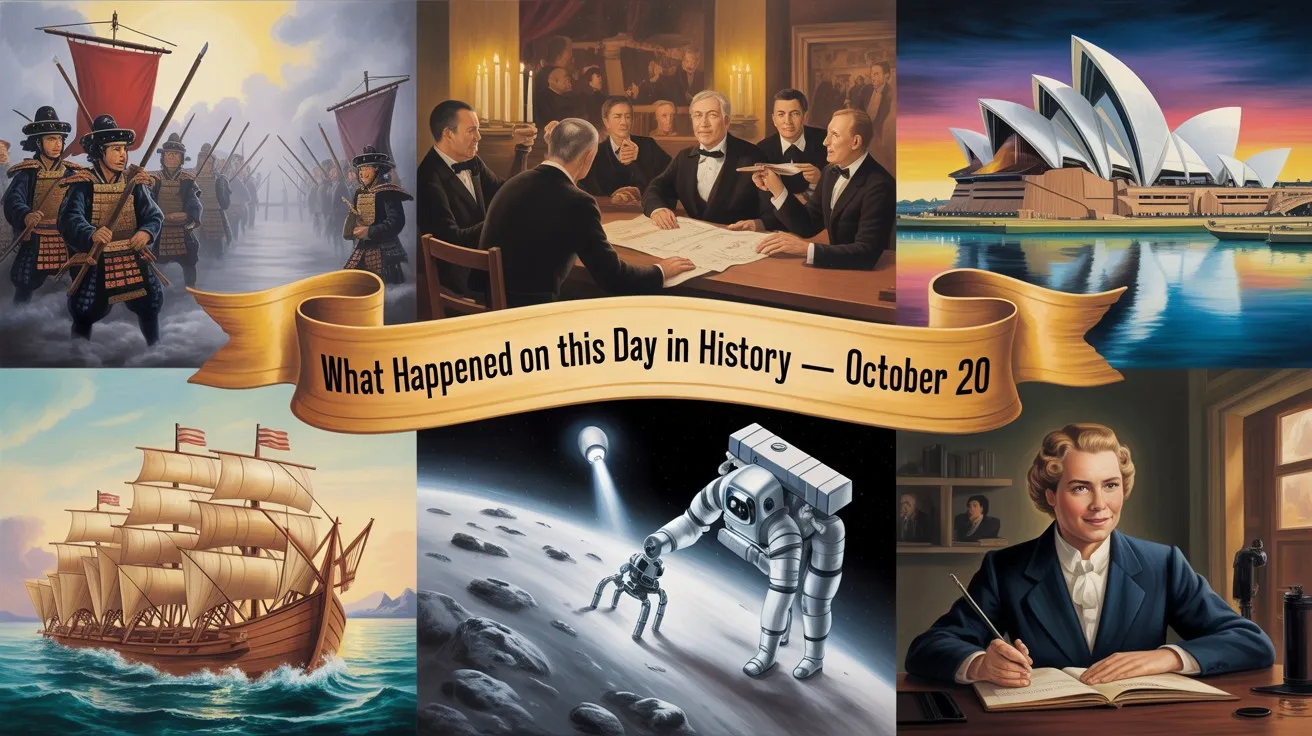
Across empires and ages, What happened on this day in history October 20 connects turning points in war, diplomacy, science and art — from shifting borders and landmark treaties to discoveries and cultural milestones that shaped the modern world.
Quick sections
Earlier history
Dynastic and naval turning points: Tokugawa hegemony (1600), Navarino’s decisive naval action (1827) and the Pragmatic Sanction’s rejection (1740) illustrate how dynastic claims, maritime force and diplomatic settlement shaped premodern state systems.
Exploration & foundations
Territorial change and institutional launches: Louisiana Purchase ratification (1803), Alaska transfer (1867), RMS Olympic’s launch (1910) and Marconi-era communications mark expansions of state space, commerce and global connectivity.
Wars & politics
Revolts, occupations and regime change: Dutch Revolt actions, the Long March survival (1935), Kragujevac massacre and Belgrade’s liberation (1944), plus late-20th/21st-century conflicts (Libya 2011, Raqqa 2017) show enduring patterns of conflict and political transformation.
Arts & culture
Cultural landmarks and media shifts: Melville’s Moby-Dick (1851), Brahms’s concerto premiere (1887), Top Gear’s relaunch (2002) and Sydney Opera House opening (1973) reveal how artistic innovation and mass media reconfigure public life.
Science, technology & media
From submarine ballistic missiles and Marconi-era telegraphy to OSIRIS-REx’s asteroid sample (2020) and Sloan Great Wall discovery (2003), events on this date demonstrate accelerating technical reach and scientific discovery across centuries.
Disasters & human rights
Earthquakes, massacres and industrial catastrophes—from the Uttarkashi quake and Oakland–Berkeley firestorm (1991) to the Cleveland LNG explosion (1944) and Kragujevac atrocity—underscore enduring challenges of safety, accountability and civilian protection.
Also Reed: What Happened On This Day In History October 19: Surprizing & Shocking Moments
Major Events on October 20
1568 — Duke of Alba defeats Dutch rebels under William the Silent
In the early phase of the Dutch Revolt the Spanish Duke of Alba’s forces routed a rebel column, reaffirming Habsburg military pressure in the Low Countries. The clash reflected the harsh repression and fiscal burdens that catalyzed sustained resistance to Spanish rule.
Although Alba’s victories temporarily stabilized royal authority, they hardened Dutch resolve and helped convert local unrest into a prolonged independence movement. The battle thus fed the long trajectory toward Dutch state formation.
1572 — Relief of Goes: Spanish troops wade fifteen miles to break the siege
During the Eighty Years’ War Spanish soldiers conducted a night march across inundated terrain to relieve the besieged town of Goes, demonstrating the extreme logistical and amphibious measures armies used in the Low Countries’ watery landscape.
Such operations underscored the strategic importance of controlling fortified towns and waterways in a conflict where inundations and dikes shaped military choices and civilian hardship.
1600 — Battle of Sekigahara establishes Tokugawa hegemony in Japan
The decisive engagement at Sekigahara produced Tokugawa Ieyasu’s dominance, enabling the Tokugawa shogunate to consolidate rule and inaugurate over two centuries of relative peace and centralized feudal order. The victory restructured daimyo power and institutionalized samurai governance.
Sekigahara’s outcome shaped Japan’s political economy, social hierarchy and isolationist foreign policies until the mid-19th century, making it a cornerstone event in Japanese state formation.
1740 — Pragmatic Sanction rejected; War of the Austrian Succession begins
When France, Prussia, Bavaria and Saxony refused to honour the Pragmatic Sanction, Europe plunged into the War of the Austrian Succession as great powers contested Habsburg succession and balance-of-power arrangements. The conflict tested dynastic diplomacy and military capacity across several theaters.
The war’s settlement and its disruptions eventually reshaped alliances and encouraged military modernization among European states in the mid-18th century.
1774 — Continental Association adopted by the First Continental Congress
Colonial delegates approved a nonconsumption and nonimportation compact to pressure Britain economically, marking a coordinated intercolonial effort to resist Parliamentary measures and assert collective rights. The Continental Association was an early institutional mechanism of revolutionary mobilization.
The agreement harmonized boycott enforcement and popular sanctions, reinforcing networks of local committees and setting the stage for further constitutional confrontation.
1781 — Austria’s Patent of Toleration approved, allowing limited religious freedom
The Habsburg Patent of Toleration granted specified Protestant and Orthodox communities limited worship rights, reflecting Enlightenment-era pressures for confessional accommodation and imperial interest in stabilizing diverse populations. The measure expanded albeit constrained religious liberties within imperial frameworks.
While not full equality, the patent facilitated greater religious pluralism and administrative recognition that shaped Habsburg social policy in the early 19th century.
1803 — U.S. Senate ratifies Louisiana Purchase
After vigorous debate and oratory the Senate approved the Louisiana Purchase, doubling U.S. territory and opening the continent for settlement and geopolitical expansion. The treaty shifted continental power dynamics and raised constitutional questions about the federal government’s authority to acquire territory.
The acquisition proved foundational for westward migration, economic development and later disputes over slavery and jurisdiction across newly added lands.
1818 — Convention of 1818 establishes U.S.–U.K. border at the 49th parallel
Negotiated settlement with Britain fixed much of the Canada–United States boundary along the 49th parallel, providing lasting clarity for continental borderlines and reducing bilateral tensions in the transborder northwest. The agreement balanced territorial claims and navigation rights in the Columbia and Great Lakes regions.
The convention exemplified peaceful boundary settlement through diplomacy rather than prolonged conflict in North American continental politics.
1822 — Congress of Verona opens, last Quadruple Alliance meeting
European powers convened at Verona to address revolutionary unrest and the post-Napoleonic order; the congress sessions reflected conservative concert diplomacy as monarchies sought to manage liberal-national uprisings and maintain reactionary stability across Europe.
Verona’s deliberations indicated the limits and strains of great-power management of internal European crises during the Restoration era.
1827 — Battle of Navarino: Allied naval victory over Ottoman–Egyptian fleet
A combined British, French and Russian fleet annihilated Ottoman–Egyptian naval forces at Navarino, decisively aiding Greek independence efforts and marking one of the last great battles fought entirely with wooden sailing ships. The engagement reshaped Eastern Mediterranean power balances and hastened Ottoman decline in the region.
Navarino demonstrated naval intervention’s political effect on nationalist movements and the internationalization of liberation struggles.
1883 — Treaty of Ancón cedes Tarapacá province to Chile
The Treaty of Ancón ended Peru’s active role in the War of the Pacific, ceding resource-rich Tarapacá to Chile and redrawing national boundaries. The treaty had long-term political and economic consequences for both nations and influenced regional geopolitics and resource control in the Pacific coast.
Territorial settlement after the war set patterns of national memory and diplomatic contention across the late 19th and early 20th centuries.
1904 — Chile and Bolivia sign Treaty of Peace and Friendship
The accord formalized border adjustments and resource arrangements following the War of the Pacific, stabilizing bilateral relations while leaving unresolved grievances in Bolivian political discourse. The treaty’s boundary provisions influenced later diplomatic negotiations and national narratives about loss and sovereignty.
Such treaties illustrate how military outcomes translated into legal settlements that shaped state consolidation in South America.
1910 — Launch of RMS Olympic, sister ship to Titanic
The ocean liner Olympic’s launch represented a peak in Edwardian maritime engineering and Atlantic luxury travel, embodying national prestige and technological achievement in passenger shipping. Her service contributed to early 20th-century oceanic mobility and commercial competition among shipping lines.
Olympic’s career and Titanic’s fate shortly after would highlight both human ambition and maritime risk in the age of liners.
1935 — End of the Chinese Communist Long March after arduous retreat
The Long March concluded in strategic survival for the Chinese Communist Party though at immense human cost; the retreat forged Mao’s leadership, mythicized resilience and provided a narrative foundation for Communist legitimacy in China’s subsequent revolutionary trajectory.
The Long March’s symbolic potency later anchored Party identity and mobilizing histories for mid-20th-century revolutionary consolidation.
1941 — Kragujevac massacre: mass murder of civilians in German-occupied Serbia
In retaliation for partisan activity German occupation forces executed thousands of civilians in Kragujevac, a brutal reprisal that exemplified occupation terror and collective punishment policies in the Balkans, leaving deep scars in local memory and fueling postwar justice demands.
Kragujevac’s atrocity became a central locus of wartime suffering and a touchstone in narratives of resistance and victimhood.
1944 — Liberation of Belgrade by Soviet Red Army and Yugoslav Partisans
Joint Soviet and partisan forces liberated Belgrade from Axis control, a pivotal moment in the Balkans’ liberation sequence and a step in establishing postwar communist authority in Yugoslavia. The operation combined large-scale offensives with guerrilla efforts and shifted political control in the region.
Belgrade’s liberation presaged the communist federation’s ascendancy and redrew immediate postwar political geography.
1944 — Cleveland LNG explosion levels 30 blocks, kills 130 people
A catastrophic liquefied natural gas leak and subsequent explosion devastated Cleveland city blocks, causing massive loss of life and urban destruction, and exposing the dangers of industrial storage in populated areas. The disaster prompted renewed scrutiny of safety regulations and urban planning for hazardous materials.
The incident shaped regulatory reforms and public awareness about industrial risk management in mid-20th-century American cities.
1944 — Douglas MacArthur lands in the Philippines, fulfilling “I shall return”
MacArthur’s return to Leyte symbolized Allied commitment to retake the Philippines and served as a powerful morale and propaganda moment; his landing began a campaign to dislodge Japanese occupation and restore Filipino governance. The operation had major strategic and symbolic significance in the Pacific war.
MacArthur’s return also influenced liberation politics and postwar leadership trajectories in the region.
1947 — HUAC begins Hollywood investigations, leading to blacklist
The House Un-American Activities Committee’s probe into alleged Communist infiltration inaugurated a prolonged era of blacklisting that deprived many film industry professionals of work and reshaped American cultural production through censorship and ideological policing. The investigations altered careers, artistic choices and national debates about free expression.
Hollywood’s blacklist era would later prompt legal and cultural reckonings about political persecution and civil liberties.
1948 — KLM Constellation crash at Glasgow Prestwick kills 40
The Lockheed Constellation’s fatal approach crash exposed aviation safety vulnerabilities in early long-range air travel and spurred investigations into navigational, mechanical and procedural causes, informing subsequent improvements in air-crew training and airport operations.
Each major air disaster in the postwar era contributed to the incremental development of global civil-aviation safety standards.
1951 — Johnny Bright incident: racially charged on-field attack in college football
The violent on-field assault on African-American player Johnny Bright during a collegiate game highlighted entrenched racial hostility and the failure of sports institutions to protect Black athletes. The incident catalyzed reforms in sportsmanship rules and drew national attention to racial injustice in athletics.
Johnny Bright’s case entered civil-rights narratives about discrimination beyond politics, affecting collegiate policy and public consciousness.
1952 — Kenyan state of emergency declared, Mau Mau crackdown begins
Governor Evelyn Baring’s emergency declaration launched an intense campaign of arrests, detention and counterinsurgency aimed at suppressing the Mau Mau movement, with profound consequences for Kenyan society and colonial governance. The emergency regime involved controversial security measures and human-rights abuses.
The conflict’s repression and later independence politics remain central to Kenyan historical memory and debates about decolonization’s costs.
1957 (removed duplicate entry) — [Note: Sydney Opera House opening properly recorded at 1973 below]
1961 — Soviet Navy fires first armed submarine-launched ballistic missile (R-13 test)
The Soviet test of a submarine-launched ballistic missile marked a major step in naval nuclear deterrent development, demonstrating seabased strategic strike capability and intensifying superpower arms competition at sea. Submarine-launched systems reshaped strategic stability and second-strike doctrines in the Cold War.
Naval missile tests like the R-13 reflected rapid technological advances in missile miniaturization and submarine platforms.
1962 — China launches offensives in Ladakh and across McMahon Line, opening Sino-Indian War
Simultaneous border offensives precipitated a brief but intense Sino-Indian conflict over Himalayan frontiers, exposing ambiguous boundary arrangements and the strategic risks of unresolved colonial-era lines. The war yielded heavy casualties and long-term diplomatic tensions between the two Asian powers.
The conflict reshaped regional security perceptions and led to enduring militarized border regimes.
1973 — “Saturday Night Massacre” during Watergate: Richardson and Ruckelshaus resign
President Nixon’s firing of the special prosecutor after his subordinates refused to comply produced a constitutional crisis of executive power and deepened public distrust, accelerating impeachment momentum and demonstrating the tensions between prosecutorial independence and presidential authority.
The episode crystallized legal norms about obstruction, presidential accountability and the rule of law in American governance.
1973 — Sydney Opera House opened by Queen Elizabeth II after 14 years of construction
The ceremonial opening of the iconic building inaugurated a global architectural landmark whose design combined expressive modernism with technical challenges; the Opera House became a symbol of national identity and a magnet for cultural life in Australia.
Its opening closed an era of ambitious postwar public architecture and launched decades of international cultural programming.
1976 — MV George Prince ferry disaster: collision kills 78 on the Mississippi River
The ferry–freighter collision near Luling–Destrehan produced massive loss of life and exposed systemic safety and communication failures in river transport, prompting investigations and reforms in navigation rules and ferry safety regulation. The disaster left enduring community trauma and prompted policy changes.
Transport tragedies like this often stimulate stricter oversight and improvements in emergency response.
1977 — Lynyrd Skynyrd plane crash kills six including band members
The rock band’s charter flight crash abruptly ended touring careers and created a lasting cultural moment of musical loss, prompting condolences and temporary disbandment. The accident spotlighted charter-flight safety and the fragility of touring life for musicians.
The crash remains a seminal event in rock history, often memorialized by fans and music historians.
1981 — Nanuet armored-car robbery results in deaths of two officers and guard
An armed robbery staged by radical groups resulted in multiple murders and spurred law-enforcement responses and prosecutions, highlighting violent urban criminality and paramilitary tactics used by extremist actors in late-20th-century America.
Such incidents influenced policing strategies and criminal-justice debates about radical violence and public safety.
1982 — Luzhniki disaster crushes 66 football fans at a UEFA Cup match
Mass fatalities at the Spartak Moscow vs. HFC Haarlem match revealed stadium overcrowding, poor crowd control and the lethal potential of mass events gone wrong, prompting attention to stadium safety standards, crowd management and emergency procedures in sports venues worldwide.
High-casualty sporting disasters have since driven regulatory changes and heightened emphasis on spectator protection.
1986 — Aeroflot Flight 6502 crashes at Kuibyshev, killing 70
The crash during landing highlighted aviation operational and training issues within Soviet civil-aviation systems, leading to inquiries and calls for stricter safety protocols and aircrew standards. Each crash produced technical investigations that informed incremental safety improvements.
Aviation tragedies in this era accelerated modernization and international cooperation on air-safety best practices.
1991 — Mw 6.8 Uttarkashi earthquake kills over 1,000 in India
A devastating Himalayan quake produced widespread destruction, heavy casualties and serious infrastructure damage in Uttarkashi region, drawing national and international relief responses and raising awareness of seismic vulnerability in mountain settlements.
Post-quake reconstruction emphasized disaster preparedness, seismic retrofitting and community resilience strategies in earthquake-prone regions.
1991 — Oakland–Berkeley firestorm kills 25 and destroys over 3,000 homes
A catastrophic wildfire and accompanying firestorm flattened large swathes of hill neighborhoods, causing significant loss of life and property and prompting fire-safety reforms, land-use debates and rethinking of urban-wildland interfaces around American cities.
The disaster illustrated climate, vegetation and ignition-risk interactions that urban planners and emergency managers must address.
1995 — Space Shuttle Columbia launches STS-73 science mission
STS-73 carried research experiments in microgravity and life sciences, continuing the shuttle program’s role as an orbiting laboratory for diverse scientific investigations and contributing data for materials science, combustion and biological research.
Shuttle science missions like STS-73 advanced long-duration experimentation capabilities and international collaboration aboard low-Earth orbit platforms.
2002 — Top Gear relaunched on BBC, beginning a new era of popular motoring television
The reboot of the motoring magazine show transformed automotive entertainment with a mix of technical reviews, celebrity features and adventurous challenges, becoming a global hit and influencing how audiences consumed car culture on television.
Top Gear’s format innovations later spawned international adaptations and shaped televised automotive journalism.
2002 — Blue Stream pipeline opens, deepest underwater gas pipeline operational
The inauguration of Blue Stream connected regional gas supplies via deepwater pipeline infrastructure, demonstrating advances in subsea engineering and altering energy geopolitics by enabling direct gas flows across the Black Sea. The project highlighted technical achievement in deepwater energy transport.
Such pipelines have major implications for regional energy security, market integration and strategic dependencies.
2003 — Discovery of the Sloan Great Wall, a vast cosmic structure identified by Princeton students
The identification of an enormous galactic wall challenged cosmologists to refine models of large-scale structure formation and stimulated debates about statistical distribution of matter in the universe. The find illustrated how large-scale astronomical surveys reveal unexpected cosmic architecture.
Cosmic-structure discoveries like the Sloan Great Wall advance understanding of cosmology and the universe’s hierarchical arrangement.
2005 — UNESCO Convention on the Protection and Promotion of the Diversity of Cultural Expressions adopted
The convention established an international legal framework to protect cultural diversity, enabling states to support creative industries while promoting cross-cultural exchange and cultural policy tools that balance market forces and cultural heritage.
The treaty reflected global concerns about cultural homogenization and provided mechanisms for sustaining varied artistic expressions.
2011 — Libyan rebel forces capture and kill Muammar Gaddafi in Sirte
The capture and subsequent killing of Gaddafi brought a symbolic end to his decades-long authoritarian rule and marked a violent turning point in Libya’s civil war, opening an uncertain post-Gaddafi transition marked by factional competition and institutional fragmentation.
Gaddafi’s fall underscored the volatile outcomes of popular uprisings and international interventions in the Arab Spring era.
2017 — SDF declares victory in Raqqa campaign, ending ISIL control of the city
The Syrian Democratic Forces’ capture of Raqqa displaced ISIL’s self-styled capital and signalled a major territorial defeat for the group, although the campaign left extensive destruction and raised complex questions about post-conflict governance, reconstruction and civilian protection.
Raqqa’s liberation was a tactical milestone in the anti-ISIL campaign but posed long-term challenges for stability and reconciliation.
2018 — Dodgers beat Brewers in Game 7 to advance to the World Series
Los Angeles’s decisive victory in the National League Championship Series propelled them to the World Series and became a celebrated moment for fans and franchise history, illustrating the high drama of playoff baseball and its cultural resonance in American sports.
Sporting milestones like this blend athletic achievement with large-scale fan mobilization and media spectacle.
2018 — Pakistan Supreme Court rulings on election-disqualification matters make national headlines
Judicial commentary and decisions regarding electoral and disqualification petitions had immediate political implications, influencing debates about judicial independence, electoral integrity and the role of courts in high-stakes national politics.
Such rulings often shape political careers and public perceptions of institutional checks and balances.
2019 — Hong Kong pro-democracy protests and global diplomatic flashpoints headline news
Widespread demonstrations in Hong Kong over governance and civil liberties drew international attention and impacted diplomatic relations, trade discussions and global perceptions of human-rights trajectories in the region. The protests showcased complex interactions among local grievances, transnational civil society and geopolitical responses.
Persistent unrest signalled deeper governance disputes and highlighted the difficulties of reconciling protest movements with political structures.
2020 — NASA’s OSIRIS-REx collects sample from asteroid Bennu, first U.S. spacecraft sample collection of an asteroid
The spacecraft’s touch-and-go maneuver successfully gathered material from Bennu’s surface, marking a major technical achievement in planetary science and sample-return capability, promising new laboratory insights into the early solar system’s composition.
OSIRIS-REx’s success advanced planetary-sampling techniques and opened avenues for studying primordial organic and mineral content in terrestrial laboratories.
2022 — Liz Truss resigns as UK Prime Minister amid political crisis
After a brief and tumultuous premiership, Truss’s resignation following market turmoil and political backlash represented a rare rapid fall from office, highlighting the fragility of party leadership and the fiscal pressures shaping modern government stability.
Her departure prompted internal party recalibration and public debate about economic stewardship and leadership standards.
2024 — Gaza war and associated high-casualty incidents remain top international headlines on Oct 20
Continued hostilities and severe strikes in the Gaza theatre generated urgent humanitarian concerns, international diplomatic responses and regional spillover risks, keeping armed conflict and civilian suffering at the center of global attention.
These ongoing events underscore the long-term human and geopolitical costs of protracted conflict and the challenges of protection for civilians.
Notable births — October 20
Snoop Dogg — American rapper & actor — Born 1971.
Béla Lugosi — Hungarian-American actor (Dracula) — Born 1882.
Mickey Mantle — American baseball legend — Born 1931.
Sir Christopher Wren — English architect (St. Paul’s Cathedral) — Born 1632.
Tommy Douglas — Canadian politician & social reformer — Born 1904.
Jelly Roll Morton — American jazz composer & pianist — Born 1890.
Wanda Jackson — American singer (“Queen of Rockabilly”) — Born 1937.
The Bāb — Iranian religious leader (founder of Bábism) — Born 1819.
Charles Ives — American modernist composer — Born 1874.
Elfriede Jelinek — Austrian author & Nobel laureate — Born 1946.
Ellery Queen — American mystery author (pseudonym) — Born 1905.
Nellie McClung — Canadian writer & women’s-rights reformer — Born 1873.
Jean-Pierre Melville — French film director — Born 1917.
Brian Schatz — U.S. senator (Hawaii) — Born 1972.
Sheldon Whitehouse — U.S. senator (Rhode Island) — Born 1955.
Robert Pinsky — American poet & critic — Born 1940.
Pauline Bonaparte — Sister of Napoleon — Born 1780.
Stanisław I — King of Poland — Born 1677.
Dame Anna Neagle — British actress — Born 1904.
Juan Marichal — Dominican baseball pitcher — Born 1937.
Notable deaths — October 20
Oscar de la Renta — Fashion designer — Died 2014.
Andrey Kolmogorov — Mathematician — Died 1987.
Charles VI — Holy Roman Emperor — Died 1740.
Joel McCrea — Actor — Died 1990.
Anthony Hecht — Poet — Died 2004.
Yoshida Shigeru — Prime Minister of Japan — Died 1967.
Harlow Shapley — Astronomer — Died 1972.
Jack Lynch — Taoiseach of Ireland — Died 1999.
E. Donnall Thomas — Physician & Nobel laureate — Died 2012.
Arthur Henderson — Statesman & Nobel laureate — Died 1935.
Valeriano Weyler — Spanish general — Died 1930.
Lydia Maria Child — Author & abolitionist — Died 1880.
Shirley Horn — Jazz musician — Died 2005.
Sir Richard Burton — Explorer & scholar — Died 1890.
Jacopo della Quercia — Sculptor — Died 1438.
James Iredell — U.S. Supreme Court justice — Died 1799.
João de Barros — Historian — Died 1570.
Jean-Paul-François, 5th Duke de Noailles — General & chemist — Died 1824.
Félix Tisserand — Astronomer — Died 1896.
Alfred B. Mullett — Architect — Died 1890.
Observances & institutional dates — October 20
- October 20 (Eastern Orthodox liturgics)
- Arbor Day (Czech Republic)
- Heroes’ Day (Kenya)
- Revolution Day (Guatemala) — one of two Patriotic Days
- Vietnamese Women’s Day (Vietnam)
- World Osteoporosis Day
- World Statistics Day
Frequently asked questions (FAQs)
Why are so many nation-shaping treaties and boundary settlements listed for October 20?
Treaties and boundary agreements often follow prolonged negotiation or postwar settlement processes that happen to culminate on particular calendar dates; October 20’s cluster reflects recurring diplomatic moments (Louisiana Purchase ratification, Convention of 1818, treaties in South America) when states codified territorial arrangements.
What was the Long March’s long-term significance after it ended on this date in 1935?
Although a tactical retreat, the Long March preserved the Chinese Communist core leadership, elevated Mao’s prominence, and created a foundational revolutionary myth that legitimized later CCP governance and mobilization tactics.
How did the Cleveland LNG explosion change urban industrial safety?
The catastrophic 1944 leak and explosion prompted stronger oversight of hazardous storage in populated areas, spurred municipal zoning reconsiderations and influenced later federal and state regulations regarding industrial site safety and emergency planning.