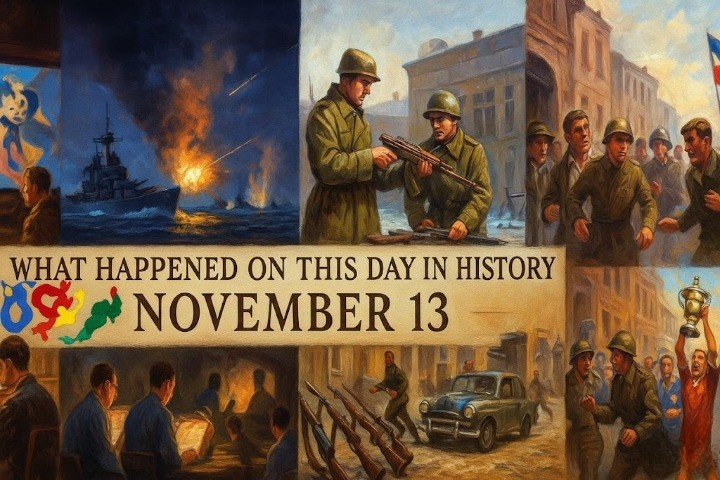
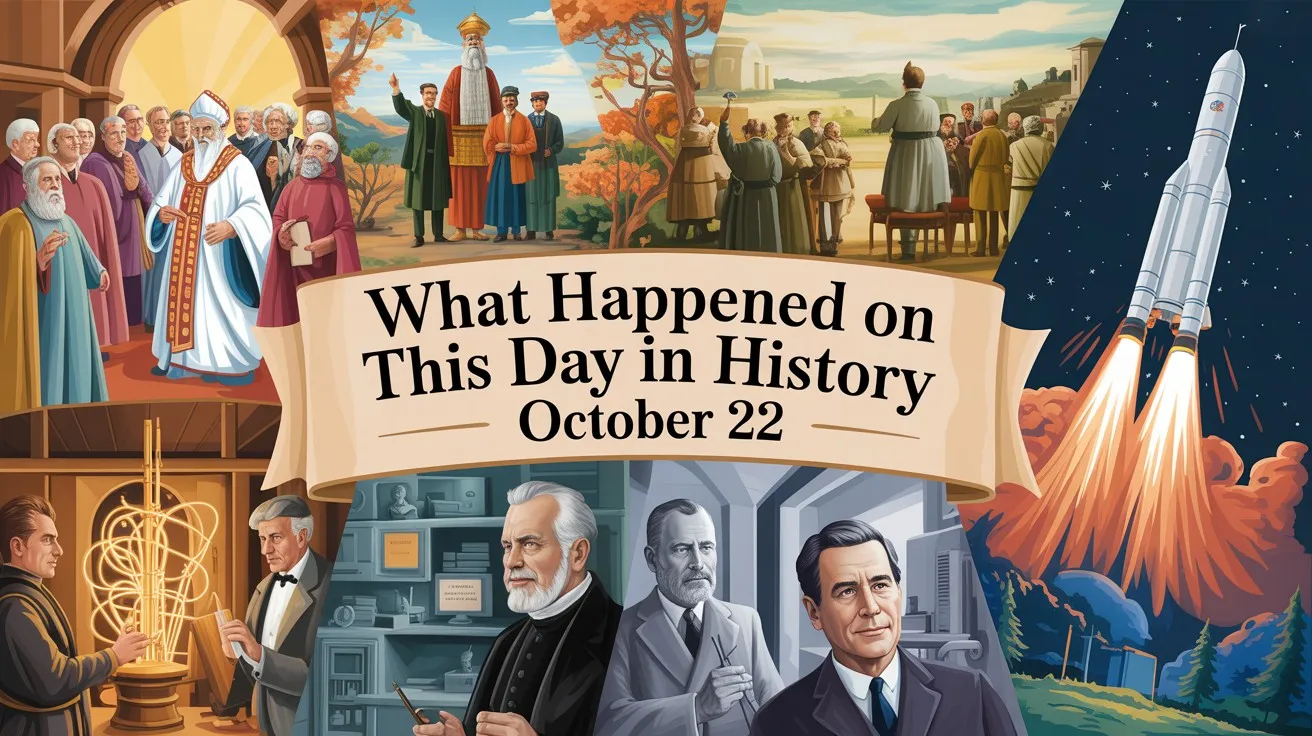
From creeds and capitals to comet sightings and Cold War crises, what happened on this day in history October 22 threads theological decisions, imperial moves, scientific firsts and modern political shocks into a single date.
Quick sections
Earlier history
451 — Chalcedon creed; 794 — Heian-kyō capital; 1600 — Sekigahara (related earlier lists) — shifting imperial centres and doctrinal turning points.
Exploration & foundations
1520 — Fagundes discovers Saint Pierre and Miquelon; 1797 — Garnerin’s parachute exhibition; 1879 — Edison’s lamp test — acts of discovery and technological groundwork.
Wars & politics
1097 — Siege of Antioch; 1805 — Trafalgar; 1944 — Aachen falls; 1962 — Cuban Missile Crisis quarantine; major sea, land and diplomatic contests across eras.
Arts & culture
1724 — Bach cantata premiere; 1883 — Met Opera opens; 1940 — Hemingway published; 1987 — Nixon in China premieres — artistic milestones that shaped cultural conversation.
Science, technology & media
1824 — Portland cement patent; 1879 — Edison lamp; 1959 — Guggenheim opens / Eisenhower transfers Army space work to NASA; 2008 — Chandrayaan-1 lunar launch — technology and institutional milestones.
Disasters & human rights
1877 — Blantyre disaster; 1941 — Kragujevac massacre; 1966 — Aberfan collapse; 2005 — Bellview crash; repeated tragedies highlight industrial, wartime and transport vulnerabilities.
Read Also: What Happened On This Day In History October 21: Unbelievable Moments
Major Events on October 22
451 — Council of Chalcedon adopts the Chalcedonian Creed
The Council of Chalcedon issued a doctrinal statement defining Christ as fully divine and fully human, a theological formulation that shaped Christology across much of Eastern and Western Christianity. The creed produced lasting ecclesiastical divisions—some churches rejected Chalcedon—while influencing liturgy, episcopal authority and theological disputes throughout late antiquity and the Middle Ages.
794 — Emperor Kanmu moves Japan’s capital to Heian-kyō (Kyoto)
Emperor Kanmu’s transfer of the capital to Heian-kyō began a long period of courtly culture centered on the new city. The Heian era produced distinctive art, literature and refined aristocratic institutions; moving the seat of government also affected provincial administration and set patterns that would shape Japanese political and cultural life for centuries.
906 — Abbasid raid under Ahmad ibn Kayghalagh against Byzantium
Abbasid general Ahmad ibn Kayghalagh led a raid into Byzantine territory, reportedly capturing several thousand inhabitants. Such incursions were part of recurring frontier warfare between Islamic polities and Byzantium, generating cycles of raiding, captivity and diplomacy that affected demographics, frontier economies and medieval perceptions of security on both sides.
1383 — Death of King Fernando of Portugal triggers civil strife
King Fernando’s death ended the male line of the House of Burgundy in Portugal and left his daughter Beatrice as heir, provoking rival claims and a period of civil war and political disorder. The dynastic crisis reshaped Iberian politics and eventually led to changes in succession that affected Portugal’s internal stability and external relations.
1721 — Peter I proclaims the Russian Empire after Great Northern War gains
Tsar Peter the Great declared the Russian Empire following military successes against Sweden, signaling Russia’s elevation to imperial status and a new posture in European affairs. The proclamation formalized reforms, the modernizing agenda of Peter’s reign, and Russia’s increasing role as a Baltic and European power into the eighteenth century.
1724 — J. S. Bach leads first performance of Schmücke dich, o liebe Seele in Leipzig
Johann Sebastian Bach premiered the cantata Schmücke dich, o liebe Seele in Leipzig, contributing to his prolific liturgical and choral output. The performance formed part of Bach’s cantata cycles that enriched Lutheran musical worship and influenced Western sacred music through their complexity, theological depth and melodic invention.
1730 — Completion of the Ladoga Canal in Russia
The Ladoga Canal’s completion improved inland navigation by bypassing the dangerous northern coast of Lake Ladoga, facilitating trade and military movement in imperial Russia. Such infrastructure projects reflected eighteenth-century state-building priorities, linking regions, expanding commerce, and enabling more reliable transport in a vast empire.
1739 — War of Jenkins’ Ear begins with attack on La Guaira
Hostilities ignited when the first attack on La Guaira signaled escalating Anglo-Spanish tensions in the Caribbean and Atlantic trade zones. The War of Jenkins’ Ear merged into broader mid-eighteenth-century Atlantic rivalries, illustrating how commercial friction, privateering and imperial competition could trigger wider conflict among European powers.
1746 — College of New Jersey (Princeton) receives its charter
The granting of a charter to the College of New Jersey established one of colonial America’s earliest higher-education institutions. Over time Princeton became a significant center of learning, clergy training and intellectual life, contributing to colonial republican discourse and later national leadership as the United States developed its intellectual institutions.
1777 — Battle of Red Bank: defenders repulse Hessian attacks at Fort Mercer
American forces at Fort Mercer successfully held off repeated Hessian assaults on the Delaware River, inflicting heavy casualties on attackers and maintaining control of key river approaches. The defense contributed to Continental strategic resilience in the region and underscored the importance of well-positioned fortifications in Revolutionary War operations.
1790 — Harmar Campaign ends with Native American victory over U.S. forces
Native American forces defeated a U.S. expedition in the Harmar Campaign, curbing American advances in the Northwest Territory. The setback influenced subsequent U.S. military efforts, diplomatic negotiations with indigenous polities, and the protracted contest over territory and sovereignty in the trans-Appalachian West.
1797 — André-Jacques Garnerin’s parachute exhibition from a balloon
French aeronaut Garnerin jumped from a balloon using a silk parachute, producing an early public demonstration of a parachute descent. His exhibition advanced aeronautical experimentation, captured public imagination about flight safety and anticipated later applications of parachuting in military and civilian contexts.
1836 — Sam Houston inaugurated as first president of the Republic of Texas
Following independence from Mexico, Sam Houston assumed office as the Republic of Texas’s inaugural president, guiding the new polity’s diplomatic and military consolidation. Houston’s administration faced questions of recognition, frontier defense and economic governance as the republic navigated its precarious position between Mexico and the United States.
1844 — Millerites anticipate end of world; Great Disappointment follows
Followers of William Miller expected Christ’s Second Advent on this date; when the anticipated event did not occur, believers experienced the “Great Disappointment.” The episode catalyzed sectarian realignments, produced new Adventist movements, and illustrated how millenarian expectations could shape religious organization and popular piety.
1859 — Spain declares war on Morocco
Spain’s declaration of war on Morocco reflected continuing imperial ambitions and regional contestation in North Africa, shaping diplomatic alignments and military operations that influenced control over Mediterranean littoral zones and colonial interactions in the late nineteenth century.
1866 — Plebiscite ratifies annexation of Veneto and Mantua to Italy
A vote confirmed the annexation of Veneto and Mantua, consolidating Italian unification gains following diplomatic accords. The plebiscite institutionalized territorial transfers that advanced the Risorgimento, altered northern Italian political geography, and integrated previously Austrian-held regions into the emerging Kingdom of Italy.
1877 — Blantyre mining disaster kills 207 miners in Scotland
An underground explosion at the Blantyre coal mine caused mass fatalities, one of Britain’s worst mining tragedies of the period. The disaster highlighted industrial safety failures, prompted inquiries into mine regulation and working conditions, and became part of broader nineteenth-century debates about labor protection and industrial oversight.
1879 — Edison tests practical incandescent bulb using carbonized filament
Thomas Edison’s successful test of an incandescent lamp with a carbonized filament marked a key step toward commercially viable electric lighting. The experiment contributed to electrification’s rapid spread, changing urban life, factory schedules and domestic habits by enabling reliable artificial illumination.
1883 — Metropolitan Opera House opens in New York City with Gounod’s Faust
The new Metropolitan Opera House inaugurated a major cultural institution in New York, staging Gounod’s Faust to inaugurate its season. The venue fostered operatic culture in the United States, attracted international artists, and helped define metropolitan tastes and the institutionalization of high arts in American cities.
1884 — International Meridian Conference designates Greenwich as prime meridian
Delegates at the conference agreed on Greenwich as the zero-longitude reference for global navigation and timekeeping, standardizing maps and facilitating international shipping and communication. Establishing a universal meridian reflected the needs of imperial navigation, science and the globalizing infrastructure of the late nineteenth century.
1895 — Paris express train overruns buffer, crashes through concourse to street below
A high-speed express train derailed in Paris after overrunning a buffer stop, crossing the concourse and falling to the street below—an extraordinary urban railway accident. The crash underscored the emerging challenges of rapid rail travel in dense city terminals and prompted attention to station design and safety protocols.
1907 — Run on Knickerbocker Trust sparks events that lead to the Panic of 1907
A depositor run on the Knickerbocker Trust Company triggered a wider financial panic, exposing fragilities in the U.S. banking system and precipitating calls for reform. The crisis influenced the eventual creation of federal mechanisms for monetary stability, including groundwork that led to the Federal Reserve System.
1910 — Dr. Hawley Harvey Crippen convicted for murder (notorious criminal case)
Hawley Harvey Crippen’s conviction for murdering his wife became a sensational early twentieth-century criminal trial, notable for international manhunt elements and forensic procedures. The case captured public attention and contributed to evolving practices in police investigation and transnational law enforcement cooperation.
1923 — Leonardopoulos–Gargalidis royalist coup attempt fails in Greece
A failed coup by royalist officers undermined the monarchy’s standing and contributed to political instability that helped pave the way for the Second Hellenic Republic. The episode reflected interwar volatility in Greek politics and the contested legitimacy of monarchist and republican factions.
1934 — FBI agents shoot and kill bank robber Pretty Boy Floyd
U.S. law-enforcement operations culminated in the killing of notorious gangster Pretty Boy Floyd, a symbolic moment in the federal campaign against organized crime and bank-robbing gangs during the Depression era. Floyd’s death illustrated shifting tactics in policing and the public crusade against high-profile criminals.
1936 — Captain Dod Orsborne convicted over theft of the Girl Pat
Dod Orsborne’s conviction for theft of the Girl Pat followed a sensational maritime disappearance that captured public imagination. The case highlighted interwar tabloid culture, questions about seamanship and the legal consequences for maritime fraud and vessel misappropriation.
1941 — Guy Môquet and 29 hostages executed by Germans in occupied France
In retaliation for a German officer’s death, occupying forces executed French resistance member Guy Môquet and others, an episode emblematic of brutal occupation reprisals. The killings became politicized symbols of resistance sacrifice and postwar memory in France’s narrative of wartime suffering.
1943 — RAF second firestorm raid on Kassel kills ~10,000 and displaces many
British bombing produced a devastating firestorm in Kassel, causing very large civilian casualties and massive homelessness. The raid exemplified the destructive scale of strategic bombing in World War II and raised enduring debates about aerial warfare’s moral and military consequences.
1946 — German engineers and technicians relocated to the Soviet Union
Over two thousand German specialists and equipment were transferred to the USSR, part of postwar reparations and technology transfers. The relocations affected industrial recovery in Germany and aided Soviet efforts to accelerate reconstruction and technical capabilities in the early Cold War environment.
1962 — Cuban Missile Crisis: Kennedy announces discovery of Soviet missiles and naval quarantine
President Kennedy disclosed U.S. reconnaissance findings of Soviet nuclear missiles in Cuba and ordered a naval “quarantine,” a tense but controlled escalation that produced intense diplomatic negotiations. The crisis brought the superpowers close to nuclear confrontation before negotiated withdrawal terms defused immediate danger.
1963 — BAC One-Eleven prototype crash kills all on board
A prototype BAC One-Eleven airliner crashed in the United Kingdom, killing its occupants and prompting investigations into aircraft design, testing procedures and aviation safety standards. The accident contributed to revisions in testing protocols and regulatory oversight for new commercial aircraft.
1964 — Jean-Paul Sartre awarded Nobel Prize in Literature; he declines it
Philosopher and novelist Jean-Paul Sartre was awarded the Nobel Prize but refused it, maintaining his stance against institutional honors. His declination highlighted debates about intellectual independence, the role of prizes, and the relationship between public recognition and personal principles in literary life.
1975 — Soviet Venera 9 lands on Venus (uncrewed mission)
The Venera 9 mission returned the first images from the surface of Venus and advanced understanding of the planet’s atmosphere and geology. The Soviet probe’s success demonstrated space exploration capabilities, international competition in planetary science, and the expanding reach of robotic planetary missions.
1981 — PATCO decertified by US Federal Labor Relations Authority after strike
Following an illegal strike by air-traffic controllers, the Federal Labor Relations Authority voted to decertify the union, a turning point in labor relations and federal responses to public-sector strikes. The decision affected union power, workplace governance and federal labor policy in subsequent decades.
1983 — Correctional officers killed at USP Marion; model inspires Supermax prisons
The murder of two officers at Marion Prison spurred changes in U.S. corrections policy, influencing the development of Supermax facilities designed for extreme security and long-term solitary confinement. The incident prompted debates about prison design, inmate management and human-rights implications.
1987 — Premiere of John Adams’ opera Nixon in China in Houston
John Adams’ Nixon in China debuted, offering an operatic exploration of recent political history and the Nixon visit to China. The work blended contemporary historical subject matter with minimalist musical language, contributing to late-twentieth-century opera’s experimentation and the arts’ engagement with modern politics.
1992 — Space Shuttle Columbia launches STS-52 to deploy LAGEOS-2 and experiments
Columbia’s STS-52 mission carried geodetic and microgravity experiments including LAGEOS-2, supporting earth-science measurements and materials research in microgravity. The flight exemplified shuttle missions’ roles in scientific deployment and international research cooperation in low Earth orbit.
1997 — Danish fugitive Steen Christensen kills two police officers during prison escape in Helsinki
A violent prison escape in Helsinki resulted in the deaths of two officers, highlighting risks in prisoner transfers and interjurisdictional criminality. The case underscored law-enforcement challenges in handling high-risk fugitives and cross-border criminal justice cooperation in Northern Europe.
1999 — Maurice Papon jailed for crimes against humanity
Former Vichy official Maurice Papon was convicted and imprisoned for his role in deportations during World War II, a landmark legal reckoning with state collaboration and wartime crimes in France. The conviction reflected long-delayed accountability processes and societal efforts to confront complicity under occupation.
2005 — Tropical Storm Alpha forms; Bellview Airlines Flight 210 crashes in Nigeria
Alpha’s formation underscored an unusually active 2005 hurricane season; in a separate tragedy, Bellview Flight 210 crashed in Nigeria with total loss of life, prompting investigations into airline operations, safety oversight and regulatory enforcement across African civil aviation sectors.
2006 — Panama Canal expansion referendum approved by large margin
A national referendum overwhelmingly supported canal expansion, setting in motion major infrastructure works to enlarge the waterway for contemporary maritime commerce. The decision reflected public backing for economic modernization initiatives and projected significant effects on global shipping capacities.
2007 — Tamil Tigers raid Anuradhapura Air Force Base; heavy losses for attackers
A daring attack by LTTE commandos struck a major Sri Lankan military installation, destroying aircraft and causing heavy casualties among the attackers. The raid highlighted insurgent capabilities and raised alarm over airport and airbase vulnerabilities during the island’s protracted civil conflict.
2008 — India launches Chandrayaan-1 lunar probe; later finds lunar water evidence
India’s first lunar mission deployed instruments that later helped detect signatures of water molecules, marking a major step in India’s space program and contributing to global lunar science, remote sensing capabilities and the expanding roster of nations conducting planetary exploration.
2010 — WikiLeaks releases large troves of U.S. Iraq and Afghanistan documents
WikiLeaks published classified documents that revealed battlefield and diplomatic detail, provoking controversy over transparency, national security and journalistic ethics. The disclosures stimulated global debate about whistleblowing, state secrecy, and the legal and political ramifications of mass document leaks.
2012 — Lance Armstrong stripped of seven Tour de France titles for doping
After prolonged investigation, cycling authorities annulled Armstrong’s wins for systematic doping, a high-profile sporting scandal that reshaped anti-doping enforcement, athlete reputations and public trust in elite competitive cycling institutions.
2013 — Australian Capital Territory legalizes same-sex marriage (jurisdictional first)
The ACT enacted marriage equality legislation, representing a local milestone in Australia’s path toward national debates and eventual broader reforms on marriage rights. The move triggered legal discussions about federal versus territorial powers and contributed to the national legislative trajectory.
2014 — Michael Zehaf-Bibeau attacks Canadian Parliament; soldier killed
An assailant launched an attack at the Canadian Parliament precinct, killing a soldier and wounding others; the event provoked national security reviews, legislative responses and public reflection on domestic extremist violence and parliamentary protection measures.
2018 — Saudi authorities describe Jamal Khashoggi killing as “rogue operation” amid global uproar
Following the murder of journalist Jamal Khashoggi, Saudi officials called the slaying a rogue operation even as international outcry intensified over accountability and press freedom. The episode strained diplomatic ties, spurred investigations and became a focal point in debates about state responsibility and human-rights norms.
2019 — Northern Ireland legalizes same-sex marriage and decriminalizes abortion after Assembly lapse
Following political impasse, UK Parliament measures led to legalization of same-sex marriage and decriminalization of abortion in Northern Ireland, reflecting rapid policy change through legislative fallback mechanisms and significant social rights expansion in the region.
2019 — Pakistan-administered Kashmir observes October 22 as “Black Day” for 1947 events
Commemorative activities marked the anniversary of contested 1947 events in Kashmir, illustrating how historical memory and regional grievances continue to shape civic observance, diplomatic rhetoric and cross-border narratives in South Asia.
2019 — Putin and Erdoğan reach Sochi agreement to halt Turkey’s offensive in northeastern Syria
Russian and Turkish leaders negotiated security arrangements intended to pause offensive operations and establish buffer mechanisms, reflecting the fluid diplomacy and complex power-sharing efforts shaping Syria’s northern front during the conflict’s fragmentation.
2020 — Afghan madrasa airstrike reported to have killed civilians including children
Reports from Afghanistan indicated a deadly strike on a religious school, highlighting ongoing civilian vulnerabilities amid prolonged conflict and the persistent humanitarian toll in wartime environments with contested targeting claims and protection concerns.
2021 — U.S. forces report killing a senior al-Qaeda leader in Syria amid other pandemic/domestic headlines
U.S. Defense announcements about counterterror operations were part of broader security reporting that day, showing continued counterterrorism activity alongside pandemic-era domestic developments and international responses to evolving militant threats.
2022 — Russia launches major missile strikes on Ukrainian power and energy infrastructure
Large-scale cruise-missile and drone attacks targeted Ukrainian energy grids, producing widespread outages and civilian hardship, intensifying the logistical and humanitarian strains of the conflict and prompting international condemnation and aid responses.
2023 — Israel–Hamas war intensifies; Gaza hospitals face catastrophic fuel shortages and humanitarian crisis warnings
Ongoing hostilities produced acute shortages of fuel and medical supplies at Gaza hospitals, threatening newborn wards and critical care. UN agencies warned of catastrophic humanitarian impacts, while international diplomatic efforts sought to mediate access and relief amid intense fighting.
2024 — FBI opens investigation into leaked U.S. intelligence about possible Israeli retaliation plans against Iran
U.S. authorities launched inquiries into alleged intelligence leaks concerning regional security plans, reflecting heightened sensitivity over disclosures, the interplay of intelligence, diplomacy and media, and concerns about operational security in a volatile regional context.
Notable births — October 22
Joan Fontaine — American actress — born 1917.
Derek Jacobi — British actor — born 1938.
Robert Rauschenberg — American artist — born 1925.
Jimmie Foxx — American baseball player — born 1907.
Karl Jansky — American radio-astronomy pioneer — born 1905.
Giovanni Giolitti — Italian prime minister — born 1842.
Collis P. Huntington — American railroad magnate — born 1821.
William IX — Duke of Aquitaine, troubadour — born 1071.
George Brassens — French singer-songwriter — born 1921.
Ivan Bunin — Russian writer, Nobel laureate — born 1870.
N. C. Wyeth — American illustrator & painter — born 1882.
George W. Beadle — American geneticist, Nobel laureate — born 1903.
Clinton J. Davisson — American physicist, Nobel laureate — born 1881.
Mei Lanfang — Chinese Peking-opera master — born 1894.
Edward R. Stettinius Jr. — U.S. statesman — born 1900.
Brian Boitano — Olympic figure skater — born 1963.
Andrew Mason — entrepreneur (Groupon) — born 1980.
Karl Muck — conductor — born 1859.
Harry Callahan — photographer — born 1912.
C. S. Rafinesque — naturalist & polymath — born 1783.
Notable deaths — October 22
Pablo Casals — cellist & conductor — died 1973.
Nadia Boulanger — composer & teacher — died 1979.
Arnold J. Toynbee — historian — died 1975.
Kingsley Amis — novelist & critic — died 1995.
Russell Means — activist — died 2012.
Paul Tillich — theologian & philosopher — died 1965.
Pretty Boy Floyd — gangster — died 1934.
Alessandro Scarlatti — composer — died 1725.
Peyton Randolph — lawyer & Continental Congress president — died 1775.
Edward Carson — Anglo-Irish politician — died 1935.
Harry Greb — boxer — died 1926.
Robert Fitzsimmons — boxing champion — died 1917.
Albert Szent-Györgyi — biochemist, Nobel laureate — died 1986.
Ye Jianying — Chinese marshal & statesman — died 1986.
Andrew Fisher — Australian prime minister — died 1928.
Komitas — Armenian composer & ethnomusicologist — died 1935.
Diego de Siloé — sculptor & architect — died 1563.
Red Barber — baseball broadcaster — died 1992.
Ewan MacColl — folk singer & playwright — died 1989.
May Irwin — comedian & music-hall star — died 1938.
Observances & institutional dates — October 22
Pope John Paul II (feast/commemoration).
October 22 (Eastern Orthodox liturgics).
International Stuttering Awareness Day.
Jidai Matsuri (Kyoto, Japan).
frequently asked questions
What is the special day of October 22?
October 22 observes varied local and international commemorations, including Pope John Paul II remembrances, International Stuttering Awareness Day, and cultural events such as Kyoto’s Jidai Matsuri; specific observances vary by country and community.
What happened on October 22nd in history?
October 22 gathers doctrinal councils, capital relocations, decisive battles, scientific breakthroughs and modern political crises—from Chalcedon and Heian-kyō to the Cuban Missile Crisis, space probes and recent geopolitical and humanitarian flashpoints—showing how one date can encompass crossroads of belief, power and discovery.
Who famous was born on October 22nd?
Several notable figures were born on October 22nd, including Joan Fontaine, the Oscar-winning American actress; Derek Jacobi, acclaimed British actor; and Robert Rauschenberg, a celebrated American artist known for his groundbreaking work in modern art.