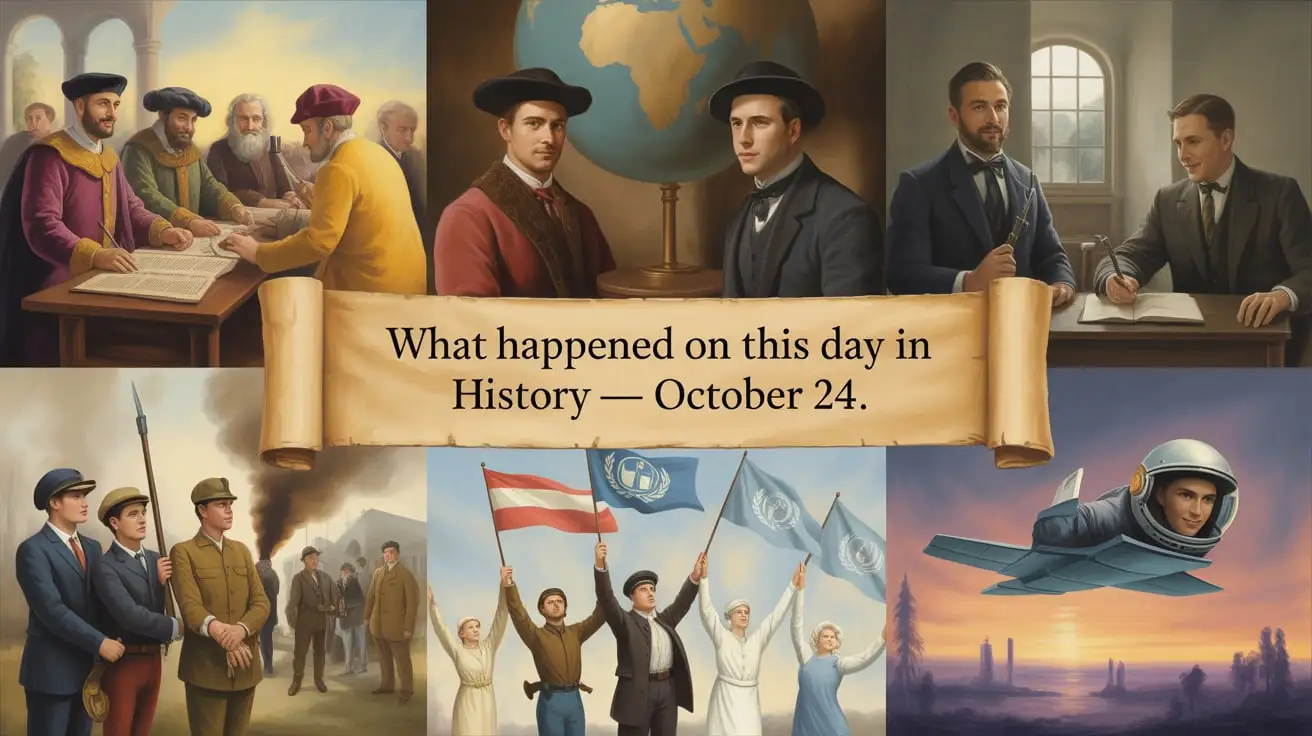
Councils, battles, early flights, and modern crises recur on the calendar; What happened on this day in history October 24 collects those hinge points that altered power, practice and daily life.
This day links imperial proclamations, scientific firsts, bold explorations and wrenching disasters across centuries.
Quick sections
Earlier history
AD 69 — Bedriacum; 1260 — Chartres dedication; 1295/earlier links — imperial, ecclesiastical and dynastic turning points set long-lasting institutional patterns.
Exploration & foundations
1520 discoveries and later aviation attempts; 1857 Sheffield FC founding; 1906 Santos-Dumont flight — instances of exploration, sporting foundations and early flight milestones.
Wars & politics
1642 Edgehill; 1812/1813 Napoleonic and Russo-Persian settlements; 1942 El Alamein; 1956 Hungarian Revolution — battles and uprisings that shifted territorial and political outcomes.
Arts & culture
1260 Chartres architecture; 1883 Met Opera and later cultural premieres; Houdini’s last performance — cultural institutions, performances and creative milestones.
Science, technology & media
1851 Lassell’s moons; 1861 telegraph completion; 1946 first Earth photo from a rocket; 2001 iPod and 2007 Chang’e-1 — innovations and media turning points shaping modern life.
Disasters & human rights
1871 Los Angeles lynching; 1927 Imatra cinema fire; 1958 Springhill/1959 Vnukovo crashes; 2011 Van earthquake — recurring tragedies that prompted safety reforms and humanitarian responses.
Major Events on October 24
AD 69 — Second Battle of Bedriacum: Vespasian’s forces prevail
Troops supporting Vespasian defeated the forces of Emperor Vitellius at Bedriacum, consolidating Vespasian’s bid for power amid Rome’s tumultuous Year of the Four Emperors. The victory helped secure Vespasian’s claim to the imperial throne and set the Flavian dynasty on a firmer footing after months of civil conflict and political upheaval.
1260 — Chartres Cathedral dedicated before King Louis IX
The completion and dedication of Chartres Cathedral, attended by King Louis IX, affirmed the cathedral’s role as a major center of Gothic architecture and pilgrimage. Its stained glass, sculptural program and architectural innovations influenced European ecclesiastical building for centuries and reinforced Chartres’ status as a spiritual and cultural landmark.
1260 — Baybars ascends the Mamluk throne after Ain Jalut victory
Following the Mamluk triumph over Mongol forces at Ain Jalut and the assassination of Sultan Qutuz, Baybars became sultan and launched a reign of consolidation. His rule fortified Mamluk control in Egypt and Syria, repelled further Mongol incursions, and shaped the political and military contours of the eastern Mediterranean for decades.
1360 — Treaty of Brétigny ratified, pausing the Hundred Years’ War
The Brétigny accords formalized territorial and ransom arrangements between England and France, temporarily halting one phase of the Hundred Years’ War. Although the treaty provided a breathing space, its terms and later repudiations underscored the conflict’s episodic nature and the fragile balances of medieval diplomacy and sovereignty.
1590 — John White returns to England after failed Roanoke relief
John White, governor of the second Roanoke Colony, sailed home having failed to find the missing colonists; his delayed return and the colony’s mysterious disappearance became one of early English America’s enduring enigmas. The Roanoke episode shaped subsequent colonial planning and the mythology of the “Lost Colony.”
1596 — Second Spanish Armada battered by storms off Cape Finisterre
A fleet dispatched against England suffered severe storm damage off Finisterre, forcing a retreat and aborting Spanish naval plans. The weather-driven failure revealed the vulnerability of large naval expeditions to maritime conditions and the logistical limits of early modern seapower projection.
1641 — Felim O’Neill’s Proclamation of Dungannon amid Irish unrest
Felim O’Neill’s proclamation sought to justify the Ulster gentry’s uprising while professing loyalty to King Charles I, reflecting the complex loyalties of seventeenth-century Ireland. The proclamation and subsequent unrest fed the wider Celtic, English and Scottish conflicts that unfolded through the 1640s.
1642 — Battle of Edgehill: first pitched battle of the English Civil War
Royalist and Parliamentarian forces clashed at Edgehill in the conflict’s opening large-scale engagement. Although tactically inconclusive, the battle marked the transition from political crisis to prolonged armed struggle, presaging a war that would reshape England’s constitutional order and social relations.
1666 — Violent tornado hits Lincolnshire, among England’s strongest recorded
A powerful tornado struck Lincolnshire, with estimated winds comparable to the highest recorded scales; contemporary accounts describe severe structural damage. The event stands out in English meteorological history for its intensity and for the rare documentation of extreme weather in the early modern period.
1707 — First Parliament of Great Britain convenes after the Union
Following the Acts of Union, the new Parliament met, formalizing the political union of England and Scotland. The assembly reorganized representation and governance for the newly constituted Kingdom of Great Britain and set a constitutional course that would shape eighteenth-century state development.
1795 — Poland partitioned completely by Russia, Prussia and Austria
The Third Partition erased the Polish–Lithuanian Commonwealth as an independent state, dividing its territory among neighboring empires. The partitioning dramatically altered the political map of Central Europe and triggered long-term movements for Polish national restoration.
1812 — Battle of Maloyaroslavets during Napoleon’s Russian campaign
Napoleon’s forces engaged Russian defenders at Maloyaroslavets, encountering fierce resistance that affected the French retreat route from Moscow. The battle contributed to the logistical collapse of the invasion and underscored the campaign’s strategic and humanitarian costs.
1813 — Treaty of Gulistan ends Russo-Persian War with major territorial losses for Iran
The Treaty of Gulistan formalized large territorial transfers from Qajar Iran to the Russian Empire, reshaping control over the Caucasus and establishing new imperial boundaries that influenced nineteenth-century regional politics and demographic patterns.
1851 — William Lassell discovers Uranus’ moons Umbriel and Ariel
Using telescope work, Lassell identified two previously unknown satellites of Uranus, expanding nineteenth-century planetary astronomy and the catalog of solar-system bodies. Such discoveries advanced observational techniques and stimulated theoretical discussion about planetary formation and orbits.
1857 — Sheffield F.C. founded, world’s oldest association football club still operating
Sheffield Football Club’s formation codified rules and local organization that fed the later codification and spread of association football. The club’s endurance links nineteenth-century recreational innovation to modern global sporting culture and organized competition.
1860 — Convention of Peking ends Second Opium War; Kowloon ceded to Britain
Treaty terms concluded hostilities with Qing China and included territorial concessions such as Kowloon’s cession. The agreement deepened imperial impositions on China, shaped later Sino-British relations, and contributed to the nineteenth-century reordering of East Asian geopolitics.
1861 — First transcontinental telegraph line completed in the United States
Completion of the transcontinental telegraph connected coasts in near real-time, revolutionizing long-distance communication, commerce and news dissemination. The line accelerated administrative coordination across vast territories and reduced the isolation of frontier regions.
1871 — Lynching of Chinese immigrants in Los Angeles highlights anti-Chinese violence
The mass killing of Chinese workers in Los Angeles exemplified violent xenophobia and racial tensions in nineteenth-century America. Such lynchings prompted debate about immigration policy, law enforcement, and the precarious civil status of immigrant communities.
1876 — Shinpūren rebellion erupts against Meiji modernizing reforms
Reactionary former samurai launched attacks opposing Meiji-era Westernizing reforms and the abolition of feudal structures. The uprising highlighted the social dislocations of rapid modernization and the political tensions as Japan transitioned toward a centralized, modern state.
1886 — Normanton incident: sinking and scandal inflame Anglo-Japanese outrage
The sinking of the British merchant ship Normanton and the perceived abandonment of Asian passengers provoked a diplomatic outcry in Japan and strained foreign relations, highlighting racial and legal inequalities in maritime practice and extraterritorial rights during the treaty-port era.
1889 — Henry Parkes’ Tenterfield Oration launches Australian federation movement
Parkes’ speech is widely read as a catalytic moment steering colonial debate toward a federated Australian nation. It supplied rhetorical momentum and public framing that influenced the federation conventions and eventual 1901 union of Australian states.
1894 — Battle of Jiuliancheng marks Japanese incursions in First Sino-Japanese War
Japanese forces crossed into Qing territory and attacked Hushan fortifications, helping to initiate a war that would alter East Asian balance, accelerate Japanese regional expansion, and expose Qing military weaknesses.
1900 — U.S. government announces plan to buy the Danish West Indies
The U.S. proposal to acquire the Danish West Indies (later the U.S. Virgin Islands) reflected American strategic and commercial interests in the Caribbean and anticipated formal transfer of sovereignty that would shape regional geopolitics.
1901 — Annie Edson Taylor survives going over Niagara Falls in a barrel
Taylor’s stunt made international headlines and opened debates about daredevil feats, safety, and public spectacle. Her survival story became part of popular culture and the lore surrounding Niagara Falls as a site of both natural wonder and human risk-taking.
1902 — Santa María volcano erupts in Guatemala, one of the twentieth century’s largest eruptions
The eruption produced widespread destruction, high fatalities and long-term environmental impacts. It ranks among the major volcanic events of the century and influenced local reconstruction efforts and volcanic monitoring practices.
1911 — Orville Wright achieves a 9-minute-45-second glider flight at Kill Devil Hills
Orville Wright’s extended glide marked continued refinement of heavier-than-air aeronautical control and flight endurance, contributing to iterative advances that underpinned powered flight development and the burgeoning field of aviation.
1912 — Battles of Kirk Kilisse and Kumanovo conclude in Balkan War victories
Serbian and Bulgarian forces achieved significant wins against Ottoman armies at Kumanovo and Kirk Kilisse, reshaping Balkan borders and accelerating the decline of Ottoman control in southeastern Europe, setting the stage for further regional realignment.
1917 — Battle of Caporetto: devastating Italian defeat in World War I
Italian lines broke in a catastrophic rout at Caporetto, creating massive retreats and heavy casualties. The defeat forced Italian military and political reorganization and had major consequences for the conduct of the war on the Italian front.
1918 — Battle of Vittorio Veneto: Italian victory helps end Austro-Hungarian resistance
Italian forces won at Vittorio Veneto, contributing to the collapse of Austro-Hungarian resistance and accelerating the end of hostilities on the Italian front. The breakthrough helped bring about postwar territorial realignments in Central Europe.
1923 — German October: Hamburg insurrection fails after miscommunication
A localized militant uprising in Hamburg, triggered by party confusion, did not expand into a wider revolution. The episode reflected the fragmented, often chaotic nature of Weimar-era radical politics and the limits of attempted insurrections.
1926 — Harry Houdini’s last performance at Detroit’s Garrick Theatre
Houdini performed his final show before his death, closing the career of a leading entertainer whose acts reshaped public expectations about magic, escapology and stagecraft. His death shortly thereafter cemented his legend in early twentieth-century popular culture.
1929 — Black Thursday opens the Wall Street crash that signals the Great Depression
Stock-market collapse unfolded as panic selling caused dramatic price falls, initiating waves of bank failures, unemployment and global economic contraction. The crash altered fiscal policy thinking and financial regulation for generations to follow.
1930 — Bloodless coup in Brazil ends the First Republic and begins the Vargas Era
A political overthrow reconfigured Brazil’s national leadership, inaugurating Getúlio Vargas’ long-term influence and a period of authoritarian modernization and socioeconomic reform that reshaped twentieth-century Brazilian politics.
1931 — George Washington Bridge opens, connecting Manhattan and New Jersey
The bridge’s dedication created a major new Hudson River crossing, easing transport, commerce and suburban commuting. Its scale and engineering symbolized the infrastructural growth of the New York metropolitan region in the early twentieth century.
1938 — Fair Labor Standards Act (40-hour week) comes into effect in the United States
The FLSA’s implementation established federal standards for maximum hours, minimum wages and child-labor restrictions, reshaping American labor law, workplace organization and industrial relations in the mid-twentieth century.
1940 — Japan’s center force temporarily repulsed at Leyte Gulf operations begin (link to later operations)
Operations in the Philippines, culminating in Leyte Gulf campaigns, marked intensifying Allied efforts to retake Pacific positions. These naval and amphibious operations demonstrated the scale of maritime logistics and the turning of strategic initiative toward Allied forces.
1944 — USS Shark and USS Tang lost in Pacific operations with heavy casualties
Submarine losses such as USS Shark and USS Tang, the latter lost after a torpedo malfunction, underline the high-risk nature of undersea warfare and the attrition experienced by submarine crews in the Pacific theater.
1945 — United Nations Charter enters into force, founding a new multilateral order
The UN Charter’s activation created an institutional framework for postwar diplomacy, collective security, human-rights norms and international cooperation, shaping the architecture of mid- and late-twentieth-century global governance.
1946 — V-2 rocket camera takes first photograph of Earth from space
A camera aboard a V-2 captured an early image of Earth from suborbital altitude, inaugurating a new observational perspective that would rapidly expand with later rocketry and satellite programs, influencing science, surveillance and public imagination.
1947 — Walt Disney testifies before HUAC amid Cold War anti-communist pressures
Disney’s testimony reflected the entertainment industry’s entanglement with Cold War-era loyalty probes and the broader culture of suspicion that shaped careers, labor relations and content in U.S. media during the late 1940s.
1947 — United Air Lines Flight 608 crashes during emergency landing attempt, killing 52
The fatal crash near Bryce Canyon highlighted aviation safety challenges of the era and prompted investigations into structural, operational and maintenance factors that inform later regulatory improvements in air travel.
1949 — Cornerstone for United Nations Headquarters laid in New York City
Laying the UN Headquarters cornerstone symbolized postwar commitment to a permanent international forum and reflected New York’s emerging role as a diplomatic center, hosting an institution intended to manage interstate cooperation and conflict prevention.
1950 — Battle of Chamdo ends; Tibet effectively annexed by the People’s Republic of China
Chinese military operations at Chamdo led to the incorporation of Tibet into the PRC’s administrative framework, initiating long-term political, cultural and human-rights controversies over governance and autonomy in the region.
1954 — President Eisenhower pledges U.S. support to South Vietnam
Eisenhower’s pledge deepened American political and financial commitment to non-communist regimes in Southeast Asia and contributed to the escalation of U.S. involvement that would expand into large-scale military engagement in later decades.
1957 — U.S. Air Force announces the X-20 Dyna-Soar crewed spaceplane program
The X-20 reflected early ambitions for reusable, crewed spaceplane capabilities; though the program was later cancelled, it signaled Cold War-era interest in advanced aerospace vehicles and contributed to technological research in hypersonics and reentry design.
1960 — Nedelin catastrophe: R-16 rocket explosion kills scores at Baikonur
A launch-pad disaster during a Soviet ICBM test killed many personnel, exposing the extreme risks of early ballistic-missile programs and prompting secrecy, safety reassessments and long-term consequences for Soviet rocketry practices.
1962 — Cold-war thriller The Manchurian Candidate premieres, capturing anxieties of the era
The film’s release, noted for its suspense and political themes, tapped into contemporary fears about brainwashing, espionage and ideological subversion that characterized early-1960s Cold War culture and artistic engagement.
1963 — Oxygen leak at Baikonur’s R-9 Desna missile facility causes fatal fire
A lethal leak during missile handling underscored hazards in rocket fuel and oxidizer management, leading to safety reviews and reinforcing the dangerous material conditions of early space and missile programs.
1964 — Northern Rhodesia becomes independent as Zambia
Zambia’s independence ended colonial administration and inaugurated a new sovereign government under President Kenneth Kaunda, joining the wider wave of African decolonization that reshaped international relations and domestic politics in the 1960s.
1970 — Salvador Allende’s election confirmed, Chile moves toward Marxist government
Allende’s validated victory signaled Chile’s electoral turn to a socialist program and set the stage for intense political polarization, economic reform attempts and international Cold War involvement in Latin America.
1975 — Icelandic women’s strike: mass participation transforms gender politics
A nationwide strike by women, with very high participation, demonstrated the social weight of gender equality demands and precipitated policy shifts and cultural recognition of women’s economic and political roles in Icelandic society.
1980 — Poland legalizes the Solidarity trade union, a political milestone
The government’s decision to legalize Solidarity represented a significant concession to mass labor mobilization, catalyzing political change that contributed to the eventual collapse of communist rule in Poland and the transformation of Central Europe.
1986 — Nezar Hindawi sentenced for attempted airline bombing at Heathrow
A long sentence reflected the seriousness with which courts treated international terrorism plots and the legal system’s response to transnational threats against civil aviation, shaping counterterrorism law enforcement approaches.
1990 — Giulio Andreotti reveals existence of Gladio to Italian parliament
Disclosure of Gladio, a NATO stay-behind network intended for resistance in case of Warsaw Pact invasion, provoked controversy about secret preparations, domestic politics, and accountability in Cold War Western Europe.
1992 — Toronto Blue Jays win World Series, first team based outside the U.S. to do so
The Blue Jays’ championship represented a milestone for Canadian professional baseball, widening the sport’s international ambitions and becoming a defining moment in Toronto’s sports history and national pride.
1998 — Deep Space 1 launches to test new spacecraft technologies and explore the asteroid belt
NASA’s Deep Space 1 mission served as a technology demonstrator, testing ion propulsion and autonomous navigation while conducting scientific observations of small bodies—an important step in robotic mission innovation.
2003 — Concorde makes its final commercial flight, ending supersonic passenger service
The retirement of Concorde closed an era of supersonic commercial travel, prompted by economics, safety concerns and market changes, and left a legacy of technological achievement and questions about the future of high-speed passenger aviation.
2004 — Arsenal’s 49-match unbeaten Premier League run ends at Manchester United
Manchester United’s victory halted Arsenal’s record-setting domestic unbeaten streak, a sporting milestone that drew wide attention to English football’s competitive narratives and club rivalries.
2005 — Hurricane Wilma makes landfall in Florida with severe damage and fatalities
Wilma’s destructive winds and flooding inflicted heavy economic losses and human casualties, testing disaster preparedness, response capacities and insurance frameworks across affected regions.
2007 — Chang’e-1 launched, opening China’s lunar exploration program
China’s first lunar orbiter inaugurated a national spaceflight agenda that would expand with later landers and sample-return missions, signaling China’s growing capabilities in planetary exploration and international space competition.
2008 — “Bloody Friday” global stock-market collapses wipe out large fractions in major indices
Coordinated sharp declines across major exchanges signaled acute market volatility and investor panic during the global financial crisis era, accelerating policy responses and regulatory scrutiny of systemic financial risks.
2014 — Chang’e-5T1 experimental lunar mission launched to test return trajectories
The mission’s behind-the-Moon return trajectory informed technology demonstrations for future sample-return missions and deepened China’s programmatic expertise for robotic lunar operations.
2015 — Oklahoma State Homecoming parade crash kills four, injures many
A vehicle driving into a parade inflicted tragic casualties and prompted renewed attention to public-event safety, emergency medical readiness and legal accountability in the wake of an unexpected attack on a community celebration.
2016 — French surveillance plane crashes in Malta, killing five crew members
A surveillance aircraft crash underscored operational risks in specialized aviation missions and led to investigations into cause, maintenance and the safety protocols for international surveillance operations.
2016 — ISIS-Khorasan Province attack kills dozens at a police academy in Pakistan
A mass attack on a police training facility produced heavy casualties and highlighted the ongoing terrorist threat in the region, prompting security reviews and counterterrorism operations against militant networks.
2018 — Hong Kong–Zhuhai–Macau Bridge opens, world’s longest sea crossing
The bridge’s opening created a massive cross-bay transport artery linking major Pearl River Delta cities, symbolizing infrastructure ambition, regional integration initiatives and engineering scale in contemporary China.
2019 — Grays lorry discovery shocks UK and prompts migrant-smuggling investigations
The discovery of a refrigerated lorry containing suspected migrant fatalities sparked investigations into human trafficking networks, border controls and the human costs of irregular migration in Europe.
2019 — Kartarpur Corridor agreement signed between India and Pakistan (Oct 24 reference)
A bilateral accord to create a pilgrimage corridor eased travel restrictions for Sikh pilgrims and reflected a rare instance of cooperative cross-border religious diplomacy amid otherwise tense relations.
2020 — COVID-19 continues to dominate headlines with record case counts in parts of the U.S.
Pandemic developments and political responses shaped public life and policymaking, as surges in cases tested healthcare capacities and domestic political debates about public-health strategy intensified.
2021 — U.S. drone strike reported to have killed a senior al-Qaeda leader in Syria
Counterterrorism operations continued to target transnational militant leadership, reflecting ongoing security priorities in Middle Eastern theaters and the continuing role of remote strike capabilities in U.S. policy.
2022 — Xi Jinping elected General Secretary for a third term; Myanmar airstrike kills many at concert (Hpakant)
Xi’s re-election signalled a consolidation of leadership continuity in China, while reports of an airstrike in Myanmar with large civilian casualties highlighted ongoing domestic conflict and humanitarian alarm in the region.
2022–2023 — Continued Russia–Ukraine strikes and Israel–Hamas war dominate global news cycles
Sustained conflicts produced infrastructure damage, humanitarian crises and diplomatic mobilization, shaping international aid flows, regional stability concerns and media attention during the period.
Read Also: What Happened On This Day In History October 23: Shocking & Epic Moments
Notable births — October 24
Bahadur Shah II — Mughal emperor — born 1775.
Sir Moses Montefiore — British philanthropist — born 1784.
Belva Ann Lockwood — American lawyer & feminist — born 1830.
Cuthbert Collingwood — British naval commander — born 1748.
Robert A. Mundell — Canadian economist, Nobel laureate — born 1932.
George Crumb — American composer — born 1929.
Luciano Berio — Italian composer — born 1925.
Peng Dehuai — Chinese military leader — born 1898.
R. K. Laxman — Indian cartoonist — born 1921.
J. Tuzo Wilson — Canadian geologist — born 1908.
Charlotte Perriand — French designer — born 1903.
Sofia Gubaidulina — Russian composer — born 1931.
Emmerich Kálmán — Hungarian composer — born 1882.
Delmira Agustini — Uruguayan poet — born 1886.
Rafael Hernández Colón — Governor of Puerto Rico — born 1936.
Massimo Taparelli d’Azeglio — Italian author & statesman — born 1798.
Aleksandr Gelfond — Russian mathematician — born 1906.
Jeff Merkley — U.S. senator (Oregon) — born 1956.
Tom Mulcair — Canadian politician — born 1954.
Mike Rounds — U.S. senator (South Dakota) — born 1954.
Notable deaths — October 24
Daniel Webster — American statesman & orator — died 1852.
John McCarthy — computer scientist (AI pioneer) — died 2011.
Edith Head — American costume designer — died 1981.
László Bíró — inventor of the ballpoint pen — died 1985.
Franz Lehár — composer — died 1948.
David Oistrakh — violinist — died 1974.
Pierre Gassendi — philosopher & scientist — died 1655.
Henri Pirenne — historian — died 1935.
Pierre Puvis de Chavannes — painter — died 1898.
A.R. Radcliffe-Brown — anthropologist — died 1955.
Valdemar IV Atterdag — King of Denmark — died 1375.
Elias Boudinot — American Revolutionary politician — died 1821.
Louis Renault — industrialist — died 1944.
Rufus W. Peckham — U.S. Supreme Court justice — died 1909.
Wilhelm Schickard — inventor — died 1635.
Jo Grimond — Liberal Party leader — died 1993.
Carl Ditters von Dittersdorf — composer — died 1799.
George Cadbury — businessman & reformer — died 1922.
Mary Steichen Calderone — physician & sex-education advocate — died 1998.
Carl Ruggles — composer — died 1971.
Observances & institutional dates — October 24
October 24 (Eastern Orthodox liturgics).
Food Day (United States).
International Day of Diplomats.
United Nations Day (anniversary of the 1945 UN Charter).
World Development Information Day.
World Polio Day.
Frequently asked Questions
How did the United Nations come into being on October 24?
The UN Charter reached the required number of ratifying states and formally entered into force on October 24, 1945, creating a permanent international body for diplomacy, conflict resolution and cooperative development.
Why is October 24 associated with early flight and space milestones?
The date links Santos-Dumont’s early European powered flight and later rocketry achievements (V-2 Earth photograph, Chang’e launches), providing a recurring focal point for aviation and space-exploration firsts.
What major political shifts are remembered on October 24?
October 24 features many political turns: the convening of Britain’s first Parliament after union (1707), partitions and treaties reshaping states (1795, 1813), declarations of independence (1964 Zambia) and large diplomatic milestones like the UN Charter (1945).