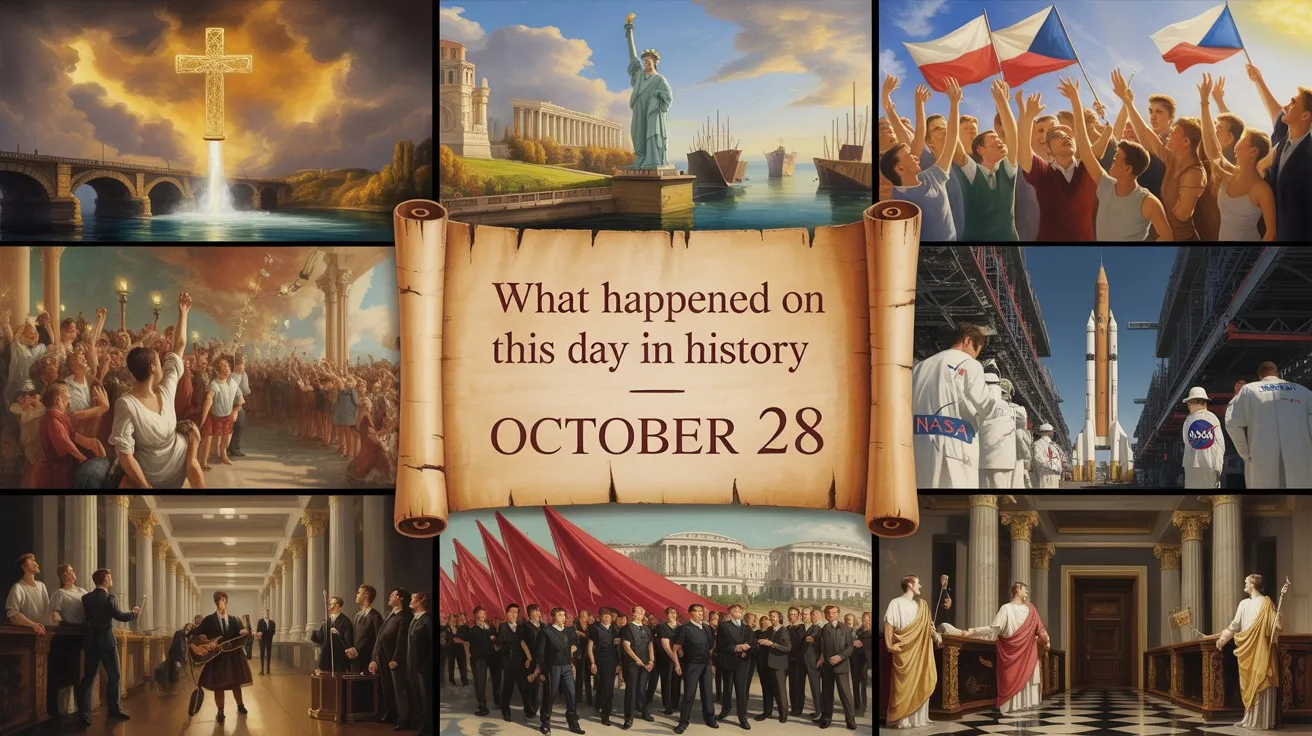
Empires shifted, cities were founded, and ordinary lives were swept up by sudden turns of fate. What happened on this day in history October 28 places Constantine’s decisive victory and Roman succession dramas beside later political seizures, public monuments and university foundings. Earthquakes and colonial claims recur on the date, showing both immediate rupture and long institutional change.
Earlier History
97 — Imperial adoption practices and Roman military influence shaped succession and stabilized rule in turbulent periods.
States & Revolutions
1922 — Mussolini’s March on Rome ended parliamentary dominance in Italy and began a long authoritarian chapter.
Science, Tech & Media
1962 & 2009 — The Gateway Arch’s completion and the Ares I-X test reflect architectural and aerospace milestones connected to civic identity and space policy.
Arts & Culture
1726 & 1893 — Swift’s Gulliver’s Travels and Tchaikovsky’s Pathétique represent literary and musical milestones that influenced later creative generations.
Disasters & Human Rights
1707, 1891, 1948 & 1995 — Major earthquakes, industrial smog, aviation accidents and the Baku Metro fire drew attention to public safety, environmental hazards and the need for institutional reform.
Read also: What Happened On This Day In History October 27
Major Events on October 28
97 — Nerva adopts Trajan as heir
Under pressure from the Praetorian Guard, Emperor Nerva adopts the general Marcus Ulpius Trajanus as his heir and successor. That act steadied an anxious imperial succession and paved the way for Trajan’s later military and administrative successes; the adoption became a model for securing legitimacy in an era of frequent palace intrigue and army influence.
306 — Maxentius proclaimed emperor
Maxentius is proclaimed emperor amid Roman political turmoil, establishing a rival claim to imperial authority in the West. His elevation intensified the Tetrarchic-era rivalries and set up a direct clash with Constantine that would decide control of Rome and influence subsequent imperial policy and dynastic precedent in the early fourth century.
312 — Constantine defeats Maxentius (Milvian Bridge)
Constantine’s victory over Maxentius made him the dominant western ruler and is associated with reported divine visions that shaped his later policies. The battle altered the balance of power in the Roman Empire, helped consolidate Constantine’s position, and is commonly linked with the emperor’s increasing support for Christianity and long-term religious change within the empire.
969 — Byzantines recover Antioch
The Byzantine Empire recovers Antioch from Arab rule, restoring imperial control over an important eastern city. Regaining Antioch reinforced Byzantine prestige and regional strategic depth, affecting trade and frontier security; the shift altered the balance among Mediterranean and Near Eastern powers for the following decades.
1344 — Latin Christians capture lower Smyrna
Latin Christian forces seize the lower town of Smyrna during the Smyrniote crusades in response to Aydınid piracy. The capture reflected maritime conflict and the contested security of Aegean coasts; control changes like this affected trade routes, regional authority, and the long-term contest between Latin and Turkish powers in the eastern Mediterranean.
1420 — Beijing designated Ming capital (Forbidden City completed)
With the Forbidden City completed and Beijing officially designated as the Ming capital, imperial administration was centralized in a new ceremonial and bureaucratic seat. The decision fixed Beijing’s political primacy for centuries, influenced court culture and urban planning, and signalled the Ming state’s assertion of dynastic authority through monumental architecture.
1449 — Christian I crowned king of Denmark
Christian I’s coronation formalizes succession in the Danish monarchy and consolidates regional dynastic authority. His reign and coronation contributed to the later formation of political unions and shifting northern European balances, shaping the monarchy’s institutional continuity amid fifteenth-century dynastic politics.
1453 — Ladislaus the Posthumous crowned king of Bohemia
Ladislaus the Posthumous is crowned king of Bohemia in Prague, representing dynastic claims complicated by early deaths and regencies. Such coronations reflected persistent struggles over inheritance and regional authority in Central Europe and contributed to the complex political fabric of late-medieval Bohemia and surrounding realms.
1492 — Columbus lands in Cuba
On his first voyage, Christopher Columbus lands in Cuba and initially believes it to be part of Asia. The landing extended Spanish claims in the Caribbean, accelerated European colonization efforts, and presaged profound and often disruptive encounters between European powers and indigenous societies across the Americas.
1516 — Battle of Yaunis Khan (Ottoman–Mamluk war)
During the Second Ottoman–Mamluk War, Ottoman forces push toward Egypt after the Mamluks fail to halt their advance at the Battle of Yaunis Khan. The campaign signaled Ottoman expansion in the eastern Mediterranean and reshaped control of key trade routes and political authority in the region in the early sixteenth century.
1520 — Magellan reaches the Pacific Ocean
Ferdinand Magellan’s expedition reaches the Pacific Ocean, achieving a crucial maritime crossing in the first circumnavigation attempt. The passage opened new global navigation routes, changed European perceptions of oceanic scale, and paved the way for later transoceanic trade and imperial competition.
1531 — Adal Sultanate seizes southern Ethiopia
In the Abyssinian–Adal war, forces of the Adal Sultanate seize parts of southern Ethiopia, intensifying regional conflict in the Horn of Africa. Such territorial shifts affected local polities’ power, patterns of military campaigning, and the long-term interaction between Christian and Muslim states in the area.
1538 — Universidad Santo Tomás de Aquino founded (Dominican Republic)
The foundation of the Universidad Santo Tomás de Aquino in what is now the Dominican Republic represents a colonial-era step in institutional education in the Americas. Early colleges and universities shaped elite formation, clerical training and colonial governance, leaving lasting marks on regional intellectual and administrative life.
1628 — Siege of La Rochelle ends (Huguenots surrender)
After a fourteen-month siege, Huguenot forces surrender at La Rochelle, a decisive episode in the French Wars of Religion. The fall curtailed substantial Protestant military independence, reinforced royal authority under the French crown, and altered confessional politics in seventeenth-century France.
1636 — Massachusetts Bay Colony votes to found a theological college (Harvard)
Colonial magistrates authorize a college to train clergy and civic leaders; this institution later becomes Harvard University. The measure reflected Puritan priorities for learned ministry and governance, establishing a long-standing center of higher education in New England that influenced American intellectual and civic life.
1640 — Treaty of Ripon signed
The Treaty of Ripon ends hostilities in the Second Bishops’ War, imposing terms that affected the Stuart monarchy’s military and fiscal position. The agreement contributed to mounting political pressures on Charles I and fed into the constitutional and religious disputes that ultimately produced broader conflict in the 1640s.
1664 — Royal Marines’ predecessor regiment established
The Duke of York and Albany’s Maritime Regiment of Foot, later known as the Royal Marines, is established. The formation institutionalized a specialized naval infantry force for British maritime operations, influencing naval warfare, shipboard security, and later imperial expeditionary capabilities.
1707 — Hōei earthquake causes thousands of deaths (Japan)
The 1707 Hōei earthquake produces massive destruction and more than 5,000 deaths in Japan. The catastrophe had significant social and economic effects, strained local relief capacities, and is remembered alongside subsequent volcanic activity, underscoring Japan’s vulnerability to major natural disasters.
1726 — Jonathan Swift publishes Gulliver’s Travels (anonymously)
Jonathan Swift anonymously publishes Travels into Several Remote Nations of the World (later titled Gulliver’s Travels), a major satirical work that influenced English literature and the novel form. Its publication shaped political satire, social critique, and literary developments in the eighteenth century and beyond.
1776 — British capture Chatterton Hill (Revolutionary War)
During the American Revolutionary War, British troops attack and seize Chatterton Hill from Continental forces, a tactical action in the wider struggle for control around New York. Such local engagements affected supply lines, morale and the shifting operational landscape of the war in 1776.
1790 — Nootka Sound convention resolves dispute with Spain
Spain concedes to British demands in a convention that resolved the Nootka Sound controversy, easing immediate tensions over Pacific Northwest claims. The agreement influenced later patterns of colonial rivalry and settlement in the Pacific and gave new clarity to competing imperial interests.
1834 — Pinjarra massacre in Swan River Colony
A violent confrontation in the Swan River Colony results in the deaths of an estimated 30 Noongar people at the hands of British colonists. The incident is part of broader frontier violence tied to settler expansion and remains a painful episode in Australia’s colonial history, influencing later reflection on indigenous dispossession.
1835 — The United Tribes of New Zealand were established
Northern Māori chiefs sign the Declaration of Independence of New Zealand, asserting autonomous authority and diplomatic identity in the face of increasing European presence. The declaration shaped later constitutional interactions and remains an important document in New Zealand’s colonial-era history.
1864 — Union attack on Richmond repulsed (American Civil War)
A Union assault on the Confederate capital of Richmond is repulsed, maintaining the Confederate government’s hold and prolonging the conflict. The action reflected the entrenched character of late-war operations and the strategic importance attached to Richmond as both a military and symbolic center.
1886 — Statue of Liberty dedicated
President Grover Cleveland dedicates the Statue of Liberty, a Franco-American gift symbolizing liberty and welcome. Soon after, the monument became an international emblem tied to immigration, national identity and civic symbolism in the United States.
1891 — Mino–Owari earthquake (Japan)
The Mino–Owari earthquake, Japan’s largest recorded inland quake, causes widespread destruction. Its scale affected infrastructure and reconstruction priorities and added to the scientific and practical awareness of seismic risk on the Japanese archipelago.
1893 — Tchaikovsky’s Pathétique premieres shortly before his death
Pyotr Tchaikovsky’s Symphony No. 6 (Pathétique) receives its première only nine days before the composer’s death, quickly entering the repertory as a deeply felt late masterpiece. The work’s reception influenced late-Romantic musical sensibilities and Tchaikovsky’s posthumous reputation.
1918 — New Polish government established in western Galicia
A new Polish government in western Galicia is announced, triggering the Polish–Ukrainian War and reflecting the region’s volatile postwar realignment. The episode shows how imperial collapse in Central Europe produced competing national claims and intermittent armed conflict.
1918 — Czech politicians take Prague; First Czechoslovak Republic formed
Czech politicians peacefully assume control of Prague, a decisive step toward establishing the First Czechoslovak Republic. The transfer of authority signalled the final unravelling of Habsburg rule in those territories and the birth of a new independent Central European state.
1919 — U.S. Congress passes the Volstead Act (Prohibition)
Over President Wilson’s veto, Congress enacts the Volstead Act to enforce Prohibition, launching a nationwide legal ban on alcoholic beverages. The law had broad social and political consequences—affecting enforcement practice, organized crime, and public debates on morality and state regulation.
1922 — Mussolini’s March on Rome (fascist takeover)
Benito Mussolini and his fascist supporters march on Rome and seize control of the Italian government, ending liberal rule and inaugurating an authoritarian regime. The event reshaped Italian politics, inspired fascist movements abroad, and had lasting implications for European interwar history.
1928 — “Indonesia Raya” first played (national anthem)
The anthem Indonesia Raya is performed for the first time at the Second Indonesian Youth Congress, a symbolic cultural moment that fed nationalist sentiment. The song later became the national anthem and a focal point for anti-colonial mobilization and identity formation.
1940 — Italy invades Greece after Greek rejection of ultimatum
Greece rejects Italy’s ultimatum and the Italian invasion through Albania follows, opening the Greco-Italian front of World War II. The campaign altered strategic calculations in the Balkans and influenced subsequent German intervention in the region.
1942 — Alaska Highway connects to North American rail network
The Alaska Highway reaches Dawson Creek, linking Alaska to continental transport networks and improving wartime logistical integration. The connection bolstered strategic mobility in the North American theater and had long-term economic and infrastructural effects for northern communities.
1948 — Paul Hermann Müller awarded Nobel Prize for DDT discovery / Donora smog disaster
Paul H. Müller receives the Nobel Prize for identifying DDT’s insecticidal properties, a scientific milestone later debated for environmental impact. The same year, the Donora smog disaster exposed industrial air-pollution risks and influenced emerging public-health and regulatory responses in the United States.
1949 — Air France Lockheed Constellation crashes in the Azores
An Air France Lockheed Constellation crashes in the Azores, killing all 48 aboard. The accident underscores the hazards of early long-distance air travel and led to scrutiny of aviation safety protocols and international flight operations in the postwar period.
1954 — Aeroflot Flight 136 crash near Krasnoyarsk
Aeroflot Flight 136 crashes near Krasnoyarsk, resulting in 19 fatalities. Such accidents highlighted the risks of mid-century civil aviation and tended to prompt reviews of mechanical reliability, pilot training and flight-safety procedures in the Soviet and international contexts.
1956 — Hungarian Revolution: ceasefire begins; Soviet withdrawal from Budapest begins
A de facto ceasefire takes effect as Soviet troops begin a partial withdrawal from Budapest amid the Hungarian Revolution. The momentary lull did not end the uprising’s suppression, but it marked a critical phase in the 1956 events that exposed Cold War tensions and Soviet limits on reform within the Eastern Bloc.
1958 — Election of Pope John XXIII
Cardinal Angelo Roncalli is elected Pope John XXIII, initiating a papacy that would soon be recognized for pastoral emphasis and for convening the Second Vatican Council. His election signalled shifts in ecclesiastical tone and later reforms in Catholic liturgy and engagement with other faiths.
1962 — Cuban Missile Crisis winds down as Khrushchev orders missile removal
Soviet Premier Nikita Khrushchev orders the removal of missiles from Cuba, effectively ending the immediate Cuban Missile Crisis. The resolution reduced the threat of direct superpower nuclear confrontation, led to new diplomatic channels and arms-control conversations, and had lasting effects on Cold War crisis management.
1962 — Gateway Arch completed in St. Louis (note on completion)
The Gateway Arch in St. Louis, designed by Eero Saarinen, is completed as a commemorative monument to westward expansion. The structure became an architectural landmark and civic symbol, reflecting mid-twentieth-century civic ambition and the use of monumental design in public memory.
1965 — Nostra aetate promulgated by Pope Paul VI
Pope Paul VI promulgates Nostra aetate, a declaration recognizing the legitimacy of non-Christian faiths and reshaping Catholic relations with other religions. The document marked a substantial shift in official Catholic ecumenical and interfaith posture and influenced decades of theological and diplomatic engagement.
1971 — Prospero satellite launched (British satellite by British rocket)
Prospero becomes the only British satellite launched by a British rocket, a notable moment in the United Kingdom’s space history. The mission demonstrated domestic launch capability and remains a distinctive footnote in Britain’s spaceflight record.
1982 — Spanish general election begins long PSOE rule
A Spanish general election ushers in an extended period of governance by the Spanish Socialist Workers’ Party (PSOE), altering post-Franco political trajectories and contributing to Spain’s democratic consolidation and policy shifts in the 1980s and beyond.
1989 — Aloha Island Air Flight 1712 crashes in Hawaii
Aloha Island Air Flight 1712 crashes into terrain at night, killing all 20 on board. The accident added to concerns about regional aviation safety and contributed to procedural and regulatory attention to short-haul and commuter flight operations.
1990 — Georgia holds only free Soviet-era election
Georgia conducts the sole genuinely free election under Soviet rule, a step toward political autonomy and the eventual declaration of independence. The vote reflected rising nationalist momentum and the Soviet Union’s loosening hold on its republics.
1995 — Baku Metro fire kills hundreds
A catastrophic fire in the Baku Metro kills 289 people and injures many more, prompting scrutiny of emergency response, infrastructure safety and public-transport system modernization in Azerbaijan and similar urban contexts.
2006 — Bykivnia graves funeral for Soviet victims
A public funeral service at Bykivnia commemorates Ukrainians killed by the Soviet secret police, part of ongoing efforts to historicize and memorialize twentieth-century political violence. The event contributed to national memory work and acknowledgment of repressive episodes.
2007 — Cristina Fernández de Kirchner elected president of Argentina
Cristina Fernández de Kirchner becomes the first directly elected female president of Argentina, marking an historic electoral outcome and shaping the country’s political course through her subsequent policies and leadership style.
2009 — Peshawar bombing kills and wounds hundreds
The 28 October 2009 Peshawar bombing kills 117 and wounds 213, a major terrorist attack within Pakistan that intensified domestic security concerns, counterterrorism responses and regional instability debates at the time.
2009 — NASA launches Ares I-X; U.S. hate-crimes law signed
NASA flies the Ares I-X test rocket as part of the Constellation effort, while the U.S. President signs the Matthew Shepard and James Byrd Jr. Hate Crimes Prevention Act into law—one technological test and one legislative milestone, each notable in their separate spheres.
2013 — Tiananmen Square car crash kills five, injures many
A car ploughs into barriers at Tiananmen Square, killing five and injuring dozens. The incident raised questions about security in major public spaces and produced a high-profile response from local authorities and media.
2014 — Cygnus CRS Orb-3 mission fails at launch
A rocket carrying the Cygnus CRS Orb-3 resupply mission to the ISS explodes seconds after liftoff at Wallops Island, destroying cargo and prompting investigation into launch-safety procedures and commercial resupply reliability for orbital operations.
2016–2023 — Regional conflicts and political developments noted on the date
From UN reports on Mosul to car bombs in Mogadishu and high-profile electoral changes, the October 28 date in recent years has collected instances of conflict, political transformation and regional crises, each reflecting broader geopolitical dynamics.
2023 — Rugby World Cup final at Stade de France (South Africa v New Zealand)
The 2023 Rugby World Cup final at the Stade de France saw South Africa defeat New Zealand 12–11, securing a fourth Webb Ellis Cup and marking a high-profile sporting moment with broad international attention.
Top 20 births (Oct 28)
- Bill Gates — American computer programmer, businessman, philanthropist — b. 1955
- Joaquin Phoenix — American actor — b. 1974
- Julia Roberts — American actress — b. 1967
- Brad Paisley — American musician — b. 1972
- Garrincha — Brazilian footballer — b. 1933
- Lenny Wilkens — American basketball player & coach — b. 1937
- Dennis Franz — American actor — b. 1944
- Jane Alexander — American actress — b. 1939
- Eros Ramazzotti — Italian singer-songwriter — b. 1963
- Auguste Escoffier — French chef — b. 1846
- Maurice, count de Saxe — French general — b. 1696
- Abba P. Lerner — economist — b. 1903
- Per Albin Hansson — prime minister of Sweden — b. 1885
- Nivedita (Margaret Noble) — Irish-born teacher & Indian nationalist supporter — b. 1867
- Giuditta Pasta — Italian opera singer — b. 1797
- Eliphalet Remington II — American manufacturer/inventor — b. 1793
- R.L.M. Synge — British biochemist (Nobel co-winner) — b. 1914
- Gennady M. Strekalov — Russian cosmonaut — b. 1940
- Mahmoud Ahmadinejad — president of Iran — b. 1956
- Caitlyn Jenner — American Olympic athlete — b. 1949
Top 20 deaths (Oct 28)
- Red Auerbach — American basketball coach — d. 2006
- Matthew Perry — American-Canadian actor — d. 2023
- Jerry Lee Lewis — American musician — d. 2022
- Marie Maynard Daly — American biochemist — d. 2003
- Ted Hughes — British poet — d. 1998
- John Wallis — English mathematician — d. 1703
- William Morris Hughes — prime minister of Australia — d. 1952
- Bernhard, prince von Bülow — German chancellor — d. 1929
- André Masson — French artist — d. 1987
- Richard E. Smalley — American Nobel-winning chemist — d. 2005
- David Jones — English artist & writer — d. 1974
- Tadeusz Mazowiecki — prime minister of Poland — d. 2013
- Louis-Eugène Cavaignac — French general — d. 1857
- Kateb Yacine — Algerian author — d. 1989
- Rafael Alberti — Spanish poet — d. 1999
- Augier Ghislain de Busbecq — Flemish diplomat/writer — d. 1592
- Galway Kinnell — American poet — d. 2014
- Korney Chukovsky — Russian children’s author — d. 1969
- Otto Messmer — American animator (Felix the Cat) — d. 1983
- Ottmar Mergenthaler — inventor (Linotype) — d. 1899
Frequently Asked Questions
What is Ohi Day and why is it observed on October 28?
Ohi Day commemorates the Greek government’s refusal to an Italian ultimatum in 1940; it is celebrated as a national day of defiance and wartime resistance in Greece and among Greek communities.
Why is the Statue of Liberty’s dedication on October 28 notable?
The 1886 dedication of the Statue of Liberty established a transatlantic civic symbol of welcome, liberty and national identity; the monument became closely associated with immigration and American civic imagery.
Why does the March on Rome matter in modern history?
The March on Rome (1922) enabled Benito Mussolini’s seizure of power, marking the collapse of liberal governance in Italy and the start of fascist rule that reshaped European politics in the interwar period.
What was the significance of the Donora smog disaster?
The 1948 Donora smog incident caused dozens of deaths and many illnesses, highlighting industrial air pollution’s health risks and prompting later regulatory attention to air quality and public health protections.