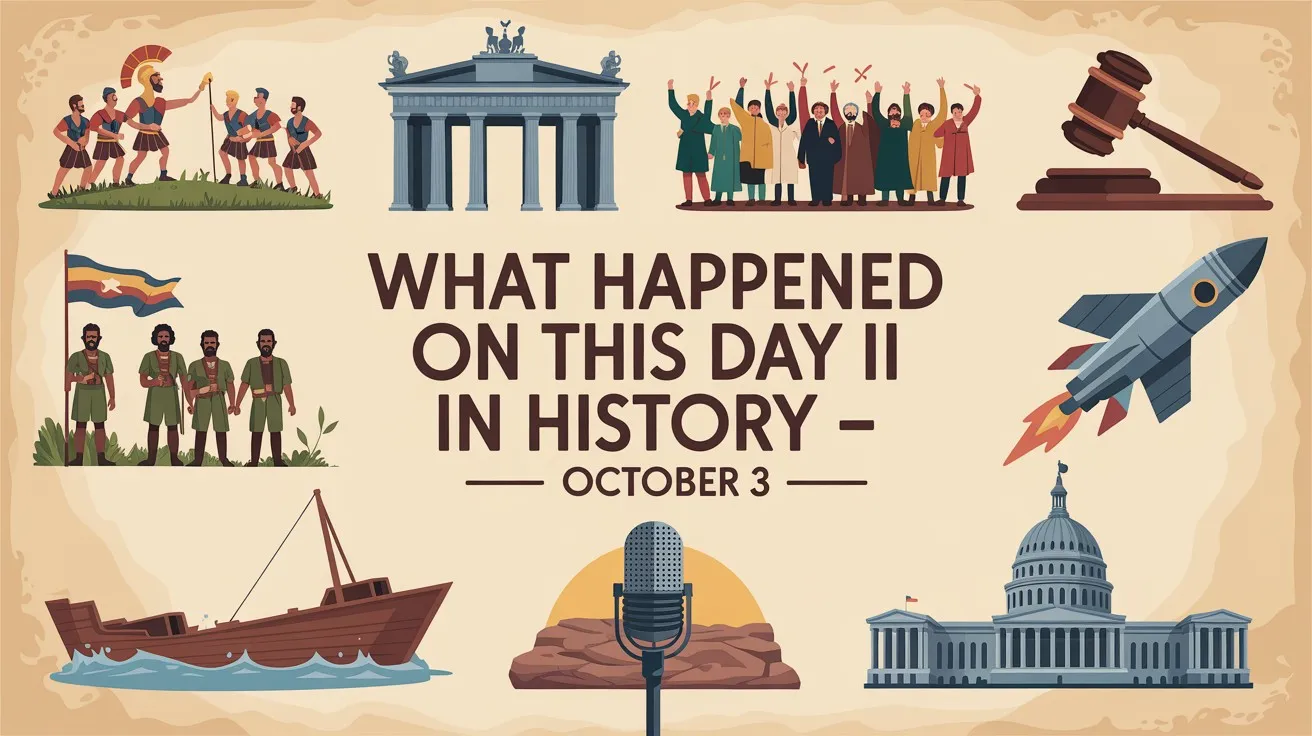
A compact roll of political turns, cultural firsts, battles, and public crises fall on October 3. What happened on this day in history October 3 threads together mythic foundations, dynastic battles, early-modern upheavals, and modern headlines — a patchwork that shows how a single calendar day can hold very different meanings across eras and places.
Major Events on October 3
2457 BC — Gaecheonjeol: Hwanung purportedly descends from heaven (Korean foundation myth)
According to Korean tradition, Hwanung — a heavenly prince — descended to earth and founded a human realm, an event commemorated as Gaecheonjeol or National Foundation Day. The story sits within Korea’s foundation myths and informs cultural memories about origins, authority and sacred kingship. Though not a historical date in the modern sense, the festival remains an important national observance in South Korea.
52 BC — Vercingetorix surrenders at Alesia (Gallic Wars)
After a long siege at Alesia, Vercingetorix, leader of the Gauls, surrendered to Julius Caesar, effectively ending a major phase of the Gallic resistance. The fall of Alesia marked a decisive consolidation of Roman power in Gaul and secured Caesar’s military reputation back in Rome.
The event reshaped the political map of Western Europe and accelerated Romanization in the region. Vercingetorix’s capture became a lasting symbol of resistance in later historiography.
42 BC — First Battle of Philippi: Triumvirs clash with assassins of Caesar
In the opening phase of the Philippi campaign, the forces of Mark Antony and Octavian met Brutus and Cassius in a contest that decided the fate of the Roman Republic’s immediate heirs. The fighting produced a mixed set of outcomes on the field; miscommunication and reversed fortunes led Cassius to believe defeat had come and to take his own life.
The campaign ultimately broke organized opposition to the Second Triumvirate and paved the way for Octavian’s rise. Philippi thus stands as a turning point from republican rivalry toward imperial consolidation.
382 — Theodosius I concludes a settlement with the Goths
Emperor Theodosius negotiated terms that settled Gothic groups within imperial borders, a policy blending diplomacy and accommodation with military pressure. The agreement reflected evolving Roman strategies for managing barbarian federates and frontier security.
By integrating Gothic contingents, the empire hoped to stabilize volatile borders while also transforming internal military dynamics. The settlement had long-term implications for imperial defense and the ethnic composition of late-Roman armies.
1392 — Muhammad VII becomes sultan of the Emirate of Granada
Muhammad VII assumed the throne during a period of dynastic competition and external pressures on the Nasrid kingdom. His accession continued Granada’s complex balancing act between internal factionalism and the growing strength of Christian Iberian states.
The sultanate’s rulers navigated diplomacy, tribute and occasional warfare as they sought to preserve autonomy on the peninsula’s southern fringe. Granada’s political life in this era foreshadowed the final century of Muslim rule in Iberia.
1574 — Relief of Leiden; Siege lifted by the Watergeuzen
After a prolonged Spanish siege, the city of Leiden was relieved when Dutch rebels and water-based operations broke the encirclement. The episode became emblematic of the Dutch Revolt and the use of deliberate flooding as a strategic defensive measure.
Leiden’s survival strengthened the Protestant republican cause in the Low Countries and featured in Dutch national memory. The relief also paved the way for Leiden’s later growth as a university town and cultural center.
1683 — Shi Lang receives the surrender of Tungning (Taiwan)
Qing naval commander Shi Lang accepted the surrender of the Ming loyalist Tungning kingdom after the Battle of Penghu, bringing Taiwan more directly under Qing influence. The capitulation marked a key step in the Qing dynasty’s consolidation of maritime frontiers and the absorption of Ming-loyalist strongholds.
It reshaped cross-strait governance and maritime trade patterns in the region. The event also highlighted the naval dimension of early modern Chinese statecraft.
1712 — Warrant issued for Rob Roy MacGregor’s arrest
Authorities in Scotland moved against the famously quarrelsome Highlander Rob Roy MacGregor amid ongoing clan conflicts and law-and-order efforts. Rob Roy’s troubles reflected broader tensions between Highland customs, English legal expansion and clan rivalries in early 18th-century Britain.
His career as cattleman, outlaw and folk hero later entered literature and popular memory. The warrant symbolized the fraught relationship between centralizing state authority and regional resistance.
1739 — Treaty of Niš ends a Russo–Turkish episode
The Treaty of Niš marked a diplomatic settlement between the Ottoman Empire and Russia after a period of frontier conflict, temporarily stabilizing the Balkans’ volatile border dynamics. Such treaties often involved territorial adjustments, guarantees and shifting alliances that reshaped Southeastern Europe.
The accord reflected the ebb and flow of Ottoman–Russian rivalry and the region’s complex ethnic and religious tapestry. Its terms influenced subsequent diplomacy in the area.
1789 — George Washington proclaims a national Thanksgiving (November 26)
President George Washington issued a proclamation setting Thursday, November 26, 1789, as a national day of thanksgiving — an early federal observance intended to mark the new nation’s blessings. The proclamation blended civic ritual with expressions of gratitude and set a precedent for later national holidays.
It reflected the young republic’s desire for unified civic rituals even as states retained broad autonomy over observance. The declaration later became part of a longer history that culminated in a standardized federal Thanksgiving.
1792 — Militia departs Valdivia to suppress a Huilliche uprising (Chile)
Colonial Spanish authorities organized an expedition from the fortified town of Valdivia in response to indigenous Huilliche resistance in southern Chile. Such confrontations were part of longer patterns of indigenous resistance, frontier policing and colonial settlement.
The campaign affected local demographic and land-use patterns and shaped later regional relations. It also exemplifies the contested character of colonial frontiers in the Americas.
1862 — Battle of Corinth begins (American Civil War)
Union and Confederate forces clashed at Corinth, Mississippi, in a confrontation that proved strategically important for control of key rail junctions and supply lines. The Union victory consolidated control in northeastern Mississippi and further limited Confederate operational flexibility in the Western Theater.
The battle’s tactical and logistical dimensions underscored the war’s growing reliance on rail and industrial resources. Local communities experienced the immediate devastation and disruption characteristic of Civil War campaigns.
1863 — U.S. President Abraham Lincoln declares the last Thursday in November Thanksgiving Day
Abraham Lincoln issued a proclamation declaring the final Thursday of November as a national day of thanksgiving and prayer, seeking to unify a divided nation amid the Civil War. The move built on earlier proclamations and popular campaigns that had asked for a formal national observance.
Lincoln’s declaration helped cement Thanksgiving as a recurring national ritual in the United States. Over time the holiday evolved into a broader cultural and commercial institution.
1866 — Treaty of Vienna transfers Venetia to Italy (mediated)
Through diplomacy that involved European great-power mediation, Venetia was transferred to the Kingdom of Italy, marking a major step in Italian unification. The arrangement — reached after the Austro-Prussian conflict and with French mediation — reshaped the Italian peninsula’s political map.
The transfer eroded the remnants of Austrian influence in northern Italy and advanced the Risorgimento’s goals. It also reconfigured regional alliances and national identity.
1873 — Modoc leaders hanged after the Modoc War (California)
Chief Kintpuash (Captain Jack) and other Modoc leaders were executed for their role in the conflict that erupted in northern California and southern Oregon. The Modoc War illustrated the violent consequences of settler expansion, reservation policies and cross-cultural misunderstandings.
Executions and removals left deep scars in indigenous communities and altered regional power dynamics. The episode remained a painful chapter in the broader history of U.S.–Native American relations.
1901 — Battle of Coyotepe Hill (Nicaragua)
U.S. forces engaged rebels at Coyotepe Hill as part of interventions in Central America during a period of repeated U.S. involvement in the region. The engagement fit into early 20th-century patterns of U.S. military action intended to protect strategic and economic interests.
Local resistance and politics shaped the course and consequences of these interventions. The battles of this era influenced subsequent regional relations and anti-imperial sentiments.
1918 — Boris III accedes to the Bulgarian throne
Following political upheavals near the close of World War I, Boris III became Tsar of Bulgaria, inheriting a kingdom shaped by wartime pressures and postwar settlements. His accession occurred amid shifting regional borders and domestic political realignments that would shape interwar Bulgaria.
Boris’s reign later navigated pressures from both internal factions and broader European dynamics. The event marked a generational transition in Bulgarian leadership.
1918 — Prince Max of Baden appointed German chancellor
Prince Maximilian of Baden took office as chancellor in the final weeks of World War I, a short-lived appointment meant to steer Germany toward armistice and constitutional reform. His administration faced collapsing fronts, domestic unrest and the urgent task of negotiating peace terms.
Max’s role was pivotal in the political transition from imperial rule toward the Weimar settlement. The appointment symbolized attempts at moderate leadership as the German state confronted defeat.
1919 — Adolfo Luque becomes the first Latin American pitcher in a World Series
Cincinnati Reds pitcher Adolfo Luque’s appearance marked an early Latin American presence in major-league postseason baseball. His participation presaged the long and growing contribution of Latin American players to professional baseball in the United States.
Luque’s career also reflected baseball’s international ties and migratory sporting cultures of the era. The milestone remains part of the sport’s evolving multicultural history.
1929 — Kingdom of Serbs, Croats and Slovenes renamed Yugoslavia
King Alexander I changed the state’s name to Yugoslavia as part of efforts to forge a unitary national identity across diverse South Slavic peoples. The rebranding aimed at political centralization but also exposed deep ethnic and regional tensions that would persist.
The name change was both symbolic and administrative, shaping interwar politics on the peninsula. Yugoslavia’s later history would be defined by competing visions of unity and autonomy.
1932 — The Kingdom of Iraq gains independence from the United Kingdom
Formal independence marked Iraq’s transition from mandate status to sovereign kingdom under international recognition, though British influence and military ties persisted. Independence launched a new but fragile era of nation-building amid internal political divisions and regional pressures.
The event reshaped British imperial commitments in the Middle East and affected subsequent governance and identity debates in Iraq. It set the stage for the kingdom’s tumultuous 20th-century trajectory.
1935 — Italy invades Ethiopia (Second Italo–Abyssinian War)
Italian forces under Mussolini launched a large-scale invasion of Ethiopia, seeking imperial expansion and asserting fascist ambitions in East Africa. The campaign provoked international condemnation and exposed the limitations of collective security institutions of the era.
Ethiopia’s resistance and later occupation had long-lasting effects on African politics and anti-colonial movements. The conflict is remembered as a striking example of aggression that presaged wider 20th-century crises.
1941 — World premiere of The Maltese Falcon (John Huston)
John Huston’s screen adaptation of Dashiell Hammett’s novel opened to audiences and later came to be regarded as a landmark of film noir and detective cinema. The picture’s tough dialogue, moral ambiguity and complex plotting influenced subsequent American genre films.
It showcased Humphrey Bogart in a defining role and helped shape cinematic representations of crime and urban modernity. The film’s premiere contributed to Hollywood’s wartime cultural output.
1942 — German V-2 rocket reaches record altitude
A test flight of the V-2 rocket achieved an altitude of roughly 85 kilometers, demonstrating the rocket’s groundbreaking but militarized technological capabilities. The V-2 represented a major advance in rocketry and a foretaste of postwar ballistic and space technologies.
Although developed as a weapon, the underlying science later contributed to spaceflight and missile programs in several countries. The tests carried both strategic and scientific significance.
1943 — Lingiades massacre in Greece
German occupation forces massacred civilians in the village of Lingiades, part of a pattern of brutal reprisals and civilian suffering in occupied Europe. The killings exemplify the war’s extreme violence against noncombatants and the devastating local consequences of occupation policies. Such episodes shaped postwar memory, justice efforts and collective trauma in affected communities. Lingiades remains a somber point of remembrance in Greek wartime history.
1945 — May-Johnson bill debate and atomic-security discussions (U.S. Congress)
Legislative debates over control of atomic research and security culminated in proposals like the May-Johnson bill, which sought to regulate nuclear information and facilities. Although the bill in its original form did not become law, the controversy propelled legislative work that led to the Atomic Energy Act of 1946.
The period’s debates reflected tensions between military, scientific and civilian control of nuclear technology. Outcomes from this legislative moment shaped postwar atomic governance.
1946 — Douglas DC-4 crash near Stephenville, Newfoundland (American Overseas Airlines)
An American Overseas Airlines DC-4 crashed close to Ernest Harmon Air Force Base, killing 39 passengers and crew, in one of the era’s tragic postwar aviation accidents. The crash called attention to navigation, weather and operational safety challenges of transatlantic air travel in the mid-20th century. Investigations into such accidents helped spur improvements in air-traffic control and aircraft systems. The loss was mourned by families and highlighted the human cost of expanding global aviation.
1949 — WERD, first Black-owned radio station in the United States, opens in Atlanta
WERD’s launch represented an important milestone in African American media ownership and community broadcasting, providing a voice and platform for Black listeners and issues. The station became a hub for local culture, civil-rights messaging and entrepreneurial leadership in radio. WERD’s existence challenged media monopolies and helped incubate important social and musical movements. Its founding remains a key moment in broadcast and Black-press history.
1951 — First Battle of Maryang San (Korean War)
Commonwealth troops engaged Chinese forces at Maryang San in a fiercely contested hill campaign, notable for tactical bravery and difficult terrain. The fighting illustrated the contested stalemate characterizing much of the Korean War’s frontline operations. Casualties and shifting gains underscored the human cost and strategic limits of positional warfare in Korea.
The battle is often remembered in regimental histories and Commonwealth military memory.
1952 — The United Kingdom conducts a nuclear test in the Montebello Islands
Britain’s successful nuclear test in Australian waters marked its accession to the group of nuclear-armed states, reshaping Cold War strategic balances and imperial defense relationships. The test reflected Britain’s desire for independent deterrent capability and technological prestige in the postwar world.
Environmental and indigenous impacts of such tests later became subjects of scrutiny and debate. The test also influenced alliance politics and nuclear proliferation dynamics.
1957 — California court rules Allen Ginsberg’s Howl not obscene
A California Superior Court decision found that the poetry volume Howl and Other Poems did not meet legal standards of obscenity, a landmark ruling for literary freedom in the United States. The judgment affirmed broader constitutional protections for artistic expression and helped loosen censorship of avant-garde literature.
The case boosted debates about community standards, artistic value and free speech in the 20th century. Howl’s legal victory became a touchstone in cultural-legal history.
1962 — Project Mercury: Wally Schirra’s six-orbit Sigma 7 flight
Astronaut Wally Schirra completed a six-orbit mission aboard Sigma 7, contributing to U.S. confidence in manned orbital operations during the early Space Race. The flight tested life-support systems, spacecraft performance and human endurance in orbit.
Schirra’s mission helped refine procedures that would be essential for future, longer missions. Project Mercury’s successes built momentum toward later Gemini and Apollo endeavors.
1963 — Violent coup ushers in military rule in Honduras
A coup in Honduras set the stage for roughly two decades of military involvement in governance, reshaping political institutions and civil-military relations. The takeover reflected regional Cold War dynamics, internal factionalism and socioeconomic pressures.
Subsequent military administrations influenced policy, human rights and electoral developments in Honduras. The coup’s legacy affected political transitions and democratic restoration efforts in later decades.
1981 — Maze (H-Block) hunger strike ends in Northern Ireland
After seven months and ten deaths, the Maze Prison hunger strike ended, leaving a deep imprint on Northern Ireland’s sectarian conflict and republican politics. The protest raised questions about prisoner status, political recognition and the state’s response to political violence. Its human toll and political aftermath reshaped republican strategy and public sympathy in some communities. The strike remains one of the conflict’s most consequential episodes.
1985 — Space Shuttle Atlantis maiden flight (STS-51-J)
Atlantis made its first flight on a mission that carried DSCS-III satellites and demonstrated the shuttle’s role in military and civil space logistics. The launch expanded the roster of operational shuttle orbiters and underscored the program’s heavy-lift and payload capabilities. Atlantis later participated in many pivotal missions in NASA’s shuttle era. The maiden flight represented both technological achievement and ongoing debates about space priorities.
1986 — Opening of TASCC superconducting cyclotron (Chalk River, Canada)
The commissioning of the TASCC cyclotron at Chalk River Laboratories advanced Canadian nuclear and particle research capacity, supporting studies in nuclear structure and applied physics. Facilities like TASCC enabled experiments with rare isotopes and contributed to scientific collaborations.
The opening signaled investment in domestic research infrastructure during an era of expanding big-science facilities. Such centers helped train scientists and pushed forward experimental techniques.
1989 — Coup suppressed in Panama City; executions follow
A failed coup in Panama was suppressed with harsh reprisals, including executions of participants, reflecting the country’s volatile politics in the post-Noriega period. The event highlighted ongoing instability and the fraught process of political transition.
Violence and summary punishments underscored the fragility of rule of law in moments of upheaval. The episode influenced later efforts at legal and institutional reform.
1990 — East–West German reunification agreement within NATO framework
Following negotiations that included German chancellor Helmut Kohl and Soviet leader Mikhail Gorbachev, an agreement allowed a unified Germany to enter NATO, clearing a major political obstacle to reunification. The decision ended four decades of Cold War division on the European continent and reshaped security structures across the continent.
Reunification carried profound political, economic and social implications for Germany and its neighbors. The October agreement was a key step toward Germany’s formal reunification in 1990.
1991 — Nadine Gordimer wins the Nobel Prize in Literature
South African novelist Nadine Gordimer was awarded the Nobel Prize for her literary work that engaged the moral and political complexities of apartheid and its aftermath. The prize recognized fiction that illuminated the human costs of racialized rule and the possibilities for ethical reckoning.
Gordimer’s international stature boosted attention to South African letters and dissident cultural voices. The award affirmed literature’s role in bearing witness to injustice.
1993 — Mogadishu raid ends disastrously (Somalia)
An American operation targeting a Somali warlord in Mogadishu resulted in heavy casualties, with 18 U.S. soldiers killed and hundreds of Somalis dead or wounded. The mission’s fallout altered U.S. policy in Somalia and influenced broader debates about intervention, urban warfare and humanitarian operations. The incident had political consequences for future peacekeeping and use-of-force decisions. Public reaction to the losses shaped subsequent operational caution.
1995 — O. J. Simpson found not guilty in murder trial
A jury acquitted O. J. Simpson of charges that he had murdered Nicole Brown Simpson and Ronald Goldman, in a verdict that ignited intense national debate about race, celebrity, policing and the criminal-justice system. The trial’s media spectacle and contested forensic evidence produced sharply divided public opinion.
Legal scholars and commentators continued to dissect the case’s procedures and social meanings for years afterward. The verdict remains a major touchstone in U.S. criminal-justice history.
2008 — Emergency Economic Stabilization Act signed (U.S.)
Facing acute financial crisis, U.S. President George W. Bush signed the Emergency Economic Stabilization Act to authorize large-scale interventions aimed at stabilizing financial markets. The legislation established mechanisms to purchase troubled assets and shore up banks, reflecting urgent policy responses to systemic risk.
The act and its aftermath sparked debate about regulation, moral hazard and fiscal responsibility. The measures were part of a broader global response to the 2008 financial meltdown.
2009 — Turkic Council expands (Azerbaijan, Kazakhstan, Kyrgyzstan, Turkey)
Several Turkic-language nations formalized cooperation within the Turkic Council framework, seeking cultural, economic and political coordination across a transregional community. The group aimed to foster shared identity, trade links and diplomatic engagement among Turkic states.
Expansion reinforced diplomacy in Eurasia and opened new channels for multilateral collaboration. The council’s growth reflected shifting post-Soviet regional architectures.
2013 — Migrant boat sinks near Lampedusa; at least 360 die
A vessel carrying migrants sank off the Italian island of Lampedusa, producing a catastrophic loss of life and renewed attention to Mediterranean migration routes. The tragedy highlighted desperate migration drivers, smuggling networks and the humanitarian challenges of rescue and reception. International appeals followed for more coordinated search-and-rescue and migration policy responses. The Lampedusa disaster became a symbol of broader regional migration crises.
2015 — Kunduz hospital airstrike kills dozens (Afghanistan)
An airstrike on a hospital in Kunduz resulted in large numbers of civilian casualties and missing persons, provoking global outrage and inquiries into rules of engagement and targeting. The incident drew attention to the complexities of modern conflict, battlefield intelligence failures, and the protection of medical facilities.
Humanitarian organizations condemned the attack and called for accountability. The strike had diplomatic and operational repercussions for coalition forces.
2019 — Knife attack at Paris police headquarters
An assailant attacked employees at the Paris police headquarters, killing several officers and wounding others in an event that shocked French security services. The attack raised urgent questions about workplace safety, radicalization, and internal vetting procedures. Investigations examined motive, background and institutional lapses. The incident reverberated across national debates on policing and counterterrorism.
2020 — U.S. President and First Lady test positive for COVID-19
The COVID-19 diagnosis of the U.S. President and First Lady dominated headlines and underscored the pandemic’s reach into the highest levels of political leadership. The hospitalization and recovery process drew global attention to public-health precautions, governance continuity and political messaging in a health crisis.
Public debate followed about responses, transparency and implications for national policy. The episode illustrated the pandemic’s intimate effect on everyday governance.
2021 — U.S. protests against Texas abortion restrictions
Thousands marched across the United States to protest new abortion restrictions in Texas, signaling renewed national mobilization over reproductive rights. The demonstrations reflected a broader, polarized national debate about access to abortion, state legislation, and judicial frameworks.
Activism on the streets sought to influence public opinion and legislative responses. The protests formed part of a sustained movement engaging courts, legislatures and civic organizations.
2021 — Plane crash near Milan kills eight
A small aircraft crash near Milan resulted in multiple fatalities, prompting investigations into causes and renewed attention to general-aviation safety standards. The tragedy affected families and local communities and led to inquiries into maintenance, weather and pilot factors.
Outcomes from the investigation aimed to improve safety oversight and reduce future accidents. The event stood as a reminder of aviation risks beyond commercial airline operations.
2022 — Ballistic missile overflight reported from North Korea
North Korea launched a ballistic missile reported to have flown over Japan, triggering emergency alerts and regional diplomatic alarm. The overflight heightened tensions in East Asia and underscored the strategic challenges posed by Pyongyang’s weapons program.
Japan and neighboring states reiterated concerns about civilian safety and deterrence postures. The incident fed into broader security calculations and alliance diplomacy.
2022 — Svante Pääbo awarded the Nobel Prize in Physiology or Medicine
Svante Pääbo received the Nobel Prize for his pioneering work in paleogenetics and ancient DNA, opening new windows into human evolution and the genetic relationships of archaic hominins. His research reshaped understanding of human origins, admixture events and the genetic basis of traits inherited from ancient populations.
The prize recognized methodological breakthroughs and interdisciplinary scientific collaboration. Pääbo’s work continues to influence evolutionary biology and genomics.
2023 — U.S. House Speaker Kevin McCarthy removed from office
In a historic vote, Speaker Kevin McCarthy was ousted by a majority of the House, the first time a speaker had been removed in U.S. history. The motion reflected intense intra-party divisions and strategic maneuvering in a fractured congressional landscape.
The removal prompted brief leadership turmoil and raised questions about institutional norms and governance stability. It became a notable episode in modern American legislative politics.
2024 — Indian government grants Classical language status to several languages
The Government of India accorded Classical language status to Bengali, Assamese, Marathi, Pali and Prakrit, recognizing their long literary traditions and historical significance. Such recognition carries cultural prestige as well as potential institutional support for scholarship and preservation.
The decision reflected broader efforts to valorize linguistic heritage and regional literatures within India’s plural cultural landscape. The move stimulated discussion about language policy and academic resources.
2024 — Large Israeli strike on Tulkarm refugee camp (West Bank) reported
Reports indicated a major Israeli military strike on the Tulkarm refugee camp, producing heavy casualties and international concern over civilian impacts. The incident formed part of intensified hostilities in the region and raised urgent questions about the protection of civilians in densely populated areas.
Humanitarian responses and diplomatic reactions followed amid broader regional tensions. The strike became a focal point in reporting on the conflict’s human cost.
Quick Sections
Earlier History
Gaecheonjeol (2457 BC), Alesia surrender (52 BC), Philippi campaign (42 BC), Theodosius’s Gothic settlement (382), Muhammad VII’s accession in Granada (1392), Relief of Leiden (1574).
Exploration & Foundations
Iraq’s independence (1932), Renaming to Yugoslavia (1929), U.S. action at Coyotepe Hill (1901), Founding of WERD radio (1949), Turkic Council expansion (2009).
Wars & Politics
Alesia & Philippi (52 BC; 42 BC), Battle of Corinth (1862), Modoc War executions (1873), Italian invasion of Ethiopia (1935), Maryang San (1951), German reunification agreement within NATO (1990), Removal of U.S. House Speaker Kevin McCarthy (2023).
Arts & Culture
World premiere of The Maltese Falcon (1941), Howl obscenity ruling (1957), Nadine Gordimer—Nobel Prize in Literature (1991), cultural-identity moments in broadcasting and film (WERD, 1949; broader cinematic and literary milestones).
Science, Technology & Media
V-2 record altitude test (1942), UK nuclear test—Montebello Islands (1952), Project Mercury—Wally Schirra’s six-orbit flight (1962), TASCC cyclotron opening (1986), Svante Pääbo—Nobel Prize in Physiology or Medicine (2022).
Disasters & Human Rights
Lampedusa migrant shipwreck (2013), Kunduz hospital airstrike (2015), Lingiades massacre (1943), Mogadishu raid (1993), Douglas DC-4 crash near Stephenville (1946), Milan-area plane crash (2021).
Read also: What Happened On this Day in History October 2
Notable births — October 3
Al Sharpton — American minister, politician, and civil-rights activist — Born 1954.
Steve Reich — American composer known for minimalism — Born 1936.
Eddie Cochran — American singer and musician — 1938–1960.
Erik Bruhn — Danish ballet dancer — 1928–1986.
Sergey Yesenin — Russian poet — 1895–1925.
John Perry Barlow — American author, lyricist and digital-rights activist — 1947–2018.
Louis Aragon — French author and intellectual — 1897–1982.
Eleonora Duse — Italian stage actress — 1858–1924.
Robert O. Keohane — American political scientist and scholar — Born 1941.
George Bancroft — American historian and statesman — 1800–1891.
Leo McCarey — American film director — 1898–1969.
Doctor Atl (Gerardo Murillo) — Mexican painter and writer — 1875–1964.
Carl von Ossietzky — German journalist and pacifist — 1889–1938.
A.Y. Jackson — Canadian landscape painter (Group of Seven) — 1882–1974.
Kathryn Sullivan — American oceanographer and astronaut — Born 1951.
Pierre Deligne — Belgian mathematician — Born 1944.
Leopold II — Grand Duke of Tuscany — 1797–1870.
William Crawford Gorgas — U.S. Army surgeon who fought yellow fever — 1854–1920.
George Ripley — American journalist and transcendentalist figure — 1802–1880.
Charles J. Pedersen — American chemist and Nobel laureate — 1904–1989.
Alain-Fournier — French author — 1886–1914.
Emilio Portes Gil — President of Mexico — 1891–1978.
T. Thomas Fortune — American journalist and civil-rights advocate — 1856–1928.
John Gorrie — American physician and refrigeration pioneer — 1803–1855.
Gertrude Berg — American actress, producer and writer — 1899–1966.
Francisco Morazán — Central American leader — 1792–1842.
Fulke Greville, 1st Baron Brooke — English writer and courtier — 1554–1628.
Townsend Harris — American diplomat — 1804–1878.
Val McCalla — British publisher — 1943–2002.
Savva Mamontov — Russian entrepreneur, patron and impresario — c.1841–1918.
Marion Delorme — French historical figure and courtesan — 1613–1650.
Stijn Streuvels — Flemish writer — 1871–1969.
Gerardo Diego — Spanish poet and musicologist — 1896–1987.
Annie Horniman — English theatre manager and patron — 1860–1937.
El Juli — Spanish bullfighter — Born 1982.
Christian d’Oriola — French Olympic fencer — 1928–2007.
Stephan G. Stephansson — Icelandic poet — 1853–1927.
Arkady Vorobyev — Soviet Olympic weightlifter — 1924–2012.
Jacques-Joachim Trotti, marquis de La Chétardie — French diplomat — 1705–1759.
Jeannette Leonard Gilder — American editor and writer — 1849–1916.
Otto Devrient — German actor and director — 1838–1894.
Piper Kelly — American speed climber — Born 1999.
Ayo Edebiri — American actress, comedian and writer — Born 1995.
Alicia Vikander — Swedish actress — Born 1988.
Tessa Thompson — American actress and musician — Born 1983.
Notable deaths — October 3
Woody Guthrie — American folk singer and songwriter — 1912–1967.
John Heisman — American football coach (Heisman Trophy namesake) — 1869–1936.
Denis Healey, Baron Healey — British politician and economist — 1917–2015.
Gustav Stresemann — German statesman and foreign minister — 1878–1929.
Akio Morita — Co-founder of Sony — 1921–1999.
Black Hawk — Sauk leader — 1767–1838.
Myles Standish — Military leader of Plymouth Colony — c.1584–1656.
Leon M. Lederman — American physicist and Nobel laureate — 1922–2018.
Carl Nielsen — Danish composer — 1865–1931.
Elias Howe — Inventor of improvements to the sewing machine — 1819–1867.
Jeanne Eagels — American actress — 1890–1929.
Jean Anouilh — French dramatist — 1910–1987.
Sir Arnold Bax — British composer — 1883–1953.
Franz Josef Strauss — German politician — 1915–1988.
Rembrandt Peale — American portrait painter — 1778–1860.
Sir Malcolm Sargent — British conductor — 1895–1967.
Guy Mollet — Prime Minister of France — 1905–1975.
William Cavendish, 4th Duke of Devonshire — British prime minister — 1720–1764.
Janet Leigh — American actress — 1927–2004.
William Steig — American cartoonist and author — 1907–2003.
Tay Garnett — American film director — 1894–1977.
Alfred Edwards Emerson — American zoologist — 1896–1976.
Charles Fuller — American playwright — 1939–2022.
Jalal Talabani — President of Iraq — 1933–2017.
E. W. Howe — American writer and editor — 1853–1937.
Jens Baggesen — Danish author — 1764–1826.
John Maitland, 1st Lord Maitland — Scottish lord chancellor — 1543–1595.
Richard von Hertwig — German biologist — 1850–1937.
Joseph Hergenröther — German theologian — 1824–1890.
Bernard Maybeck — American architect — 1862–1957.
Max Wolf — German astronomer — 1863–1932.
Margaret Maultasch — Countess of Tyrol — 1318–1369.
Fay Templeton — American singer and actress — 1865–1939.
Alexandru Averescu — Romanian premier and general — 1859–1938.
Matthias Georg Monn — Austrian composer — 1717–1750.
George Kennedy Allen Bell — British clergyman — 1883–1958.
Florence Rena Sabin — American anatomist and medical researcher — 1871–1953.
Lucy Hobbs Taylor — American dentist and pioneer — 1833–1910.
Juan Carreño de Miranda — Spanish court painter — 1614–1685.
Observances & institutional dates
- National Foundation Day (Gaecheonjeol) — South Korea (mythic founding observance).
- National Day — Iraq (independence from the United Kingdom, 1932).
- German Unity Day — Germany (national celebration of reunification).
- 3 October Festival — Leiden, Netherlands (local historical commemorations).
- Morazán Day — Honduras (honoring Francisco Morazán).
- Mean Girls Day (popular cultural observance).
- Eastern Orthodox liturgics — October 3 entries (saints such as Théodore Guérin and Maximian of Bagai noted in church calendars).
Frequently asked questions (FAQs)
What makes October 3 historically significant?
October 3 recurs as a date where very different kinds of events coincide: foundation myths, decisive battles, political transitions and modern crises. The mix of ancient, early-modern and contemporary incidents shows how calendar dates carry layered memories — from national festivals like Korea’s foundation observance to contemporary headlines about political and humanitarian events.
Why is German Unity Day observed on October 3?
German Unity Day marks the formal political reunification of the Federal Republic of Germany (West) and the German Democratic Republic (East), completed in October 1990 after a series of negotiations during 1989–1990. The date commemorates the legal and institutional steps that ended four decades of division and restored a single German state.
What is Gaecheonjeol and how is it celebrated?
Gaecheonjeol, or National Foundation Day, commemorates the mythic descent of Hwanung in Korea’s origin stories and serves as a symbolic national holiday. Observances typically include cultural programs, official ceremonies and public reflections on national history and identity rather than a single standardized ritual.
How are tragic events like Lampedusa or Kunduz remembered in public discourse?
Catastrophic events such as the Lampedusa migrant sinking or the Kunduz hospital strike become focal points for debates about policy, accountability and humanitarian protection. They prompt inquiries, calls for reform, and sustained civil-society advocacy aimed at preventing recurrence — even as survivors and families continue to seek truth and redress.