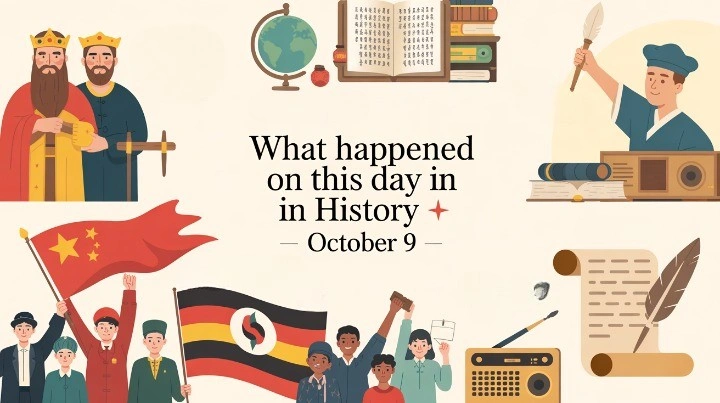
From defining battles and royal decrees to breakthroughs in science, language, and media, the date October 9 stands at the center of history’s timeline. What happened on this day in history October 9 reveals how moments of conflict, creativity, and reform have continually reshaped societies and inspired change across generations.
Major Events on October 9
0768 — Carloman I and Charlemagne crowned kings of the Franks
When Pepin’s realm was divided, Carloman and Charlemagne were anointed as co-rulers — a dynastic partition that soon resolved with Charlemagne’s ascendancy. The coronations marked an important step in Carolingian consolidation and the political reordering of western Europe.
Charlemagne’s later expansion and reforms reshaped medieval governance, law and church relations. This succession episode shows how sibling politics often determined state trajectories in the early Middle Ages.
1238 — James I of Aragon founded the Kingdom of Valencia
James I’s conquest and settlement of the eastern Iberian coast established Valencia as a political and economic unit within the Crown of Aragon. The foundation involved organized resettlement, legal charters and the integration of diverse communities into a new municipal and agrarian order. Valencia’s development influenced Mediterranean trade and legal traditions in medieval Spain. Over time it became a durable center of language, commerce and regional identity.
1410 — First known mention of the Prague astronomical clock
References to Prague’s famous clock mark the start of its long public life as both a scientific instrument and civic symbol. The Orloj combined timekeeping, astronomical data and animated figures to educate and amaze urban audiences. Its continued repairs and restorations across centuries testify to municipal pride and the endurance of public craftsmanship. The clock remains an emblem of Prague’s historical continuity.
1446 — The Hangul alphabet published in Korea
The promulgation of Hangul introduced a phonetic, scientifically designed script that democratized literacy in Korea. Before Hangul, literacy was constrained by Chinese-character literacy; the new alphabet expanded written expression to broader social classes. Hangul’s design reflects intentional linguistic reform with clear social aims, and it became central to Korean identity and education. Hangul Day commemorates this durable cultural transformation.
1514 — Mary Tudor marries Louis XII of France (becomes Queen consort)
Mary Tudor’s marriage to Louis XII was a dynastic alliance of Tudor England and the French crown, shaped by high diplomacy and courtly negotiation. Though brief, the union illustrates how royal marriages were used to secure alliances, peace and succession claims in Renaissance Europe. Mary’s subsequent return to England and remarriage to Charles Brandon add personal drama to the diplomatic story. Such marriages often had outsized political consequences relative to their personal duration.
1594 — Campaign of Danture ends; Portuguese forces defeated in Sri Lanka
Portuguese military operations in Sri Lanka culminated at Danture when local resistance routed colonial forces, effectively ending that campaign. The battle underscores the limits of early European military projection in South Asia and the persistence of indigenous polities in defending sovereignty. Danture’s outcome reconfigured Portuguese influence on the island and complicated colonial ambitions. It remains a significant episode in the island’s resistance history.
1604 — Kepler’s Supernova appears — last Milky Way supernova visible to the naked eye
The bright “new star” observed by Kepler challenged medieval assertions of celestial immutability and fueled early modern astronomical inquiry. Detailed observations of the event contributed to debates about the nature of the heavens and helped advance empirical methods in astronomy. Kepler’s engagement with the phenomenon exemplified growing scientific rigor during the period. The supernova remains an important datum in the development of modern astronomy.
1635 — Roger Williams banished from Massachusetts Bay Colony; later founds Providence
Expelled for advocating religious liberty and separation of church and state, Roger Williams left Massachusetts and helped establish Providence as a refuge for dissenters. His insistence on conscience and fair dealing with Native peoples influenced later American ideas about religious toleration. Williams’s settlement became a practical experiment in pluralism and municipal self-government. His life illustrates early colonial conflicts over belief, governance and rights.
1701 — Collegiate School of Connecticut chartered (later Yale University)
The chartering of the Collegiate School of Connecticut created an enduring institution for clerical training and higher learning in colonial New England. Yale’s early curricular and religious orientation reflected the intellectual priorities of colonial elites while laying groundwork for the academy’s later national role. Over centuries the institution expanded into a major university influencing U.S. intellectual and civic life. Its founding is a milestone in American educational history.
1708 — Battle of Lesnaya — Peter the Great defeats the Swedes
Peter the Great’s victory at Lesnaya struck a blow against Swedish forces during the Great Northern War and helped secure Russian advances in the region. The battle’s outcome undermined Swedish strategic cohesion and aided subsequent Russian campaigns that transformed northern European power balances. Lesnaya contributed to Peter’s consolidation of military reforms and the expansion of Russian influence westward. It was an important step in Russia’s emergence as a major power.
1740 — Massacre of ethnic Chinese in Batavia (colonial violence)
Violence by Dutch colonists and local fighters against Batavia’s Chinese population escalated into a massacre with catastrophic loss of life. The episode reflects volatile interethnic relations under colonial rule, economic tensions and the brutal capacity of imperial policing. The Batavia massacre left deep social scars and is a somber reminder of how colonial governance could produce mass violence. Historical memory of the event informs later discussions of colonial justice and community protection.
1760 — Russian and Austrian occupation of Berlin during the Seven Years’ War
The brief occupation of Berlin demonstrates how the Seven Years’ War imperiled European capitals and compelled shifting diplomatic calculations among great powers. Occupations like this strained civilian resources, shaped wartime negotiations and influenced subsequent settlement priorities. The war reconfigured alliances and colonial stakes, and the Berlin episode is emblematic of the conflict’s continental reach. Its diplomatic ripples lasted well after military operations ceased.
1779 — Siege of Savannah: Franco-American assault repulsed with heavy casualties
The Franco-American attempt to retake Savannah was beaten back by British defenses, producing heavy allied casualties and stalling southern allied operations. The defeat highlighted the difficulty of combined operations and the strength of fortified positions in the Revolutionary southern theater. Savannah’s outcome shaped subsequent strategy and underscored persistent regional challenges for the American cause. It remains a significant episode in the Revolution’s southern campaigns.
1790 — Algerian earthquake and Mediterranean tsunami — catastrophic natural disaster
A powerful quake in northern Algeria produced tsunami waves that struck Mediterranean coasts and killed thousands, profoundly affecting coastal towns and maritime trade. The disaster revealed the vulnerability of premodern communities to sudden geological events and challenged relief capacity.
It also influenced settlement, coastal defenses and later disaster awareness in the region. The event remains one of North Africa’s deadliest historical natural catastrophes.
1799 — Sinking of HMS Lutine with valuable cargo — maritime loss and insurance lore
The loss of HMS Lutine, famed for its valuable cargo of gold and silver, had wide financial repercussions and entered maritime folklore. The Lutine bell became a ceremonial object at Lloyd’s, and the wreck stimulated maritime salvage and insurance practice changes. The incident shows how a single shipwreck could affect commercial networks and institutional procedures in the age of sail. Salvage attempts and legend have kept the Lutine story alive in maritime history.
1804 — Founding of Hobart, capital of Tasmania
Hobart’s founding established a major colonial port and administrative center in Van Diemen’s Land, facilitating convict settlement, whaling and trade. The town’s growth reflects British colonial strategies and the economic exploitation of Australian resources. Hobart later developed civic institutions and port infrastructure that shaped regional development. Its founding remains a key moment in Australasian colonial history.
1806 — Prussia declares War of the Fourth Coalition against Napoleonic France
Prussia’s entry into the Fourth Coalition precipitated another phase of Napoleonic conflict across continental Europe, with major battles and political realignments following swiftly. The war showed how shifting alliances and military innovation shaped early 19th-century geopolitics. Prussia’s eventual defeat and reforms after the campaign had long-term consequences for military modernization and later German unification. The declaration marks an important pivot in Napoleonic-era diplomacy and warfare.
1812 — War of 1812: capture of HMS Detroit and HMS Caledonia on Lake Erie (naval action)
Naval action on the Great Lakes was crucial to control of frontier supply lines during the War of 1812; the capture of British vessels reaffirmed American naval initiative in the region. These engagements affected troop movements and regional dominance during the conflict. Lake Erie operations exemplify how inland naval power could decisively influence land campaigns in North America. Control of the lakes shaped the war’s tactical and logistical possibilities.
1820 — Guayaquil declares independence from Spain
Guayaquil’s proclamation of independence provided an essential maritime base for liberating forces and accelerated the broader Spanish American independence movements. The port’s strategic position facilitated troop movements, supply lines and diplomatic outreach. Guayaquil’s emergence as a free port was a turning point in the dissolution of Spanish authority in the region. Its role highlights the importance of local urban centers in continental revolutions.
1825 — Arrival of the Restauration in New York — first organized Norwegian immigration to the U.S.
The arrival of the Restauration signaled the beginning of organized Norwegian emigration to America, launching diasporic networks that later expanded across the 19th century. Early migrants established communities, remittance networks and cultural ties that reshaped transatlantic demographic flows. The voyage is remembered as a foundational moment in Norwegian-American history and an example of larger European migration waves to the New World.
1831 — Assassination of Ioannis Kapodistrias, first head of state of independent Greece
Kapodistrias’s murder by political opponents revealed tensions in post-independence Greek governance and complicated attempts at building stable national institutions. His death provoked a crisis that slowed centralization and influenced later monarchy arrangements. Kapodistrias is remembered for state-building efforts and attempts to modernize Greece amid factional resistance. The assassination reflects the fragility of nascent nation-states after liberation struggles.
1834 — Opening of the Dublin and Kingstown Railway — Ireland’s first public railway
The Dublin–Kingstown line inaugurated modern public rail transport in Ireland, indicating the rapid diffusion of railway technology across Europe. Rail connectivity transformed commuting, commerce and urban expansion, reshaping the island’s economic geography. The line’s success encouraged further infrastructure investment and technological adoption across the British Isles. It stands as an early marker of industrial mobility.
1847 — Abolition of slavery in Swedish colony of Saint Barthélemy
The Swedish decision to abolish slavery in Saint Barthélemy reflected wider 19th-century abolitionist currents and colonial administrative change. Emancipation affected labor regimes, local economies and the social fabric of the island population. The event is part of a broader history of abolition across Atlantic colonies and the uneven processes of post-emancipation adjustment. It signals shifting moral and political norms in imperial policymaking.
1861 — Battle of Santa Rosa Island — Union forces repel Confederate attempt to capture Fort Pickens
Union defenses at Fort Pickens held against Confederate incursions, securing a strategic Gulf coastline position early in the Civil War. Control of coastal forts and ports played a crucial role in blockades, supply routes and campaign planning. The Union’s successful defense at Santa Rosa Island helped maintain a naval foothold that supported subsequent Gulf operations. Coastal engagements often had outsized strategic importance in the maritime dimensions of the war.
1864 — Battle of Toms Brook — Union cavalry victory during Sheridan’s Shenandoah campaign
Union cavalry successes at Toms Brook disrupted Confederate cavalry operations and contributed to the momentum of Sheridan’s Shenandoah Valley campaign. The battle illustrated evolving cavalry tactics and the growing mobility and coordination in Union forces late in the war. Sheridan’s campaign weakened Confederate logistical capacity and helped secure the Valley as Union territory. Toms Brook is remembered as a clear cavalry triumph with strategic effects.
1873 — U.S. Naval Academy meeting establishes the U.S. Naval Institute
The formation of the Naval Institute created an enduring forum for professional discussion, strategy and innovation among naval officers. The organization published journals, promoted scholarship and influenced sea-power debates in the United States. Over generations the Institute helped shape doctrine and the professional identity of naval officers. Its founding underscores the role of professional bodies in military modernization.
1874 — Universal Postal Union established by Treaty of Bern
The UPU standardized international mail procedures and rates, greatly facilitating global communications and commerce. By making international mail predictable, it reduced transaction costs for individuals and businesses and supported expanding international networks. The union remains a key multilateral institution for cross-border postal cooperation and service standards. Its creation is a milestone of 19th-century administrative globalization.
1888 — Washington Monument opens to the public in Washington, D.C.
Opening the Washington Monument completed a symbolic national memorial and provided the public with access to a central civic landmark. The monument became a focal point for national ceremonies and an architectural expression of American memory-making. Its public opening marked the physical completion of a decades-long civic project and enriched the capital’s monumental landscape. The obelisk endures as an icon of U.S. national symbolism.
1900 — Cook Islands become a United Kingdom territory
The Cook Islands’ shift to UK territorial status reflected colonial expansion and the geopolitics of Pacific imperialism at the turn of the century. Colonial arrangements reshaped local governance, trade patterns and indigenous relations, producing long-term social and legal consequences. The Cook Islands later evolved distinct administrative relationships, but the 1900 status remains part of the islands’ colonial legacy. Territorial incorporation reveals broader patterns of European and imperial reach across Oceania.
1911 — Wuchang Uprising begins (Xinhai Revolution) — accidental bomb ignites a nationwide revolt
An accidental explosion in Wuchang catalysed a broader uprising that soon spread to other provinces and culminated in the Xinhai Revolution, toppling the Qing dynasty. The revolt rapidly turned localized unrest into national revolution, and the resulting political change established the Republic of China. Wuchang’s spark illustrates how single incidents can unleash latent revolutionary forces when social, military and political conditions align. The uprising is a turning point in modern Chinese history.
1913 — SS Volturno fire in the mid-Atlantic — dramatic multinational rescue
When SS Volturno caught fire, a multinational fleet of rescuers responded under hazardous conditions, showcasing both the perils of ocean travel and the willingness of ships of different flags to aid survivors. The incident highlighted improvements and gaps in maritime safety, prompting reflection on lifeboat procedures and shipboard standards. The rescue effort captured global attention and became an example of maritime cooperation. Volturno’s story entered the era’s maritime lore.
1914 — End of Siege of Antwerp (World War I) — German capture of strategic port
Antwerp’s fall to German forces demonstrated the vulnerability of neutral or forward ports in early WWI and had logistical and symbolic consequences for the Allies. The capture affected supply lines and refugee flows and signalled the intensity of early German operations in western Europe. Antwerp’s fate underscored the war’s civilian and military disruptions and the fraught nature of contested urban defenses. The siege is one of the conflict’s early pivotal episodes.
1918 — Finnish Parliament elects Prince Frederick Charles of Hesse (never accedes)
Finland’s tumultuous postwar politics led the Parliament to elect a German prince as king, but his accession was overtaken by Germany’s defeat in WWI and shifting domestic politics. The episode highlights the unsettled nature of state formation after empire collapse and the influence of international outcomes on national choices. Finland ultimately remained a republic, and the episode underlines how external events can nullify domestic institutional plans. It’s an instructive footnote in Finland’s early independence.
1919 — Cincinnati Reds win World Series; Black Sox scandal unfolds
The 1919 World Series victory became infamous as revelations of match-fixing emerged, leading to the Black Sox scandal and major reforms in baseball governance. The scandal eroded public trust and prompted the creation of a stronger central authority (the Commissioner) to protect the sport’s integrity. The episode affected professional sports’ legal and ethical frameworks and remains a watershed in American sporting history. Its consequences reshaped how leagues police integrity and gambling influences.
1934 — Assassination of King Alexander I of Yugoslavia and French minister Louis Barthou in Marseille
The murders removed a major Balkan leader and a French foreign minister, intensifying diplomatic crises and highlighting extremist reach in interwar Europe. The assassination prompted investigations and security reform while magnifying regional tensions in the Balkans. It remains an emblematic interwar political homicide that had outsized consequences for European diplomacy. The killings underscored the era’s volatility.
1936 — Hoover (Boulder) Dam begins generating electricity — major engineering achievement
When the dam started producing power, it materially transformed the American West with irrigation, hydroelectricity and long-term water management. The infrastructure enabled southern California’s growth and underpinned 20th-century regional development. Its construction also raised questions about labor, environmental change and federal investment. Hoover Dam remains a landmark of large-scale engineering and public-works ambition.
1937 — Murder of nine priests in Zhengding, China — wartime atrocity amid Japanese advance
The killing of clergy who sheltered locals reflects the brutality of the Sino-Japanese war and the vulnerability of civilians and religious protectors in wartime. Such episodes contributed to international outrage and complex local memories of occupation-era violence. The murders illustrate how wartime conduct could devastate protective institutions and deepen communal trauma. They are part of the broader history of wartime atrocities in East Asia.
1941 — Coup in Panama installs Ricardo Adolfo de la Guardia Arango as president
Political turnover in Panama reshaped the isthmus’s governance at a delicate wartime moment; the coup affected domestic alignment and U.S.-Panama relations during WWII. Panama’s strategic position and the canal’s importance meant political change there had regional significance. The episode exemplifies how national politics in small states could have outsized international ramifications. The coup influenced subsequent Panama governance and U.S. policy in the hemisphere.
1942 — Australia adopts the Statute of Westminster (royal assent) — legal autonomy step
By adopting the Statute of Westminster, Australia took an important legal step toward full legislative independence from Britain, aligning wartime constitutional arrangements with evolving dominion sovereignty. The adoption reflected changing imperial relations and the practical realities of wartime governance. This act is a milestone in the constitutional maturation of the Commonwealth realm and its legal autonomy. It contributed to postwar decolonization and self-governance trends.
1950 — Goyang Geumjeong Cave massacre begins (Korea)
The Goyang Geumjeong Cave killings are part of the Korean Peninsula’s violent mid-20th-century struggles and reflect internecine conflict amid war and political breakdown. The massacre had local human costs and added to the broader tragedy of the Korean conflict’s civilian toll. Such episodes complicate narratives of national liberation and highlight the human price of ideological and military contests. The event remains a tragic episode in Korea’s modern history.
1962 — Uganda becomes independent as a Commonwealth realm (Independence Day)
Uganda’s independence marked the end of British colonial rule and the start of sovereign statehood within the Commonwealth framework. The transition reflected wider African decolonization and the political reordering of global relations in the postwar era. Uganda’s independence set the stage for subsequent nation-building challenges and regional dynamics in East Africa. The date is celebrated as a national holiday and a symbol of self-determination.
1963 — Vajont Dam landslide and catastrophic wave — major engineering disaster in Italy
A giant landslide into the Vajont reservoir produced an overtoping wave that destroyed downstream communities and killed thousands, revealing grave lapses in geological assessment and decision-making. The disaster prompted legal scrutiny, engineering reforms and debates over corporate and governmental responsibility. Vajont remains a cautionary tale in environmental risk management and infrastructural ethics. The event influenced dam safety standards worldwide.
1966 — Binh Tai massacre (Republic of Korea Army) during the Vietnam War
Allegations of mass civilian killings by ROK forces at Binh Tai highlight the dark side of counterinsurgency campaigns and the vulnerability of noncombatants. Incidents like this deepened controversies over allied conduct and accountability in Vietnam. They contributed to later debates about rules of engagement, human rights and the long-term reputational costs of wartime excesses. Historical study of such events informs modern military ethics and reconciliation efforts.
1967 — Che Guevara executed in Bolivia (following capture) — revolutionary martyrdom
Che’s execution ended his guerrilla campaign and rapidly transformed him into a global emblem of revolutionary zeal, shaping protest iconography for decades. The episode intensified discussions about guerrilla strategy, international solidarity movements and the visual politics of martyrdom. Che’s symbolic afterlife influenced intellectual, cultural and activist currents across continents. The event is a defining moment in Cold War-era insurgent histories.
1969 — National Guard called in for Chicago Eight demonstrations — domestic political turmoil
The deployment during demonstrations around the Chicago Eight trial reflected wider social unrest, contested protest politics and the state’s response to domestic dissent in late-1960s America. The confrontations highlighted tensions between free-expression claims and public-order imperatives and became a touchstone in legal and cultural battles over protest rights. The episode helped shape subsequent protest law and public perceptions of civil unrest.
1970 — Khmer Republic proclaimed in Cambodia — regime change amid regional turmoil
The declaration replaced Cambodia’s monarchy with a republican regime during a period of coup politics and intensifying regional conflict. The change reflected Cold War-era pressures, domestic factionalism and the spillover effects of the Vietnam War. The Khmer Republic’s troubled existence preceded further upheavals that culminated in catastrophic late-1970s events. The proclamation is a critical episode in Cambodia’s modern political chronology.
1980 — Pope John Paul II meets the Dalai Lama — symbolic interfaith encounter
The private audience in Vatican City signalled a respectful exchange between Catholic and Tibetan-Buddhist leadership and underscored the papacy’s international moral outreach. The meeting carried symbolic weight for human-rights concerns and cross-cultural religious dialogue. Such encounters foster diplomatic goodwill and spotlight concerns about religious freedom and exile communities. The meeting became part of both leaders’ broader engagement with global moral issues.
1981 — France abolishes capital punishment under President François Mitterrand
Abolishing the death penalty represented a decisive legal and moral shift in French criminal justice and aligned France with broader European abolitionist trends. The reform reflected political commitments to human rights and penal modernization under the Mitterrand government. France’s decision influenced comparative debates about punishment, rehabilitation and state authority over life and death. The abolition remains a landmark in French legal history.
1983 — Assassination attempt on South Korean president Chun Doo-hwan in Rangoon — mass casualties
The Rangoon bombing, which injured and killed visitors and officials, was an attempt on the president’s life that produced substantial collateral civilian loss. The attack had diplomatic repercussions, intensified security concerns and shaped relations with North Korea (widely suspected of responsibility). The incident highlighted the perilous intersection of political assassination, transnational sabotage and civilian vulnerability. Its effects rippled across Korean peninsula diplomacy.
1984 — Thomas the Tank Engine & Friends premieres on ITV — cultural children’s TV debut
The new show based on the Reverend Wilbert Awdry’s Railway Series introduced generations of children to model-based storytelling and nurtured a global fan base. Its simple, character-driven narratives and practical effects bridged classic children’s literature and television production. The program’s longevity and international reach show how children’s media can become a durable cultural industry. The premiere is a milestone in family television history.
1986 — Phantom of the Opera opens (London); Fox Broadcasting Company launches (US) — cultural and media milestones
Andrew Lloyd Webber’s Phantom opened to widespread acclaim and eventual global success, while Fox’s launch added a new, commercially-driven broadcaster to the U.S. television market. Both events reshaped entertainment: one by expanding modern musical theatre’s global footprint, the other by diversifying broadcast competition and programming formats. These developments had long-term consequences for media production, distribution and audience tastes worldwide.
1992 — Peekskill meteorite crashes into parked car — well-documented meteorite fall
The Peekskill meteorite’s fall, captured on multiple videos, provided scientists with a rare, well-documented meteorite recovery and generated public fascination. Because the fall was filmed, researchers could precisely reconstruct the trajectory and recovery context, enriching meteoritics research. The event shows how everyday objects can gain scientific importance when cosmic events intersect human environments. The Peekskill meteorite became an accessible case study in planetary science outreach.
1995 — Amtrak Sunset Limited derailed by saboteurs near Palo Verde, Arizona — domestic terrorism scare
The deliberate derailment of a passenger train emphasized vulnerabilities in transport security and provoked law-enforcement and legislative attention to rail safety. While casualties were limited, the incident raised public alarm about infrastructure protection and the prospect of sabotage. It spurred reviews of rail surveillance, emergency response and criminal investigations into motives and networks. The event remains a cautionary note in transport security policy.
1997 — Dario Fo awarded the Nobel Prize in Literature — recognition of satirical theatre
The prize to the Italian playwright honored a career of political satire, popular theatre and linguistic experiment that challenged authority and embraced popular storytelling. Fo’s recognition spotlighted theatre’s capacity to engage social critique and to revive dramatic traditions with contemporary urgency. The award expanded international awareness of modern European playwrights who blend humor with civic commentary. It is a highlight in late-20th-century theatrical recognition.
2001 — Wayne Newton named USO celebrity frontman (succeeds Bob Hope)
The United Service Organizations’ appointment of Wayne Newton signaled continuity in celebrity support for U.S. troops and the USO’s role in morale-building across conflicts. Newton’s selection reflected the USO’s aim to maintain visible, high-profile engagement with service members worldwide. Such appointments help link popular culture and military support in public life. The changeover echoes earlier celebrity-military partnerships dating back to World War II.
2004 — Afghanistan’s first presidential election (Hamid Karzai elected)
Afghanistan’s 2004 election, the country’s first direct presidential vote, marked an important step in post-Taliban political reconstruction and international state-building. Karzai’s election followed transitional governance and signified nascent efforts at democratic institution-building amid security challenges. The vote’s conduct and aftermath revealed both the possibilities and limits of externally supported political transitions in conflict-affected societies. It remains a key moment in Afghanistan’s recent political history.
2006 — North Korea conducts its first nuclear test
The test marked a crucial escalation in Pyongyang’s weapons program and intensified international efforts to constrain proliferation through sanctions and diplomacy. The event complicated regional security and underscored the challenge of verification and negotiation with isolated nuclear aspirants. It prompted renewed discussion of multilateral security frameworks and nonproliferation tools. The test remains a focal point in Northeast Asian security policy.
2007 — Dow Jones reaches an all-time high (14,164) ahead of the 2008 crash
The 2007 peak represented the crest of a long bull market before the global financial crisis precipitated rapid declines and systemic turmoil. The high-water mark underscores how financial markets can detach from underlying vulnerabilities and how shocks can reverse long-term gains. The subsequent fallout led to regulatory reform, monetary interventions and debates about risk, leverage and market stability. The date sits in narratives about pre-crisis exuberance.
2009 — First lunar impact by NASA’s LCROSS / Lunar Precursor Robotic Program (note: program timeline)
Lunar precursor missions and related impacts expanded scientific understanding of lunar volatiles and crater composition; early robotic programs help prepare for later exploration. Controlled impacts and remote sensing have provided data about water ice and surface composition, shaping future mission planning. Robotic lunar science in this era advanced planetary science and resource-assessment efforts. These missions illustrate how robotic precursors inform human exploration objectives.
2012 — Assassination attempt on Malala Yousafzai — global education activism spotlighted
The attack on Malala for advocating girls’ education provoked international condemnation and catalyzed support for education rights worldwide. Her survival and continued advocacy made her a potent symbol for educational access and human-rights campaigning. The incident led to funding, policy attention and heightened global awareness of education under conditions of extremism. Malala’s story continues to inspire transnational movements for girls’ schooling.
2016 — ARSA (Arakan Rohingya Salvation Army) attacks Myanmar security forces — conflict escalation
ARSA’s attacks marked the beginning of intensified clashes and a subsequent government security response that precipitated large-scale displacement of Rohingya civilians. The events contributed to a humanitarian crisis, international concern and debate over citizenship, human rights and military conduct. The episode is part of a longer pattern of communal tension and state response in Rakhine State. It remains central to understanding Myanmar’s contemporary human-rights challenges.
2019 — Turkey begins military offensive in north-eastern Syria
Turkey’s cross-border operations altered the military balance in northeast Syria, producing displacement, political friction and new alignments among regional actors. The offensive triggered international criticism, refugee movements and shifting Kurdish strategies. The operation emphasized how local, regional and global stakes intersect in Syria’s prolonged conflict. It remains a consequential episode in Middle Eastern geopolitics.
2024 — Hurricane Milton lands on Siesta Key, Florida as Category 3 (significant damage)
This recent storm inflicted heavy infrastructure and economic losses in coastal Florida, underscoring ongoing vulnerabilities to intense hurricanes and the fiscal and humanitarian costs of major landfalls. The event triggered emergency response, recovery planning and renewed attention to resilience and coastal management in hurricane-prone regions.
Climate-linked storm patterns and mitigation strategies continue to shape regional policy after such episodes. The damage summary figures reflect immediate fiscal impact and long-term recovery needs.
Continue your timeline journey: here’s what happened on October 8
Quick sections
Earlier History
Medieval crowns, script reform and imperial standoffs—October 9 gathers episodes of dynastic change and state formation across Eurasia.
Exploration & Foundations
From Guayaquil’s independence and Hobart’s founding to the Restauration’s arrival, the date links port cities, migration and colonial foundations.
Wars & Politics
Napoleonic coalitions, revolutionary uprisings, world wars and modern offensives all recur on the date—showing persistent strategic ruptures.
Arts, Culture & Media
From the Prague clock and Hangul to theatrical premieres and broadcast launches, October 9 features cultural innovations and media milestones.
Science, Technology & Media
Kepler’s supernova, meteorite falls, rail and dam projects and early broadcasting mark the day’s scientific and infrastructural landmarks.
Disasters & Human Rights
Vajont, Peshtigo/Chicago-era fires (earlier-discussed overlaps), wartime massacres and earthquakes show the date’s unfortunate association with human tragedy and policy reforms.
Notable births — October 9
Charles X — King of France — Born 1757.
Alfred Dreyfus — French army officer (Dreyfus Affair) — Born 1859.
Jacques Tati — Filmmaker & actor — Born 1908.
Léopold Sédar Senghor — Poet, first President of Senegal — Born 1906.
Max von Laue — Physicist, Nobel laureate — Born 1879.
Karl Schwarzschild — Astronomer — Born 1873.
Emil Fischer — Chemist, Nobel laureate — Born 1852.
Mihajlo Pupin — Physicist & inventor — Born 1854.
Ferdinand Verbiest — Jesuit missionary & astronomer — Born 1623.
Annika Sörenstam — Champion golfer — Born 1970.
Steve Ovett — Runner — Born 1955.
Boris Nemtsov — Russian politician — Born 1959.
Nikolay Bukharin — Soviet political leader/theorist — Born 1888.
Charles William Ferdinand of Brunswick — Prussian duke & field marshal — Born 1735.
Lewis Cass — U.S. statesman — Born 1782.
Robert de Sorbon — Founder of the Sorbonne — Born 1201.
Jody Williams — Activist, Nobel Peace laureate — Born 1950.
Tawfīq al-Ḥakīm — Egyptian author & playwright — Born 1898.
Mário de Andrade — Brazilian modernist writer — Born 1893.
Donald, Baron Coggan — Archbishop of Canterbury — Born 1909.
Notable deaths — October 9
Robert H. Jackson — U.S. Supreme Court Justice — Died 1954.
Anna Freud — Psychoanalyst — Died 1982.
Andrzej Wajda — Film director — Died 2016.
Gordon Allport — Psychologist — Died 1967.
Robert Grosseteste — Bishop & scholar — Died 1253.
Pope Clement II — Died 1047.
Pieter Zeeman — Physicist, Nobel laureate — Died 1943.
Felix Wankel — Inventor — Died 1988.
Joseph F. Glidden — Barbed wire inventor — Died 1906.
Max Faget — Spacecraft engineer — Died 2004.
Louis Barthou — French statesman (assassinated) — Died 1934.
Gabriel Fallopius — Anatomist — Died 1562.
Thomas Steitz — Biochemist, Nobel laureate — Died 2018.
Maurice Allais — Economist, Nobel laureate — Died 2010.
Valery Bryusov — Poet — Died 1924.
André Maurois — Writer — Died 1967.
Hugo Preuss — Weimar Constitution author — Died 1925.
Nicolai Hartmann — Philosopher — Died 1950.
Sir Wilfred Grenfell — Medical missionary — Died 1940.
Richard F. Heck — Chemist, Nobel laureate — Died 2015.
Observances & Institutional Dates
- Hangul Day (South Korea) — celebrating the Korean alphabet.
- Independence Day (Uganda) — independence from the United Kingdom (1962).
- Independence of Guayaquil (Ecuador) — declared 1820.
- World Post Day (international) — celebrates postal services (UN observance).
- Fire Prevention Day (Canada & USA).
- Leif Erikson Day (U.S., Iceland, Norway).
- National Nanotechnology Day (United States).
- Takayama Autumn Festival (Japan) and local cultural observances.
Frequently asked questions
Why is Hangul Day (October 9) important in Korea?
Hangul Day marks the creation and promulgation of Hangul, a phonetic script designed to make literacy accessible. Its adoption fostered wider reading and writing, strengthened cultural cohesion and remains central to Korean linguistic identity and education.
Did the Wuchang Uprising start on October 9 or 10?
The Wuchang Uprising is generally dated October 10, 1911 (Double Ten); an explosion and unrest across those early October days triggered the wider revolutionary wave. When summarizing early-October events, Wuchang is sometimes mentioned alongside October 9, but the canonical start date accepted in most scholarship is October 10.
What was the Rainhill Trials’ significance (Stephenson’s Rocket)?
Stephenson’s Rocket’s success at the Rainhill Trials demonstrated practical steam locomotive performance, shaping early railway standards and accelerating investment in rail infrastructure that transformed 19th-century transport and commerce.
How did the Vajont disaster change engineering oversight?
Vajont exposed failures of geological assessment and reservoir safety; its legal and technical aftermath increased emphasis on geotechnical studies, regulatory oversight and the ethical duties of engineers in planning major infrastructure projects.