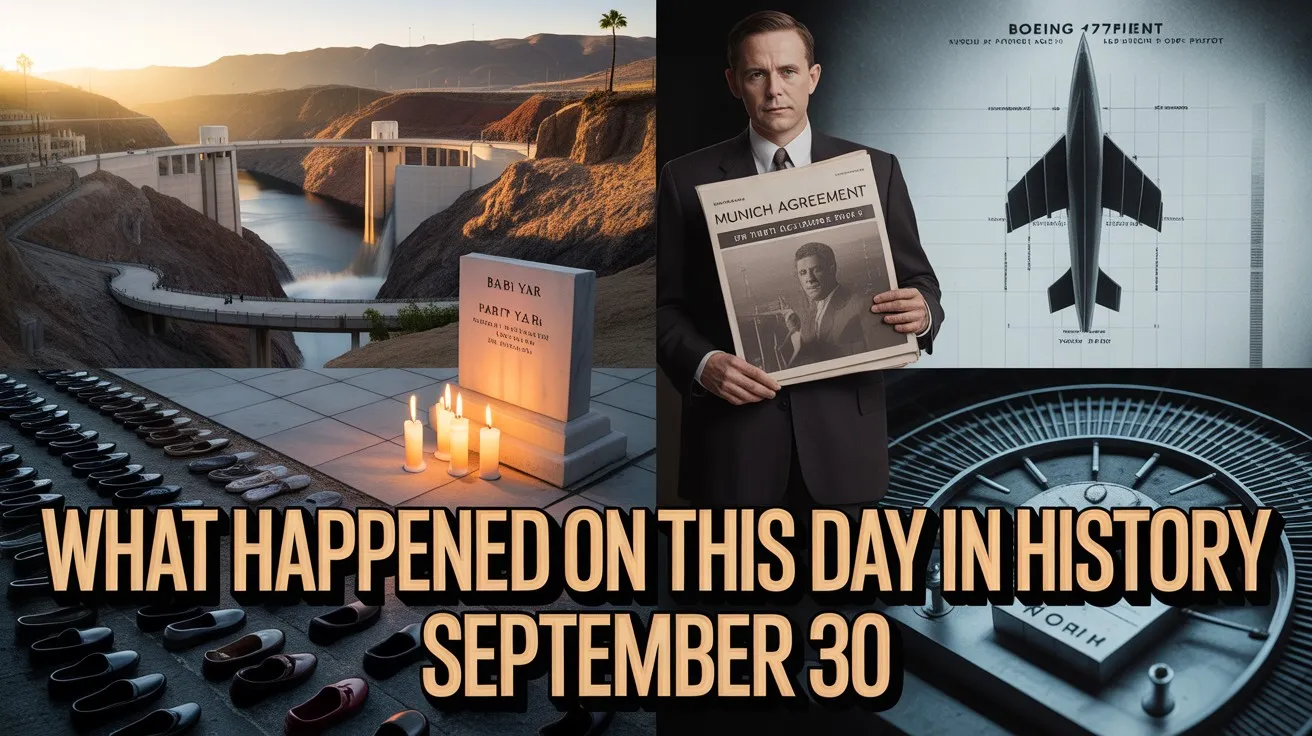
What happened on this day in history September 30 collects a wide sweep of human activity: dynastic struggles and legal ruptures, artistic premieres and technological rollouts, and disasters that forced legal, moral and engineering change. Each anniversary is a lens—sometimes corrective, sometimes cautionary—on how societies organize power, remember victims and push innovation forward.
Major Events on September 30
489 — Theoderic the Great Defeats Odoacer (Ostrogothic Victory)
Theoderic’s Ostrogothic forces defeated Odoacer’s army for a second time in Italy, strengthening Theoderic’s position as ruler and paving the way for his eventual control of the peninsula. The victory furthered the transformation of Roman institutions under Gothic rule and advanced Theoderic’s reputation as a stabilizing sovereign.
Military success helped Theoderic consolidate alliances with foederati and local elites. In the long term, his reign shaped the successor politics of post-Roman Italy.
737 — Turgesh Repel Umayyad Invasion at Khuttal
Turgesh forces drove back a Umayyad invasion of Khuttal, pursuing the retreating army south of the Oxus and capturing their baggage train, in a setback for early Umayyad expansion in Central Asia. The clash illustrated the limits of Arab control in the region and the durability of steppe and mountain polities.
The defeat affected supply lines and morale for the Umayyad frontier armies. It also reinforced local resistance to caliphal authority in Transoxiana and adjacent districts.
1139 — Devastating 7.7 Earthquake in the Caucasus (Seljuk Era)
A powerful earthquake struck the Caucasus in 1139, causing mass destruction and an estimated death toll that historical sources put as high as hundreds of thousands; it remains recorded among the region’s catastrophic quakes. Contemporary accounts emphasize collapsed settlements, ruined fortifications and major social disruption.
The scale of destruction reshaped settlement patterns and strained medieval relief capacities. The catastrophe affected Seljuk political and military priorities in the area for years afterward.
1342 — Battle of Morlaix (Hundred Years’ War Theatre)
In 1342 English and French forces fought at Morlaix in Brittany as part of the wider Hundred Years’ War; the encounter reflected the intermittent fighting and local alliances that characterized the Anglo-French contest. Control of Breton strongpoints mattered for naval supply and continental influence.
Skirmishes like Morlaix prolonged regional instability and molded feudal loyalties. The campaign dynamics in Brittany became a repeated feature of Anglo-French rivalry.
1399 — Henry IV Proclaimed King of England
Henry Bolingbroke was proclaimed King Henry IV after deposing Richard II, inaugurating Lancastrian rule and setting England on a course of dynastic contention. His accession ended Richard II’s direct line and launched political realignments that later contributed to the Wars of the Roses.
Henry’s reign involved balancing noble factions and suppressing rebellions. The change of dynasty reshaped medieval English governance and succession politics.
1520 — Suleiman the Magnificent Proclaimed Sultan of the Ottoman Empire
Suleiman I formally assumed the Ottoman sultanate in 1520 and soon presided over an era of territorial expansion, legal reform and cultural flowering that defined the empire’s classical age. His long rule centralized administration while enabling major military campaigns in Europe, Asia and North Africa.
Suleiman’s patronage also advanced Ottoman architecture, law and the arts. The proclamation marked the start of a transformative six-decade reign.
1541 — Hernando de Soto Enters Tula Territory (North American Contact)
Spanish explorer Hernando de Soto and his expedition entered the territory of Tula in present-day western Arkansas in 1541, encountering fierce resistance from indigenous communities. Those clashes exemplified early and often violent patterns of Spanish entry into North American interior regions. De Soto’s march through the Southeast had lasting demographic, cultural and epidemiological consequences. The episode is part of the fraught early-contact history between Europeans and Native American polities.
1551 — Ouchi Clan Coup and City Burning (Japan)
A military coup within the Ōuchi clan in 1551 forced their lord to commit suicide and resulted in the city’s burning, illustrating the turbulent warlord politics of Sengoku-period Japan. The incident underscores how internal clan rivalries and military adventurism could quickly destabilize urban centers.
Such upheavals reshaped regional power balances and opened spaces for ambitious daimyo to expand. The episode is emblematic of the era’s endemic factional violence.
1578 — Tegucigalpa Claimed by Spanish Colonizers (Central America)
Spanish forces claimed the area that became Tegucigalpa in 1578, initiating colonial administration and resource exploitation that would eventually produce a regional capital. The settlement grew around mining and administrative functions typical of Spanish colonial urbanism.
Over centuries, Tegucigalpa evolved into Honduras’s political center. The claim illustrates local outcomes of Iberian expansion in Central America.
1736 — Lebanese Council Reforms the Maronite Church
The Lebanese Council of 1736 convened Maronite and Latin clergy to enact reforms and codify canons, a major turning point in structuring Maronite ecclesiastical life and relations with Rome. The council’s decisions clarified diocesan boundaries, clerical discipline and liturgical norms, strengthening institutional coherence.
Its measures helped stabilize internal church governance amid Ottoman rule. The council remains a foundational reform moment for the Maronites.
1744 — Battle of Madonna dell’Olmo (War of the Austrian Succession)
French and Spanish forces defeated Sardinian troops at Madonna dell’Olmo in 1744 but soon withdrew from Sardinia, reflecting the shifting operational priorities of the War of the Austrian Succession.
The clash showed how tactical victories could fail to produce lasting strategic gain if supply or diplomacy intervened. Campaigns in Italy often turned on shifting alliances and logistics. The battle’s aftermath demonstrated the war’s fluid frontlines.
1791 — Premiere of Mozart’s The Magic Flute (Opera Debut)
Mozart’s opera The Magic Flute received its first performance in 1791, two months before the composer’s death, blending popular singspiel elements with Masonic symbolism and operatic invention. The work quickly became a staple of the repertory due to its memorable arias, choruses and dramatic charm.
The Magic Flute balanced didactic allegory with accessible music, securing a broad popular and artistic appeal. Its premiere marked one of Mozart’s final public creative achievements.
1791 — France’s National Constituent Assembly Dissolved
On the eve of a new legislative phase, France’s National Constituent Assembly dissolved in 1791 and was replaced by the Legislative Assembly, a crucial institutional step in the Revolutionary transition from constitutional experiment toward escalating partisan contestation.
The change reflected shifting centers of authority and the mobilization of political clubs, factions and newly enfranchised publics. The new assembly would face acute crises, including war and internal unrest. This procedural shift is a key moment in revolutionary constitutional evolution.
1863 — Bizet’s Les pêcheurs de perles Premieres in Paris
Georges Bizet’s opera Les pêcheurs de perles premiered in Paris in 1863; while it was not an immediate success, the work later gained appreciation as part of Bizet’s early operatic output and contributed to his developing musical voice.
The opera’s exotic setting and lyrical writing foreshadowed the composer’s later gifts for melody and orchestration. Over time the piece has received revivals and scholarly reassessment. Bizet’s career culminated famously with Carmen a few years later.
1882 — Edison’s First Commercial Hydroelectric Plant Begins Operation (Appleton)
Thomas Edison’s Appleton hydroelectric plant began commercial operation in 1882, an early milestone in the electrification of American industry and municipal power supply. The plant demonstrated practical generation and distribution of electric light for industry and urban consumers.
Edison’s efforts accelerated broader investments in electrical infrastructure across the United States. Appleton’s operation marks a step in the transition to modern energy systems.
1888 — Jack the Ripper Murders (Third & Fourth Victims)
On this date in 1888 Jack the Ripper killed Elizabeth Stride and Catherine Eddowes, the infamous third and fourth canonical victims whose brutal slayings intensified public alarm in Victorian London. The crimes provoked sensational press coverage, investigative challenges and widespread fear, while also exposing social conditions in Whitechapel.
The Ripper murders remain emblematic of unsolved criminal mysteries and urban inequality. They stimulated changes in policing practice and public debate about safety.
1906 — Royal Galician Academy Begins Work (Galician Language Authority)
The Royal Galician Academy began activity in La Coruña in 1906, establishing a major institutional authority for the Galician language and culture. The academy’s work promoted linguistic standardization, literary production, and regional identity within Spain.
Institutional language bodies like this helped revitalize minority languages and codify norms for education and publication. The academy remains central to Galician cultural life.
1907 — McKinley National Memorial Dedicated in Canton, Ohio
The McKinley National Memorial opened in 1907 as the resting place for President William McKinley and his family, a national shrine reflecting early twentieth-century commemoration practices. The memorial combined civic architecture and presidential memory to shape public reverence for a martyred leader. Such monuments shaped local tourism and national rituals around presidential remembrance. Canton’s memorial remains a focal point for McKinley studies and local heritage.
1909 — RMS Mauretania’s Record Westbound Atlantic Crossing
Cunard’s RMS Mauretania completed a record westbound crossing of the Atlantic in 1909 that would stand for two decades, demonstrating advances in marine engineering, speed and passenger transport. The achievement promoted the prestige of ocean liners in an era before widespread air travel.
Fast transatlantic service mattered for mail, commerce and elite mobility between Europe and North America. The record highlighted the technological competition among shipbuilders and lines.
1915 — First Ground-to-Air Aircraft Kill (Radoje Ljutovac)
Serbian soldier Radoje Ljutovac became the first in history to shoot down an enemy aircraft with ground-to-air fire in 1915, an early landmark in anti-aircraft warfare. His action foreshadowed the rapid development of dedicated anti-aircraft weapons, tactics and command structures during World War I.
Ground-based air defense would become crucial as military aviation matured. Ljutovac’s achievement entered military lore as the first confirmed ground intercept kill.
1918 — Battle of Dibrivka (Makhno’s Insurgent Success)
Insurgent forces led by Nestor Makhno defeated Central Powers detachments at Dibrivka during the chaotic Ukrainian War of Independence in 1918, demonstrating the volatile multiparty struggle on the former Russian imperial periphery.
Makhno’s forces combined guerrilla mobility with local peasant support to exploit collapsing frontlines. The victory boosted anarchist military confidence though it did not secure long-term state-building. The battle typifies the intense local contestation that followed empire collapse.
1935 — Hoover Dam Dedicated (Colorado River Engineering)
The Hoover Dam on the Arizona–Nevada border was formally dedicated in 1935, symbolizing New Deal-era engineering ambition, massive public-works capacity and the transformation of arid landscapes through large-scale water management. The dam provided electricity, irrigation and flood control while enabling urban and agricultural expansion in the Southwest.
It also raised questions about displacement, labor conditions and environmental change. Hoover Dam remains an icon of twentieth-century infrastructural modernity.
1936 — Journalists Race Around the World by Commercial Flights (18½ Days)
Journalists Herbert Ekins, Dorothy Kilgallen and Leo Kieran began a widely covered race to travel around the world using only commercial airline flights in 1936, completing their journey in about 18½ days—an early public illustration of accelerating global air connectivity. The feat showcased how commercial aviation was shrinking travel times and linking distant cities for reporters and publics alike.
The stunt captured popular imagination about modern speed and global reach. It also presaged the mass travel era after WWII.
1938 — Munich Agreement Signed; League Outlaws Intentional Bombing of Civilians
On September 30, 1938 Britain, France, Germany and Italy signed the Munich Agreement, allowing Germany to annex the Sudetenland, a watershed moment in pre-WWII appeasement politics that failed to prevent larger conflict.
In the same diplomatic moment the League of Nations also adopted a unanimous prohibition condemning intentional bombing of civilian populations—an aspirational norm that would soon be violated in the coming war. Munich’s terms and the League’s pronouncements together capture the era’s contradictory hopes and limits. The agreement’s fallout discredited appeasement and reshaped alliance calculations.
1939 — Sikorski Becomes Prime Minister of Polish Government-in-Exile; NBC Televises Football
In 1939 General Władysław Sikorski assumed leadership of Poland’s government-in-exile after the invasion, becoming a central figure in wartime Polish diplomacy and military organization. That year also saw NBC broadcast the first televised American football game, an early milestone in the medium’s sports programming and domestic mass culture.
The juxtaposition—wartime exile leadership and television’s infancy—illustrates how 1939 fused geopolitical catastrophe with nascent technological shifts. Both items would have lasting cultural or political ripples.
1941 — Babi Yar Massacre Comes to an End (Kyiv Atrocity)
German forces, aided by local collaborators, completed the two-day mass executions at Babi Yar near Kyiv in late September 1941, murdering tens of thousands—primarily Jews—and beginning a chapter of mass shooting extermination across the occupied Soviet territories. The atrocity exemplified the mobile, systematic violence of the Holocaust before industrialized camp murder became dominant, and it left deep scars in local and Jewish memory.
Babi Yar’s aftermath included attempts to conceal evidence and contentious debates over memorialization; the site later inspired literature, art and protracted struggles over how to commemorate mass murder under changing political regimes. Its historical centrality stems from scale, method and the moral challenges it poses for remembrance.
1943 — United States Merchant Marine Academy Dedicated
President Roosevelt dedicated the United States Merchant Marine Academy in 1943 to train officers for wartime and peacetime merchant shipping, reflecting the strategic importance of sealift and logistics in global conflict. The academy helped professionalize merchant marine service, crucial to Allied supply chains.
Its graduates have continued to play roles in military sealift and commercial shipping. The institution remains a link between naval operations and civilian maritime capacity.
1944 — German Counteroffensive to Retake Nijmegen Salient (Operation Market Garden Aftermath)
In 1944 German forces launched a counteroffensive aiming to retake the Nijmegen salient captured during Operation Market Garden, pushing back Allied gains and complicating liberation plans in the Netherlands. The fighting underscored the limits of airborne-enabled thrusts and the resilience of German defensive operations.
Nijmegen’s contested ground affected civilian life and logistics for both armies. The episode contributed to protracted winter fighting in Western Europe.
1945 — Bourne End Rail Crash Kills 43 (Hertfordshire)
A tragic rail collision at Bourne End in 1945 killed 43 people, highlighting postwar challenges in rail safety and signaling systems. The accident provoked investigations and calls for stricter safety standards and operational oversight. Rail disasters like Bourne End accelerated reforms in maintenance and crew training. The human toll underscored transport vulnerabilities even in peacetime reconstruction.
1947 — 1947 World Series Begins (Multiple Firsts); Pakistan Joins UN
The 1947 World Series opened with a series of baseball firsts—it was televised, included an African-American player, surpassed $2 million in receipts and used six umpires—marking a new era in commercial sports and integration. That same year, Pakistan joined the United Nations, taking its place in postwar international organization and diplomatic life.
Both items illustrate different facets of 1947: cultural modernization and the reshaping of global statehood. The dual set of firsts and entries signals shifting postwar horizons.
1949 — Berlin Airlift Ends (Sustained Supply Success)
The Berlin Airlift formally ended in 1949 after Western Allies delivered over two million tons of supplies to blockaded West Berlin—an unprecedented logistical effort that undercut the Soviet blockade and symbolized Cold War resolve. The airlift preserved West Berlin’s viability and became an emblem of collective Western commitment. Its success helped define early Cold War politics and the division of Germany. The operation set standards for air-logistics in crises.
1954 — USS Nautilus Commissioned (First Nuclear-Powered Vessel)
The U.S. Navy commissioned USS Nautilus in 1954 as the world’s first nuclear-powered submarine, inaugurating a new era in naval endurance, speed and strategic deterrence. Nuclear propulsion transformed submarine operations by removing the need for frequent surfacing to recharge batteries.
Nautilus’s capabilities reshaped Cold War naval strategy and undersea doctrine around sustained submerged patrols. The vessel became a technological icon of mid-twentieth-century maritime innovation.
1955 — James Dean’s Fatal Crash (Cultural Icon)
Actor James Dean died in an automobile accident in 1955 while en route to a racing event; his untimely death cemented his status as an emblem of youthful rebellion and tragic celebrity. Dean’s image and films contributed to postwar popular culture and the notion of the American antihero.
His passing prompted extensive media fascination and enduring cult status. The crash highlighted the intersection of celebrity, youth culture and media myth-making.
1966 — Bechuanaland Gains Independence as Botswana
Bechuanaland declared independence in 1966, becoming the Republic of Botswana and joining the wave of African decolonization that reshaped the continent’s political map. Botswana’s emergence marked a negotiated transition from colonial rule to sovereign status and initiated distinctive postcolonial development patterns.
The country has since been noted for relative political stability and mineral-driven economic growth. Independence Day remains central to national identity.
1968 — Boeing 747 Rolled Out (Jumbo Jet Debut)
Boeing unveiled the 747 in 1968, introducing the “jumbo jet” that revolutionized long-haul air travel with vastly increased passenger capacity and spurred the massification of international flying. The 747’s economics reshaped airline networks, airport design and global tourism patterns.
Its introduction symbolized a new scale in civil aviation engineering and commercial ambition. The aircraft became an enduring icon of air transport for decades.
1970 — Dawson’s Field Hostage Negotiation (PFLP Deal)
Jordan negotiated with the Popular Front for the Liberation of Palestine (PFLP) for the release of remaining hostages after the Dawson’s Field hijackings in 1970, a crisis that involved multiple hijacked airliners and transnational militant tactics. The deal reflected the intense pressures on states to respond to politically motivated aviation terrorism.
The incident influenced later counterterrorism law, airport security and international cooperation against hijacking. Dawson’s Field marked a watershed in modern political violence.
1975 — Malév Flight 240 Crashes into the Mediterranean (Beirut Approach)
Malév Flight 240 crashed into the Mediterranean Sea near Beirut on approach in 1975, killing 60 people and illustrating aviation hazards related to approach procedures and regional operating conditions. The tragedy spurred investigations into flight safety, crew procedures and approach infrastructure.
Aviation accidents prompted incremental improvements in navigation aids and rescue responses. The crash remains part of Lebanon’s difficult aviation history amid regional turmoil.
1978 — Finnair Flight 405 Hijacking in Oulu, Finland
Finnair Flight 405 was hijacked in 1978 by Aarno Lamminparras in Oulu, in a dramatic incident that tested crisis management and airline security protocols. The hijacking ended with hostages released and the perpetrator taken into custody, but it underscored vulnerabilities in civil aviation.
Such events contributed to progressively tighter passenger and baggage screening standards internationally. The incident remains a cautionary example in Finland’s aviation security timeline.
1980 — Ethernet Specifications Published (Networking Standard)
Xerox, Intel and Digital Equipment Corporation published Ethernet specifications in 1980, launching a local-area networking standard that would become foundational for modern computer networks and the eventual growth of corporate and campus internets. Ethernet’s simplicity, scalability and cost-effectiveness made it ubiquitous in wired networking.
The protocol’s diffusion enabled the PC revolution and underpinned later internet infrastructure. Ethernet remains a core technology in networking stacks worldwide.
1993 — Latur Earthquake (Maharashtra, India) Devastation
A 6.2 magnitude earthquake struck Latur in 1993, killing thousands (approximately 9,748) and injuring tens of thousands, revealing vulnerabilities in building practices, emergency response and rural disaster preparedness in India. The catastrophe prompted national and international relief and triggered debates about seismic-resistant construction.
Latur’s aftermath spurred policy reforms in hazard mitigation and community preparedness. The event remains a major case study in South Asian seismic disaster response.
1994 — Space Shuttle Endeavour Launched on STS-68
NASA launched Space Shuttle Endeavour on mission STS-68 in 1994, part of the shuttle program’s series of Earth-observation and scientific flights that contributed to remote-sensing research. Shuttle missions combined payload deployment, scientific experiments and maintenance tasks for space infrastructure.
Endeavour’s flight reflected continued investment in human-tended orbital science despite program costs and risks. STS-68 added to data crucial for Earth systems research.
1999 — Tokaimura Nuclear Accident (Japan)
The Tokaimura criticality accident in 1999 at a fuel-processing site caused fatal radiation exposure for two technicians and severe contamination concerns—the second-worst nuclear accident in Japan’s history—prompting urgent regulatory scrutiny. The event highlighted procedural lapses, training deficits and oversight weaknesses in handling fissile material.
Tokaimura led to prosecutions, industrial reforms and tightened safety regimes in Japan’s nuclear sector. The accident remains a sobering lesson for nuclear safety culture.
2000 — Muhammad al-Durrah Killed During Second Intifada Coverage (Gaza)
Twelve-year-old Muhammad al-Durrah was shot and killed on camera during the early days of the Second Intifada in 2000, an incident that became a potent and contested symbol in Israeli–Palestinian media and political narratives.
The footage provoked immediate global reaction, contested forensic claims and enduring politicized memory across the conflict. The event elevated questions about civilian exposure, media framing and the politics of imagery in wartime. Al-Durrah’s death remains evocative in regional discourse.
2005 — Danish Newspaper Publishes Controversial Cartoons of Muhammad
A Danish paper published cartoons of the Prophet Muhammad in 2005, triggering worldwide protests, debates over free expression and condemnations that spread into violence in some countries. The controversy foregrounded tensions between secular press freedoms and religious sensitivities in an increasingly interconnected media environment.
Diplomatic strains and debates about tolerance, blasphemy laws and multicultural politics followed. The episode became a landmark in twenty-first-century debates over speech and respect.
2009 — 7.6 Mw Sumatra Earthquake Kills Over 1,100
A powerful 7.6 magnitude earthquake struck Sumatra in 2009, causing over a thousand deaths and extensive damage, followed by rescue and relief operations that tested Indonesia’s disaster-response capacity. The quake underscored the archipelago’s seismic risk and the ongoing need for resilient building practices and early-warning systems.
International aid and domestic coordination sought to address immediate humanitarian needs and longer-term reconstruction. The event contributed to the evolving regional architecture of disaster response.
2016 — Hurricane Matthew Reaches Category 5 in Caribbean
Hurricane Matthew intensified into a Category 5 storm in the Caribbean in 2016, producing catastrophic damage, mass displacement and high death tolls in affected islands and prompting expansive humanitarian operations. The storm’s storm surge and rainfall-driven flooding devastated infrastructure and livelihoods, testing national and international disaster relief systems.
Matthew’s impact highlighted climate vulnerability in the Caribbean and the importance of resilient coastal planning. The hurricane’s effects reverberated in regional recovery strategies.
2016 — Van Gogh Museum Paintings Recovered After 2002 Theft
Two Van Gogh paintings stolen in 2002 were recovered in 2016, a high-profile restitution that drew attention to art-market security, provenance work and law-enforcement cooperation across borders. Recoveries of stolen masterpieces underscore the complex interplay of criminal networks, auction monitoring and police investigations.
The return restored cultural patrimony and renewed debate about museum security and illicit trafficking. Such recoveries are celebrated milestones in cultural heritage protection.
2019 — Hong Kong Protests Ahead of China’s National Day; Indonesia Protests Over Corruption Bill
On September 30, 2019 Hong Kong protesters clashed with police ahead of China’s National Day, part of months-long pro-democracy demonstrations; Indonesia’s parliament also faced nationwide protests over a contested corruption bill. Both episodes exemplified how civic mobilization and contested legislation can provoke mass action and confrontations with state authority.
The days’ unrest signaled persistent governance challenges in divergent political systems. Global attention to both movements showed the transnational resonance of protest tactics and demands.
2020 — Nagorno-Karabakh Fighting; U.S. Presidential Debate Preparations
In 2020 intense fighting between Armenia and Azerbaijan over Nagorno-Karabakh continued to produce casualties and diplomatic alarm; in the U.S. domestic sphere, President Trump and Joe Biden prepared for their first presidential debate—a sign of how global conflict and domestic political spectacle can occupy the same news cycle.
The simultaneous items show the multiplicity of pressing agendas on a single date. Both stories influenced international diplomacy and national politics in their respective arenas.
2021 — Fumio Kishida Elected LDP Leader; Germany’s Rising Cases & Coalition Talks
Japan’s Liberal Democratic Party elected Fumio Kishida as leader in 2021, positioning him to become prime minister, while Germany navigated rising COVID cases as coalition negotiations followed the federal election—two political developments with governance consequences.
Kishida’s selection shaped Tokyo’s domestic and foreign policy direction; Germany’s transition marked a generational political shift in Europe. Both events contributed to changing leadership landscapes after a turbulent pandemic year.
2022 — Russia Formalizes Annexation Claims; Hurricane Ian Recovery Continues
In 2022 Russia signed decrees formalizing annexation claims over occupied Ukrainian territories after disputed referendums, a move widely condemned and escalating legal and humanitarian crisis; concurrently, Hurricane Ian’s devastation in Florida and the Carolinas continued to drive recovery and policy debates over resilience.
The juxtaposition underscores how state violence and natural catastrophe can dominate international and domestic agendas. Both items sustained continuing diplomatic, legal and humanitarian responses.
2023 — U.S. Congress Shutdown Threat; Polish Demonstrations on Abortion Anniversary
On September 30, 2023 the U.S. Congress faced a looming shutdown deadline amid partisan funding disputes, while mass demonstrations in Poland marked opposition to abortion restrictions and concerns about democratic backsliding. The two events reflect how institutional stalemate and civic protest can signal governance stress and contested rights.
Policy outcomes and public responses in both countries had immediate material effects on services and social life. The day highlighted democratic tensions in different contexts.
2024 — Continued Ukraine Strikes; Beirut Protests over Living Conditions
In 2024 intense missile, drone and artillery strikes were reported across multiple Ukrainian fronts, and Lebanon saw mass protests in Beirut over deteriorating living conditions—both reflecting deepening humanitarian concerns and political volatility. These crises demanded urgent international attention for relief, mediation and long-term stabilization.
The overlapping emergencies underscore the sustained global pattern of armed conflict and socio-economic distress in the mid-2020s. They also illustrate how anniversaries keep contemporary tragedies present in public memory.
Quick Sections
Earlier History
- Ostrogothic consolidation under Theoderic (489).
- Medieval earthquakes and mass fatalities in the Caucasus (1139).
- Dynastic turnover in England (Henry IV proclaimed, 1399).
Exploration & Colonial Foundations
- De Soto’s entry into Tula territory (1541).
- Tegucigalpa was claimed by Spain (1578).
- Iloilo opened to world trade and other colonial port developments (related items appear across dates).
Wars & Politics
- Frederick’s rivalries and medieval pacts reverberate through later state-building.
- Battles and campaigns in the Hundred Years’ War, War of the Austrian Succession and revolutionary France (1342; 1744; 1791).
- 20th–21st century: Munich Agreement (appeasement), Balkan/post-Soviet and Nagorno-Karabakh wars, coups and impeachment crises.
Arts & Culture
- Mozart’s The Magic Flute (1791) and Bizet’s Les pêcheurs de perles (1863).
- Popular culture markers: James Dean (1955), rise of televised sports (1939 World Series TV), and art-theft recoveries.
Science, Technology & Media
- Edison’s Appleton hydroelectric plant (1882), Hoover Dam dedication (1935), Ethernet specs published (1980).
- Naval and aerospace milestones: USS Nautilus (1954), Boeing 747 rollout (1968), Space Shuttle flights and Endeavour (1994).
Disasters & Human Rights
- Babi Yar massacre (1941) and Latur earthquake (1993) as major human-rights and natural-disaster events.
- Tokaimura and other nuclear/aviation accidents shaped safety regimes; Hurricane Matthew and Ian underscore climate vulnerability.
Notable births — September 30
- Ehud Olmert — Israeli politician and former prime minister.
- L. Paul Bremer III — U.S. diplomat, Iraq Coalition Provisional Authority director.
- Jacques Necker — Finance minister of Louis XVI.
- Michael Powell — British film director noted for vivid cinema.
- Barry J. Marshall — Nobel laureate physician (ulcer bacteriology).
- José María Morelos — Mexican revolutionary leader and priest.
- David Oistrakh — Soviet violin virtuoso.
- Frederick S. Roberts — Prominent British field marshal (Earl Roberts).
- Jean Perrin — French physicist, Nobel laureate (Brownian motion).
- Hans Geiger — Co-inventor of the Geiger counter.
- W. S. Merwin — American poet and translator.
- Marion Cotillard — French actress, Academy Award winner.
- Max Verstappen — Dutch Formula One driver (notable modern sports figure).
- Ta-Nehisi Coates — American author and journalist on race.
Notable deaths — September 30
- James Dean — Iconic American actor (d. 1955).
- Pete Rose — (Listed in your feed as dying Sept 30, 2024) American baseball figure.
- George Whitefield — Eighteenth-century Anglican evangelist.
- Jessye Norman — American operatic soprano.
- Martin Lewis Perl — Nobel Prize-winning physicist.
- Patrick White — Australian novelist, Nobel laureate.
- H. Saint John Philby — British explorer and Arabist.
- Herbert Bayer — Graphic artist and designer.
- Charles F. Richter — Seismologist (Richter scale).
- Ralph M. Steinman — Immunologist and Nobel laureate.
- Anwar al-Awlaki — U.S.-born radical cleric (killed 2011).
- Robert Kardashian — Lawyer and businessman.
Observances & institutional dates
- Independence Day / Botswana Day — Botswana (Bechuanaland independence, 1966).
- Michaelmas / Feast of the Archangels (Michael, Gabriel, Raphael) — Christian quarter-day observance.
- International Translation Day — professional and cultural observance for translators.
- National Day for Truth & Reconciliation / Orange Shirt Day — Canada (honours residential-school survivors).
- World Heart Day — global cardiovascular awareness.
- International Day of Awareness of Food Loss & Waste — sustainability focus.
- Agricultural Reform (Nationalization) Day — São Tomé and Príncipe.
Read Also: What happened on this day in history September 2
Short FAQs
Why is the Munich Agreement (1938) historically important?
Munich symbolized the failure of appeasement: it ceded the Sudetenland to Germany in hopes of peace, but instead emboldened Nazi expansion and undermined Allied credibility.
Why does the USS Nautilus (1954) matter?
As the first nuclear-powered vessel, Nautilus transformed naval operations by enabling sustained submerged endurance and reshaping Cold War submarine strategy.
What was the Babi Yar massacre and why is it central to Holocaust studies?
Babi Yar was a mass shooting site near Kyiv in 1941 where tens of thousands—primarily Jews—were murdered; it exemplifies the early, mobile execution phase of the Holocaust and the challenges of commemoration.
What long-term lessons came from disasters like Tokaimura and Latur?
Tokaimura highlighted nuclear safety, procedural discipline and regulatory oversight; Latur exposed seismic vulnerability and the need for building codes and disaster preparedness in developing regions.