

We barely give it a second thought. We sit, work, eat, and relax on one every single day. But have you ever paused, mid-sit, to wonder: who invented the chair? It’s a deceptively simple question that opens a portal into human history, social hierarchy, design evolution, and our fundamental desire for comfort and status. The truth is, there is no single inventor, no “Eureka!” moment in a workshop. The chair is not an invention in the modern sense, but a profound evolution.
Its story begins not with a name, but with a basic human need to elevate ourselves from the ground, transforming from a simple utility into a powerful symbol that has shaped societies for millennia.
To understand the chair is to understand the history of civilization itself. From stone thrones that embodied divine authority to the ergonomic marvels of the modern office, the chair’s journey mirrors our own—reflecting changes in technology, materials, social structure, and even our understanding of the human body. Let’s trace this remarkable lineage.
The Dawn of Seating: From the Ground to Status Symbol
Long before “chair” was a concept, humans sat on the ground, rocks, or fallen logs. The pivotal shift occurred when we began to construct seating, intentionally creating an object for elevation. This shift is intimately tied to the rise of social stratification. The earliest known chairs appear not in homes, but in the circles of power.
Ancient Egypt (c. 2680 BCE): The Throne is Born
When asking “who invented the chair,” archaeological evidence points most decisively to ancient Egypt. Here, the chair emerged as a definitive symbol of status and divinity. The average Egyptian sat on stools or the floor, but the pharaoh, the living god, required elevation. The most famous example is the Tutankhamun’s Golden Throne (c. 1336–1327 BCE), an breathtaking artifact of ebony, gold, and precious stones.
Earlier still, a statue of the architect Khaefre (c. 2570 BCE) shows the pharaoh seated on a throne with lion’s paw feet, establishing an iconography of power that would echo for centuries. Egyptian chairs featured straight backs, rigid construction (often from imported wood), and were often works of art reserved for the elite. They didn’t just invent a piece of furniture; they invented the throne, a concept that would dominate rulership for ages.
Global Parallels: Mesopotamia, China, and the Greeks
Egypt was not alone. In Mesopotamia, rulers were depicted on ornate chairs, while commoners used stools and benches. In ancient China, during the Shang and Zhou dynasties, elevated seating existed alongside floor-sitting traditions, with hierarchy determining who got to sit and on what. The ancient Greeks (c. 800-146 BCE) refined the chair into more democratic, though still status-conscious, forms.
The klismos, with its elegant, outward-curving backrest and saber legs, is a design icon celebrated for its beauty and relative comfort. It was used by both men and women, reflecting a different social dynamic than the absolute power of the Egyptian throne.
Read Also: How People Kept Food Cold Before Refrigerators
The Middle Ages to the Renaissance: Seating Gets a Backbone
Following the fall of Rome, chair design in Europe regressed in comfort but intensified in symbolic weight. The chair became even more exclusive. The word itself derives from the Latin cathedra, which gives us “cathedral”—the place of the bishop’s chair. To “hold the chair” meant to hold authority.
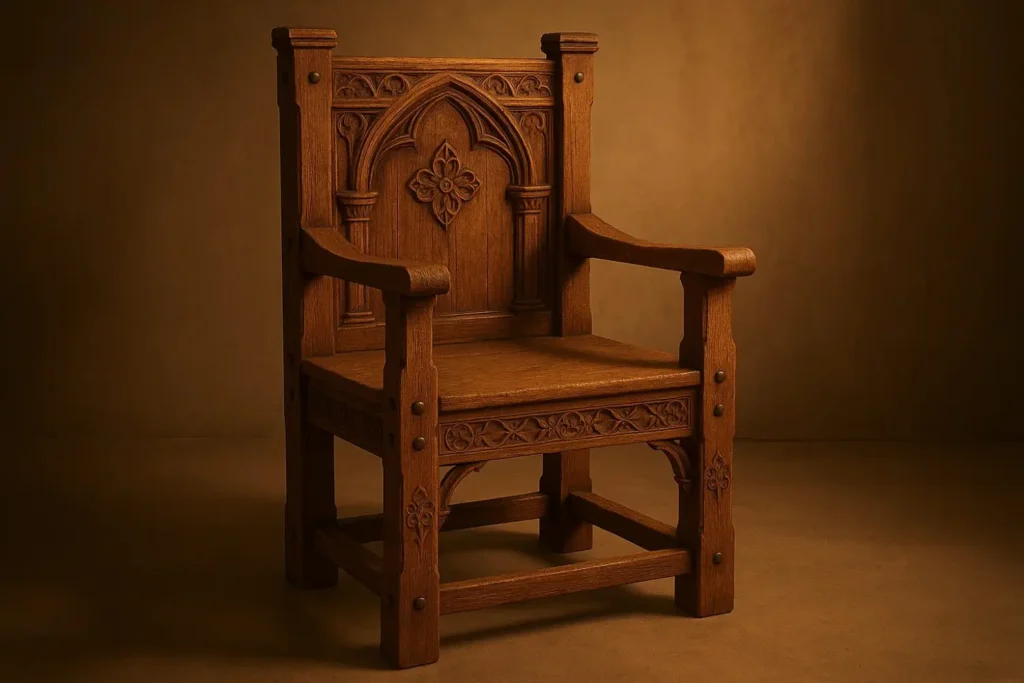
In medieval Europe, the lord of the manor possessed the sole chair—often a massive, heavy great chair placed on a dais. Everyone else made do with benches, stools, or chests. The chair was authority made physical. This began to change during the Renaissance (14th-17th centuries). As wealth spread to the merchant class, so did the desire for symbolic furniture.
Chairs became more common in affluent households, though still prized possessions. Design flourished with intricate carvings, upholstery (a revolution in comfort using velvet and leather stuffed with horsehair or straw), and a greater variety of forms like the caqueteuse (a conversation chair) and the farthingale (wide-sided to accommodate elaborate dresses).
The Revolution of Comfort and Accessibility
The 18th century marked a turning point. The question “who invented the chair” now shifts from “who made the first one” to “who invented key innovations that made it comfortable and ubiquitous.”
- The Windsor Chair (18th Century): An English folk design of stunning simplicity and durability, often made of multiple woods. Its spindle back and saddle seat made it affordable and practical, spreading from cottages to gardens and eventually across the Atlantic to America.
- The Rococo and the Fauteuil (18th Century): In France, comfort became an art form. The fauteuil, an upholstered armchair with an open sides, was designed for the salons of Paris—places of conversation and leisure. It was lighter and more social than earlier armchairs.
- The 19th Century: Mechanization and Specialization The Industrial Revolution answered “who invented the chair” with “many people, and machines.” Mass production through steam-powered bending and machining made chairs affordable for the emerging middle class. This era saw an explosion of styles (Victorian, Revivalism) and the birth of specialized chairs: the office swivel chair (invented by Charles Darwin, who added wheels to his desk chair to access specimens more easily), the dentist’s chair, and the railroad chair.
The 20th Century: The Chair as Art and Science
Modernism transformed the chair from a status symbol into a playground for design ideology, new materials, and ergonomics.
- The Bauhaus (1920s): Designers like Marcel Breuer asked: if we can make a chair from steel tubing, why use wood? His Wassily Chair (1925) and Cesca Chair (1928) used bent tubular steel to create lightweight, strong, and radically modern forms. This was a true invention, redefining the materiality of seating.
- Mid-Century Modernism (1940s-60s): Designers like Charles and Ray Eames became household names. They pioneered techniques in molded plywood (Eames LCW, 1946) and fiberglass-reinforced plastic (Eames DAR, 1948), creating chairs that were affordable, mass-producible, sculptural, and comfortable. The chair was now a design icon for the masses.
- The Ergonomics Revolution (Late 20th Century): As office work exploded, the focus shifted to health and support. The task chair evolved with adjustable height, lumbar support, and swivel mechanisms. While no single “inventor” exists here, designers like Bill Stumpf pioneered research-driven ergonomics, culminating in chairs like the Herman Miller Aeron (1994), which treated sitting as a biomechanical science.
So, Who Invented the Chair?
We must conclude that the chair had no single inventor. It was:
- Incremental Evolution: A slow evolution from stools and thrones over 5,000 years.
- Cultural Co-Invention: Independently developed by advanced civilizations (Egypt, Mesopotamia, China, Greece) as a natural byproduct of social hierarchy and craft.
- A Series of Innovators: A chain of contributors—from the unknown Egyptian craftsmen of Khaefre’s throne, to the Greek maker of the first klismos, to the medieval carpenter, to Breuer, the Eameses, and modern ergonomic engineers. Each answered the question for their own time.
The chair’s invention is ongoing. Today, we see it in gaming chairs optimized for long sessions, ball chairs for core stability, and AI-aided designs that perfectly map to the human spine. The drive for comfort, health, and aesthetic expression continues.
Final Words:
The next time you lower yourself into a chair, remember you’re engaging with one of humanity’s oldest and most meaningful artifacts. From the stone seats of Neolithic elders to the algorithmically-designed ergonomic throne in your home office, the chair has always been a proxy for power, a canvas for culture, and a tool for the body. The answer to “who invented the chair” is, in a very real sense, us—collectively, across centuries and continents.
We invented it to lift our leaders to the heavens, to ease our weary bodies, to showcase our wealth, to enable our work, and to express our artistic vision. It is a testament to human ingenuity, proving that even the most mundane objects in our daily lives contain an epic story of invention, adaptation, and design. The chair, ultimately, is a mirror. Look at what a society sits on, and you’ll understand who they are.
Frequently asked questions
Was there a single person who invented the chair?
No, there is no single named inventor of the chair. It was not a sudden invention but a gradual evolution over thousands of years, developed independently by several ancient civilizations like Egypt, Mesopotamia, China, and Greece as social hierarchies and crafts advanced.
What is the oldest known chair?
The oldest known representations and artifacts of chairs come from ancient Egypt, dating to around 2680 BCE. A statue of Pharaoh Khafre shows him on a throne, and the famous Tutankhamun’s Golden Throne (c. 1336–1327 BCE) is one of the most intact and elaborate early examples.
Why were chairs so rare in the Middle Ages?
In medieval Europe, chairs were potent symbols of authority and power. Typically, only the head of a household (like a lord or bishop) owned a proper chair, often placed on a raised dais. Everyone else used benches, stools, or chests, making the chair itself a literal seat of power.
When did chairs become common in everyday households?
Chairs began to become more common, though still prized possessions, during the Renaissance (14th-17th centuries) among the wealthy merchant class. Widespread accessibility truly arrived in the 19th century with the mass-production capabilities of the Industrial Revolution, which made furniture affordable for the middle class.
What was a major innovation in chair design?
A pivotal innovation was the use of bent tubular steel by the Bauhaus school in the 1920s. Marcel Breuer’s Wassily Chair (1925) revolutionized design by introducing a lightweight, strong, and modern material, moving away from traditional wood and paving the way for 20th-century modernism.
Who contributed to making chairs comfortable and ergonomic?
While comfort evolved over centuries, the 20th century saw a scientific approach. Designers like Charles and Ray Eames pioneered molded plywood and fiberglass for contoured comfort. Later, ergonomic research by designers like Bill Stumpf led to iconic, health-focused office chairs like the Herman Miller Aeron (1994).
Is there a difference between a stool, a throne, and a chair?
Yes, the distinction is often about form and symbolism. A stool has no back. A chair has a back and is for sitting. A throne is an especially ornate and elevated chair, specifically designed to symbolize sovereign power, authority, and divinity.