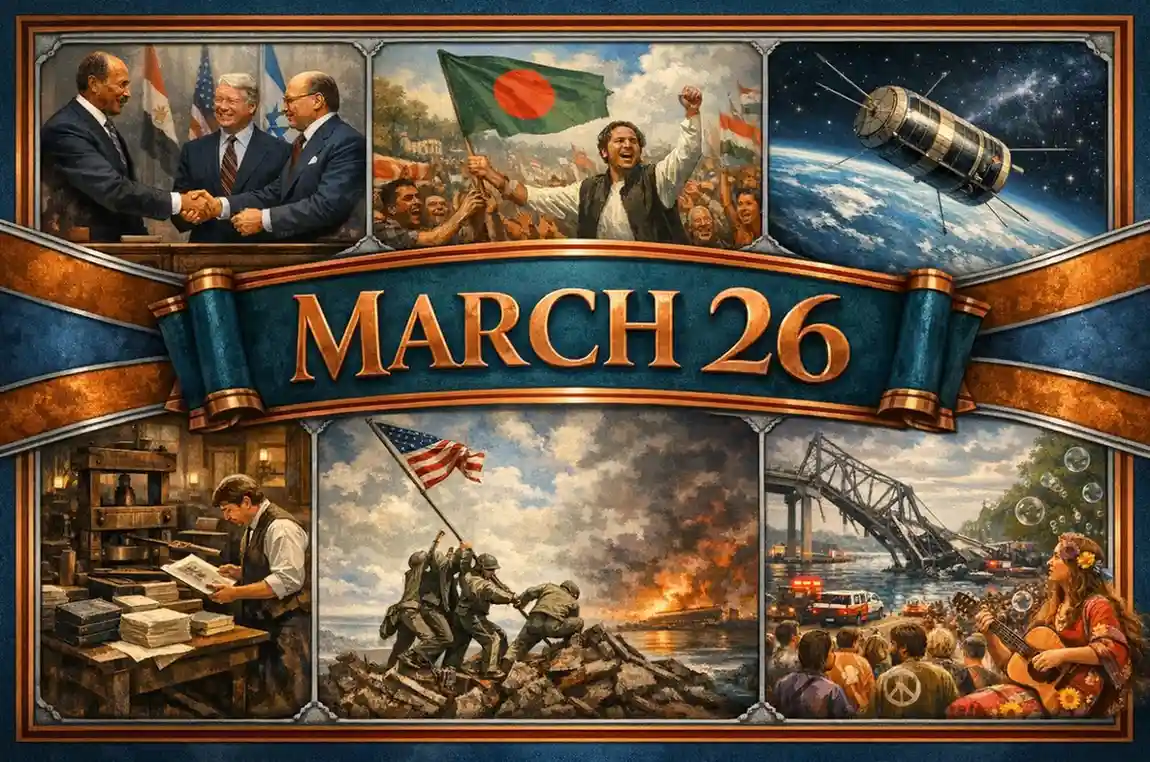
When we look at this day in history March 26, we see a landscape shaped by the redrawing of borders and the search for lasting peace. It is a date of profound geopolitical transformation, most notably in 1971 when East Pakistan declared its independence to become Bangladesh, and again in 1979 with the signing of the historic Egypt–Israel peace treaty.
Important Events That Happened On March 26 In History
590 – Proclamation of Theodosius
Byzantine Emperor Maurice officially proclaimed his son, Theodosius, as co-emperor. This move was intended to secure the dynastic succession within the Byzantine Empire during a period of significant military challenges on the imperial frontiers.
624 – First Eid al-Fitr Celebration
The very first Eid al-Fitr was celebrated by the early Muslim community. This holiday marked the conclusion of the first communal fast of Ramadan, establishing one of the most significant religious observances in the Islamic world.
752 – Election of Pope Stephen II
Following the death of Pope Zachary, Stephen II was elected to the papacy. His short but impactful reign was characterized by his efforts to seek protection for Rome from the Lombards, eventually leading to a pivotal alliance with the Franks.
1021 – Succession of al-Zahir
The death of the Fatimid caliph al-Hakim bi-Amr Allah was publicly announced, six weeks after it actually occurred. Simultaneously, the succession of his son, al-Zahir li-i’zaz Din Allah, was confirmed, ensuring the continuity of the Fatimid Caliphate in Egypt.
1027 – Coronation of Conrad II
Pope John XIX crowned Conrad II as the Holy Roman Emperor in Rome. Conrad II was the founder of the Salian dynasty, and his coronation solidified his control over the German, Italian, and Burgundian kingdoms.
1169 – Saladin Becomes Emir of Egypt
Saladin (Salah ad-Din) was appointed as the emir and vizier of Egypt under the Fatimid Caliphate. This appointment was a crucial stepping stone in his rise to power, eventually leading him to found the Ayyubid dynasty and recapture Jerusalem.
1244 – Treaty of Almizra
The Crown of Aragon and the Crown of Castile signed the Treaty of Almizra. This agreement defined the specific borders for their respective territorial expansions into al-Andalus, effectively preventing conflict between the two Christian kingdoms during the Reconquista.
1344 – End of the Siege of Algeciras
The lengthy Siege of Algeciras concluded with a victory for the Christian forces of Alfonso XI of Castile. The siege is historically significant as one of the first military engagements in Europe where gunpowder and cannons were utilized.
1351 – Combat of the Thirty
During the War of the Breton Succession, thirty Breton knights challenged and defeated thirty English knights in a pre-arranged judicial combat. The event became a celebrated example of medieval chivalry and martial prowess.
1484 – Caxton Prints Aesop’s Fables
William Caxton, the man who introduced the printing press to England, published his English translation of Aesop’s Fables. This helped standardize the English language and made these classic moral tales accessible to a wider audience.
1552 – Guru Amar Das Becomes Third Sikh Guru
Guru Amar Das officially became the third of the ten Sikh Gurus. His leadership was marked by the strengthening of the Sikh community and the formalization of the Langar (community kitchen), which promoted equality among all people.
1636 – Founding of Utrecht University
Utrecht University was established in the Netherlands. It quickly grew into one of the most prestigious institutions in Europe, contributing significantly to the Dutch Golden Age of science and philosophy.
1640 – Royal Academy of Turku Founded
Queen Christina of Sweden, at the suggestion of Count Per Brahe, founded the Royal Academy of Turku. It was the first university in Finland, serving as the intellectual heart of the region for centuries before eventually moving to Helsinki.
1651 – Wreck of the San José
The Spanish ship San José, heavily loaded with silver, was driven south by powerful winds and wrecked on the coast of southern Chile. The surviving crew members who made it to shore were reportedly killed by the indigenous Cunco people.
1697 – Safavids Take Basra
Troops from the Safavid Empire of Persia successfully took control of the strategic port city of Basra. The conquest allowed the Safavids to extend their influence over the Persian Gulf trade routes.
1700 – Discovery of New Britain
English explorer William Dampier became the first European to circumnavigate New Britain. He discovered that it was an island—which he named Nova Britannia—rather than a part of the New Guinea mainland as previously believed.
1812 – Caracas Earthquake
A massive earthquake struck Caracas, Venezuela, on Holy Thursday. The disaster caused widespread devastation and thousands of deaths, occurring during the Venezuelan War of Independence and having a profound psychological impact on the revolution.
1812 – “Gerrymander” Term Coined
A political cartoon published in the Boston-Gazette used the word “gerrymander” for the first time. The term described the oddly shaped electoral districts created under Massachusetts Governor Elbridge Gerry to favor his political party.
1830 – Publication of the Book of Mormon
The first copies of the Book of Mormon were published by Egbert B. Grandin in Palmyra, New York. The publication led to the formal organization of the Church of Jesus Christ of Latter-day Saints shortly thereafter.
1839 – First Henley Royal Regatta
The inaugural Henley Royal Regatta was held on the River Thames in England. Originally a local fair with boat races, it evolved into one of the most prestigious amateur rowing events in the world.
1871 – Paris Commune Elections
The citizens of Paris held elections to form the Commune Council. This revolutionary socialist government took control of the city following the French defeat in the Franco-Prussian War, though its rule was ultimately short-lived.
1885 – North-West Rebellion Begins
The Métis people, led by Louis Riel, began the North-West Rebellion against the Canadian government in the District of Saskatchewan. The conflict arose from grievances over land rights and the rapid expansion of European settlers into the west.
1896 – Brunner Mine Disaster
An explosion at the Brunner Mine in New Zealand killed 65 coal miners. It remains the deadliest industrial accident in the country’s history, leading to significant changes in mining safety regulations and labor organization.
1913 – Capture of Adrianople
During the First Balkan War, Bulgarian forces successfully captured the strategic city of Adrianople (modern-day Edirne) from the Ottoman Empire. The victory was a decisive blow that led to the end of the war’s major hostilities.
1915 – First Stanley Cup “Inter-League” Championship
The Vancouver Millionaires defeated the Ottawa Senators to win the 1915 Stanley Cup. This was the first time the championship was played between the winners of the Pacific Coast Hockey Association and the National Hockey Association.
1917 – First Battle of Gaza
During World War I, British forces attempted to capture the city of Gaza from the Ottoman Empire. The British advance was successfully halted by roughly 17,000 Ottoman troops, resulting in a strategic victory for the Turks.
1922 – German Social Democratic Party in Poland
The German Social Democratic Party was formally established in Poland. The party aimed to represent the interests of the German minority within the newly independent Polish state.
1931 – Founding of Swissair
Swissair was established as the national airline of Switzerland through a merger between Ad Astra Aero and Balair. For decades, it was known as one of the world’s most respected and financially stable international carriers.
1931 – Ho Chi Minh Communist Youth Union Founded
The Ho Chi Minh Communist Youth Union was established in Vietnam. The organization was designed to mobilize young people in support of the Vietnamese independence movement and communist ideology.
1934 – UK Driving Test Introduced
The United Kingdom officially introduced a voluntary driving test to improve road safety. It became mandatory the following year, fundamentally changing how British citizens were licensed to operate motor vehicles.
1939 – Final Offensive of the Spanish Civil War
Nationalist forces under General Francisco Franco began their final offensive against the remaining Republican strongholds. This led to the rapid collapse of the Republic and the end of the devastating three-year civil war.
1942 – First Women Prisoners at Auschwitz
The first transport of female prisoners arrived at the Auschwitz concentration camp in German-occupied Poland. These 999 women were transferred from the Ravensbrück camp, marking a horrific expansion of the camp’s operations.
1945 – Battle of Iwo Jima Ends
The Battle of Iwo Jima officially concluded as American forces secured the island. The five-week battle was one of the bloodiest in the Pacific Theater, and the island served as a critical airbase for the final stages of World War II.
1954 – The “Romeo” Nuclear Test
The United States detonated the “Romeo” shot as part of Operation Castle at Bikini Atoll. The thermonuclear device produced a yield of 11 megatons, far exceeding its predicted power and contributing to significant environmental fallout.
1958 – Launch of Explorer 3
The United States Army successfully launched the Explorer 3 satellite. The mission followed the success of Explorer 1 and was designed to gather more data on cosmic rays and micrometeorites in Earth’s orbit.
1967 – Central Park Be-In
Approximately ten thousand people gathered in New York City’s Central Park for an “Easter Sunday Be-In.” The event was a peaceful celebration of the 1960s counterculture movement, featuring music, poetry, and art.
1970 – South Vietnamese Land Reform
President Nguyễn Văn Thiệu implemented the “Land-to-the-Tiller” program. This ambitious land reform effort was intended to solve the problem of land tenancy by distributing property to peasants, hoping to reduce support for communist insurgents.
1971 – Independence of Bangladesh
East Pakistan officially declared its independence from Pakistan to form the new nation of Bangladesh. The declaration, led by Sheikh Mujibur Rahman, triggered the Bangladesh War of Independence and a significant humanitarian crisis.
1975 – Biological Weapons Convention
The Biological Weapons Convention, the first multilateral disarmament treaty banning the development, production, and stockpiling of an entire category of weapons of mass destruction, officially came into force.
1979 – Egypt–Israel Peace Treaty
President Anwar al-Sadat of Egypt and Prime Minister Menachem Begin of Israel signed a historic peace treaty in Washington, D.C., witnessed by President Jimmy Carter. The treaty ended 30 years of war between the two nations and established full diplomatic relations.
1981 – Founding of the UK Social Democratic Party
The Social Democratic Party (SDP) was launched in the United Kingdom. Formed by the “Gang of Four”—disaffected senior Labour Party members—it sought to create a new centrist force in British politics.
1982 – Vietnam Veterans Memorial Groundbreaking
A groundbreaking ceremony was held in Washington, D.C., for the Vietnam Veterans Memorial. Designed by Maya Lin, the memorial was built to honor the service and sacrifice of the American men and women who served in the Vietnam War.
1991 – Treaty of Asunción
Argentina, Brazil, Uruguay, and Paraguay signed the Treaty of Asunción. This agreement established Mercosur, a regional trade bloc designed to promote free trade and the fluid movement of goods and people across the “South Common Market.”
1991 – Hijacking of Singapore Airlines Flight 117
Four Pakistani terrorists hijacked Singapore Airlines Flight 117 shortly after takeoff. The plane was diverted to Changi Airport, where Singaporean special forces eventually stormed the aircraft and rescued all passengers and crew.
1997 – Heaven’s Gate Mass Suicides
The bodies of 39 members of the Heaven’s Gate cult were found in a mansion in San Diego, California. The group had committed a mass suicide, believing their souls would board an extraterrestrial spacecraft trailing the Comet Hale–Bopp.
1998 – Oued Bouaicha Massacre
During the Algerian Civil War, fifty-two people—most of whom were infants and children—were killed in the Oued Bouaicha massacre. The attackers utilized axes and knives in one of the most brutal incidents of the decade-long conflict.
2005 – Anti-Secession Law Protest
Hundreds of thousands of people demonstrated in Taipei, Taiwan, to oppose China’s newly passed Anti-Secession Law. The law authorized the use of “non-peaceful means” should Taiwan formally declare independence, sparking widespread regional tension.
2010 – Sinking of the ROKS Cheonan
The South Korean Navy corvette Cheonan was split in two and sunk by a torpedo, resulting in the deaths of 46 sailors. An international investigation concluded that a North Korean submarine was responsible for the attack.
2017 – Anti-Corruption Protests in Russia
Tens of thousands of people joined anti-corruption protests in 99 cities across Russia. Surveys later indicated that a large portion of the population supported the demonstrations and held President Putin personally responsible for systemic corruption.
2024 – Collapse of the Francis Scott Key Bridge
In Baltimore, Maryland, the MV Dali container ship collided with a support pillar of the Francis Scott Key Bridge. The impact caused the entire bridge to collapse into the Patapsco River, resulting in the deaths of six construction workers on the span.
Read Also: This day in history March 25: Foundations, Faith, and Freedom
Famous People Born on March 26
| Name | Description | Date |
|---|---|---|
| William Jefferson Hague, Baron Hague of Richmond | British politician, Conservative Party leader, foreign secretary | March 26, 1961 – Present |
| A.E. Housman | English scholar and celebrated poet | March 26, 1859 – April 30, 1936 |
| Fuʾād I | First king of Egypt (1922–1936) | March 26, 1868 – April 28, 1936 |
| Edward Bellamy | American writer, utopian author of Looking Backward | March 26, 1850 – May 22, 1898 |
| Sir Benjamin Thompson, count von Rumford | American-born British physicist, founder of Royal Institution | March 26, 1753 – March 21, 1814 |
| James B. Conant | American educator and scientist, president of Harvard University | March 26, 1893 – February 11, 1978 |
| Conrad Gesner | Swiss physician and naturalist, “father of modern zoology” | March 26, 1516 – December 13, 1565 |
| Palmiro Togliatti | Italian politician, leader of Italian Communist Party | March 26, 1893 – August 21, 1964 |
| Gregory Corso | American Beat poet | March 26, 1930 – January 17, 2001 |
| William Blount | American politician, first territorial governor of Tennessee | March 26, 1749 – March 21, 1800 |
| Carl E. Wieman | American physicist, Nobel Prize winner (Bose-Einstein condensate) | March 26, 1951 – Present |
| George William Frederick Charles, 2nd duke of Cambridge | British field marshal, commander in chief of British army | March 26, 1819 – March 17, 1904 |
| Sir Bernard Katz | German-born British physiologist, Nobel Prize winner | March 26, 1911 – April 20, 2003 |
| Nathaniel Bowditch | American navigator and mathematician | March 26, 1773 – March 16, 1838 |
| Christian B. Anfinsen | American biochemist, Nobel Prize winner | March 26, 1916 – May 14, 1995 |
| Othmar Herman Ammann | American engineer, designer of Verrazano-Narrows Bridge | March 26, 1879 – September 22, 1965 |
| George Smith | British Assyriologist, translator of the Epic of Gilgamesh | March 26, 1840 – August 19, 1876 |
| Katharine Jefferts Schori | American bishop, first female presiding bishop of Episcopal Church | March 26, 1954 – Present |
| Elizabeth Jane Howard | British novelist | March 26, 1923 – January 2, 2014 |
| Wilhelm Backhaus | German pianist, renowned Beethoven interpreter | March 26, 1884 – July 5, 1969 |
| Sir Gerald du Maurier | British actor-manager | March 26, 1873 – April 11, 1934 |
| A.C. Bradley | British literary critic, preeminent Shakespearean scholar | March 26, 1851 – September 2, 1935 |
| William Ferguson Massey | Prime minister of New Zealand (1912–1925) | March 26, 1856 – May 10, 1925 |
| Julius Schnorr von Carolsfeld | German painter, member of Nazarene movement | March 26, 1794 – May 24, 1872 |
| Wayne Embry | American basketball player and executive, first Black NBA general manager | March 26, 1937 – Present |
| Eder Jofre | Brazilian boxer, world bantamweight and featherweight champion | March 26, 1936 – October 2, 2022 |
| Ernst Engel | German statistician (Engel’s law) | March 26, 1821 – December 8, 1896 |
| Charles de Lorraine, duke de Mayenne | French noble, leader of the Holy League | March 26, 1554 – October 13, 1611 |
| Herman Haupt | American civil engineer and inventor | March 26, 1817 – December 14, 1905 |
| Li Keran | Chinese painter, prominent 20th-century artist | March 26, 1907 – December 5, 1989 |
Famous People Died on March 26
| Name | Description | Date |
|---|---|---|
| Daniel Patrick Moynihan | United States senator and sociologist | March 16, 1927 – March 26, 2003 |
| Richard Serra | American sculptor, master of large-scale steel works | November 2, 1938 – March 26, 2024 |
| James Hutton | Scottish geologist, originator of uniformitarianism | June 3, 1726 – March 26, 1797 |
| Edmund Muskie | American politician, secretary of state, senator, governor | March 28, 1914 – March 26, 1996 |
| David Packard | American engineer, co-founder of Hewlett-Packard | September 7, 1912 – March 26, 1996 |
| Gregory XI | Pope (1370–1378), last French pope | 1329 – March 26, 1378 |
| al-Ḥallāj | Islamic mystic and Sufi teacher | c.858 – March 26, 922 |
| Jim Harrison | American novelist and poet (Legends of the Fall) | December 11, 1937 – March 26, 2016 |
| James Callaghan, Baron Callaghan | Prime minister of the United Kingdom (1976–1979) | March 27, 1912 – March 26, 2005 |
| Jim Thompson | American-born Thai businessman, revived Thai silk industry | March 21, 1906 – March 26, 1967 |
| Richard Allen | American clergyman, founder of African Methodist Episcopal Church | February 14, 1760 – March 26, 1831 |
| Garnet Wolseley, 1st Viscount Wolseley | British field marshal, modernized British army | June 4, 1833 – March 26, 1913 |
| Augusta Savage | American sculptor and educator, Harlem Renaissance figure | February 29, 1892 – March 26, 1962 |
| Lin Yutang | Chinese author and inventor | October 10, 1895 – March 26, 1976 |
| Max Ophüls | German-French film director | May 6, 1902 – March 26, 1957 |
| Tomas Tranströmer | Swedish poet, Nobel Prize in Literature | April 15, 1931 – March 26, 2015 |
| Sir John Vanbrugh | British architect and dramatist (Blenheim Palace) | January 24, 1664 – March 26, 1726 |
| Alfonso XI | King of Castile and Leon (1312–1350) | 1311 – March 26, 1350 |
| Sancho I | Second king of Portugal (1185–1211) | 1154 – March 26, 1211 |
| David Storey | English novelist and playwright | July 13, 1933 – March 26, 2017 |
| Sugawara Michizane | Japanese scholar, later deified as Tenjin (patron of scholarship) | 845 – March 26, 903 |
| T.H. Green | English Idealist philosopher | April 7, 1836 – March 26, 1882 |
| Geraldine Ferraro | American politician, first female vice-presidential nominee of a major party | August 26, 1935 – March 26, 2011 |
| George Sisler | American baseball player, Hall of Fame first baseman | March 24, 1893 – March 26, 1973 |
| Henry M. Leland | American engineer and manufacturer, founder of Cadillac and Lincoln | February 16, 1843 – March 26, 1932 |
| Spyridon Louis | Greek marathon runner, first modern Olympic marathon winner (1896) | January 12, 1873 – March 26, 1940 |
| Édouard Herriot | French statesman, premier of France three times | July 5, 1872 – March 26, 1957 |
| Isaac Mayer Wise | American rabbi, greatest organizer of Reform Judaism | March 29, 1819 – March 26, 1900 |
| Alex Comfort | English gerontologist and author (The Joy of Sex) | February 10, 1920 – March 26, 2000 |
| Diana Wynne Jones | British fantasy writer | August 16, 1934 – March 26, 2011 |
Observances & Institutional Dates
- Independence Day (Bangladesh): Celebrating the 1971 declaration of independence and honoring those who fought in the liberation war.
- National Science Appreciation Day (USA): A day dedicated to highlighting the importance of scientific research and education.
- Purple Day: An international grassroots effort dedicated to increasing awareness about epilepsy worldwide.
- Martyr’s Day (Mali): Commemorating those who died during the struggle for democracy in the early 1990s.
- Prince Kūhiō Day (Hawaii): A state holiday honoring Prince Jonah Kūhiō Kalanianaʻole, a representative to the U.S. Congress.
Frequently Asked Questions
- What happened on March 26, 1971? East Pakistan declared independence, marking the birth of Bangladesh.
- When was the Egypt–Israel peace treaty signed? It was signed on March 26, 1979, in Washington, D.C.
- What is the significance of the Brunner Mine? It was the site of New Zealand’s worst industrial accident on March 26, 1896, killing 65 miners.
- Why is March 26 known as Purple Day? It is an international day to raise awareness about epilepsy and support those affected by the condition.