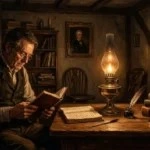
The sun dips below the horizon, and suddenly, your world shrinks to the size of a single room. Outside, it is pitch black. There are no streetlights, no phone screens, no glow from a neighbour’s television. The darkness is absolute — the kind of dark that modern eyes have genuinely never experienced. Everything you do after sunset depends on one fragile, flickering flame.
So how did people light their homes before electricity? The answer reaches back forty thousand years, crosses every civilization on earth, and involves some genuinely strange ingredients — including fish, beetles, and the rendered fat of whatever animal happened to be nearby.
Fire at the Cave Mouth — Where It All Began
Long before anyone thought to make a lamp, fire was the answer. Archaeological evidence from sites in South Africa — Blombos Cave, dated to around 70,000 BCE — shows that early humans were already managing fire intentionally, using it for warmth, cooking, and almost certainly for light. Hearths were the original light source, and for tens of thousands of years, that was enough.
But a hearth in the middle of a room is inconvenient. You can’t carry it. You can’t place it near your work. So somewhere around 40,000 years ago, humans started making lamps — shallow stone dishes filled with animal fat, with a moss or lichen wick resting in the oil. The caves at Lascaux in France, home to some of the most breathtaking prehistoric paintings in the world, were painted partly by the light of these small stone lamps. Those artists were working in deep, lightless tunnels, with nothing between them and total darkness but a burning piece of animal fat.
The genius of that leap — from standing beside a fire to carrying light in your hand — changed human life forever.
Ancient Egypt and the Oil Lamp That Lasted 4,000 Years
The oil lamp was, without question, the workhorse of human lighting for most of recorded history. Ancient Egyptians were using ceramic lamps filled with castor oil or sesame oil as far back as 3,000 BCE. They were simple, shallow bowls with a pinched edge to hold the wick — and here is what strikes you when you think about it: the design barely changed for four thousand years.
Romans refined the form somewhat, producing enclosed terracotta lamps with a small hole for the wick and a larger hole to pour oil through. Olive oil was the preferred fuel across the Mediterranean world — cleaner-burning and less smoky than animal fat. In wealthier Roman households, banks of oil lamps could create real illumination. In poorer ones, a single lamp might be shared by the whole family.
What nobody tells you about ancient lighting is how much it smelled. Animal fat lamps produced a thick, yellowish smoke with an odour that you’d recognise immediately. The inside of a medieval cottage wasn’t just dark — it was fragrant in all the wrong ways.
The oil lamp spread across the Islamic world, through Persia and Central Asia, into China and India. By the 7th century CE, Islamic scholars were conducting groundbreaking work in mathematics, medicine, and astronomy, often late into the night — all by the light of an oil lamp.
Tallow Candles and the Long Dark of the Middle Ages
For ordinary people in medieval Europe, candles were the main source of indoor light — but not the beautiful beeswax candles you might imagine. Those were expensive, reserved for churches and the very wealthy. What most people burned were tallow candles: cylinders of rendered animal fat, usually from sheep or cattle, wrapped around a wick of twisted plant fibre.
Tallow candles were cheap enough for working families to afford, but they came with serious drawbacks. They burned unevenly, dripped constantly, and had to be regularly “snuffed” — not to extinguish them, but to trim the charred wick so they wouldn’t gutter out or smoke. A household servant in a great medieval estate could have trimming candles as a formal part of their job description.
In England, the Tallow Chandlers’ Company — the guild of candle-makers — received its first royal charter in 1462. The beeswax alternative, far superior in every way, was a luxury mostly confined to monasteries and the homes of the nobility. If you attended a candlelit banquet in 1350, whether the room smelled sweetly of beeswax or rancidly of tallow told you immediately whose house you were in.
Rushlight, Kindling, and the Ingenious Tricks of the Rural Poor
Here is something that rarely gets mentioned when people romanticise life in the pre-electric past: the rural poor often couldn’t afford even tallow candles regularly. They used rushlights instead — strips of rush plant (the soft-stemmed wetland grass) peeled and dipped in kitchen grease, then held at an angle in a simple iron clip. One rushlight burned for roughly twenty to forty minutes.
The 18th-century naturalist Gilbert White, writing from Hampshire in 1789, described rushlights in precise detail in his famous “Natural History of Selborne.” He calculated that a family could make enough rushlights for a year from just a pound of grease — a small but telling fact about how carefully people managed every resource in their lives. Light wasn’t taken for granted. Light was budgeted.
In Japan and China, paper lanterns with oil wicks served a similar everyday function, while in coastal communities across northern Europe and North America, people used fish-oil lamps — and in the far north, the oil of sea mammals like whales and seals had been the primary fuel for thousands of years.
🕯️ Comparison: Lighting Methods Through the Ages
| 🔥 Method | 📅 Era / Region | ⛽ Fuel Used | 👥 Typical Users | ⏱️ Burn Time |
|---|---|---|---|---|
| Stone fat lamp | 40,000 BCE, worldwide | Animal fat, lichen wick | All people | Several hours |
| Ceramic oil lamp | 3000 BCE, Egypt / Rome / Arabia | Olive oil, castor oil | All classes | 4–8 hours |
| Tallow candle | Medieval Europe, from ~400 CE | Rendered animal fat | Middle & lower classes | 2–4 hours |
| Beeswax candle | Medieval Europe | Beeswax | Wealthy, clergy | 4–8 hours |
| Rushlight | Pre-industrial Europe | Kitchen grease, rush pith | Rural poor | 20–40 min |
| Whale / fish oil lamp | 17th–19th century, coastal regions | Whale oil, cod liver oil | Maritime communities | 4–6 hours |
| Gas lamp (indoor) | 1810s onward, Britain / Europe | Coal gas | Urban middle class+ | Continuous |
| Kerosene lamp | 1850s onward, worldwide | Kerosene (paraffin) | All classes | Continuous |
The Argand Lamp and the First Real Revolution in Home Lighting
For thousands of years, the basic oil lamp changed remarkably little. Then, in 1780, a Swiss physicist named Aimé Argand changed everything. His invention — the Argand lamp — used a hollow circular wick and a glass chimney to create a controlled airflow around the flame. The result was a light source roughly ten times brighter than any candle, with far less smoke.
The Argand lamp was embraced by the scientific and professional classes almost immediately. In the late 18th century, when natural philosophers and physicians needed to read fine print, examine specimens, or write through long winter evenings, the Argand lamp gave them something genuinely new: reliable, bright, steady light after dark.
It was expensive — whale oil, which it burned most efficiently, was a premium commodity — but for those who could afford it, the Argand lamp essentially extended the useful working day. Some historians argue it contributed to the acceleration of intellectual and scientific productivity in the late Enlightenment period. That’s a big claim, but when you think about what it means to have suddenly have a decent reading light for the first time in human history, it doesn’t seem unreasonable.
Gas Lighting and the Transformation of the Victorian City
The next leap was gas — and it didn’t just change homes, it transformed cities. In 1807, London’s Pall Mall became one of the first streets in the world to be lit by gas lamps, an event that drew curious crowds who reportedly couldn’t believe what they were seeing. By 1823, London had over 40,000 gas lamps on its streets.
Indoors, gas lighting reached upper-middle-class Victorian homes from the 1840s onward. It was still a luxury — installation was expensive, and the pipes required a connection to the municipal supply. But for those who had it, gas light was transformative. Steadier than any candle, significantly brighter, and requiring no constant attention, it made evening activities like reading, needlework, socialising, and even entertaining in the home far more practical.
Working-class families continued relying on candles and, from the 1850s onward, kerosene (paraffin) lamps, which became affordable after Abraham Gesner’s 1846 distillation process made kerosene cheap to produce. The kerosene lamp spread across the world faster than almost any other domestic technology of the 19th century — and in many parts of the world, it remained the primary home light source well into the 20th century.
What Life After Dark Actually Looked Like — For Most People
Here’s the part that surprises most people who think about this seriously: for most of human history, most ordinary people simply went to bed when it got dark. This wasn’t just poverty — it was rational. Light was expensive, fragile, and dangerous. House fires caused by knocked-over candles or lamps were a leading cause of death well into the 19th century.
The historian A. Roger Ekirch, in his groundbreaking 2005 book “At Day’s Close: Night in Times Past,” documented something genuinely startling: pre-industrial people often slept in two distinct phases, waking in the middle of the night for an hour or two of quiet activity — prayer, conversation, reading by a single candle — before sleeping again until dawn. Artificial light shaped not just how people worked, but how they slept, how they thought, and how they structured their inner lives.
The wealthy lit their homes more thoroughly, but even they managed light carefully. A great country house in 1780 might have hundreds of candles for a formal dinner — and then return to near-darkness the moment the guests went home. Light was performance. Light was status. Light was never, ever taken for granted.
🕯️ Frequently Asked Questions
Before candles, people primarily used oil lamps — shallow stone or ceramic dishes filled with animal fat or plant oil, with a simple plant-fibre wick. These date back at least 40,000 years and were used across almost every early civilisation. Before lamps, the open hearth fire served as the main light source indoors.
Wealthy households could afford beeswax candles, which were cleaner and less smelly than tallow. By the 18th and 19th centuries, the rich had access to Argand lamps (burning whale oil) and later gas lighting. Poor families relied on tallow candles, rushlights, and from the mid-1800s, affordable kerosene lamps. The quality and quantity of light available was one of the clearest markers of social class in pre-industrial society.
Gas street lighting appeared in London from around 1807, but domestic gas lighting in private homes became more common from the 1840s onward — and mainly in upper-middle-class urban households at first. Working-class families in cities often didn’t have gas lighting at home until the late 19th century, and rural populations frequently relied on kerosene or candles until electrification reached them in the 20th century.
Very. House fires caused by candles, oil lamps, and gas leaks were common and often fatal in pre-electric homes. Open flames near timber frames, thatched roofs, and dry furnishings made fire a constant domestic hazard. London’s Great Fire of 1666, while a street-level catastrophe, also reflected how readily fire spread in densely packed buildings where open flames were everywhere. Gas lighting introduced explosion risks on top of fire risks.
There were similarities and differences. Oil lamps were universal, but the specific fuels varied — plant oils like rapeseed and camellia were common in China and Japan, rather than olive oil. Paper lanterns were widely used in East Asia, both indoors and as portable lights. Japan also developed distinctive lamp designs using vegetable oil and a shallow dish with a wick, often placed in carved stone or ceramic lantern housings that are still culturally iconic today.
People started having light in their homes around 40,000 years ago, using fire and simple fat lamps. Later, they used oil lamps and candles for thousands of years. Electric lights only began appearing in homes in the late 1800s, and became common in the early 1900s.
The Long Shadow of a Single Flame
The story of how people lit their homes before electricity is really a story about what human beings do with darkness — and how much of civilisation was built under conditions of near-total night. Every book read by candlelight, every conversation held by lamplight, every discovery made in the wavering glow of a fat-burning wick: all of it happened in circumstances that would strike most of us today as impossibly difficult.
The electric bulb, when it finally arrived in the 1880s, didn’t just change how homes looked at night. It changed sleep patterns, extended working hours, altered social life, and eventually reshaped the entire pace of modern existence. Darkness, once an inescapable daily presence, became optional almost overnight.
If this made you curious about what other ordinary parts of daily life looked like before the modern world intervened, you might also enjoy reading about What Did People Do for Fun Before Modern Technology? History of Fun.