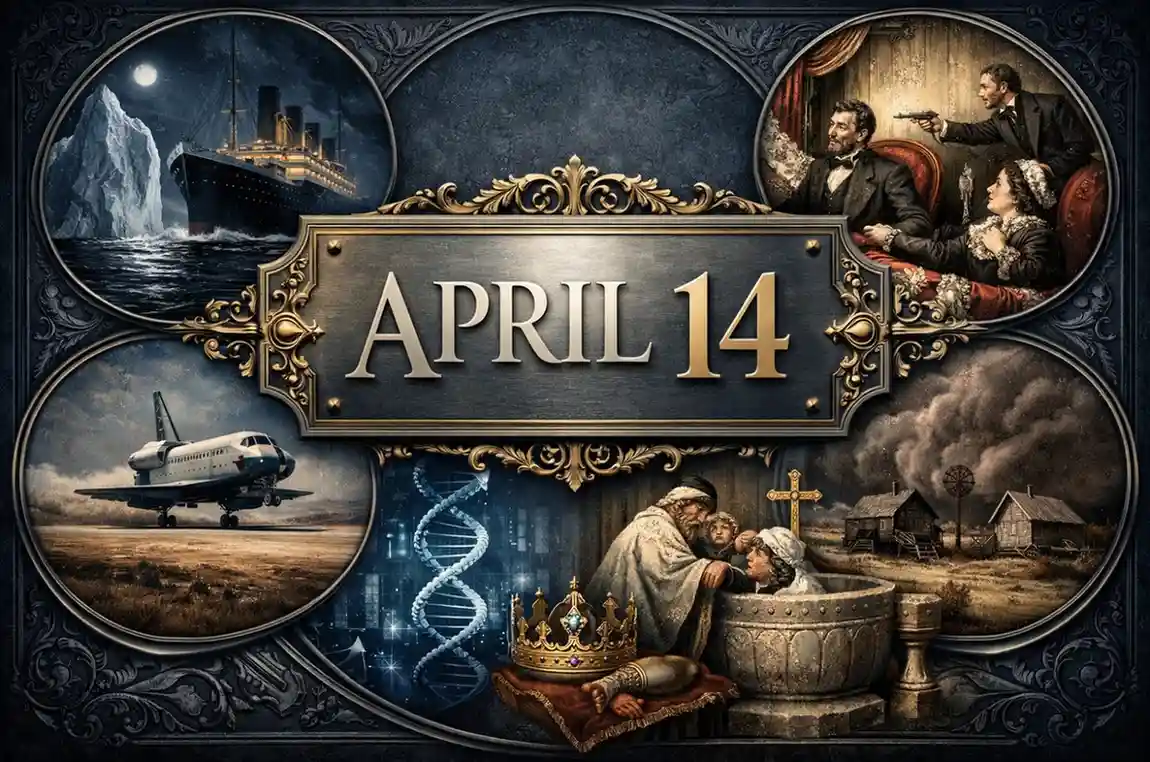
Exploring the significance of this day in history April 14 confronts us with some of history’s most startling transformations. Between the fatal wounding of Abraham Lincoln and the Titanic’s disastrous meeting with an iceberg, these 24 hours are firmly locked in the world’s memory. Such events prove that a brief instant—a bullet or a metal tear—is all it takes to shift a country’s entire trajectory.
Important Events That Happened On April 14 In History
43 BC – Battle of Forum Gallorum
Legions loyal to the Roman Senate, commanded by Gaius Pansa, engaged and defeated the forces of Mark Antony in a brutal clash. This battle was part of the internal power struggle following the assassination of Julius Caesar and sought to preserve the Republic’s authority. Although the Senate’s forces were victorious, the conflict resulted in heavy casualties and the eventual rise of the Second Triumvirate. It stands as a pivotal moment in the transition of Rome from a republic toward an era of absolute imperial rule.
69 – First Battle of Bedriacum
Vitellius, leading his Rhine-based legions, secured a decisive victory over the Roman Emperor Otho during the chaotic Year of the Four Emperors. The defeat forced Otho to commit suicide shortly after, allowing Vitellius to march on Rome and claim the imperial throne for himself. This military engagement highlighted the instability of the empire as rival generals used their armies to seize political control. The battle was a stark example of the civil unrest that plagued the Roman world during the first century.
966 – Conversion of Mieszko I
The pagan ruler of the Polans, Mieszko I, officially converted to Christianity following his marriage to the Christian princess Doubravka of Bohemia. This religious transition is traditionally celebrated as the symbolic founding of the Polish state and its entry into Western Latin culture. By adopting the faith, Mieszko secured diplomatic ties with neighboring Christian powers and centralized his authority over his subjects. This event laid the spiritual and political foundation for a kingdom that would endure for over a thousand years.
972 – Wedding of Otto II and Theophanu
Otto II, the Co-Emperor of the Holy Roman Empire, married the Byzantine princess Theophanu in a grand ceremony held in the city of Rome. On the same day, she was officially crowned as empress by Pope John XIII, solidifying an alliance between the Western and Eastern empires. This marriage brought significant Byzantine cultural and artistic influence to the German court and helped stabilize regional diplomatic relations. Theophanu went on to become one of the most powerful and influential women of the medieval era.
1205 – Battle of Adrianople
A combined Bulgarian and Cuman army led by Tsar Kalojan successfully ambushed and defeated the forces of the Latin Empire of Constantinople. The engagement resulted in the capture of the Latin Emperor Baldwin I and the destruction of much of his elite knightly force. This victory halted the immediate expansion of the Latin Empire and reasserted Bulgarian dominance in the Balkan region. It remains one of the most significant military triumphs in medieval Bulgarian history, shifting the balance of power in the East.
1395 – Battle of the Terek River
The Central Asian conqueror Timur achieved a massive military victory over the army of the Golden Horde at the Terek River. This defeat broke the power of Khan Tokhtamysh and initiated the permanent military and political decline of the Golden Horde khanate. Timur’s victory allowed him to exert influence over the region and secured his northern borders for further campaigns in the East. The aftermath of the clash left a power vacuum that eventually facilitated the rise of the Grand Duchy of Moscow.
1471 – Battle of Barnet
Yorkist forces under King Edward IV defeated the Lancastrian army led by the Earl of Warwick during the bloody Wars of the Roses. The Earl of Warwick, known as the “Kingmaker,” was killed in the retreat, effectively removing a major obstacle to Yorkist rule. This victory allowed Edward IV to resume his place on the throne and significantly weakened the Lancastrian cause in England. The battle was fought in a thick morning fog, which led to confusion and friendly fire that decided the outcome.
1561 – Nuremberg Celestial Phenomenon
Residents of Nuremberg reported a strange celestial phenomenon described as a massive aerial battle involving globes, crosses, and crescents in the sky. This historic broadsheet account detailed a spectacle that lasted for over an hour and ended with various objects crashing outside the city. While modern scholars interpret this as a complex sun dog or atmospheric refraction, the event was viewed by contemporaries as a divine sign. It remains one of the most famous early documentations of an unexplained aerial event in European history.
1639 – Battle of Chemnitz
Swedish forces achieved a significant victory over the Holy Roman Empire and the Electorate of Saxony during the Thirty Years’ War. This clash ended the military effectiveness of the Saxon army for the remainder of the conflict and opened the way for Sweden to advance. The Swedish success secured their dominance in northern Germany and allowed them to push their front lines deeper into Bohemia. This battle was a key turning point that helped dictate the eventual terms of the peace settlements in Europe.
1775 – First Abolition Society Founded
The Society for the Relief of Free Negroes Unlawfully Held in Bondage was organized in Philadelphia by Benjamin Franklin and Benjamin Rush. This institution became the first formal abolition society in North America, dedicated to protecting the rights of kidnapped or illegally enslaved individuals. The group provided legal assistance and advocated for the total end of the slave trade within the American colonies. Its founding marked the beginning of organized institutional resistance to slavery in the years preceding the Revolutionary War.
1793 – Siege of Port-au-Prince
French troops led by Léger-Félicité Sonthonax secured a victory against rebelling slave settlers during a fierce siege of Port-au-Prince. This military action took place during the early, complex stages of the Haitian Revolution as various factions fought for control of the colony. Sonthonax sought to maintain French authority while also managing the demands for emancipation from the enslaved population. The conflict highlighted the growing instability of the colonial system and the inevitable move toward national independence for Haiti.
1816 – Bussa’s Rebellion
Bussa, an enslaved man in British-ruled Barbados, led a massive slave rebellion that challenged the colonial administration’s control over the island. While the uprising was eventually suppressed by the military, it significantly advanced the cause of emancipation within the British Empire. Bussa is now honored as the first national hero of Barbados for his leadership and his dedication to the fight for freedom. His actions demonstrated the deep-seated resistance to slavery and paved the way for future legislative reforms in the Caribbean.
1849 – Hungary Declares Independence
Hungary officially declared its independence from the Austrian Empire, naming the revolutionary leader Lajos Kossuth as its acting head of state. This bold declaration was the climax of the 1848 revolution and sought to establish a fully sovereign and democratic Hungarian nation. The move was met with immediate military resistance from the Habsburgs and their allies, leading to a prolonged and bloody war. Although the revolution was eventually crushed, the declaration remains a foundational moment for modern Hungarian national identity.
1858 – The Christiania Fire
A devastating fire swept through the city of Christiania, Norway, destroying several major city blocks and leaving approximately 1,000 people homeless. The blaze was one of the most destructive in the city’s history, leveling residential and commercial buildings near the central Stortorvet square. Following the disaster, city authorities implemented stricter building codes and fire safety regulations to prevent similar tragedies in the future. The reconstruction effort helped modernize the urban layout of what is now the modern capital city of Oslo.
1865 – Assassination of Abraham Lincoln
President Abraham Lincoln was shot in the head by John Wilkes Booth while attending a play at Ford’s Theatre in Washington, D.C. The assassin, a Confederate sympathizer, hoped to plunge the Union government into chaos during the final days of the Civil War. Lincoln was carried to a nearby house but never regained consciousness and passed away the following morning. This tragic event shocked the nation and fundamentally changed the direction of the Reconstruction era in the United States.
1865 – Attack on William H. Seward
On the same night as the Lincoln assassination, U.S. Secretary of State William H. Seward was brutally attacked in his home by Lewis Powell. The assailant used a knife to wound Seward and several members of his family as part of a wider conspiracy to kill top officials. Although he sustained severe injuries, Seward survived the attempt on his life and continued to serve in the government for years. This coordinated attack highlighted the extreme danger and political instability that gripped the capital during the war’s conclusion.
1881 – Four Dead in Five Seconds
A rapid and violent shootout known as the “Four Dead in Five Seconds” gunfight occurred on the streets of El Paso, Texas. Marshal Dallas Stoudenmire engaged several armed men in a brief but deadly confrontation that resulted in four fatalities in a matter of moments. This event became a legendary part of the history of the American Old West and solidified Stoudenmire’s reputation as a fierce lawman. The gunfight demonstrated the lawlessness and the quick-trigger violence that characterized frontier towns during the late nineteenth century.
1890 – Founding of the Pan-American Union
The Pan-American Union was formally established during the First International Conference of American States held in Washington, D.C. This organization was created to promote commercial cooperation and maintain peaceful diplomatic relations between the various nations of the Americas. It served as a precursor to the modern Organization of American States, fostering a sense of regional unity and shared interests. The founding of the union marked a significant step in the history of international diplomacy within the Western Hemisphere.
1894 – First Motion Picture House Opens
The first commercial motion picture house in history opened its doors to the public in New York City, utilizing ten Kinetoscope viewing devices. These early machines allowed individuals to view short, looped films through a peep-show aperture for a small fee. This debut marked the beginning of the commercial film industry and introduced the general public to the magic of moving images. It laid the technical and economic groundwork for the eventual development of large-scale cinema and modern global entertainment.
1895 – Ljubljana Earthquake
The city of Ljubljana was struck by a powerful earthquake that became the most destructive seismic event in the history of the region. The disaster caused widespread damage to the city’s historic architecture and forced a massive reconstruction effort that modernised the urban landscape. Architects from across Europe contributed to the rebuilding, which introduced new Art Nouveau styles to the Slovenian capital. This event is remembered as a turning point that transformed the city from a provincial town into a modern European center.
1900 – Opening of Exposition Universelle
The grand world’s fair known as the Exposition Universelle officially opened in Paris to celebrate the achievements of the past century. The fair featured massive pavilions, the debut of the Paris Metro, and showcased technological marvels like the first public demonstration of talking films. Millions of visitors from around the world attended the event, which highlighted France’s cultural and industrial prestige on the global stage. It remains one of the most famous and influential international exhibitions ever held, shaping early twentieth-century design.
1906 – Azusa Street Revival Begins
The first meeting of the Azusa Street Revival was held in Los Angeles, marking the birth of Pentecostalism as a global religious movement. Led by William J. Seymour, the revival was characterized by diverse participants and an emphasis on spiritual experiences such as speaking in tongues. The movement spread rapidly across international borders, eventually becoming one of the largest and most influential branches of Christianity in the world. This event is considered a landmark in the history of modern religious expression and global mission work.
1908 – Failure of Hauser Dam
The steel-built Hauser Dam on the Missouri River in Montana suffered a catastrophic failure, sending a 30-foot surge of water downstream. The massive wall of water destroyed bridges, power lines, and infrastructure as it tore through the river valley toward local settlements. While advance warnings prevented a high death toll, the economic damage to the region’s mining and power industries was immense. The disaster led to significant changes in dam engineering and safety regulations to prevent similar structural failures in the future.
1909 – Adana Massacre Begins
Muslim residents and soldiers in the Ottoman Empire began a systematic massacre of the Armenian population in the province of Adana. This wave of violence resulted in the deaths of thousands of Armenians and the widespread destruction of their homes, schools, and businesses. The event occurred during a period of political upheaval and served as a tragic precursor to the larger genocide that would follow years later. The international community condemned the atrocities, which highlighted the growing ethnic tensions within the declining Ottoman state.
1912 – Titanic Hits an Iceberg
The British passenger liner RMS Titanic struck a massive iceberg in the North Atlantic during its maiden voyage from Southampton to New York. The collision occurred late at night and caused a series of fatal punctures along the ship’s hull that overwhelmed its safety compartments. Despite being touted as “unsinkable,” the vessel began to take on water rapidly, initiating a desperate evacuation effort for the thousands on board. This disaster remains the most famous maritime tragedy in history, leading to major changes in sea safety laws.
1929 – Inaugural Monaco Grand Prix
The first-ever Monaco Grand Prix took place through the narrow, winding streets of the Principality of Monaco. Driver William Grover-Williams secured the historic victory behind the wheel of a Bugatti Type 35, navigating the challenging urban course with precision. This event established one of the most prestigious and difficult races in the world of professional motorsport. Today, the Monaco Grand Prix remains a crown jewel of the Formula 1 calendar, known for its glamour and its unforgiving racing conditions.
1931 – Second Spanish Republic Proclaimed
The Second Spanish Republic was officially proclaimed following municipal elections that signaled a widespread desire for democratic reform and an end to the monarchy. King Alfonso XIII was forced into exile, and a new provisional government was established to lead the nation toward a republican constitution. In Barcelona, local leader Francesc Macià simultaneously proclaimed the Catalan Republic as a gesture of regional autonomy. This transition marked the beginning of a turbulent political era that would eventually lead to the Spanish Civil War.
1935 – Black Sunday Dust Storm
A massive and terrifying dust storm known as “Black Sunday” swept across the Oklahoma and Texas panhandles during the height of the Dust Bowl. The storm created a wall of black dust that blocked out the sun entirely, reducing visibility to zero and choking the local population. It was considered one of the worst and most destructive storms of the era, displacing thousands of farmers and causing severe environmental damage. This event highlighted the devastating impact of prolonged drought and poor land management practices in the American plains.
1944 – Bombay Explosion
A massive explosion occurred in the Bombay harbor when a cargo ship carrying a mixture of ammunition and cotton caught fire and detonated. The blast was so powerful that it destroyed dozens of nearby vessels and leveled a significant portion of the surrounding docklands. At least 300 people were killed, and the resulting economic damage was valued at over 20 million pounds during the height of the war. This disaster disrupted vital Allied supply lines and remains one of the deadliest industrial accidents in Indian history.
1945 – Razing of Friesoythe
Canadian military forces deliberately destroyed the German town of Friesoythe on the orders of Major General Christopher Vokes during the final weeks of the war. The action was taken as a retaliatory measure following reports that a Canadian officer had been killed by a local civilian. Nearly every building in the town was razed to the ground, leaving the civilian population without shelter as the front lines moved forward. This controversial event remains a somber example of the extreme violence and harsh reprisals that occurred during the invasion of Germany.
1958 – Sputnik 2 Re-enters Atmosphere
The Soviet satellite Sputnik 2 fell from orbit and burned up in the atmosphere after completing a 162-day mission in space. This historic spacecraft was the first to carry a living animal, a dog named Laika, into Earth’s orbit to study the effects of spaceflight on biological organisms. While Laika likely survived for only a few hours due to overheating, the mission provided essential data for future human space exploration. The re-entry marked the end of a pivotal chapter in the early Space Race between the Soviet Union and the West.
1967 – Eyadéma Takes Power in Togo
Gnassingbé Eyadéma led a successful military coup to overthrow President Nicolas Grunitzky and install himself as the new leader of Togo. He established a centralized and authoritarian government, holding the title of President for the next thirty-eight years until his death. His long rule was characterized by political stability but also by the suppression of dissent and a strong cult of personality. This takeover significantly shaped the modern political history of Togo and its relations with other West African nations.
1978 – Tbilisi Language Demonstrations
Thousands of Georgians gathered in the streets of Tbilisi to protest Soviet attempts to remove the Georgian language’s status as the official state tongue. The demonstrators successfully pressured the central government to maintain the constitutional protection for their native language, marking a rare victory against Moscow’s authority. This event is celebrated as a major milestone in the defense of Georgian national identity and cultural heritage during the Soviet era. Today, the date is observed in Georgia as a day of national pride and linguistic rights.
1979 – Rice Riots in Liberia
The Progressive Alliance of Liberia staged a massive protest in the capital city of Monrovia against a proposed government increase in the price of rice. The demonstration quickly turned violent as police clashed with the unarmed protestors, resulting in over 70 deaths and hundreds of serious injuries. These “Rice Riots” undermined the stability of the government and served as a precursor to the military coup that would occur the following year. The event highlighted the deep-seated economic grievances and political tensions within Liberian society.
1981 – First Shuttle Flight Completes
The Space Shuttle Columbia successfully landed at Edwards Air Force Base in California, completing its first-ever orbital test flight. This mission, known as STS-1, proved that a reusable spacecraft could safely launch into orbit and return to Earth for future use. Astronauts John Young and Robert Crippen were hailed as heroes for testing the complex systems of the new Space Transportation System. The successful touchdown inaugurated a thirty-year program that would revolutionize satellite deployment, scientific research, and international cooperation in space.
1986 – Deadliest Hailstorm in Bangladesh
One of the most extreme weather events on record occurred in the Gopalganj district of Bangladesh when massive hailstones fell from the sky. Each stone weighed approximately one kilogram, and the intensity of the storm resulted in the deaths of 92 people and extensive property damage. The hailstones were so large and heavy that they easily pierced through roofs and caused fatal injuries to those caught outdoors. This event remains a tragic record of the destructive power of localized severe thunderstorms in South Asia.
1988 – USS Samuel B. Roberts Hits a Mine
The American frigate USS Samuel B. Roberts struck a submerged Iranian mine while patrolling the Persian Gulf during Operation Earnest Will. The explosion caused severe structural damage and nearly sank the vessel, though the crew managed to save the ship through heroic damage control efforts. This incident led to a significant escalation in tensions and the subsequent launch of Operation Praying Mantis by the United States military. It highlighted the ongoing dangers of naval warfare and mining operations in the strategically vital oil-producing region.
1988 – Soviet Withdrawal from Afghanistan
In a formal United Nations ceremony held in Geneva, the Soviet Union signed an agreement pledging to withdraw its military forces from Afghanistan. This deal aimed to bring an end to a decade-long conflict that had resulted in hundreds of thousands of casualties and the displacement of millions. The agreement outlined a timeline for the departure of Soviet troops and sought to establish a framework for a peaceful transition of power. This withdrawal marked the beginning of the end of the Soviet-Afghan War and a major shift in Cold War dynamics.
1994 – Friendly Fire Incident in Iraq
Two U.S. Air Force fighter jets mistakenly shot down two U.S. Army Black Hawk helicopters over northern Iraq during Operation Provide Comfort. The “friendly fire” incident resulted in the deaths of 26 people, including military personnel and international officials from various Allied nations. The tragedy was attributed to a series of communication failures and misidentifications by the pilots and radar controllers involved in the mission. This event led to a major investigation and significant changes to the rules of engagement and air coordination procedures.
1999 – NATO Bombs Refugee Convoy
During the air campaign against Yugoslavia, NATO aircraft mistakenly bombed a convoy of ethnic Albanian refugees who were fleeing the conflict in Kosovo. Yugoslav officials reported that 75 civilians were killed and many others were wounded in the tragic error. NATO eventually acknowledged the mistake, stating that the pilots believed the convoy was a military target. This event drew intense international criticism and highlighted the extreme risks and human costs associated with modern high-altitude aerial bombardment campaigns.
2002 – Hugo Chávez Returns to Power
President Hugo Chávez returned to office in Venezuela just two days after being ousted and arrested during a brief military-backed coup. A massive wave of popular protests combined with loyalty from key military units forced the interim government to step down and restore Chávez to the presidency. This return solidified his political power and deepened the ideological divisions within the country and across Latin America. The failed coup attempt remains a defining moment in the modern history of Venezuela and its relationship with the United States.
2003 – Human Genome Project Completed
Scientists officially announced the completion of the Human Genome Project after successfully sequencing 99% of the human genetic code with extreme accuracy. This international collaborative effort provided a comprehensive map of the human blueprint, opening new doors for medical research and personalized medicine. The data allows researchers to better understand genetic diseases and develop more effective treatments tailored to individual patients. This achievement is considered one of the greatest scientific milestones in history, comparable to the landing of man on the moon.
2014 – Nyanya Bus Station Bombing
Two powerful bombs detonated at a crowded bus station in Nyanya, Nigeria, killing at least 88 people and leaving hundreds more with life-altering injuries. The extremist group Boko Haram claimed responsibility for the attack, which targeted morning commuters in a suburb of the nation’s capital. The explosion caused widespread panic and highlighted the persistent threat of terrorism in the region’s urban centers. This tragedy was part of a larger campaign of violence that has displaced millions and caused a major humanitarian crisis in West Africa.
2014 – Chibok Schoolgirl Abduction
In a shocking act of mass violence, militants from Boko Haram abducted 276 female students from a government secondary school in Chibok, Nigeria. The kidnapping sparked the global “#BringBackOurGirls” campaign and drew intense international attention to the plight of women and children in the conflict. While some of the girls eventually escaped or were released through negotiations, many remained in captivity for years. This event remains a haunting symbol of the use of abduction as a weapon of war and the struggle for education in the region.
2022 – Sinking of the Moskva
The Russian warship Moskva, the flagship of the Black Sea Fleet, sank while being towed toward port during the Russian invasion of Ukraine. Ukrainian officials stated that the vessel was struck by two Neptune anti-ship missiles, while Russia attributed the loss to a fire and subsequent ammunition explosion. The loss of the cruiser was a significant symbolic and military blow to the Russian naval presence in the region. It marked the first time a flagship of this size had been sunk in combat since the end of the Second World War.
2023 – Launch of the JUICE Mission
The European Space Agency successfully launched the Jupiter Icy Moons Explorer (JUICE) mission from a spaceport in French Guiana. This ambitious robotic mission is designed to spend years traveling to the outer solar system to study Jupiter and its three largest moons: Ganymede, Callisto, and Europa. Scientists hope to investigate whether these icy worlds harbor underground oceans that could potentially support life. This mission represents a major step forward in our efforts to understand the conditions for habitability in the deep reaches of space.
Famous People Born On April 14
| Name | Description | Date |
|---|---|---|
| Mani | Iranian religious leader and founder of Manichaeism | April 14, 216 – 274? |
| Abraham Ortelius | Flemish cartographer who published the first modern atlas | April 14, 1527 – July 4, 1598 |
| William Henry Cavendish Bentinck, 3rd duke of Portland | British prime minister (twice in the late 18th century) | April 14, 1738 – October 30, 1809 |
| Denis Ivanovich Fonvizin | Russian dramatist and satirist of the nobility | April 14, 1744 – December 12, 1792 |
| Horace Bushnell | American theologian, “father of American religious liberalism” | April 14, 1802 – February 17, 1876 |
| Justin S. Morrill | U.S. legislator who established land-grant colleges | April 14, 1810 – December 28, 1898 |
| Augustus Henry Lane-Fox Pitt-Rivers | British archaeologist, “father of British archaeology” | April 14, 1827 – May 4, 1900 |
| Gerhard Rohlfs | German explorer of North African deserts | April 14, 1831 – June 2, 1896 |
| Isabella Stewart Gardner | American art patron and collector (Gardner Museum) | April 14, 1840 – July 17, 1924 |
| Adna R. Chaffee | U.S. Army chief of staff, Indian Wars veteran | April 14, 1842 – November 1, 1914 |
| Pyotr Arkadyevich Stolypin | Russian statesman known for agrarian reforms | April 14, 1862 – September 18, 1911 |
| Peter Behrens | German architect and pioneer of industrial design | April 14, 1868 – February 27, 1940 |
| Viktor Elpidiforovich Borisov-Musatov | Russian Art Nouveau painter | April 14, 1870 – November 8, 1905 |
| James Branch Cabell | American author known for Jurgen (1919) | April 14, 1879 – May 5, 1958 |
| Moritz Schlick | German philosopher, leader of the Vienna Circle | April 14, 1882 – June 22, 1936 |
| Edward C. Tolman | American psychologist, developed purposive behaviorism | April 14, 1886 – November 19, 1959 |
| Arnold J. Toynbee | British historian of A Study of History | April 14, 1889 – October 22, 1975 |
| Juan Belmonte | Spanish bullfighter, revolutionary in style | April 14, 1892 – April 8, 1962 |
| Harold Stephen Black | American electrical engineer, invented negative feedback | April 14, 1898 – December 11, 1983 |
| Jalen Williams | American professional basketball player, 2025 NBA champion | April 14, 2001 – Present |
| Sarah Michelle Gellar | American actress, Buffy the Vampire Slayer | April 14, 1977 – Present |
| Adrien Brody | American actor, Oscar winner for The Pianist and The Brutalist | April 14, 1973 – Present |
| Greg Maddux | American baseball pitcher, four-time Cy Young Award winner | April 14, 1966 – Present |
| Gregory P. Winter | British biochemist, Nobel Prize for antibody engineering | April 14, 1951 – Present |
| Gary Larson | American cartoonist, The Far Side | April 14, 1950 – Present |
| Francis Collins | American geneticist, former director of the NIH | April 14, 1950 – Present |
| Pete Rose | American baseball player, all-time hits leader | April 14, 1941 – September 30, 2024 |
| Julie Christie | British actress, 1960s–70s film icon | April 14, 1940 (or 1941) – Present |
| Lilly Ledbetter | American activist, namesake of Fair Pay Act | April 14, 1938 – October 2024 |
| Bruce Alberts | American biochemist, former president of the National Academy of Sciences | April 14, 1938 – Present |
Famous People Died On April 14
| Name | Description | Date |
|---|---|---|
| Sergius III | Pope during a scandalous period (904–911) | Unknown – April 14, 911 |
| Peter Bartholomew | French pilgrim who claimed to discover the Holy Lance | Unknown – April 14, 1099 |
| Fulk IV | Count of Anjou (1068–1109) | 1043 – April 14, 1109 |
| Louis of Nassau | Dutch military leader in the revolt against Spain | January 10, 1538 – April 14, 1574 |
| William Fiennes, 1st Viscount Saye and Sele | English statesman, opponent of Charles I | May 28, 1582 – April 14, 1662 |
| Avvakum Petrovich | Russian archpriest, leader of the Old Believers | 1620/1621 – April 14, 1682 |
| Thomas Otway | English dramatist, forerunner of sentimental drama | March 3, 1652 – April 14, 1685 |
| Louis De France | Son of Louis XIV, father of Louis XV’s grandfather | November 1, 1661 – April 14, 1711 |
| Michel Chamillart | French controller general under Louis XIV | January 10, 1652 – April 14, 1721 |
| Jean-Baptiste-Joseph Gobel | Archbishop of Paris during the French Revolution | September 1, 1727 – April 26, 1794 |
| William Whitehead | British poet laureate (1757–1785) | February 12, 1715 – April 14, 1785 |
| François de Cuvilliés the Elder | Bavarian Rococo architect and decorator | October 23, 1695 – April 14, 1768 |
| Ignaz Bösendorfer | Austrian piano maker, founder of Bösendorfer | July 28, 1796 – April 14, 1859 |
| Osman Nuri Paşa | Ottoman field marshal, hero of the Siege of Plevna | 1832 – April 14, 1900 |
| Mikhail Aleksandrovich Vrubel | Russian modernist painter and sculptor | March 17, 1856 – April 14, 1910 |
| Carl Hagenbeck | German animal trainer and dealer | June 10, 1844 – April 14, 1913 |
| John Westlake | English lawyer and social reformer | February 4, 1828 – April 14, 1913 |
| Cap Anson | American baseball player and manager | April 11/17, 1851 – April 14, 1922 |
| Vladimir Mayakovsky | Russian poet of the Revolution | July 19, 1893 – April 14, 1930 |
| Emmy Noether | German mathematician, innovator in abstract algebra | March 23, 1882 – April 14, 1935 |
| Gillis Grafström | Swedish figure skater, three-time Olympic gold medalist | June 7, 1893 – April 14, 1938 |
| Ramana Maharshi | Hindu philosopher and yogi (“Sage of Arunachala”) | December 30, 1879 – April 14, 1950 |
| Ernest Bevin | British trade unionist and statesman | March 9, 1881 – April 14, 1951 |
| Rachel Carson | American biologist and environmental writer | May 27, 1907 – April 14, 1964 |
| Károly Kerényi | Hungarian classical philologist and religions scholar | January 19, 1897 – April 14, 1973 |
| Fredric March | American actor, versatile stage and film star | August 31, 1897 – April 14, 1975 |
| David Elazar | Israeli army commander, chief of staff during Yom Kippur War | 1925 – April 14, 1976 |
| F.R. Leavis | British literary critic | July 14, 1895 – April 14, 1978 |
| Simone de Beauvoir | French writer and feminist existentialist | January 9, 1908 – April 14, 1986 |
| Bernie Madoff | American hedge-fund investor, operator of largest Ponzi scheme | April 29, 1938 – April 14, 2021 |
Observances & Institutional Dates
- Day of the Georgian Language: A national observance in Georgia celebrating the 1978 demonstrations that protected the official status of the native language.
- Pan American Day: An international holiday observed by several countries in the Americas to promote regional cooperation and the history of the Pan-American Union.
- World Quantum Day: An international event dedicated to raising awareness about quantum science and its impact on modern technology and the future.
- Commemoration of Anfal Genocide: A somber day of remembrance in Iraqi Kurdistan for the victims of the systematic campaign against the Kurdish people in the 1980s.
Frequently Asked Questions
- When was Abraham Lincoln assassinated? He was shot on April 14, 1865, and passed away the following morning on April 15.
- What happened to the Titanic on this day? The RMS Titanic struck an iceberg at 11:40 PM on April 14, 1912, and sank in the early hours of the next day.
- Who was the first human in space to re-enter on this day? The dog Laika was the first living animal in orbit aboard Sputnik 2, which re-entered the atmosphere on April 14, 1958.
- What is the significance of the Black Sunday storm? It was one of the most severe dust storms of the 1930s Dust Bowl, occurring on April 14, 1935, and causing massive environmental ruin.