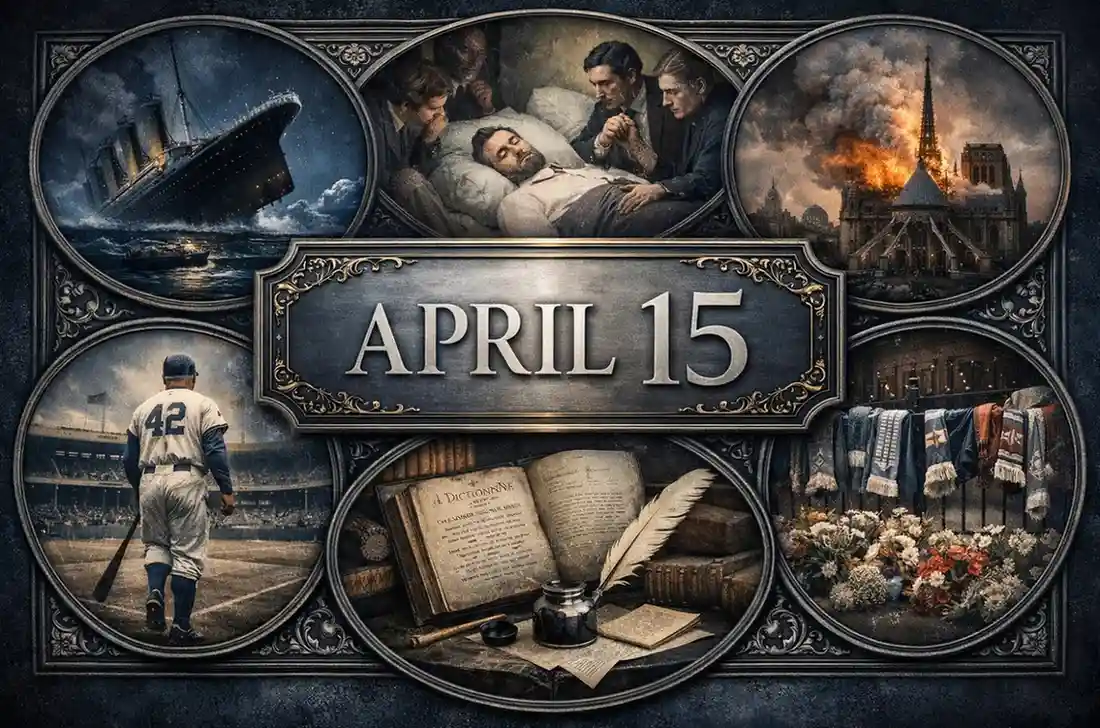
A review of what happened on this day in history April 15 brings us to a date of profound loss and transformative beginnings. From the final plunge of the RMS Titanic into the icy Atlantic to the passing of Abraham Lincoln, these moments have shaped the collective memory of the modern world. Such events serve as powerful reminders of human fragility and the enduring strength of the institutions and movements that arise from the ashes of tragedy.
Important Events That Happened On April 15 In History
769 – End of the Lateran Council
The Lateran Council concluded its sessions by officially condemning the earlier Council of Hieria and its controversial iconoclastic rulings. The gathered clergy issued an anathematization against those who sought to destroy religious imagery, reaffirming the veneration of icons within the Church. This decision marked a major theological victory for those defending traditional artistic expressions in Christian worship. It helped stabilize the religious landscape of the time and defined the official stance against the destruction of sacred art.
1071 – Fall of Bari
The city of Bari, which served as the final Byzantine possession in southern Italy, was officially surrendered to the Norman leader Robert Guiscard. This event followed a grueling three-year siege that effectively ended over five centuries of Byzantine presence on the Italian peninsula. The loss of the city signaled a permanent shift in regional power toward the rising Norman dynasties of the Mediterranean. It remains a significant milestone in the decline of Eastern Roman influence over the Western European territories.
1191 – Coronation of Henry VI
King Henry VI of Germany was officially crowned as the Holy Roman Emperor by Pope Celestine III during a grand ceremony in Rome. This elevation to the imperial throne allowed him to further his ambitions of uniting the German crown with the Kingdom of Sicily. His reign was characterized by a push for centralized power and an aggressive foreign policy across the European continent. The coronation finalized his status as one of the most powerful secular rulers of the medieval period.
1277 – Battle of Elbistan
The Mamluk Sultanate achieved a major military victory over the Mongol forces during the fierce Battle of Elbistan in Anatolia. Led by Sultan Baibars, the Mamluk army successfully engaged the Ilkhanate Mongol troops and their local allies, halting their regional expansion. This clash demonstrated the effectiveness of Mamluk tactical discipline against the previously dominant Mongol cavalry. The victory reasserted Islamic authority in the area and temporarily weakened the Mongol grip on the eastern frontiers of the Mediterranean.
1450 – Battle of Formigny
French forces launched a decisive attack on English troops during the Battle of Formigny, nearly annihilating the opposing army. This engagement occurred during the final stages of the Hundred Years’ War and utilized superior artillery to break the English defensive lines. The victory effectively ended English military domination in Northern France and paved the way for the liberation of Normandy. It is remembered as a pivotal moment that signaled the inevitable conclusion of the long-standing dynastic conflict.
1632 – Battle of Rain
Swedish forces under the command of King Gustavus Adolphus defeated the army of the Holy Roman Empire during the Thirty Years’ War. The Swedish victory at the River Lech allowed their military to advance deeper into Bavaria and secure a strategic advantage. During the engagement, the imperial commander Count Tilly was mortally wounded, depriving the Catholic League of its most experienced leader. This success further solidified the reputation of the Swedish king as a brilliant and revolutionary military tactician.
1642 – Battle of Kilrush
A Confederate Irish militia was routed during the Battle of Kilrush while attempting to block the advance of a Royalist Army. The clash was part of the wider Irish Confederate Wars and resulted in a significant victory for the government forces led by the Earl of Ormonde. Despite having superior numbers, the militia lacked the training and equipment to withstand the disciplined Royalist charge across the open terrain. This defeat hindered the efforts of the Irish Catholic confederacy to secure control over the Leinster region.
1715 – Pocotaligo Massacre
The Pocotaligo Massacre occurred when members of the Yamasee tribe attacked colonial officials and settlers in South Carolina, triggering the Yamasee War. This violent outbreak was the result of long-standing grievances regarding trade abuses, land encroachment, and the local slave trade. The conflict became one of the most serious threats to the survival of the British colonies in the American South during the eighteenth century. It led to a total realignment of tribal alliances and a restructuring of colonial Indian policy in the region.
1755 – Samuel Johnson’s Dictionary Published
Samuel Johnson’s landmark work, A Dictionary of the English Language, was officially published in London after years of intensive labor. This comprehensive volume provided clear definitions and literary examples for over 40,000 words, setting a new standard for English lexicography. It remained the preeminent English dictionary for over a century until the eventual completion of the Oxford English Dictionary. The publication is celebrated as a monumental achievement in the history of the English language and literary scholarship.
1817 – American School for the Deaf Founded
Thomas Hopkins Gallaudet and Laurent Clerc established the first American school for deaf students in Hartford, Connecticut. Originally known as the Connecticut Asylum for the Education and Instruction of Deaf and Dumb Persons, it pioneered specialized teaching methods. The institution introduced a standardized form of sign language that would eventually evolve into modern American Sign Language (ASL). Its founding represented a major advancement in the civil rights and educational opportunities for the deaf community in the United States.
1861 – Lincoln’s Call for Militia
President Abraham Lincoln issued a formal proclamation calling for 75,000 militiamen to quell the insurrection following the fall of Fort Sumter. This executive action signaled the federal government’s commitment to using military force to preserve the Union and enforce national laws. The call for troops prompted several more Southern states to secede, rapidly escalating the crisis into the full-scale American Civil War. This moment marked the end of peace and the beginning of the deadliest conflict in the nation’s history.
1865 – Passing of Abraham Lincoln
President Abraham Lincoln passed away early in the morning after being shot by John Wilkes Booth at Ford’s Theatre the previous night. His death plunged the nation into deep mourning just as the American Civil War was reaching its conclusion. Only three hours after the president expired, Vice President Andrew Johnson was officially sworn in as the 17th President of the United States. The loss of Lincoln’s leadership created a massive political vacuum that complicated the upcoming challenges of the Reconstruction era.
1892 – Formation of General Electric
The General Electric Company was officially formed through the merger of the Edison General Electric Company and the Thomson-Houston Electric Company. This corporate union brought together the innovations of Thomas Edison with the industrial strength of his primary competitors. The new entity became a dominant force in the global electrification movement, producing everything from light bulbs to massive power generators. Its creation helped accelerate the technological transformation of the modern industrial world and the widespread adoption of electricity.
1896 – Closing of the First Modern Olympics
The closing ceremony of the Games of the I Olympiad took place in Athens, Greece, marking the successful conclusion of the first modern international Olympic Games. Athletes from various nations competed in a series of events intended to revive the ancient spirit of sporting excellence and global cooperation. The success of the Athens games ensured that the Olympic movement would continue as a recurring international tradition. This event established the foundation for the massive global sporting spectacle that continues to unite the world today.
1912 – Sinking of the RMS Titanic
The RMS Titanic officially disappeared beneath the surface of the North Atlantic at 2:20 a.m., hours after striking a massive iceberg. Of the 2,224 passengers and crew on board, only 710 survived the frigid waters by securing places in the limited number of lifeboats. The tragedy resulted in the deaths of over 1,500 people, including some of the most prominent figures of the early twentieth century. The disaster led to immediate international reforms in maritime safety, including requirements for sufficient lifeboats and 24-hour radio monitoring.
1923 – Insulin Becomes Generally Available
Insulin became generally available for public use, providing a life-saving treatment for millions of people living with diabetes. Prior to this breakthrough, a diagnosis of the disease was often a death sentence due to the inability of the body to regulate blood sugar. The successful isolation and mass production of the hormone represented one of the most significant medical achievements in human history. This development transformed diabetes into a manageable chronic condition, allowing patients to lead long and productive lives.
1941 – The Belfast Blitz
During the height of the Second World War, some 200 bombers of the German Luftwaffe launched a devastating air raid on the city of Belfast. The attack targeted industrial areas and shipyards but caused widespread destruction across residential neighborhoods, killing approximately 1,000 people. This event was the deadliest air raid on a city outside of London during the entire German bombing campaign against the United Kingdom. The resilience of the local population in the aftermath of the “Belfast Blitz” became a symbol of national defiance.
1945 – Liberation of Bergen-Belsen
British military forces officially liberated the Bergen-Belsen concentration camp, discovering thousands of starving and diseased prisoners inside the wire. The soldiers found evidence of horrific atrocities and neglect that shocked the international community and the public at home. Among the victims who had perished at the camp shortly before the arrival of the Allied troops was the young diarist Anne Frank. The liberation provided the world with some of the first direct visual evidence of the extent of the Holocaust’s devastation.
1947 – Jackie Robinson’s Debut
Jackie Robinson made his historic debut for the Brooklyn Dodgers, officially breaking the long-standing color line in Major League Baseball. As the first African American player in the modern era, he faced intense scrutiny and racial hostility from fans and fellow athletes alike. His courage and exceptional performance on the field helped pave the way for the eventual integration of all professional sports in America. This event is celebrated as a major milestone in the broader struggle for civil rights and racial equality in the United States.
1952 – First Flight of the B-52
The Boeing B-52 Stratofortress successfully completed its first flight, introducing a massive long-range heavy bomber to the United States Air Force. Designed to carry nuclear weapons during the Cold War, the aircraft became a staple of American aerial power for decades. Its versatile design allowed it to be adapted for conventional bombing, cruise missile deployment, and maritime reconnaissance missions. Even after seventy years of service, the B-52 remains a primary component of the nation’s strategic bomber fleet due to its reliability.
1960 – Creation of the SNCC
Ella Baker led a historic conference at Shaw University that resulted in the creation of the Student Nonviolent Coordinating Committee (SNCC). This organization became one of the most influential and active groups during the Civil Rights Movement of the 1960s. It focused on grassroots organizing and student-led protests, such as sit-ins and voter registration drives across the segregated American South. The SNCC played a critical role in mobilizing young people to challenge systemic racism and advocate for legislative change.
1969 – EC-121 Shootdown Incident
North Korean fighter aircraft shot down a United States Navy EC-121 reconnaissance plane over the Sea of Japan, killing all 31 crew members. The incident occurred in international airspace and triggered a major diplomatic and military crisis between the two nations. The United States responded by mobilizing naval forces in the region but ultimately chose not to launch a retaliatory strike to avoid a wider war. This event highlighted the persistent tensions on the Korean Peninsula and the risks associated with Cold War surveillance missions.
1986 – Operation El Dorado Canyon
The United States launched a series of bombing raids against targets in Libya in a mission known as Operation El Dorado Canyon. The strikes were a direct response to a discotheque bombing in West Germany that had killed two American servicemen and was linked to Libyan state sponsorship. President Ronald Reagan authorized the mission to deter future acts of international terrorism and degrade Libya’s military infrastructure. The operation sparked intense international debate regarding the use of military force as a tool for counter-terrorism.
1989 – The Hillsborough Disaster
A fatal human crush occurred at Hillsborough Stadium during an FA Cup semi-final match between Liverpool and Nottingham Forest. Due to overcrowding and poor crowd management by the police, 97 Liverpool fans lost their lives and hundreds more sustained serious injuries. The tragedy led to a decades-long struggle for justice by the families of the victims to uncover the truth about the events. This disaster resulted in the Taylor Report, which mandated the removal of perimeter fencing and the introduction of all-seater stadiums in English football.
1989 – Tiananmen Square Protests Begin
The death of the reformist leader Hu Yaobang sparked the beginning of a massive student-led protest movement in Beijing’s Tiananmen Square. Demonstrators gathered to mourn his passing and call for greater political freedom, government transparency, and economic reforms in China. The protests grew in size and intensity over several weeks, attracting support from a wide cross-section of Chinese society. This movement eventually led to a violent military crackdown in June, which remains a deeply sensitive and significant event in modern Chinese history.
2013 – Boston Marathon Bombings
Two pressure-cooker bombs exploded near the finish line of the Boston Marathon, killing three people and causing injuries to more than 500 others. The attack triggered a massive multi-day manhunt that paralyzed the city of Boston and its surrounding suburbs. The perpetrators were eventually identified as two brothers who had been radicalized by extremist ideologies. This tragedy highlighted the persistent threat of domestic terrorism and led to a massive outpouring of community resilience known as “Boston Strong.”
2019 – Notre-Dame de Paris Fire
A catastrophic fire broke out in the attic of the Notre-Dame Cathedral in Paris, causing the iconic spire to collapse and destroying the historic oak roof. Firefighters worked through the night to save the main stone structure and the twin bell towers from total destruction. The event was watched by millions of people worldwide and triggered a massive international fundraising effort to restore the medieval masterpiece. The cathedral is currently undergoing a meticulous reconstruction process to return it to its former glory as a symbol of French heritage.
Read Also: This day in history April 14: Presidential Tragedy & Maritime Disaster
Famous People Born On April 15
| Name | Description | Date |
|---|---|---|
| Süleyman II | Ottoman sultan (1687–91) | April 15, 1642 – June 23, 1691 |
| Christian V | King of Denmark–Norway who consolidated absolutism | April 15, 1646 – August 25, 1699 |
| William Cullen | Scottish physician and innovative medical professor | April 15, 1710 – February 5, 1790 |
| Marie Camargo | French ballerina, pioneer of technical innovations | April 15, 1710 – April 20, 1770 |
| William Augustus, duke of Cumberland | British general, “Butcher Cumberland” | April 15, 1721 – October 31, 1765 |
| Étienne Geoffroy Saint-Hilaire | French naturalist, principle of “unity of composition” | April 15, 1772 – June 19, 1844 |
| Sir James Clark Ross | British naval explorer of Antarctic and Arctic | April 15, 1800 – April 3, 1862 |
| Hermann Günther Grassmann | German mathematician, developed vector calculus | April 15, 1809 – September 26, 1877 |
| John Lothrop Motley | American diplomat and historian of the Dutch Republic | April 15, 1814 – May 29, 1877 |
| Benjamin Jowett | British classical scholar, translator of Plato | April 15, 1817 – October 1, 1893 |
| Joseph Emerson Brown | Confederate governor of Georgia during Civil War | April 15, 1821 – November 30, 1894 |
| Wilhelm Busch | German painter and poet, precursor of the comic strip | April 15, 1832 – January 9, 1908 |
| Bliss Carman | Canadian regional poet of the Maritimes | April 15, 1861 – June 8, 1929 |
| Johannes Stark | German physicist, Nobel Prize for Stark effect | April 15, 1874 – June 21, 1957 |
| James Jackson Jeffries | American heavyweight boxing champion (1899–1905) | April 15, 1875 – March 3, 1953 |
| Sir David Ross | Scottish moral philosopher, critic of utilitarianism | April 15, 1877 – May 5, 1971 |
| Max Wertheimer | Czech-born psychologist, co-founder of Gestalt psychology | April 15, 1880 – October 12, 1943 |
| Stanley Melbourne Bruce | Prime Minister of Australia (1923–29) | April 15, 1883 – August 25, 1967 |
| Nikolay Stepanovich Gumilyov | Russian poet, founder of Acmeist movement | April 15, 1886 – August 24, 1921 |
| Thomas Hart Benton | American Regionalist painter and muralist | April 15, 1889 – January 19, 1975 |
| Nikolay Nikolayevich Semyonov | Soviet chemist, Nobel Prize for chemical kinetics | April 15, 1896 – September 25, 1986 |
| Gerhard Fieseler | German aviator and aircraft designer | April 15, 1896 – September 1, 1987 |
| Joe Davis | English snooker player, world champion (1927–46) | April 15, 1901 – July 10, 1978 |
| Arshile Gorky | American painter, link between Surrealism and Abstract Expressionism | April 15, 1904 – July 21, 1948 |
| Nikolaas Tinbergen | Dutch ethologist, Nobel Prize for animal behavior | April 15, 1907 – December 21, 1988 |
| Elizabeth Catlett | American-born Mexican sculptor and printmaker | April 15, 1915 – April 2, 2012 |
| Harold Washington | First African American mayor of Chicago (1983–87) | April 15, 1922 – November 25, 1987 |
| Anthony F.C. Wallace | Canadian-American psychological anthropologist | April 15, 1923 – October 5, 2015 |
| Neville Marriner | British conductor, founder of Academy of St. Martin in the Fields | April 15, 1924 – October 2, 2016 |
| Tomas Tranströmer | Swedish poet, Nobel Prize in Literature (2011) | April 15, 1931 – March 26, 2015 |
Famous People Died On April 15
| Name | Description | Date |
|---|---|---|
| Suiko | First reigning empress of Japan in recorded history | 554 – April 15, 628 |
| Godwine | Earl of Wessex, most powerful man in pre-Norman England | Unknown – April 15, 1053 |
| Manuel Chrysoloras | Greek scholar who pioneered Greek literature in the West | c.1350 – April 15, 1415 |
| Yamana Mochitoyo | Powerful Japanese feudal lord of the 15th century | June 26, 1404 – April 15, 1473 |
| Richard Mulcaster | English schoolmaster, pioneering educational theorist | c.1531 – April 15, 1611 |
| John Carver | First governor of Plymouth Colony | c.1576 – April 15, 1621 |
| George Calvert, 1st Baron Baltimore | English statesman, founder of Maryland colony | 1578/1579 – April 15, 1632 |
| Simon Dach | Prussian poet, leader of the Königsberg circle | July 29, 1605 – April 15, 1659 |
| Archibald Campbell, 3rd duke of Argyll | Scottish politician during early Hanoverian period | June 1682 – April 15, 1761 |
| Mikhail Lomonosov | Russian poet, scientist, and grammarian | November 19, 1711 – April 15, 1765 |
| Oliver Evans | American inventor of high-pressure steam engine | September 13, 1755 – April 15, 1819 |
| Hubert Robert | French painter, “Robert des Ruines” | May 22, 1733 – April 15, 1808 |
| Jacques Cassini | French astronomer, mapped Saturn’s satellites | February 18, 1677 – April 15, 1756 |
| Emma Willard | American educator, founder of Troy Female Seminary | February 23, 1787 – April 15, 1870 |
| Yap Ah Loy | Chinese leader who developed Kuala Lumpur | March 14, 1837 – April 15, 1885 |
| St. Damien of Molokai | Belgian priest who served Hawaiian lepers | January 3, 1840 – April 15, 1889 |
| Jules Dalou | French sculptor of allegorical and naturalist works | December 31, 1838 – April 15, 1902 |
| Benjamin Guggenheim | American industrialist, died on the Titanic | October 26, 1865 – April 15, 1912 |
| Thomas Andrews | Irish shipbuilder, chief designer of the Titanic | February 7, 1873 – April 15, 1912 |
| William Thomas Stead | British journalist, died on the Titanic | July 5, 1849 – April 15, 1912 |
| Joe Masseria | New York crime boss (early 1930s) | c.1887 – April 15, 1931 |
| Julia Clifford Lathrop | American social worker, first director of U.S. Children’s Bureau | June 29, 1858 – April 15, 1932 |
| César Vallejo | Peruvian poet, major voice of social change | March 16, 1892 – April 15, 1938 |
| Robert Musil | Austrian novelist, The Man Without Qualities | November 6, 1880 – April 15, 1942 |
| Aristarkh Vasilyevich Lentulov | Russian avant-garde painter | January 16, 1882 – April 15, 1943 |
| Giovanni Gentile | Italian philosopher, “philosopher of fascism” | May 29, 1875 – April 15, 1944 |
| Wallace Beery | American actor, over 250 films | April 1, 1885 – April 15, 1949 |
| Viktor Mikhaylovich Chernov | Founder of Russian Social Revolutionary Party | December 1, 1873 – April 15, 1952 |
| Emil Nolde | German Expressionist painter and printmaker | August 7, 1867 – April 15, 1956 |
| Frank Hyneman Knight | American economist, founder of Chicago school | November 7, 1885 – April 15, 1972 |
Observances & Institutional Dates
- Jackie Robinson Day (United States): A day dedicated to honoring the legacy of the man who integrated professional baseball on April 15, 1947.
- Hillsborough Disaster Memorial: A somber day of remembrance in Liverpool to honor the 97 fans who lost their lives in the 1989 stadium tragedy.
- World Art Day: An international celebration of the fine arts, held on the birthday of Leonardo da Vinci to promote creative activity worldwide.
- Tax Day (United States & Philippines): The official deadline for individual citizens to file their annual tax returns with the federal government.
Frequently Asked Questions
- When did the Titanic sink? The Titanic officially sank at 2:20 a.m. on April 15, 1912, after hitting an iceberg the previous evening.
- Who broke the color line in baseball on this day? Jackie Robinson made his debut for the Brooklyn Dodgers on April 15, 1947, ending racial segregation in the major leagues.
- What happened to Abraham Lincoln on April 15? President Lincoln died at 7:22 a.m. on April 15, 1865, from a gunshot wound sustained at Ford’s Theatre.
- Why do we celebrate World Art Day on April 15? The date was chosen to honor the birth of Leonardo da Vinci, a symbol of peace, freedom of expression, and multiculturalism.