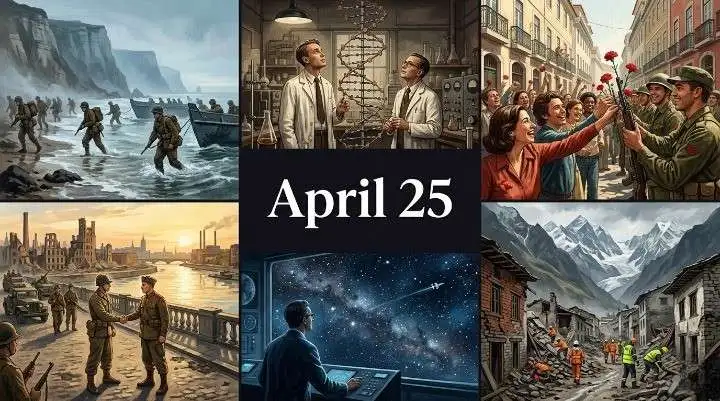
Captain Charles Bean stood on the deck of a transport ship in the pre-dawn darkness of April 25, 1915, watching thousands of young Australians and New Zealanders climb into rowing boats. They were heading toward the jagged cliffs of Gallipoli, unaware that the beach below was a death trap of Turkish machine guns. This day in history April 25 marks the birth of a national identity forged in fire, but it also saw humanity unlock the very code of life and a nation win back its soul through a peaceful coup. April 25 holds both the worst and the best of what we are. Here is what happened on April 25 in history.
📅 Quick Facts — April 25 in History
| 📌 Category | 📖 Event / Detail |
|---|---|
| ⚔️ Most Significant Event | Battle of Gallipoli begins (1915) |
| 🏆 Top 10 Key Events |
• Battle of Gallipoli — 1915 • Crick & Watson publish DNA structure — 1953 • UN founding negotiations begin — 1945 • Carnation Revolution, Portugal — 1974 • Elbe Day — US & Soviet troops meet — 1945 • First practical solar cell demonstrated — 1954 • Saint Lawrence Seaway opens — 1959 • ANZAC Day first commemorated — 1916 • Flint water crisis begins — 2014 • Samantha Smith invited to USSR — 1983 |
| ⚔️ Key Battles | Gallipoli/ANZAC Cove (1915); Battle of Hedgeley Moor (1464); Battle of Almansa (1707); Battle of Kapyong (1951); Battle of Marks’ Mills (1864) |
| 👤 Key Figures | Francis Crick, James Watson, Violeta Chamorro, Samantha Smith, Yuri Andropov |
| 🌍 Observances | ANZAC Day (Australia, NZ, Tonga); Freedom Day (Portugal); Liberation Day (Italy); World Malaria Day; Military Foundation Day (North Korea) |
Story of the Day: The Day the Sun Rose on the Double Helix
In a cramped laboratory in Cambridge, two men named Francis Crick and James Watson stood over a makeshift model of metal plates and wire. On April 25, 1953, they published their findings in the journal Nature, revealing the twisted ladder shape of DNA to a world that didn’t yet realize the revolution had begun. By identifying the double helix, they didn’t just find a molecule; they found the blueprint for every living thing on Earth. It was the moment biology moved from guesswork to a hard science, paving the way for everything from genetic testing to the cure for ancient diseases.
Important Events That Happened On April 25 In History
404 BC – Sparta Ends the Peloponnesian War
Admiral Lysander sailed his fleet into position around Athens and let hunger do the rest. After decades of on-and-off warfare that had exhausted the Greek world, the blockade finally broke Athenian resistance without a single decisive land battle. Athens surrendered, its Long Walls torn down to the sound of flutes. Sparta became the dominant power in Greece — though it would prove no better at running an empire than Athens had been. The war’s real legacy was a weakened Greek world, made vulnerable to the Macedonian rise that followed within decades.
775 – The Battle of Bagrevand Breaks Armenian Resistance
Armenian nobles had gambled on a rebellion against Abbasid rule, and on this day they lost. The defeat at Bagrevand wasn’t just a military setback — it ended a way of life. Leading nakharar families, the old Armenian aristocracy, fled west into Byzantine territory rather than face subjugation. The South Caucasus entered a new era, with Islam gradually replacing older religious and cultural structures across the region. Some of the refugee families would serve Byzantium for generations, their descendants rising to command armies and, in one case, an emperor’s throne.
799 – Pope Leo III Runs to Charlemagne
Someone in Rome had attacked the pope in the street — physically assaulting him and attempting, by some accounts, to gouge out his eyes and cut out his tongue. Leo III fled north across the Alps to the Frankish court at Paderborn. His appeal to Charlemagne set in motion one of the most consequential meetings in medieval history: Charlemagne would eventually travel to Rome to restore Leo, and Leo would crown him Emperor on Christmas Day 800. The relationship between papal authority and secular power — a tension that would define European politics for centuries — was forged right here, in one pope’s desperate flight from his own city.
1134 – Zagreb Gets Its Name
A single legal document, the Felician Charter, contains the earliest written mention of Zagreb — recording that a bishopric had been established there around 1094. The name appears almost in passing, as if the settlement needed no further introduction. That brevity tells us something: this was already a real place, with real people, long before any scribe thought to write it down. Zagreb today is the capital of Croatia, home to nearly a million people — all of whom can trace their city’s paper trail back to this one charter.
1464 – Battle of Hedgeley Moor, Wars of the Roses
Lord Montagu moved his Yorkist force north and met the Duke of Somerset’s Lancastrian army on open moorland near the River Breamish. Somerset’s left and right wings broke and fled almost immediately, leaving Sir Ralph Percy alone on the field. Percy refused to run. He was killed fighting, reportedly crying that he had saved the bird he wore on his badge — a reference to a vow he had made. His men remembered the line. The Lancastrian cause in Northumberland effectively ended here, though the Wars of the Roses had years of bloodshed still ahead.
1607 – Dutch Fleet Destroys Spain at Gibraltar
Eighteen Dutch warships sailed straight into the Bay of Gibraltar and attacked the Spanish fleet at anchor — an act of calculated audacity during the Eighty Years’ War. The Spanish had their sails furled, their powder not entirely ready. Within hours, twenty-one Spanish ships were destroyed or captured. The victory didn’t end the war, which had twenty more years to run, but it demonstrated that the Dutch Republic, barely three decades old, could project naval power across Europe. Control of Atlantic trade was shifting from Iberian hands to northern ones, and this battle was part of that long transfer.
1644 – China’s Last Ming Emperor Dies Alone on a Hill
The Chongzhen Emperor climbed Coal Hill behind the Forbidden City as rebel forces under Li Zicheng stormed Beijing below. He had already sent away his family, not wanting them captured. Alone except for one eunuch, he hanged himself from a tree. His final note, written on the hem of his robe, asked the rebels to spare the people and punish only him. It wasn’t the rebels who ultimately won: Manchu forces used the chaos to invade, and within months a new dynasty — the Qing — controlled China. It would rule for 268 years.
1707 – Almansa: France and Spain Win the Peninsula
A Franco-Spanish army under the Duke of Berwick met the allied forces of Britain, the Netherlands, and Portugal on the plains near Almansa, in eastern Spain. Berwick’s cavalry broke the allied flanks before their infantry could engage effectively, and what followed was a rout. Some 15,000 allied soldiers were killed or captured. The battle effectively secured the Bourbon Philip V on the Spanish throne — the same succession that had sparked the war in the first place. A Frenchman (Berwick, a bastard son of King James II of England) had won Spain for a Bourbon king. History’s ironies rarely come so neat.
1792 – The Guillotine’s First Use and France’s New Anthem, Same Day
Nicolas Pelletier, a highwayman, became the first person executed by guillotine in Paris — a machine specifically designed to make death equal across social classes, quick, and supposedly humane. The crowd reportedly booed: they felt cheated of the drawn-out spectacle they were used to. That same evening, a young army officer named Claude Joseph Rouget de Lisle sat down and wrote a marching song for troops heading to the front. He called it “War Song for the Rhine Army.” Soldiers from Marseille sang it as they marched into Paris weeks later, and the name changed to “La Marseillaise.” France got its anthem and its method of execution on the same spring day.
1829 – Fremantle Claims Western Australia
Captain Charles Fremantle arrived off the coast of what is now Western Australia in HMS Challenger, dropped anchor, and prepared to claim the territory for Britain. He was ahead of the main colonists by weeks, essentially holding the place. His name was given to the port city beside Perth — though the Indigenous Noongar people had been living across that coastline for tens of thousands of years before any British captain wrote their arrival in a logbook. The Swan River Colony was formally proclaimed on June 18, 1829, beginning a settlement history that was neither clean nor simple.
1846 – The First Shots of the Mexican-American War
A US patrol under Captain Seth Thornton crossed the Rio Grande into disputed territory and rode straight into a Mexican ambush. Sixteen Americans were killed or wounded, the rest taken prisoner. President Polk had been looking for a reason to press America’s claims over Texas; now he had one. Congress declared war within two weeks, citing American blood shed on American soil — though Mexico insisted the land wasn’t American at all. The war that followed took half of Mexico’s territory and drew the borders that still exist today. The “Thornton Affair” was the spark that reshaped a continent.
1849 – Montreal Burns Over a Signature
Lord Elgin, the Governor General of Canada, signed the Rebellion Losses Bill — a law compensating those who had suffered property damage in the 1837–38 rebellions, including some who had rebelled against British rule. English-speaking Tories in Montreal considered this outrageous. That evening, a mob attacked the Parliament building and burned it to the ground. Elgin’s carriage was pelted with eggs and stones as he left. The riots lasted for days. Parliament never returned to Montreal; the capital moved between cities until Ottawa was chosen permanently in 1857. A signature started a fire that changed Canada’s political geography.
1859 – The Suez Canal Breaks Ground
British and French engineers drove the first shovels into Egyptian sand at Port Said on April 25, 1859. A French diplomat named Ferdinand de Lesseps had spent years charming, lobbying, and occasionally bribing his way to this moment. The canal would take ten years and an estimated 1.5 million laborers to build, with death tolls that were never accurately counted. When it opened in 1869, it cut the sea route from Europe to India by roughly 7,000 kilometres. Every subsequent geopolitical struggle over that thin strip of water — Suez Crisis, 1956; Ever Given, 2021 — traces back to this first stroke of a shovel.
1862 – Farragut Demands New Orleans
Admiral David Farragut had already run his fleet past two Confederate forts at the mouth of the Mississippi in a night battle that should not have worked. Now he anchored below New Orleans and sent a messenger ashore demanding surrender. The city’s commander refused. Farragut sent the messenger again. New Orleans — the Confederacy’s largest city and most important port — fell within days without a direct assault. Losing it cut off a vital artery. Historians have argued it was one of the most decisive Union actions of the entire war, achieved largely by one admiral’s decision to sail through fire rather than wait.
1864 – Battle of Marks’ Mills: A Lopsided Disaster
Eight thousand Confederate soldiers caught a Union supply convoy northwest of Camden, Arkansas — 1,800 soldiers and hundreds of civilian wagon teamsters — and tore it apart. The Union force had almost no room to maneuver. By the end of the engagement, 1,500 Union combatants were killed or wounded, and the entire wagon train was captured. It was one of the most complete Confederate tactical victories of the Trans-Mississippi theater, yet it changed little strategically. The Confederacy couldn’t sustain its momentum; within a year, the war was over.
1882 – France Seizes Hanoi
Commandant Henri Rivière led a small column of French marine infantry up to the gates of Hanoi’s citadel and demanded it surrender. When the Vietnamese garrison refused, Rivière attacked with about 200 men and took the fortress. France had been expanding its foothold in Indochina for two decades; this was the moment it reached the north. The seizure triggered a wider conflict with China, which considered Vietnam a tributary state, and set off a war that lasted until 1885. French control of Indochina — the colony that would eventually produce Vietnam, Cambodia, and Laos — was cemented by this single morning’s aggression.
1898 – America Declares War on Spain
Congress voted to recognize that a state of war had existed between the United States and Spain since April 21, when the US Navy began blockading Cuba. The Spanish-American War lasted only four months but permanently altered global power. Spain lost Cuba, Puerto Rico, Guam, and the Philippines. The United States gained them — entering the 20th century as a Pacific as well as Atlantic power. What had begun as a humanitarian argument over Cuban independence ended with America running an overseas empire it had spent a century insisting it didn’t want.
1901 – New York Demands License Plates
New York became the first US state to require automobile license plates — though drivers had to make their own. The law specified that plates must display the owner’s initials, at least three inches tall. Some owners had their initials made in leather, others in brass. The fine for driving without one was $25 — significant money in 1901. It seems minor, but this was the first acknowledgment by any American government that cars needed regulating at all. Everything that followed — speed limits, traffic lights, emissions standards — began with New York deciding that a machine moving through public space had to be identified.
1915 – Gallipoli: The Landing That Built Two Nations
Before 4 AM on April 25, 1915, wooden boats scraped onto a beach that nobody had planned to land on — a navigational error had put the Anzac troops a mile off course, at the foot of steep ridges instead of gentler terrain. The Turks above opened fire. The Australians and New Zealanders climbed anyway, and by nightfall they had carved out a small, precarious perimeter. The campaign lasted eight months and failed to knock the Ottoman Empire out of the war. But the men who came ashore on that misnamed beach became the foundation of national identity for two young nations. Gallipoli made Australia and New Zealand.
1916 – Anzac Day Is Observed for the First Time
Exactly one year after the landing at Anzac Cove, memorial services were held across Australia, New Zealand, and wherever Anzac troops were serving. In London, a march of soldiers down the Mall was watched by thousands. In Cairo, men who had survived the previous year’s landing stood at parade. It wasn’t yet a public holiday — that came later — but the observance had already taken on the weight of something permanent. The decision to mark the date, not just mourn it privately, was made remarkably quickly. Grief, when it is shared and public, has a different texture than grief kept indoors.
1920 – The Middle East Gets Its Modern Shape at San Remo
Allied leaders meeting in the Italian Riviera town of San Remo divided the former Ottoman territories of the Middle East among themselves under League of Nations mandates. Britain took Iraq and Palestine; France took Syria and Lebanon. The populations living in these territories were not significantly consulted. The decisions made in San Remo created borders and political structures whose consequences are still being argued over — and fought over — a century later. If you want to understand the modern Middle East, a large part of the answer lies in a conference room in a seaside resort in 1920.
1933 – Nazi Germany Restricts Jewish Students
Germany’s new Nazi government passed the Law Against Overcrowding in Schools and Universities, formally capping the number of Jewish students permitted in public education. Jewish enrollment was to be reduced to match Jews’ proportion of the general population — roughly 1.5% — with even lower quotas in some districts. It was one of the first legal acts of systematic exclusion, arriving within months of Hitler taking power. Many German Jewish families still believed the measures would ease. They did not ease. The law was the first step in a process that, within a decade, aimed at eliminating Jewish life in Europe entirely.
1938 – The Supreme Court Rewrites Federal Law in One Opinion
Erie Railroad Co. v. Tompkins sounds dry, but it overturned 96 years of federal common law in a single decision. Before Erie, federal courts in diversity cases could apply their own sense of general common law — effectively making up rules as they went. After Erie, federal courts had to apply the law of the state where the case arose. Justice Louis Brandeis wrote that there was no such thing as general federal common law. Lawyers and law students still argue about what Erie fully means. What’s certain is that it changed how litigation works in America in ways too numerous to count.
1944 – The United Negro College Fund Is Born
On April 25, 1944, representatives from twenty-seven historically Black colleges and universities came together to incorporate the United Negro College Fund. Frederick D. Patterson, president of Tuskegee Institute, had proposed the idea: rather than each institution scrambling alone for donations, they would fundraise together. The first campaign raised $760,000 — more than any of them had managed separately. Over the following decades, the UNCF would put millions of students through college. Its motto, coined in 1972 — “A mind is a terrible thing to waste” — became one of the most recognized advertising lines in American history.
1945 – Four Events in One Day: The World Changes Shape
American and Soviet troops shook hands at Torgau on the River Elbe, cutting Nazi Germany physically in half — Elbe Day, the moment two great armies finally met after years of fighting toward each other across Europe. That same day in northern Italy, the National Liberation Committee declared a general uprising, beginning what Italians remember as Liberation Day. In San Francisco, delegates from fifty nations sat down to begin negotiating the Charter of the United Nations. And in Lapland, the last German soldiers crossed out of Finland, ending the Lapland War. April 25, 1945 was the day the old world ended and several possible new ones began.
1951 – Kapyong: Australians and Canadians Hold the Line
As Chinese forces pushed south in massive numbers during the Korean War’s spring offensive, two Commonwealth battalions — the 3rd Royal Australian Regiment and the 2nd Princess Patricia’s Canadian Light Infantry — were ordered to hold the Kapyong Valley long enough for the South Korean 6th Division to withdraw. They held for two days, at times surrounded, calling in artillery fire on their own positions when Chinese infantry breached the wire. The Chinese advance was halted. Both battalions received the US Presidential Unit Citation — one of the few times non-American units received the honor. Kapyong is barely known outside Australia and Canada; within those countries, it carries the weight of Gallipoli’s echo.
1953 – Watson and Crick Publish the Double Helix
A short paper in the journal Nature — under 900 words — described the structure of DNA for the first time. James Watson and Francis Crick at Cambridge had built their model using X-ray crystallography data, some of it produced by Rosalind Franklin whose contribution was not adequately credited. The final line of the paper noted, with monumental understatement, that the structure “immediately suggests a possible copying mechanism for the genetic material.” That copying mechanism is the engine of all life. Everything in modern biology — genetic medicine, forensic science, evolutionary research, the entire biotechnology industry — traces back to this brief paper in a scientific journal.
1954 – The First Practical Solar Cell
Bell Telephone Laboratories held a press demonstration in New York, showing off a silicon solar cell that could convert sunlight into electricity at roughly 6% efficiency — far beyond anything previously achieved. The New York Times called it “the beginning of a new era.” It was. Solar cells powered early satellites, then calculators, then slowly spread into homes and fields. Seven decades later, solar is the fastest-growing energy source on the planet. The researchers who stood in that Bell Labs room in 1954 couldn’t have imagined that the technology they were demonstrating would one day reshape the global energy economy.
1959 – The Saint Lawrence Seaway Opens
On April 25, 1959, the Saint Lawrence Seaway officially opened to shipping, connecting the Great Lakes to the Atlantic Ocean with a navigable channel that could accommodate oceangoing vessels. It had taken five years to build and required relocating entire communities. Ships from Europe could now sail directly to Chicago, Detroit, and Cleveland without transferring cargo. The seaway transformed the industrial economies of the Great Lakes basin — and complicated them, too, as invasive species hitched rides in ships’ ballast water and began spreading through ecosystems that had no defenses against them. Great engineering and unintended consequences tend to arrive together.
1960 – USS Triton Completes the First Submerged Circumnavigation
The nuclear submarine USS Triton surfaced in the Atlantic after 84 days underwater — having followed Ferdinand Magellan’s route around the globe without once surfacing. The journey had been classified; the crew didn’t know their mission’s full significance until it was over. Triton covered roughly 41,500 miles submerged, proving that nuclear submarines could operate indefinitely without coming up for air. The Cold War implications were obvious: these vessels could shadow enemy fleets, lurk off coastlines, and carry nuclear missiles — invisibly, indefinitely. The circumnavigation was a feat of endurance wrapped in a weapons demonstration.
1961 – The Integrated Circuit Gets Its Patent
Robert Noyce, working at Fairchild Semiconductor, received a patent for an integrated circuit — a single piece of semiconductor material containing multiple electronic components. Jack Kilby at Texas Instruments had demonstrated a similar device earlier, and a patent dispute was eventually settled by sharing credit. But the integrated circuit changed everything: it made computers smaller, cheaper, and faster at an exponential rate. The chip in your phone today contains billions of transistors; the first integrated circuits had a handful. Noyce would later co-found Intel. The patent granted on April 25, 1961 is one of the most economically significant documents of the 20th century.
1972 – Vietnam: The North Vietnamese Push Toward Kontum
North Vietnamese forces of the 320th Division struck South Vietnamese positions northwest of Kontum during the Nguyen Hue Offensive — known in the West as the Easter Offensive. Five thousand ARVN troops were forced to retreat; another 2,500 were cut off. The offensive, launched just weeks earlier, was the largest conventional North Vietnamese operation of the war. It failed to achieve its final objectives, partly due to American airpower, but it demonstrated that South Vietnam could not hold without US support. Nixon’s response — Linebacker II bombing campaigns — temporarily stabilized the front. But the writing was on the wall.
1974 – Portugal’s Carnation Revolution
Shortly after midnight on April 25, 1974, a radio station in Lisbon played a forbidden song — the signal for the Armed Forces Movement to begin. By morning, soldiers had occupied key points across Portugal. The Estado Novo regime, which had ruled the country with an iron hand for 48 years, collapsed without significant resistance. Remarkably, almost no one died. Civilians poured into the streets and began placing carnations in the soldiers’ rifle barrels — which is how the revolution got its name. Portugal became a democracy. Its African colonies — Angola, Mozambique, Guinea-Bissau — were granted independence within the year. A song and a flower ended nearly half a century of dictatorship.
1980 – Dan-Air Flight 1008 Crashes in Tenerife
A British Dan-Air charter flight approaching Los Rodeos Airport in Tenerife struck a mountain ridge while attempting to fly a holding pattern it had not been properly cleared to fly. All 146 people on board were killed. The investigation found that the crew had descended below the minimum safe altitude in an area of high terrain, confused by unclear air traffic control instructions. Aviation safety boards across Europe used the accident to tighten instrument approach procedures and phraseology standards. The passengers — mostly British tourists heading for a holiday — are remembered on the hillside where the aircraft came down.
1981 – Tsuruga: Japan’s Forgotten Nuclear Incident
During routine maintenance at the Tsuruga Nuclear Power Plant on Japan’s Honshu coast, radioactive waste water leaked and contaminated the facility. More than 100 workers were exposed to radiation; the full extent wasn’t disclosed publicly for weeks. Japan’s nuclear industry, already secretive about incidents, covered up the full details. Tsuruga-1 became a reference point in debates about nuclear transparency in Japan — debates that became far more urgent three decades later, in 2011, at Fukushima. The instinct to minimize and delay disclosure, rather than disclose fully and quickly, cost the industry credibility it never fully recovered.
1982 – Israel Returns the Sinai to Egypt
On April 25, 1982, Israel completed its withdrawal from the Sinai Peninsula — handing back territory it had seized in 1967 and held for 15 years. The withdrawal fulfilled the terms of the Camp David Accords negotiated by Jimmy Carter in 1978. Egypt’s President Sadat had been assassinated six months earlier specifically because he’d made peace with Israel; his successor Hosni Mubarak honored the agreement anyway. The Sinai handover remains one of the few successful territorial peace deals in the modern Middle East — an example that, under the right conditions, land-for-peace can actually work.
1983 – Samantha Smith Writes a Letter That the Kremlin Answers
A ten-year-old girl from Manchester, Maine, named Samantha Smith wrote a letter to Soviet leader Yuri Andropov asking why the USSR wanted war. She had watched the news and was frightened. Most such letters go unanswered. Andropov read this one and invited her to visit the Soviet Union personally. Samantha and her family traveled to the USSR that summer — her trip broadcast widely on both sides of the Iron Curtain. She was called “America’s Little Ambassador.” She died in a plane crash two years later, at age 13. The peace camps and scholarships created in her name outlasted the Cold War she feared.
1983 – Pioneer 10 Crosses Pluto’s Orbit
NASA’s Pioneer 10 spacecraft, launched in 1972, crossed the orbital path of Pluto on April 25, 1983 — becoming the first human-made object to travel beyond the orbits of all known planets in the solar system. It was still transmitting data. Scientists received its last faint signal in January 2003, by which time it was 12 billion kilometres from Earth. Pioneer 10 is now somewhere in the direction of the constellation Taurus, drifting through interstellar space with a gold plaque on its side — a diagram of human beings and where they came from, addressed to whoever might one day find it.
1990 – Violeta Chamorro: Nicaragua’s First Woman President
Violeta Chamorro took office in Managua on April 25, 1990, becoming the first woman to serve as president of Nicaragua — and, at the time, the first democratically elected female head of state in Latin American history. She had won a surprise election against the Sandinista incumbent Daniel Ortega, running as a symbol of reconciliation after years of civil war. Her government’s task was to disarm the Contras, rebuild an economy shattered by war and US sanctions, and hold together a country that had been fighting itself for a decade. She managed all three, at least in part. Her election was one of the Cold War’s quieter endings.
2001 – Bush Pledges to Defend Taiwan
In a television interview, President George W. Bush was asked whether the United States would defend Taiwan militarily if China attacked. Previous presidents had maintained studied ambiguity on the question. Bush said: “Yes, we will.” The statement shocked American foreign policy circles, and the White House spent the following days walking it back toward the traditional “strategic ambiguity” posture. Whether it was deliberate policy or an off-script moment, the pledge set a template for debates about US-Taiwan relations that became far more pointed in subsequent decades as China’s military power grew.
2004 – One Million March for Women’s Rights in Washington
Over one million people gathered on the National Mall in Washington, D.C. on April 25, 2004 — one of the largest demonstrations in American history. The March for Women’s Lives was a direct response to the Partial-Birth Abortion Ban Act signed in 2003 and other restrictions on reproductive healthcare. Organizers included major women’s health organizations. Participants came from across the country and from overseas. The march did not immediately change policy, but it demonstrated the depth of public feeling about reproductive rights and set the stage for the more acute political battles of subsequent decades.
2005 – Ethiopia’s Stolen Obelisk Comes Home
Italian forces had taken the Obelisk of Axum from Ethiopia in 1937 — looting a 1,700-year-old monument that stood 24 metres tall and weighed 160 tonnes as a trophy of Mussolini’s invasion. It had stood in Rome for 68 years. On April 25, 2005, the final section was flown back to Ethiopia and reunited with the pieces that had already been returned. Reinstalling it in Axum took five more years. The obelisk’s return was one of the first major instances of a Western nation repatriating a significant cultural artifact taken by colonial force — a precedent that museums and governments have been arguing about ever since.
2005 – The Amagasaki Train Disaster
A seven-car commuter train approaching Amagasaki Station in Hyogo Prefecture, Japan, was traveling too fast on a curve. The driver had already overshot a station and was trying to make up time. The train derailed and plowed into an apartment building at full speed. One hundred and seven people died, including the driver; nearly five hundred were injured. Investigators found that the driver — 23 years old — had been under intense pressure from his railway company’s disciplinary system, which punished delays harshly. Japan’s railways revised their safety culture significantly after Amagasaki. The disaster raised questions about whether a system optimized for punctuality had made safety secondary.
2005 – Bulgaria and Romania Join the EU
Bulgaria and Romania signed the Treaty of Accession 2005 on April 25 of that year, formally beginning the process of joining the European Union. Full membership came on January 1, 2007. The accession completed the EU’s largest-ever expansion and extended the bloc’s borders deep into the Balkans and Black Sea region. It was also controversial: critics in western EU states raised concerns about judicial systems, corruption levels, and the pace of democratic reforms. Both countries remained under special monitoring mechanisms for years after joining. The process illustrated how difficult it is to build European institutions across radically different political cultures.
2007 – Boris Yeltsin’s Funeral: An Orthodox Burial for a Head of State
Boris Yeltsin, the first president of post-Soviet Russia, died on April 23, 2007, and was buried on April 25 in Moscow’s Novodevichy Cemetery. His funeral was the first for a Russian head of state to be sanctioned by the Russian Orthodox Church since the burial of Tsar Alexander III in 1894 — over a century earlier. World leaders attended. Vladimir Putin, who owed his rise to Yeltsin’s patronage, gave a eulogy. The ceremony marked the symbolic end of an era that had begun when Yeltsin climbed on a tank outside the Russian parliament in August 1991. Whether that era was a success or a failure remains among Russia’s most contested questions.
2014 – Flint’s Water Crisis Begins
On April 25, 2014, city officials in Flint, Michigan switched the municipality’s water supply from Detroit’s treated system to the Flint River as a cost-saving measure. Within months, residents were complaining about the water’s color, smell, and taste. Tests would eventually confirm what residents had been saying all along: the water was leaching lead from aging pipes. Children were being poisoned. State officials, aware of the problem, did not act for months. The Flint water crisis became a defining example of environmental racism and institutional failure — a wealthy country allowing a majority-Black, low-income city to drink contaminated water while officials drafted memos about it.
2015 – Nepal Earthquake: 8,962 Dead
On April 25, 2015, a 7.8-magnitude earthquake struck Nepal at 11:56 AM local time, with its epicentre near Gorkha, northwest of Kathmandu. Buildings collapsed across the Kathmandu Valley; ancient temples and heritage sites were destroyed in seconds. At least 8,962 people were confirmed dead and nearly 22,000 injured. Entire villages in the mountains were buried under landslides. An aftershock seventeen days later killed hundreds more. The international response was large, but Nepal’s geography — narrow mountain roads, remote villages — made rescue operations extraordinarily difficult. Reconstruction took years and is still incomplete in some areas. The earthquake reshaped Nepal’s landscape, literally and politically.
Take A Look Back At April 24 Stories
Observances on April 25
Anzac Day — Observed in Australia, New Zealand, and Tonga, Anzac Day honours the soldiers who served and died in wars, with the landing at Gallipoli on April 25, 1915 at its heart. Dawn services, marches, and the Last Post are marked in towns and cities across both countries.
Freedom Day (Portugal) — April 25 is Portugal’s national day of democracy, marking the 1974 Carnation Revolution that ended 48 years of authoritarian rule. It is celebrated as a public holiday with marches and concerts.
Liberation Day (Italy) — Italy marks the 1945 uprising that drove German forces out of the country’s northern cities. It is a national holiday featuring military parades and public ceremonies.
World Malaria Day — Established by the World Health Assembly in 2007, World Malaria Day recognizes the global effort to prevent and control malaria, which still kills hundreds of thousands of people annually, predominantly children under five in sub-Saharan Africa.
Military Foundation Day (North Korea) — Marks the founding of North Korea’s Korean People’s Revolutionary Army.
Famous People Born On April 25
| Name | Description | Date |
|---|---|---|
| Conrad IV | German king (1237–54) and king of Sicily | April 25, 1228 – May 21, 1254 |
| Ezzelino III da Romano | Italian noble, podestà of Verona, Vicenza, and Padua | April 25, 1194 – October 1, 1259 |
| Gaston, duke d’Orléans | French prince, conspirator against Louis XIII’s ministers | April 25, 1608 – February 2, 1660 |
| Sir William Temple, Baronet | English statesman and diplomat | April 25, 1628 – January 27, 1699 |
| Richard Boyle, 3rd earl of Burlington | English architect, originator of Palladian style | April 25, 1694 – December 4, 1753 |
| Emmerich de Vattel | Swiss jurist, The Law of Nations | April 25, 1714 – December 28, 1767 |
| Augustus Keppel | English admiral and politician | April 25, 1725 – October 2, 1786 |
| Sir Marc Isambard Brunel | French-British engineer, solved underwater tunneling | April 25, 1769 – December 12, 1849 |
| Nicolas-Charles Oudinot, duc de Reggio | French marshal in Napoleonic Wars | April 25, 1767 – September 13, 1847 |
| John Keble | Anglican priest, poet, leader of Oxford Movement | April 25, 1792 – March 29, 1866 |
| Abdülmecid I | Ottoman sultan (1839–61), issued reform edicts | April 25, 1823 – June 25, 1861 |
| Sebastián Lerdo de Tejada | President of Mexico (1872–76) | April 25, 1827 – April 1889 |
| John Frank Stevens | American civil engineer, Panama Canal chief engineer | April 25, 1853 – June 2, 1943 |
| Edwin Robert Anderson Seligman | American economist, taxation expert | April 25, 1861 – July 8, 1939 |
| Walter de la Mare | British poet and novelist of ghostly tales | April 25, 1873 – June 22, 1956 |
| Félix d’Hérelle | French-Canadian microbiologist, discovered bacteriophage | April 25, 1873 – February 22, 1949 |
| Semyon Mikhaylovich Budenny | Soviet marshal, Red Army cavalry commander | April 25, 1883 – October 17, 1973 |
| Felix Klein | German mathematician, Erlanger Programm | April 25, 1849 – June 22, 1925 |
| William Brennan | Associate justice of U.S. Supreme Court (1956–90) | April 25, 1906 – July 24, 1997 |
| Meyer Fortes | British social anthropologist of West Africa | April 25, 1906 – January 27, 1983 |
| Karel Appel | Dutch painter, cofounder of COBRA group | April 25, 1921 – May 3, 2006 |
| Melissa Hayden | Canadian-born ballet dancer | April 25, 1923 – August 9, 2006 |
| Albert King | American blues guitarist and singer | April 25, 1923 – December 21, 1992 |
| Cy Twombly | American painter, draftsman, and sculptor | April 25, 1928 – July 5, 2011 |
| Paul Mazursky | American actor, writer, and director | April 25, 1930 – June 30, 2014 |
| Meadowlark Lemon | American basketball player, Harlem Globetrotter | April 25, 1932 – December 27, 2015 |
| Henck Arron | Prime minister of Suriname, led nation to independence | April 25, 1936 – December 4, 2000 |
| Ted Kooser | American poet, U.S. Poet Laureate (2004–06) | April 25, 1939 – Present |
| Jon Kyl | U.S. senator from Arizona | April 25, 1942 – Present |
| Vladislav Tretiak | Soviet ice hockey goaltender, considered greatest ever | April 25, 1952 – Present |
Famous People Died On April 25
| Name | Description | Date |
|---|---|---|
| Sancho IV | King of Castile and Leon (1284–95) | 1257 – April 25, 1295 |
| Benedict XII | Pope (1334–42), third Avignon pope | Unknown – April 25, 1342 |
| Antoku | 81st emperor of Japan, died in Battle of Dannoura | December 22, 1178 – April 25, 1185 |
| Naresuan | King of Siam (1590–1605), national hero of Thailand | 1555 – April 25, 1605 |
| Jacob van Heemskerck | Dutch naval commander and Arctic explorer | March 13, 1567 – April 25, 1607 |
| David Teniers, the Younger | Flemish Baroque painter of peasant life | December 15, 1610 – April 25, 1690 |
| Matthias Gallas, count von Campo | Austrian imperial general, Thirty Years’ War | September 16, 1584 – April 25, 1647 |
| Anders Celsius | Swedish astronomer, invented Celsius temperature scale | November 27, 1701 – April 25, 1744 |
| James Relly | Welsh Methodist minister, influenced Universalism | c.1722 – April 25, 1778 |
| William Cowper | English poet, precursor of Romanticism | November 26, 1731 – April 25, 1800 |
| William Beaumont | U.S. army surgeon, studied human digestion | November 21, 1785 – April 25, 1853 |
| Louis-Sébastien Mercier | French writer of middle-class drama | June 6, 1740 – April 25, 1814 |
| Daniel Maclise | Irish historical painter | January 25, 1806 – April 25, 1870 |
| Anna Sewell | British author, Black Beauty | March 30, 1820 – April 25, 1878 |
| Kawanabe Kyōsai | Japanese painter and caricaturist | May 18, 1831 – April 25, 1889 |
| Nathaniel Woodard | Anglican priest, founder of middle-class public schools | March 21, 1811 – April 25, 1891 |
| John Knowles Paine | American composer, first professor of music at U.S. university | January 9, 1839 – April 25, 1906 |
| Emmeline Blanche Woodward Wells | American Mormon leader and feminist | February 29, 1828 – April 25, 1921 |
| Ellen Key | Swedish feminist writer, “Pallas of Sweden” | December 11, 1849 – April 25, 1926 |
| Pyotr Nikolayevich, Baron Wrangel | Russian White general in Civil War | August 27, 1878 – April 25, 1928 |
| George Herriman | American cartoonist, creator of Krazy Kat | August 20, 1880 – April 25, 1944 |
| Vladimir Nemirovich-Danchenko | Russian cofounder of Moscow Art Theatre | December 23, 1858 – April 25, 1943 |
| Wilhelm Dörpfeld | German archaeologist of Greek architecture | December 26, 1853 – April 25, 1940 |
| Fuad Chehab | President of Lebanon (1958–64) | 1902 – April 25, 1973 |
| Ishibashi Tanzan | Prime minister of Japan (1956–57) | September 25, 1884 – April 25, 1973 |
| Carol Reed | British film director, The Third Man | December 30, 1906 – April 25, 1976 |
| David Merrick | American theatrical producer | November 27, 1911 – April 25, 2000 |
| Alan Sillitoe | British writer, Angry Young Man | March 4, 1928 – April 25, 2010 |
| Jane Jacobs | American-born Canadian urbanist and writer | May 4, 1916 – April 25, 2006 |
| John Havlicek | American basketball player, Boston Celtics legend | April 8, 1940 – April 25, 2019 |
📅 Frequently Asked Questions — April 25 in History
On April 25, 1915, Allied forces — primarily Australian and New Zealand troops — landed on the Gallipoli Peninsula in Ottoman Turkey as part of a campaign to knock the Ottoman Empire out of World War I. The landing was made at the wrong beach due to a navigational error, under heavy fire. The campaign lasted eight months and ended in Allied withdrawal, but the date became foundational to the national identities of Australia and New Zealand.
By sheer historical impact, the Gallipoli landing of 1915 is the most globally remembered event. But the double helix publication of 1953 — Watson and Crick describing the structure of DNA — may have the deeper long-term significance, having launched modern biology, medicine, and biotechnology.
Oliver Cromwell, the English military and political leader who overthrew the monarchy and ruled as Lord Protector of England, was born on April 25, 1599. Guglielmo Marconi, the inventor of radio, was born on April 25, 1874.
April 25 has seen more than its share of military history: the Gallipoli landing (1915), the Battle of Kapyong in Korea (1951), the Carnation Revolution’s bloodless coup in Portugal (1974), and the Dutch destruction of Spain’s fleet at Gibraltar (1607). The day Sparta ended the Peloponnesian War (404 BC) also falls on April 25.
Anzac Day marks the anniversary of the April 25, 1915 landing at Gallipoli, where Australian and New Zealand Army Corps soldiers came ashore under fire during World War I. The campaign failed militarily, but the bravery of the troops became the founding story of both nations’ military identity. It is now the most solemn public holiday in Australia and New Zealand, observed with dawn services and marches.
In 2015, a magnitude 7.8 earthquake struck Nepal, killing nearly 9,000 people and destroying large parts of the Kathmandu Valley. In 2014, Flint, Michigan switched its water supply to the Flint River, beginning a contamination crisis that poisoned thousands of residents with lead. In 2005, the stolen Obelisk of Axum was returned to Ethiopia after 68 years in Rome.