The archives of our past show a mix of ancient lore and modern science, and looking at this day in history April 24 reveals how much our world has changed through a few key events. From the legendary end of the Trojan War to the moment the Hubble Space Telescope first reached orbit, these milestones mark the long path from old-world stories to our current understanding of the stars.
Important Events That Happened On April 24 In History
1479 BC – Accession of Thutmose III
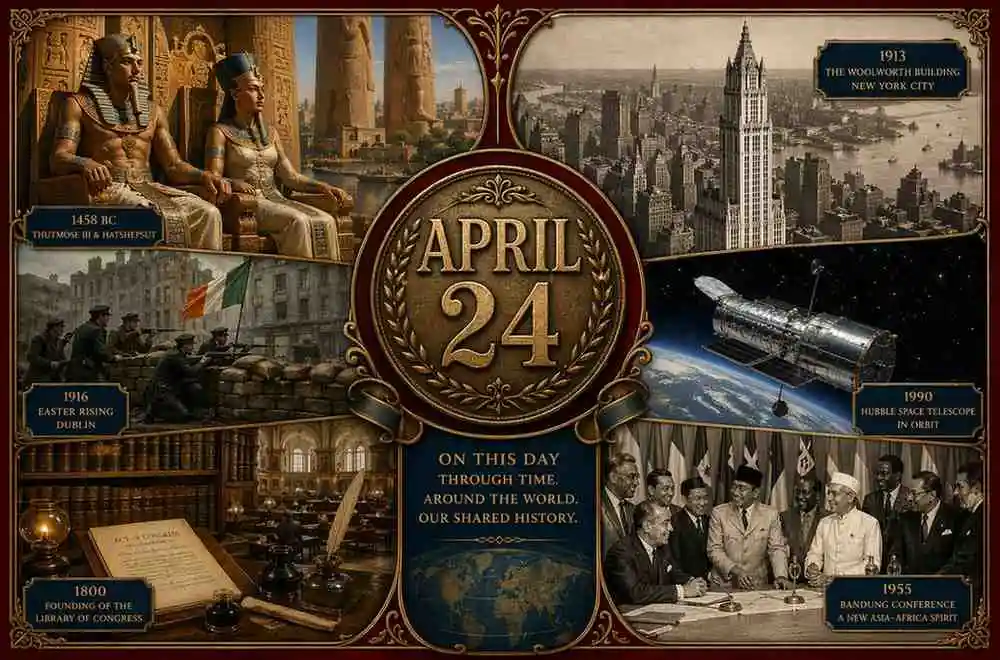
Thutmose III ascended to the throne of Egypt as the sixth pharaoh of the Eighteenth Dynasty. According to the Low Chronology, actual power effectively shifted to his stepmother Hatshepsut. This co-regency created a unique political dynamic that defined the early years of his rule. He later became known for his military genius and the vast expansion of the Egyptian Empire.
1183 BC – Traditional Fall of Troy
Chief librarian Eratosthenes of Alexandria provided the traditional reckoning for the Fall of Troy. This date marks the legendary end of the Trojan War between the Greeks and the Trojans. The event is central to classical mythology and has inspired countless works of literature. Historical debates continue regarding the physical reality of the city and the specific conflict.
858 – Consecration of Pope Nicholas I
Pope Nicholas I was officially consecrated following the death of Pope Benedict III earlier that month. His papacy was defined by his strong stance on the authority of the Roman Catholic Church. He worked to strengthen the power of the papacy over secular rulers and local bishops alike. His leadership influenced the legal and spiritual direction of the Western Church for centuries.
934 – Deposition of Al-Qahir
Abbasid Caliph Al-Qahir was deposed and blinded following a period of political instability. His nephew al-Radi succeeded him as the new caliph to lead the Islamic state in Baghdad. The event highlighted the growing influence of military commanders over the caliphate’s office. This transition of power was a significant moment in the decline of central Abbasid authority.
1547 – Battle of Mühlberg
The Duke of Alba led the Spanish-Imperial forces of Charles I to victory at the Battle of Mühlberg. The troops successfully defeated the forces of the Schmalkaldic League in a decisive engagement. This victory helped the Emperor re-establish control over the rebellious Protestant princes. The battle remains a major milestone in the religious and political wars of the Reformation.
1558 – Marriage of Mary, Queen of Scots
Mary, Queen of Scots, married the Dauphin of France, François, at Notre-Dame de Paris. The union was a strategic alliance intended to unite the French and Scottish thrones. Mary became the Queen consort of France a year later when her husband succeeded to the throne. This marriage played a critical role in the complex dynastic politics of 16th-century Europe.
1704 – First Regular Newspaper in America
The Boston News-Letter was published as the first regular newspaper in British Colonial America. It provided the colonists with a consistent source of local and international news from London. The paper was a pioneer in the development of the American press and commercial advertising. Its successful publication marked the beginning of a new era for information sharing in the colonies.
1793 – Acquittal of Jean-Paul Marat
French revolutionary Jean-Paul Marat was acquitted by the Revolutionary Tribunal in Paris. The Girondin faction had brought charges against him in an attempt to curb his radical influence. His release was celebrated by the common people and weakened the position of his political rivals. This acquittal signaled the rising power of the Jacobins during the French Revolution’s peak.
1800 – Establishment of the Library of Congress
President John Adams signed legislation to appropriate $5,000 for the Library of Congress. The funds were used to purchase books that were necessary for the official use of Congress. This founding act established what would become the largest library in the entire world. It started with a small collection housed in the Capitol before expanding into its own buildings.
1837 – Great Fire of Surat
A devastating fire broke out in the city of Surat in India, causing widespread destruction. The blaze resulted in more than 500 deaths and the total loss of more than 9,000 houses. This disaster was one of the most catastrophic fires in the history of the Indian subcontinent. The event forced a significant rebuilding of the city and a review of urban planning and safety.
1877 – Russo-Turkish War Begins
The Russian Empire officially declared war on the Ottoman Empire following tensions in the Balkans. The conflict was driven by Russian support for Slavic independence and a desire for territory. This declaration launched a series of military campaigns that shifted the map of Eastern Europe. The war eventually led to the liberation of several nations and the decline of Ottoman power.
1885 – Annie Oakley Hired
Nate Salsbury hired American sharpshooter Annie Oakley to join Buffalo Bill’s Wild West. She became one of the show’s most famous stars and an icon of the American frontier spirit. Her incredible skill with firearms amazed audiences across the United States and Europe. This hiring was a major turning point in her career, making her a global household name.
1895 – Joshua Slocum Sets Sail
Joshua Slocum set sail from Boston aboard the sloop Spray to begin a historic voyage. He was the first person to attempt a single-handed circumnavigation of the entire world. The journey took more than three years and covered over 46,000 miles across the oceans. His success became a landmark achievement in the history of solo sailing and navigation.
1913 – Woolworth Building Opens
The Woolworth Building in New York City officially opened as the world’s tallest skyscraper. Designed by Cass Gilbert, the structure was hailed as a “Cathedral of Commerce” for its beauty. It held the title of the tallest building for seventeen years until the completion of 40 Wall Street. This architectural milestone signaled the start of the modern skyscraper boom in Manhattan.
1914 – Franck–Hertz Experiment Presented
The Franck–Hertz experiment was presented to the German Physical Society as a pillar of science. The results provided direct evidence for the quantized nature of energy levels in atoms. This presentation was a fundamental step in the development of modern quantum mechanics. The researchers eventually received the Nobel Prize in Physics for their groundbreaking work.
1915 – Arrest of Armenian Intellectuals
The arrest of 250 Armenian intellectuals in Istanbul marked a dark chapter in global history. This event is recognized as the beginning of the Armenian genocide under Ottoman rule. Community leaders and thinkers were targeted in an effort to silence the Armenian voice. The date is commemorated annually as a day of remembrance for the victims of the atrocities.
1916 – Launch of the Easter Rising
Irish rebels led by Patrick Pearse and James Connolly launched an uprising in Dublin. They proclaimed the establishment of an Irish Republic and seized key buildings in the city. The rebellion was a direct challenge to British rule in Ireland during World War I. Though suppressed, the event sparked the movement that led to Irish independence years later.
1916 – Shackleton’s Lifeboat Launch
Ernest Shackleton and five men launched a lifeboat from the uninhabited Elephant Island. They intended to sail across the Southern Ocean to organize a rescue for their stranded crew. This daring voyage in the James Caird is considered one of the greatest feats of seamanship. The mission was a desperate attempt to save the survivors of the sunken ship Endurance.
1918 – First Tank-to-Tank Combat
The first tank-to-tank combat in history occurred during the Second Battle of Villers-Bretonneux. Three British Mark IV tanks encountered three German A7V tanks on the Western Front. This engagement demonstrated a new phase of armored warfare during the First World War. It set the precedent for future military strategies involving direct combat between armored vehicles.
1922 – Imperial Wireless Chain
The first segment of the Imperial Wireless Chain came into operation on this calendar date. It provided wireless telegraphy between Leafield in Oxfordshire and the city of Cairo, Egypt. This technology allowed for faster communication across the vast British Empire without cables. The system revolutionized how government and commercial messages were sent internationally.
1924 – Thorvald Stauning Becomes Premier
Thorvald Stauning began his first term as the premier of Denmark to lead the government. He was the first Social Democrat to hold the office, marking a shift in Danish politics. His leadership helped establish the foundations of the modern Danish welfare state. He remained a dominant figure in the nation’s political landscape for several decades.
1926 – Treaty of Berlin Signed
Germany and the Soviet Union signed the Treaty of Berlin to confirm their diplomatic ties. Each nation pledged to remain neutral if the other was attacked by a third party. The agreement was set to last for five years and sought to prevent international isolation. It was a major strategic move for both governments following the end of the Great War.
1932 – Mass Trespass of Kinder Scout
Benny Rothman led a mass trespass of Kinder Scout in the Peak District of England. The protest was organized to demand the “right to roam” on private land for the public. This event led to significant legal reforms and the creation of National Parks in Britain. It remains a celebrated moment in the history of civil disobedience and land access rights.
1933 – Persecution of Jehovah’s Witnesses
Nazi Germany began its systematic persecution of Jehovah’s Witnesses on this specific date. The government shut down the Watch Tower Society office in the city of Magdeburg. Members of the faith were targeted for their refusal to pledge total allegiance to the state. This action was an early step in the broader campaign against religious and social minorities.
1944 – SBS Raid on Santorini
The Special Boat Service launched a daring raid against the German garrison of Santorini. The mission took place in occupied Greece as part of the broader Allied effort in the Aegean. The raid was intended to disrupt enemy communications and gather intelligence on the island. This operation demonstrated the effectiveness of specialized naval forces during World War II.
1953 – Winston Churchill Knighted
Winston Churchill was knighted by Queen Elizabeth II at Buckingham Palace in London. The honor recognized his historic leadership of the United Kingdom during World War II. He became a Knight of the Garter, the highest order of chivalry in the British system. This event took place during his second term as the nation’s Prime Minister.
1955 – Bandung Conference Ends
The Bandung Conference ended after twenty-nine non-aligned nations finished their meeting. The leaders of Asia and Africa gathered to condemn colonialism, racism, and the Cold War. This summit led to the development of the Non-Aligned Movement in global politics. It was a landmark event for the voice of the developing world on the international stage.
1957 – Suez Canal Reopens
The Suez Canal was officially reopened to international shipping following the Suez Crisis. The reopening was made possible by the introduction of UNEF peacekeepers to the region. The canal had been blocked for months by sunken ships during the military conflict. This restoration of the waterway was critical for the flow of global trade and oil supplies.
1963 – Marriage of Princess Alexandra
Princess Alexandra of Kent married Angus Ogilvy at Westminster Abbey in London. The royal wedding was attended by the Queen and numerous international dignitaries. The couple’s union was a major social event in Britain during the early 1960s. Princess Alexandra continued her role as a working member of the British Royal Family.
1965 – Civil War in the Dominican Republic
Civil war broke out in the Dominican Republic following a military and social uprising. Colonel Francisco Caamaño overthrows the triumvirate that had held power since the coup. The conflict sought to restore the democratically elected president Juan Bosch to office. The situation eventually led to a major military intervention by the United States.
1967 – Death of Vladimir Komarov
Cosmonaut Vladimir Komarov died when the parachute of his Soyuz 1 craft failed to open. He became the first human to lose his life during an active space mission in history. The tragedy occurred during re-entry following a mission plagued by technical difficulties. His death was a somber milestone for the Soviet space program during the space race.
1967 – Westmoreland News Conference
American General William Westmoreland spoke at a news conference regarding the Vietnam War. He claimed that the enemy had gained support in the U.S. to hope for a political win. The general argued that the military struggle was being undermined by domestic opposition. These comments highlighted the growing divide in American public opinion over the conflict.
1970 – China Enters the Space Age
China launched its first satellite, Dong Fang Hong I, into orbit using its own booster. This success made China the fifth nation to achieve independent orbital capability. The satellite broadcast the patriotic song “The East is Red” as it circled the planet. This milestone signaled China’s arrival as a major player in global aerospace technology.
1970 – The Gambia Becomes a Republic
The Gambia officially became a republic within the Commonwealth of Nations on this day. Dawda Jawara was inaugurated as the first President of the newly formed republic. The transition marked the end of the nation’s status as a constitutional monarchy. This development was a final step in the country’s journey toward full sovereignty.
1979 – Death of Blair Peach
New Zealand teacher and activist Blair Peach died following a protest in Southall, London. He was knocked unconscious during a demonstration against a National Front meeting. His death triggered a national outcry regarding police tactics and racial tensions in Britain. The event led to a long-running campaign for justice and reforms in public policing.
1980 – Operation Eagle Claw
Eight U.S. servicemen died during the failed mission known as Operation Eagle Claw. The secret operation was an attempt to end the Iran hostage crisis and rescue the captives. A collision between a helicopter and a transport plane caused the fatal disaster in the desert. The failure had significant political consequences and led to a redesign of special operations.
1990 – Launch of Hubble Space Telescope
The Hubble Space Telescope was launched into orbit from the Space Shuttle Discovery. The mission, designated STS-31, placed the advanced observatory above the Earth’s atmosphere. Hubble has provided some of the most detailed and iconic images of the distant universe. This launch changed the field of astronomy and our understanding of the cosmos forever.
1990 – Gruinard Island Declared Clean
Gruinard Island in Scotland was officially declared free of the anthrax disease. The island had been under strict quarantine for 48 years following biological tests. A massive decontamination effort successfully removed the lethal spores from the soil. This declaration allowed for the eventual return of the land to public and private use.
1993 – Bishopsgate IRA Bombing
An IRA truck bomb devastated the Bishopsgate area of London’s financial district. the explosion caused massive structural damage to buildings and several injuries. This attack was one of the largest bombings in the history of the Northern Ireland conflict. It led to the creation of the “Ring of Steel” security measures in the city of London.
1994 – DC-3 Ditching in Botany Bay
A Douglas DC-3 aircraft ditched into Botany Bay shortly after taking off from Sydney Airport. The pilot performed a successful water landing after the plane suffered an engine failure. Remarkably, all 25 people on board survived the accident without any life-threatening injuries. The event is remembered as a testament to the skill of the crew and the durability of the plane.
1996 – Antiterrorism Act Passed
The Antiterrorism and Effective Death Penalty Act of 1996 was passed into law in the U.S. The legislation was a response to the Oklahoma City bombing and the World Trade Center attack. It introduced new restrictions on habeas corpus and expanded the power of federal law enforcement. This act significantly impacted the legal landscape of criminal justice and national security.
2004 – Libya Sanctions Lifted
The United States officially lifted economic sanctions that had been imposed on Libya. This move rewarded the nation for its cooperation in eliminating weapons of mass destruction. The sanctions had been in place for 18 years following tensions and acts of terrorism. The lifting of the measures marked a major shift in the diplomatic relations between the two.
2005 – Inauguration of Pope Benedict XVI
Cardinal Joseph Ratzinger was inaugurated as the 265th Pope of the Catholic Church. He took the name Pope Benedict XVI following his election in the papal conclave. The ceremony in Rome was attended by millions of faithful and hundreds of world leaders. His papacy focused on traditional doctrine and the theological foundations of the faith.
2006 – Dahab Resort Bombings
A series of bombings struck the Egyptian resort city of Dahab, killing 23 people. The attacks targeted popular tourist spots during a busy holiday period in the region. This violence was part of a larger trend of attacks against tourism in the Sinai Peninsula. The Egyptian government responded with increased security and crackdowns on extremist groups.
2011 – WikiLeaks Guantanamo Files
WikiLeaks began publishing a massive leak of files related to the Guantanamo Bay prison. The documents provided a detailed look at the treatment and status of the detainees held there. This publication triggered international debate over the legality and ethics of the facility. The leak was one of the largest disclosures of classified military information in history.
2013 – Rana Plaza Collapse
A commercial building known as Rana Plaza collapsed near Dhaka, Bangladesh, killing 1,134. The disaster was one of the deadliest industrial accidents in history, injuring 2,500 more. The building housed several garment factories that produced clothing for global brands. This tragedy sparked an international movement for better labor safety and worker rights.
2013 – Bachu County Violence
Violence broke out in Bachu County in the Xinjiang region of China, resulting in 21 deaths. The conflict involved clashes between local residents and government security forces. This event highlighted the ongoing ethnic and political tensions in the western province. The Chinese government labeled the incident as a terrorist act by extremist groups.
2025 – Nantes School Stabbing
A mass stabbing occurred at a school in Nantes, France, leaving one person dead. Three other victims were wounded in the attack, which shocked the local community. Emergency services responded quickly to the scene to provide medical aid and security. This event led to a national discussion regarding safety in educational institutions.
Famous People Born On April 24
| Name | Description | Date |
|---|---|---|
| Sir Thomas Lucy | English squire, possible model for Shakespeare’s Justice Shallow | April 24, 1532 – July 7, 1600 |
| Xu Guangqi | Chinese Ming dynasty official, influential Christian convert | April 24, 1562 – November 8, 1633 |
| John Graunt | English statistician, founder of demography | April 24, 1620 – April 18, 1674 |
| Giovanni Battista Martini | Italian composer and music theorist | April 24, 1706 – August 3, 1784 |
| Eleazar Wheelock | American educator, founder of Dartmouth College | April 22, 1711 – April 24, 1779 |
| Edmund Cartwright | British inventor of the power loom | April 24, 1743 – October 30, 1823 |
| John Trumbull | American poet, leader of Hartford Wits | April 24, 1750 – May 11, 1831 |
| Thomas Addis Emmet | Irish lawyer, leader of United Irishmen | April 24, 1764 – November 14, 1827 |
| Jean-Marc-Gaspard Itard | French physician, worked with “wild boy of Aveyron” | April 24, 1774 – July 5, 1838 |
| Peter Vivian Daniel | Associate justice of U.S. Supreme Court (1841–60) | April 24, 1784 – May 31, 1860 |
| Karl Leberecht Immermann | German dramatist and novelist | April 24, 1796 – August 25, 1840 |
| Marie Taglioni | Italian ballet dancer, Romantic era icon | April 23, 1804 – April 24, 1884 |
| Walthère Frère-Orban | Prime minister of Belgium (1868–70, 1878–84) | April 24, 1812 – January 1, 1896 |
| Anthony Trollope | English novelist, Barsetshire series | April 24, 1815 – December 6, 1882 |
| Jean-Charles Galissard de Marignac | Swiss chemist, atomic weights and isotopes | April 24, 1817 – April 15, 1894 |
| Klaus Groth | German regional poet in Low German (Plattdeutsch) | April 24, 1819 – June 1, 1899 |
| Janko Král’ | Slovak poet and revolutionary | April 24, 1822 – May 23, 1876 |
| R.M. Ballantyne | Scottish adventure writer, The Coral Island | April 24, 1825 – February 8, 1894 |
| Carl Spitteler | Swiss poet, Nobel Prize in Literature (1919) | April 24, 1845 – December 29, 1924 |
| Marcus Clarke | English-born Australian novelist, His Natural Life | April 24, 1846 – August 2, 1881 |
| Joseph-Simon Gallieni | French military officer, pacified Madagascar | April 24, 1849 – May 27, 1916 |
| Erich Raeder | German naval commander in chief (1928–43) | April 24, 1876 – November 6, 1960 |
| Hugh Caswall Tremenheere Dowding, 1st Baron Dowding | British air chief marshal, Battle of Britain | April 24, 1882 – February 15, 1970 |
| Sir Stafford Cripps | British chancellor of the exchequer (1947–50) | April 24, 1889 – April 21, 1952 |
| Benjamin Lee Whorf | American linguist, Whorfian hypothesis | April 24, 1897 – July 26, 1941 |
| Manuel Ávila Camacho | President of Mexico (1940–46) | April 24, 1897 – October 13, 1955 |
| José Antonio Primo de Rivera, marqués de Estella | Spanish fascist leader, founder of Falange | April 24, 1903 – November 20, 1936 |
| Robert Penn Warren | American poet and novelist, first U.S. poet laureate | April 24, 1905 – September 15, 1989 |
| George Oppen | American Objectivist poet | April 24, 1908 – July 7, 1984 |
| Sue Grafton | American mystery writer, alphabet series | April 24, 1940 – December 28, 2017 |
Famous People Died On April 24
| Name | Description | Date |
|---|---|---|
| Saint Mellitus of Canterbury | First bishop of London, third archbishop of Canterbury | Unknown – April 24, 624 |
| Saint Wilfrid | English saint, bishop, and monastic founder | 634 – April 24, 709 |
| Garcilaso de la Vega | Spanish chronicler of Incas and South America | April 12, 1539 – April 24, 1616 |
| Concino Concini, marquis d’Ancre | Italian adventurer, dominated French government under Louis XIII | Unknown – April 24, 1617 |
| John Stewart, 4th earl of Atholl | Scottish Roman Catholic noble, supporter of Mary, Queen of Scots | Unknown – April 24, 1579 |
| Eugene of Savoy | Austrian field marshal and statesman | October 18, 1663 – April 24, 1736 |
| Fredrik Axel von Fersen | Swedish soldier and politician, leader of Hat Party | April 5, 1719 – April 24, 1794 |
| Grigory Orlov | Russian military officer, lover of Catherine the Great | October 17, 1734 – April 24, 1783 |
| Nicolas Pineau | French wood-carver and Rococo interior designer | October 8, 1684 – April 24, 1754 |
| Franciszek Bohomolec | Polish dramatist and linguistic reformer | January 29, 1720 – April 24, 1784 |
| Johann Peter Frank | German physician, pioneer in public health | March 19, 1745 – April 24, 1821 |
| James T. Fields | American publisher and author | December 31, 1817 – April 24, 1881 |
| Heinrich Leo | Prussian conservative historian | March 17, 1799 – April 24, 1878 |
| Gabriele Rossetti | Italian poet and scholar, father of Dante Gabriel Rossetti | February 28, 1783 – April 24, 1854 |
| Vasily Andreyevich Zhukovsky | Russian poet, precursor of Pushkin | February 9, 1783 – April 24, 1852 |
| Léonard-Sylvain-Julien Sandeau | French novelist | February 19, 1811 – April 24, 1883 |
| Crowfoot | Blackfoot chief, advocate of peace with whites | c.1836 – April 24, 1890 |
| Helmuth von Moltke | Prussian field marshal, architect of German unification wars | October 26, 1800 – April 24, 1891 |
| Norodom | King of Cambodia (1860–1904), placed country under French control | 1834 – April 24, 1904 |
| Richard James Oglesby | Governor of Illinois and U.S. senator | July 25, 1824 – April 24, 1899 |
| G. Stanley Hall | American psychologist, founder of child psychology | February 1, 1844 – April 24, 1924 |
| Felix Adler | American educator, founder of Ethical Movement | August 13, 1851 – April 24, 1933 |
| Paul Shorey | American classical scholar | August 3, 1857 – April 24, 1934 |
| Finley Peter Dunne | American humorist, creator of Mr. Dooley | July 10, 1867 – April 24, 1936 |
| George Grey Barnard | American sculptor, collector for the Cloisters | May 24, 1863 – April 24, 1938 |
| Karin Boye | Swedish modernist poet and novelist | October 26, 1900 – April 24, 1941 |
| Willa Cather | American novelist of frontier life | December 7, 1873 – April 24, 1947 |
| Hendrik Anthony Kramers | Dutch physicist, light absorption and dispersion | December 17, 1894 – April 24, 1952 |
| Gerhard Domagk | German bacteriologist, Nobel Prize for Prontosil | October 30, 1895 – April 24, 1964 |
| T.V. Soong | Chinese financier and Nationalist official | December 4, 1894 – April 24, 1971 |
Observances & Institutional Dates
- Armenian Genocide Remembrance Day: A day of commemoration in Armenia and several other nations for the victims of the 1915 atrocities.
- Republic Day (The Gambia): A public holiday marking the day in 1970 when the nation officially became a republic.
- National Panchayati Raj Day (India): A day of recognition for the decentralized local government system in the Republic of India.
- World Day for Laboratory Animals: An international day focused on the welfare and protection of animals used in scientific research.
Frequently Asked Questions
- What happened on April 24, 1916?
The Easter Rising began in Dublin as Irish rebels proclaimed an independent republic and seized control of the city. - Why is the launch of the Hubble Space Telescope significant?
It provided the first high-resolution look at the distant universe from above the Earth’s atmosphere on April 24, 1990. - What is Armenian Genocide Remembrance Day?
It commemorates the arrest of Armenian intellectuals in 1915, which is considered the start of the genocide. - When did the first regular newspaper in America start?
The Boston News-Letter began regular publication on April 24, 1704.