Imagine standing on a lonely cliffside in ancient Greece, watching a bonfire ignite on a distant peak. You know exactly what that spark means—the enemy has been spotted, and the news must travel over a hundred miles before sunrise. Today, we pull a glass rectangle from our pockets to send a message across the globe in a millisecond, but for most of human history, silence was the default. How did people communicate before phones without the luxury of instant connection? The answer reveals a world of ingenuity, grit, and surprisingly complex systems that kept empires alive.
The Ancient Art of Sending Messages on Foot
The oldest method was also the most exhausting. Messenger runners carried news, letters, and commands on foot — sometimes across enormous distances.
In ancient Persia around 500 BCE, Cyrus the Great created one of the world’s first organised relay systems. Fresh runners were stationed at regular intervals along major roads, each one carrying a message to the next post before handing it off. The Greek historian Herodotus described it in admiring terms: neither snow, nor rain, nor heat, nor night could stop them. (Sound familiar? That phrase eventually inspired the motto of the United States Postal Service — though nobody officially adopted it.)
The Inca Empire in South America built their own version called the chasqui system. Young runners stationed in small huts along mountain roads would sprint full speed to the next hut the moment a message arrived. Using this relay method, news could travel roughly 1,500 miles along the Andes in just five days.
For ordinary people though, none of this was available. If you were a peasant in medieval England and you needed to get word to someone in the next village, you walked there yourself — or you found someone who happened to be heading that way.
How Written Letters Crossed Empires
The moment writing was invented, humans started sending it to each other. And the systems that grew up around letter delivery were surprisingly sophisticated.
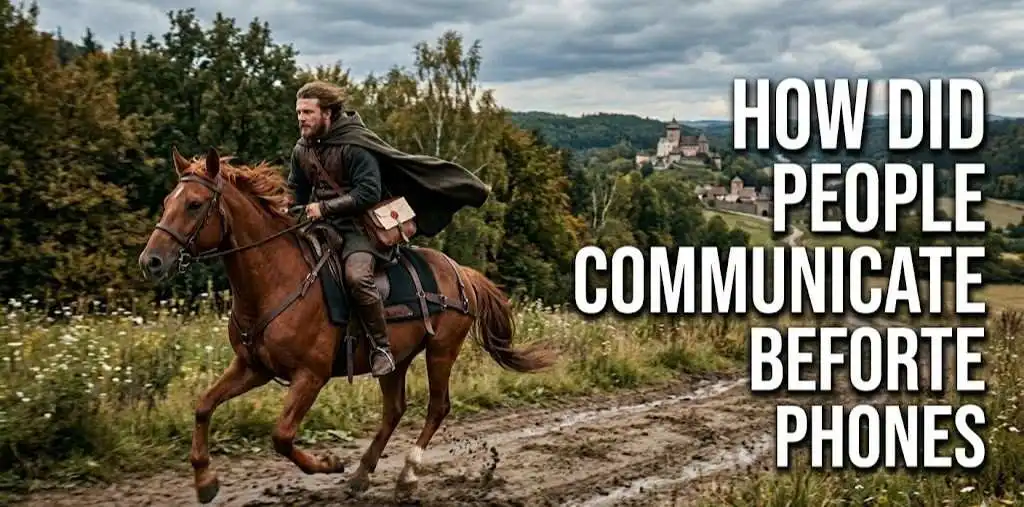
Rome’s cursus publicus, established by Augustus Caesar around 20 BCE, was an empire-wide postal service available to government officials and military commanders. Horses were stationed at relay points every fifteen to twenty miles, allowing official messages to travel at a speed of about 50 miles per day — fast enough that news of a crisis in Britain could reach Rome within two weeks.
In the medieval Islamic world, the Barid postal system used both horses and homing pigeons and covered territories stretching from Spain to Central Asia. By the 13th century, the Egyptian Mamluk Sultanate was running one of the world’s most efficient pigeon post networks, with trained birds that could fly 90 miles in a single day.
Regular people couldn’t access any of this, of course. If you wanted to send a letter, you paid a travelling merchant to carry it, or you waited for a family member making the same journey. Letters were precious, rare objects — often read aloud to whole households because so few people could read at all.
Drums, Smoke, and Fire: Communication Across Open Landscapes
Written language didn’t suit every landscape or every people. Across Africa, the Americas, and Indigenous Australia, communities developed brilliant systems for sending messages through sound and light.
The talking drums of West and Central Africa are one of the most sophisticated examples. These instruments — called dundun in Yoruba culture or ntumpane among the Akan people — could mimic the tonal patterns of spoken language. A skilled drummer could transmit complex messages across several miles, and those messages would be relayed by drummers in the next village, then the next. The system effectively worked like a telegraph network, centuries before the telegraph existed.
Smoke signals were used across North America, China, and the ancient Mediterranean. The Great Wall of China employed smoke beacons from as early as the 3rd century BCE, with watchtower soldiers lighting fires to signal the number and direction of incoming invaders. Different amounts of smoke meant different things — one column might mean a small force was approaching, several columns meant a major attack.
Here’s what strikes you when you think about it: these weren’t crude, primitive solutions. They were precisely calibrated, community-maintained systems that generations of people trained their whole lives to operate.
The Surprising Sophistication of Medieval Town Criers
Before mass literacy, information spread through people whose entire job was to shout it loudly in public squares.
Town criers were official civic employees, not wandering gossips. In medieval and early modern England, they held a legal role — proclamations delivered by a town crier had the same official weight as a printed notice. They rang a bell, called “Oyez! Oyez! Oyez!” (from the Old French word for “hear ye”), and then delivered news from the monarch, the local council, or the merchant guilds.
The word “news” itself comes partly from this world. Before newspapers, “news” was something spoken aloud — a story arriving in town on someone’s lips. The phrase “by word of mouth” used to carry far more weight than it does today.
In towns across Europe, news also spread through church bells. The number of peals, the rhythm, the time of day — all of these carried coded meaning that locals understood instinctively. A fast, urgent ring meant danger. A slow toll marked a death. A joyful peal announced a birth or a royal event. For anyone living within earshot of a church tower, this was essentially a local broadcasting system.
Optical Telegraphs: The Victorian Internet Nobody Talks About
Most people assume communication technology jumped straight from letters on horseback to the electric telegraph in the 1840s. But there was a remarkable chapter in between that almost nobody remembers.
In 1794, a French engineer named Claude Chappe built the world’s first optical telegraph network across France. Towers were constructed on hilltops roughly ten miles apart, each one equipped with a mechanical arm system called a semaphore. Operators would arrange the arms into different positions — 98 possible configurations — to send coded messages. A trained observer in the next tower would read the configuration and repeat it, passing the message along the chain.
At its peak, the French semaphore network covered over 3,000 miles, with more than 500 stations. A message could travel from Paris to Toulon — roughly 500 miles — in about 12 minutes. Napoleon used this network extensively for military coordination. It was, in every meaningful sense, a telegraph — just one powered by human eyes and muscles instead of electricity.
Britain built its own version, and at one point there was a semaphore line running from London to Portsmouth specifically to relay news between the Admiralty and the naval fleet. The whole system became obsolete almost overnight when the electric telegraph arrived. But for fifty years, it was the fastest long-distance communication technology on Earth.
How Ordinary People Actually Kept in Touch
For most of human history, the vast majority of people communicated using none of these grand systems. No imperial post. No semaphore towers. Just the fabric of daily community life.
Villages were dense social environments where information moved constantly through gossip, market-day conversation, and shared community events. The local inn or tavern was effectively a news exchange — merchants, travellers, and pilgrims brought stories from distant places and traded them over a meal.
The rise of coffeehouses in 17th-century England and the Islamic world created a new kind of public information space. London’s coffeehouses from the 1650s onwards were buzzing hubs of political news, commercial gossip, and intellectual debate. Lloyds of London — the famous insurance market — started as a coffeehouse on Tower Street where shipping merchants gathered to share news of voyages at sea.
The wealthy communicated through personal correspondence carried by private servants. A well-connected aristocratic family in 18th-century England might exchange hundreds of letters a year — their letters were carefully preserved, sealed with wax, and often read by multiple people at either end. Ordinary labourers communicated almost entirely by being physically present together.
When the Penny Post Changed Everything
The moment communication stopped being a luxury and became available to ordinary people is surprisingly specific. It happened in Britain on January 10, 1840.
That was the day Rowland Hill’s Uniform Penny Post came into effect, making it possible for anyone in Britain to send a letter anywhere in the country for one penny, regardless of distance. Before this reform, postage was paid by the recipient, not the sender — and it was expensive. A typical letter might cost the equivalent of a day’s wages for a working-class person. Naturally, only the wealthy wrote letters regularly.
The Penny Post triggered an explosion of written communication. In the first year after the reform, letter volume in Britain nearly doubled. By 1850, it had increased fivefold. For the first time in history, a factory worker in Manchester could afford to write to a sister in London.
This is the moment that really shifted something deep in human society — not the invention of the telephone, which came later. The Penny Post made communication democratic. Everything that followed — the telegraph, the telephone, the internet — was building on that foundationm
📡 Key Methods Compared: Speed and Reach Through History
| 📨 Method | 📅 Era | ⚡ Speed | 👥 Who Could Use It | 🗺️ Maximum Range |
|---|---|---|---|---|
| Foot messenger relay | 500 BCE – 1800s | ~100–150 miles/day | Rulers & military | Empire-wide |
| Pigeon post | 1200s – 1900s | ~60–90 miles/day | Military & government | Hundreds of miles |
| Talking drums | Prehistory – present | Miles per minute (relay) | Community-wide | Hundreds of miles via relay |
| Horse-mounted post | 1500s – 1840s | ~50 miles/day | Those who could pay | National |
| Optical semaphore | 1794 – 1850s | 500 miles in 12 minutes | Government & military | National networks |
| Penny Post (letter) | 1840 onward | 1–3 days nationwide | Everyone | National, then global |
📬 Frequently Asked Questions
It could take months, or even years, depending on the route. Letters between Europe and the colonies often relied on sailing ships, meaning communication was at the mercy of storms, winds, and whether the ship actually survived the journey.
Generally, no. Signal fires were massive, expensive, and often illegal to use without government permission because they were strictly reserved for military alerts. Misusing them could often lead to severe punishment or death.
The biggest barrier was the lack of a standardized infrastructure. Because there was no universal postal system for most of history, messages had to rely on private arrangements, luck, and the willingness of travelers to carry news from one place to another.
For the majority of history, communication for the illiterate was almost entirely oral. People relied on town criers, traveling bards, sermons in church, and local gossip to stay informed about events happening in the wider world.
A Final Thought on the Lost Art of Patience
We live in a world of instant gratification where a missing text message feels like a crisis. Looking back at how our ancestors connected, we find a strange comfort in their limitations. They didn’t have the luxury of constant availability, but they developed a deep, focused patience that we have largely traded away. Their messages had to be worth the journey, and their news was awaited with a genuine anticipation that is impossible to replicate in our modern, hyper-connected landscape. The human drive to reach out and touch someone—whether through a plume of smoke on a mountain or a carefully penned letter—remains the same, regardless of the tools we use.
If this made you curious about how daily life functioned in the past, you might also enjoy reading about How Did People Travel Before Cars: The Tough Reality.