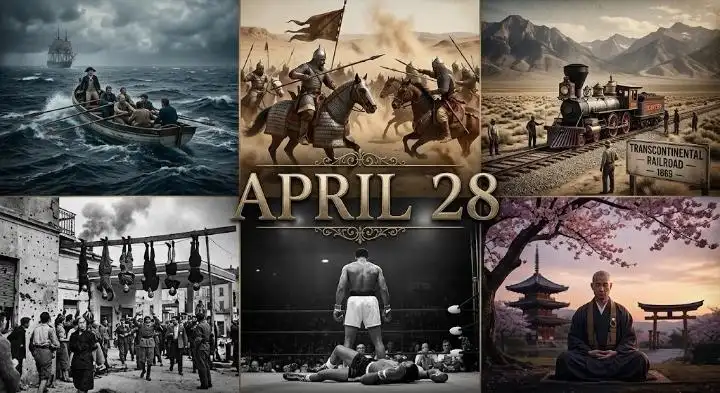
In the grey pre-dawn of April 28, 1789, Lieutenant William Bligh was dragged from his bunk by men he had commanded for months. They set him adrift in a small open boat with 18 loyal sailors — nowhere near enough food, no charts, no certainty of survival. The rebels on the Bounty pointed the ship toward Tahiti. Bligh, astonishingly, sailed 3,600 miles to safety. April 28 carries echoes of that same volatile mix: loyalty broken, power seized, consequences lasting centuries. From an ancient battlefield in Persia to the end of a fascist dictator dangling from a Milan petrol station, this date rarely sat still. Here is what happened on this day in history April 28 — and why it still matters.
🏴☠️ Quick Facts — April 28 in History
| 📌 Category | 📖 Event / Detail |
|---|---|
| 🌟 Most Significant Event | Mutiny on the Bounty (April 28, 1789 — traditionally associated with the April 25 entry cycle); Mussolini’s execution (April 28, 1945) is the single most searched event for this date range |
| 🏆 Key Events |
• Battle of Hormozdgan — 224 • Conrad of Montferrat assassinated — 1192 • Battle of Cerignola — 1503 • Mutiny on the Bounty — 1789 • Billy the Kid escapes — 1881 • Wembley Stadium opens — 1923 • Exercise Tiger disaster — 1944 • Mussolini shot — 1945 • Pink Floyd’s Dark Side hits No. 1 — 1973 • Chernobyl disaster revealed — 1986 • Port Arthur massacre — 1996 |
| ⚔️ Key Battles | Battle of Hormozdgan (224), Battle of Cerignola (1503), Battle of Attock (1758), Exercise Tiger WWII rehearsal attack (1944) |
| 👤 Key Figures | Ardashir I, Conrad of Montferrat, Napoleon Bonaparte, Billy the Kid, Benito Mussolini, Muhammad Ali, Charles de Gaulle, Thor Heyerdahl, Aldrich Ames |
| 🌍 Observances | Mujahideen Victory Day (Afghanistan), National Heroes Day (Barbados), Restoration of Sovereignty Day (Japan), Sardinia Day (Sardinia), Workers’ Memorial Day / World Day for Safety and Health at Work (international), National Day of Mourning (Canada), Ed Balls Day |
Story of the Day: Mussolini Shot Dead at Lake Como (1945)
By April 28, 1945, Benito Mussolini was no longer a dictator — he was a fugitive. German forces were collapsing across northern Italy, and Mussolini had tried to slip into Switzerland hidden inside a German military convoy. Italian partisans stopped the column near Lake Como. Walter Audisio, a resistance fighter, pulled him out of a German coat he’d borrowed to hide his face. Mussolini reportedly said very little. Audisio shot him and his mistress Clara Petacci outside a lakeside villa in Giulino di Mezzegra.
The next morning their bodies, along with other executed fascist officials, were hung upside down from the roof of a petrol station on Piazzale Loreto in Milan — the same square where fifteen partisans had been shot and displayed the previous year. For many Italians, the image closed a brutal chapter. For historians, it remains one of the most visceral endings of any 20th-century regime.
Important Events That Happened On April 28 In History
224 – The Battle of Hormozdgan: End of the Parthian Empire
Near the Hormozdgan plain in what is now Iran, two armies met to decide who ruled Persia. Ardashir I, a regional lord from Fars who had been expanding his territory for years, brought his forces against Artabanus V, the Parthian emperor who had ruled a vast empire stretching from the Euphrates to central Asia. Artabanus was killed in the fighting — one of those rare battles where the ruler himself dies on the field. With him went the Parthian dynasty that had checked Rome for three centuries. Ardashir went on to found the Sasanian Empire, which became Rome’s most formidable rival for the next four hundred years.
357 – Constantius II Enters Rome
Emperor Constantius II rode into Rome on April 25, 357 — his first visit to the capital despite having ruled the empire for decades. He came to celebrate victory over the usurper Magnus Magnentius, a Gallic general who had seized the western empire years earlier. Rome staged its grandest ceremonial triumph: crowds, chariots, gilded troops. But the city that had once defined empire was already peripheral — Constantius governed from Milan and Constantinople. He reportedly craned his neck at the Forum and the Colosseum like a tourist, marvelling at scale he had never seen. He never returned.
1192 – Conrad of Montferrat Assassinated in Tyre
Two days after election as King of Jerusalem, Conrad of Montferrat stepped out in Tyre and was stabbed twice by two men who had spent weeks gaining his trust. The killers were Hashshashin — members of the Nizari Ismaili sect whose leader, Rashid ad-Din Sinan, operated from the Syrian mountains. Conrad had been a ferocious defender of the Crusader states, holding Tyre against Saladin when almost every other city had fallen. His death threw the succession into crisis; within days, his widow Isabella was remarried to Henry II of Champagne to stabilize the kingdom. Who ordered the assassination — Sinan acting alone, Richard I of England, or Saladin — was disputed then and remains disputed now.
1253 – Nichiren Proclaims Namu Myōhō Renge Kyō
On a hilltop in Awa Province, Japan, a Buddhist monk named Nichiren turned east toward the rising sun and chanted Namu Myōhō Renge Kyō for the first time. He declared it the essential teaching of Buddhism — the invocation of the Lotus Sutra distilled to a single phrase anyone could recite. His government had him arrested, exiled twice, and nearly executed before he died. Nichiren Buddhism survived and spread; today tens of millions of people worldwide practice traditions tracing back to that morning chant. In Japan, his followers built one of the most politically influential Buddhist movements of the 20th century.
1294 – Temür Elected Khagan of the Mongols
When Kublai Khan died in February 1294, the question of succession was genuinely uncertain. Three months later, on April 25, the Mongol kurultai (assembly of nobles) elected Temür, Kublai’s grandson, as Khagan with the title Oljeitu. He was 35, untested as a ruler, and inherited the largest land empire in history. Temür proved a consolidator rather than a conqueror: he stopped the endless military campaigns that had drained the empire and focused on administration. The peace that followed his accession, however brief, allowed trade on the Silk Road to flourish — and goods, ideas, and plague to move freely between continents.
1503 – The Battle of Cerignola: Gunpowder Changes Everything
On a dusty plain outside the town of Cerignola in southern Italy, the Spanish commander Gonzalo de Córdoba did something almost no European general had done before: he dug in and let the enemy come to him, trusting arquebusiers to hold a defensive line. The French cavalry and Swiss pikemen who charged that line were mown down by gunpowder weapons before they could close. France lost the Kingdom of Naples that day. Military historians mark Cerignola as the first battle in European history decided primarily by small-arms fire — the moment that made the armoured knight obsolete and pointed toward every infantry battle that followed over the next five centuries.
1611 – University of Santo Tomas Founded in Manila
Dominican friars established a college in Manila on April 25, 1611, that would grow into the Pontifical and Royal University of Santo Tomas — now the largest Catholic university in the world by enrolment, with over 40,000 students. Founded 25 years before Harvard, it remains the oldest existing university in Asia. Its founding was part of the Spanish colonial project in the Philippines, designed to train clergy and produce a literate Catholic elite. Centuries later, it became a centre of Philippine intellectual and nationalist life — and its alumni include José Rizal’s contemporaries and generations of Filipino professionals, lawyers, and physicians.
1625 – Spain and Portugal Move to Retake Bahia
A joint fleet of 52 Spanish and Portuguese warships began operations to retake the Brazilian port of Salvador de Bahia on April 25, 1625, after the Dutch West India Company had seized it the previous year. The Dutch garrison had hoped to hold the city as a base for attacking the Portuguese sugar economy in Brazil. They could not: the combined Iberian fleet was one of the largest expeditionary forces assembled in the Americas at that time, and the Dutch surrendered within weeks. Brazil stayed Portuguese — and remained the economic heart of the Portuguese empire — for another two centuries.
1738 – The Pope Bans Freemasonry
Pope Clement XII issued the papal bull In Eminenti on April 25, 1738 — the first formal Catholic prohibition of Freemasonry. His stated objections were several: the lodges welcomed men of all religions, they swore their members to secrecy, and they operated outside Church oversight. The ban was not merely religious; there was deep political anxiety about secretive associations that met across national and class lines. The prohibition was repeated by multiple popes and remains technically in force. It did not stop Freemasonry from spreading throughout Europe and the Americas — nor from counting kings, presidents, and founding fathers among its members.
1758 – Marathas Defeat the Afghans at Attock
At the fortress of Attock on the Indus River, Maratha forces under Raghunath Rao defeated an Afghan garrison and captured the city on April 25, 1758. It was the high-water mark of Maratha expansion northward — they had marched from the Deccan to the Khyber Pass, a distance of over a thousand miles, and effectively expelled Afghan influence from the Punjab. Three years later, at the Third Battle of Panipat, Ahmad Shah Durrani would reverse all of it. The Maratha push to Attock remains one of the most audacious military campaigns in 18th-century South Asia, remembered in the Maratha tradition as proof of what the confederacy could achieve at its peak.
1788 – Maryland Ratifies the U.S. Constitution
Maryland became the seventh state to ratify the United States Constitution on April 25, 1788, by an overwhelming vote of 63 to 11. Nine states were needed to make the document operational; Maryland’s comfortable majority gave the ratification movement real momentum after harder fights in other states. The debate in Maryland reflected the wider national argument: Anti-Federalists worried about a too-powerful central government and the absence of a Bill of Rights, while Federalists argued the existing Articles of Confederation were simply unworkable. Maryland’s ratification came just weeks before South Carolina and New Hampshire — the decisive ninth state — would follow.
1789 – Mutiny on the Bounty
On the morning of April 28, 1789, Fletcher Christian and a group of armed sailors entered Lieutenant William Bligh’s cabin on HMS Bounty and seized the ship. Bligh and 18 men loyal to him were put into a 23-foot open boat in the middle of the Pacific with minimal supplies. What followed was one of the most extraordinary open-ocean voyages in history: Bligh navigated 3,618 miles to Timor without losing a man, using only a sextant and a pocket watch. Most of the mutineers eventually settled on Pitcairn Island with their Tahitian companions, where their descendants still live. Bligh was court-martialled and acquitted; Christian was never brought to justice.
1792 – France Invades the Austrian Netherlands
French revolutionary armies crossed into the Austrian Netherlands — present-day Belgium and Luxembourg — on April 25, 1792, beginning what would become the French Revolutionary Wars. France had declared war on Austria just five days earlier; the invasion was meant to be swift and liberating, with the local population expected to rise up against their Habsburg rulers. Instead, the French troops initially broke and ran at the first contact. The war that opened on this day would reshape Europe for the next 23 years, topple dozens of monarchies, and eventually produce Napoleon Bonaparte as its defining figure.
1794 – Sardinian Revolution Against Savoy
Giovanni Maria Angioy led a popular uprising across Sardinia on April 25, 1794, driving Viceroy Balbiano and his officials out of Cagliari in what became known as the Sa die de sa Sardigna — the Day of Sardinia. The revolution was partly fuelled by the ideas of the French Revolution, partly by local grievances against Piedmontese rule, and partly by an older Sardinian desire for self-governance. The uprising failed within two years; Angioy fled to France and the Savoy restored control. But April 25 remained in Sardinian memory as a symbol of resistance, and it is now a regional public holiday on the island.
1796 – Napoleon Signs the Armistice of Cherasco
Three days of rapid battlefield victories had left the Kingdom of Sardinia without its army. On April 25, 1796, Napoleon Bonaparte — 26 years old, barely known outside military circles — dictated terms at Cherasco. Sardinia gave France its Alpine passes, key fortresses, and a free hand to operate in northern Italy. It was Napoleon’s first major diplomatic triumph, achieved before he had finished his first month commanding the Army of Italy. Within weeks he would be striking at the Austrian Empire itself. The Armistice of Cherasco was the moment Europe learned it had a new kind of general on its hands.
1858 – The Bawani Imli Massacre
British colonial forces hanged 52 Indian freedom fighters on a tamarind tree in Fatehpur, Uttar Pradesh on April 25, 1858 — a mass execution carried out in the aftermath of the 1857 uprising. The men are remembered in Indian history as martyrs of the first independence movement. The tamarind tree (Imli) became a memorial site; Bawani simply means “52” in Hindi. Colonial accounts recorded the hangings as the suppression of a mutiny. Indian nationalist historians recorded them as the killing of freedom fighters. The site remains a place of commemoration in Fatehpur today.
1859 – Wreck of the Pomona
The sailing clipper Pomona, bound from Liverpool to New York carrying mostly Irish emigrants, struck rocks on the Wexford coast on the night of April 25, 1859. Of the 448 people aboard, 424 died — one of the worst peacetime maritime disasters of the 19th century. The few survivors clung to rigging until dawn. Most of the dead were families leaving Ireland in the years after the Famine, chasing the same promise of American life that had already taken so many of their neighbours across the Atlantic. The Pomona disaster barely registers in history books, drowned out by more famous shipwrecks, but 424 lives ended here.
1869 – Ten Miles of Track in One Day
Chinese and Irish workers laying the transcontinental railroad for the Central Pacific completed ten miles and 56 feet of track between sunrise and sunset on April 25, 1869 — a record that has never been matched in the history of American railroad construction. The feat involved moving 3,520 rails, 25,800 spikes, and 7,040 bolts, all done by hand. Thomas Durant of the Union Pacific had bet $10,000 it couldn’t be done; he lost. The record was set deliberately to upstage the rival Union Pacific just days before the two lines met at Promontory Summit, Utah. The men who set it earned no bonus.
1881 – Billy the Kid Escapes
Pat Garrett had Billy the Kid locked in a jail in Mesilla, New Mexico, on death row for the murder of a sheriff. On April 25, 1881, Billy escaped — killing two deputies in the process, using a gun he had either hidden or sweet-talked a deputy into handing him. How he got the weapon was never definitively established. He walked out of the Lincoln County courthouse in broad daylight. Garrett tracked him down less than three months later in Fort Sumner and shot him dead. The Lincoln County escape is the most audacious moment in a short life that had already attracted enough legend for ten men.
1887 – The Schnaebelé Affair Defused
Prussian secret police had arrested French police inspector Guillaume Schnaebelé on April 20, 1887, in what France considered an ambush on its own territory — possibly a deliberate provocation. French military figures pushed for war. On April 25, German Emperor Wilhelm I ordered Schnaebelé released, accepting that the arrest had been made under a misunderstanding. The crisis dissolved within hours. Franco-German relations had been taut since the 1871 war; this episode came uncomfortably close to reigniting them. The two countries would hold their peace for another 27 years.
1910 – First Long-Distance Air Race in Britain
Louis Paulhan, a Frenchman flying a Farman biplane, landed in Manchester on April 25, 1910, winning the first long-distance aeroplane race held in the United Kingdom — a 185-mile course from London, staged by the Daily Mail for a £10,000 prize. His British rival Claude Grahame-White had led overnight but landed to rest; Paulhan flew through the night. The race drew enormous crowds and newspaper coverage. It happened just six years after the Wright Brothers’ first flight and helped convince the British military — slowly, reluctantly — that aircraft were going to matter.
1920 – Azerbaijan Soviet Socialist Republic Founded
On April 25, 1920, the Red Army crossed into Azerbaijan and the Bolsheviks proclaimed the Azerbaijan Soviet Socialist Republic. The short-lived Azerbaijan Democratic Republic — which had been the first secular democratic republic in the Muslim world — was extinguished within 23 months of its founding. Azerbaijan was absorbed into the Soviet Union, where it remained until 1991. The oil fields around Baku were a primary motive; Soviet planners considered control of Caspian oil essential. The 1920 takeover is still a charged date in Azerbaijani historical memory.
1923 – Wembley Stadium Opens
King George V attended the first event at the newly built Empire Stadium — the FA Cup Final between Bolton Wanderers and West Ham United — on April 25, 1923. The problem was that an estimated 200,000 people arrived for a stadium built for 127,000. Police on horseback, including a famous white horse named Billy, spent an hour clearing spectators off the pitch before the match could begin. The game became known simply as the White Horse Final. Wembley went on to host the 1948 Olympics, the 1966 World Cup Final, and Live Aid. The original twin towers were demolished in 2003 when the current stadium was built.
1930 – First Night Game in Organised Baseball
The Independence Producers hosted the Muskogee Chiefs under artificial lighting in Independence, Kansas on April 25, 1930 — the first night game in the history of organised professional baseball in America. It was a minor-league game in a minor-league town, but the concept spread quickly. Night baseball meant working men could attend without taking time off. The major leagues resisted for years — Wrigley Field in Chicago didn’t get lights until 1988 — but the Independence game started a quiet revolution in how America experienced its national sport.
1937 – Yellow Fever Vaccine Developed
South African virologist Max Theiler, working at the Rockefeller Foundation in New York, developed an effective yellow fever vaccine on April 25, 1937. He had spent years attenuating the virus — weakening it through repeated laboratory cultivation until it produced immunity without disease. Yellow fever had killed millions across the Americas and Africa for centuries, repeatedly devastating port cities and military campaigns. Theiler’s vaccine, known as 17D, is still used today and remains one of the most effective vaccines ever produced. He received the Nobel Prize in Physiology or Medicine in 1951 — the only Nobel ever awarded for work on yellow fever.
1941 – Ustaše Massacre at Gudovac
On April 25, 1941, Croatian Ustaše militia entered the village of Gudovac and killed nearly 200 Serb men and boys — the first mass killing of what became a systematic genocide against Serbs, Jews, and Roma in the newly created Independent State of Croatia. The Gudovac victims were taken to a nearby forest and killed with axes and knives to avoid drawing attention. Over the next four years, the Ustaše killed between 300,000 and 500,000 people, primarily in concentration camps including Jasenovac. Gudovac is remembered in Serbia as the opening act of one of World War II’s most underreported atrocities.
1944 – Exercise Tiger Disaster
Nine German E-boats slipped through the English Channel in the early hours of April 25, 1944, and attacked an Allied convoy rehearsing the Normandy landings off Slapton Sands in Devon. They sank two tank landing ships and damaged a third, killing 946 American soldiers and sailors — more than died at Utah Beach on D-Day itself. The disaster was hushed up by Allied commanders to protect the security of Operation Overlord; families received no details, bodies were buried in unmarked graves, and survivors were ordered not to speak. The full story did not emerge publicly until the 1980s.
1945 – Mussolini and Clara Petacci Shot Dead
Benito Mussolini, once the most powerful man in Italy, was pulled from a German military lorry near Lake Como by Italian resistance fighters. Walter Audisio shot him and his mistress Clara Petacci at a villa gate in Giulino di Mezzegra. Their bodies, along with those of other executed fascists, were transported overnight to Milan and hung upside down from a petrol station canopy on Piazzale Loreto — a deliberate inversion of the fascist spectacle that Mussolini had staged for 21 years. Italy had been at war since 1940; within two weeks, Germany surrendered. The hanging at Piazzale Loreto became one of the defining images of World War II’s end in Europe.
1945 – Final Nazi Gas Chamber Executions at Mauthausen
On the same day Mussolini died, Nazi guards at Mauthausen concentration camp in Upper Austria used gas chambers for the last time, executing 33 Austrian socialist and communist political prisoners. It was the final recorded use of gas chambers by the Nazi regime. American forces liberated Mauthausen five days later, on May 5, 1945. The camp had killed an estimated 90,000 people since 1938. The 33 men murdered on April 25 died knowing, from the sound of Allied artillery in the distance, that liberation was days away.
1947 – Kon-Tiki Sets Sail
Norwegian explorer Thor Heyerdahl and five crew members pushed off from Callao, Peru on April 25, 1947, on a raft of balsa wood logs they had named Kon-Tiki. Heyerdahl’s theory — that Polynesia could have been settled by South American peoples sailing westward on ocean currents — was considered eccentric by most anthropologists. He decided to prove it was physically possible. After 101 days at sea, Kon-Tiki struck a reef at Raroia in the Tuamotu Islands, having covered 4,300 miles. The voyage, and the documentary film that followed, made Heyerdahl famous worldwide. Modern DNA evidence has since confirmed that South Americans did reach Polynesia — though they likely came later than Heyerdahl believed.
1948 – Stravinsky Premieres Orpheus in New York
Igor Stravinsky stepped onto the podium at the New York City Center on April 25, 1948, to conduct the world premiere of Orpheus, a ballet he had composed for Lincoln Kirstein and George Balanchine’s company. The work marked a new period in Stravinsky’s output — cooler, more classical in structure than his early Russian ballets, yet unmistakably his. Balanchine choreographed it, and the collaboration between the two men produced some of the defining works of 20th-century American ballet. Orpheus is still performed by companies around the world.
1952 – Japan Regains Sovereignty
Three events converged on April 25, 1952 to formally close World War II for Japan. The Treaty of San Francisco, signed the previous September, came into force — ending the Allied occupation and restoring Japanese sovereignty. On the same day, Dwight D. Eisenhower resigned as Supreme Allied Commander of NATO to campaign for the presidency. Also that day, Japan and the Republic of China signed the Treaty of Taipei, formally ending the Sino-Japanese War. Japan in 1952 was impoverished, occupied for seven years, and stripped of empire. Within three decades it became the world’s second-largest economy. Japan marks April 25 as Restoration of Sovereignty Day.
1965 – U.S. Troops Land in the Dominican Republic
American paratroopers and Marines landed in Santo Domingo on April 25, 1965, in an intervention President Lyndon Johnson justified as preventing a “Communist dictatorship.” A military coup had overthrown the Dominican government; forces loyal to exiled elected president Juan Bosch were fighting to restore him. Johnson feared another Cuba. The intervention drew sharp criticism in Latin America and within the United States, with many analysts concluding the Communist threat was wildly exaggerated. About 23,000 American troops were eventually deployed. The occupation lasted 17 months and ended with an election that the United States-backed candidate won.
1967 – Muhammad Ali Refuses Army Induction
Muhammad Ali appeared at the Armed Forces Examining and Entrance Station in Houston on April 25, 1967, and refused to step forward when his name was called for induction into the U.S. Army. He cited his Muslim faith and his opposition to the Vietnam War. Within hours, the New York State Athletic Commission suspended his boxing licence. He was stripped of the heavyweight championship he had held since 1964 and subsequently convicted of draft evasion, facing five years in prison. The Supreme Court overturned his conviction in 1971. By then, public opinion on the war had largely caught up with Ali’s position — and he had become something more than a boxer.
1969 – De Gaulle Resigns as President of France
Charles de Gaulle had staked his presidency on a referendum on regional reform on April 28, 1969. When it failed, he resigned immediately — not because the reform itself was vital, but because he had made the vote personally binding. He left the Élysée Palace and flew to his country home at Colombey-les-Deux-Églises. He never returned to public life and died 18 months later. De Gaulle had twice saved France — in 1940 when he refused to accept defeat, and in 1958 when he returned to prevent civil war. He was 78 when he resigned. The French Fifth Republic he created in 1958 remains in place today.
1970 – Nixon Authorises Cambodia Campaign
U.S. President Richard Nixon formally authorised American combat troops to participate in operations inside Cambodia on April 25, 1970, expanding a war that many Americans believed was being wound down. The invasion targeted North Vietnamese supply routes and base areas along the Cambodian border. Four days later Nixon announced the decision publicly, triggering the largest student protest movement in American history. Four students were shot dead by National Guard troops at Kent State University on May 4. The Cambodia operation deepened the political fractures over Vietnam that would consume the Nixon presidency.
1973 – Dark Side of the Moon Hits No. 1
Pink Floyd’s The Dark Side of the Moon reached the top of the Billboard 200 chart on April 25, 1973, beginning a chart run that lasted 741 weeks — the longest of any album in history. Recorded at Abbey Road Studios, the album had been released in March 1973. Its themes — time, mental illness, greed, war, death — were not designed for commercial radio, yet it sold over 50 million copies and never really left the cultural conversation. In 1988, fifteen years after its release, it re-entered the Top 200. It was still charting in the 21st century.
1975 – South Vietnam’s Military Command Collapses
General Cao Văn Viên, the chief of South Vietnam’s Joint General Staff and the highest-ranking officer in the South Vietnamese military, boarded a plane for the United States on April 25, 1975, as North Vietnamese forces closed on Saigon. His departure was the effective end of South Vietnam’s military command structure. Saigon fell five days later, on April 30. General Viên never returned to Vietnam and settled in Virginia, where he later wrote a detailed account of the war’s final years. His departure is one of the precise moments when an entire nation’s fate sealed itself.
1977 – Baader-Meinhof Trial Verdict
Andreas Baader, Gudrun Ensslin, and Jan-Carl Raspe — the core leadership of the Red Army Faction, also known as the Baader-Meinhof Group — were found guilty on April 25, 1977, of four counts of murder and more than 30 counts of attempted murder after a trial lasting nearly two years. They were sentenced to life imprisonment. That October, German authorities announced all three had died in their Stammheim Prison cells — officially by suicide. The circumstances remained contested; supporters alleged murder. The RAF continued operating for another 21 years, carrying out further assassinations before formally disbanding in 1998.
1978 – President of Afghanistan Overthrown and Killed
Mohammad Daoud Khan, who had ruled Afghanistan since 1973, was shot dead along with most of his family on April 25, 1978, in a coup carried out by pro-Communist military officers aligned with the People’s Democratic Party of Afghanistan. The coup, known as the Saur Revolution, installed Nur Muhammad Taraki as head of state and inaugurated a period of radical land reform, persecution of religious and tribal leaders, and growing Soviet involvement. Afghan resistance to the Communist government began almost immediately. The Soviet Union invaded in December 1979. The chain of events that opened on April 25, 1978, ended four decades and millions of deaths later.
1983 – The Hitler Diaries Hoax Begins
Stern, a major West German news magazine, published its first excerpts from what it claimed were the private diaries of Adolf Hitler on April 25, 1983 — one of the biggest media frauds of the 20th century. The diaries had been forged by Konrad Kujau, a Stuttgart dealer in Nazi memorabilia, using paper, ink, and binding materials that were quickly revealed to be post-war materials. Historians had expressed doubts immediately; forensic tests confirmed forgery within weeks. Stern had paid approximately 10 million German marks for them. Kujau and a journalist who had pushed the story served prison sentences. The affair became a landmark case study in journalistic failure.
1986 – Chernobyl Disaster Goes Public
Staff at the Forsmark Nuclear Power Plant in Sweden detected unusually high radiation readings on April 25, 1986 — not from Sweden, but from their own workers’ clothing. Radiation coming from the east had set off alarms across Scandinavia. Soviet authorities, who had been managing the crisis at Chernobyl for two days in near-total secrecy, were forced to acknowledge the accident publicly. Reactor No. 4 at the Chernobyl plant in Ukraine had exploded on April 26. The Soviet admission — brief, minimising, and late — came only after a foreign country had detected their catastrophe. The Forsmark detection is the moment the world learned that nuclear disasters cannot be contained by borders or silence.
1988 – Aloha Airlines Flight 243
Clarabelle “C.B.” Lansing, a flight attendant on Aloha Airlines Flight 243, was standing in the forward cabin at 24,000 feet over Maui when a section of the plane’s fuselage ripped open. She was blown out of the aircraft and was never found. Eighty-nine other passengers were injured; remarkably, the plane landed safely. Subsequent investigation found the Boeing 737 had been subjected to far more pressurisation cycles than the airframe was designed to handle. The accident fundamentally changed how airlines approach ageing aircraft inspection and maintenance, with new programmes adopted across the industry within two years.
1991 – Space Shuttle Discovery: STS-39
Space Shuttle Discovery launched from Kennedy Space Center on April 25, 1991, on mission STS-39 — the first unclassified shuttle mission to be flown for the U.S. Department of Defense. Previous military shuttle missions had been classified, with launch times, orbits, and payloads kept secret. STS-39 marked a shift toward greater openness in American military space activities as the Cold War wound down. The mission carried a suite of sensors designed to observe the Earth’s aurora and to characterise the debris and contamination environment surrounding a spacecraft in orbit.
1994 – Aldrich Ames Pleads Guilty
Aldrich Ames stood in a federal courtroom on April 25, 1994, and pleaded guilty to espionage — having spent nine years selling CIA secrets to the Soviet Union and then Russia for approximately $4.6 million. His information led directly to the exposure and execution of at least ten CIA sources inside the Soviet intelligence services. Ames had worked as a counterintelligence officer, giving him access to the very operations he was betraying. His arrest in February 1994 triggered a crisis in the CIA and led to a comprehensive review of security practices. He received a life sentence and remains in federal prison.
1996 – Port Arthur Massacre, Tasmania
Martin Bryant walked into the Broad Arrow Café at the Port Arthur historic site in Tasmania on April 25, 1996, and opened fire with a semi-automatic rifle. He killed 35 people and wounded 23 more — the deadliest mass shooting in Australian history and one of the worst in the world. The Australian government responded with legislation passed within 12 days: a mandatory buyback of semi-automatic weapons, tighter licensing, and uniform gun laws across all states. More than 650,000 firearms were surrendered and destroyed. Australia has not experienced a comparable mass shooting since. The Port Arthur reforms became an internationally cited model of policy response to gun violence.
2004 – Abu Ghraib Photographs Released
CBS News broadcast photographs on April 25, 2004 that showed American military personnel abusing detainees at Abu Ghraib prison in Iraq — including images of prisoners stripped, stacked, and subjected to degrading treatment by guards who posed for the camera. The images caused immediate international outrage and became a defining symbol of the failures of the Iraq War and the treatment of prisoners in the “War on Terror.” Eleven soldiers were eventually convicted. Senior officials insisted the abuse was the work of a few rogue individuals; subsequent investigations suggested systemic failures extended much higher up the chain of command.
Read Also About April 27 Facts
Famous People Born On April 28
| Name | Description | Date |
|---|---|---|
| Charles Cotton | English poet, collaborator with Izaak Walton | April 28, 1630 – February 16, 1687 |
| Charles de Valois, duke d’Angoulême | French military leader, illegitimate son of Charles IX | April 28, 1573 – September 24, 1650 |
| Henry Dundas, 1st Viscount Melville | British politician, “King of Scotland” | April 28, 1742 – May 28, 1811 |
| Francis Baily | British astronomer, discovered “Baily’s beads” | April 28, 1774 – August 30, 1844 |
| Charles Sturt | Australian explorer of Murray and Murrumbidgee rivers | April 28, 1795 – June 16, 1869 |
| Anthony Ashley Cooper, 7th earl of Shaftesbury | British social and industrial reformer | April 28, 1801 – October 1, 1885 |
| Peter Guthrie Tait | Scottish mathematician and physicist, quaternions | April 28, 1831 – July 4, 1901 |
| Bernhard Gillam | American political cartoonist | April 28, 1856 – January 19, 1896 |
| Hermann Lietz | German educational reformer | April 28, 1868 – June 12, 1919 |
| P.A. de László | Hungarian-born British portrait painter | April 28, 1869 – November 22, 1937 |
| Hugh Cholmondeley, 3rd Baron Delamere | British colonist in Kenya | April 28, 1870 – November 13, 1931 |
| Karl Kraus | Austrian satirist and writer | April 28, 1874 – June 12, 1936 |
| John Jacob Niles | American folk singer and composer | April 28, 1892 – March 1, 1980 |
| Ye Jianying | Chinese communist military and political leader | April 28, 1897 – October 22, 1986 |
| William Soutar | Scottish poet of the Scottish Renaissance | April 28, 1898 – October 15, 1943 |
| Jan Oort | Dutch astronomer, Oort cloud | April 28, 1900 – November 5, 1992 |
| Maurice Thorez | French Communist Party leader | April 28, 1900 – July 11, 1964 |
| Johan Borgen | Norwegian novelist and dramatist | April 28, 1902 – October 16, 1979 |
| Dudley Fitts | American translator of classical Greek works | April 28, 1903 – July 10, 1968 |
| Bart J. Bok | Dutch-born American astronomer, Bok globules | April 28, 1906 – August 7, 1983 |
| Erich Salomon | German photojournalist, candid photography pioneer | April 28, 1886 – July 7, 1944 |
| Reg Butler | English figurative sculptor | April 28, 1913 – October 23, 1981 |
| Rowland Evans | American journalist and columnist | April 28, 1921 – March 23, 2001 |
| Kenneth Kaunda | First president of Zambia (1964–91) | April 28, 1924 – June 17, 2021 |
| Harper Lee | American author, To Kill a Mockingbird | April 28, 1926 – February 19, 2016 |
| Gene Shoemaker | American astrogeologist, co-discoverer of Shoemaker-Levy 9 | April 28, 1928 – July 18, 1997 |
| Yves Klein | French Nouveau Réalisme artist | April 28, 1928 – June 6, 1962 |
| James Baker | American government official and political manager | April 28, 1930 – Present |
| Diane Johnson | American novelist and academic | April 28, 1934 – Present |
| Saddam Hussein | President of Iraq (1979–2003) | April 28, 1937 – December 30, 2006 |
Famous People Died On April 28
| Name | Description | Date |
|---|---|---|
| Louis d’Armagnac, duc de Nemours | French duke, last of the House of Armagnac | 1472 – April 28, 1503 |
| Thomas Betterton | Leading English actor of the Restoration | c.1635 – April 28, 1710 |
| Thomas Pitt | British merchant, governor of Madras | July 5, 1653 – April 28, 1726 |
| Sir Eyre Coote | British commander in India | 1726 – April 28, 1783 |
| Charles-Hector, count d’Estaing | French naval commander in American Revolution | November 24, 1729 – April 28, 1794 |
| Johann Friedrich, count von Struensee | German physician, absolute ruler of Denmark (1770–72) | August 5, 1737 – April 28, 1772 |
| Sir Charles Bell | Scottish anatomist, “Magna Carta of neurology” | November 1774 – April 28, 1842 |
| Ludwig Tieck | German Romantic writer and critic | May 31, 1773 – April 28, 1853 |
| Johannes Müller | German physiologist and comparative anatomist | July 14, 1801 – April 28, 1858 |
| Isaäc da Costa | Dutch poet and Calvinist writer | January 14, 1798 – April 28, 1860 |
| James Murray Mason | U.S. senator, Confederate diplomat in Trent Affair | November 3, 1798 – April 28, 1871 |
| Carlo Poerio | Italian revolutionary of the Risorgimento | October 13, 1803 – April 28, 1867 |
| Heinrich von Treitschke | German historian and political writer | September 15, 1834 – April 28, 1896 |
| Edouard van Beneden | Belgian embryologist, discovered chromosome numbers | March 5, 1846 – April 28, 1910 |
| Luisa Tetrazzini | Italian coloratura soprano | June 29, 1871 – April 28, 1940 |
| Gavrilo Princip | Bosnian Serb nationalist, assassinated Archduke Franz Ferdinand | July 25, 1894 – April 28, 1918 |
| Li Dazhao | Chinese communist, cofounder of Chinese Communist Party | October 29, 1888 – April 28, 1927 |
| Sir Eyre Crowe | British diplomat, anti-German policy before WWI | July 30, 1864 – April 28, 1925 |
| Paul Deschanel | President of France (1920) | February 13, 1855 – April 28, 1922 |
| Charley Patton | American Delta blues singer-guitarist | 1891? – April 28, 1934 |
| Sir Alexander Campbell Mackenzie | Scottish composer, British music revival | August 22, 1847 – April 28, 1935 |
| Fuʾād I | First king of Egypt (1922–36) | March 26, 1868 – April 28, 1936 |
| William Franklin Knox | U.S. secretary of the navy during WWII | January 1, 1874 – April 28, 1944 |
| Roberto Farinacci | Italian fascist politician | October 16, 1892 – April 28, 1945 |
| Benito Mussolini | Italian fascist dictator | July 29, 1883 – April 28, 1945 |
| François de La Rocque | French fascist politician | 1885 – April 28, 1946 |
| Léon Jouhaux | French labor leader, Nobel Peace Prize (1951) | July 1, 1879 – April 28, 1954 |
| Carlos Ibáñez del Campo | President of Chile (1927–31, 1952–58) | November 3, 1877 – April 28, 1960 |
| Jacques Maritain | French Catholic philosopher | November 18, 1882 – April 28, 1973 |
| Richard Hughes | British novelist, A High Wind in Jamaica | April 19, 1900 – April 28, 1976 |
Observances on April 28
Mujahideen Victory Day (Afghanistan) — marks the 1992 fall of Kabul to Mujahideen forces, ending the Soviet-backed government.
National Heroes Day (Barbados) — honours the national heroes of Barbados, including Errol Barrow, the father of Barbadian independence.
Restoration of Sovereignty Day (Japan) — commemorates the 1952 coming-into-force of the Treaty of San Francisco, ending the Allied occupation.
Sardinia Day (Sardinia, Italy) — a regional public holiday commemorating the 1794 uprising that expelled Piedmontese officials from Cagliari.
Workers’ Memorial Day / World Day for Safety and Health at Work (international) — a day of remembrance for workers killed, disabled, or made ill by their jobs, observed in over 100 countries.
National Day of Mourning (Canada) — observed in Canada on Workers’ Memorial Day, honouring workers who have died or been injured at work.
Ed Balls Day — an informal internet observance commemorating former UK Shadow Chancellor Ed Balls accidentally tweeting his own name in 2011. It returns every April 28.
🏴☠️ Frequently Asked Questions — April 28 in History
Lieutenant William Bligh and 18 loyal sailors were cast adrift in a small boat during the infamous Mutiny on the Bounty. The mutineers, led by Fletcher Christian, took control of the ship to sail toward Tahiti.
The 1789 Mutiny on the Bounty is widely regarded as the most famous event, though the 1945 execution of Benito Mussolini holds immense weight for 20th-century history. Both events represent dramatic turning points in their respective eras.
While many notable figures share this birthday, the date is often more defined by the deaths or political shifts of major figures like Mussolini or the resignation of Charles de Gaulle.
The Battle of Hormozdgan in 224 was a defining military conflict that ended the Parthian Empire. Additionally, the 1945 execution of Mussolini marked the effective military end of the fascist regime in Italy.
It is an international day of remembrance for those who have lost their lives or suffered injuries while working. It serves as a reminder to improve safety standards globally.
The date continues to be observed annually for safety awareness, but the 1996 Port Arthur massacre remains the most notable modern historical event on this calendar day.