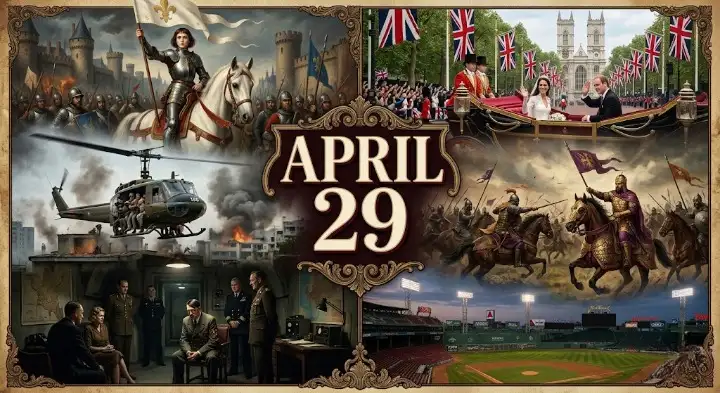
In the quiet of a bunker in 1945, a dictator married his companion just hours before his death, while halfway across the world, thousands scrambled to escape a city destined to fall. April 29 carries the weight of crumbling empires and the hope of new beginnings, from ancient battles to the modern global stage. Whether it is the bravery of a teenage soldier in 15th-century France or the celebration of a royal marriage, this day shows the sheer intensity of the human story.
⚜️ Quick Facts — April 29 in History
| 📌 Category | 📖 Event / Detail |
|---|---|
| 🌟 Most Significant Event | 1429 – Joan of Arc arrives at the Siege of Orléans |
| 🏆 Top 10 Key Events |
• Battle of Levounion — 1091 • Expulsion of Jews from Spain — 1492 • Siege of Quebec — 1760 • Captain Cook reaches Botany Bay — 1770 • Capture of New Orleans — 1862 • Easter Rising ends in Ireland — 1916 • Hitler marries Eva Braun — 1945 • Saigon evacuation (Fall of Saigon) — 1975 • LA Riots begin — 1992 • Wedding of Prince William & Catherine Middleton — 2011 |
| ⚔️ Key Battles | Battle of Levounion (1091), Battle of Västerås (1521), Siege of Quebec (1760), Battle of Fort Royal (1781) |
| 👤 Key Figures (active this day) | Joan of Arc, Alexios I Komnenos, James Cook, Adolf Hitler, Eva Braun, Muhammad Ali, Prince William, Catherine Middleton |
| 🌍 Observances | International Dance Day, Shōwa Day (Japan) |
Story of the Day: Joan of Arc Saves Orléans
A seventeen-year-old girl dressed in white armor rode toward the besieged city of Orléans, her banner snapping in the wind. Joan of Arc believed she heard voices from God telling her to drive the English out of France, and she had finally convinced the Dauphin to let her try. Her arrival on April 29, 1429, changed the mood of the entire war. Within days, she had shattered the English morale. This moment turned the tide of the Hundred Years’ War and sparked a national identity that would define France for centuries to come.
Important Events That Happened On April 29 In History
801 – Earthquake in the Apennines
The ground violently shifted beneath Rome and Spoleto, tearing through the quiet landscape of the Central Apennines. Ancient stone structures could not withstand the force, and the basilica of San Paolo Fuori le Mura suffered heavy damage. Repair crews worked for years to stabilize what the earth had tried to dismantle. This event remains a grim reminder of how quickly the natural world can damage the monuments we believe are permanent.
1091 – Battle of Levounion
Byzantine Emperor Alexios I Komnenos stood against the tide of the Pechenegs who had long plagued his borders. Taking the offensive at the Battle of Levounion, his forces pinned the invaders against the hills and delivered a decisive, crushing blow. The victory essentially ended the Pecheneg threat to the Byzantine Empire for generations. It showed that even a weakened empire could survive through tactical brilliance and iron-willed leadership.
1429 – Relief of the Siege of Orléans
Joan of Arc rode toward the walls of Orléans with a small supply convoy, bringing hope to a city that had been starving for months. The English, who had controlled the perimeter, were stunned by the audacity of this young woman and the renewed spirit of the French troops. Her arrival broke the psychological stalemate of the siege. Orléans was liberated shortly after, proving that the Hundred Years’ War could actually be won by the French.
1483 – Conquest of Gran Canaria
Castilian forces landed on the shores of Gran Canaria, determined to add the island to their growing empire. The local indigenous population faced a technologically superior military, leading to the island’s formal annexation by the Kingdom of Castile. This victory tightened Spanish control over the Atlantic trade routes. It was a major step toward the unified Spain that would soon look toward the Americas.
1492 – Expulsion of Jews Announced
Zaragoza’s procurators received an official decree from the Spanish Crown, marking the beginning of a dark era for the kingdom. The decision to expel all Jewish people from the territory was read aloud, setting a deadline for their departure. This policy forced thousands to choose between their faith and their homes. The resulting exodus scattered communities across the Mediterranean and reshaped the demographics of the region forever.
1521 – Battle of Västerås
Swedish rebels moved against the Danish forces occupying their land, striking during the heat of the Swedish War of Liberation. A fierce clash at Västerås saw the Danish troops outmaneuvered and forced into retreat. This victory provided the Swedish resistance with the momentum they desperately needed. It was the spark that would eventually lead to the total collapse of the Kalmar Union and the birth of an independent Sweden.
1670 – Election of Pope Clement X
Cardinals emerged from a grueling four-month conclave, having finally reached a decision on the leader of the Church. Emilio Altieri accepted the heavy mantle of the papacy and took the name Clement X. He began his tenure at the age of 80, navigating the complex politics of 17th-century Europe. His reign focused on stabilizing Church influence amidst the rising power of secular monarchies.
1760 – Siege of Quebec
French soldiers surrounded the city of Quebec, hoping to reclaim what they had lost to the British just months earlier. The winter had been brutal, and both sides were desperate to secure the stronghold before reinforcements arrived. The conflict saw intense artillery fire and skirmishes that pushed the city to its limits. It proved to be a final, desperate roll of the dice for French colonial ambitions in North America.
1770 – James Cook at Botany Bay
The HMS Endeavour dropped anchor in a quiet harbor on the coast of a continent unknown to the British. James Cook rowed ashore at Botany Bay, stepping onto a land that he would soon claim for the British Crown. His arrival initiated the process of permanent European settlement in Australia. This moment fundamentally altered the future of an entire continent and its indigenous people.
1781 – Battle of Fort Royal
British and French fleets lined up off the coast of Martinique, cannons ready to decide the balance of naval power in the Caribbean. The Battle of Fort Royal broke out as ships exchanged devastating broadsides, filling the air with thick smoke and splintering wood. Neither side secured a total victory, but the engagement demonstrated how the American Revolutionary War had become a global struggle. It kept the British Navy occupied and unable to fully support their troops in the American colonies.
1826 – Discovery of Centaurus A
Astronomer James Dunlop stared through his telescope and identified a strange, luminous object in the southern sky. He cataloged what we now know as the galaxy Centaurus A, or NGC 5128. Its unique appearance, characterized by a thick dust lane, would later reveal it to be one of the most radio-bright galaxies in the sky. This discovery expanded our view of the universe, proving that there were complex structures far beyond our own galaxy.
1861 – Maryland Votes Against Secession
The House of Delegates in Maryland met under immense pressure as the American Civil War tore the country apart. Many voices argued for joining the South, but the final vote went in favor of remaining with the Union. This decision kept the capital, Washington D.C., from being entirely surrounded by Confederate territory. It was a narrow escape that ensured the stability of the Northern government during its most vulnerable year.
1862 – Capture of New Orleans
Union Admiral David Farragut steamed his fleet past the forts guarding the Mississippi River and arrived at the docks of New Orleans. The city, a vital Confederate port, fell almost immediately to the invading naval force. This loss deprived the South of its largest city and a key economic hub. It was a massive blow to the Confederacy, making it clear that the Union’s grip on the river was tightening.
1862 – Siege of Corinth Begins
Union General Henry Halleck moved his army toward Corinth, Mississippi, hoping to draw the Confederate forces of P. G. T. Beauregard into a final showdown. The two massive armies began a slow, grinding approach that defined the nature of warfare in the West. Every movement was calculated to choke off Confederate supply lines and force a retreat. The siege eventually forced the Confederates to abandon the city, ceding control of a critical railway junction.
1864 – Theta Xi Founded
Students at Rensselaer Polytechnic Institute gathered to establish the Theta Xi fraternity, the only one created during the height of the American Civil War. They built an organization that focused on engineering and professional standards during a time of national division. The fraternity survived the turmoil of the 1860s and grew into a national institution. It remains a unique example of how civilian life continued to evolve even while the country fought for its soul.
1903 – Landslide in Frank, Alberta
The side of Turtle Mountain in Frank, Alberta, collapsed without warning, sending millions of tons of limestone into the valley below. The landslide buried the town in mere minutes, killing 70 people who were caught in their homes. It remains one of the deadliest geological disasters in Canadian history. The event changed how mining towns in the region were planned and monitored for safety.
1910 – The People’s Budget
Members of the British Parliament voted to pass the People’s Budget, a piece of legislation that sent shockwaves through the aristocracy. It was the first time in history that the government explicitly used taxation to redistribute wealth among the public. The move stripped the House of Lords of much of its power to block financial bills. This transformed the British political system and set the stage for the modern welfare state.
1911 – Tsinghua University Founded
A new institution opened its doors in Beijing, funded by a portion of the indemnity paid after the Boxer Rebellion. Tsinghua University began with the goal of preparing students for studies in the United States, but it soon became a powerhouse of domestic research. It quickly rose to become a leading university in China. Today, it serves as a central hub for innovation and the training of the country’s future leaders.
1916 – The Siege of Kut Surrender
British forces under siege at Kut-al-Amara finally raised the white flag, facing starvation and dwindling ammunition. The 6th Indian Division surrendered to the Ottoman Army, marking one of the most embarrassing defeats for the British military up to that time. Over 13,000 men were taken prisoner, many of whom would not survive the harsh captivity that followed. This disaster forced the British to rethink their entire strategy in the Middle East.
1916 – Easter Rising Ends
Irish rebels walked out of the ruins of the General Post Office in Dublin and surrendered to British forces after six days of intense urban warfare. The city was a smoldering wreck, and the leadership of the Easter Rising knew their dream of immediate independence had failed. The British moved quickly to execute the leaders, which turned them into national martyrs. That decision ignited a fire of resentment that led to a successful war of independence within five years.
1945 – Surrender of Caserta
German commanders in Italy met with Allied leaders to sign the official document of surrender at Caserta. The ceremony brought an end to the brutal fighting that had ravaged the Italian peninsula for years. It was a sign that the Nazi war machine was finally collapsing from the inside out. With Italy secured, the Allies were free to push their remaining forces toward the final liberation of Europe.
1945 – Food Airdrops to the Netherlands
Allied planes roared over the skies of the occupied Netherlands, but this time they were not dropping bombs. Thousands of tons of food were released in a desperate effort to save a population dying from the “Hunger Winter.” The mission, code-named Operation Manna, provided the first relief many Dutch citizens had seen in months. It was a gesture of mercy that helped thousands of people survive until the final liberation.
1945 – Hitler Marries Eva Braun
Deep within the Führerbunker in Berlin, Adolf Hitler married his longtime companion Eva Braun in a quiet, solemn ceremony. The world outside was ending, and the Soviet army was only blocks away from their hiding place. Hours after the vows were exchanged, they took their own lives to avoid capture. This final, strange moment marked the pathetic end of a regime that had plunged the world into global chaos.
1945 – Dachau Liberated
American soldiers rolled into the Dachau concentration camp, coming face-to-face with the true, horrific nature of the Nazi regime. The troops found thousands of emaciated survivors living in subhuman conditions. The sight was so shocking that it fundamentally changed the soldiers’ understanding of the war they were fighting. This liberation served as one of the most important pieces of evidence used later to prosecute Nazi leaders for crimes against humanity.
1946 – Far East War Crimes Tribunal
Judges convened the International Military Tribunal for the Far East to hold the Japanese leadership accountable for their actions during the war. Former Prime Minister Hideki Tojo and 28 other leaders were formally indicted on charges of atrocities and war crimes. The trial brought long-awaited justice for millions of victims across Asia. It established a new precedent in international law that no official, regardless of their rank, was above justice.
1952 – Pan Am Flight 202 Crash
A Pan Am Boeing 377 Stratocruiser disappeared over the Amazon basin during a flight from Buenos Aires to New York. The wreckage was eventually found deep in the Brazilian jungle, with no survivors among the 50 people on board. Search efforts were hampered by the dense, unforgiving terrain of the region. This tragedy led to significant improvements in flight tracking and safety protocols for trans-continental flights.
1953 – First 3D TV Broadcast
Viewers in Los Angeles tuned into the ABC affiliate, KECA-TV, to see something they had never seen before: a 3D television show. An episode of Space Patrol was broadcast using an experimental process that required viewers to use special glasses. While the technology was clunky and short-lived, it was a massive step forward for home entertainment. It showed that the future of television was limited only by the imagination of the engineers.
1967 – Muhammad Ali Stripped of Title
Muhammad Ali refused to be inducted into the U.S. Army, citing his religious beliefs as a conscientious objector. The state responded by stripping him of his boxing titles and suspending his license to compete. He was essentially exiled from the sport at the peak of his physical powers. This stand made him a lightning rod for the political debates of the era and transformed him into a global symbol of civil rights.
1970 – Invasion of Cambodia
United States and South Vietnamese forces crossed the border into Cambodia, targeting the sanctuaries used by the North Vietnamese army. The mission aimed to disrupt the Ho Chi Minh Trail and prevent supplies from reaching the Viet Cong. The move sparked massive protests across American university campuses as the war seemed to be expanding rather than ending. It was a controversial decision that added yet another layer of complexity to the Vietnam War.
1974 – Nixon Releases Watergate Transcripts
President Richard Nixon went on national television to announce that he was releasing edited transcripts of the recordings from his office. He hoped the documents would clear his name in the Watergate scandal, but the move only fueled further suspicion. The public and Congress remained convinced that the President was hiding something significant. This decision ultimately accelerated his path toward resignation later that same year.
1975 – Operation Frequent Wind
United States helicopters began a frantic, last-minute evacuation of Americans and South Vietnamese allies from the rooftop of the embassy in Saigon. The city was falling to the North Vietnamese Army, and the end of U.S. involvement in the war was unfolding in a chaotic, desperate scene. This final mission marked the end of years of American combat in Southeast Asia. It remains a powerful, haunting image of a war that had changed the world.
1975 – Capture of Trường Sa Islands
North Vietnamese troops finalized their occupation of the islands in the South China Sea that had been held by South Vietnam. The capture was part of the swift, decisive push that ended the war and consolidated communist control over the entire country. The islands remain a point of regional tension to this day. This strategic victory allowed the new government to solidify its territorial claims almost immediately after the war ended.
1985 – Space Shuttle Challenger Launch
The Space Shuttle Challenger roared off the launchpad at the Kennedy Space Center on the STS-51-B mission. The flight carried the Spacelab-3 laboratory, which allowed researchers to conduct experiments in microgravity for the first time on such a scale. This mission pushed the boundaries of what could be achieved in space. It highlighted the shuttle’s potential to act as a versatile tool for scientific discovery.
1986 – LA Public Library Fire
A massive, intentional fire broke out in the Central Library of Los Angeles, creating a blaze that proved nearly impossible to contain. The inferno lasted for hours, destroying or damaging nearly 400,000 books and irreplaceable archives. The loss devastated the city’s intellectual community. Rebuilding the collection took years of intense work and global support, but the library eventually emerged stronger than ever.
1986 – USS Enterprise in Suez
The USS Enterprise made history as the first nuclear-powered aircraft carrier to navigate the Suez Canal. It traveled from the Red Sea to the Mediterranean, demonstrating the reach and capabilities of the U.S. Navy. The transit was a logistical feat that required precise coordination between military and canal authorities. This movement showed that the U.S. could project power anywhere in the world on a moment’s notice.
1986 – Khalistan Declaration
An assembly of Sikhs gathered as a Sarbat Khalsa to formally declare the independence of a new state called Khalistan. The move was a direct challenge to the authority of the Indian government and reflected deep-seated tensions within the region. The declaration led to increased security crackdowns and long-standing political conflict. It remains a sensitive issue that still echoes in the politics of the Sikh diaspora.
1991 – Cyclone in Bangladesh
A massive cyclone tore through the Chittagong district of Bangladesh with winds reaching 155 miles per hour. The storm surge decimated the coastline, killing at least 138,000 people and leaving ten million without a home. The scale of the destruction required a global humanitarian response. This disaster served as a wakeup call for the necessity of better cyclone preparedness in low-lying, densely populated coastal regions.
1991 – Racha Earthquake in Georgia
A powerful 7.0 magnitude earthquake struck the Racha region of Georgia, collapsing ancient homes and mountain villages. The disaster killed 270 people and left thousands more to face the elements without shelter. Rescue teams struggled to reach the remote, mountainous terrain in the immediate aftermath. The tragedy highlighted the vulnerability of historic structures to seismic activity in the Caucasus.
1992 – Los Angeles Riots
Violent riots erupted across Los Angeles following the acquittal of four police officers involved in the beating of Rodney King. For three days, the city descended into chaos as businesses were looted and buildings were burned to the ground. Sixty-three people died, and the city was left scarred by the experience. The event forced a national conversation on race, police brutality, and the justice system that is still happening today.
1997 – Chemical Weapons Convention
The Chemical Weapons Convention finally entered into force, legally binding its signatories to stop the production, stockpiling, and use of chemical agents. This international agreement aimed to eliminate an entire class of weapons of mass destruction. Most of the world’s nations signed on, pledging to verify the destruction of existing stockpiles. It was a rare, successful example of global cooperation to make the world a safer place.
2004 – Final Oldsmobile Produced
The last Oldsmobile rolled off the assembly line in Lansing, Michigan, ending 107 years of American automotive history. Once a symbol of engineering innovation and mid-market success, the brand had slowly lost its place in the modern market. The closure of the plant marked the end of an era for the auto industry. Many collectors and enthusiasts gathered to witness the final car, celebrating a brand that had put millions of Americans on the road.
2011 – Royal Wedding
Prince William and Catherine Middleton walked down the aisle of Westminster Abbey in a ceremony watched by billions around the world. The event revitalized the image of the British monarchy, bringing a sense of modern hope to a historic institution. Street parties were held across the United Kingdom, turning the day into a massive, nationwide celebration. It was one of the most televised moments in history, marking the start of a new chapter for the royals.
2013 – Explosion in Prague
An office building in central Prague was rocked by a powerful explosion that shattered windows for blocks and left 43 people injured. Investigators later determined that the blast was likely caused by a natural gas leak. The incident created panic in the heart of the historic city as emergency services rushed to find survivors in the debris. It was a stark reminder of how urban infrastructure can fail with devastating results.
2013 – National Airlines Flight 102 Crash
A Boeing 747 freighter crashed shortly after takeoff from Bagram Airfield in Afghanistan, killing all seven crew members on board. The plane appeared to lose control as cargo shifted during the ascent, leading to a catastrophic fall. Investigators recovered the flight data to understand how such a robust aircraft could fail so quickly. The crash highlighted the dangerous reality of operating heavy transport planes in high-stakes military environments.
2015 – Orioles vs. White Sox Empty Stadium
The Baltimore Orioles played the Chicago White Sox in a game that was officially closed to the public due to protests in the city. The result was a haunting sight: a professional baseball game played in total silence, with not a single fan in the stands. It was the first time in MLB history that a game had been held under such conditions. The match served as a strange, quiet moment of reflection on the social tension gripping the nation.
Read also About the April 28 Facts
Famous People Born On April 29
| Name | Description | Date |
|---|---|---|
| James Butler, 2nd duke of Ormonde | Irish general, powerful Tory minister (1710–14) | April 29, 1665 – November 16, 1745 |
| Vasily Nikitich Tatishchev | Russian historian, first comprehensive Russian history | April 29, 1686 – July 26, 1759 |
| Robert Sandeman | Scottish minister, founder of Sandemanian sect | April 29, 1718 – April 2, 1771 |
| Pedro António Correia Garção | Portuguese Neoclassical poet | April 29, 1724 – November 10, 1772 |
| Jean-Georges Noverre | French choreographer, revolutionized ballet | April 29, 1727 – October 19, 1810 |
| Oliver Ellsworth | 3rd chief justice of the U.S., author of federal court system | April 29, 1745 – November 26, 1807 |
| Charles Nodier | French writer, influenced Romantic movement | April 29, 1780 – January 27, 1844 |
| Sir James Brooke | British trader, first White Rajah of Sarawak | April 29, 1803 – June 11, 1868 |
| Vincent, Count Benedetti | French diplomat, role in Franco-German War (1870) | April 29, 1817 – March 28, 1900 |
| Georges Boulanger | French general, threatened Third Republic | April 29, 1837 – September 30, 1891 |
| Constantine P. Cavafy | Greek poet, major figure in Western poetry | April 29, 1863 – April 29, 1933 |
| Karl Philipp, prince von Wrede | Bavarian field marshal, allied then opposed Napoleon | April 29, 1767 – December 12, 1838 |
| Jean-Baptiste, Count Jourdan | French marshal, sponsored conscription | April 29, 1762 – November 23, 1833 |
| Bernie Madoff | American hedge-fund manager, largest Ponzi scheme | April 29, 1938 – April 14, 2021 |
| Duke Ellington | American jazz composer and bandleader | April 29, 1899 – May 24, 1974 |
| Hirohito | Emperor of Japan (1926–89), longest-reigning monarch | April 29, 1901 – January 7, 1989 |
| Fred Zinnemann | Austrian-born American film director | April 29, 1907 – March 14, 1997 |
| Alla Rakha | Indian tabla player, finest in Indian music | April 29, 1919 – February 3, 2000 |
| Maya Deren | American avant-garde filmmaker, “mother” of American avant-garde | April 29, 1917 – October 13, 1961 |
| Urie Bronfenbrenner | Russian-born American psychologist, ecological systems theory | April 29, 1917 – September 25, 2005 |
| Irvin Kershner | American director, The Empire Strikes Back | April 29, 1923 – November 27, 2010 |
| George Allen | American professional football coach | April 29, 1922 – December 31, 1990 |
| Paul Baran | American electrical engineer, packet switching pioneer | April 29, 1926 – March 26, 2011 |
| Willie Nelson | American country music singer-songwriter | April 29, 1933 – Present |
| Luis Aparicio | Venezuelan-American baseball Hall of Fame shortstop | April 29, 1934 – Present |
| Zubin Mehta | Indian orchestral conductor | April 29, 1936 – Present |
| Peter A. Diamond | American economist, Nobel Prize (2010) | April 29, 1940 – Present |
| Daniel Day-Lewis | British actor, three-time Oscar winner | April 29, 1957 – Present |
| Michelle Pfeiffer | American actress | April 29, 1958 – Present |
| Andre Agassi | American tennis player, eight Grand Slam titles | April 29, 1970 – Present |
Famous People Died On April 29
| Name | Description | Date |
|---|---|---|
| Saint Hugh of Cluny | French abbot, medieval monasticism’s apex | 1024 – April 29, 1109 |
| Louis II, duke of Anjou | Duke of Anjou, king of Naples and Sicily | October 7, 1377 – April 29, 1417 |
| Lautaro | Mapuche leader, led uprising against Spanish in Chile | 1535 – April 29, 1557 |
| Théodore-Agrippa d’Aubigné | French Huguenot poet and soldier | February 8, 1552 – April 29, 1630 |
| John Cleveland | English Metaphysical poet | June 16, 1613 – April 29, 1658 |
| George Farquhar | Irish dramatist, original comic dialogue | 1678 – April 29, 1707 |
| Charles-Irénée Castel, abbé de Saint-Pierre | French publicist, proposed international peace organization | February 13, 1658 – April 29, 1743 |
| Ezekiel Landau | Polish rabbi, authority on Jewish law | October 8, 1713 – April 29, 1793 |
| Bernardo, Marquess Tanucci | Italian statesman, Kingdom of Naples-Sicily | January 20, 1698 – April 29, 1783 |
| Charles-Nicolas Cochin the Younger | French engraver | February 22, 1715 – April 29, 1790 |
| Rufus King | American Founding Father, Federalist senator | March 24, 1755 – April 29, 1827 |
| Aloysius Bertrand | French writer, introduced prose poem | April 20, 1807 – April 29, 1841 |
| José María Obando | President of Colombia (1853–54) | 1795 – April 29, 1861 |
| Reinhart Pieter Dozy | Dutch Arabist, Spanish Islam | February 21, 1820 – April 29, 1883 |
| Heinrich Federer | Swiss novelist of Christian fiction | October 6, 1866 – April 29, 1928 |
| José Félix Uriburu | Argentine general, led 1930 military coup | July 20, 1868 – April 29, 1932 |
| Constantine P. Cavafy | Greek poet | April 29, 1863 – April 29, 1933 |
| Leroy Carr | American blues singer and pianist | March 27, 1905 – April 29, 1935 |
| Wallace Hume Carothers | American chemist, invented nylon | April 27, 1896 – April 29, 1937 |
| William Hooker Gillette | American playwright and actor, Sherlock Holmes | July 24, 1853 – April 29, 1937 |
| Billy Bitzer | American cinematographer, pioneer with D.W. Griffith | April 21, 1874 – April 29, 1944 |
| Bernardino Luís Machado | President of Portugal (1915–17, 1925–26) | March 28, 1851 – April 29, 1944 |
| Irving Fisher | American economist, capital theory | February 27, 1867 – April 29, 1947 |
| Ludwig Wittgenstein | Austrian-born British philosopher | April 26, 1889 – April 29, 1951 |
| Tanabe Hajime | Japanese philosopher of science | February 3, 1885 – April 29, 1962 |
| Anthony Mann | American film director of Westerns | June 30, 1906 – April 29, 1967 |
| Anthony Boucher | American author, cofounder of The Magazine of Fantasy & Science Fiction | August 21, 1911 – April 29, 1968 |
| Jules Stein | American cofounder of MCA | April 26, 1896 – April 29, 1981 |
| Alfred Hitchcock | English-born American film director | August 13, 1899 – April 29, 1980 |
| Raúl Prebisch | Argentine economist, dependency theory | April 17, 1901 – April 29, 1986 |
Observances on April 29
- International Dance Day (UNESCO): Celebrated annually to honor the art of dance and its ability to transcend cultural and political boundaries.
- Shōwa Day: A Japanese national holiday observed to reflect on the events of the Shōwa era and the long reign of Emperor Hirohito.
⚜️ Frequently Asked Questions — April 29 in History
The wedding of Prince William and Catherine Middleton took place at Westminster Abbey in London. It was a global media event that drew millions of viewers and marked a major moment for the British Royal family.
The arrival of Joan of Arc at the Siege of Orléans in 1429 is arguably the most significant. Her presence turned the tide of the Hundred Years’ War and ultimately led to the liberation of France from English control.
While the list of births is long, the date is more defined by the deaths and events that shaped modern nations. You will often find more historical focus on figures like Joan of Arc, Alexios I Komnenos, or Muhammad Ali’s political stands.
The end of the Vietnam War was marked by the fall of Saigon and the start of Operation Frequent Wind on this day in 1975. Additionally, the Battle of Levounion in 1091 and the Siege of Quebec in 1760 are key military engagements.
International Dance Day is an annual observance by UNESCO to celebrate the universal language of dance. It is remembered because it highlights the cultural importance of movement and its ability to unite people across the world.
In 2015, a historic Major League Baseball game between the Baltimore Orioles and Chicago White Sox was played to an empty stadium due to civil unrest. It remains the only game in the league’s history to be closed to the public.