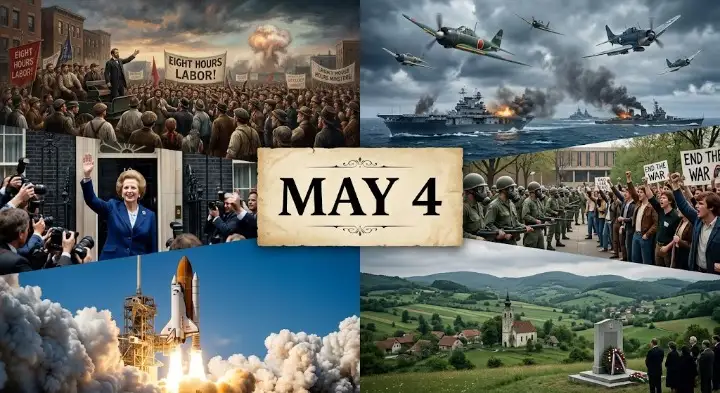
Labor strikes, student protests, and political shifts define the landscape of May 4. From the chaotic streets of 1886 Chicago to the tragic silence on an Ohio college campus, this date serves as a reminder of how quickly public demonstrations can spiral into defining moments of conflict. This post examines what happened on May 4 in history, covering the high-stakes political maneuvers and the grassroots movements that changed the course of modern society.
⚡ Quick Facts — May 4 in History
| 📌 Category | 📖 Event / Detail |
|---|---|
| 🌟 Most Significant Event | Haymarket Affair (1886) |
| 🏆 Top 10 Key Events | • Battle of Seringapatam (1799) • Haymarket Affair (1886) • Kent State Shootings (1970) • Margaret Thatcher becomes PM (1979) • Latvia Independence (1990) • Battle of the Coral Sea (1942) • Al Capone transferred (1932) • Sears Tower topped out (1973) • Torino plane crash (1949) • PEPCON disaster (1988) |
| ⚔️ Key Battles | Battle of Seringapatam, Battle of the Coral Sea, Naval Battle of Hakodate |
| 👤 Key Figures | Tipu Sultan, Margaret Thatcher, Al Capone, Edward IV |
| 🌍 Observances | International Firefighters’ Day, Star Wars Day, Youth Day (China), Greenery Day (Japan) |
Story of the Day: The Haymarket Affair
Violence erupted in Chicago on May 4, 1886, when a labor protest at Haymarket Square turned deadly. Thousands gathered to demand an eight-hour workday, but as police moved to disperse the crowd, a bomb tore through the air. The explosion killed an officer and triggered a chaotic exchange of gunfire that left seven more officers and four civilians dead. This confrontation became the primary symbol for the struggle of the working class, cementing the fight for labor rights as a central part of American social history.
Important Events That Happened On May 4 In History
1256 – The Augustinian Order Founded
Pope Alexander IV issues the papal bull Licet ecclesiae catholicae from the Lecceto Monastery. This formal act unites several hermit groups into a single Augustinian monastic order. The decree standardizes their religious practice and centralizes their authority under the Church. It remains a foundational moment for one of the most prominent mendicant orders in Catholic history.
1415 – John Wycliffe Condemned
The Council of Constance declares the late reformer John Wycliffe a heretic long after his death. Church leaders order his writings burned and his remains exhumed to be desecrated as punishment for his dissent. This harsh reaction shows the institutional fear of his early calls for scripture to be accessible to common people. His ideas eventually laid the groundwork for the Protestant Reformation a century later.
1436 – Engelbrekt Engelbrektsson Assassinated
Swedish rebel leader Engelbrekt Engelbrektsson meets his end in an ambush, marking the death of a man who rose to challenge the Kalmar Union. His leadership of a peasant uprising transformed him from a local miner into a figurehead for Swedish national identity. While his life ended in political treachery, his movement ignited the desire for Swedish autonomy. The nation eventually gained full independence, largely fueled by the spirit of his rebellion.
1471 – The Battle of Tewkesbury
King Edward IV corners the Lancastrian forces at Tewkesbury, dealing a crushing blow to the House of Lancaster. Edward of Westminster, the Prince of Wales, dies in the fighting, effectively ending the Lancastrian line of succession for the throne. This victory cements Edward IV’s power in the Wars of the Roses. England enters a brief period of relative stability under the House of York.
1493 – Division of the New World
Pope Alexander VI releases the bull Inter caetera, drawing a line of demarcation to settle colonial disputes. Spain receives rights to lands west of the line, while Portugal claims those to the east. This arbitrary mapping fundamentally shapes the future culture, language, and colonization of the Americas. Every modern border in Latin America traces its roots back to this ecclesiastical division.
1626 – Peter Minuit Arrives in Manhattan
Dutch explorer Peter Minuit steps off the ship See Meeuw onto the shores of Manhattan Island. Appointed as the director-general of New Netherland, he begins the task of governing the growing Dutch trading outpost. His arrival marks the start of more aggressive European settlement in the region. The island soon becomes the epicenter of a global commercial network.
1738 – The Imperial Theatrical School Founded
Empress Anna of Russia signs the decree to establish the first ballet school in St. Petersburg. This institution provides the formal structure needed to develop the world-class dancers who would later define the Russian arts. It survives centuries of political upheaval, transitioning through imperial and Soviet eras. Today, the school is known as the Vaganova Academy of Russian Ballet.
1776 – Rhode Island Renounces Allegiance
Rhode Island politicians vote to sever their ties with King George III, becoming the first American colony to officially do so. This bold act of defiance effectively makes the colony an independent state before the Continental Congress even adopts the Declaration of Independence. Their decision signals that the war for American independence has become a war for total sovereignty. The move inspires other colonies to follow suit in the coming months.
1799 – The Fall of Seringapatam
British General George Harris orders the final assault on the capital of the Kingdom of Mysore, ending the Fourth Anglo-Mysore War. During the fierce street-to-street fighting, Tipu Sultan dies defending his fortress. His defeat removes the strongest obstacle to British colonial expansion in Southern India. The fall of the city marks the effective end of the Mysore state’s independence.
1814 – Napoleon Begins Exile
Napoleon Bonaparte arrives at the port of Portoferraio on the island of Elba to start his forced retirement. Stripped of his empire, he arrives with a small guard and the title of “Emperor of Elba.” The French populace watches closely to see if the once-mighty leader will truly accept his diminished status. He remains on the island for less than a year before mounting a desperate return to power.
1814 – Spain Returns to Absolutism
King Ferdinand VII signs a decree abolishing the liberal Spanish Constitution of 1812. He moves to dismantle the democratic reforms implemented during the Peninsular War to restore absolute monarchical power. This reactionary policy triggers long-term political instability and internal conflict within Spain. The country remains fractured between traditionalists and reformers for generations.
1823 – Naval Battle off Salvador
Lord Cochrane leads a Brazilian squadron against a Portuguese fleet near Salvador, Bahia. This engagement is a crucial test for the newly formed Brazilian naval forces during their war for independence. Brazilian victory forces the Portuguese to reconsider their hold on the coastal regions of the country. This battle is a pivotal moment in ensuring Brazil’s final separation from Portugal.
1836 – Ancient Order of Hibernians Formed
Irish immigrants in New York City gather to establish the Ancient Order of Hibernians. They organize primarily to provide mutual aid and protect the Catholic Church in a hostile social environment. Over time, the organization becomes a significant vehicle for Irish-American political and social power. It continues to preserve Irish culture and traditions in North America today.
1859 – The Royal Albert Bridge Opens
The Cornwall Railway celebrates the completion of the Royal Albert Bridge, finally linking Devon and Cornwall. Engineering marvel Isambard Kingdom Brunel designs the structure to withstand the treacherous currents of the River Tamar. Its opening revolutionizes transport in the West Country, boosting trade and communication significantly. The bridge remains in daily use, a testament to mid-19th-century railway engineering.
1869 – The Battle of Hakodate
Imperial Japanese naval forces engage the Tokugawa shogunate’s remaining fleet in the Sea of Japan. This intense four-day struggle effectively crushes the final organized resistance against the Meiji Restoration. The defeat of the shogunate leads to the surrender of the Ezo Republic shortly after. Japan begins its rapid transition toward a centralized, modern state under the Emperor.
1871 – First Professional Baseball League
The National Association of Professional Base Ball Players kicks off its inaugural season in Fort Wayne, Indiana. This league marks the official start of organized professional baseball in the United States. Teams begin competing for the first time with standardized rules and paid players. It paves the way for the development of modern Major League Baseball.
1904 – Panama Canal Construction Begins
The United States government officially takes over the massive project to dig the Panama Canal. Engineers and workers arrive to begin clearing the dense jungle and cutting through the mountain terrain. It is one of the most ambitious and dangerous infrastructure projects in human history. Completion of the canal changes global trade routes forever by connecting the Atlantic and Pacific oceans.
1910 – Royal Canadian Navy Created
The Canadian government passes the Naval Service Act to establish its own independent naval force. Until this point, Canada relied entirely on the British Royal Navy for its maritime security. Creating this force marks a shift toward greater autonomy within the British Empire. It is a defining moment for Canada’s developing national military identity.
1912 – Invasion of Rhodes
Italian forces launch a military operation to occupy the Ottoman-controlled island of Rhodes. This campaign is part of Italy’s effort to expand its influence in the Mediterranean and secure colonial assets. The island falls quickly, becoming an Italian possession during the Italo-Turkish War. This occupation lasts for decades, significantly altering the island’s administrative and cultural landscape.
1919 – The May Fourth Movement
Chinese students gather in Tiananmen Square to protest the terms of the Treaty of Versailles. They are outraged that the treaty transfers former German concessions in China to Japan instead of returning them to Chinese control. This surge of nationalism sparks a massive intellectual and political revolution across the country. The event remains a touchstone for modern Chinese political consciousness.
1926 – The United Kingdom General Strike
Millions of workers across the United Kingdom walk off the job to protest wage cuts and poor working conditions. This massive, coordinated strike brings the country to a standstill, paralyzing transportation and industry. The government prepares for potential civil unrest as the strike continues for nine days. It highlights the deep tensions between the working class and the political establishment of the era.
1927 – Academy of Motion Picture Arts and Sciences Incorporated
Industry leaders in Hollywood incorporate the Academy to advance the arts and sciences of motion pictures. Their goal is to organize the rapidly growing film community and standardize professional practices. The organization soon becomes the most powerful arbiter of excellence in the film industry. It remains the host of the annual Academy Awards ceremony.
1932 – Al Capone Transferred
Federal agents move Al Capone from a Chicago jail to the Atlanta federal penitentiary after the Supreme Court rejects his appeal. The infamous mobster was convicted of tax evasion and sentenced to eleven years. His removal from the Chicago scene signals a shift in the government’s crackdown on organized crime. He eventually ends up at Alcatraz to serve the remainder of his term.
1942 – Battle of the Coral Sea
U.S. Navy aircraft from the USS Yorktown launch an attack on Japanese forces stationed at Tulagi. This clash marks the opening phase of a major naval confrontation in the Pacific theater of World War II. The battle is unique because it is fought entirely by carrier-based aircraft, with ships never seeing one another. It prevents a Japanese invasion of Port Moresby and changes the strategic balance in the region.
1945 – Liberation of Neuengamme
British soldiers reach the gates of the Neuengamme concentration camp near Hamburg, finding evidence of the horrors committed by the Nazi regime. The liberation occurs as the war in Europe reaches its final, collapsing stage. Thousands of survivors are freed from the brutal conditions of the camp. The site is later preserved as a memorial to the victims of the Holocaust.
1945 – Surrender at Lüneburg Heath
German military commanders sign a document of surrender covering all forces in the Netherlands, Denmark, and northwest Germany. This act marks the beginning of the end for the Third Reich in the North. It comes into effect the following day, silencing the guns in these sectors. This localized surrender acts as a precursor to the total capitulation of Germany.
1946 – Alcatraz Riot Suppressed
U.S. Marines from the nearby Treasure Island base intervene to end a two-day violent prison uprising at Alcatraz. The riot results in the deaths of five people, including both guards and inmates. It remains one of the bloodiest incidents in the history of the federal prison system. The event forces a reevaluation of prison security and prisoner management.
1949 – Torino Football Team Plane Crash
A plane carrying the entire Torino football team crashes into the Superga hill near Turin. Everyone on board, including players, coaches, and staff, dies in the tragedy. The team was considered the best in the world at the time, and their loss devastates the nation of Italy. They remain a legendary symbol in football history, immortalized by the outpouring of public grief.
1953 – Hemingway Wins Pulitzer
Ernest Hemingway receives the Pulitzer Prize for Fiction for his novella The Old Man and the Sea. The story of an aging fisherman’s struggle against a giant marlin captures the American imagination. It helps cement Hemingway’s status as a dominant literary figure of the 20th century. The recognition highlights his shift toward themes of endurance and personal dignity.
1959 – First Annual Grammy Awards
The music industry holds its first-ever Grammy Awards ceremony to honor achievements in recording arts. Organized by the National Academy of Recording Arts and Sciences, the event marks the formal professionalization of the music business. The ceremony showcases the diverse range of talent emerging in the post-war era. It quickly evolves into the most prestigious event in the global music industry.
1961 – Freedom Riders Begin
A group of civil rights activists board buses in Washington, D.C., to travel through the segregated South. They intend to challenge the local defiance of Supreme Court rulings that outlawed segregation in interstate transportation. Their journey is met with severe violence and intimidation by white mobs. The bravery of the riders draws national attention to the brutality of the Jim Crow system.
1961 – Balloon Altitude Record
Malcolm Ross and Victor Prather ascend in the Strato-Lab V balloon to reach 113,740 feet. Their flight in an open gondola sets a new world record for manned balloon altitude. The mission helps scientists understand the conditions of the upper atmosphere and test equipment for future space flight. Their achievement is a major milestone in early aerospace development.
1970 – Kent State Shootings
Ohio National Guardsmen open fire on a crowd of students protesting the Vietnam War at Kent State University. The gunfire kills four students and wounds nine others, shocking the nation. These images of soldiers turning weapons on civilians polarize American opinion on the war. It remains a painful symbol of the domestic divisions caused by the Vietnam conflict.
1972 – Greenpeace Foundation Established
The environmental advocacy group formerly known as the Don’t Make A Wave Committee officially adopts the name Greenpeace Foundation. The organization shifts from a small protest group to a formalized global movement for environmental protection. Their focus on high-visibility direct action begins to shape international policies on nuclear testing and conservation. The name becomes synonymous with global ecological activism.
1973 – Sears Tower Topped Out
Construction crews place the final beam on the 108-story Sears Tower in Chicago, reaching a height of 1,451 feet. Upon completion, it officially becomes the tallest building in the world. Its architectural design represents the ambition of American corporate power in the late 20th century. The tower dominates the city skyline and remains an iconic landmark of modern engineering.
1978 – Cassinga Day Attack
South African forces launch an aerial and ground assault on a SWAPO base in Cassinga, Angola. The attack leads to the deaths of roughly 600 people, most of whom were refugees and combatants. The incident becomes a central point of remembrance in Namibia, marking a dark chapter in the struggle for independence. The event is now officially commemorated as Cassinga Day.
1979 – Thatcher Becomes Prime Minister
Margaret Thatcher arrives at 10 Downing Street, becoming the first female Prime Minister of the United Kingdom. Her victory for the Conservative Party begins a transformative era of free-market reform and political realignment. She is known for her uncompromising stance on policy and her influence on global politics throughout the 1980s. Her leadership remains the subject of intense historical debate.
1982 – HMS Sheffield Sunk
An Argentinian Exocet missile strikes the British destroyer HMS Sheffield during the Falklands War. The attack kills twenty sailors and leaves the ship crippled. It is a stunning blow to the British fleet, proving the lethal effectiveness of modern anti-ship missiles. The loss highlights the high stakes and technological intensity of the conflict.
1988 – PEPCON Disaster
A massive fire at the Pacific Engineering and Production Company of Nevada (PEPCON) facility leads to a series of catastrophic explosions. Tons of ammonium perchlorate, used as space shuttle fuel, detonate, leveling buildings across Henderson, Nevada. The shockwave is felt for miles, causing widespread damage and injuries. It remains one of the largest industrial accidents in United States history.
1989 – Oliver North Convicted
A jury finds former White House aide Oliver North guilty on three criminal charges related to the Iran-Contra affair. He is acquitted of nine other charges as the trial navigates the complex web of secret funding and illegal arms sales. His convictions are later overturned on appeal, leaving the full truth of the scandal a matter of public debate. The case remains a major stain on the administration of the era.
1989 – Space Shuttle Atlantis Launches
NASA launches the Atlantis on mission STS-30 to deploy the Magellan space probe toward Venus. This mission represents a bold step in expanding human knowledge of the solar system. The probe provides the first high-resolution radar maps of the Venusian surface. It is a successful demonstration of the shuttle’s role in deep-space exploration.
1990 – Latvia Declares Independence
The Supreme Council of Latvia votes to restore the country’s independence from the Soviet Union. This declaration marks the culmination of the growing movement for self-determination in the Baltic states. It sets the stage for the eventual dissolution of the Soviet Union. For the Latvian people, it is the realization of a long-held dream for national sovereignty.
1994 – Rabin-Arafat Peace Accord
Israeli Prime Minister Yitzhak Rabin and PLO leader Yasser Arafat sign a landmark agreement in Cairo. The accord establishes the framework for Palestinian self-rule in the Gaza Strip and the West Bank city of Jericho. It is a moment of profound hope for resolving the decades-long Israeli-Palestinian conflict. Though the peace process later stalls, the signing remains a historic attempt at coexistence.
1998 – Unabomber Sentenced
A federal judge sentences Theodore Kaczynski to four life terms plus 30 years in prison for his role in a long-standing bombing campaign. Kaczynski avoids the death penalty by accepting a plea agreement. His arrest and subsequent conviction bring an end to a terrifying era of mail bombings that spanned nearly two decades. He is sent to a high-security facility to serve his sentence.
2000 – First Mayor of London
Ken Livingstone is elected as the first Mayor of London, filling a newly created office separate from the ceremonial Lord Mayor. His victory marks a major shift in the governance of the British capital, concentrating power in an elected executive. He focuses on improving public transportation and urban infrastructure. The position quickly becomes one of the most influential political roles in the United Kingdom.
2002 – Plane Crash in Kano
A commercial airliner crashes shortly after takeoff near the Mallam Aminu Kano International Airport in Nigeria. The accident claims the lives of 103 people and leaves dozens more injured. It is a devastating tragedy for the local community and the nation’s aviation sector. Investigations into the cause of the crash highlight the ongoing need for improved aviation safety standards.
2007 – Greensburg Tornado
A massive 1.7-mile wide EF5 tornado tears through the heart of Greensburg, Kansas, destroying nearly every building in the town. It is the first tornado to be rated on the new Enhanced Fujita scale, showcasing its unprecedented destructive power. The disaster serves as a stark warning of the danger of extreme weather events. The community begins the difficult process of rebuilding from the ground up.
2014 – Nairobi Bus Bombings
Two explosions hit buses in the Kenyan capital of Nairobi, killing three people and injuring 62 others. The coordinated attack sends shockwaves through the city as authorities scramble to identify the perpetrators. It highlights the persistent security challenges facing East Africa due to regional instability. Kenya continues to deal with the threat of extremist violence in urban centers.
2019 – W Series Inaugural Race
The first race of the all-female W Series motorsport championship takes place at the Hockenheimring circuit. Jamie Chadwick wins the historic opening event, setting the stage for her season-long dominance. The series is designed to provide greater opportunities for women in a male-dominated sport. It gains significant attention as a new platform for promoting gender diversity in auto racing.
2023 – Serbia Spree Shooting
A lone gunman opens fire in the Serbian towns of Mladenovac and Smederevo, killing nine people and wounding thirteen. This tragedy follows another mass shooting in the country only two days earlier, leading to a period of intense national mourning. The government responds with strict measures to control gun ownership. The violence prompts a national conversation about mental health and social stability.
Continue your journey through time by clicking here.
Famous People Born On May 4
| Name | Description | Date |
|---|---|---|
| Tyagaraja | Indian composer of Carnatic devotional songs | May 4, 1767 – January 6, 1847 |
| Friedrich Arnold Brockhaus | German publisher of noted encyclopaedia | May 4, 1772 – August 20, 1823 |
| Johann Friedrich Herbart | German philosopher and educator, scientific pedagogy | May 4, 1776 – August 14, 1841ERC20ERC20 |
| Louis-Jacques ThenardERC20ERC20 | French chemist, Thenard’s blueERC20ERC20 | May 4, 1777 – June 21, 1857ERC20ERC20 |
| John McLeod CampbellERC20ERC20 | Scottish theologianERC20ERC20 | May 4, 1800 – February 27, 1872ERC20ERC20 |
| Sir William Fothergill CookeERC20ERC20 | English inventor, electric telegraph pioneerERC20ERC20 | May 4, 1806 – June 25, 1879ERC20ERC20 |
| Alexandre-Florian-Joseph Colonna, Count WalewskiERC20ERC20 | French statesman, illegitimate son of Napoleon IERC20ERC20 | May 4, 1810 – September 27, 1868ERC20ERC20 |
| Julia TylerERC20ERC20 | American first lady, wife of John TylerERC20ERC20 | May 4, 1820 – July 10, 1889ERC20ERC20 |
| Frederic Edwin ChurchERC20ERC20 | American Romantic landscape painter, Hudson River SchoolERC20ERC20 | May 4, 1826 – April 7, 1900ERC20ERC20 |
| Alberto Blest GanaERC20ERC20 | Chilean novelist, founder of social novelERC20ERC20 | May 4, 1830 – November 9, 1920ERC20ERC20 |
| William Kingdon CliffordERC20ERC20 | British mathematician and philosopherERC20ERC20 | May 4, 1845 – March 3, 1879ERC20ERC20 |
| Richard HoveyERC20ERC20 | American poet and dramatistERC20ERC20 | May 4, 1864 – February 24, 1900ERC20ERC20 |
| Alexandre BenoisERC20ERC20 | Russian artist, cofounder of Mir iskusstvaERC20ERC20 | May 4, 1870 – February 9, 1960ERC20ERC20 |
| A. Mitchell PalmerERC20ERC20 | U.S. attorney general, “Red Scare” raidsERC20ERC20 | May 4, 1872 – May 11, 1936ERC20ERC20 |
| Ramiro de MaeztuERC20ERC20 | Spanish journalist and sociopolitical theoristERC20ERC20 | May 4, 1875 – October 29, 1936ERC20ERC20 |
| Fritz von OpelERC20ERC20 | German industrialist, rocket propulsion experimentsERC20ERC20 | May 4, 1899 – April 8, 1971ERC20ERC20 |
| Morris FisherERC20ERC20 | American rifle shooter, five Olympic gold medalsERC20ERC20 | May 4, 1892 – May 23, 1968ERC20ERC20 |
| Joy Bright HancockERC20ERC20 | U.S. naval officer, early women’s Navy pioneerERC20ERC20 | May 4, 1898 – August 20, 1986ERC20ERC20 |
| Agustín YáñezERC20ERC20 | Mexican novelist and statesmanERC20ERC20 | May 4, 1904 – January 17, 1980ERC20ERC20 |
| Mary Agnes HallarenERC20ERC20 | U.S. Army officer, Women’s Army Corps commanderERC20ERC20 | May 4, 1907 – February 13, 2005ERC20ERC20 |
| Lincoln KirsteinERC20ERC20 | American dance impresario, cofounder of NYC BalletERC20ERC20 | May 4, 1907 – January 5, 1996ERC20ERC20 |
| Jane JacobsERC20ERC20 | American-born Canadian urbanist, Death and Life of Great American CitiesERC20ERC20 | May 4, 1916 – April 25, 2006ERC20ERC20 |
| Tanaka KakueiERC20ERC20 | Prime minister of Japan (1972–74)ERC20ERC20 | May 4, 1918 – December 16, 1993ERC20ERC20 |
| Nick JoaquinERC20ERC20 | Filipino novelist, poet, and essayistERC20ERC20 | May 4, 1917 – April 29, 2004ERC20ERC20 |
| Eugenie ClarkERC20ERC20 | American ichthyologist, shark behavior expertERC20ERC20 | May 4, 1922 – February 25, 2015ERC20ERC20 |
| Eric SykesERC20ERC20 | British comedy writer and performerERC20ERC20 | May 4, 1923 – July 4, 2012ERC20ERC20 |
| Ruth FirstERC20ERC20 | South African anti-apartheid activist and scholarERC20ERC20 | May 4, 1925 – August 17, 1982ERC20ERC20 |
| Luis Herrera CampínsERC20ERC20 | President of Venezuela (1979–84)ERC20ERC20 | May 4, 1925 – November 9, 2007ERC20ERC20 |
| Hosni MubarakERC20ERC20 | President of Egypt (1981–2011)ERC20ERC20 | May 4, 1928 – February 25, 2020ERC20ERC20 |
| Audrey HepburnERC20ERC20 | Belgian-born British actress and humanitarianERC20ERC20 | May 4, 1929 – January 20, 1993ERC20ERC20 |
Famous People Died On May 4
| Name | Description | Date |
|---|---|---|
| Saint GotthardERC20ERC20 | Bavarian archbishop and saintERC20ERC20 | c.960 – May 4, 1038ERC20ERC20 |
| Coluccio SalutatiERC20ERC20 | Florentine chancellor and HumanistERC20ERC20 | February 16, 1331 – May 4, 1406ERC20ERC20 |
| Lorenzo di Piero de’ Medici, duca di UrbinoERC20ERC20 | Ruler of Florence, dedicatee of Machiavelli’s The PrinceERC20ERC20 | September 12, 1492 – May 4, 1519ERC20ERC20 |
| Ulisse AldrovandiERC20ERC20 | Italian Renaissance naturalistERC20ERC20 | September 11, 1522 – May 4, 1605ERC20ERC20 |
| Pierre ViretERC20ERC20 | Swiss religious Reformer of French-speaking SwitzerlandERC20ERC20 | 1511 – May 4, 1571ERC20ERC20 |
| Paulus BuysERC20ERC20 | Dutch statesman, advocate of Holland (1572–85)ERC20ERC20 | 1531 – May 4, 1594ERC20ERC20 |
| Isaac BarrowERC20ERC20 | English mathematician, teacher of Isaac NewtonERC20ERC20 | October 1630 – May 4, 1677ERC20ERC20 |
| Nicolas Desmarets, marquis de MailleboisERC20ERC20 | French finance minister under Louis XIVERC20ERC20 | September 10, 1648 – May 4, 1721ERC20ERC20 |
| Claude GillotERC20ERC20 | French painter and engraver, master of WatteauERC20ERC20 | April 27, 1673 – May 4, 1722ERC20ERC20 |
| Louis-Armand II de Bourbon, prince de ContiERC20ERC20 | French princeERC20ERC20 | November 10, 1695 – May 4, 1727ERC20ERC20 |
| Louis-Antoine de NoaillesERC20ERC20 | French cardinal and archbishop of ParisERC20ERC20 | May 27, 1651 – May 4, 1729ERC20ERC20 |
| Eustace BudgellERC20ERC20 | English writer, contributor to The SpectatorERC20ERC20 | August 19, 1686 – May 4, 1737ERC20ERC20 |
| Madeleine GuimardERC20ERC20 | French ballerina, leading dancer at Paris OpéraERC20ERC20 | December 27, 1743 – May 4, 1816ERC20ERC20 |
| Alexandre-Rodolphe VinetERC20ERC20 | Swiss theologian and literary criticERC20ERC20 | June 17, 1797 – May 4, 1847ERC20ERC20 |
| Charles Rigault de GenouillyERC20ERC20 | French admiral, invaded VietnamERC20ERC20 | April 12, 1807 – May 4, 1873ERC20ERC20 |
| William Holmes McGuffeyERC20ERC20 | American educator, McGuffey ReadersERC20ERC20 | September 23, 1800 – May 4, 1873ERC20ERC20 |
| William FroudeERC20ERC20 | English engineer, naval architecture pioneerERC20ERC20 | November 28, 1810 – May 4, 1879ERC20ERC20 |
| Irvin McDowellERC20ERC20 | Union general, commanded at First Battle of Bull RunERC20ERC20 | October 15, 1818 – May 4, 1885ERC20ERC20 |
| AlexanderERC20ERC20 | Prince of Serbia (1842–58)ERC20ERC20 | October 11, 1806 – May 4, 1885ERC20ERC20 |
| Roundell Palmer, 1st earl of SelborneERC20ERC20 | British lord high chancellorERC20ERC20 | November 27, 1812 – May 4, 1895ERC20ERC20 |
| Ion GhicaERC20ERC20 | Prime minister of Romania (1866–67, 1870–71)ERC20ERC20 | 1816 – May 4, 1897ERC20ERC20 |
| Horatio Nelson LayERC20ERC20 | British diplomat, organized Chinese Maritime CustomsERC20ERC20 | 1832 – May 4, 1898ERC20ERC20 |
| Augustus Henry Lane-Fox Pitt-RiversERC20ERC20 | British archaeologist, “father of British archaeology”ERC20ERC20 | April 14, 1827 – May 4, 1900ERC20ERC20 |
| Potter PalmerERC20ERC20 | American merchant and real estate promoterERC20ERC20 | May 20, 1826 – May 4, 1902ERC20ERC20 |
| Nettie StevensERC20ERC20 | American biologist, discovered sex determination by chromosomesERC20ERC20 | July 7, 1861 – May 4, 1912ERC20ERC20 |
| Milan ŠtefánikERC20ERC20 | Czechoslovak leader and astronomerERC20ERC20 | July 21, 1880 – May 4, 1919ERC20ERC20 |
| Joseph BarrellERC20ERC20 | American geologistERC20ERC20 | December 15, 1869 – May 4, 1919ERC20ERC20 |
| E. NesbitERC20ERC20 | British children’s author, The Railway ChildrenERC20ERC20 | August 15, 1858 – May 4, 1924ERC20ERC20 |
| Carl von OssietzkyERC20ERC20 | German pacifist journalist, Nobel Peace Prize (1935)ERC20ERC20 | October 3, 1889 – May 4, 1938ERC20ERC20 |
| Robert F. WagnerERC20ERC20 | U.S. senator, architect of welfare stateERC20ERC20 | June 8, 1877 – May 4, 1953ERC20ERC20 |
Observances on May 4
- International Firefighters’ Day: Honors the bravery and sacrifice of those who battle blazes and save lives.
- Star Wars Day: Celebrated globally by fans of the space opera franchise with the phrase “May the Fourth be with you.”
- Youth Day (China): Commemorates the May Fourth Movement of 1919 and the spirit of student activism.
- Greenery Day (Japan): A holiday dedicated to appreciating nature and the environment.
- Coal Miners Day (India): Recognizes the vital and difficult work performed by miners in the energy sector.
- Dave Brubeck Day (United States): Celebrates the life and jazz contributions of the legendary American pianist.
- Cassinga Day (Namibia): A solemn remembrance of the victims of the 1978 attack on a refugee base.
- Restoration of Independence Day (Latvia): Celebrates the 1990 declaration of sovereignty.
- Anti-Bullying Day (United Nations): Promotes awareness and action against bullying in all forms.
⚡ Frequently Asked Questions — May 4 in History
The Haymarket Affair occurred in Chicago during a labor rally for an eight-hour workday. A bomb was thrown at police, causing a chaotic gunfight that resulted in multiple deaths and deeply impacted the American labor movement.
The Haymarket Affair of 1886 is widely considered the most significant because it turned the fight for labor rights into a global symbol of workers’ resistance. It remains a key case study in how public protest influences political policy.
While many notable individuals have birthdays today, there are no singular household names among the top historical lists. The date is more characterized by its collective events rather than a specific individual’s birth.
The Battle of the Coral Sea began on May 4, 1942, during World War II, when U.S. aircraft attacked Japanese positions. It stands out as a unique naval confrontation fought entirely by carrier-based aircraft.
Star Wars Day is a popular cultural event held on May 4 because of the pun “May the Fourth be with you,” a play on the franchise’s famous line. It is remembered annually as a global celebration of the films’ enduring impact on pop culture.
In 2023, Serbia experienced a tragic spree shooting in Mladenovac and Smederevo that killed nine people. This event triggered significant national changes to gun control laws and sparked a country-wide discussion on public safety.