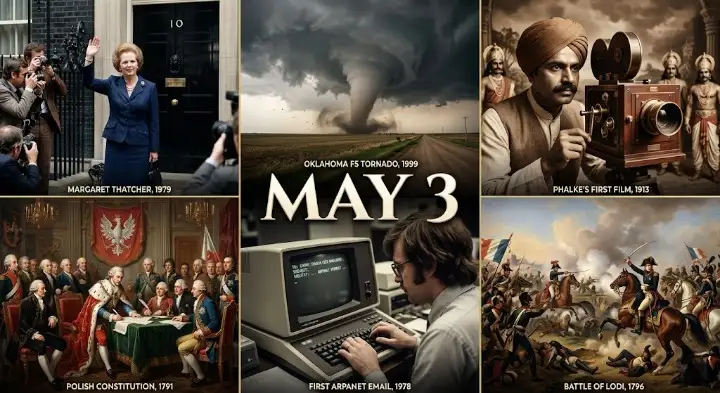
Margaret Thatcher stepped into 10 Downing Street, shattering a glass ceiling that had stood for centuries in British politics. Her ascent on May 3, 1979, changed the economic map of the Western world. That same date, 20 years later, the sky over Oklahoma turned a bruised purple as an F5 tornado tore through the landscape with winds faster than any ever measured. From political upheaval to the raw fury of nature, May 3 captures both our greatest ambitions and our deepest vulnerabilities.
👑 Quick Facts — May 3 in History
| 📌 Category | 📖 Event / Detail |
|---|---|
| 🌟 Most Significant Event | 1979 – Margaret Thatcher becomes the first female Prime Minister of the United Kingdom |
| 🏆 Key Events | • The May 3rd Constitution (1791) • Indian film industry birth (1913) • First spam email (1978) • Oklahoma tornado outbreak (1999) • Belgrade school shooting (2023) |
| ⚔️ Key Battles | Battle of Fuentes de Oñoro (1811), Battle of Tolentino (1815) |
| 👤 Key Figures | Margaret Thatcher, Niccolò Machiavelli, James Brown, Golda Meir, Raja Harishchandra |
| 🌍 Observances | World Press Freedom Day, Constitution Day (Poland), Constitution Memorial Day (Japan) |
Britain’s Conservative Party swept the 1979 general election, handing the keys of power to a chemist-turned-barrister who refused to play by the “gentleman’s club” rules of Westminster. Margaret Thatcher arrived at the doorstep of Downing Street, already dubbed “The Iron Lady” by Soviet media. She moved quickly to dismantle the post-war consensus, privatizing state-owned industries and breaking the influence of labor unions. Her polarizing style defined the 1980s, creating a legacy that forced Britain to reinvent its economic identity. History remembers her as a leader who shifted the political needle permanently.
Important Events That Happened On May 3 In History
752 – Bird Jaguar IV Ascends
Bird Jaguar IV stepped onto the throne in Yaxchilan, claiming his place among the divine kings of the Maya. His coronation in modern-day Chiapas solidified his family’s grip on a city-state known for its intricate stone carvings. Political stability followed, allowing for a golden age of architecture and artistic output. The site remains a vital link for understanding Mayan royal life today.
996 – Gregory V Becomes Pope
Otto III looked toward his cousin, Bruno of Carinthia, to fill the seat of St. Peter after the death of John XV. Bruno took the name Gregory V, becoming the first German pope in history. This appointment signaled the tightening bond between the Holy Roman Empire and the Papacy. It sparked a series of power struggles that would define the Middle Ages for years to come.
1481 – Rhodes Earthquake
The island of Rhodes shuddered as the largest of three massive earthquakes shattered its foundations. Thousands of citizens perished instantly as stone walls and homes collapsed under the tectonic force. Survivors faced the grim reality of rebuilding a strategic stronghold in the wake of such widespread destruction. The event remains a stark reminder of the island’s volatile geological location.
1491 – João I Baptized
Nkuwu Nzinga, the monarch of the Kingdom of Kongo, knelt before Portuguese missionaries to receive the sacrament of baptism. He adopted the name João I, aligning his kingdom with the Catholic faith and European influence. This decision opened trade and diplomatic doors that drastically altered the region’s cultural trajectory. Within a generation, the local aristocracy was deeply integrated into Western customs.
1568 – Massacre at San Mateo
French soldiers, fueled by rage over the destruction of Fort Caroline, stormed the Spanish-held San Mateo fort. They set the structure ablaze and killed hundreds of Spanish troops in a brutal act of frontier vengeance. This clash over colonial dominance in Florida sent shockwaves back to Europe’s royal courts. It highlighted the dangerous and shifting loyalties in the race to control the New World.
1616 – Treaty of Loudun
French nobility signed the Treaty of Loudun, finally bringing a halt to the chaotic civil war that had paralyzed the nation. It granted concessions to the rebellious princes and signaled a fragile peace for the young King Louis XIII. The victory was short-lived, as internal rivalries continued to simmer beneath the surface of the French court. It was a temporary bandage on a deeply fractured kingdom.
1715 – Solar Eclipse Across Eurasia
Edmond Halley watched his calculations manifest in the sky as a total solar eclipse plunged northern Europe and Asia into darkness. His prediction hit the mark within a mere four minutes, proving the precision of his astronomical models. Thousands of people stopped their work to witness the midday sun vanish from the horizon. It stood as a public triumph for the burgeoning science of celestial mechanics.
1791 – The Constitution of May 3
Polish lawmakers gathered to adopt the first modern constitution in Europe, hoping to save the failing Commonwealth. It abolished the “liberum veto” and established a constitutional monarchy to curb the influence of foreign powers. Despite the document’s brilliance, neighboring empires invaded soon after to crush the reform movement. It remains a powerful symbol of Polish resilience and desire for sovereignty.
1802 – Washington, D.C. Incorporated
Congress passed the act to abolish the District’s original Board of Commissioners, establishing the City of Washington as a formal municipality. A new mayor-council government took control, aiming to turn the swampy capital into a functional seat of democracy. The city began to grow into the sprawling federal hub that currently manages the country’s affairs. It was the first step toward the modern administrative power structure.
1808 – The Fortress of Sveaborg Falls
Swedish defenders finally surrendered the impregnable fortress of Sveaborg to the advancing Russian armies. The loss proved to be the death knell for Sweden’s campaign in the Finnish War, handing control of Finland to the Czar. Russia seized the strategic coastal position, gaining a permanent foothold in the Baltic. It transformed the map of Northern Europe for the next century.
1808 – Execution at Príncipe Pío
French firing squads lined up the Madrid rebels who had dared to rise up just one day earlier on May 2. Soldiers executed the prisoners near Príncipe Pío hill, attempting to extinguish the spark of resistance through sheer terror. Instead, the bloodshed ignited a nationwide guerrilla war against Napoleon’s occupying forces. It became a defining moment of defiance for the Spanish people.
1811 – Battle of Fuentes de Oñoro
Lord Wellington positioned his Anglo-Portuguese army to stop Marshal Masséna from reaching the besieged town of Almeida. Intense fighting erupted as both sides clashed in a brutal, point-blank struggle for control of the village streets. The French finally retreated, failing to break the blockade and securing a defensive win for the coalition. It proved that Wellington’s troops could hold their ground against seasoned veterans.
1815 – Battle of Tolentino
Joachim Murat, the King of Naples, led his forces against the Austrians in a desperate bid to hold his throne. The Battle of Tolentino turned into a rout, effectively ending the Neapolitan War and Murat’s reign. Austrian victory ensured their dominance over the Italian peninsula for the coming decades. It was the last stand for a king who had gained his crown through Napoleon’s favor.
1830 – Canterbury and Whitstable Railway
Steam hissed as the Canterbury and Whitstable Railway opened its tracks to passengers for the very first time. It introduced the innovation of season tickets and featured the world’s first tunnel built for a steam-hauled line. People flocked to experience the thrill of rail travel, which promised to revolutionize regional transport. It served as a blueprint for the sprawling rail networks that soon covered England.
1837 – University of Athens Founded
King Otto of Greece officially established the University of Athens, the first of its kind in the newly liberated nation. It aimed to cultivate a new generation of intellectuals to lead the country’s cultural revival. Scholars flocked to the campus to study medicine, law, and history in the shadow of ancient ruins. It remains the academic heart of the modern Greek state.
1848 – Benty Grange Helmet Found
Excavators digging in a barrow at Benty Grange farm discovered a rare Anglo-Saxon helmet adorned with a boar crest. This intricate piece of armor offered a rare look at the warrior culture of early medieval Britain. Its discovery provided physical evidence of the artistic and martial traditions long lost to time. It is now a centerpiece for anyone interested in early English craftsmanship.
1849 – May Uprising in Dresden
Revolutionaries barricaded the streets of Dresden, signaling the final push of the German revolutions of 1848–49. Citizens fought against the monarchy, demanding democratic rights and national unity in a climate of intense social unrest. Prussian troops eventually moved in to crush the insurgency, restoring the old order through force. It represented the end of an era for German democratic reformers.
1855 – William Walker’s Expedition
American adventurer William Walker set sail from San Francisco with 60 men, aiming to seize control of Nicaragua. His private army sought to capitalize on the region’s political instability to forge an empire of his own. This bold and illegal move led to a chaotic chapter of “filibustering” that angered regional neighbors. It serves as a reminder of the era’s unchecked expansionist ambitions.
1901 – The Great Fire of Jacksonville
A spark in a local fiber factory ignited a blaze that consumed the heart of Jacksonville, Florida. High winds carried embers across the city, turning thousands of homes and businesses into ash within hours. Nearly the entire downtown was decimated, leaving residents homeless and searching for a fresh start. The city eventually rose from the ruins to become a bustling port.
1913 – Raja Harishchandra Premieres
Dadasaheb Phalke unveiled Raja Harishchandra to a captivated audience, marking the start of the Indian film industry. This first full-length feature film told the story of an ancient king known for his unwavering honesty. It captured the public imagination and launched a global cultural powerhouse. Today, India produces more films annually than any other nation.
1920 – Failed Bolshevik Coup
Bolshevik agents attempted to overthrow the democratic government in the Democratic Republic of Georgia, hoping to bring it into the Soviet fold. Local security forces acted quickly, suppressing the uprising before it could gain a foothold. The republic maintained its independence for a short time longer, guarding its brief experiment with democracy. It highlights the constant pressure the nation faced from the growing Soviet threat.
1921 – Partition of Ireland
The Government of Ireland Act 1920 came into effect, carving the island into two distinct political entities. Northern Ireland and Southern Ireland were created, formalizing the split between unionists and nationalists. This decision drew a border that remains one of the most sensitive topics in British-Irish relations. It fundamentally changed the governing structure of the entire region.
1921 – First Sales Tax
West Virginia made history by passing the first broad-based sales tax in the United States. Lawmakers aimed to stabilize state revenue, though implementation stalled for years due to logistical hurdles. This pioneering tax policy set a precedent that almost every other state eventually adopted. It remains a key component of how American states fund their infrastructure today.
1928 – Jinan Incident
A clash in Jinan, China, left twelve Japanese civilians dead, sparking immediate retaliation from the Japanese military. Over the following days, more than 2,000 Chinese civilians were slaughtered in a brutal cycle of violence. This incident significantly escalated the tensions between the two nations leading up to full-scale war. It was a bloody indicator of the conflict to come in the Pacific.
1939 – All India Forward Bloc
Netaji Subhas Chandra Bose announced the formation of the All India Forward Bloc to consolidate radical factions within the independence movement. He sought to create a more militant and unified front against British colonial rule. His efforts rallied thousands of people who were tired of the slow pace of diplomatic negotiations. The group became a significant voice in the struggle for Indian freedom.
1942 – Invasion of Tulagi
Japanese naval troops launched an invasion of Tulagi Island as part of the broader Operation Mo. This move triggered the Battle of the Coral Sea, drawing American and Australian forces into a fierce naval confrontation. It was the opening move of a campaign to control the strategic sea lanes of the Pacific. The clash set the tone for the brutal island-hopping campaigns that followed.
1945 – Sinking of the Cap Arcona
British Royal Air Force planes bombed the prison ships Cap Arcona, Thielbek, and Deutschland in Lübeck Bay, unaware that thousands of prisoners were aboard. More than 7,000 people died in the cold waters just days before the end of the war in Europe. It stands as one of the most tragic and preventable disasters of the conflict. The survivors were left to recount a harrowing tale of mistaken identity.
1947 – New Japanese Constitution
Japan’s post-war constitution officially went into effect, establishing a pacifist parliamentary democracy. It renounced the nation’s right to wage war and limited the authority of the Emperor to a ceremonial role. This document transformed Japan from an imperial power into a stable, modern state focused on economic development. It continues to be the foundation of the country’s governance.
1948 – Shelley v. Kraemer
The U.S. Supreme Court delivered a landmark ruling in Shelley v. Kraemer, declaring that racially restrictive housing covenants were legally unenforceable. The court decided that state courts could no longer force property owners to uphold private contracts that discriminated against minorities. It was a significant victory for the civil rights movement in its quest for fair housing. The decision opened neighborhoods that had been segregated for decades.
1951 – Opening of Royal Festival Hall
London opened the Royal Festival Hall as the centerpiece of the Festival of Britain, a celebration of national renewal. The modern, glass-fronted building marked a departure from traditional architectural styles after the war. Thousands attended the inaugural concerts, signaling a return to cultural life and artistic expression. It remains a beloved venue for music and public events.
1951 – MacArthur Hearings Begin
The U.S. Senate committees gathered behind closed doors to investigate the controversial removal of General Douglas MacArthur by President Truman. Lawmakers debated the boundaries of presidential authority and the strategy for the ongoing Korean War. The hearings gripped the nation as they tried to understand the clash between military leadership and civilian oversight. It was a pivotal moment in American civil-military relations.
1952 – Landing at the North Pole
Lieutenant Colonels Joseph O. Fletcher and William P. Benedict successfully landed their plane at the exact geographic North Pole. They became the first people to stand on the very top of the world after flying directly to the location. Their mission proved that landing in such remote, frozen terrain was possible with the right equipment. It expanded the reach of American polar exploration and research.
1952 – Kentucky Derby Televised
CBS broadcast the Kentucky Derby to a national television audience for the first time, bringing the excitement of the track into millions of living rooms. Hill Gail crossed the finish line first, while viewers across the country watched the race unfold in real time. This innovation transformed the Derby from a regional tradition into a massive national spectacle. It changed the sports broadcasting industry forever.
1953 – Rescue on Pit River Bridge
Two men survived a terrifying plunge when their semitrailer crashed over the Pit River Bridge and fell into the water below. Virginia Schau captured the daring rescue on camera, creating the only Pulitzer Prize-winning photograph taken by a woman at that time. The image showed the world the incredible risks rescuers took to save lives. It remains one of the most famous news photos of the 1950s.
1957 – Dodgers Move to Los Angeles
Brooklyn Dodgers owner Walter O’Malley confirmed the team would leave New York for Los Angeles. The decision broke the hearts of millions of fans who had cheered for the “Bums” in Flatbush. It paved the way for Major League Baseball to become a true coast-to-coast enterprise. Fans in New York still debate the legacy of that move today.
1963 – Birmingham Campaign Violence
Police in Birmingham, Alabama, unleashed dogs and high-pressure hoses against protesters during the civil rights movement. The shocking images were broadcast globally, turning the eyes of the world toward the systemic inequality in the South. This violent suppression backfired, fueling support for the campaign and forcing federal intervention. It proved to be a turning point for the cause of racial justice.
1968 – Flight 352 Crash
Braniff International Airways Flight 352 disintegrated in the sky after flying into a severe storm near Dawson, Texas. All 85 people on board perished in the crash, leaving behind a community in deep mourning. Investigators worked to determine how the weather caused such a catastrophic failure of the aircraft. The tragedy led to new standards for flight safety in adverse weather conditions.
1971 – Erich Honecker Takes Power
Erich Honecker became the First Secretary of the Socialist Unity Party, effectively taking control of East Germany. He would remain the nation’s leader until the fall of the Berlin Wall in 1989. His rule was marked by rigid adherence to Soviet-style governance and the construction of the wall itself. He stands as the face of the authoritarian regime that controlled East Germany for decades.
1978 – The First Spam Email
Gary Thuerk, a marketing representative for Digital Equipment Corporation, sent a mass message to hundreds of ARPANET users. He wanted to invite them to a product demo, but his unsolicited email quickly drew the ire of network administrators. This was the first documented case of “spam,” an annoyance that has plagued the digital world ever since. It was a small experiment that spawned a massive industry.
1979 – Conservative Election Win
Margaret Thatcher’s Conservative Party won the UK general election in a landslide, signaling a move toward market-driven policies. The result paved the way for Thatcher to become the first female Prime Minister in the country’s history the following day. She brought a toughness to the office that completely reshaped the British economy. It was the beginning of the “Thatcherite” era.
1986 – Air Lanka Flight 512 Bombing
A bomb exploded on Air Lanka Flight 512 while it was sitting on the tarmac at Colombo airport in Sri Lanka. The blast killed 21 people and injured 41 others, creating a scene of absolute devastation. The attack served as a violent reminder of the ongoing ethnic tensions in the nation. It was one of the deadliest aviation incidents in the country’s history.
1987 – Talladega Crash
Bobby Allison’s car flew into the fencing at the start-finish line at Talladega Superspeedway, narrowly missing the crowd. The terrifying crash prompted NASCAR to mandate restrictor plates to slow down cars at its fastest tracks. This change significantly increased driver safety, though it altered the strategy of competitive racing. It was a moment that redefined how professional stock car racing functioned.
1999 – Oklahoma City F5 Tornado
An F5 tornado tore through the southwestern outskirts of Oklahoma City, killing 45 people and causing massive destruction. Meteorologists recorded wind speeds near 301 mph, the highest ever documented on Earth. The devastation was so widespread that “May 3” became a shorthand for this catastrophic weather event. It remains a grim benchmark for meteorologists tracking severe storms.
1999 – Kargil War Infiltration
Pakistani soldiers infiltrated the Indian-controlled side of the border near Kargil, igniting a high-altitude conflict. Indian forces mobilized to push the intruders back, leading to weeks of intense mountain warfare. The standoff threatened to escalate into a full-scale war between the two nuclear-armed neighbors. It was a tense period that tested the diplomacy and military readiness of both countries.
2000 – Geocaching Begins
Dave Ulmer hid the first “geocache” in the woods and posted its coordinates on a Usenet group, launching a global hobby. The game used GPS technology to lead people on treasure hunts in parks, cities, and remote wilderness areas. It turned hiking into an interactive adventure for people of all ages. Today, millions of caches are hidden in almost every country on the planet.
2001 – U.S. Loses UN Seat
The United States failed to retain its seat on the United Nations Human Rights Commission for the first time since 1947. This unexpected loss sent a message of frustration from other UN members regarding American foreign policy. It sparked a heated debate about the nation’s role and influence within international human rights institutions. The event remains a notable moment in U.S.-UN diplomatic history.
2006 – Armavia Flight 967 Crash
Armavia Flight 967 plunged into the Black Sea near Sochi, Russia, during a flight from Yerevan. All 113 passengers and crew members died in the cold water as the plane crashed in poor weather conditions. Investigators looked for answers as families across two nations waited for news. The tragedy left a lasting scar on the aviation records of the region.
2007 – Madeleine McCann Disappears
Three-year-old Madeleine McCann went missing from her family’s vacation rental in Praia da Luz, Portugal. The event turned into the most heavily reported missing-person case in modern history, drawing global attention to the search. Despite years of investigations and international interest, the mystery of her disappearance remains unsolved. It continues to haunt the public imagination.
2015 – Garland Shooting
Two gunmen launched an attack on an anti-Islam event in Garland, Texas, which had been organized in response to the Charlie Hebdo shooting. Security forces intervened and neutralized the attackers before they could reach the main crowd. The attempted massacre sparked intense debates about free speech and security in the digital age. It highlighted the ongoing tensions surrounding extremist violence.
2016 – Fort McMurray Wildfire
A massive wildfire ripped through Fort McMurray, Alberta, forcing 88,000 residents to evacuate their homes. The blaze destroyed over 2,400 buildings, turning parts of the community into a charred landscape. It was the largest wildfire evacuation in Alberta’s history, showing how quickly nature can overwhelm modern settlements. The town’s long recovery process became a symbol of resilience for the province.
2021 – Mexico City Metro Collapse
An elevated section of the Mexico City Metro collapsed as a train was traveling across it, killing 26 people and injuring 98. The structural failure drew immediate scrutiny to the maintenance and construction of the city’s transit infrastructure. Families demanded accountability as engineers and officials investigated the cause of the disaster. It remains a painful memory for the capital’s commuters.
2023 – Belgrade School Shooting
A student opened fire in a Belgrade school, killing nine students and a security guard in a rare act of mass violence for Serbia. The country, which had rarely seen such attacks, was left in shock and mourning. Citizens held vigils and debated how to address the underlying causes of the violence in their schools. It forced a national conversation about safety and youth mental health.
2023 – Ethnic Violence in Manipur
Clashes erupted between the Meitei and Kuki Zo people in the Indian state of Manipur, leading to widespread chaos and displacement. Homes were burned and communities turned against each other in a sudden wave of ethnic tension. The conflict drew national attention as authorities struggled to restore order and keep the peace. It highlighted the fragile balance of power in the region.
Wondering what came before today? Find out here.
Famous People Born On May 3
| Name | Description | Date |
|---|---|---|
| Theobald I | King of Navarre (1234–53), trouvère poet | May 3, 1201 – July 8, 1253 |
| Saint Sergius of Radonezh | Russian Orthodox monk, founder of Trinity Monastery | May 3, 1314 – September 25, 1392 |
| Pedro González, cardinal de Mendoza | Spanish prelate, “third king of Spain” | May 3, 1428 – January 11, 1495 |
| Constantine III | Byzantine emperor (January–April/May 641) | May 3, 612 – April/May 641 |
| Matthäus Daniel Pöppelmann | German architect, designer of the Zwinger in Dresden | May 3, 1662 – January 17, 1736 |
| William Broome | British scholar, collaborator with Alexander Pope on Homer | May 3, 1689 – November 16, 1745 |
| Henri Pitot | French hydraulic engineer, inventor of pitot tube | May 3, 1695 – December 27, 1771 |
| George Macartney, Earl Macartney | First British emissary to Beijing | May 3, 1737 – March 31, 1806 |
| Emmanuel-Joseph Sieyès | French politician and constitutional theorist | May 3, 1748 – June 20, 1836 |
| August von Kotzebue | German playwright of melodramatic drama | May 3, 1761 – March 23, 1819 |
| Elizabeth of France | French princess, sister of Louis XVI | May 3, 1764 – May 10, 1794 |
| Saint Giuseppe Cottolengo | Italian saint, founder of Little House of Divine Providence | May 3, 1786 – April 30, 1842 |
| James Thomason | British lieutenant governor of North-Western Provinces, India | May 3, 1804 – September 27, 1853 |
| Henryk Dembiński | Polish soldier and revolutionary leader | May 3, 1791 – June 13, 1864 |
| Laura Matilda Towne | American educator of freedmen after Civil War | May 3, 1825 – February 22, 1901 |
| Edward Dowden | Irish critic and Shakespeare scholar | May 3, 1843 – April 4, 1913 |
| Wilbur Olin Atwater | American chemist, pioneer of nutrition science | May 3, 1844 – September 22, 1907 |
| E.W. Howe | American editor, novelist, and essayist | May 3, 1853 – October 3, 1937 |
| Vito Volterra | Italian mathematician, integral equations | May 3, 1860 – October 11, 1940 |
| Max Hussarek, Freiherr von Heinlein | Prime minister of Austria during WWI | May 3, 1865 – March 6, 1935 |
| V. Walfrid Ekman | Swedish oceanographer, Ekman layer/spiral | May 3, 1874 – March 9, 1954 |
| Karl Abraham | German psychoanalyst, infant sexuality studies | May 3, 1877 – December 25, 1925 |
| Henri-René Lenormand | French dramatist of subconscious motivation | May 3, 1882 – February 16, 1951 |
| Marcel Dupré | French organ virtuoso and composer | May 3, 1886 – May 30, 1971 |
| Herman Francis Mark | Austrian American chemist, father of polymer science | May 3, 1895 – April 6, 1992 |
| V.K. Krishna Menon | Indian nationalist and diplomat | May 3, 1897 – October 6, 1974 |
| Alfred Kastler | French physicist, Nobel Prize (1966) | May 3, 1902 – January 7, 1984 |
| May Sarton | American poet, novelist, and essayist | May 3, 1912 – July 16, 1995 |
| William Inge | American playwright, Pulitzer Prize for Picnic | May 3, 1913 – June 10, 1973 |
| Isadore Singer | American mathematician, Abel Prize (2004) | May 3, 1924 – February 11, 2021 |
Famous People Died On May 3
| Name | Description | Date |
|---|---|---|
| Béla IV | King of Hungary (1235–70), rebuilt after Mongol invasion | 1206 – May 3, 1270 |
| Alexander (V) | Antipope (1409–10) | c.1339 – May 3, 1410 |
| Johannes Sturm | German educator, model Latin Gymnasium | October 1, 1507 – May 3, 1589 |
| Henry Garnett | English Jesuit, implicated in Gunpowder Plot | 1555 – May 3, 1606 |
| Johan Björnsson Printz | Swedish colonial governor of New Sweden | July 20, 1592 – May 3, 1663 |
| Heinrich Biber | Bohemian Baroque violinist and composer | August 12, 1644 – May 3, 1704 |
| Dga’-ldan | Dzungar Mongol leader (reigned 1676–97) | 1664? – May 3, 1697 |
| Francesco Algarotti | Italian art connoisseur of the Enlightenment | December 11, 1712 – May 3, 1764 |
| Benedict XIV | Pope (1740–58), known for intelligence and moderation | March 31, 1675 – May 3, 1758 |
| Anthony Benezet | American educator, abolitionist, and social reformer | January 31, 1713 – May 3, 1784 |
| Joseph Joubert | French man of letters | May 6, 1754 – May 3, 1824 |
| Aleksey Andreyevich, Graf Arakcheyev | Russian general and statesman under Alexander I | October 4, 1769 – May 3, 1834 |
| Ferdinando Paer | Italian composer of opera buffa | June 1, 1771 – May 3, 1839 |
| Thomas Coke | First bishop of the Methodist Church | September 9, 1747 – May 3, 1814 |
| Thomas Hood | English poet and humorist, “The Song of the Shirt” | May 23, 1799 – May 3, 1845 |
| Adolphe Adam | French composer, ballet Giselle | July 24, 1803 – May 3, 1856 |
| Jonathan Homer Lane | American astrophysicist, studied Sun as gaseous body | August 9, 1819 – May 3, 1880 |
| Sir Charles Tilston Bright | British engineer, laid first Atlantic telegraph cable | June 8, 1832 – May 3, 1888 |
| Henri-Louis Tolain | French politician and workers’ association organizer | June 18, 1828 – May 3, 1897 |
| Howard T. Ricketts | American pathologist, discovered Rocky Mountain spotted fever | February 9, 1871 – May 3, 1910 |
| Daniel Edgar Sickles | American politician, acquired land for Central Park | October 20, 1825 – May 3, 1914 |
| Oscar Solomon Straus | First Jewish U.S. Cabinet member | December 23, 1850 – May 3, 1926 |
| Thorvald Stauning | Prime minister of Denmark (1924–26, 1929–42) | October 26, 1873 – May 3, 1942 |
| Frank M. Andrews | U.S. Army air force officer | February 3, 1884 – May 3, 1943 |
| Mariano Fortuny | Spanish-Italian fashion and textile designer | May 11, 1871 – May 3, 1949 |
| Louis Wirth | American sociologist, urban problems pioneer | August 28, 1897 – May 3, 1952 |
| Earnest A. Hooton | American physical anthropologist | November 20, 1887 – May 3, 1954 |
| Howard Spring | Welsh-born British novelist | February 10, 1889 – May 3, 1965 |
| Ernie Nevers | American football and baseball player | June 11, 1903 – May 3, 1976 |
| Lev Semyonovich Pontryagin | Russian mathematician, topology and control theory | September 3, 1908 – May 3, 1988 |
Observances on May 3
- Constitution Day (Poland): Celebrates the landmark adoption of Europe’s first modern constitution in 1791.
- Fiesta de las Cruces (Spain and Hispanic America): A traditional festival featuring elaborately decorated crosses adorned with flowers.
- International Sun Day: A global effort to raise awareness about the benefits of solar energy and renewable resources.
- Constitution Memorial Day (Japan): Marks the day Japan’s post-war constitution took effect in 1947, promoting a peaceful democracy.
- World Press Freedom Day: An annual observance dedicated to highlighting the importance of a free and independent press in global society.
👑 Frequently Asked Questions — May 3 in History
Margaret Thatcher was elected as the Prime Minister of the United Kingdom, becoming the first woman to hold the position. Her victory marked a major shift in British politics and set the stage for a decade of significant economic change.
The election of Margaret Thatcher in 1979 is widely considered the most significant because of her lasting impact on global economic policies. Other major candidates include the 1791 Polish Constitution and the birth of the Indian film industry in 1913.
Niccolò Machiavelli, the influential Italian philosopher and writer, was born on this day in 1469. Other notable births include the singer James Brown, born in 1933, and the Israeli Prime Minister Golda Meir, born in 1898.
The Battle of Fuentes de Oñoro in 1811 and the Battle of Tolentino in 1815 were major military engagements that occurred on this date. Additionally, in 1999, the infiltration of soldiers in Kargil sparked a brief but intense war between India and Pakistan.
World Press Freedom Day is a global observance held on May 3 to emphasize the vital role of the media in a free society. It is remembered to protect journalists’ safety and to defend the right to express information without government interference or censorship.
In 2023, a school shooting occurred in Belgrade, Serbia, which was the first of its kind in the nation. Also in 2023, ethnic violence broke out in the Indian state of Manipur, leading to widespread unrest and community displacement.