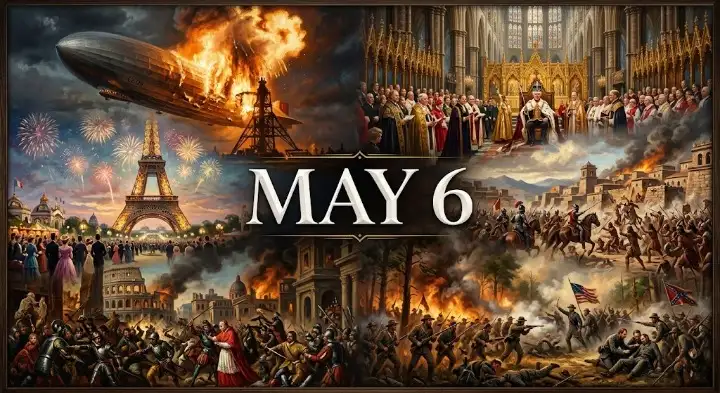
In the skies over New Jersey on May 6, 1937, the pride of German engineering, the Hindenburg, transformed into a death trap in less than sixty seconds. That same date, centuries earlier, the eternal city of Rome was ransacked by soldiers, shattering the peace of the Renaissance. May 6 is a date where monumental human achievements collided with sudden, devastating ruin. This post tracks these moments to show the weight of what happened on this day in history May 6.
🎈 Quick Facts — May 6 in History
| 📌 Category | 📖 Event / Detail |
|---|---|
| 🌟 Most Significant Event | The Hindenburg Disaster (1937) |
| 🏆 Top 10 Key Events | • Sack of Rome (1527) • Siege of Cuzco (1536) • Eiffel Tower opening (1889) • Chinese Exclusion Act (1882) • Roger Bannister’s sub-four-minute mile (1954) • Coronation of Charles III (2023) • First televised royal wedding (1960) • Coronation of George V (1910) • Founding of the New York Herald (1835) • Death of Pim Fortuyn (2002) |
| ⚔️ Key Battles | Siege of Acre (1104), Battle of Chancellorsville (1863), Battle of Prague (1757) |
| 👤 Key Figures | King Henry VIII, Louis XIV, Chief Crazy Horse, Babe Ruth, Steve Jobs}- |
| 🌍 Observances | International No Diet Day, Hıdırellez, Martyrs’ Day (Lebanon and Syria) |
Story of the Day: The Hindenburg Disaster
Lakehurst, New Jersey, May 6, 1937: The LZ 129 Hindenburg approached its mooring mast, a majestic silver giant against the gray sky. Without warning, a spark ignited the hydrogen within the airship’s skin. The inferno consumed the vessel in under a minute, turning a symbol of luxury air travel into a falling torch before the eyes of gathered reporters. Thirty-six people perished in the flames. This catastrophe ended the era of passenger zeppelins instantly, shifting the future of aviation toward the heavier-than-air planes that dominate our skies today.
Important Events That Happened On May 6 In History
1104 – King Baldwin I begins the siege of Acre
King Baldwin I surrounded the vital port city of Acre, targeting the Fatimid-held stronghold to expand Crusader reach. This maneuver tightened the grip of the Kingdom of Jerusalem on the Mediterranean coast. Winning the city secured a essential naval hub for trade and military supply. The siege reshaped regional power dynamics for the next several decades.
1527 – The Sack of Rome
Mutinous Imperial troops under Holy Roman Emperor Charles V breached the defenses of Rome, leading to widespread looting and destruction. This violence crippled the Papacy and forced many artists to flee, effectively ending the high Renaissance era. The city never fully regained its former cultural dominance. The event is widely viewed as a definitive closure of the Renaissance period.
1536 – The Siege of Cuzco commences
Manco Inca Yupanqui led an Incan army to retake the city of Cuzco from Spanish occupiers. The intense urban battle forced the conquistadors into a defensive posture against overwhelming numbers. While the Spanish ultimately held their ground, the revolt shattered their sense of total control. This uprising remains a powerful example of indigenous resistance against colonial expansion.
1541 – Henry VIII mandates English Bibles
King Henry VIII ordered that an English-language Bible be placed in every church throughout his realm for public access. This directive shifted religious power, moving the scriptures away from the exclusive control of Latin-speaking clergy. Literacy rates grew as citizens gathered to hear the texts in their own language. The move was a calculated effort to accelerate the English Reformation.
1542 – Francis Xavier reaches Old Goa
Francis Xavier arrived in Old Goa, the capital of Portuguese India, to begin his missionary work in the East. His arrival marked the start of a massive expansion of Jesuit influence across Asia. He would spend the rest of his life traveling, preaching, and establishing permanent Catholic communities. His efforts fundamentally altered the religious demographics of the region.
1594 – Fall of Coevorden
Dutch and English forces successfully captured the city of Coevorden, previously held by the Spanish. This tactical victory provided the Dutch with a crucial inland base during their long struggle for independence. The fall of the city signaled a shift in military momentum in the northern provinces. It eventually paved the way for broader regional stability.
1659 – Richard Cromwell removed as Lord Protector
British Army factions removed Richard Cromwell from his role as Lord Protector, effectively ending the fragile Protectorate government. The soldiers immediately moved to reinstall the Rump Parliament in a bid for control. This political instability signaled the collapse of the Commonwealth. It set the stage for the eventual restoration of the monarchy the following year.
1682 – Louis XIV moves to Versailles
Louis XIV officially transitioned his entire royal court to the newly expanded Palace of Versailles. By isolating the nobility in this opulent environment, he centralized power and kept his rivals under constant surveillance. The move turned the palace into the undisputed cultural and political center of Europe. It solidified his image as the absolute, unchecked ruler of France.
1757 – Battle of Prague
Prussian forces engaged an Austrian army in a violent clash on the outskirts of Prague during the Seven Years’ War. The fight resulted in heavy casualties for both sides, turning the city into a central focus of the conflict. Prussia gained a temporary tactical advantage but faced fierce, ongoing resistance. The battle remains a core example of the high-stakes warfare defining 18th-century Europe.
1757 – End of the Burmese Civil War
The signing of a peace agreement brought a formal conclusion to the Konbaung–Hanthawaddy War and the wider Burmese Civil War. This unified the region under the rising Konbaung Dynasty after seventeen years of internal strife. Central authority was restored, allowing the kingdom to stabilize its economy and borders. The resolution marked a new era of expansion for the Burmese state.
1757 – Christopher Smart enters St Luke’s
The poet Christopher Smart was admitted to St Luke’s Hospital for Lunatics, marking the start of a six-year confinement. His incarceration in the asylum triggered a prolific period of writing, including his famous work, Jubilate Agno. His experience sheds light on the harsh and often misunderstood treatment of mental health in 18th-century London. He remains a noted figure in English literary history.
1782 – Construction of the Grand Palace begins
King Buddha Yodfa Chulaloke ordered the construction of the Grand Palace in Bangkok to serve as the royal residence of Siam. The site was built to reflect the power and divine status of the monarch. It quickly became the heart of the city and the administrative center of the kingdom. The palace complex still serves as a global symbol of Thai culture and craftsmanship.
1801 – HMS Speedy captures El Gamo
Captain Thomas Cochrane, commanding the 14-gun HMS Speedy, successfully captured the 32-gun Spanish frigate El Gamo. This engagement is often studied for Cochrane’s daring tactical maneuvering against a significantly larger opponent. The victory boosted British naval morale during the Napoleonic Wars. It solidified Cochrane’s reputation as one of history’s most brilliant and audacious naval commanders.
1835 – New York Herald publishes first issue
James Gordon Bennett, Sr. released the first edition of the New York Herald, changing the face of American journalism. He introduced a focus on crime, sports, and business, making news accessible to the common person rather than just the elite. The publication quickly grew into one of the most widely read papers in the country. It pioneered many of the business models used in modern news organizations.
1840 – The Penny Black is released
The Penny Black, the world’s first adhesive postage stamp, became valid for use across the United Kingdom. This innovation made mail affordable for everyone, revolutionizing communication between citizens. It ended the complicated and expensive process of paying for letters based on distance and sheet count. The system established the standard model for global postal services.
1857 – 34th Regiment of Bengal Native Infantry disbanded
The East India Company officially disbanded the 34th Regiment of Bengal Native Infantry following the revolt led by sepoy Mangal Pandey. This action was intended to quell the growing dissent among Indian soldiers against British authority. Instead, the move backfired and served as a major catalyst for the War of Indian Independence. It marked a point of no return in the relationship between the British and their colonial troops.
1861 – Arkansas secedes from the Union
Arkansas officially declared its secession from the United States, joining the Confederacy as tensions over slavery and states’ rights reached a boiling point. The decision split families and communities across the state. It placed Arkansas on the front lines of the upcoming American Civil War. The state’s resources and geography became essential to the Confederate war effort.
1863 – Battle of Chancellorsville ends
The Battle of Chancellorsville concluded with a decisive defeat of the Union’s Army of the Potomac by Robert E. Lee’s smaller Confederate forces. Lee’s bold tactical risks resulted in what many historians call his greatest military masterpiece. Despite the victory, the Confederacy suffered a critical blow with the mortal wounding of General “Stonewall” Jackson. The engagement significantly bolstered Southern morale before the Gettysburg campaign.
1877 – Chief Crazy Horse surrenders
Chief Crazy Horse of the Oglala Lakota led his people to surrender to United States troops in Nebraska. This marked the end of his long, defiant resistance against the encroachment of settlers on Lakota lands. His surrender signaled the effective end of the Great Sioux War. It remains a poignant moment in the history of Native American displacement.
1882 – Phoenix Park Murders
Fenian assassins killed Thomas Henry Burke and Lord Frederick Cavendish in Dublin’s Phoenix Park. The act was a direct attack on British colonial administration in Ireland. It ignited a firestorm of political outrage and led to a harsh crackdown by the authorities. The incident radicalized both sides and shifted the trajectory of the Irish independence movement.
1882 – Chinese Exclusion Act passed
The United States Congress passed the Chinese Exclusion Act, the first federal law to ban a specific ethnic group from entering the country. The legislation was driven by intense anti-immigrant sentiment and labor disputes on the West Coast. It created a legal framework for systemic discrimination that lasted for decades. The act fundamentally reshaped American immigration policy.
1889 – Eiffel Tower opens
Gustave Eiffel opened his iron tower to the public during the Universal Exposition in Paris. While initial critics called the structure an eyesore, it soon became the city’s most beloved landmark. The tower showcased the potential of iron and steel in modern engineering. It stands today as the quintessential icon of France.
1901 – Gorkhapatra first issue
The first edition of Gorkhapatra, the oldest state-owned newspaper in Nepal, hit the streets. It began as a weekly and served as the primary source of government information for the Nepali people. Through decades of political change, it has remained a consistent voice for the state. It is a key artifact in the development of modern Nepali media.
1906 – Russian Constitution adopted
The Russian Constitution of 1906 was formally adopted, marking the transition from an absolute autocracy to a limited constitutional monarchy. The document followed the unrest of the 1905 Revolution and promised new civil rights. While Tsar Nicholas II frequently undermined these powers, the change provided a blueprint for future political reform. It remains a pivotal moment in the lead-up to the 1917 revolutions.
1910 – George V becomes King
Following the death of his father, Edward VII, George V ascended to the throne of Great Britain. He took power during a time of immense social and political change across his vast empire. His reign would eventually encompass the First World War and the Irish independence struggle. He became a symbol of national stability during a period of global turmoil.
1915 – Babe Ruth hits first home run
Boston Red Sox pitcher Babe Ruth hit his first major league home run during a game against the New York Yankees. At this time, he was primarily known for his pitching prowess rather than his legendary batting. This singular moment foreshadowed his future role in changing how the game of baseball was played. He soon transitioned into the most dominant slugger in the sport’s history.
1915 – SY Aurora breaks loose
The SY Aurora, part of the Imperial Trans-Antarctic Expedition, tore away from its anchorage during a fierce Antarctic gale. This incident trapped the ship’s crew on the ice and began a harrowing 312-day ordeal of survival. The men faced starvation, extreme cold, and isolation while cut off from the rest of the expedition. Their eventual rescue became a legendary story of endurance.
1916 – Martyrs’ Square executions
Djemal Pasha ordered the public execution of twenty-one Lebanese nationalists in Beirut’s Martyrs’ Square. The crackdown was meant to crush growing anti-Ottoman sentiment in the region. Instead, the deaths united diverse communities against Ottoman rule. The square remains a lasting memorial to those who sacrificed their lives for independence.
1916 – Emperor Duy Tân captured
French colonial authorities captured the Vietnamese Emperor Duy Tân after he attempted to mobilize his people against their rule. He was promptly deposed, stripped of his titles, and exiled to the island of Réunion. His capture silenced one of the most prominent royal voices for Vietnamese sovereignty. The event solidified French colonial control in Indochina.
1933 – Institut für Sexualwissenschaft raided
The Deutsche Studentenschaft raided the Institut für Sexualwissenschaft, run by Magnus Hirschfeld, in a violent effort to purge “un-German” ideas. The attackers dragged years of research and personal libraries into the street and burned them. This destruction represented the early stages of the Nazi effort to erase minority identities. It remains a stark reminder of the cost of authoritarian censorship.
1935 – Works Progress Administration created
President Franklin D. Roosevelt signed Executive Order 7034, establishing the Works Progress Administration to tackle the massive unemployment of the Great Depression. The agency provided millions of Americans with jobs building public infrastructure like bridges, roads, and schools. It changed the physical landscape of the nation while keeping families fed during a time of crisis. The WPA remains a hallmark of the New Deal’s legacy.
1937 – Hindenburg disaster
The German zeppelin Hindenburg ignited while attempting to land at Lakehurst, New Jersey, burning to the ground in under one minute. Thirty-six people perished, and the footage of the tragedy reached millions via radio and newsreels. The disaster effectively ended the era of luxury airship travel. It shifted the aviation industry toward the heavier-than-air planes that dominate global transport today.
1940 – The Grapes of Wrath wins Pulitzer
John Steinbeck was awarded the Pulitzer Prize for his novel The Grapes of Wrath. The book depicted the harsh realities of the Dust Bowl and the migration of displaced workers to California. Its success brought national attention to the plight of the rural poor during the Depression. The novel remains a cornerstone of American literature and social commentary.
1941 – Bob Hope performs first USO show
Bob Hope stepped onto the stage at March Field in California to perform his very first USO show for American soldiers. This act launched a decades-long tradition of bringing comedy and music to troops stationed around the world. He became an icon of wartime morale and a household name. His shows set the standard for how the military interacts with civilian entertainers.
1941 – Republic P-47 Thunderbolt first flight
The Republic P-47 Thunderbolt successfully completed its maiden flight, introducing one of the most rugged fighters of World War II. Known for its heavy armament and ability to absorb significant battle damage, the plane became a favorite for ground-attack missions. It played a critical role in securing Allied air superiority in both Europe and the Pacific. The P-47 remains a standout example of successful military engineering.
1942 – Corregidor surrenders
The last American forces in the Philippines surrendered to Japanese troops on the island of Corregidor. The fall of the fortress completed the Japanese conquest of the archipelago and forced many Allied soldiers into captivity. This defeat was a major blow to American forces in the Pacific theater. It led to the famous Bataan Death March and a long occupation of the Philippines.
1945 – Axis Sally’s final broadcast
Mildred Gillars, known as “Axis Sally,” delivered her last propaganda radio broadcast intended to demoralize Allied troops. Her efforts to influence Western soldiers had largely failed, and she was captured shortly after the end of the war. Her broadcast career represents the desperate final attempts by the Axis powers to influence public opinion. She was eventually prosecuted for treason.
1945 – Prague Offensive begins
The Prague Offensive launched as the final major battle of the Eastern Front in World War II. Red Army forces surged into the city to liberate it from remaining German control days before the war ended. The struggle was intense and resulted in significant loss of life during the closing hours of the conflict. It marked the definitive end of Nazi power in Czechoslovakia.
1949 – EDSAC runs first program
The EDSAC computer performed its first successful operation, becoming the first practical electronic digital stored-program computer. This breakthrough allowed for complex calculations to be completed in a fraction of the time previously required. It paved the way for the digital age and all future computing technology. The machine proved that stored-program concepts were viable for real-world use.
1954 – Roger Bannister runs sub-four-minute mile
Roger Bannister crossed the finish line at Oxford, becoming the first person to run a mile in under four minutes. Experts had long debated whether the human body was physically capable of such a feat. His success shattered the psychological barrier for athletes around the world. It remains one of the most iconic achievements in the history of track and field.
1960 – Princess Margaret’s royal wedding
Princess Margaret and Antony Armstrong-Jones were married at Westminster Abbey, becoming the first royal wedding to be televised. More than 20 million viewers tuned in, showcasing the new power of media in the lives of the monarchy. The event was a cultural spectacle that blended tradition with modern fame. It set the precedent for the massive public interest in royal nuptials today.
1966 – Moors murderers sentenced
Ian Brady and Myra Hindley were sentenced to life imprisonment for the Moors murders in England. The cruelty of their crimes shocked the nation and led to intense debates about the justice system. Their case remains one of the most infamous in British criminal history. The verdict provided closure for the families of the victims after a long and grueling investigation.
1972 – Three Turkish radicals executed
Deniz Gezmiş, Yusuf Aslan, and Hüseyin İnan were executed in Ankara after being convicted of trying to overthrow the constitutional order. Their deaths became a rallying cry for student movements and leftist politics in Turkey. The executions heightened political polarization throughout the country for years. They are still remembered as symbols of ideological resistance.
1975 – Armenian Genocide commemoration
An estimated 100,000 Armenians gathered in Beirut during a temporary lull in the Lebanese Civil War to honor the 60th anniversary of the Armenian genocide. The event highlighted the enduring pain of the diaspora and their commitment to remembrance. It was a massive display of solidarity in a time of extreme domestic conflict. The gathering reinforced the global push for historical recognition.
1976 – Friuli earthquake
A 6.5-magnitude earthquake struck the Friuli region of Northern Italy, causing widespread destruction. Up to 978 people were killed, and thousands more were left injured or homeless. The scale of the disaster triggered a massive, highly efficient reconstruction effort. The recovery is often cited as a successful model for post-disaster community management.
1983 – Hitler Diaries exposed as hoax
Experts officially revealed that the “Hitler Diaries,” long considered a major historical find, were complete forgeries. The revelation embarrassed many media outlets that had rushed to publish the contents without proper verification. It served as a massive lesson in the necessity of rigorous historical skepticism. The incident is still used as a case study for media ethics and source checking.
1984 – Korean Martyrs canonized
Pope John Paul II traveled to Seoul to canonize 103 Korean Martyrs who died for their faith. This was the first time such a ceremony was held outside of the Vatican. It signaled the growing importance of the Asian church in the global Catholic community. The event was a landmark moment for religious identity in South Korea.
1988 – Widerøe Flight 710 crash
Widerøe Flight 710 crashed into Mt. Torghatten in Norway, killing all thirty-six passengers and crew on board. The tragedy devastated the community and prompted a thorough investigation into aviation safety in mountainous terrain. It remains one of the deadliest aviation accidents in Norwegian history. Families of the victims successfully advocated for better safety protocols afterward.
1994 – Channel Tunnel opening
Queen Elizabeth II and French President François Mitterrand gathered to officially open the Channel Tunnel, linking the United Kingdom and France. The massive project represented an unprecedented feat of engineering and international cooperation. It transformed travel between the two nations, allowing high-speed trains to cross the sea in minutes. The tunnel has since become a vital artery for European commerce.
1996 – William Colby’s body recovered
Search teams discovered the body of former CIA director William Colby on a Maryland riverbank, eight days after he vanished. His disappearance had triggered an intense search across the region. The circumstances of his death fueled numerous theories given his background in intelligence. His passing marked the end of a long and controversial career in the shadows.
1997 – Bank of England gains independence
The British government granted the Bank of England independence from political control, a move labeled the most significant shift in its 300-year history. This policy was designed to keep inflation stable by removing interest rate decisions from the hands of short-term politicians. It stabilized the national economy and gained international praise. Most central banks now follow a similar model of independence.
1998 – Kerry Wood ties record
Chicago Cubs pitcher Kerry Wood struck out 20 batters in a single game, tying the major league record previously held by Roger Clemens. In only his fifth career start, he threw a near-perfect one-hitter against the Houston Astros. The performance was widely regarded as one of the most dominant displays of pitching in baseball history. He became an overnight sensation in the sports world.
1998 – Apple unveils iMac
Steve Jobs stood on stage to introduce the first iMac, a colorful, all-in-one computer that aimed to make technology accessible and stylish. Its unique design and focus on internet connectivity helped save Apple from the brink of financial collapse. The launch signaled a new direction for personal computing, prioritizing aesthetics alongside functionality. It remains one of the most successful product launches in tech history.
1999 – First Scottish and Welsh elections
The United Kingdom held the inaugural elections for the newly devolved Scottish Parliament and the Welsh Assembly. This move decentralized power away from London, giving local representatives more control over their own regional policies. It changed the structure of British politics and fueled debates about the future of the union. These bodies now shape critical legislation for their respective countries.
2001 – Pope John Paul II enters a mosque
Pope John Paul II became the first pope in history to enter and pray inside a mosque during his visit to Syria. His gesture of interfaith dialogue was intended to bridge divides between the Catholic Church and the Muslim world. He emphasized the common values shared by the two faiths at a time of increasing geopolitical tension. The visit remains a landmark moment for global religious diplomacy.
2002 – Pim Fortuyn assassinated
Dutch politician Pim Fortuyn was assassinated in Hilversum shortly after conducting a radio interview. His death sent shockwaves through the Netherlands and brought the issue of immigration and secularism to the forefront of national politics. The attack was a rare instance of political murder in a country known for its stability. It permanently altered the landscape of Dutch electoral campaigns.
2004 – Friends finale airs
The final episode of Friends aired, drawing an audience of over 50 million viewers in the United States. It was a cultural event that concluded a decade of television history and defined the “must-see TV” era of the 1990s. The characters became household names, and the show’s impact on fashion and pop culture continues to be felt. It remains the gold standard for sitcom success.
2010 – Flash Crash
The Dow Jones Industrial Average plummeted nearly 1,000 points in just 36 minutes, an event known as the Flash Crash. The sudden drop was largely driven by automated trading algorithms that triggered a chaotic market feedback loop. While the market recovered quickly, the event exposed the risks inherent in computerized high-frequency trading. It forced regulators to rethink how they oversee modern stock exchanges.
2013 – Cleveland kidnapping victims found
Three women who had been missing for over a decade were discovered alive in a home in Cleveland, Ohio. Their rescue captivated the world and brought international attention to the failures of the local justice system. The survivors began the difficult process of healing after years of captivity. Their case spurred new conversations about human trafficking and community safety.
2023 – Coronation of Charles III
King Charles III and Queen Camilla were crowned at Westminster Abbey in London. The ceremony was the first such event for a British monarch in 70 years, updating traditional rituals for the 21st century. It signaled a new era for the British monarchy amidst changing public attitudes toward the institution. The event drew massive global coverage and tourism to the capital.
2023 – Allen, Texas mass shooting
A gunman killed eight people and injured seven others during a mass shooting at a shopping center in Allen, Texas. A police officer on an unrelated call killed the perpetrator, ending the attack in minutes. The tragedy reignited national debates regarding gun violence and public safety. It remains a painful example of the ongoing struggle with mass shootings in the United States.
Click here to browse our collection of previous daily facts.
Famous People Born On May 6
| Name | Description | Date |
|---|---|---|
| Henry II | Holy Roman emperor (1014–24), last of Saxon dynasty | May 6, 973 – July 13, 1024 |
| Marcellus II | Pope for 22 days in April–May 1555 | May 6, 1501 – May 1, 1555 |
| Diego de Saavedra Fajardo | Spanish diplomat and anti-Machiavellian writer | May 6, 1584 – August 24, 1648 |
| Johann Joachim Becher | German chemist, phlogiston theory precursor | May 6, 1635 – October 1682/1685 |
| Alain-René Lesage | French satirist, author of Gil Blas | May 6, 1668 – November 17, 1747 |
| Johann Andreas Stein | German piano builder | May 6, 1728 – February 29, 1792 |
| Jean Senebier | Swiss botanist, photosynthesis research | May 6, 1742 – July 22, 1809 |
| Joseph Joubert | French man of letters | May 6, 1754 – May 3, 1824 |
| Henry Phillpotts | Church of England bishop of Exeter | May 6, 1778 – September 18, 1869 |
| William Strong | Associate justice of U.S. Supreme Court (1870–80) | May 6, 1808 – August 19, 1895 |
| Martin Delany | African American abolitionist and physician | May 6, 1812 – January 24, 1885 |
| Robert O’Hara Burke | Australian explorer, led first south-north crossing | May 6, 1820? – June 28, 1861? |
| Wilhelm Heinrich Riehl | German journalist, sociological history pioneer | May 6, 1823 – November 16, 1897 |
| Abraham Jacobi | German-born physician, founder of American pediatrics | May 6, 1830 – July 10, 1919 |
| Max Eyth | German engineer, agricultural mechanization pioneer | May 6, 1836 – August 25, 1906 |
| Grove Karl Gilbert | American geologist, founder of modern geomorphology | May 6, 1843 – May 1, 1918 |
| Henry Edward Armstrong | English organic chemist, naphthalene research | May 6, 1848 – July 13, 1937 |
| Robert Peary | American Arctic explorer, reached North Pole (1909) | May 6, 1856 – February 20, 1920 |
| Willem Kloos | Dutch poet and critic, 1880 literary revival | May 6, 1859 – March 31, 1938 |
| Luis María Drago | Argentine statesman, Drago Doctrine | May 6, 1859 – June 9, 1921 |
| Oscar W. Underwood | U.S. congressman, Underwood Tariff Act (1913) | May 6, 1862 – January 25, 1929 |
| Gaston Leroux | French novelist, The Phantom of the Opera | May 6, 1868 – April 15, 1927 |
| John T. McCutcheon | American newspaper cartoonist | May 6, 1870 – June 10, 1949 |
| A.P. Giannini | American banker, founder of Bank of America | May 6, 1870 – June 3, 1949 |
| Victor Grignard | French chemist, Nobel Prize (1912), Grignard reaction | May 6, 1871 – December 13, 1935 |
| Christian Morgenstern | German poet and humorist | May 6, 1871 – March 31, 1914 |
| Cemal Paşa | Turkish political leader, Ottoman government in WWI | May 6, 1872 – July 21, 1922 |
| Willem de Sitter | Dutch astronomer, cosmological models | May 6, 1872 – November 20, 1934 |
| William Bowie | American geodesist, isostasy research | May 6, 1872 – August 28, 1940 |
| William Daniel Leahy | American admiral, chief of staff to FDR | May 6, 1875 – July 20, 1959 |
Famous People Died On May 6
| Name | Description | Date |
|---|---|---|
| Dieric Bouts | Netherlandish painter | c.1415 – May 6, 1475 |
| Charles III, 8th duke de Bourbon | French constable, later general for Charles V | February 17, 1490 – May 6, 1527 |
| Giaches de Wert | Flemish madrigal composer | 1535 – May 6, 1596 |
| Ḥayyim ben Joseph Vital | Jewish Kabbalist, outstanding expounder of occult doctrine | 1543 – May 6, 1620 |
| John Murray, 2nd earl and 1st marquess of Atholl | Scottish Royalist leader | May 2, 1631 – May 6, 1703 |
| Sir Robert Bruce Cotton, 1st Baronet | English antiquarian, founder of Cottonian Library | January 22, 1571 – May 6, 1631 |
| Moshe Ḥayyim Luzzatto | Italian-Jewish cabalist, founder of modern Hebrew poetry | 1707 – May 6, 1747 |
| Philippe Grandjean | French type engraver, Romain du Roi | 1666 – May 6, 1714 |
| Johann Michael Fischer | German Baroque and Rococo architect | 1692 – May 6, 1766 |
| Demetrius Augustine Gallitzin | American missionary, “Apostle of the Alleghenies” | December 22, 1770 – May 6, 1840 |
| Lady Anne Barnard | Scottish author of “Auld Robin Gray” | December 8, 1750 – May 6, 1825 |
| Sir William Hamilton, 9th Baronet | Scottish metaphysical philosopher | March 8, 1788 – May 6, 1856 |
| Samuel David Gross | American surgeon, influential textbook author | July 8, 1805 – May 6, 1884 |
| Friedrich Bayer | German businessman, founder of Bayer AG | June 6, 1825 – May 6, 1880 |
| José Antonio Páez | Venezuelan general, first president | June 13, 1790 – May 6, 1873 |
| Lord Frederick Charles Cavendish | British politician, murdered by Fenians | November 30, 1836 – May 6, 1882 |
| Judah P. Benjamin | Confederate statesman, later English lawyer | August 6, 1811 – May 6, 1884 |
| William T. Sampson | U.S. admiral, Spanish-American War strategist | February 9, 1840 – May 6, 1902 |
| Franz von Lenbach | German portraitist of late 19th-century Germany | December 13, 1836 – May 6, 1904 |
| Alexander William Williamson | English chemist, alcohol/ether structure | May 1, 1824 – May 6, 1904 |
| Fanny Cerrito | Italian ballerina and choreographer | May 11, 1817 – May 6, 1909 |
| Hudson Maxim | American inventor of explosives | February 3, 1853 – May 6, 1927 |
| Paul Doumer | President of France (1931–32) | March 22, 1857 – May 6, 1932 |
| Agnes Smedley | American journalist, chronicler of Chinese communism | February 23, 1892 – May 6, 1950 |
| Élie-Joseph Cartan | French mathematician, Lie group theory | April 9, 1869 – May 6, 1951 |
| Myron C. Taylor | American financier, U.S. Steel chief executive | January 18, 1874 – May 6, 1959 |
| Theodore von Kármán | Hungarian-born American aerospace engineer | May 11, 1881 – May 6, 1963 |
| Zhou Zuoren | Chinese essayist and literary scholar | January 16, 1885 – May 6, 1967 |
| József Mindszenty | Hungarian cardinal, anti-communist symbol | March 29, 1892 – May 6, 1975 |
| Bernard Leach | British potter, influenced modern ceramic design | January 5, 1887 – May 6, 1979 |
Observances on May 6
- International No Diet Day: A day dedicated to body acceptance and moving away from restrictive eating habits.
- Hıdırellez (Turkey): A traditional spring festival celebrating the meeting of the prophets Hızır and İlyas, marking the arrival of warmer weather.
- Martyrs’ Day (Lebanon and Syria): A somber memorial for the nationalists executed by the Ottomans in 1916.
- National Azulejo Day (Portugal): A celebration of the country’s famous hand-painted, tin-glazed ceramic tiles.
🎈 Frequently Asked Questions — May 6 in History
The German zeppelin Hindenburg burst into flames while attempting to land in New Jersey. The fire destroyed the ship in less than a minute, killing 36 people and effectively ending the age of commercial passenger airships.
The 1937 Hindenburg disaster is widely considered the most significant event due to its massive impact on global aviation history and its status as one of the most famous captured tragedies.
While many figures share this date, Sigmund Freud, the father of psychoanalysis, was born on May 6, 1856.
The Battle of Chancellorsville concluded on May 6, 1863, resulting in a significant Confederate victory against the Union Army in the American Civil War.
Hıdırellez is a spring festival in Turkey marking the start of summer. It is remembered for its focus on new beginnings, traditional rituals for prosperity, and the meeting of mythical figures Hızır and İlyas.
In 2023, the coronation of King Charles III and Queen Camilla took place at Westminster Abbey in London, marking a historic shift for the British monarchy.