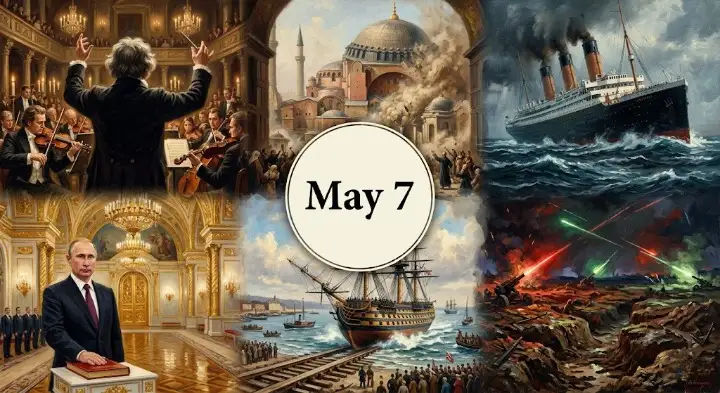
In the crowded Theater am Kärntnertor in Vienna on May 7, 1824, Ludwig van Beethoven stood facing the orchestra, frantically waving his baton to guide a symphony he could not hear. When the final notes of his Ninth Symphony faded, the audience erupted into thunderous applause, but the deafening roar never reached the maestro’s ears until a soloist gently turned him around to face the weeping, cheering crowd. Understanding what happened on this day in history May 7 helps us trace the fragile lines connecting our cultural milestones and political turning points.
🎼 Quick Facts — May 7 in History
| 📌 Category | 📖 Event / Detail |
|---|---|
| 🌟 Most Significant Event | World premiere of Ludwig van Beethoven’s Ninth Symphony in Vienna (1824) |
| 🏆 Top 10 Key Events | • Jewish revolt breaks out against Constantius Gallus (351) • The massive dome of the Hagia Sophia collapses in Constantinople (558) • Crusader armies face massive defeat at the Battle of Harran (1104) • The strategic Siege of Málaga begins during the Spanish Reconquista (1487) • Legendary warship HMS Victory is launched at Chatham Dockyard (1765) • German submarine U-20 torpedoes and sinks the luxury liner RMS Lusitania (1915) • The grueling Battle of Dien Bien Phu ends in a decisive French defeat (1954) • Soviet Union announces they are holding captured American U-2 pilot Gary Powers (1960) • Edvard Munch’s iconic masterpiece “The Scream” is safely recovered in Norway (1994) • Vladimir Putin is officially inaugurated as President of Russia for the first time (2000) |
| ⚔️ Key Battles | Battle of Philomelion (1190), Battle of Vrtijeljka (1685), Battle of the Coral Sea (1942), Battle of Dien Bien Phu (1954) |
| 👤 Key Figures | Ludwig van Beethoven, Winston Churchill, Vladimir Putin, Alexander Stepanovich Popov}- |
| 🌍 Observances | Defender of the Fatherland Day (Kazakhstan), Dien Bien Phu Victory Day (Vietnam), Radio Day (Russia, Bulgaria) |
Story of the Day: The Day the World Heard the Ninth Symphony
On May 7, 1824, Vienna’s musical elite gathered to witness something many feared was impossible: a completely deaf Ludwig van Beethoven directing a brand-new, massive symphony. Beethoven kept time furiously, trailing several bars behind the actual musicians because his ears could no longer catch the soaring violins or the thunderous operatic chorus singing of universal brotherhood. When the music stopped, the audience went wild, throwing hats into the air and clapping until their palms bled.
The oblivious composer kept turning pages until soprano Caroline Unger took his sleeve and turned him around to see the standing ovation, cementing the Ninth Symphony as a timeless triumph of the human spirit over physical limitation.
Important Events That Happened On May 7 In History
351 – The Jewish Revolt Against Constantius Gallus
Jewish insurgents across Galilee grabbed weapons to strike back against the Roman Empire as Caesar Constantius Gallus arrived in Antioch. Roman tax policies and religious oppression had pushed local populations past their breaking point. Roman legions retaliated with extreme brutality, burning entire towns and slaughtering thousands of citizens to reassert imperial dominance. The destruction shattered Jewish demographic centers in Palestine, shifting the focus of intellectual life firmly toward Babylon.
558 – Collapse of the Hagia Sophia Dome
Engineers and priests stood in horror inside Constantinople as the spectacular main dome of the Hagia Sophia crashed to the floor just twenty years after its completion. Severe earthquakes had cracked the structure, and its shallow design put immense outward pressure on the supporting walls. Emperor Justinian I immediately ordered an ambitious rebuild, demanding the structure be raised even higher to prevent future disasters. The modified, steeper dome survived the test of time, keeping the monument standing as a marvel of Byzantine architectural engineering.
1104 – Defeat at the Battle of Harran
The Seljuk emirs of Mosul and Mardin combined forces to ambush the advancing armies of the Crusader States near Antioch and Edessa. Overconfident Frankish knights charged directly into a classic nomadic horse-archer trap that decimated their ranks. Count Baldwin of Edessa was captured during the chaos, crippling the political leadership of the Latin East. This crushing defeat halted early Crusader expansion into the Middle East, ending their myth of battlefield invincibility.
1190 – Victory at the Battle of Philomelion
Emperor Frederick Barbarossa led his massive German crusader army to smash through a blocking force of Rum Seljuks in Anatolia. The European soldiers were starving and exhausted, but their heavy cavalry charges shattered the lighter Turkish formations. This victory opened the road to the regional capital of Iconium, boosting crusader morale across the continent. The triumph proved hollow just weeks later when Barbarossa unexpectedly drowned in a nearby river, leaving his leaderless army to dissolve.
1274 – Opening of the Second Council of Lyon
Pope Gregory X gathered hundreds of bishops and kings in France to open the Second Council of Lyon with the goal of saving the Holy Land. Church leaders quickly turned their attention to internal corruption and the chaotic process of electing the Bishop of Rome. The council passed a strict decree locking cardinals in a secure room until they chose a pope, heavily restricting their food and comfort if they dragged their feet. This system birthed the modern papal conclave, a process still used today to select the head of the Catholic Church.
1342 – Election of Pope Clement VI
Cardinal Pierre Roger stepped out of the conclave doors in Avignon, France, having been elected to the papacy under the name Clement VI. The brilliant French churchman loved luxury, art, and political influence far more than spiritual asceticism. His court quickly became one of Europe’s most lavish cultural hubs, draining the papal treasury to fund grand buildings and master artists. When the Black Death struck Europe a few years later, Clement would famously survive by sitting between two massive, purifying fires.
1487 – Commencement of the Siege of Málaga
Spanish forces under King Ferdinand and Queen Isabella surrounded the wealthy Moorish port city of Málaga to choke off its supply lines. The Muslim defenders refused early surrender offers, relying on their thick stone walls and coastal fortifications to hold out against the Christian assault. Months of brutal artillery bombardments and starvation eventually broke the city’s defenses, leading to a merciless Spanish breakthrough. The fall of Málaga signaled the closing chapter of the Reconquista, leaving the Emirate of Granada completely isolated.
1544 – The Burning of Edinburgh
English soldiers marched into Edinburgh under orders from King Henry VIII to burn the Scottish capital to the ground. This brutal campaign, known as the Rough Wooing, aimed to force the Scots to marry the infant Mary, Queen of Scots, to Henry’s young son. English troops torched Holyrood Palace and the city streets, but failed to capture the heavily fortified Edinburgh Castle. The violent destruction alienated the Scottish population entirely, pushing them directly into a strategic alliance with Catholic France instead.
1625 – Funeral of King James VI and I
Mourners packed the dark aisles of Westminster Abbey as England held a massive state funeral for King James VI and I. The monarch had successfully unified the Scottish and English crowns under a single ruler, navigating decades of religious plots and political strife. His lavish burial cost the crown a fortune, filling the streets with paid mourners and heavy black banners. The throne passed to his stubborn son, Charles I, whose catastrophic relationship with Parliament would eventually trigger the bloody English Civil War.
1664 – Versailles Palace Inaugural Celebrations
King Louis XIV opened the gates of his unfinished Palace of Versailles to launch a legendary week-long festival called the Pleasures of the Enchanted Island. The young Sun King used elaborate plays, horse ballets, and fireworks to show off his absolute power to the French nobility. By forcing the country’s top aristocrats to party in his backyard, Louis began turning a muddy hunting lodge into a gilded cage of political control. The party set the standard for royal excess, establishing Versailles as the beating heart of French absolute monarchy.
1685 – Battle of Vrtijeljka
Ottoman forces marched up the rocky slopes of Mount Vrtijeljka to confront a defensive line of Montenegrin rebels and Venetian irregulars. The local highlanders fought fiercely to protect their territory from imperial taxation and Islamic dominance, but were badly outnumbered. Ottoman cavalry broke through the rebel positions, killing the famous guerilla leader Bajo Pivljanin during the retreat. The defeat allowed Turkish forces to temporarily sack the regional capital of Cetinje, reminding the Balkan tribes of the high cost of rebellion.
1697 – Destruction of Tre Kronor Castle
A sudden, uncontrollable fire ripped through Stockholm’s medieval Tre Kronor castle, forcing the royal family to flee for their lives. The historic timber-framed fortress housed Sweden’s central national library and historical archives, most of which dissolved into ash within hours. Firefighters watched helplessly as the central tower collapsed into the burning ruins of the royal apartments. The tragedy cleared the way for the construction of the massive, modern Stockholm Royal Palace that occupies the site today.
1718 – Founding of New Orleans
Jean-Baptiste Le Moyne, Sieur de Bienville, ordered his men to clear a swampy bend along the lower Mississippi River to found the trading post of New Orleans. The French colonists faced brutal humidity, deadly disease, and constant seasonal flooding in their new subtropical outpost. Despite the terrible terrain, the settlement quickly became a vital strategic port for controlling the vast interior trade networks of North America. The city grew into a unique cultural melting pot, blending French, Spanish, African, and Native American traditions.
1763 – Outbreak of Pontiac’s War
Chief Pontiac led a large coalition of Native American warriors to launch a surprise raid on Fort Detroit, marking the official start of Pontiac’s War. The indigenous tribes were deeply angered by the arrogant policies of the new British commanders who took over after the French left. The British garrison discovered the plot just in time, forcing Pontiac to settle into a grueling, months-long siege of the outpost. This pan-tribal uprising forced the British crown to issue the Proclamation of 1763, forbidding white settlement west of the Appalachian Mountains.
1765 – Launch of HMS Victory
Shipwrights cheered at Chatham Dockyard as the massive hull of the HMS Victory slid smoothly into the water for the first time. The giant first-rate ship of the line required thousands of mature oak trees to build and carried over one hundred brass cannons. The Royal Navy kept her in reserve for more than a decade before commissioning her into active service during the global turmoil of the American Revolution. The vessel achieved permanent legendary status as Admiral Nelson’s flagship at the Battle of Trafalgar, and she remains the world’s oldest commissioned warship.
1794 – Cult of the Supreme Being Introduced
Maximilien Robespierre stood before the French National Convention to officially introduce the Cult of the Supreme Being as the new national religion. The radical Jacobin leader wanted to replace traditional Catholicism with a rational, state-controlled civic deism that celebrated virtue and republican values. This move deeply alienated both devout Christians and hardline atheists within the revolutionary government. Robespierre’s religious obsession convinced his political rivals that his grip on reality was failing, accelerating his arrest and execution just two months later.
1798 – Attack on the Îles Saint-Marcouf
A large French amphibious force rowed out to attack a small British garrison holding the strategic Îles Saint-Marcouf off the coast of Normandy. The British defenders used heavy artillery and muskets to tear the exposed wooden landing craft to pieces before they could reach the beaches. The French suffered massive casualties and were forced to retreat, failing to secure the islands as a base for a future invasion of England. This small coastal battle proved the absolute dominance of British defensive firepower in the English Channel.
1832 – Treaty of London Recognizes Greek Independence
Diplomats from Britain, France, and Russia gathered in Europe to sign the Treaty of London, formally establishing an independent Kingdom of Greece. The signing powers chose the young Bavarian Prince Otto to be the country’s first king, hoping an outsider could stabilize the war-torn region. This international agreement ended centuries of direct Ottoman rule over the Greek heartland after a brutal decade of revolutionary warfare. The treaty redrew the map of southeastern Europe, triggering the slow decay of Ottoman power in the Balkans.
1840 – The Great Natchez Tornado
A massive, violent tornado touched down on the Mississippi River, tearing directly through the bustling river port of Natchez, Mississippi. The powerful vortex lifted steamboats out of the water, flattened brick buildings along the shoreline, and killed 317 people in minutes. Most of the victims were poor river workers and slaves whose deaths were barely recorded in official state registries. It remains the second deadliest tornado in American history, highlighting the extreme vulnerability of early frontier settlements to natural disasters.
1864 – Grant Moves Southward from the Wilderness
General Ulysses S. Grant ordered the battered Army of the Potomac to pack up and march south after days of bloody, indecisive fighting in the Wilderness. Previous Union generals had always retreated northward after suffering heavy casualties against Robert E. Lee’s Confederate army. Grant’s refusal to back down signaled a grim change in Northern military strategy, committing to a relentless war of attrition. The movement sparked the bloody Battle of Spotsylvania Court House, pushing the Civil War toward its final, destructive phase.
1864 – Launch of the City of Adelaide
Workers in Sunderland, England, cheered as the innovative clipper ship City of Adelaide slid into the sea to begin her career. Built with a strong iron frame and a smooth wooden hull, the vessel was engineered specifically for speed and durability on long ocean voyages. She spent decades carrying thousands of British emigrants and valuable cargo to South Australia, helping build the infrastructure of the developing colony. Today, she rests in Port Adelaide as the world’s oldest surviving clipper ship.
1895 – Alexander Popov Demonstrates His Lightning Detector
Russian physicist Alexander Stepanovich Popov stood before his colleagues in Saint Petersburg to demonstrate a primitive radio receiver configured as a lightning detector. His clever device used a coherer tube to automatically register the electromagnetic static generated by distant lightning strikes. While Guglielmo Marconi was conducting similar experiments in Italy, Popov’s work formed the foundation of early radio development in Eastern Europe. The anniversary of this presentation is still celebrated as Radio Day across parts of the former Soviet Union.
1915 – Sinking of the RMS Lusitania
A single torpedo fired by the German submarine U-20 struck the starboard side of the British luxury liner RMS Lusitania off the southern coast of Ireland. The massive ship listed violently and sank in just eighteen minutes, killing 1,199 passengers, including 128 American citizens. Germany defended the attack by pointing out that the passenger liner was secretly carrying tons of military ammunition through a declared war zone. The public outrage turned American popular opinion sharply against the German Empire, setting the stage for the United States to eventually enter World War I.
1915 – China Accedes to the Twenty-One Demands
The Republic of China bowed to intense military pressure from Tokyo, agreeing to thirteen of Japan’s cynical Twenty-One Demands. This forced agreement gave the Empire of Japan broad economic control over Manchuria, Shandong, and the domestic Chinese mining industry. President Yuan Shikai signed the document to avoid an immediate war his young government could not win. The capitulation sparked furious anti-Japanese protests across China, fueling a wave of modern nationalism that eventually exploded into the May Fourth Movement.
1920 – Capture of Kyiv in the Polish-Soviet War
Polish cavalry and infantry units under Marshal Józef Piłsudski marched into the streets of Kyiv alongside a symbolic force of Ukrainian allies. The Kyiv Offensive aimed to create a friendly Ukrainian buffer state to protect Poland from Bolshevik expansion. The victory was short-lived, as local citizens showed little interest in supporting the Polish-backed government. Within a single month, a massive Red Army counter-offensive drove the Polish forces back out, starting a brutal struggle for control of Eastern Europe.
1920 – Treaty of Moscow Signed
Diplomats from Soviet Russia and the Democratic Republic of Georgia signed the Treaty of Moscow, with Russia formally recognizing Georgian sovereignty. In exchange for independence, Georgia agreed to legalize local Bolshevik organizations and expel foreign troops from its territory. The peace was entirely deceptive, as Vladimir Lenin’s regime merely wanted time to consolidate power closer to home. Just six months later, the Soviet Red Army invaded the Caucasus republic anyway, forcibly absorbing Georgia into the growing Soviet Union.
1930 – The Salmas Earthquake
A massive 7.1 magnitude earthquake ripped through the border regions of northwestern Iran and southeastern Turkey, destroying dozens of rural villages in seconds. The violent shaking leveled almost every adobe home in the city of Salmas, killing up to three thousand residents. Terrified survivors faced days of powerful aftershocks and a complete lack of medical aid in the remote mountainous terrain. The disaster forced the Iranian government to completely rebuild the regional capital on a safer grid system nearby.
1931 – The Two-Gun Crowley Standoff
More than three hundred heavily armed New York City police officers surrounded a top-floor apartment on West 91st Street to capture nineteen-year-old killer Francis “Two-Gun” Crowley. A massive crowd of ten thousand spectators gathered in the streets to watch the dramatic, two-hour gun battle unfold. Police chopped holes in the roof to drop tear gas into the apartment while Crowley fired back with multiple pistols until he was wounded. The high-profile shootout and Crowley’s subsequent execution in the electric chair gripped depression-era newspaper readers.
1937 – Arrival of the Condor Legion in Spain
German military pilots equipped with advanced Heinkel He 51 biplanes arrived in Spain to support General Francisco Franco’s fascist forces. Dictator Adolf Hitler used the Spanish Civil War as a live-fire testing ground for his new Luftwaffe tactics and military equipment. The German air crews provided devastating tactical support, testing the terror-bombing methods that would soon devastate European cities. Their intervention shifted the balance of power in Spain, ensuring the eventual destruction of the democratic Spanish Republic.
1940 – The Norway Debate Begins
Members of the British House of Commons gathered for a furious, historic session known as the Norway Debate following a disastrous British military campaign in Scandinavia. Backbench politicians turned on Prime Minister Neville Chamberlain, loudly accusing his administration of incompetence and weakness in facing Nazi Germany. Leo Amery shocked the chamber by quoting Oliver Cromwell, shouting at the Prime Minister to go. The political revolt forced Chamberlain’s resignation three days later, clearing the path for Winston Churchill to take command of the British war effort.
1942 – Sinking of the Shōhō in the Battle of the Coral Sea
American carrier-based dive-bombers and torpedo planes swarmed the Japanese light aircraft carrier Shōhō, sinking her in minutes during the Battle of the Coral Sea. The swift destruction prompted the famous radio message from pilot Robert Dixon: “Scratch one flat top!” This clash marked the first time in naval history that two opposing fleets engaged each other without their surface ships ever making visual contact. The strategic engagement successfully blocked Japan’s naval advance toward Port Moresby, saving Australia from potential isolation.
1945 – Last German U-boat Attack of World War II
A lone German submarine stalked two merchant freighters off the Firth of Forth, Scotland, sinking both vessels just hours before Germany’s official surrender. The lethal torpedo strikes killed dozens of Allied merchant sailors who thought the war was already effectively over. Even with Berlin in ruins and the Nazi command collapsing, isolated submarine crews continued carrying out their final operational orders. The tragic engagement stood as the final naval action of the European theater, bringing a bloody end to the long Battle of the Atlantic.
1946 – Founding of Tokyo Telecommunications Engineering
Engineers Masaru Ibuka and Akio Morita started a small electronic repair shop in a bombed-out Tokyo department store with just twenty employees. Their tiny firm, initially named Tokyo Telecommunications Engineering, focused on creating innovative consumer goods for a struggling postwar Japan. The founders struggled early on, but hit their stride by licensing transistor technology to build groundbreaking portable radios. The ambitious company later changed its name to Sony, transforming into a global electronics giant that revolutionized consumer entertainment.
1948 – Founding of the Council of Europe
Hundreds of European political leaders gathered at the Hague Congress to officially sign the charter establishing the Council of Europe. Championed by figures like Winston Churchill, the new organization sought to protect human rights, democracy, and the rule of law across a shattered continent. By creating a unified forum for legal and cultural cooperation, the founders hoped to make another devastating European war impossible. The council went on to create the European Court of Human Rights, establishing a powerful legal shield for individual citizens.
1952 – Integrated Circuit Concept Published
British radar expert Geoffrey Dummer presented a radical paper at a Washington electronics conference, describing for the first time the concept of the integrated circuit. He envisioned a future where a solid block of semiconductor material could hold multiple electronic components, eliminating the need for messy hand-wired connections. While Dummer failed to build a working prototype himself, his visionary ideas directly inspired American inventors a few years later. His theory laid the foundation for the microchips that power every computer and smartphone today.
1954 – French Defeat at the Battle of Dien Bien Phu
Viet Minh nationalist forces overran the central French command bunker in northwestern Vietnam, bringing a dramatic end to the grueling Battle of Dien Bien Phu. The French military had intentionally set up an isolated valley outpost, daring the communist forces to attack them in the open. General Vo Nguyen Giap shocked the world by hauling heavy artillery pieces up sheer mountain cliffs by hand, turning the French base into a deadly trap. This humiliating defeat shattered France’s colonial ambitions in Indochina, splitting Vietnam in two and drawing the United States into the region.
1960 – Khrushchev Announces Capture of Gary Powers
Soviet Premier Nikita Khrushchev stood before the Supreme Soviet to triumphantly announce that his military was holding American U-2 pilot Gary Powers alive. The United States government had initially issued a clumsy cover story about a missing weather research plane, assuming the pilot and spy equipment had been obliterated during the shootdown. Khrushchev’s dramatic reveal exposed the American lies to the world, destroying a critical peace summit in Paris. The high-profile spy scandal froze Cold War relations to a dangerous new low.
1964 – Hijacking of Pacific Airlines Flight 773
A deeply indebted passenger named Francisco Gonzales pulled a pistol and shot both pilots inside the cockpit of Pacific Airlines Flight 773 over California. The twin-engine airliner plunged into a steep, uncontrollable dive, slamming into a hillside in Contra Costa County and killing all 44 people on board. Investigators found Gonzales’s life insurance policy and a suicide note among the wreckage, proving the crash was a deliberate act. The horrific tragedy forced commercial airlines to implement strict new regulations requiring cockpit doors to be locked at all times during flight.
1886 – Patrick Morrow Completes the Seven Summits
Canadian mountaineer Patrick Morrow reached the snowy peak of Mount Kosciuszko in Australia, becoming the first person to successfully climb the highest mountain on each of the seven continents. Morrow chose to follow a list proposed by legendary climber Reinhold Messner, which focused on true geographical boundaries rather than easier political borders. His incredible feats of physical endurance pushed the limits of modern high-altitude mountaineering. His success sparked a popular global racing trend among elite climbers seeking to replicate his achievement.
1991 – Sungai Buloh Fireworks Disaster
A massive fire tore through the Bright Sparklers fireworks factory in Sungai Buloh, Malaysia, triggering a chain reaction of explosions that flattened an entire industrial neighborhood. The violent blasts shattered windows miles away and ignited fires that killed 26 workers and injured over a hundred locals. Investigators discovered the factory had been operating illegally with terrible safety standards and improper chemical storage. The national tragedy forced the Malaysian government to radically overhaul its hazardous material laws and ban traditional firecracker manufacturing.
1992 – Michigan Ratifies the 27th Amendment
The Michigan legislature voted to ratify a 203-year-old proposed constitutional amendment, officially making it the 27th Amendment to the United States Constitution. Originally drafted by James Madison in 1789, the simple law prevents members of Congress from receiving a mid-term salary increase until an election has taken place. An aggressive, decade-long letter campaign led by a persistent university student revived the forgotten bill. The unusual ratification proved that centuries-old political ideas can still reshape modern constitutional law.
1992 – First Mission of Space Shuttle Endeavour
NASA engineers watched proudly as the Space Shuttle Endeavour blasted off from the Kennedy Space Center on its inaugural orbital mission, STS-49. Built to replace the tragic loss of the Challenger, the brand-new orbiter carried an advanced crew tasked with capturing a stranded communications satellite. The astronauts performed a historic, three-person spacewalk to manually grab the tumbling spacecraft and install a new booster motor. The dramatic, successful rescue mission proved the versatility of the Space Shuttle fleet for complex orbital repairs.
1992 – The McDonald’s Murders in Nova Scotia
Three young men broke into a McDonald’s restaurant in Sydney, Nova Scotia, carrying pistols and knives for a late-night robbery. The thieves brutally attacked the helpless staff, killing three teenage employees and leaving a fourth permanently disabled over a small amount of cash. The shocking level of violence horrified the quiet Canadian community, which was entirely unaccustomed to brutal commercial robberies. The high-profile crime remains one of the most notorious fast-food murders in Canadian history, leading to major security upgrades in restaurants nationwide.
1994 – Edvard Munch’s “The Scream” Recovered
Norwegian undercover detectives successfully recovered Edvard Munch’s masterpiece “The Scream” completely undamaged after it was brazenly stolen from the National Gallery in Oslo. Thieves had broken into the museum months earlier, leaving a sarcastic note thanking the staff for their terrible security. The police coordinated a risky sting operation with the help of British art experts, tricking the criminals into trying to sell the famous painting. The recovery relieved art lovers worldwide and forced European museums to upgrade their anti-theft systems.
1998 – Mercedes-Benz Buys Chrysler
German automaker Daimler-Benz announced a massive $40 billion purchase of the Chrysler Corporation, forming the industrial giant DaimlerChrysler. Corporate executives pitched the historic deal as a perfect marriage of German engineering precision and American mass-market appeal. The colossal merger shook up the global automotive industry, raising fears of massive layoffs and factory closures across Detroit. The cultural differences between the two firms eventually doomed the partnership, leading to a costly corporate split less than a decade later.
1999 – Pope John Paul II Visits Romania
Pope John Paul II stepped off an airplane in Bucharest, becoming the first Roman Catholic pope to visit a predominantly Eastern Orthodox country since the Great Schism of 1054. Crowds of devout Christians lined the streets to cheer the historic pontiff as he met with local Orthodox leaders to preach reconciliation. The emotional visit marked a major breakthrough for inter-faith diplomacy in Eastern Europe after decades of forced communist atheism. The public gathering showed the world that ancient religious divides could be bridged through open dialogue.
1999 – NATO Bombs the Chinese Embassy in Belgrade
A NATO stealth bomber dropped precision-guided bombs directly onto the Chinese embassy in Belgrade during the Kosovo War, killing three Chinese journalists and wounding twenty others. United States officials quickly apologized, claiming military planners had used an outdated map that incorrectly identified the building as a Yugoslav military supply headquarters. The lethal mistake triggered furious anti-American protests across China and severely strained diplomatic relations between Washington and Beijing. The incident highlighted the high risk of intelligence failures during complex air campaigns.
1999 – Military Coup in Guinea-Bissau
Rebel soldiers in Guinea-Bissau launched a final assault on the presidential palace, successfully ousting President João Bernardo Vieira from power. Weeks of political instability and military mutinies had paralyzed the West African nation, destroying local infrastructure and forcing thousands of civilians to flee. The coup leaders promised to restore democratic order, but the violent power shift plunged the country into a long cycle of economic decay. The political collapse reminded regional neighbors of the extreme fragility of democratic institutions in the area.
2000 – First Inauguration of Vladimir Putin
Vladimir Putin walked through the gilded doors of the Grand Kremlin Palace to take the official oath of office as President of Russia for the very first time. The former intelligence officer promised to protect free speech, build a strong economy, and restore state authority after a decade of chaotic post-Soviet capitalism. International observers watched closely, wondering whether the new leader would guide Russia toward western integration or return to authoritarian rule. His ascent marked the beginning of a political era that would completely transform global geopolitics.
2002 – EgyptAir Flight 843 Crash
An EgyptAir Boeing 737-500 flew directly into a foggy hillside during a turbulent approach to Tunis-Carthage International Airport, killing 14 people on board. The flight crew struggled to maintain situational awareness while navigating severe wind shear and low visibility near the runway. Rescue teams rushed through the dense fog to pull survivors from the broken fuselage before it caught fire. The tragic accident forced North African aviation authorities to upgrade their local radar coverage and approach warning systems.
2002 – China Northern Airlines Flight 6136 Plunge
A China Northern Airlines passenger jet plunged from the sky into the Yellow Sea near Dalian, killing all 112 passengers and crew members. Investigators recovered the black boxes from the seabed and discovered the crash was caused by an onboard cabin fire deliberately started by a suicidal passenger. The arsonist had purchased multiple life insurance policies right before boarding the flight, hoping to secure money for his family. The horrific mass murder forced Chinese airports to implement much stricter security checks on liquid carry-on items.
2004 – Beheading of Nick Berg
Islamist militants released a horrifying videotape on the internet showing the brutal execution of American businessman Nick Berg in Iraq. The radical group, led by Abu Musab al-Zarqawi, claimed the murder was direct retaliation for the abuse of Iraqi prisoners at Abu Ghraib. The graphic footage shocked the global public, demonstrating a terrifying new use of online propaganda to spread political terror. The tragic event marked a dark escalation in the Iraq War, forcing private contractors to re-evaluate their safety in conflict zones.
2023 – Tanur Boat Disaster
An overcrowded double-decker tourist boat listed violently and capsized in the coastal waters of Tanur in Kerala, India, killing 22 passengers. Local operators had ignored maximum capacity limits and safety warnings, operating the converted vessel without a valid license or life jackets. Nearby fishermen dove into the dark water to rescue trapped children and families before the boat settled into the mud. The avoidable disaster sparked nationwide outrage, forcing Indian maritime authorities to crack down on illegal tourist operations.
Ready for more? Discover what happened on the previous day.
Famous People Born On May 7
| Name | Description | Date |
|---|---|---|
| Giovanni Pontano | Italian prose writer and poet, Renaissance humanist | May 7, 1426 – September 1503 |
| Louis I de Bourbon, prince de Condé | Huguenot military leader in French Wars of Religion | May 7, 1530 – March 13, 1569 |
| Innocent X | Pope (1644–55), patron of Baroque art | May 7, 1574 – January 7, 1655 |
| Stephanus Van Cortlandt | First native-born mayor of New York City | May 7, 1643 – November 25, 1700 |
| Germain Boffrand | French Rococo architect | May 7, 1667 – March 18, 1754 |
| Carl Heinrich Graun | German composer of opera and sacred music | May 7, 1704 – August 8, 1759 |
| William Bainbridge | American naval officer, captured HMS Java (1812) | May 7, 1774 – July 27, 1833 |
| Dániel Berzsenyi | Hungarian poet, introduced classical metres | May 7, 1776 – February 24, 1836 |
| William Bernard Ullathorne | Roman Catholic missionary to Australia | May 7, 1806 – March 21, 1889 |
| Sir Arthur Purves Phayre | British commissioner in Burma | May 7, 1812 – December 14, 1885 |
| Norman Shaw | British architect, English Domestic Revival | May 7, 1831 – November 17, 1912 |
| Karl Mauch | German explorer, discovered Great Zimbabwe ruins | May 7, 1837 – April 4, 1875 |
| Joseph Gurney Cannon | U.S. speaker of the House (1903–11) | May 7, 1836 – November 12, 1926 |
| Gustave Le Bon | French social psychologist, crowd psychology pioneer | May 7, 1841 – December 13, 1931 |
| Mary Mahoney | First African-American professional nurse | May 7, 1845 – January 4, 1926 |
| Adolf von Harnack | German theologian and church historian | May 7, 1851 – June 10, 1930 |
| Oskar von Miller | German engineer, founded Deutsches Museum | May 7, 1855 – April 9, 1934 |
| Marcus Loew | American motion-picture executive, co-founder of MGM | May 7, 1870 – September 5, 1927 |
| Stanisław Przybyszewski | Polish essayist and playwright | May 7, 1868 – November 23, 1927 |
| Willem Elsschot | Flemish novelist and poet | May 7, 1882 – June 1, 1960 |
| Archibald MacLeish | American poet and public official | May 7, 1892 – April 20, 1982 |
| Pavel Sergeevich Aleksandrov | Russian mathematician, topology contributions | May 7, 1896 – November 16, 1982 |
| Kitty Godfree | English tennis champion, Wimbledon winner | May 7, 1896 – June 19, 1992 |
| Simon Ramo | American engineer, ICBM program chief scientist | May 7, 1913 – June 27, 2016 |
| Sir Huw Pyrs Wheldon | British broadcasting executive, BBC television | May 7, 1916 – March 14, 1986 |
| Eva Perón | Argentine political leader and activist | May 7, 1919 – July 26, 1952 |
| Ruth Prawer Jhabvala | German-born novelist and screenwriter | May 7, 1927 – April 3, 2013 |
| Johnny Unitas | American football quarterback, NFL legend | May 7, 1933 – September 11, 2002 |
| Tony O’Reilly | Irish rugby player and business executive | May 7, 1936 – Present |
| Angela Carter | British author of feminist and magical realist fiction | May 7, 1940 – February 16, 1992 |
Famous People Died On May 7
| Name | Description | Date |
|---|---|---|
| Saint John of Beverley | Bishop of York, medieval English saint | Unknown – May 7, 721 |
| William I | Norman king of Sicily (1154–66) | 1120 – May 7, 1166 |
| Franz von Sickingen | German knight, Reformation-era figure | March 2, 1481 – May 7, 1523 |
| Johann Jakob Froberger | German Baroque keyboard composer | May 19, 1616 – May 7, 1667 |
| Edward Montagu, 2nd earl of Manchester | Parliamentarian general in English Civil War | 1602 – May 7, 1671 |
| Jacques-Auguste de Thou | French statesman and historian | October 8, 1553 – May 7, 1617 |
| Fyodor III | Tsar of Russia (1676–82) | June 9, 1661 – May 7, 1682 |
| Mary of Modena | Queen of England, wife of James II | October 5, 1658 – May 7, 1718 |
| Leopold Koželuch | Czech composer of symphonies and operas | December 9, 1752 – May 7, 1818 |
| Niccolò Piccinni | Italian opera composer of Neapolitan school | January 16, 1728 – May 7, 1800 |
| Pietro Nardini | Italian violinist and composer | April 12, 1722 – May 7, 1793 |
| Antoine-Quentin Fouquier-Tinville | French Revolutionary prosecutor of Reign of Terror | June 10, 1746 – May 7, 1795 |
| Richard Cumberland | English sentimental dramatist | February 19, 1732 – May 7, 1811 |
| Andrew Fuller | English Baptist minister, missionary society founder | February 6, 1754 – May 7, 1815 |
| Henry Peter Brougham, 1st Baron Brougham and Vaux | British lord chancellor, reformer | September 19, 1778 – May 7, 1868 |
| Watkin Tench | British army officer, chronicler of early Australia | c.1758 – May 7, 1833 |
| Thomas Barnes | British journalist, influential editor of The Times | September 16, 1785 – May 7, 1841 |
| Charles de Coster | Belgian novelist, The Legend of Thyl Ulenspiegel | August 20, 1827 – May 7, 1879 |
| Luiz Alves de Lima e Silva, duke de Caxias | Brazilian military hero and statesman | August 25, 1803 – May 7, 1880 |
| Carl Ferdinand Wilhelm Walther | Lutheran theologian, Missouri Synod founder | October 25, 1811 – May 7, 1887 |
| Dmitry Andreyevich, Count Tolstoy | Russian tsarist education minister | March 13, 1823 – May 7, 1889 |
| Samuel Cousins | English mezzotint engraver | May 9, 1801 – May 7, 1887 |
| Henri-Eugène-Philippe-Louis d’Orléans, duke d’Aumale | French noble and colonialist | January 16, 1822 – May 7, 1897 |
| Elbert Hubbard | American writer, “A Message to Garcia” | June 19, 1856 – May 7, 1915 |
| Charles Frohman | American theatrical manager | June 17, 1860 – May 7, 1915 |
| Sir Hugh Percy Lane | Irish art dealer, Impressionist collector | November 9, 1875 – May 7, 1915 |
| Albert Ball | British fighter ace, WWI (43 victories) | August 21, 1896 – May 7, 1917 |
| John Henry Patterson | American manufacturer, popularized cash register | December 13, 1844 – May 7, 1922 |
| William Hesketh Lever | British entrepreneur, founded Lever Brothers | September 19, 1851 – May 7, 1925 |
| George Lansbury | British Labour Party leader (1931–35) | February 21, 1859 – May 7, 1940 |
Observances on May 7
Defender of the Fatherland Day (Kazakhstan)
Kazakhstan celebrates Defender of the Fatherland Day to honor the official creation of its national armed forces. Communities host military parades, state ceremonies, and public concerts to recognize the service of local soldiers. The holiday serves as a moment of national pride, highlighting the country’s military independence and regional security efforts since the collapse of the Soviet Union.
Dien Bien Phu Victory Day (Vietnam)
Vietnam observes Dien Bien Phu Victory Day to commemorate their historic triumph over French colonial forces. Cities across the nation hold colorful military parades, veterans’ reunions, and educational exhibits to remember the sacrifices made during the grueling siege. The national holiday celebrates the end of foreign dominance and the birth of modern Vietnamese independence.
Radio Day (Russia, Bulgaria)
Russia and Bulgaria celebrate Radio Day to honor Alexander Popov’s pioneering demonstration of the radio receiver. Academic institutions and media networks host technology forums, public lectures, and science awards to recognize innovations in telecommunications. The observance highlights the region’s historical contributions to global scientific development.
🎼 Frequently Asked Questions — May 7 in History
German submarine U-20 fired a single torpedo into the side of the British luxury liner RMS Lusitania off the coast of Ireland. The massive passenger ship sank in just eighteen minutes, killing 1,199 people, including 128 Americans. The international outrage turned American public opinion sharply against Germany, accelerating the United States’ eventual entry into World War I.
The world premiere of Ludwig van Beethoven’s Ninth Symphony in Vienna on May 7, 1824, stands as the day’s most significant cultural event. The iconic masterpiece introduced vocal soloists into a traditional symphony for the first time, forever changing classical music. The achievement remains a profound symbol of artistic genius overcoming complete physical deafness.
Legendary German composer and pianist Johannes Brahms was born on May 7, 1833, in Hamburg. He grew up to become one of the fundamental figures of the Romantic musical era, famous for his intricate symphonies and chamber works. Music historians routinely group him alongside Bach and Beethoven as one of the great “Three Bs” of classical music history.
The Battle of Dien Bien Phu ended on May 7, 1954, when Viet Minh forces overran the central French command bunker in Vietnam. The decisive communist victory shattered France’s colonial empire in Indochina and forced a withdrawal from the region. The historic battle fundamentally reshaped Southeast Asian politics and directly set the stage for the Vietnam War.
Dien Bien Phu Victory Day is a major national holiday in Vietnam that honors the surrender of French colonial forces in 1954. It is remembered as a classic military triumph where a determined guerrilla force used brilliant logistics to defeat a modern Western army. The anniversary celebrates the liberation of the Vietnamese people from decades of foreign rule.
On May 7, 2025, the Indian Army and Air Force launched a series of coordinated surgical strikes code-named Operation SINDOOR inside Pakistan. The cross-border military operation was a direct retaliation for the Pahalgam Attack that killed 26 people. The high-profile strike significantly raised military and political tensions between the two nuclear-armed nations.