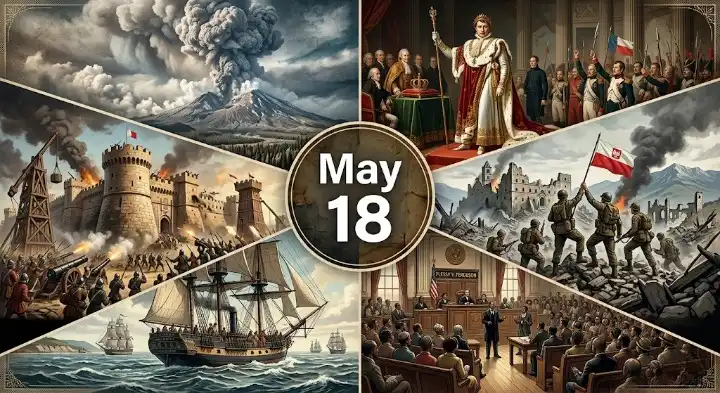
David Johnston stood on a ridge six miles from Mount St. Helens on the morning of May 18, 1980, tracking volcanic gases. Minutes later, the mountain’s north face slid away and a massive blast vaporized his outpost, leaving his final radio words hanging in the air: “This is it!” This day in history May 18 reveals a landscape of massive upheavals, from crowning emperors to defining legal segregation. Below is a deep journey into the global shifts, human tragedies, and turning points that define this date.
👶 Quick Facts — May 18 in History
| 📌 Category | 📖 Event / Detail |
|---|---|
| 🌟 Most Significant Event | Catastrophic volcanic eruption of Mount St. Helens in Washington, United States (1980) |
| 🏆 Top 10 Key Events | • Free food distributions begin in Constantinople under Constantine the Great (332) • Crusaders massacre Jews in Worms, Germany (1096) • Henry II of England marries Eleanor of Aquitaine (1152) • Fall of Acre: Mamluks capture the last major Crusader stronghold (1291) • The Seven Years’ War officially begins as Britain declares war on France (1756) • Napoleon Bonaparte is proclaimed Emperor of the French by the Senate (1804) • US Supreme Court issues the “separate but equal” ruling in Plessy v. Ferguson (1896) • Bath School disaster: Dynamite bombings kill 44 in Michigan (1927) • Battle of Monte Cassino ends as Polish forces capture the monastery ruins (1944) • Sri Lankan government declares victory over the Tamil Tigers, ending the civil war (2009) |
| ⚔️ Key Battles | Siege of Antioch (1268), Battle of Buyur Lake (1388), Great Siege of Malta begins (1565), Battle of Tourcoing (1794), Battle of Las Piedras (1811), Siege of Vicksburg begins (1863), Battle of Monte Cassino (1944) |
| 👤 Key Figures | Constantine the Great, Napoleon Bonaparte, Abraham Lincoln, Ulysses S. Grant, Menachem Begin, Joe Biden |
| 🌍 Observances | Baltic Fleet Day (Russia), International Museum Day, Day of Remembrance of Crimean Tatar genocide (Ukraine), Independence Day (Somaliland), National Speech Pathologist Day (United States), Revival, Unity, and Poetry of Magtymguly Day (Turkmenistan), Teacher’s Day (Syria) |
Story of the Day: The Day the Mountain Exploded
Geologists knew the Washington volcano was waking up, but nobody predicted the sheer violence of what occurred at 8:32 a.m. A moderate earthquake triggered the largest landslide in recorded history, stripping the mountain of its northern flank. Depressurized magma instantly erupted sideways, blasting a superheated cloud of ash and rock at speeds crossing 600 miles per hour. Fifty-seven people perished, hundreds of homes disappeared under mudflows, and a dense, black ash cloud turned morning into pitch-black night across eastern Washington. It fundamentally changed modern volcanology and reshaped the Pacific Northwest landscape forever.
Important Events That Happened On May 18 In History
332 – Free Food in Constantinople
Emperor Constantine the Great stood before his citizens and announced a permanent system of free bread distributions to feed the growing population of his new capital. Roman leaders had long used free grain to prevent urban unrest and maintain loyalty among city dwellers. This policy turned Constantinople into a magnet for settlers, accelerating the shift of imperial power away from Rome. The system sustained the city for centuries, helping it become the economic heartbeat of the medieval world.
872 – Louis II Crowned Holy Roman Emperor Again
Louis II entered Rome surrounded by papal guards to receive his imperial crown from Pope Adrian II for the second time in his life. His first coronation took place twenty-eight years earlier under his father’s shadow, but this ceremony asserted his independent authority over unruly Italian nobles. The double crowning highlighted the volatile politics of the Carolingian dynasty as regional kings fought over fractured borders. Louis spent the rest of his days defending southern Italy from invasion, proving how fragile the imperial title truly was.
1012 – Papacy of Benedict VIII Begins
Cardinal Giovanni of the Tusculum family took the name Benedict VIII and claimed the papal throne just days after his predecessor died mysteriously. Powerful Roman clans immediately opposed his election, forcing the new pope to consolidate power using military alliance and family wealth. His rise sparked a fierce local conflict that required intervention from German royalty to secure his seat. Benedict went on to reform church administration, launching a era where noble families openly bartered for spiritual control of Europe.
1096 – The First Crusade Worms Massacre
Count Emicho led a frenzied mob of European crusaders into the German town of Worms, targeting the local Jewish community under the guise of holy war. Local citizens and the town bishop tried to shield their neighbors, but the crusaders smashed through defenses and murdered around 800 Jews. It was one of the earliest and bloodiest anti-Semitic pogroms committed by armies marching toward Jerusalem. The tragedy shattered centuries of peaceful coexistence along the Rhine and set a horrific precedent for the remainder of the crusades.
1152 – Henry II Marries Eleanor of Aquitaine
Henry Plantagenet married Eleanor of Aquitaine in a swift, unannounced ceremony just eight weeks after her marriage to the French king was annulled. The union combined Henry’s northern French lands with Eleanor’s massive southern duchy, creating an empire that stretched from England to the Pyrenees. King Stephen of England watched in horror as his cousin became the most powerful landlord across the English Channel. Within two years, Stephen was dead, Henry took the throne, and this powerhouse couple redefined medieval European politics for decades.
1268 – Fall of the Principality of Antioch
Mamluk Sultan Baibars brought his siege engines to the walls of Antioch, launching an all-out assault on the historic Crusader capital. Christian defenders were short-handed and collapsed after a brief three-day struggle, ending over 170 years of Frankish rule in the city. Baibars ordered the systematic destruction of the city’s grand churches and enslaved thousands of its inhabitants. The loss crippled the remaining Crusader states in the Levant, showing that their presence in the region was nearing its end.
1291 – Fall of Acre Ends Crusader Presence
Sultan Al-Ashraf Khalil led his victorious Mamluk soldiers through the shattered gates of Acre, cutting down the last defending Templar and Hospitaller knights. Acre was the final major stronghold for European forces fighting in the Levant, making its fall a decisive historical turning point. Terrified civilians rushed into the harbor, trying to board ships under a rain of burning arrows. The loss closed the chapter on the original Crusader kingdoms in the Holy Land, ending two centuries of direct western military occupation.
1302 – The Bruges Matins Massacre
Flemish weavers and butchers sneaked through the dark streets of Bruges, slipping into houses to murder the sleeping French garrison stationed there. The local militia used a simple trick, forcing residents to pronounce a Flemish phrase that French soldiers couldn’t say without revealing their accent. By daybreak, over two thousand Frenchmen lay dead in the streets, sparking an open rebellion against royal taxation. The bloody night led directly to the Battle of the Golden Spurs, where peasant infantry shocked the world by defeating France’s elite knights.
1388 – General Lan Yu Crushes Mongol Hordes
General Lan Yu deployed his Ming dynasty soldiers under the cover of a massive northern dust storm, catching the Mongol camp completely off guard near Buyur Lake. Khan Tögüs Temür fled into the wasteland as his elite forces collapsed, leaving behind his imperial seals, treasure, and thousands of captured relatives. The decisive cavalry strike broke the back of the Northern Yuan dynasty’s plans to retake the Chinese mainland. It secured the northern frontier for the early Ming emperors, ensuring decades of stability and internal growth.
1499 – Alonso de Ojeda Sails for Venezuela
Alonso de Ojeda ordered his crew to raise anchor and steer their ships out of Cádiz harbor, hunting for new wealth across the Atlantic Ocean. Sailing alongside Italian navigator Amerigo Vespucci, Ojeda aimed to chart coastlines that Christopher Columbus had only glimpsed a year earlier. The expedition mapped the vast shores of modern-day Venezuela, naming the region “Little Venice” after seeing stilt houses built over the water. This voyage filled missing gaps on early world maps, driving a wave of Spanish conquerors toward South America.
1565 – Great Siege of Malta Begins
Ottoman admiral Piyale Pasha anchored a massive fleet off the rocky coast of Malta, landing thousands of elite Janissaries to crush the Knights Hospitaller. Grand Master Jean de Valette held the island’s fortresses with just a few thousand men against overwhelming eastern forces. The brutal conflict raged through a long summer of close-quarters combat, subterranean mining, and heavy artillery duels. The knights’ stubborn defense eventually forced an Ottoman retreat, marking a major check on Turkish expansion in the Mediterranean.
1593 – Heresy Arrest Warrant Issued for Christopher Marlowe
English authorities arrived at the home of playwright Thomas Kyd, uncovering papers containing radical statements that denied the divinity of Jesus Christ. Under torture, Kyd claimed the heretical writings belonged to his roommate, the brilliant and cynical theater star Christopher Marlowe. The Privy Council immediately issued an arrest warrant for Marlowe, ordering him to report for daily questioning. Days later, before his trial could begin, Marlowe died in a mysterious tavern brawl, leaving historians to wonder if he was assassinated by government spies.
1631 – John Winthrop Becomes Governor of Massachusetts
John Winthrop raised his right hand in the frontier settlement of Dorchester, taking the oath of office to become the first official governor of the Massachusetts Bay Colony. Winthrop envisioned creating a strict Puritan society that would shine like a “city upon a hill” for the Christian world to emulate. His administration established the legal, religious, and political foundations that shaped early New England life. The governance style fueled rapid colonial growth while sparking sharp conflicts with anyone who challenged church authority.
1652 – Slavery Abolished in Rhode Island
Roger Williams and regional leaders met in Warwick to pass a landmark statute outlawing lifelong human bondage within Rhode Island’s borders. The progressive law declared that no person could be forced to serve a master for more than ten years, mirroring standard indentured servant contracts. However, colonial merchants largely ignored the legislation, and towns lacked the political will or power to enforce it against wealthy elites. By the next century, the colony became a major hub for the transatlantic slave trade, showing the gap between early ideals and economic reality.
1695 – The Linfen Earthquake Striking Shaanxi
A sudden, violent tremor tore through the heart of China’s Shaanxi province during the reign of the Qing dynasty, flattening villages and towns in seconds. The massive earthquake triggered widespread landslides, collapsed ancient city walls, and ignited fires that burned for days. Modern geologists estimate the death toll crossed fifty-two thousand people, with hundreds of thousands more losing their homes and crops. The scale of the disaster forced the imperial court to release emergency silver reserves to prevent total economic collapse in the region.
1756 – Great Britain Declares War on France
King George II signed the official declaration of war against France, transforming colonial skirmishes in the American wilderness into a global conflict. This act marked the formal start of the Seven Years’ War, a clash fought across Europe, North America, India, and the high seas. The war forced shifting alliances between major global empires, driving up massive national debts on both sides. Britain’s eventual victory reshaped global borders but created the heavy colonial taxes that triggered the American Revolution.
1783 – United Empire Loyalists Reach New Brunswick
A fleet of transport ships dropped anchor in the harbor of Parrtown, carrying thousands of refugees who refused to live under the new United States government. These United Empire Loyalists abandoned their homes, lands, and businesses in America out of deep loyalty to the British Crown. They stepped onto the rocky, forested shores of New Brunswick to build new settlements from scratch in the northern wilderness. Their arrival fundamentally altered the culture, politics, and population density of eastern Canada, forming a lasting anti-revolutionary identity.
1794 – Battle of Tourcoing in Flanders
General Joseph Souham led his French republican soldiers into a chaotic clash against a combined coalition of British and Austrian imperial troops. The French forces used superior numbers and rapid maneuvers to isolate allied columns, turning a planned British advance into a disorganized retreat. The victory protected northern France from foreign invasion and boosted the morale of the young revolutionary government in Paris. It proved that France’s citizen-conscript armies could defeat Europe’s professional mercenary forces.
1803 – UK Revokes Treaty of Amiens
Prime Minister Henry Addington ordered British ambassadors out of Paris, formally declaring war on France and ending a brief, fourteen-month period of European peace. The United Kingdom accused Napoleon Bonaparte of violating territorial agreements by expanding French influence into Italy and Switzerland. Napoleon used the declaration to justify a massive military buildup, assembling a invasion force along the English Channel. The renewal of hostilities locked the two superpowers into the Napoleonic Wars, a struggle that lasted over a decade.
1804 – Napoleon Proclaimed Emperor of the French
The French Senate passed a historic decree granting the title of Emperor to Napoleon Bonaparte, ending France’s first experiment with a radical republic. Napoleon argued that a hereditary monarchy was the only way to protect revolutionary gains from royalist conspiracies and foreign assassination plots. The move solidified his absolute control over French law, the military, and the daily lives of citizens. Within months, he crowned himself in Paris, setting off a new era of imperial expansion across the European continent.
1811 – Battle of Las Piedras in Uruguay
José Artigas rallied his band of revolutionary gauchos and patriots on the plains outside Montevideo, charging Spanish royalist lines with mismatched weapons. The sudden, fierce assault broke the professional Spanish infantry, forcing the colonial governor to retreat behind city walls. The victory marked the first great military triumph for the independence movement in the Río de la Plata region. It transformed Artigas into a folk hero and ignited a widespread rebellion that eventually ended Spanish rule in Uruguay.
1812 – Spencer Perceval’s Assassin Sentenced to Death
John Bellingham stood in the dock at the Old Bailey, listening calmly as a judge sentenced him to hang for shooting British Prime Minister Spencer Perceval. Bellingham insisted he acted alone out of personal desperation, furious that the government refused to compensate him for a failed Russian business venture. The court rejected his claims of insanity, wrapping up the high-profile trial in less than eight hours. His execution took place three days later, closing the case on the only assassination of a British prime minister in history.
1843 – The Disruption of the Free Church of Scotland
Thomas Chalmers led more than four hundred ministers out of the General Assembly of the Church of Scotland, marching through Edinburgh’s crowded streets to form a breakaway church. The historic split occurred because ministers refused to let wealthy landlords appoint local preachers against the wishes of congregations. This mass walkout forced pastors to abandon their state-funded salaries, historic manses, and local parish buildings for their principles. The event reshaped Scottish religious, social, and educational life, splitting small communities across the nation.
1848 – First German National Assembly Opens
Over five hundred freely elected delegates from across the fractured German states marched into St. Paul’s Church in Frankfurt to hold their opening session. The assembly met in the wake of popular revolutions, aiming to draft a unified constitution and create a democratic German nation. The delegates debated for months over civil rights, borders, and the balance of royal power. Though regional monarchs eventually crushed the movement, this assembly created the ideological framework for modern German democracy.
1860 – Abraham Lincoln Wins Republican Nomination
Abraham Lincoln sat in a Springfield telegraph office while delegates at the Republican National Convention in Chicago cast their decisive third-ballot votes. Lincoln’s campaign managers worked the floor of the temporary convention hall, outmaneuvering frontrunner William H. Seward by presenting Lincoln as a moderate westerner. The surprising nomination united the young party around an anti-slavery platform tailored to win northern states. His convention victory set the stage for an electoral win that triggered the American Civil War.
1863 – Siege of Vicksburg Begins
Major General Ulysses S. Grant ordered his Union soldiers to dig trenches and position heavy artillery around the Confederate fortress city of Vicksburg, Mississippi. The stronghold controlled a vital bend in the Mississippi River, preventing northern steamboats from moving supplies deep into the south. Grant launched two bloody direct assaults before settling into a grueling war of attrition to starve out the defenders. The resulting forty-seven-day siege split the Confederacy in half and turned the tide of the war in the Western theater.
1896 – Plessy v. Ferguson Secures Segregation
The United States Supreme Court delivered a crushing eight-to-one ruling stating that racially segregated public facilities did not violate the Constitution. The landmark decision established the infamous “separate but equal” legal doctrine, turning state-sponsored racism into the law of the land. Justice John Marshall Harlan wrote a lonely, passionate dissent, warning that the ruling would cause deep social wounds for generations. The decision cleared the way for decades of oppressive Jim Crow laws across the American South.
1896 – The Khodynka Tragedy in Moscow
A massive crowd of over half a million people surged across Khodynka Field to collect free souvenir cups and sausages celebrating Tsar Nicholas II’s coronation. Rumors spread that the gifts were running out, causing a violent panic that pushed thousands of people into deep drainage ditches crisscrossing the field. Royal guards could not control the crush, resulting in the trampling deaths of 1,389 men, women, and children. The Tsar’s decision to attend a lavish royal ball later that night damaged his public reputation, alienating poor citizens.
1900 – UK Establishes Tonga Protectorate
British envoy Basil Thomson arrived in Nukuʻalofa to sign a treaty of friendship, officially establishing a protectorate over the island Kingdom of Tonga. King George Tupou II agreed to handle foreign policy through British channels to prevent other European empires from seizing his territory. Unlike neighboring Pacific islands, Tonga managed to retain its internal monarchy and domestic laws throughout the colonial era. The agreement kept Tonga protected from foreign annexation until it regained full independence seventy years later.
1912 – First Indian Film Released
Dadasaheb Torne stood inside the Coronation Cinematograph in Mumbai, watching the crowd react to his silent feature film, Shree Pundalik. The movie captured the life of a famous Hindu saint, mixing traditional stage acting with imported photographic equipment. Though brief and shot like a recorded play, it captured the imagination of local audiences who had only seen foreign films. The successful screening proved Indians wanted local stories on screen, sparking the birth of the massive Indian film industry.
1917 – Selective Service Act Passed
President Woodrow Wilson signed a historic mobilization bill giving the federal government the power to draft young men for military service. The United States had entered World War I with a small volunteer army that was unready for heavy combat on the Western Front. The new system required millions of citizens to register at local draft boards, creating a massive pool of fresh troops. This act transformed the American military from a frontier defense force into a global army capable of breaking the European stalemate.
1922 – IRA Attacks Belfast Police Headquarters
Seamus Woods led a squad of armed Irish Republican Army fighters in a daring daylight raid on the Royal Irish Constabulary barracks in central Belfast. The attackers breached security lines to seize intelligence documents and weapons before setting fire to offices inside. The violent assault marked a sharp escalation of conflict in northern cities during the Irish revolutionary period. The raid triggered immediate British military retaliation, tightening security grids across the newly formed Northern Ireland border.
1926 – Aimee Semple McPherson Disappears
Evangelist Aimee Semple McPherson walked onto the beach in Venice, California, went for a swim in the ocean, and vanished without a trace. Her massive congregation at the Angelus Temple went into deep mourning, fearing their charismatic leader had drowned in the surf. Weeks later, McPherson walked out of the Mexican desert, claiming she had been kidnapped and held for ransom in a shack. The bizarre incident sparked a sensational media circus and a grand jury investigation that split public opinion over her story.
1927 – The Bath School Disaster
Disgruntled school board member Andrew Kehoe sat in his truck outside the Bath Consolidated School in Michigan, detonating a massive cache of dynamite he spent months hiding under the floorboards. The horrific explosion tore through the wing of the school, killing thirty-eight elementary school children and seven adults. Kehoe then blew up his own vehicle, killing himself and the town’s superintendent in a final act of vengeance over high property taxes. It remains the deadliest school massacre in United States history.
1927 – Tongji Reaches National University Status
The Nationalist government in Nanking signed an official decree elevating Tongji University to become one of China’s first official national universities. Founded by German doctors two decades earlier, the institution had built a reputation for engineering and medical research. The new status brought federal funding and prestige, transforming the campus into a center for technological modernization. The university survived wartime relocations and political purges, training generations of scientists who built China’s infrastructure.
1933 – FDR Creates Tennessee Valley Authority
President Franklin D. Roosevelt signed a landmark New Deal bill establishing the Tennessee Valley Authority to modernize one of the poorest regions in America. The federal corporation set out to build a massive network of dams to control devastating floods and generate cheap electricity for rural homes. The project brought thousands of construction jobs to unemployed workers during the worst years of the Great Depression. The agency transformed southern agriculture and manufacturing, proving that large-scale federal planning could drive economic recovery.
1944 – Battle of Monte Cassino Concludes
Polish soldiers raised their national flag over the ruined hilltop monastery of Monte Cassino after German paratroopers evacuated their defensive lines under the cover of night. Allied forces had spent four months and suffered over fifty-five thousand casualties trying to break through this section of the German Winter Line in Italy. Intense naval and aerial bombing reduced the ancient historic abbey to piles of jagged stone rubble. The costly victory cleared the road to Rome, allowing allied armies to advance north through the Italian peninsula.
1944 – Soviet Deportation of Crimean Tatars
Red Army soldiers knocked on doors across Crimea in the pre-dawn hours, giving over 180,000 ethnic Crimean Tatars just minutes to pack their belongings. On orders from Joseph Stalin, the state packed entire families into overcrowded cattle cars bound for exile in Central Asia. Stalin falsely accused the entire ethnic minority of collaborating with Nazi occupiers during the war. Nearly half of the deported population died from starvation, disease, and harsh conditions during the journey and the early years of exile.
1948 – China’s First Legislative Yuan Convenes
Delegates from across China took their seats in a grand assembly hall in Nanking for the opening session of the First Legislative Yuan under the nation’s new constitution. The gathering represented China’s first major attempt to transition toward a modern, representative constitutional democracy. However, the historic session met under the dark shadow of an escalating civil war against communist forces. Within a year, the nationalist government collapsed on the mainland, forcing the entire legislature to flee to Taiwan.
1953 – Jacqueline Cochran Breaks Sound Barrier
Jacqueline Cochran settled into the cockpit of her Canadian-built F-86 Sabre jet over California’s Rogers Dry Lake, pushing the aircraft into a steep, roaring dive. She crossed the sky at an average speed of 652 miles per hour, becoming the first woman to break the sound barrier. Cochran was a legendary aviation pioneer who had led the Women Airforce Service Pilots during World War II. Her supersonic flight smashed historic gender barriers in aviation, opening the door for women in military aerospace programs.
1955 – Operation Passage to Freedom Ends
The final military transport ships departed from Haiphong harbor, bringing an end to a massive, ten-month evacuation of civilians from North Vietnam. Following the end of the First Indochina War, the international operation moved over 310,000 Vietnamese to the south to escape the new communist regime. The migration shifted the religious, economic, and political balance of South Vietnam, concentrating a large Catholic population around Saigon. The exodus set the stage for deep social divisions that fueled the Vietnam War.
1962 – Évian Accords End Algerian War
French and Algerian diplomats gathered in Switzerland to sign a historic settlement, bringing a formal end to eight years of brutal colonial warfare. The agreement guaranteed a national referendum on self-determination, clearing the path for Algeria to gain full independence from France. The war had cost hundreds of thousands of lives and brought down the French Fourth Republic in Paris. The accords triggered a massive exodus of European settlers who fled across the Mediterranean to escape the new independent government.
1965 – Israeli Spy Eli Cohen Hanged in Damascus
Syrian guards led convicted spy Eli Cohen to a public gallows in Marjeh Square, executing him before thousands of onlookers and live television cameras. Operating under an alias as a wealthy Arab businessman, Cohen had spent years gathering intelligence within the highest levels of Syrian military society. The deep secrets he radioed back to Tel Aviv provided Israel with critical data on Golan Heights fortifications. His dramatic capture and execution turned him into a legendary figure in modern intelligence history.
1969 – Launch of Apollo 10
Astronauts Thomas Stafford, John Young, and Eugene Cernan sat strapped inside their capsule as a massive Saturn V rocket roared off its pad at Cape Kennedy. Apollo 10 served as the final dress rehearsal for the moon landing, designed to test all systems and procedures in lunar orbit without actually touching down. The crew flew their lunar module down within eight miles of the cratered moon surface before returning home safely. The mission proved that landing human boots on the moon was achievable.
1972 – Aeroflot Flight 1491 Crash Near Kharkiv
An Antonov An-24 passenger turboprop began its descent toward Kharkiv International Airport when its wings suddenly snapped off in mid-air. The fractured aircraft plunged into a field near Ruska Lozova, instantly killing all 112 passengers and crew members on board. Soviet investigators discovered that deep metal fatigue cracks had formed in the wing structure over years of service. The disaster forced Aeroflot to ground and modify its entire fleet of regional aircraft to prevent similar structural failures.
1973 – Aeroflot Flight 109 Bombing
A passenger airliner flying over Siberia exploded in mid-air after a hijacker detonated a crude bomb inside the main passenger cabin. The attacker had demanded the pilots alter course and fly the plane to China, detonating his explosives when a sky marshal moved in to stop him. The blast destroyed the aircraft, killing all eighty-two people on board in the remote wilderness. The tragedy forced Soviet aviation authorities to install reinforced cockpit doors and tighten pre-flight baggage screenings at regional airports.
1974 – Smiling Buddha Nuclear Test
Indian scientists detonated a nuclear device deep beneath the desert sands of Pokhran, making India the sixth nation to develop nuclear weapons capabilities. Code-named “Smiling Buddha,” the successful underground explosion surprised global intelligence networks and shifted the balance of power in South Asia. Prime Minister Indira Gandhi declared the test was for peaceful energy purposes, but neighboring Pakistan immediately viewed it as a direct threat. The test triggered a dangerous nuclear arms race across the subcontinent.
1977 – Menachem Begin Wins Israeli Election
Menachem Begin stood before roaring supporters to celebrate a historic election victory that ended nearly thirty years of unbroken Labor Party governance. Begin’s right-wing Likud party tapped into deep-seated frustrations among working-class and Mizrahi immigrants who felt left out by the old elite. His rise to the prime minister’s office altered Israel’s domestic policies and approach to regional peace negotiations. The political shift led directly to the Camp David Accords and a peace treaty with Egypt two years later.
1980 – Gwangju Uprising Begins in South Korea
Chonnam National University students marched into the streets of Gwangju, shouting slogans against the military dictatorship of General Chun Doo-hwan. Military paratroopers responded with extreme violence, beating protestors with batons and firing live ammunition into unarmed crowds. The brutal crackdown enraged local residents, who raided police armories to form their own civilian militias to defend the city. The bloody ten-day stand became a foundational moment for South Korea’s modern democracy movement.
1980 – Miami Race Riots Break Out
Anger boiled over in Miami’s Overtown and Liberty City neighborhoods after an all-white jury acquitted four police officers in the beating death of Arthur McDuffie. Crowds flooded the streets, setting fires to commercial businesses and throwing rocks at passing police vehicles. The governor deployed thousands of National Guard troops to enforce a strict citywide curfew and restore order. Three days of intense rioting left eighteen people dead and caused millions of dollars in property damage, exposing deep racial divides.
1990 – TGV Train Sets Rail Speed Record
Engineers sat in the cab of a heavily modified French TGV train as it accelerated down a new stretch of high-speed track, hitting a record 320.2 miles per hour. The run shattered the existing world rail speed record, proving steel-wheel trains could travel safely at extreme speeds on standard tracks. The test provided critical aerodynamic and braking data used to design the next generation of European express transit systems. It established France as a world leader in high-speed rail technology.
1991 – Somaliland Declares Independence
Clan elders and political leaders gathered in the northern city of Burao to sign a declaration breaking away from war-torn Somalia to form the Republic of Somaliland. The historic decision followed years of brutal civil conflict and the collapse of the central government in Mogadishu. While the rest of Somalia slid into decades of warlord conflict, Somaliland established a stable domestic government, its own currency, and peaceful elections. Despite this internal success, the international community has never officially recognized its statehood.
1993 – Nørrebro Riots in Copenhagen
Angry protestors filled the streets of Copenhagen’s Nørrebro district after Danish voters approved a referendum adopting the European Union’s Maastricht Treaty. Activists clashed with riot squads, pelting them with cobblestones and building flaming barricades across major intersections. Cornered by crowds, Danish police opened direct fire on civilians for the first time since World War II, wounding eleven demonstrators. The historic violence shocked the peaceful nation and sparked a major independent investigation into police crowd-control tactics.
1994 – Israeli Forces Withdraw from Gaza Strip
General Amnon Lipkin-Shahak ordered the final convoys of Israeli soldiers out of their bases in the Gaza Strip, ending twenty-seven years of direct military occupation. The historic pullback ceded administrative control of the territory to the newly formed Palestinian National Authority under the terms of the Oslo Accords. Palestinian police forces immediately took over security checkpoints as crowds celebrated in the streets. The withdrawal was intended to be a major step toward a lasting two-state peace agreement.
2005 – Hubble Confirms New Moons of Pluto
Astronomers working with data from the Hubble Space Telescope confirmed the existence of two tiny, previously unknown moons orbiting Pluto, later named Nix and Hydra. The discovery proved that the icy world possessed a far more complex satellite system than scientists had imagined when they only knew of Charon. The data helped NASA flight controllers plan the trajectory for the New Horizons spacecraft, which was preparing to launch toward the outer solar system. The find added fresh fuel to debates over Pluto’s planetary status.
2006 – Nepal Curtails Monarchy Power
Lawmakers gathered in Kathmandu to pass a landmark bill stripping King Gyanendra of his veto powers, control over the army, and tax-exempt status. The historic vote declared Nepal a secular nation, ending centuries of official identity as a Hindu monarchy. The legislation followed weeks of massive pro-democracy protests that forced the king to restore parliament. The political shift cleared the path for Nepal to transition into a federal republic, ending royal rule.
2009 – Sri Lankan Civil War Ends
Government forces overran the final pocket of jungle held by the Liberation Tigers of Tamil Eelam, killing their leader Velupillai Prabhakaran. The decisive battle ended nearly twenty-six years of ethnic conflict that had cost over one hundred thousand lives and devastated communities across the island. While celebrations broke out in Colombo, international observers raised serious concerns over civilian casualties during the final offensive. The military victory brought peace but left deep wounds that require long-term reconciliation efforts.
2015 – Salgar Landslide in Colombia
Heavy midnight rains triggered a flash flood along the Liboriana River, sending a massive wall of mud and rock crashing through the mountain town of Salgar. The landslide hit while residents were sleeping, destroying dozens of homes and bridges within minutes. Emergency crews worked through deep mud to recover seventy-eight bodies and rescue survivors cut off from clean water. The tragedy exposed the vulnerability of rural Colombian towns to extreme weather events caused by shifting climate patterns.
2018 – Santa Fe High School Shooting
A student armed with a shotgun and a revolver opened fire inside an art class at Santa Fe High School in Texas, killing eight students and two teachers. The attacker also planted explosive devices around the campus before surrendering to police officers inside the building. The tragedy reignited emotional national debates over campus security measures, mental health access, and state gun control laws. It left another small community grieving from the epidemic of American school violence.
2018 – Cubana de Aviación Flight 972 Crash
A Boeing 737 passenger jet stalled and plunged into a field moments after taking off from Havana’s José Martí International Airport, erupting into a massive fireball. The aging aircraft was carrying 113 people, and only one passenger managed to survive her severe injuries. Investigators traced the cause to errors made by the flight crew, who miscalculated the plane’s weight and balance adjustments during takeoff. The disaster led to a major inspection of safety protocols and fleet maintenance standards across Cuba’s aviation industry.
2019 – Joe Biden Launches Presidential Campaign
Joe Biden stepped onto a stage in Philadelphia to deliver his first major rally speech, formally entering the race for the 2020 United States presidency. Biden framed his campaign as a direct battle for the “soul of the nation,” focusing on political moderation, working-class jobs, and global alliances. The veteran politician positioned himself as the candidate best suited to defeat Donald Trump in key rust belt states. The launch kicked off a long primary journey that eventually led him to the White House.
2026 – Islamic Center of San Diego Shooting
Two teenage gunmen opened fire outside the Islamic Center of San Diego, killing a security guard and two community members before fleeing the scene. The shooters carried out a brief drive-by shooting targeting a nearby landscaper before taking their own lives inside a stopped vehicle nearby. Police quickly classified the attack at the county’s largest mosque as a hate crime, causing national civil rights groups to condemn the violence. The security guard’s rapid intervention prevented the attackers from entering the mosque school, saving dozens of children.
Get a deeper dive into what occurred just yesterday.
Famous People Born On May 18
| Name | Description | Date |
|---|---|---|
| Piero di Tommaso Soderini | Florentine statesman (1498–1512) | May 18, 1452 – June 13, 1522 |
| Stefano della Bella | Italian Baroque printmaker | May 18, 1610 – July 12, 1664 |
| Joseph Butler | Anglican bishop and moral philosopher | May 18, 1692 – June 16, 1752 |
| Ruggero Giuseppe Boscovich | Italian astronomer and mathematician | May 18, 1711 – February 13, 1787 |
| Lionel Lukin | British engineer, pioneer of “unsinkable” lifeboat | May 18, 1742 – February 16, 1834 |
| Hugh Clapperton | Scottish explorer of West Africa | May 18, 1788 – April 13, 1827 |
| Frederick Augustus II | King of Saxony (1836–54) | May 18, 1797 – August 9, 1854 |
| Arsène-Jules-Étienne-Juvénal Dupuit | French engineer and economist, public works analysis | May 18, 1804 – September 5, 1866 |
| James Bicheno Francis | British-American engineer, invented Francis turbine | May 18, 1815 – September 18, 1892 |
| Wilhelm Hofmeister | German botanist, pioneer of comparative plant morphology | May 18, 1824 – January 12, 1877 |
| Kawanabe Kyōsai | Japanese painter and caricaturist | May 18, 1831 – April 25, 1889 |
| Sheldon Jackson | American Presbyterian missionary and educator | May 18, 1834 – May 2, 1909 |
| Oliver Heaviside | British physicist, predicted ionosphere | May 18, 1850 – February 3, 1925 |
| I.L. Peretz | Polish-Jewish Yiddish writer | May 18, 1852 – April 3, 1915 |
| Gertrude Käsebier | American photographer, Photo-Secession founder | May 18, 1852 – October 13, 1934 |
| Harry Fielding Reid | American seismologist, elastic rebound theory | May 18, 1859 – June 18, 1944 |
| William Heinemann | English publisher | May 18, 1863 – October 5, 1920 |
| Robert E. Horton | American hydraulic engineer, drainage analysis | May 18, 1875 – April 22, 1945 |
| Eurico Gaspar Dutra | President of Brazil (1945–50) | May 18, 1885 – June 11, 1974 |
| Gunnar Gunnarsson | Icelandic novelist and short-story writer | May 18, 1889 – November 21, 1975 |
| Thomas Midgley, Jr. | American chemist, tetraethyl lead and Freon | May 18, 1889 – November 2, 1944 |
| Yoshida Tetsurō | Japanese architect, spread Japanese architecture to West | May 18, 1894 – September 8, 1956 |
| Edward Hastings Chamberlin | American economist, monopolistic competition | May 18, 1899 – July 16, 1967 |
| Vincent du Vigneaud | American biochemist, Nobel Prize (1955) for hormone synthesis | May 18, 1901 – December 11, 1978 |
| Henri Sauguet | French composer | May 18, 1901 – June 22, 1989 |
| Big Joe Turner | American blues shouter, rock and roll progenitor | May 18, 1911 – November 24, 1985 |
| Richard Brooks | American screenwriter and director | May 18, 1912 – March 11, 1992 |
| Elman Rogers Service | American anthropologist, cultural evolution | May 18, 1915 – November 14, 1996 |
| Brooks Robinson | American baseball Hall of Fame third baseman | May 18, 1937 – September 26, 2023 |
| W.G. Sebald | German-English novelist, Austerlitz | May 18, 1944 – December 14, 2001 |
Famous People Died On May 18
| Name | Description | Date |
|---|---|---|
| Saint John I | Pope (523–26) | – May 18, 526 |
| Pietro Pomponazzi | Italian Renaissance Aristotelian philosopher | September 16, 1462 – May 18, 1525 |
| Jean de Lorraine, 1st cardinal de Lorraine | French cardinal of the Guise family | April 9, 1498 – May 18, 1550 |
| Georg Böhm | German Baroque keyboard composer | September 2, 1661 – May 18, 1733 |
| Thomas Brattle | British American colonial merchant, Harvard official | June 20, 1658 – May 18, 1713 |
| Johann Joachim Kändler | German Baroque porcelain sculptor | 1706 – May 18, 1775 |
| Túpac Amaru II | Peruvian Inca revolutionary leader | c.1740? – May 18, 1781 |
| Caroline Bonaparte | Queen of Naples, Napoleon’s youngest sister | March 25, 1782 – May 18, 1839 |
| Duncan Cameron | Canadian fur trader | 1764 – May 18, 1848 |
| George Meredith | English Victorian poet and novelist | February 12, 1828 – May 18, 1909 |
| Eliza Orzeszkowa | Polish novelist, Positivist writer | June 6, 1841 – May 18, 1910 |
| Eduard Adolf Strasburger | German plant cytologist | February 1, 1844 – May 18, 1912 |
| John Nevil Maskelyne | British magician and illusionist | December 22, 1839 – May 18, 1917 |
| Franklin K. Lane | U.S. secretary of the interior (1913–20) | July 15, 1864 – May 18, 1921 |
| Alphonse Laveran | French physician, Nobel Prize for malaria parasite | June 18, 1845 – May 18, 1922 |
| Standish James O’Grady | Irish historical novelist, “father of Irish literary revival” | September 18, 1846 – May 18, 1928 |
| Bill Haywood | American labor leader, Industrial Workers of the World (IWW) | February 4, 1869 – May 18, 1928 |
| Werner Sombart | German historical economist | January 19, 1863 – May 18, 1941 |
| Philippe-Jean Bunau-Varilla | French engineer, key figure in Panama Canal | July 26, 1859 – May 18, 1940 |
| May Wilson Preston | American illustrator, Ashcan School | August 11, 1873 – May 18, 1949 |
| Norman Robert Campbell | British physicist and philosopher of science | March 7, 1880 – May 18, 1949 |
| Jacob S. Coxey | American businessman, led Coxey’s Army protest | April 16, 1854 – May 18, 1951 |
| Bruce Rogers | American typographer and book designer | May 14, 1870 – May 18, 1957 |
| Elmer Davis | American journalist, director of Office of War Information | January 13, 1890 – May 18, 1958 |
| Kasimir Fajans | Polish-American physical chemist, radioactive displacement law | May 27, 1887 – May 18, 1975 |
| Leroy Anderson | American composer, “Sleigh Ride” | June 29, 1908 – May 18, 1975 |
| Jeannette Rankin | First woman member of U.S. Congress | June 11, 1880 – May 18, 1973 |
| William Saroyan | American author | August 31, 1908 – May 18, 1981 |
| Hedley Bull | Australian international relations scholar | June 10, 1932 – May 18, 1985 |
| Pierre-Gilles de Gennes | French physicist, Nobel Prize (1991) for liquid crystals | October 24, 1932 – May 18, 2007 |
Observances on May 18
- Baltic Fleet Day (Russia): Celebrates the founding of Russia’s historic Baltic naval fleet by Tsar Peter the Great in 1703.
- International Museum Day: Established in 1977 to raise public awareness about the role of museums in cultural exchange and education.
- Day of Remembrance of Crimean Tatar Genocide (Ukraine): Honors the memories of the thousands of Tatars forcibly deported from their homes by the Soviet regime in 1944.
- Independence Day (Somaliland): Marks the region’s self-declared breakaway from Somalia in 1991, celebrated locally despite a lack of formal global recognition.
- National Speech Pathologist Day (United States): Recognizes the medical professionals who diagnose and treat speech, language, and swallowing disorders.
- Revival, Unity, and Poetry of Magtymguly Day (Turkmenistan): Celebrates the historic national poet Magtymguly Pyragy and his influence on Turkmen identity.
- Teacher’s Day (Syria): A national holiday dedicated to honoring educators for their work in training the nation’s youth.
🌋 Frequently Asked Questions — May 18 in History
Mount St. Helens erupted violently in Washington state after a moderate earthquake triggered a massive landslide on its northern flank. The lateral blast killed fifty-seven people, destroyed hundreds of homes, and sent a dense column of volcanic ash drifting across the United States.
The catastrophic eruption of Mount St. Helens in 1980 stands out due to its sheer physical impact and how it reshaped modern volcanology. Another massive turning point was the 1896 Plessy v. Ferguson Supreme Court decision, which legalized racial segregation across the United States for over fifty years.
Tsar Nicholas II, the last Emperor of Russia who presided over the fall of the Romanov dynasty, was born on this day in 1868. Other notable historical births on this date include Persian poet and mathematician Omar Khayyam in 1048, and Pope John Paul II in 1920.
Polish forces captured the ruined monastery of Monte Cassino on this day in 1944, ending one of the bloodiest campaigns of World War II in Italy. This hard-won victory broke a vital German defensive line and opened the direct highway toward Rome for allied armies.
This observance honors the 180,000 ethnic Crimean Tatars who were rounded up and forcibly exiled to Central Asia by Soviet forces on Stalin’s orders in 1944. It is remembered to mark the mass loss of life, cultural destruction, and decades of suffering endured by this minority group.
Two teenage gunmen targeted the Islamic Center of San Diego in 2026, killing a security guard and two community members before taking their own lives. The shooting is being investigated as a hate crime, and the quick action of the guard kept the shooters from harming children inside the mosque school.