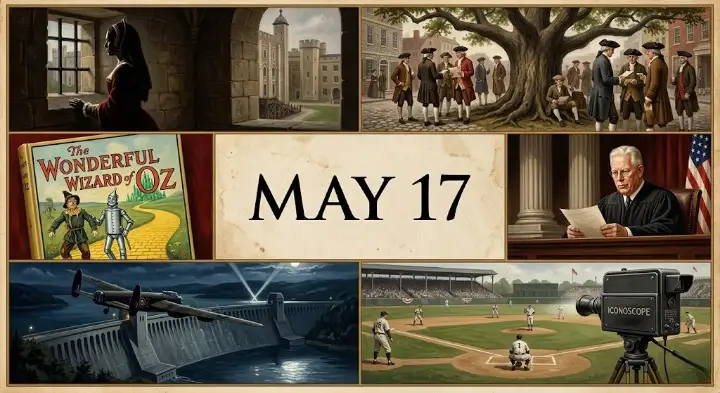
King Henry VIII sat in a private chamber at Lambeth Palace on the morning of May 17, 1536, watching his archbishops declare his marriage to Anne Boleyn completely invalid. Two days later, her head would fall at the Tower of London. Centuries later on this exact calendar date, nine American judges signed a paper that shattered the legal foundations of American apartheid. This post walks you through the world-changing trials, battles, and breakthroughs that define this day in history May 17.
👶 Quick Facts — May 17 in History
| 📌 Category | 📖 Event / Detail |
|---|---|
| 🌟 Most Significant Event | The US Supreme Court strikes down school segregation in Brown v. Board of Education (1954) |
| 🏆 Top 10 Key Events | • Henry VIII and Anne Boleyn’s marriage is annulled (1536) • The New York Stock Exchange is created under a buttonwood tree (1792) • L. Frank Baum publishes The Wonderful Wizard of Oz (1900) • British Liberal government collapses during World War I (1915) • The Supreme Court rules public school segregation unconstitutional (1954) • Fidel Castro signs the Cuban Agrarian Reform Law (1959) • Car bombs kill 33 people in Dublin and Monaghan (1974) • An Iraqi missile strikes the USS Stark, killing 37 sailors (1987) • The WHO removes homosexuality from its list of mental diseases (1990) • Massachusetts becomes the first US state to legalize same-sex marriage (2004) |
| ⚔️ Key Battles | Battle of Rovine (1395), Battle of Zusmarshausen (1648), Battle of Big Black River Bridge (1863) |
| 👤 Key Figures | Chief Justice Earl Warren, Anne Boleyn, L. Frank Baum, Fidel Castro |
| 🌍 Observances | International Day Against Homophobia, Biphobia and Transphobia; Constitution Day (Norway); World Telecommunication Day |
Story of the Day: The Day Jim Crow Began to Die
Chief Justice Earl Warren cleared his throat in a packed Washington courtroom and began reading a unanimous decision that would alter American history. For decades, black children were forced into underfunded, separate schools under the legal fiction of “separate but equal.” The court ruled that segregated public schools are inherently unequal, violating the US Constitution. This monumental ruling provided the legal fuel for the Civil Rights Movement, showing that institutional racism could be defeated through the law. It stands as the moment modern America began forcing itself to live up to its promises.
Important Events That Happened On May 17 In History
352 – Pope Liberius Takes the Chair
Roman priests gathered in the city’s ancient basilicas to elect Pope Liberius following the death of Pope Julius I in the previous month. The new pontiff immediately inherited a theological firestorm over the nature of Christ that divided the Roman Empire. Roman Emperor Constantius II eventually exiled Liberius to Thrace for refusing to condemn orthodox theologians. His turbulent reign showed how deeply intertwined early church politics were with imperial imperial power.
884 – Pope Hadrian III Ascends the Papal Throne
Roman clergy selected Pope Hadrian III following the death of Pope Marinus I earlier that month. The new pope faced severe food shortages and deep political fractures across Italy during his brief reign. Imperial factions assassinated prominent church officials in Rome shortly before Hadrian died under mysterious circumstances during a journey to Germany. His quick death left the papacy vulnerable to the chaotic feudal wars of the dark ages.
1395 – Mircea the Elder Halts the Sultan at Rovine
Wallachian soldiers stood deep in the swampy terrain of Rovine as an invading Ottoman army rushed toward their lines. Prince Mircea the Elder used hidden trenches and thousands of archers to shred the advancing rows of Turkish cavalry. Sultan Bayezid I suffered heavy casualties and pulled his surviving forces back across the Danube River. The defense saved Wallachia from becoming an Ottoman province for decades and protected central Europe from immediate invasion.
1521 – The Execution of Edward Stafford
Executioners led Edward Stafford, 3rd Duke of Buckingham, onto the scaffold at Tower Hill after King Henry VIII accused him of treason. Stafford possessed royal bloodlines that made the paranoid Tudor monarch view him as a direct threat to the crown. Paid informants testified that the Duke harbored secret ambitions to seize the throne if the king died without a male heir. His swift death warned the English nobility that loyalty to the Tudor crown was a matter of survival.
1527 – Narváez Sails for Florida
Pánfilo de Narváez stood on the docks of Sanlúcar de Barrameda as his fleet departed Spain to explore Florida with 600 ambitious men. The expedition quickly ran into hurricanes, hostile native tribes, starvation, and devastating tropical diseases. Desperate survivors built makeshift rafts from horse hides only to drown in the unpredictable waters of the Gulf of Mexico. By 1536 only four men survived the entire ordeal after wandering across the American Southwest for years.
1536 – George Boleyn and the Alleged Conspirators Die
Five English courtiers, including George Boleyn, Viscount Rochford, walked up the steps of the Tower Hill scaffold under the watchful eyes of royal guards. Thomas Cromwell fabricated charges of incest and treason against them to purge the inner circle of the queen. The condemned men refused to confess to the fabricated crimes but accepted their deaths according to the customs of the era. Their executions cleared the path for the systematic destruction of the entire Boleyn family.
1536 – Archbishop Cranmer Erases a Royal Marriage
Archbishop Thomas Cranmer sat in a solemn court at Lambeth Palace and declared that Henry VIII and Anne Boleyn’s marriage is annulled. The legal decree transformed Queen Anne into a commoner and stripped her daughter, the future Queen Elizabeth I, of her royal legitimacy. Courtiers designed this legal maneuver to ensure the king could marry Jane Seymour without any legal complications. The disgraced queen spent her final afternoon locked inside the Tower of London awaiting the French swordsman.
1590 – Anne of Denmark is Crowned in Scotland
Danish princess Anne of Denmark sat before Scottish nobles at Holyrood Abbey to be crowned Queen of Scotland. Ministers from the Presbyterian church argued for hours over whether anointing her with holy oil was a pagan ritual before finally relenting. King James VI watched his young bride accept the heavy crown amid lavish celebrations that depleted the Scottish treasury. The union cemented a vital Protestant alliance between the seafaring nations of northern Europe.
1639 – The Treaty of Zuhab Redraws the Middle East
Persian and Ottoman diplomats met in a military camp to sign the Treaty of Zuhab, ending fifteen years of bloody warfare between the empires. Negotiators drew a border line through the Zagros Mountains, giving Mesopotamia to Constantinople and the Caucasus region to Isfahan. Soldiers laid down their arms after decades of siege warfare that devastated the local population. The boundary line established that morning remains the modern border separating Iran and Iraq.
1642 – French Settlers Clear the Wilderness at Montréal
Paul de Chomedey, Sieur de Maisonneuve, stepped onto the muddy shores of the Saint Lawrence River and founds the Ville Marie de Montréal. Catholic missionaries erected a bark altar and celebrated mass while surrounded by dense forests and watching Iroquois territory. The isolated outpost served as an evangelical mission designed to convert native populations to Christianity. The vulnerable settlement eventually evolved into Canada’s premier fur trading hub and a major global metropolis.
1648 – Imperial Ranks Shatter at Zusmarshausen
An allied French and Swedish army launched a surprise assault that defeats Imperial and Bavarian forces in the Battle of Zusmarshausen. Marshal Turenne used coordinated artillery fire to pin down the imperial rearguard while cavalry overran their defensive flanks. The imperial commander died in the chaos, forcing his panicked troops into a messy retreat across the countryside. The decisive victory left Austria completely exposed and forced the Holy Roman Emperor to sign the Peace of Westphalia.
1673 – Marquette and Jolliet Paddle into the Unknown
Jacques Marquette and Louis Jolliet pushed two birch bark canoes into the waters of the Fox River to begin exploring the Mississippi River. The Jesuit priest and French fur trader sought to map the unknown waterways of North America and find a passage to the Pacific Ocean. They paddled past towering bluffs, documented indigenous villages, and confirmed that the great river flowed south into the Gulf of Mexico. Their journey opened the interior of the continent to French settlement.
1756 – King George II Ignites a World War
The Seven Years’ War formally begins when Great Britain declares war on France after months of undeclared border skirmishes in the Ohio River Valley. King George II signed the declaration to stop French expansion in North America and protect British colonial trade routes. The conflict quickly spread across Europe, India, the Caribbean, and Africa, involving every major global superpower. The declaration marked the start of the first truly global war in human history.
1760 – The British Navy Saves Quebec
French forces besieging Quebec retreat into the woods after the Royal Navy arrives to relieve the trapped British garrison. General Levi heard the cannons of HMS Vanguard echo through the St. Lawrence River and realized his troops would be cut off from supplies. The retreating French army abandoned their heavy siege guns and wounded soldiers outside the city walls. The timely arrival of the fleet secured British control over Canada, ending French imperial ambitions in North America.
1792 – Merchants Gather Under the Buttonwood Tree
Twenty-four prominent stockbrokers met outside 68 Wall Street to sign the Buttonwood Agreement, forming the New York Stock Exchange. The men established a fixed commission rate and agreed to give each other preference in all public security auctions. They conducted business in local coffee houses, trading revolutionary war bonds and simple bank stocks. This informal pact under a tree created the institutional framework for the largest financial market in the world.
1805 – Muhammad Ali Seizes Power in Cairo
Albanian military commander Muhammad Ali becomes Wāli of Egypt after local scholars and citizens revolt against the corrupt Ottoman governor. Ali used his loyal mercenary troops to restore order in the chaotic streets of Cairo, forcing the Sultan to recognize his authority. He quickly centralized control, eliminated the old ruling elite, and initiated massive industrial reforms. His appointment established a ruling dynasty that governed Egypt for over a century.
1809 – Napoleon Strips the Pope of His Lands
Emperor Napoleon I orders the annexation of the Papal States to the French Empire during a military campaign in Austria. The French dictator viewed the independent church territories as a security risk that refused to enforce his continental trade blockade. French soldiers removed the papal flags from Rome and replaced them with the tricolor flag of France. Pope Pius VII retaliated by excommunicating the emperor, leading to the pontiff’s immediate arrest.
1814 – Austrian Troops Take Control of Monaco
The occupation of Monaco changes from French to Austrian control as allied armies dismantle the collapsed empire of Napoleon. Prince Honoré IV reclaimed his ancestral palace only to find it ransacked by departing revolutionary soldiers. The changing of the guard placed the tiny Mediterranean principality under the protection of the Kingdom of Sardinia. The diplomatic shift saved the Grimaldi dynasty from extinction during the reorganization of Europe.
1814 – Norway Asserts Independence at Eidsvoll
The Constitution of Norway is signed and Crown Prince Christian Frederick of Denmark is elected King of Norway by the Norwegian Constituent Assembly. Elected delegates met in a country manor to draft a liberal constitution inspired by American and French democratic ideals. The assembly defied European superpowers who intended to hand the country over to Sweden after the Napoleonic Wars. The bold declaration laid the foundational groundwork for modern Norwegian democracy.
1859 – Rules are Set for Australian Football
Tom Wills and members of the Melbourne Football Club codify the first rules of Australian rules football during a meeting at a local hotel. The creators designed the game to keep cricketers fit during the harsh winter months using an oval ball and open fields. They combined elements of traditional English school games with unique local adaptations to reduce severe injuries. These original ten rules laid the foundation for the most popular sport in Australia.
1863 – Rosalia de Castro Revives the Galician Tongue
Rosalía de Castro publishes Cantares Gallegos, the first major book written entirely in the Galician language for centuries. The author penned lyrical poems that captured the poverty, culture, and deep nostalgia of the rural communities of northwestern Spain. Her work defied cultural elites who viewed the regional language as a vulgar dialect unfit for high literature. The publication ignited a massive cultural revival that restored Galician pride.
1863 – Union Cannons Roar at Big Black River Bridge
Union forces under John A. McClernand defeat a Confederate rearguard and capture around 1,700 men at the Battle of Big Black River Bridge. Union infantry charged across an open bayou, trapping the southern defenders against the deep riverbank. Panicked Confederate soldiers burned the railway bridge behind them as they fled toward the fortifications of Vicksburg. The swift victory allowed General Ulysses S. Grant to isolate the southern stronghold.
1865 – The Birth of Global Telecommunications
Delegates from twenty nations gather in Paris to establish the International Telegraph Union to standardize communication technology across borders. The founders drafted common rules to connect separate national telegraph networks, ensuring messages could travel across Europe without manual transcription. They created a universal morse code system for international lines to reduce transmission errors. This historic agreement created the oldest international intergovernmental organization in the world.
1875 – Oliver Lewis Rides into Derby History
African American jockey Oliver Lewis guides a chestnut colt named Aristides to win the first Kentucky Derby with a record time of 2:37.75. A crowd of 10,000 spectators cheered at Churchill Downs as Lewis pulled away from the pack on the final stretch. The young rider executed a perfect strategy designed by his trainer, Ansel Williamson, who was also born enslaved. The historic victory established the Derby as America’s premier horse racing event.
1900 – The Wonderful Wizard of Oz Appears in Print
L. Frank Baum holds the very first copy of his children’s novel, The Wonderful Wizard of Oz, giving it to his sister as a gift. Baum teamed up with illustrator W.W. Denslow to create an entirely new kind of American fairy tale featuring farm girls, scarecrows, and yellow brick roads. George M. Hill Company printed a small initial run that sold out immediately through local bookstores. The magical story evolved into a multi-generational cultural phenomenon.
1902 – An Ancient Mechanical Computer Surfaces in Greece
Greek archaeologist Valerios Stais examines a corroded lump of bronze recovered from an ancient shipwreck and discovers the Antikythera mechanism. Stais noticed gear wheels and complex inscriptions hidden beneath the calcified exterior of the marine artifact. The device used bronze gears to track solar cycles, lunar phases, and the precise timing of the ancient Olympic Games. The find proved that ancient Greek mechanical engineering was centuries ahead of what historians believed.
1914 – The Protocol of Corfu Grants Epirus Autonomy
Diplomats from regional superpowers sign the Protocol of Corfu, recognizing full autonomy to Northern Epirus under nominal Albanian sovereignty. The agreement ended bloody border clashes between local Greek militias and the newly formed Albanian military. The pact guaranteed religious freedom and local language rights for the Greek population living along the tense border. The compromise fell apart months later when World War I engulfed Europe.
1915 – The Last Liberal Government Falls in London
Prime Minister H.H. Asquith watches the last British Liberal Party government fall in the wake of the devastating Shell Crisis. British newspapers exposed severe munitions shortages on the Western Front, sparking public outrage across the country. The military failure forced Asquith to dismantle his cabinet and form a wartime coalition government with the Conservative Party. The political collapse marked the permanent decline of the Liberal Party in British politics.
1933 – Quisling Launches a Fascist Movement in Norway
Vidkun Quisling and Johan Bernhard Hjort form Nasjonal Samling, the national-socialist party of Norway, during a meeting in Oslo. The founders adopted paramilitary styles, anti-Semitic rhetoric, and the Nordic sun cross symbol to mimic Nazi Germany. The party struggled to attract voters, failing to win a single seat in parliament during democratic elections. Quisling later used this political framework to collaborate with Nazi occupiers during World War II.
1937 – The Spanish Prime Minister Resigns Amid Leftist Feuds
The Largo Caballero government resigns in the wake of the bloody Barcelona May Days civil war within the Spanish Civil War. Anarchists and Marxist factions fought each other in the streets, destroying the unity of the anti-fascist Republican coalition. Juan Negrín stepped forward to form a new government that excluded the powerful anarch-syndicalist CNT union. The political shift allowed Soviet intelligence services to gain deep control over the Republic.
1939 – Princeton and Columbia Play for the TV Cameras
The Columbia Lions and the Princeton Tigers play in the United States’ first televised sporting event, a collegiate baseball game in New York City. NBC engineer station W2XBS parked a single, bulky iconoscope camera near the third-base line to broadcast the game. A tiny audience of viewers watched a fuzzy, black-and-white stream from their living rooms as Princeton won 2-1. This experimental broadcast launched the modern multi-billion-dollar sports television industry.
1940 – Nazi Boots March into Brussels
German troops occupy Brussels, Belgium, without resistance as Allied forces retreat toward the coast of France. Panzer divisions overran outer fortresses, forcing the Belgian government to flee to France. Nazi administrators draped swastika flags over historic municipal buildings and established a harsh military regime. The fall of the capital marked the complete collapse of Belgian national defense within three weeks of invasion.
1943 – The Dambuster Raids Shock the Ruhr Valley
Avro Lancaster bombers from No. 617 Squadron RAF fly low over Germany to commence the Dambuster Raids against vital hydro-electric dams. Wing Commander Guy Gibson guided his crews as they dropped experimental bouncing bombs designed by Barnes Wallis. The explosive weapons skipped across the water to destroy the Möhne and Eder dams, sending millions of tons of water roaring through industrial towns. The dangerous mission crippled German war production across the valley.
1953 – A Deadly Crash in Marshall, Texas
Delta Air Lines Flight 318 encounters severe thunderstorms and crashes near Marshall, Texas, killing 19 people on board. The Douglas DC-3 aircraft suffered structural failure after flying into extreme turbulence that tore off a wing tip. Rescuers searched through dense pine forests to locate the scattered wreckage of the commercial plane. The tragedy led to stricter federal safety regulations regarding radar equipment on passenger flights.
1959 – Fidel Castro Signs the Agrarian Reform Law
Fidel Castro travels to the Sierra Maestra mountains to sign the First Agrarian Reform Law, a cornerstone of the Cuban Revolution. The new law capped private land ownership and outlawed foreign possession of Cuban agricultural estates. Government officials seized millions of acres of sugarcane fields from American corporations to distribute land to over 100,000 peasants. The economic decree permanently fractured relations between Havana and Washington.
1967 – Nasser Demands UN Troops Leave Sinai
President Gamal Abdel Nasser of Egypt demands the dismantling of the peace-keeping UN Emergency Force stationed in the Sinai Peninsula. UN Secretary-General U Thant complied with the request, pulling international troops out of their defensive buffer positions along the border. Egyptian tanks immediately moved into the desert slots while closing the strategic Straits of Tiran to Israeli shipping. The aggressive maneuver made the outbreak of the Six-Day War inevitable.
1969 – Venera 6 Descends into the Clouds of Venus
The Soviet Venera 6 spacecraft enters the boiling atmosphere of Venus, deploying a reinforced parachute system to slow its descent. The scientific probe beamed back real-time data regarding atmospheric pressure, extreme temperatures, and gas compositions for 51 minutes. The transmission abruptly stopped when the immense pressure of the planet crushed the titanium hull of the machine. The mission confirmed that the surface of Venus was a hellish environment.
1973 – Watergate Hearings Retake the Airwaves
Televised hearings begin in the United States Senate as the Select Committee on Presidential Campaign Activities opens its investigation into the Watergate scandal. Millions of Americans sat glued to their television screens as Senator Sam Ervin questioned White House officials about political espionage and cover-ups. The daily broadcasts exposed deep corruption inside the Nixon administration. The public testimony turned public opinion decisively against the president.
1974 – Car Bombs Bring the Troubles to Dublin
Ulster Volunteer Force terrorists detonate four unannounced car bombs in Dublin and Monaghan, Ireland, killing 33 civilians and injuring 300 others. The explosions ripped through crowded midday shopping streets without warning, causing horrific casualties and absolute panic. It became the deadliest single day of violence during the entire multi-decade conflict known as The Troubles. Decades later, families of the victims still demand answers regarding alleged British security collusion.
1974 – The SLA Headquarters Explodes in Los Angeles
Police in Los Angeles raid the Symbionese Liberation Army’s headquarters, firing thousands of rounds into a barricaded house in Compton. The tactical team used tear gas canisters that accidentally ignited a massive fire, trapping the radical militants inside. Six members of the domestic terrorist group, including founding member Camilla Hall, died in the burning structure. The violent shootout broadcasted live on national television, shocking viewers across America.
1977 – Chuck E. Cheese Debuts in California
Nolan Bushnell opens the first Chuck E. Cheese’s Pizza Time Theatre in San Jose, California, introducing a new family entertainment concept. The Atari co-founder combined a pizza parlor with arcade tokens and a stage show featuring animatronic animal characters. Children lined up around the block to play electronic games while eating pizza and watching the robotic rat perform. The concept revolutionized the amusement industry and expanded across North America.
1980 – Chun Doo-hwan Declares Martial Law in Seoul
General Chun Doo-hwan of South Korea seizes control of the government and declares martial law to suppress growing student demonstrations. Military authorities closed universities, banned all political assemblies, and arrested prominent opposition leaders across the country. Elite paratroopers deployed into major cities with fixed bayonets to enforce strict nighttime curfews. The authoritarian crackdown triggered the historic Gwangju Uprising days later.
1980 – The Shining Path Attacks in Chuschi
Maoist guerrilla group Shining Path attacks a remote polling location in the mountain town of Chuschi, burning ballot boxes on the eve of Peru’s presidential elections. The radical insurgents chanted communist slogans and threatened election officials to launch their war against the state. This violent incident marked the official beginning of the internal conflict in Peru. The subsequent decades of guerrilla warfare resulted in tens of thousands of deaths.
1980 – Rioting Explodes in Downtown Miami
Rioting breaks out in downtown Miami following the controversial acquittal of four white police officers in the killing of Arthur McDuffie. An all-white jury cleared the officers of beating the black insurance salesman to death, sparking immediate outrage. Protesters set fires, overturned vehicles, and clashed with National Guard troops across Liberty City for three days. The civil unrest resulted in 18 deaths and millions of dollars in property damage.
1983 – Massive Mercury Pollution Exposed in Tennessee
The U.S. Department of Energy declassifies documents showing the world’s largest mercury pollution event occurred in Oak Ridge, Tennessee. The files revealed that federal nuclear weapons plants spilled 4.2 million pounds of toxic mercury into local waterways and soil during the Cold War. Government officials hid the ecological disaster for decades until an independent newspaper filed a Freedom of Information Act request. The revelation forced a massive environmental cleanup.
1983 – Israel and Lebanon Sign an Aborted Peace Pact
Lebanon, Israel, and the United States sign an agreement on Israeli withdrawal from Lebanese territory following a year of occupation. The treaty promised an end to hostilities and established a joint security zone along the volatile southern border. Syria condemned the pact and pressured the weak Lebanese government to reject the terms of the deal. The agreement collapsed within months as civil war violence escalated across Beirut.
1984 – Prince Charles Attacks Modern Architecture
Prince Charles addresses the Royal Institute of British Architects and calls a proposed glass addition to the National Gallery a “monstrous carbuncle on the face of a much-loved friend.” The royal speech shocked the audience and ignited an intense public debate regarding modern architecture versus classical design. Developers eventually abandoned the controversial modern blueprint in favor of a traditional stone wing. The intervention established the prince as an outspoken critic of urban development.
1987 – An Iraqi Missile Strikes the USS Stark
An Iraqi Dassault Mirage F1 fighter jet fires two Exocet missiles into the U.S. Navy warship USS Stark during the Iran-Iraq War. The sea-skimming weapons struck the frigate’s hull without warning, detonating inside the crew quarters and killing 37 sailors. The crew fought raging fires for hours to save the listing vessel from sinking in the Persian Gulf. Baghdad claimed the attack was an accident, apologizing to Washington for mistaking the ship for an Iranian tanker.
1990 – The WHO Removes Homosexuality from Its Disease List
The General Assembly of the World Health Organization eliminates homosexuality from the official list of psychiatric diseases. Medical experts reviewed decades of behavioral data and concluded that same-sex attraction is a natural variation of human sexuality. The historic declaration ended decades of institutional medical discrimination and state-sponsored conversion therapies worldwide. The decision provided a major global victory for the modern LGBTQ+ rights movement.
1992 – Black May Protests Fill the Streets of Bangkok
Three days of popular protests against the military government of Prime Minister Suchinda Kraprayoon begin in downtown Bangkok. Over 200,000 demonstrators gathered to demand democratic elections and an end to military corruption. Troops opened fire with automatic weapons, leading to a crackdown that results in 52 confirmed deaths and thousands of arrests. The royal family eventually intervened to force the dictator to resign.
1994 – Malawi Holds Its First Democratic Election
Citizens across Malawi stand in long lines to vote as the nation holds its first multi-party elections since gaining independence. Voters rejected the decades-long authoritarian rule of President Hastings Banda, electing opposition leader Bakili Muluzi to the presidency. International observers praised the peaceful transition and high voter turnout across rural provinces. The election ended thirty years of single-party dictatorship, launching modern democracy in Malawi.
1995 – A Stolen Tank Rampages Through San Diego
Shawn Nelson breaks into the California Army National Guard Armory in San Diego, steals an M60 Patton tank, and drives it onto local highways. The military veteran crushed fire hydrants, utility poles, and parked cars during a destructive 23-minute chase. Police officers climbed aboard the vehicle when it became stuck on a concrete highway divider, opening the hatch to shoot Nelson. The wild incident exposed severe security flaws at domestic military installations.
1997 – Zaire is Renamed the Democratic Republic of the Congo
Troops of Laurent-Désiré Kabila march into Kinshasa to finalize the overthrow of the corrupt dictator Mobutu Sese Seko. Cheering crowds lined the streets as the rebel soldiers assumed control of the capital city without significant resistance. Kabila declared himself president and immediately announced that Zaire is officially renamed the Democratic Republic of the Congo. The regime change ended thirty-two years of totalitarian rule.
2000 – Copenhagen Explodes in Football Riots
Arsenal and Galatasaray fans clash in the 2000 UEFA Cup Final riots across the main square of Copenhagen. British and Turkish supporters threw iron chairs, bottles, and bricks at each other during hours of street fighting before the match. Riot police used tear gas and batons to separate the chanting crowds, resulting in four stabbings and dozens of arrests. The violent clashes marred the championship match and triggered a massive security review by UEFA.
2004 – Massachusetts Legalizes Same-Sex Marriage
Couples gather at city halls across Boston as the first legal same-sex marriages in the United States are performed in the state of Massachusetts. The historic event followed a landmark state supreme court ruling that declared denying marriage rights to gay couples violated the state constitution. Clerks issued hundreds of marriage licenses to long-term couples who waited through the night. The legal shift launched a national debate that reshaped American family law.
2006 – The USS Oriskany Sinks in the Gulf of Mexico
Demolition teams detonate C-4 explosives inside the hull of the USS Oriskany, sinking the massive aircraft carrier to form an artificial reef. The legendary historic warship settled to the ocean floor off the coast of Pensacola, Florida, in less than thirty-seven minutes. Environmental crews spent months removing toxic materials from the vessel before the controlled sinking. The underwater site became the largest artificial reef in the world for scuba divers.
2007 – Korean Trains Cross the DMZ
Trains from North and South Korea cross the 38th Parallel in a highly anticipated test-run agreed by both governments. The locomotives traveled across the heavily fortified Demilitarized Zone for the first time since the rail lines were severed during the Korean War in 1953. Commuters and international diplomats cheered as the passenger trains rolled over the border under intense military guard. The brief crossing symbolized a rare moment of peace on the peninsula.
2010 – Pamir Airways Flight 112 Crashes in the Mountains
Pamir Airways Flight 112 disappears from radar screens and crashes into a rugged mountain peak in Afghanistan’s Shakardara District, killing 44 people. The Antonov An-24 passenger plane encountered zero-visibility fog conditions while approaching Kabul International Airport. Search teams climbed through treacherous terrain for days to locate the scattered wreckage of the aircraft. The investigation cited severe weather conditions and pilot error as the primary causes of the disaster.
2014 – A Government Plane Crash in Laos Kills 17
A military plane crash in northern Laos kills 17 people, including the nation’s defense minister and several high-ranking government officials. The Ukrainian-designed Antonov An-74 aircraft slammed into the jungle canopy while attempting to land at an airfield in Xiangkhouang Province. Only three passengers survived the impact and initial fire. The sudden loss of top political leaders forced an immediate reorganization of the country’s defense cabinet.
Take another look at the past: access our archives here.
Famous People Born On May 17
| Name | Description | Date |
|---|---|---|
| Albert | Duke of Prussia, last grand master of Teutonic Knights | May 17, 1490 – March 20, 1568 |
| Jien | Buddhist monk and first great Japanese historian | May 17, 1155 – October 28, 1225 |
| John Gill | American patriot and publisher | May 17, 1732 – August 25, 1785 |
| Karl Ferdinand, count von Buol-Schauenstein | Austrian foreign minister (1852–59) | May 17, 1797 – October 28, 1865 |
| Robert Smith Surtees | English novelist, creator of Mr. Jorrocks | May 17, 1805 – March 16, 1864 |
| Sergey Mikhaylovich Solovyov | Russian historian | May 17, 1820 – April 16, 1879 |
| Thomas Davidson | Scottish paleontologist, brachiopod authority | May 17, 1817 – October 14, 1885 |
| Robert Machray | Scottish-born archbishop of Rupert’s Land, Canada | May 17, 1831 – March 9, 1904 |
| Sir Joseph Norman Lockyer | British astronomer, discovered helium in Sun’s atmosphere | May 17, 1836 – August 16, 1920 |
| Julius Wellhausen | German biblical scholar, Pentateuch analysis | May 17, 1844 – January 7, 1918 |
| T.M. Healy | First governor-general of Irish Free State | May 17, 1855 – March 26, 1931 |
| Charles Robert Ashbee | English architect, leader of Arts and Crafts Movement | May 17, 1863 – May 23, 1942 |
| Alfonso XIII | King of Spain (1902–31) | May 17, 1886 – February 28, 1941 |
| Yasui Sōtarō | Japanese Western-style painter | May 17, 1888 – December 10, 1959 |
| Alfonso Reyes | Mexican poet and essayist | May 17, 1889 – December 27, 1959 |
| Odd Hassel | Norwegian chemist, Nobel Prize (1969), conformational analysis | May 17, 1897 – May 11, 1981 |
| Alfred Joseph Casson | Canadian painter, member of Group of Seven | May 17, 1898 – February 19, 1992 |
| Werner Egk | German composer of theatre music | May 17, 1901 – July 10, 1983 |
| Khuang Aphaiwong | Three-time premier of Thailand | May 17, 1902 – March 15, 1968 |
| Cool Papa Bell | American baseball player, fastest base runner of all time | May 17, 1903 – March 7, 1991 |
| Frederic Prokosch | American novelist | May 17, 1908 – June 6, 1989 |
| Karl Schäfer | Austrian figure skater, two Olympic gold medals | May 17, 1909 – April 26, 1976 |
| Robin Maugham | English novelist, The Servant | May 17, 1916 – March 13, 1981 |
| Birgit Nilsson | Swedish operatic soprano, Wagnerian interpreter | May 17, 1918 – December 25, 2005 |
| Peter Mennin | American composer, conservative Neoclassical | May 17, 1923 – June 17, 1983 |
| Robin Howard | British dance patron, promoted modern dance in England | May 17, 1924 – June 12, 1989 |
| Franz Sondheimer | German-born scientist, steroid synthesis | May 17, 1926 – February 11, 1981 |
| Jackie McLean | American jazz alto saxophonist | May 17, 1931 – March 31, 2006 |
| Alan Kay | American computer scientist, object-oriented programming | May 17, 1940 – Present |
| Robert Nardelli | American businessman, CEO of Home Depot and Chrysler | May 17, 1948 – Present |
Famous People Died On May 17
| Name | Description | Date |
|---|---|---|
| Edward Stafford, 3rd duke of Buckingham | English noble, executed under Henry VIII | February 3, 1478 – May 17, 1521 |
| Francisco Gómez de Sandoval y Rojas, duke de Lerma | Spanish statesman, first of the validos (favourites) | 1553 – May 17, 1625 |
| Abraham de Fabert | Marshal of France, commander under Louis XIII and Louis XIV | October 11, 1599 – May 17, 1662 |
| Samuel Clarke | English theologian and philosopher, Newtonian exponent | October 11, 1675 – May 17, 1729 |
| Claude Buffier | French Jesuit philosopher and historian | May 25, 1661 – May 17, 1737 |
| Jean Cavalier | French Huguenot leader of the Camisards | November 28, 1681 – May 17, 1740 |
| Leopold Auenbrugger von Auenbrugg | Austrian physician, invented percussion diagnostic technique | November 19, 1722 – May 17, 1809 |
| Michel-Jean Sedaine | French dramatist, Le Philosophe sans le savoir | June 2, 1719 – May 17, 1797 |
| Armand-Emmanuel du Plessis, duke de Richelieu | Prime minister of France (1815–18, 1820–21) | September 25, 1766 – May 17, 1822 |
| John Deere | American inventor and manufacturer, steel plow pioneer | February 7, 1804 – May 17, 1886 |
| György Klapka | Hungarian military leader in 1848–49 revolution | April 7, 1820 – May 17, 1892 |
| William Robinson | British landscape designer, wild garden advocate | July 5, 1838 – May 17, 1935 |
| Paul Dukas | French composer, The Sorcerer’s Apprentice | October 1, 1865 – May 17, 1935 |
| Nahum Sokolow | Jewish journalist and Zionist leader | February 3, 1861 – May 17, 1936 |
| Michael Jan de Goeje | Dutch scholar, edited Arabic works | August 13, 1836 – May 17, 1909 |
| José Santos Zelaya | President and dictator of Nicaragua (1893–1910) | November 1, 1853 – May 17, 1919 |
| Radomir Putnik | Serbian army commander, victorious against Austrians (1914) | January 24, 1847 – May 17, 1917 |
| Herbert David Croly | American editor, founder of The New Republic | January 23, 1869 – May 17, 1930 |
| Cass Gilbert | American architect, Woolworth Building, Supreme Court | November 24, 1859 – May 17, 1934 |
| Félix Éboué | Black colonial administrator, supported de Gaulle | December 26, 1884 – May 17, 1944 |
| Olga Samaroff | American pianist and music educator | August 8, 1882 – May 17, 1948 |
| George William Forbes | Prime minister of New Zealand during Depression | May 12, 1869 – May 17, 1947 |
| Owen Josephus Roberts | Associate justice of U.S. Supreme Court (1930–45) | May 2, 1875 – May 17, 1955 |
| Jules Supervielle | French poet and short-story writer | January 16, 1884 – May 17, 1960 |
| Harold Rugg | American educator, social studies textbook series | January 17, 1886 – May 17, 1960 |
| E. Franklin Frazier | American sociologist, African American social structure | September 24, 1894 – May 17, 1962 |
| Otto V. Kuusinen | Finnish Communist leader, Soviet party official | October 4, 1881 – May 17, 1964 |
| Josef Beran | Roman Catholic archbishop of Prague, cardinal | December 29, 1888 – May 17, 1969 |
| Nigel Balchin | English novelist | December 3, 1908 – May 17, 1970 |
| Erwin Wilhelm Müller | German-U.S. physicist, field emission microscopy | June 13, 1911 – May 17, 1977 |
Observances on May 17
- International Day Against Homophobia, Biphobia and Transphobia: Celebrated globally to mark the World Health Organization’s 1990 decision to declassify homosexuality as a mental illness.
- Constitution Day (Norway): Known locally as Syttende Mai, this national holiday features colorful children’s parades and traditional clothing to honor the 1814 constitutional signing.
- World Telecommunication and Information Society Day: Organized by the UN to mark the 1865 founding of the International Telegraph Union in Paris.
- Galician Literature Day: Celebrated across northwestern Spain to honor Rosalía de Castro’s 1863 book that saved the regional language from extinction.
⚖️ Frequently Asked Questions — May 17 in History
The United States Supreme Court handed down its unanimous decision in Brown v. Board of Education. Chief Justice Earl Warren declared that racial segregation in public schools violated the 14th Amendment, effectively striking down the legal doctrine of “separate but equal.”
The unanimous ruling in Brown v. Board of Education (1954) is widely considered the most significant event on this date. It dismantled state-sponsored segregation in American schools and served as a legal catalyst for the broader Civil Rights Movement.
Famous English physician Edward Jenner, who pioneered the world’s first smallpox vaccine, was born on May 17, 1749. On this same date in 1936, iconic American actor and director Dennis Hopper was born in Kansas.
An Iraqi fighter jet fired two Exocet missiles into the guided-missile frigate USS Stark in the Persian Gulf during the Iran-Iraq War in 1987. The attack killed 37 American sailors and crippled the warship, sparking a major international incident.
World Telecommunication Day commemorates the founding of the International Telegraph Union in Paris on May 17, 1865. The global observance highlights how cross-border communication technologies connect humanity and drive technological innovation.
Military officials in northern Laos suffered a devastating loss in 2014 when a government transport plane crashed in a remote northern province. The disaster killed 17 people, including the Laotian Defense Minister, Douangchay Phichit, and his wife.