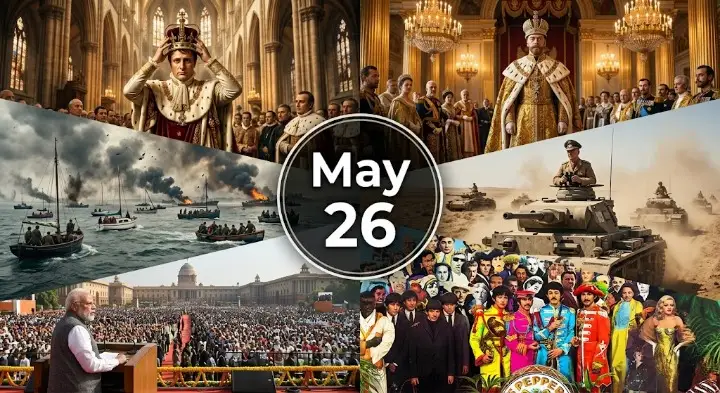
Napoleon Bonaparte marched into Milan Cathedral on May 26, 1805, reached for the ancient Iron Crown of Lombardy, and placed it onto his own head. He declared himself King of Italy, matching his French imperial title and defying European rivals who watched his growing empire with absolute terror. This single spring day holds centuries of explosive historical shifts, from desperate wartime rescues to major political downfalls. Finding out what happened on this day in history May 26 reveals exactly how thin the line is between total triumph and complete catastrophe.
👶 Quick Facts — May 26 in History
| 📌 Category | 📖 Event / Detail |
|---|---|
| 🌟 Most Significant Event | Operation Dynamo begins: The massive Allied military evacuation of trapped British, French, and Belgian troops from the beaches of Dunkirk, France, starts during World War II (1940) |
| 🏆 Top 10 Key Events | • Germanicus celebrates a spectacular Roman triumph for his military victories in Germania (17) • The Battle of Avarayr is fought between Armenian rebels and the Sasanian Empire (451) • King Edmund I of England is murdered during a brawl at a feast in Pucklechurch (946) • Protestant reformer John Calvin is officially banished and exiled from the city of Geneva (1538) • English colonists and Mohegan allies commit the Mystic massacre against the Pequot tribe in Connecticut (1637) • US President Andrew Johnson is narrowly acquitted of his impeachment charges by the Senate (1868) • Nicholas II is crowned at the Uspensky Cathedral, becoming the last reigning Tsar of Russia (1896) • The inaugural 24 Hours of Le Mans endurance automotive race begins in France (1923) • The Beatles release their groundbreaking, genre-defining album “Sgt. Pepper’s Lonely Hearts Club Band” in the UK (1967) • Narendra Modi is sworn in for his first term as the 14th Prime Minister of India (2014) |
| ⚔️ Key Battles | Battle of Avarayr (451), Battle of Haarlemmermeer (1573), Battle of Montijo (1644), Battle of Ackia (1736), Battle of Palonegro (1900), Battle of the Overpass (1937), Battle of Dunkirk (1940), Battle of Gazala (1942) |
| 👤 Key Figures | Napoleon Bonaparte, Tsar Nicholas II, Winston Churchill, Narendra Modi |
| 🌍 Observances | Georgia Independence Day, Guyana Independence Day, National Sorry Day (Australia), Mother’s Day (Poland), National Paper Airplane Day (United States) |
Story of the Day: The Miracle at Dunkirk
Winston Churchill faced total military disaster on May 26, 1940, as the German blitzkrieg trapped the British Expeditionary Force against the English Channel. The Royal Navy launched Operation Dynamo, a desperate gamble to rescue over 300,000 soldiers stranded on the shallow beaches of Dunkirk.
Destroyers could not reach the shoreline, prompting a call for civilian help. Hundreds of ordinary fishing boats, pleasure yachts, and lifeboats braved Luftwaffe bombings to ferry troops to safety. What started as a tragic retreat transformed into a legendary symbol of British resilience, saving the core of the British Army to fight another day.
Important Events That Happened On May 26 In History
17 – Germanicus Celebrates a Roman Triumph
Germanicus rode through the streets of Rome in a decorated chariot while crowds cheered his victories over rebellious Germanic tribesmen. His soldiers paraded captured treasures and royal prisoners west of the Elbe River to signal the restoration of Roman honor. Tiberius watched his popular nephew with growing jealousy, fearing the young general’s massive influence over the public. This grand display marked the peak of Germanicus’s military career before his mysterious, untimely death in the East.
451 – Battle of Avarayr
Vardan Mamikonian led Christian Armenian rebels into a desperate clash against the massive Sasanian Empire on the plains of Avarayr. The heavily outnumbered Armenian forces were broken on the battlefield, and their charismatic leader lay dead among the casualties. Persian victory came at an unsustainable cost, forcing the Shah to reconsider his forced conversion policy. Armenia secured the right to practice Christianity openly, turning a military defeat into a lasting spiritual victory.
866 – Basil I Co-Emperor Coronation
Basil the Macedonian stood inside the Hagia Sophia as Michael III placed the co-emperor’s crown upon his head. The former peasant had risen from royal stable master to the highest ranks of Byzantine power through raw ambition and calculated violence. This political partnership bound the two men together in a tense, paranoid alliance for control of Constantinople. Within sixteen months, Basil murdered his benefactor to seize total control of the throne and found the Macedonian dynasty.
946 – Death of King Edmund I
King Edmund I plunged into a chaotic tavern brawl in Pucklechurch to protect his royal seneschal from an outlaw named Leofa. The young English monarch received a fatal stab wound in the scuffle, dying instantly at just twenty-four years old. England faced a sudden leadership crisis because the king’s two young sons were far too young to rule. Eadred stepped forward to assume the crown, keeping the kingdom stable while Viking threats loomed on the horizon.
961 – Otto II Named Heir Apparent
King Otto I gathered his powerful nobles at Aachen to elect his six-year-old son, Otto II, as co-ruler of the East Frankish Kingdom. The young boy received his crown in the historic royal chapel, formally securing the Ottonian family succession before his father’s trip to Rome. Matilda took charge of her grandson’s education to prepare him for the heavy burdens of medieval kingship. This ceremony established a stable transition of power that helped solidify the foundations of the Holy Roman Empire.
1135 – Alfonso VII Emperor Coronation
Alfonso VII walked into León Cathedral to receive the crown of Imperator totius Hispaniae before a gathering of bishops and nobles. The proud ruler of León and Castile claimed supremacy over all of Spain, demanding homage from neighboring Christian and Muslim princes. This bold coronation aimed to unite fractured Iberian kingdoms under one centralized, authoritative ruler to drive the Reconquista forward. His grand imperial title caused friction with rival lords, setting off decades of internal power struggles.
1293 – Kamakura Earthquake
A massive earthquake violently shook the ground beneath Kamakura, toppling thousands of wooden homes and historic temples in seconds. Firestorms swept through the dense Japanese capital while the earth continued to tremble with violent aftershocks. Approximately 23,000 residents lost their lives in the chaos, reducing the political heart of the Kamakura shogunate to ash. The disaster triggered widespread social panic and political unrest, leaving deep scars on the ruling samurai class.
1328 – William of Ockham Flees Avignon
William of Ockham slipped out of the papal city of Avignon under the cover of night alongside Franciscan leader Michael of Cesena. The brilliant philosopher fled because he faced a certain death sentence from Pope John XXII over his radical views on apostolic poverty. The fugitives sought political asylum with Holy Roman Emperor Louis IV, a bitter enemy of the papacy. This daring escape allowed Ockham to keep writing his influential works on logic and church limitations.
1538 – John Calvin Expelled from Geneva
Geneva’s city council ordered John Calvin and his fellow ministers to pack their bags and leave the city immediately. The fiery reformer had angered local authorities by refusing to administer communion using standard Bernese liturgical practices. Calvin headed for Strasbourg, spending three productive years preaching to French refugees and refining his theological ideas. The religious chaos in Geneva eventually forced the council to beg for his return to restore public order.
1573 – Battle of Haarlemmermeer
Spanish and Dutch warships collided on the choppy waters of Haarlemmermeer during a critical naval clash of the Eighty Years’ War. Admiral Bossu led the Spanish fleet to a decisive victory, breaking the naval blockade that kept the city of Haarlem alive. The defeat left the starving citizens of Haarlem without any hope of rescue or incoming winter supplies. Spanish forces captured the city weeks later, executing the garrison and punishing the rebellious Dutch inhabitants.
1637 – Mystic Massacre
Captain John Mason led a combined force of English colonists and Mohegan allies to surround a fortified Pequot village near the Mystic River. The attackers set fire to the crowded wooden palisades, shooting anyone who tried to escape the roaring flames. Approximately 500 Pequot men, women, and children died in the horrific blaze or at the hands of the militia. This brutal action broke the power of the Pequot tribe and changed the dynamics of New England colonial warfare.
1644 – Battle of Montijo
Portuguese and Spanish armies clashed on the fields of Montijo during the bitter Portuguese Restoration War. General Matias de Albuquerque launched a surprise attack that sent the Spanish troops into a temporary, chaotic retreat. Both sides suffered heavy casualties and quickly claimed a glorious victory once the smoke cleared from the battlefield. Portugal maintained its hard-fought independence from the Spanish crown, showing the world that the Braganza dynasty was here to stay.
1736 – Battle of Ackia
French Governor Bienville led a combined force of French regulars and Choctaw warriors to attack the fortified Chickasaw village of Ackia. British-backed Chickasaw defenders fired accurately from behind their sturdy log cabins, easily repelling the frontal assault. The French forces suffered heavy losses and retreated toward the coast, abandoning their plans to link Louisiana with New France. This critical frontier battle secured Chickasaw control over the region and blocked French expansion down the Mississippi River.
1783 – North Stratford Great Jubilee Day
Townspeople gathered at North Stratford, Connecticut, to hold a joyful Great Jubilee Day celebration marking the end of the American Revolutionary War. Neighbors cheered, fired salutes, and shared community meals to celebrate the departure of British troops from American soil. The local gathering reflected a collective sense of relief across the thirteen exhausted, newly independent states. This local holiday marked the transition from a long war for freedom to the difficult task of nation-building.
1821 – Peloponnesian Senate Established
Greek rebels gathered at the Kaltezi Monastery to officially establish the Peloponnesian Senate during the opening months of their revolution. This new assembly formed the very first organized central administration for the Greek independence movement against Ottoman rule. Rebel leaders worked together to coordinate military actions, manage scarce resources, and build a unified political front. This temporary government laid the groundwork for a free Greek state, despite deep internal rivalries.
1822 – Grue Church Fire
A massive fire tore through the packed wooden timbers of Grue Church during a crowded Sunday service in Norway. The building’s main doors swung inward, trapping panicked worshippers inside as smoke filled the sanctuary. At least 113 people died in the inferno, making it the worst fire disaster in Norwegian history. This national tragedy prompted Norway to pass a strict law requiring all public building doors to open outward for safety.
1864 – Montana Territory Organized
President Abraham Lincoln signed the Organic Act to create the Montana Territory out of the vast, expanding public lands of the American West. The federal legislation established a new government at Bannack to manage the massive influx of gold miners and settlers. Territorial status brought federal courts and law enforcement to a chaotic region plagued by frontier vigilantism. This political boundary set the stage for the mining booms that shaped the modern state of Montana.
1865 – General Edmund Kirby Smith Surrenders
Confederate General Edmund Kirby Smith signed formal surrender terms aboard the USS Fort Jackson off the coast of Galveston, Texas. As commander of the Trans-Mississippi Department, he controlled the very last organized full army of the Confederate cause. His surrender brought an end to all major military resistance in the American Civil War after four years of bloody conflict. The United States began the difficult process of rebuilding a fractured nation and integrating millions of freed slaves.
1868 – Andrew Johnson Acquitted
Chief Justice Salmon P. Chase read out the final United States Senate votes during the dramatic impeachment trial of President Andrew Johnson. Radical Republicans fell exactly one vote short of the two-thirds majority required to remove the president from office. Johnson survived the political challenge, preserving the constitutional balance of power between the executive and legislative branches. The narrow acquittal left the president politically broken, shifting control of Southern Reconstruction over to Congress.
1869 – Boston University Chartered
The Commonwealth of Massachusetts officially signed the charter to found Boston University under the leadership of three prominent Methodist businessmen. The new institution broke traditional academic barriers by refusing to impose any religious tests on its incoming students or faculty. Founders committed the university to providing equal educational opportunities for both men and women from its very first day. This progressive decision helped establish the school as a leader in modern American higher education.
1879 – Treaty of Gandamak
Yakub Khan signed the Treaty of Gandamak with British representative Louis Cavagnari to bring a temporary halt to the Second Anglo-Afghan War. Afghanistan surrendered control of its foreign policy to the United Kingdom in exchange for an annual subsidy and military protection. The agreement established a British residency in Kabul, sparking an immediate, violent backlash from independent Afghan tribesmen. This controversial treaty drew Britain deeper into the geopolitical conflict known as the Great Game.
1896 – Nicholas II Coronation
Nicholas II walked into the Assumption Cathedral in Moscow to be crowned the last Tsar of Imperial Russia. The traditional ceremony featured glittering gold robes and ancient religious rituals designed to highlight the absolute power of the Romanov dynasty. Public celebrations turned tragic days later when a massive crowd stampede at Khodynka Field killed over a thousand people. This dark start to his reign foreshadowed the violent revolutions that destroyed the Russian Empire.
1896 – First Dow Jones Industrial Average Published
Charles Dow calculated and published the very first edition of the Dow Jones Industrial Average inside the Wall Street Journal. The index tracked twelve major industrial companies to give investors a clear picture of American economic health. The opening average closed at 40.94, offering a simple tool to analyze stock market trends. This financial invention changed global investing, becoming the world’s most famous barometer for the American stock market.
1900 – Battle of Palonegro
Conservative government forces launched a massive counterattack against Liberal rebels to end the bloody, fifteen-day Battle of Palonegro. The brutal trench warfare left thousands of decomposing bodies scattered across the hills of Santander, Colombia. This decisive victory turned the tide of the Thousand Days’ War firmly in favor of the ruling Conservative Party. The conflict left Colombia economically ruined and politically fractured, setting the stage for the loss of Panama.
1903 – Românul de la Pind Founded
Aromanian intellectuals gathered in Bucharest to publish the first weekly edition of the newspaper Românul de la Pind. The publication served as a vital cultural lifeline for the Aromanian minority living across the volatile Balkan Peninsula. Editors used the pages to promote their distinct language, document local history, and advocate for minority education rights. The newspaper remained in print until World War II, preserving a unique cultural heritage.
1908 – Middle East Oil Discovery
Drillers struck a massive commercial oil vein at Masjed Soleyman in southwest Persia after years of expensive, frustrating exploration. The Anglo-Persian Oil Company quickly secured exclusive rights to manage and exploit this valuable new underground energy source. This historic strike marked the first major commercial oil discovery in the modern Middle East, reshaping global energy markets. The find drew foreign corporate interests into Persian politics, changing the region’s history forever.
1918 – Democratic Republic of Georgia Established
Noe Jordania stood before a packed assembly in Tbilisi to declare the independence of the Democratic Republic of Georgia. The new state broke away from the collapsing Russian Empire following the chaos of the Bolshevik Revolution. Georgia established a progressive social democratic government that guaranteed voting rights for women and launched sweeping agrarian reforms. This brief period of independence ended three years later when the Soviet Red Army invaded.
1923 – First 24 Hours of Le Mans Begins
Drivers lined up their sports cars on the dirt roads of Le Mans, France, to start the first 24 Hours of Le Mans endurance race. Rain and mud battered the competitors as they pushed their machines through the night to test mechanical reliability. This grueling event moved away from pure top-speed racing to focus on fuel efficiency and engineering stamina. The contest became the oldest endurance race in the world, driving decades of automotive innovation.
1926 – Abd el-Krim Surrenders
Riffian leader Abd el-Krim walked into a French military camp to surrender, ending the brutal Rif War in northern Morocco. A joint force of 250,000 French and Spanish troops used superior firepower and chemical weapons to crush the tribal resistance. The surrender ended the short-lived Republic of the Rif and restored European colonial control over the region. Abd el-Krim went into exile, leaving behind a legacy of anti-colonial guerrilla tactics.
1927 – Last Ford Model T Produced
Workers at the Highland Park plant gathered around the assembly line as the 15,007,003rd Ford Model T rolled off the floor. Henry Ford climbed inside the historic vehicle alongside his son Edsel to drive it out of the factory doors. This final run brought an end to nineteen years of production that put America on wheels and transformed manufacturing. Ford shut down his assembly lines for months to retool his factories for the Model A.
1936 – Tommy Henderson’s Ten-Hour Speech
Independent politician Tommy Henderson stood up in the Northern Ireland House of Commons to criticize the annual Appropriation Bill. He spoke continuously through the night, attacking the government’s handling of unemployment and poor public sanitation systems. Henderson finally sat down in the early hours of the morning after talking for ten record-breaking hours. His epic filibuster highlighted deep political frustrations within the Belfast parliament, though it failed to stop the bill.
1937 – Battle of the Overpass
Ford Motor Company security guards attacked Walter Reuther and fellow United Auto Workers organizers on a pedestrian overpass in Dearborn, Michigan. Company thugs beat the unarmed union members to stop them from handing out union pamphlets to arriving factory workers. News photographers captured graphic images of the assault, exposing Ford’s brutal anti-union tactics to the American public. This public relations disaster forced Ford to eventually sign a contract with the UAW.
1938 – HUAC First Session
Chairman Martin Dies opened the very first official session of the House Un-American Activities Committee in Washington, D.C. The congressional committee focused its investigative powers on uncovering Nazi and Communist subversion within American public life. Critics accused the group of using dramatic public hearings to smear political opponents and restrict free speech rights. This initial meeting launched an era of government investigations that peaked during the Cold War.
1940 – Siege of Calais Ends
Brigadier Claude Nicholson surrendered the remaining British and French troops to German forces after a brutal four-day Siege of Calais. The small garrison fought out of ammunition, holding off an entire German panzer division in the burning streets of the French port. This stubborn defense bought valuable time for Allied forces to build a defensive perimeter around the nearby beaches of Dunkirk. The sacrifice of Calais allowed the mass evacuation of British troops to succeed.
1942 – Battle of Gazala Begins
General Erwin Rommel led the German Afrika Korps on a sweeping desert march around the southern end of the British defensive line at Gazala. The surprise armored advance caught the Allied forces off guard, setting off weeks of chaotic tank battles in Libya. Rommel’s bold tactical maneuvering shattered the British Eighth Army and forced a disorganized retreat toward Egypt. This brilliant victory allowed the Axis forces to capture the strategic port city of Tobruk.
1948 – Civil Air Patrol Established as USAF Auxiliary
President Harry S. Truman signed Public Law 80-557 to establish the Civil Air Patrol as a permanent civilian auxiliary of the United States Air Force. The legislation recognized the valuable anti-submarine patrols and search missions flown by civilian pilots during World War II. This new status provided federal funding for emergency services, aerospace education, and youth cadet training programs. The volunteer organization continued to handle domestic search and rescue missions across the country.
1966 – Guyana Gains Independence
Guyanese citizens gathered in Georgetown to watch the British Union Jack come down and the new multi-colored flag of Guyana go up. Prime Minister Forbes Burnham took control of the new nation, ending more than a century of British colonial rule. The transition to independence brought a wave of national pride alongside deep ethnic and political divisions. Guyana began its journey as a sovereign nation, working to build a stable economy based on bauxite and sugar.
1967 – The Beatles Release Sgt. Pepper
The Beatles released their groundbreaking eighth studio album, Sgt. Pepper’s Lonely Hearts Club Band, across the United Kingdom. Record stores sold out of the LP instantly as fans rushed to hear the band’s experimental psychedelic sounds and studio innovations. The album featured a collage cover and printed lyrics, changing how musicians approached long-form studio recordings. This musical release became the definitive soundtrack for the Summer of Love, transforming global pop culture.
1968 – H-dagurinn in Iceland
Icelandic transportation workers stayed up all night moving road signs and repainting lines for H-dagurinn, or H-Day. At exactly 6:00 AM, all vehicle traffic across the island nation switched from driving on the left to driving on the right side of the road. Thorough government planning and public education campaigns helped prevent major accidents during the sudden morning commute. This shift synchronized Iceland’s traffic laws with continental Europe and Scandinavia.
1969 – Apollo 10 Returns to Earth
The Apollo 10 command module splashed down safely in the Pacific Ocean after an eight-day mission to the Moon. Astronauts Tom Stafford, John Young, and Gene Cernan completed a full dress rehearsal for the upcoming lunar landing, flying their lunar module within eight miles of the cratered surface. The crew tested all critical communications, radar systems, and docking maneuvers in lunar orbit. This successful test cleared the way for Apollo 11 to attempt the first crewed landing two months later.
1970 – Tupolev Tu-144 Exceeds Mach 2
Soviet test pilots pushed the Tupolev Tu-144 supersonic airliner past Mach 2 during a high-altitude flight over the Soviet Union. The sleek transport became the first commercial aircraft in aviation history to fly at twice the speed of sound. This technological achievement gave the Soviet aviation industry a temporary victory over the Anglo-French Concorde team. Despite its impressive top speed, the aircraft suffered from high operating costs and safety issues that cut its commercial life short.
1971 – Burunga Massacre
Pakistan Army soldiers rounded up dozens of local residents in the quiet village of Burunga during the Bangladesh Liberation War. The troops tied up the prisoners, targeting the local Hindu population before opening fire with automatic weapons. At least 71 civilians died in the immediate shooting, and soldiers set fire to the remaining village homes. This brutal attack formed part of a systematic campaign of violence that forced millions of refugees to flee into India.
1972 – Anti-Ballistic Missile Treaty Signed
President Richard Nixon and Soviet General Secretary Leonid Brezhnev signed the Anti-Ballistic Missile Treaty during a historic summit meeting in Moscow. The Cold War agreement limited both superpowers to just two ABM launch sites each to prevent an unmanageable defensive arms race. This strategic treaty rested on the concept of Mutually Assured Destruction, reducing the incentive for either nation to launch a first nuclear strike. The accord marked a major milestone in the era of detente.
1981 – Italian Government Resigns Over P2 Scandal
Prime Minister Arnaldo Forlani walked into the presidential palace to hand over his cabinet’s formal resignation to President Sandro Pertini. The coalition government collapsed after investigators discovered a secret membership list for the illegal, pseudo-masonic lodge known as Propaganda Due (P2). The registry included top military leaders, prominent judges, and key politicians linked to a shadow network of corruption. This explosive scandal triggered a deep political crisis across Italy.
1981 – USS Nimitz Flight Deck Crash
An EA-6B Prowler electronic warfare jet drifted off course and crashed violently into parked aircraft on the flight deck of the USS Nimitz. The impact ignited a massive fuel fire that triggered explosions among the ready-to-use missiles and ammunition. The disaster killed 14 crewmen and injured 45 others before emergency teams managed to suppress the flames. This deadly accident led the United States Navy to institute strict drug-testing policies for all active-duty military personnel.
1983 – Sea of Japan Earthquake and Tsunami
A powerful 7.8 magnitude earthquake struck off the coast of Akita, violently shaking northern Honshu with destructive force. The underwater shift generated a series of tsunami waves that smashed into coastal towns within fifteen minutes of the initial tremor. The fast-moving waters swept away vehicles, shattered fishing ports, and caused approximately 100 deaths along the coast. This disaster prompted Japan to upgrade its early warning systems and reinforce regional sea walls.
1986 – European Community Adopts European Flag
European ministers gathered in Brussels to raise the blue flag with twelve gold stars, officially adopting it as the emblem of the European Community. The circle of stars symbolised unity, solidarity, and perfect harmony among the diverse peoples of Europe. This symbolic flag replaced older organizational emblems, creating a recognizable visual identity for European integration. The design carried over to become the official flag of the modern European Union.
1991 – Zviad Gamsakhurdia Elected President
Georgian citizens lined up at polling stations to overwhelmingly elect Zviad Gamsakhurdia as the first president of the Republic of Georgia. The former Soviet dissident secured more than 86 percent of the vote during the country’s first multi-party democratic election. His new administration promised to guide the nation through its transition away from decades of Soviet control. His nationalist policies quickly sparked intense ethnic conflicts, leading to a violent civil war months later.
1991 – Lauda Air Flight 004 Crash
Lauda Air Flight 004 climbed out of Bangkok when an uncommanded thrust reverser deployed on its left engine at high altitude. The Boeing 767 broke apart mid-air and crashed into the dense jungle of Phu Toei National Park in Thailand. All 223 passengers and crew members died instantly in the worst aviation disaster in Thai history. The tragedy forced aviation safety regulators to demand mechanical modifications to prevent thrust reversers from deploying during flight.
1998 – Ellis Island Boundary Ruling
The Supreme Court of the United States announced its final decision in New Jersey v. New York after a long boundary dispute. The court ruled 6-3 that the filled land making up most of Ellis Island belonged to New Jersey, not New York. The decision left New York with control over only the original, natural island acreage containing the main immigration building. This historic ruling split jurisdiction over the gateway where millions of immigrants first entered America.
1998 – First National Sorry Day in Australia
More than a million Australians gathered at public community events to participate in the nation’s very first National Sorry Day. The new observance focused on acknowledging the historical mistreatment of Indigenous children removed from their families, known as the Stolen Generations. Participants signed apology books and marched to promote reconciliation between Indigenous and non-Indigenous communities. This annual event became a key moment in Australia’s ongoing national reconciliation movement.
1998 – MIAT Mongolian Airlines Crash
A Harbin Y-12 twin-engine aircraft took off from Erdenet on a scheduled domestic flight through changing mountain weather. The plane flew into a heavy ridge nearby, destroying the aircraft and killing all 28 passengers and crew members on board. The tragedy highlighted the severe infrastructural challenges facing Mongolia’s expanding domestic aviation sector during its post-Soviet transition. Safety teams used the accident data to overhaul regional flight paths and weather communication rules.
2002 – I-40 Bridge Collapse
The captain of the tugboat Robert Y. Love blacked out at the wheel, causing the barge to drift off course on the Arkansas River. The vessel slammed into a support pier of the Interstate 40 bridge near Webbers Falls, Oklahoma, causing a 500-foot section of highway to plunge into the water. Fourteen people died as passenger cars and semi-trucks drove off the broken span before traffic could be stopped. Local teams rebuilt the critical bridge in just forty-seven days.
2003 – Ukrainian-Mediterranean Airlines Flight 4230 Crash
A Yakovlev Yak-42 pilot struggled through heavy fog while attempting to land for a refueling stop in Maçka, Turkey. The aircraft struck a mountain ridge on its third landing attempt, killing all 75 people on board. The casualties included 62 Spanish military personnel returning home from a peacekeeping mission in Afghanistan. The tragedy triggered a major political scandal in Spain over the poor safety standards of chartered military transport flights.
2008 – Southern China Floods
Torrents of heavy seasonal rain triggered catastrophic flooding across twelve provinces in eastern and southern China. The rising waters washed away farmlands, triggered mudslides, and destroyed thousands of rural homes over several weeks. The disaster caused 148 deaths and forced emergency teams to evacuate 1.3 million residents to temporary shelters. Government agencies spent billions of yuan on emergency relief and rebuilding damaged river dikes.
2014 – Narendra Modi Sworn In
Narendra Modi stood before a massive crowd of international leaders at the Rashtrapati Bhavan to take his official oath as the 15th Prime Minister of India. His Bharatiya Janata Party had secured a historic absolute majority in parliament, ending decades of unstable coalition governments in New Delhi. The ceremony marked a major political shift toward a nationalist, business-focused economic agenda. Modi promised to reform government bureaucracy and transform India into a global manufacturing powerhouse.
2020 – George Floyd Protests Erupt
Protesters filled the streets of Minneapolis–Saint Paul, burning buildings and clashing with police officers following the murder of George Floyd. The local demonstration quickly exploded into a global social movement against police brutality and systemic racism. Millions of people participated in marches across the United States and around the world under the banner of Black Lives Matter. The widespread civil unrest forced a national conversation on race, police funding, and criminal justice reform.
2021 – San Jose VTA Shooting
A disgruntled transit worker opened fire inside a Valley Transportation Authority rail yard in San Jose, California, during a morning shift change. The gunman targeted his fellow employees, killing nine people before turning the weapon on himself as police officers entered the complex. This tragic event shook the local community and renewed national debates over workplace safety and gun control laws. VTA workers shut down regional light rail services for months to grieve and update security.
2025 – Liverpool Parade Ramming
A speeding car veered off course and rammed into a dense crowd of football fans gathered on Water Street in Liverpool. Worshippers of the club had lined the streets to celebrate Liverpool F.C.’s Premier League trophy parade when the vehicle struck. The chaotic incident left 65 people injured, turning a celebratory sports event into a major emergency operation. Local police quickly detained the driver, while medical teams rushed the wounded to regional hospitals.
Click here to read the full archives from our recent entries.
Famous People Born On May 27
| Name | Description | Date |
|---|---|---|
| Thomas Emlyn | English Presbyterian minister, first to adopt “Unitarian” | May 27, 1663 – July 30, 1741 |
| Louis-Antoine de Noailles | French cardinal and archbishop of Paris | May 27, 1651 – May 4, 1729 |
| Frans Cornelis Donders | Dutch ophthalmologist, physiology of the eye | May 27, 1818 – March 24, 1889 |
| Sir Henry Parkes | Australian politician, “father of Australian federation” | May 27, 1815 – April 27, 1896 |
| Joachim Raff | German composer and teacher | May 27, 1822 – June 24, 1882 |
| Jay Gould | American railroad financier and speculator | May 27, 1836 – December 2, 1892 |
| Wild Bill Hickok | American frontiersman and lawman | May 27, 1837 – August 2, 1876 |
| Julia Ward Howe | American author, “Battle Hymn of the Republic” | May 27, 1819 – October 17, 1910 |
| Alzina Parsons Stevens | American labor leader and child-welfare reformer | May 27, 1849 – June 3, 1900 |
| May Eliza Wright Sewall | American educator and woman suffragist | May 27, 1844 – July 23, 1920 |
| Fromental Halévy | French composer of grand opera, La Juive | May 27, 1799 – March 17, 1862 |
| Georges Rouault | French Expressionist painter and printmaker | May 27, 1871 – February 13, 1958 |
| Arnold Bennett | British novelist and playwright | May 27, 1867 – March 27, 1931 |
| Karl Bühler | German psychiatrist and psychologist | May 27, 1879 – October 24, 1963 |
| Max Brod | German-language novelist, friend and editor of Kafka | May 27, 1884 – December 20, 1968 |
| Kasimir Fajans | Polish-American physical chemist, radioactive displacement law | May 27, 1887 – May 18, 1975 |
| Frank Edward Woolley | English cricketer, considered one of the greatest | May 27, 1887 – October 18, 1978 |
| Louis-Ferdinand Céline | French writer, Journey to the End of the Night | May 27, 1894 – July 1, 1961 |
| Dashiell Hammett | American writer, hard-boiled detective fiction pioneer | May 27, 1894 – January 10, 1961 |
| Sir John Douglas Cockcroft | British physicist, Nobel Prize (1951) | May 27, 1897 – September 18, 1967 |
| Rachel Carson | American biologist and environmental writer | May 27, 1907 – April 14, 1964 |
| John Cheever | American short-story writer, suburban life | May 27, 1912 – June 18, 1982 |
| Sam Snead | American golfer, 82 PGA tournament wins | May 27, 1912 – May 23, 2002 |
| Vincent Price | American actor, horror film icon | May 27, 1911 – October 25, 1993 |
| Hubert Humphrey | 38th vice president of the United States (1965–69) | May 27, 1911 – January 13, 1978 |
| Teddy Kollek | Mayor of Jerusalem (1965–93) | May 27, 1911 – January 2, 2007 |
| Herman Wouk | American novelist, The Caine Mutiny | May 27, 1915 – May 17, 2019 |
| Nakasone Yasuhiro | Prime minister of Japan (1982–87) | May 27, 1918 – November 29, 2019 |
| Caryl Chessman | American criminal, anti-capital punishment symbol | May 27, 1921 – May 2, 1960 |
| John Barth | American postmodern novelist | May 27, 1930 – April 2, 2024 |
Famous People Died On May 27
| Name | Description | Date |
|---|---|---|
| Simeon I | Tsar of first Bulgarian empire (925–27) | 864/865 – May 27, 927 |
| Charles Lennox, 1st Duke of Richmond | Illegitimate son of Charles II | July 29, 1672 – May 27, 1723 |
| Leonardo Vinci | Italian composer, Neapolitan opera originator | 1690 – May 27, 1730 |
| Ewald Friedrich, count von Hertzberg | Prussian statesman and foreign minister | September 2, 1725 – May 27, 1795 |
| Niccolò Paganini | Italian violin virtuoso and composer | October 27, 1782 – May 27, 1840 |
| Robert Torrens | British economist and colonizer | 1780 – May 27, 1864 |
| J. Edgar Thomson | American civil engineer, president of Pennsylvania Railroad | February 10, 1808 – May 27, 1874 |
| Charles Latour Rogier | Belgian statesman, leader of 1830 revolution | August 17, 1800 – May 27, 1885 |
| Frederic Eugene Ives | American photographer and inventor | February 17, 1856 – May 27, 1937 |
| Robert Koch | German bacteriologist, Nobel Prize (1905) | December 11, 1843 – May 27, 1910 |
| Joseph Swan | English physicist, early electric lightbulb | October 31, 1828 – May 27, 1914 |
| Joseph-Simon Gallieni | French military officer, pacified Madagascar | April 24, 1849 – May 27, 1916 |
| Gabriel Miró | Spanish writer | July 28, 1879 – May 27, 1930 |
| James Montgomery Flagg | American illustrator, “Uncle Sam” poster | June 18, 1877 – May 27, 1960 |
| Chen Duxiu | Chinese communist, cofounder of CCP | October 9, 1879 – May 27, 1942 |
| Joseph Gordon Coates | Prime minister of New Zealand (1925–28) | February 3, 1878 – May 27, 1943 |
| Evans Carlson | U.S. Marine officer, Carlson’s Raiders | February 26, 1896 – May 27, 1947 |
| Rudolph Wurlitzer | American musical instrument maker | December 30, 1873 – May 27, 1948 |
| Robert L. Ripley | American cartoonist, “Believe It or Not!” | February 22, 1890? – May 27, 1949 |
| Aquilino Ribeiro | Portuguese novelist | September 13, 1885 – May 27, 1963 |
| Jawaharlal Nehru | First prime minister of India (1947–64) | November 14, 1889 – May 27, 1964 |
| Fred Lazarus, Jr. | American merchant, Federated Department Stores | October 29, 1884 – May 27, 1973 |
| John Howard Northrop | American biochemist, Nobel Prize (1946) | July 5, 1891 – May 27, 1987 |
| Richard Nugent | African American writer, Harlem Renaissance | July 2, 1906 – May 27, 1987 |
| Hildegarde Flanner | American poet and essayist | June 3, 1899? – May 27, 1987 |
| Ernst Ruska | German engineer, invented electron microscope | December 25, 1906 – May 27, 1988 |
| Maurice Richard | Canadian ice hockey legend, Montreal Canadiens | August 4, 1921 – May 27, 2000 |
| Luciano Berio | Italian avant-garde composer | October 24, 1925 – May 27, 2003 |
| Umberto Agnelli | Italian industrialist, Fiat chairman | November 1, 1934 – May 27, 2004 |
| Gil Scott-Heron | American poet and musician, hip-hop forefather | April 1, 1949 – May 27, 2011 |
Observances on May 26
- Georgia Independence Day: Celebrates the 1918 declaration of independence from the Russian Empire, marked by military parades and cultural festivals in Tbilisi.
- Guyana Independence Day: Commemorates the nation’s freedom from British colonial rule in 1966 with flag-raising ceremonies and national carnivals.
- National Sorry Day (Australia): A solemn day of remembrance honoring the Stolen Generations of Indigenous children who were forcibly removed from their families.
- Mother’s Day (Poland): Known locally as Dzień Matki, families celebrate by giving mothers flowers, handmade cards, and small gifts to show appreciation.
- National Paper Airplane Day (United States): A lighthearted unofficial holiday celebrating the simple joy of folding and flying paper gliders through competitions and classroom activities.
🎖️ Frequently Asked Questions — May 26 in History
Allied forces launched Operation Dynamo to begin the massive Dunkirk evacuation from northern France. Civilian and military boats worked together under intense German fire to rescue over 300,000 trapped soldiers. This desperate operation saved the core of the British military, allowing them to continue the fight against Nazi Germany.
The start of the Dunkirk evacuation in 1940 stands as the most critical event of this day. It prevented the total destruction of the British Army and kept Britain in World War II during its darkest hour. The successful rescue completely changed the strategic direction of the war against the Axis powers.
American western movie icon John Wayne was born on this day in 1907 under the name Marion Robert Morrison. Influential American photographer Dorothea Lange, famous for her powerful Depression-era portraits, was also born on this day in 1895.
General Erwin Rommel launched his surprise offensive in Libya to begin the Battle of Gazala in 1942. His armored columns bypassed British defensive lines, setting off weeks of intense desert tank combat. This brilliant tactical move eventually led to a major Axis victory and the capture of Tobruk.
Australia holds National Sorry Day to acknowledge the historical trauma suffered by the Stolen Generations of Indigenous children. The annual observance honors the children who were forcibly separated from their communities by past government assimilation policies. It serves as a vital step toward healing and national reconciliation.
A vehicle drove directly into a crowded sports celebration on Water Street during a football victory parade in Liverpool in 2025. The unexpected crash injured 65 people and turned the city’s Premier League celebration into a chaotic medical emergency.