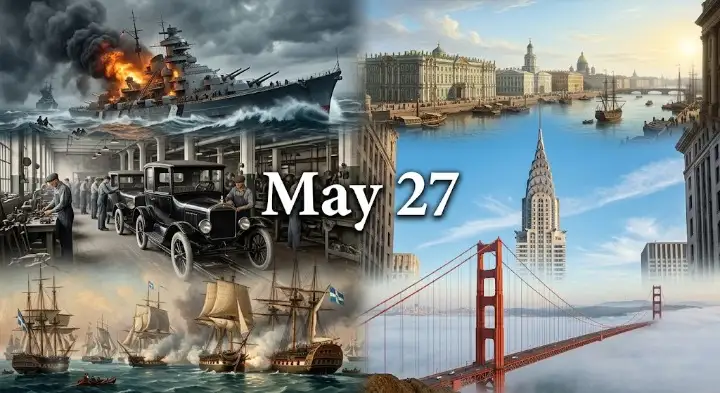
An American battleship, an English prime minister, and a Russian tsar all share a single date on the calendar. On May 27, 1941, the pride of the German Navy, Bismarck, slipped beneath the waves of the North Atlantic after a relentless chase. On that same day in 1798, Great Britain’s prime minister stood on a muddy heath facing a loaded pistol in a bloodless duel of honor, while centuries earlier, Peter the Great dug his spade into Baltic marshland to build a new empire.
👶 Quick Facts — May 27 in History
| 📌 Category | 📖 Event / Detail |
|---|---|
| 🌟 Most Significant Event | Sinking of the German battleship Bismarck: The pride of the Nazi Kriegsmarine is cornered and sunk by the British Royal Navy in the Atlantic Ocean (1941) |
| 🏆 Top 10 Key Events | • Rhineland massacres reach Mainz, where Crusaders slaughter hundreds of local Jewish residents (1096) • Coronation of King John of England at Westminster Abbey (1199) • Tsar Peter the Great founds the city of Saint Petersburg after capturing the region from Sweden (1703) • Giuseppe Garibaldi begins the Siege of Palermo during the Expedition of the Thousand (1860) • A massive E-4 tornado strikes St. Louis, Missouri, killing 255 people and causing immense damage (1896) • Ford ends production of the legendary Model T after manufacturing fifteen million vehicles (1927) • The iconic Chrysler Building opens in New York City, briefly becoming the world’s tallest structure (1930) • The Golden Gate Bridge opens to pedestrian crowds in San Francisco, a day before vehicular traffic begins (1937) • Sinking of the German battleship Bismarck during World War II (1941) • SS leader Reinhard Heydrich is mortally wounded during an ambush by Czech operatives in Prague (1942) |
| ⚔️ Key Battles | Battle of Clontibret (1595), Battle of Shanhai Pass (1644), Battle of Oulart Hill (1798), Battle of Tsushima (1905) |
| 👤 Key Figures | King John of England, Peter the Great, Giuseppe Garibaldi, Franklin D. Roosevelt |
| 🌍 Observances | Mother’s Day (Bolivia), National Reconciliation Week (Australia), Children’s Day (Nigeria) |
Story of the Day: The Downfall of the Bismarck
Thick black smoke poured from the crippled titan as British shells tore through its steel armor. On the morning of May 27, 1941, the German battleship Bismarck found itself surrounded, battered, and unable to steer in the rough waters of the North Atlantic. Just days earlier, this single ship had shocked the world by destroying the pride of the Royal Navy, HMS Hood. Now, cornered by a vengeful British fleet, the unsinkable monster was reduced to a burning wreck. Nearly 2,100 men lost their lives as the vessel rolled over and slipped beneath the freezing waves, closing a dramatic chapter of naval warfare.
Important Events That Happened On May 27 In History
1096 – Count Emicho enters Mainz
Count Emicho led his crusading mob through the gates of Mainz and immediately targeted the local Jewish neighborhood. Religious fervor transformed into localized warfare as regular citizens faced an armed, fanatical militia. At least 600 Jewish residents lost their lives in a single day of targeted violence. This tragedy marked the beginning of centuries of systemic persecution across the European continent.
1120 – Richard III of Capua is anointed
Richard III of Capua stood before church authorities to receive the holy oils confirming his title as Prince. Nobles pledged their swords to the young ruler, securing his dynasty’s hold over southern Italian lands. High fever struck the palace just days later, cutting his reign short before he could rule on his own. His sudden death threw the region back into a complex struggle for territorial power.
1153 – Malcolm IV becomes King of Scotland
Twelve-year-old Malcolm IV knelt before Scottish nobles to claim the crown of his grandfather, King David I. Clan leaders watched anxiously, wondering if a boy could defend the borders against aggressive English neighbors. The young monarch secured his borders through diplomacy but suffered from failing health throughout his brief reign. His early passing passed the crown to his brother, setting up centuries of border conflicts.
1199 – John is crowned King of England
Archbishop Hubert Walter placed the crown of England onto the head of King John inside Westminster Abbey. The new king inherited a vast empire but lacked the military genius of his late brother, Richard the Lionheart. Financial crises and broken promises eventually forced John into a corner with his own barons. His turbulent reign led directly to the signing of the Magna Carta, reshaping global legal history forever.
1257 – Richard of Cornwall crowned King of the Germans
Richard of Cornwall walked down the aisle of Aachen Cathedral alongside his wife, Sanchia of Provence, to receive the German crown. Immense wealth from English tin mines bought the loyalty of local princes who needed financial backing. German barons accepted his gold but largely ignored his laws, leaving the region fractured into independent territories. His crown brought status but failed to unite central Europe under a single strong ruler.
1595 – Gaelic Irish army wins the Battle of Clontibret
Hugh O’Neill deployed his hidden musketeers along the muddy lanes of Monaghan to ambush an advancing English column. Irish fighters utilized the boggy terrain to neutralize heavy armor, forcing the enemy into a chaotic retreat. The battle ended in a decisive Irish victory that shook English confidence in Ulster. This clash proved the Nine Years’ War would be a long, bloody struggle for control of Ireland.
1644 – Manchu forces win the Battle of Shanhai Pass
Manchu regent Dorgon ordered his cavalry through the gates of the Great Wall to smash the rebel army of Li Zicheng. Imperial defenders opened the gates willingly, choosing to ally with outsiders rather than cede power to peasant rebels. The combined force swept the field clean and marched into the capital city of Beijing. This single military alliance ended the Ming Dynasty and established the long-lasting Qing Empire.
1703 – Tsar Peter the Great founds Saint Petersburg
Peter the Great drove a spade into the muddy, mosquito-ridden marshlands of the Neva River delta to claim a window to the West. Thousands of forced laborers died draining the swamps to erect a grand stone capital from nothing. The new port bypassed frozen northern trade routes and connected Russia directly to European commerce. His Baltic city stood as a monument to radical westernization and imperial ambition.
1798 – The Pitt–Tierney duel takes place
Prime Minister William Pitt the Younger stood pacing on Putney Heath, holding a loaded pistol aimed at his political rival George Tierney. Insults exchanged on the parliament floor led both men to settle their policy disputes with black powder. Both gentlemen fired into the crisp morning air, missing each other entirely to satisfy their personal honor. The bloodless encounter allowed the prime minister to return to managing Britain’s war against Napoleon.
1798 – Battle of Oulart Hill sparks Irish rebellion
Father John Murphy led a determined band of Wexford pikemen up the slopes of Oulart Hill to confront a detachment of royal militia. The rebels swarmed the government lines, using speed and fury to overwhelm the professional soldiers. Nearly the entire militia unit lay dead on the hillside by afternoon, sending shockwaves through Dublin Castle. This surprise victory turned a localized protest into a full-scale national uprising.
1799 – Austrian forces win at Winterthur
French soldiers retreated into the narrow streets of Winterthur as Austrian columns pressed their advantage during the War of the Second Coalition. Strategic crossroads changed hands multiple times throughout the day as artillery battered the Swiss town. Austrian discipline eventually broke the French lines, securing key alpine passes for the allied armies. The victory allowed coalition forces to unite and push the French out of Switzerland.
1813 – American forces capture Fort George
American artillery batteries opened fire from the lake, shattering the wooden walls of British-held Fort George in Canada. Infantry stormed the beaches under heavy musket fire, forcing the outnumbered defenders to abandon their positions. The successful amphibious landing gave the United States temporary control over the Niagara frontier. The retreating British forces burned their supplies, leaving a ruined fort but preventing a total surrender.
1832 – Ibrahim Pasha captures Acre
Egyptian heavy artillery breached the ancient stone walls of Acre after a brutal five-month siege. Ibrahim Pasha led his troops through the smoke, wrestling control of the strategic port away from Ottoman defenders. The fall of this coastal fortress broke the Sultan’s grip on the Syrian province. This victory forced European powers to intervene before the Ottoman Empire collapsed entirely.
1860 – Giuseppe Garibaldi begins the Siege of Palermo
Giuseppe Garibaldi led his famous Redshirts down from the mountains to strike royalist positions inside Palermo. Local citizens joined the fight, throwing furniture from windows to create barricades against the Neapolitan garrison. The bold urban assault caught the city’s defenders completely off guard, sparking a popular revolution. This fierce street fighting marked a major breakthrough for the cause of Italian unification.
1863 – First infantry assault at the Siege of Port Hudson
Union regiments charged across open ground into a hail of Confederate minié balls along the Mississippi River. African American soldiers of the Native Guards fought in the front lines, proving their bravery under intense enemy fire. The desperate assault failed to breach the southern fortifications, leaving hundreds dead in the ravines. This bloody repulse turned the operation into the longest siege in American military history.
1874 – First Dorsland trekkers leave Pretoria
Gert Alberts guided his heavy ox-wagons away from the dusty streets of Pretoria into the unknown western wilderness. Families packed their entire lives into canvas-covered carts, seeking escape from British political influence in the Transvaal. This initial group faced dry deserts, strange tropical diseases, and hostile terrain on their journey toward Angola. Their departure marked the start of the epic Dorsland Trek across southern Africa.
1883 – Alexander III is crowned Tsar of Russia
Alexander III sat upon the imperial throne inside Moscow’s Assumption Cathedral amid a sea of glittering gold and silk. The new Tsar swore to rule with an iron fist, determined to crush the revolutionary movements that killed his father. Heavy security ringed the holy city, keeping the regular population away from their autocrat. His coronation initiated an era of severe political repression that delayed Russia’s inevitable social explosion.
1896 – Massive tornado strikes St. Louis
A massive F4 tornado dropped out of a greenish-black sky, cutting a path of total destruction through St. Louis and East St. Louis. The roaring vortex obliterated factories, lifted houses from their foundations, and tossed steamboats onto the riverbanks. At least 255 people lost their lives during the minutes of terror. The disaster caused over ten million dollars in damage, forcing a complete overhaul of Midwestern building practices.
1905 – Battle of Tsushima begins
Admiral Togo ordered the Japanese fleet into a classic battle line to intercept the exhausted Russian Baltic fleet. Advanced optical rangefinders and explosive shells allowed Japanese gunners to rip the czar’s battleships apart at extreme distances. The opening salvos decided the fate of the entire naval campaign within hours. This clash marked the first time an Asian power defeated a modern European empire in open warfare.
1915 – HMS Princess Irene explodes off Sheerness
A sudden, blinding flash ripped the ocean liner HMS Princess Irene apart as it sat at anchor near Kent. The vessel, converted into a naval minelayer, disappeared instantly in a column of smoke and flying debris. The catastrophic accidental explosion took the lives of 352 dockworkers and crewmen on board. Investigators blamed volatile explosives stored incorrectly in the cargo hold for the sudden tragedy.
1917 – Pope Benedict XV promulgates Canon Law
Pope Benedict XV signed the Code of Canon Law, gathering centuries of scattered church decrees into a single legal volume. Vatican legal scholars spent more than a decade organizing thousands of historical documents for regular priests to use. This comprehensive handbook standardized Catholic administrative policy from Rome to the furthest global missions. The code modern church governance and remained active for over sixty years.
1919 – The NC-4 aircraft arrives in Lisbon
Lieutenant Commander Albert Read taxied his dented navy flying boat into Lisbon harbor to a roaring crowd. The wood-and-canvas aircraft survived engine failures and thick ocean fog to complete the first transatlantic flight in human history. This military expedition proved long-distance aviation across the Atlantic was possible through careful planning. Their triumph occurred weeks before the more famous non-stop flight by Alcock and Brown.
1927 – Ford ceases manufacture of the Model T
Assembly lines ground to a sudden halt across America as Henry Ford ended production of the legendary Model T. Over fifteen million “Tin Lizzies” had transformed global society by making automobiles affordable to regular families. Factory workers immediately began clearing the floors to retool the heavy machinery for the upcoming Model A. The shutdown marked the end of the pioneer era of mass-market transportation.
1930 – Chrysler Building opens in New York City
Eager crowds pushed through the doors of the Chrysler Building to marvel at the world’s newest and tallest skyscraper. Architect William Van Alen had secretly hidden a stainless steel spire inside the fire tower to win a fierce architectural race for height. The gleaming art deco monument held the world record for just eleven months before the Empire State Building surpassed it. Its iconic sunburst crown remains a symbol of American ambition.
1933 – FDR signs the Federal Securities Act
President Franklin D. Roosevelt signed the Federal Securities Act to restore public trust in Wall Street after the Great Depression. The new law forced financial institutions to provide full, honest disclosures regarding any investment options sold to regular citizens. Corporate leaders fought the regulations, but the White House insisted on transparency to protect the national economy. This emergency legislation laid the groundwork for modern American financial regulation.
1935 – Supreme Court strikes down the NIRA
Chief Justice Charles Evans Hughes read aloud the unanimous decision declaring the National Industrial Recovery Act unconstitutional. The court ruled that the White House had overstepped its legal authority by attempting to regulate a local poultry business. This legal defeat shattered a cornerstone of Roosevelt’s early New Deal economic recovery plan. The ruling forced the administration to find new ways to help American workers.
1937 – Golden Gate Bridge opens to pedestrians
Two hundred thousand people walked, ran, and danced across the newly completed Golden Gate Bridge on its opening day. The massive orange suspension spans defied critics who claimed the fierce bay currents made construction impossible. Pedestrians enjoyed the panoramic views for a full day before automobile traffic took over the lanes. The bridge linked San Francisco directly to Marin County, transforming regional development.
1940 – British troops killed in Le Paradis massacre
German soldiers lined ninety-nine British survivors of the Royal Norfolk Regiment against a barn wall and opened fire with machine guns. The men had run out of ammunition and surrendered legally after a brutal rearguard defense near Dunkirk. Two wounded privates crawled out from beneath the bodies to tell the world what happened. This war crime resulted in the post-war execution of the German commanding officer.
1941 – FDR declares an unlimited national emergency
President Franklin D. Roosevelt sat before a bank of radio microphones to warn the nation of imminent Nazi danger. He declared an unlimited national emergency, granting the White House expanded powers to build up the American military. The address signaled that the United States could no longer remain completely isolated from the global conflict. Within months, American factories shifted entirely to wartime production.
1942 – Reinhard Heydrich is ambushed in Prague
Czechoslovak patriots stepped into the path of Reinhard Heydrich’s open-top Mercedes and detonated a modified anti-tank grenade. The high-ranking SS leader, known as the Butcher of Prague, suffered severe internal injuries from the blast. He died of infection eight days later, marking the only successful assassination of a top Nazi leader during the war. The occupying regime launched brutal reprisals against local villages in revenge.
1950 – Linnanmäki amusement park opens
Helsinki children lined up outside the gates of Linnanmäki as the rides spun to life for the first time. Non-profit child welfare organizations built the park to raise funds for impoverished families recovering from the war. The wooden roller coaster quickly became a beloved fixture of the local summer season. All profits continue to support youth programs across Finland to this day.
1958 – First flight of the F-4 Phantom II
Test pilot Robert Little pushed the throttles forward, lifting the twin-engine F-4 Phantom II into the sky above Missouri. The sleek jet fighter flew at twice the speed of sound, utilizing advanced radar instead of traditional cannon systems. It quickly became the primary combat aircraft for multiple branches of the American military. The versatile design served throughout the Cold War and reshaped modern aerial tactics.
1960 – Turkish military coup removes President Bayar
General Cemal Gürsel led tanks into the streets of Ankara, arresting President Celâl Bayar and suspending the democratic constitution. Military officers claimed the intervention was necessary to save the secular republic from political infighting and economic ruin. The cabinet faced public trials on an island prison, resulting in multiple executions. This takeover established a pattern of military intervention in Turkish politics for decades.
1962 – Centralia mine fire is ignited
Town workers set fire to a local landfill, unaware the flames would catch an exposed coal seam running directly beneath Centralia. The fire spread deep into the abandoned labyrinth of mining tunnels, defying all early containment efforts. Toxic gases and sudden sinkholes eventually forced the entire community to abandon their homes. The underground inferno still burns through the coal today, turning the town into a ghost city.
1965 – American warships begin bombardment in Vietnam
Naval guns opened fire from the coast, sending high-explosive shells crashing into National Liberation Front positions inside South Vietnam. This bombardment marked the first direct use of American naval artillery to support ground troops during the conflict. The escalation signaled a shift from an advisory role to direct combat operations. The continuous shelling devastated coastal defenses but failed to stop guerrilla movements.
1967 – Australians vote for Indigenous rights
Millions of citizens marked their ballots in a historic constitutional referendum regarding the status of First Nations peoples. Over ninety percent of voters supported the change, granting the federal government power to create targeted assistance laws. The victory allowed Indigenous Australians to be counted in the national census data for the first time. This overwhelming result marked a major turning point for civil rights down under.
1967 – USS John F. Kennedy is launched
Jacqueline Kennedy stood with her daughter Caroline to smash a champagne bottle against the bow of America’s newest aircraft carrier. The massive warship slid into the Virginia waters as the last conventionally powered carrier built for the Navy. Thousands of shipyard workers cheered the completion of the floating airfield named for the late president. The ship went on to serve in global conflicts for four decades.
1971 – Dahlerau train disaster kills 46
A crowded passenger train packed with school children collided head-on with an unscheduled freight transport near Wuppertal. The impact crushed the lightweight commuter cars, trapping dozens of passengers beneath twisted metal. Forty-six people lost their lives in the worst railway accident in West German history. Investigation revealed a tragic misunderstanding between the local station manager and the train crew.
1971 – Pakistani forces carry out the Bagbati massacre
Armed soldiers surrounded the remote village of Bagbati, trapping hundreds of Bengali Hindu civilians inside their homes. Militia units opened fire without warning, killing over two hundred people before burning the entire settlement. The targeted assault was part of a larger campaign to suppress the growing independence movement. The survivors fled toward the Indian border, leaving behind a scarred landscape.
1975 – Dibbles Bridge coach crash kills 33
A tour bus carrying elderly passengers suffered a catastrophic brake failure while descending a steep hill in North Yorkshire. The vehicle smashed through the stone walls of Dibbles Bridge and landed upside down in a ravine below. Thirty-three people died in the impact, marking the worst road accident in United Kingdom history. The disaster led to strict new safety regulations for commercial transport vehicles.
1977 – Plane crash at Havana airport kills 67
A Soviet-built passenger jet clipped power lines during a storm and came crashing down short of the Havana runway. Emergency crews rushed through the tropical downpour, but the intense fire consumed the wreckage within minutes. Sixty-seven passengers and crew members perished in the tragic accident. Aviation authorities blamed poor visibility and sudden wind shear for the fatal descent.
1980 – South Korean troops retake Gwangju
South Korean airborne divisions advanced into the center of Gwangju to crush a civilian uprising against the military dictatorship. Tanks rolled over citizen barricades as soldiers opened fire on armed militias defending the provincial office. At least 207 people died during the violent crackdown, though locals claim the true number is much higher. The tragic event became a rallying cry for the nation’s eventual democratic transition.
1984 – Danube–Black Sea Canal opens
Nicolae Ceaușescu stood on the deck of a presidential yacht to officially open the massive Danube–Black Sea Canal. Political prisoners had dug the initial channels during the 1950s under brutal conditions that cost thousands of lives. The finished shortcut bypassed difficult shallow waters, linking central European trade directly to the sea. The expensive mega-project stood as a monument to communist industrial ambition.
1988 – Somali National Movement launches offensive
Rebel commandos slipped into the strategic northern cities of Hargeisa and Burao to attack government military garrisons. The surprise assault opened a major front in the Somaliland War of Independence. Government forces responded with heavy artillery, destroying entire residential neighborhoods in the fighting. This offensive initiated a brutal civil conflict that eventually led to the separation of Somaliland.
1996 – Boris Yeltsin meets Chechen rebels
President Boris Yeltsin sat across a table from Chechen rebel leaders inside the Kremlin to sign a surprise cease-fire. The ongoing war had drained Russian military resources and severely damaged the president’s domestic popularity before the upcoming election. The temporary peace agreement paused the heavy artillery shelling that had leveled Grozny. The truce stopped the immediate bloodshed but failed to resolve the underlying conflict.
1997 – F5 tornado destroys Jarrell, Texas
A massive, slow-moving F5 tornado dropped out of a supercell storm, grinding across the community of Jarrell, Texas. The three-quarter-mile-wide vortex ripped homes clean off their foundations, leaving nothing but bare concrete pads behind. Twenty-seven people lost their lives as the storm erased an entire subdivision in minutes. The extreme damage forced meteorologists to re-evaluate how they measure tornado intensity.
1998 – Michael Fortier sentenced for bombing plot
Federal Judge Dale Cook handed down a twelve-year prison sentence to Michael Fortier for his role in the Oklahoma City tragedy. Fortier admitted he knew about the plot to bomb the federal building but failed to warn law enforcement. His cooperation and testimony against the main bombers helped prosecutors secure death penalty convictions. His sentence reminded the public that silence carries heavy legal consequences.
1999 – Space Shuttle Discovery docks with ISS
Commander Kent Rominger guided Space Shuttle Discovery toward the international space station, completing the first successful docking in orbit. The crew opened the hatches to deliver four tons of supplies, tools, and scientific gear to the expanding outpost. This mission proved that complex orbital construction maneuvers were possible using shuttle technology. Their work paved the way for permanent human habitation in space.
2001 – Abu Sayyaf group takes hostages in Palawan
Islamist militants storm an upscale resort on Palawan island, seizing twenty wealthy tourists and staff members at gunpoint. The armed group used fast boats to escape into the dense southern jungle before military units could respond. The kidnapping launched a complex, year-long hostage crisis that involved international rescue operations. The incident damaged local tourism and escalated regional counter-terrorism efforts.
2006 – Yogyakarta earthquake strikes Java
A sudden 6.4 magnitude earthquake tore through the historic province of Yogyakarta on the island of Java. The early morning tremor collapsed thousands of poorly reinforced brick homes, trapping families while they slept. More than 5,700 people lost their lives and 37,000 suffered serious injuries in the disaster. International aid poured into the region to rebuild the shattered cultural heartland of Indonesia.
2014 – Kerala Blasters FC is formed
Indian football executives announced the creation of Kerala Blasters FC, sparking an instant sports revolution in the southern state. Passionate local fans quickly organized the Manjappada supporters’ group, filling the stadium with a sea of bright yellow shirts. The team brought top-tier professional football to a region traditionally dominated by cricket. Their massive fan base transformed the landscape of the Indian Super League.
2016 – Barack Obama visits Hiroshima
Barack Obama walked into the Hiroshima Peace Memorial Park, becoming the first sitting American president to visit the atomic bomb site. He stood alongside elderly Hibakusha survivors, offering a somber message of peace without delivering a formal apology. The historic meeting focused the eyes of the world on the lasting legacy of nuclear warfare. His quiet embrace of a survivor symbolized a deep reconciliation between former enemies.
2017 – Andrew Scheer wins Conservative leadership
Andrew Scheer stepped onto the stage after a marathon voting session to take over the leadership of the Conservative Party of Canada. The young politician narrowly defeated his rivals on the final ballot, replacing interim leader Rona Ambrose. He promised to unite the fractured party factions ahead of the national election campaign. His victory set up a fierce political showdown over the country’s economic future.
2018 – Catastrophic flood hits Ellicott City
A sudden atmospheric river dropped months of rain over the Patapsco Valley in hours, triggering a historic flash flood. Raging brown water tore through the historic streets of Ellicott City, destroying the lower floors of stone buildings. The deluge swept away hundreds of vehicles and claimed the life of a local resident. The disaster occurred just two years after a previous “once-in-a-lifetime” flood event.
Look back at yesterday’s significant moments right here.
Famous People Born On May 27
| Name | Description | Date |
|---|---|---|
| Thomas Emlyn | English Presbyterian minister, first to adopt “Unitarian” | May 27, 1663 – July 30, 1741 |
| Louis-Antoine de Noailles | French cardinal and archbishop of Paris | May 27, 1651 – May 4, 1729 |
| Frans Cornelis Donders | Dutch ophthalmologist, physiology of the eye | May 27, 1818 – March 24, 1889 |
| Sir Henry Parkes | Australian politician, “father of Australian federation” | May 27, 1815 – April 27, 1896 |
| Joachim Raff | German composer and teacher | May 27, 1822 – June 24, 1882 |
| Jay Gould | American railroad financier and speculator | May 27, 1836 – December 2, 1892 |
| Wild Bill Hickok | American frontiersman and lawman | May 27, 1837 – August 2, 1876 |
| Julia Ward Howe | American author, “Battle Hymn of the Republic” | May 27, 1819 – October 17, 1910 |
| Alzina Parsons Stevens | American labor leader and child-welfare reformer | May 27, 1849 – June 3, 1900 |
| May Eliza Wright Sewall | American educator and woman suffragist | May 27, 1844 – July 23, 1920 |
| Fromental Halévy | French composer of grand opera, La Juive | May 27, 1799 – March 17, 1862 |
| Georges Rouault | French Expressionist painter and printmaker | May 27, 1871 – February 13, 1958 |
| Arnold Bennett | British novelist and playwright | May 27, 1867 – March 27, 1931 |
| Karl Bühler | German psychiatrist and psychologist | May 27, 1879 – October 24, 1963 |
| Max Brod | German-language novelist, friend and editor of Kafka | May 27, 1884 – December 20, 1968 |
| Kasimir Fajans | Polish-American physical chemist, radioactive displacement law | May 27, 1887 – May 18, 1975 |
| Frank Edward Woolley | English cricketer, considered one of the greatest | May 27, 1887 – October 18, 1978 |
| Louis-Ferdinand Céline | French writer, Journey to the End of the Night | May 27, 1894 – July 1, 1961 |
| Dashiell Hammett | American writer, hard-boiled detective fiction pioneer | May 27, 1894 – January 10, 1961 |
| Sir John Douglas Cockcroft | British physicist, Nobel Prize (1951) | May 27, 1897 – September 18, 1967 |
| Rachel Carson | American biologist and environmental writer | May 27, 1907 – April 14, 1964 |
| John Cheever | American short-story writer, suburban life | May 27, 1912 – June 18, 1982 |
| Sam Snead | American golfer, 82 PGA tournament wins | May 27, 1912 – May 23, 2002 |
| Vincent Price | American actor, horror film icon | May 27, 1911 – October 25, 1993 |
| Hubert Humphrey | 38th vice president of the United States (1965–69) | May 27, 1911 – January 13, 1978 |
| Teddy Kollek | Mayor of Jerusalem (1965–93) | May 27, 1911 – January 2, 2007 |
| Herman Wouk | American novelist, The Caine Mutiny | May 27, 1915 – May 17, 2019 |
| Nakasone Yasuhiro | Prime minister of Japan (1982–87) | May 27, 1918 – November 29, 2019 |
| Caryl Chessman | American criminal, anti-capital punishment symbol | May 27, 1921 – May 2, 1960 |
| John Barth | American postmodern novelist | May 27, 1930 – April 2, 2024 |
Famous People Died On May 27
| Name | Description | Date |
|---|---|---|
| Simeon I | Tsar of first Bulgarian empire (925–27) | 864/865 – May 27, 927 |
| Charles Lennox, 1st Duke of Richmond | Illegitimate son of Charles II | July 29, 1672 – May 27, 1723 |
| Leonardo Vinci | Italian composer, Neapolitan opera originator | 1690 – May 27, 1730 |
| Ewald Friedrich, count von Hertzberg | Prussian statesman and foreign minister | September 2, 1725 – May 27, 1795 |
| Niccolò Paganini | Italian violin virtuoso and composer | October 27, 1782 – May 27, 1840 |
| Robert Torrens | British economist and colonizer | 1780 – May 27, 1864 |
| J. Edgar Thomson | American civil engineer, president of Pennsylvania Railroad | February 10, 1808 – May 27, 1874 |
| Charles Latour Rogier | Belgian statesman, leader of 1830 revolution | August 17, 1800 – May 27, 1885 |
| Frederic Eugene Ives | American photographer and inventor | February 17, 1856 – May 27, 1937 |
| Robert Koch | German bacteriologist, Nobel Prize (1905) | December 11, 1843 – May 27, 1910 |
| Joseph Swan | English physicist, early electric lightbulb | October 31, 1828 – May 27, 1914 |
| Joseph-Simon Gallieni | French military officer, pacified Madagascar | April 24, 1849 – May 27, 1916 |
| Gabriel Miró | Spanish writer | July 28, 1879 – May 27, 1930 |
| James Montgomery Flagg | American illustrator, “Uncle Sam” poster | June 18, 1877 – May 27, 1960 |
| Chen Duxiu | Chinese communist, cofounder of CCP | October 9, 1879 – May 27, 1942 |
| Joseph Gordon Coates | Prime minister of New Zealand (1925–28) | February 3, 1878 – May 27, 1943 |
| Evans Carlson | U.S. Marine officer, Carlson’s Raiders | February 26, 1896 – May 27, 1947 |
| Rudolph Wurlitzer | American musical instrument maker | December 30, 1873 – May 27, 1948 |
| Robert L. Ripley | American cartoonist, “Believe It or Not!” | February 22, 1890? – May 27, 1949 |
| Aquilino Ribeiro | Portuguese novelist | September 13, 1885 – May 27, 1963 |
| Jawaharlal Nehru | First prime minister of India (1947–64) | November 14, 1889 – May 27, 1964 |
| Fred Lazarus, Jr. | American merchant, Federated Department Stores | October 29, 1884 – May 27, 1973 |
| John Howard Northrop | American biochemist, Nobel Prize (1946) | July 5, 1891 – May 27, 1987 |
| Richard Nugent | African American writer, Harlem Renaissance | July 2, 1906 – May 27, 1987 |
| Hildegarde Flanner | American poet and essayist | June 3, 1899? – May 27, 1987 |
| Ernst Ruska | German engineer, invented electron microscope | December 25, 1906 – May 27, 1988 |
| Maurice Richard | Canadian ice hockey legend, Montreal Canadiens | August 4, 1921 – May 27, 2000 |
| Luciano Berio | Italian avant-garde composer | October 24, 1925 – May 27, 2003 |
| Umberto Agnelli | Italian industrialist, Fiat chairman | November 1, 1934 – May 27, 2004 |
| Gil Scott-Heron | American poet and musician, hip-hop forefather | April 1, 1949 – May 27, 2011 |
Observances on May 27
- Mother’s Day (Bolivia): Celebrated on this specific date to honor the courageous women who died defending the city of Cochabamba during the country’s war of independence in 1812.
- National Reconciliation Week (Australia): Commences annually on this date to mark the anniversary of the landmark 1967 referendum that recognized Indigenous Australians in the national census.
- Children’s Day (Nigeria): Established to highlight the social and educational challenges faced by youth, celebrated with school parades and community festivals across the nation.
- Armed Forces Day (Nicaragua): A national day dedicated to honoring the sacrifices and service of military personnel defending the republic’s borders.
- Slavery Abolition Day (Guadeloupe, Saint Barthélemy, Saint Martin): A solemn public holiday remembering the legal termination of human bondage in the French Caribbean territories.
- Navy Day (Japan): Established historically to commemorate Admiral Togo’s decisive victory over the Russian fleet at the Battle of Tsushima in 1905.
⚓ Frequently Asked Questions — May 27 in History
On this day in 1941, the British Royal Navy cornered and sank the German battleship Bismarck in the North Atlantic. The dramatic naval battle ended a relentless multi-day chase that followed the destruction of the British flagship HMS Hood. Nearly 2,100 German crewmen lost their lives as the pride of Hitler’s fleet slipped beneath the waves.
The sinking of the German battleship Bismarck in 1941 stands out as the most significant event due to its massive impact on World War II naval strategy. It permanently checked Germany’s surface fleet ambitions and secured vital Atlantic supply lines for Great Britain. The intense hunt and final destruction of the ship remain one of the most famous naval engagements in modern history.
Wild West legend James Butler “Wild Bill” Hickok was born on this day in 1837. He gained fame across the American frontier as a deadly gunslinger, scout, and lawman before his murder in a Deadwood saloon. His exploits became the foundation for countless stories that shaped the global myth of the American Old West.
The Battle of Tsushima began on this day in 1905 during the Russo-Japanese War. Admiral Togo led the Japanese fleet to a decisive victory, destroying the advancing Russian Baltic fleet in the waters between Korea and Japan. This clash marked the first modern naval defeat of a European superpower by an Asian nation.
Bolivia celebrates Mother’s Day on this specific date to honor the Heroines of Coronilla who fought during the war of independence in 1812. With the regular army defeated, hundreds of regular women armed themselves to defend the city of Cochabamba against Spanish troops. Their brave but tragic stand on the hillside became a national symbol of maternal strength and patriotism.
A catastrophic flash flood devastated the historic downtown area of Ellicott City, Maryland, on this day in 2018. Intense rainfall caused the Patapsco Valley to overflow, sweeping away hundreds of cars and destroying businesses. The disaster shocked the community because it occurred just two years after another historic flood had wrecked the exact same streets.