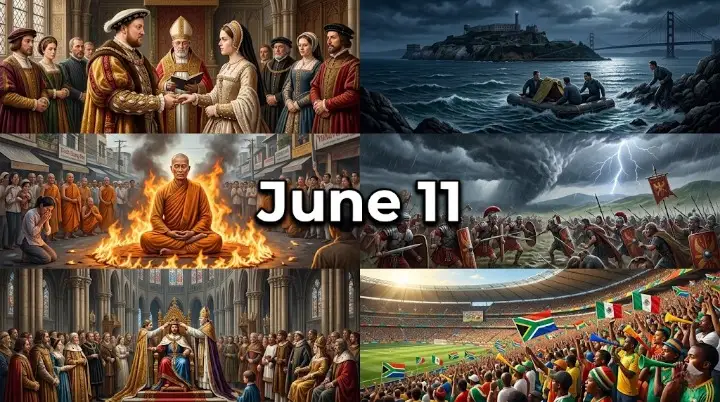
On a warm Tuesday morning in London, an ambitious nineteen-year-old monarch took the hand of a Spanish princess, sealing a union that would alter the religious and political landscape of Europe forever. King Henry VIII married Catherine of Aragon on this day in history June 11, starting a tumultuous twenty-four-year marriage that eventually sparked the English Reformation. Little did the wedding guests know that the young groom’s desperate quest for a male heir would lead to severed ties with Rome, the creation of the Church of England, and a trail of executed queens.
Story of the Day: The Great Escape from Alcatraz
Three prisoners slipped out of their cells at the Alcatraz Federal Penitentiary on the night of June 11, 1962, leaving behind dummy heads made of soap, toothpaste, and human hair to fool the guards. Frank Morris, along with brothers John and Clarence Anglin, spent months using sharpened spoons to chip away at the decaying concrete around their cell vents. They climbed a utility corridor to the roof, slid down a vent pipe, and launched a homemade raft made from fifty stolen raincoats into the frigid, treacherous waters of San Francisco Bay. The FBI launched one of the largest manhunts in American law enforcement history, but the men were never seen again. While authorities claim the trio drowned in the powerful Pacific currents, the mysterious disappearance cemented the prison’s reputation as an inescapable fortress that three men might have actually beaten.
Important Events That Happened On June 11 In History
173 – The Rain Miracle
Marcus Aurelius watched his exhausted Roman legions crumble in the suffocating heat of modern-day Moravia, completely surrounded by the hostile Quadi tribes who had shattered their peace treaty. Desperate soldiers prayed for survival as water supplies ran dry and the enemy prepared a final, crushing assault. Dark clouds suddenly gathered over the battlefield, unleashing a violent thunderstorm that drenched the parched Romans while striking their enemies with terrifying bolts of lightning. The unexpected torrent revived the Roman army, allowing them to rally and completely subdue the panicked Germanic warriors in an event celebrated across the empire as a divine intervention.
631 – The Emperor’s Ransom
Emperor Taizong of Tang watched his emissaries depart the imperial capital, their carts piled high with glittering gold and precious silks destined for the rugged territory of the Xueyantuo tribe. These vast riches carried a single, urgent purpose: purchasing the freedom of thousands of Chinese citizens captured during the bloody collapse of the Sui dynasty. Tang authorities valued human capital above gold, recognizing that rebuilding a fractured nation required the hands of its displaced people. The diplomatic mission successfully retrieved the prisoners, restoring families and securing vital labor to fuel the early decades of the prosperous Tang golden age.
786 – The Fakhkh Massacre
Husayn ibn Ali al-Abid led a desperate band of Alid rebels into the valley of Fakhkh near Mecca, raising their banners against the overwhelming military might of the Abbasid Caliphate. The idealistic uprising sought to overthrow what they viewed as an oppressive regime, but the Abbasid generals moved with ruthless, synchronized precision. Abbasid cavalry cut down the outmatched rebels, executing Husayn and leaving the battlefield strewn with the bodies of his followers. The brutal suppression failed to extinguish the Alid cause, instead forcing the survivors into exile, where Idris ibn Abdallah escaped to Morocco and founded the independent Idrisid dynasty.
980 – The Rise of Rus’
Vladimir the Great stood before the citizens of Kyiv as the undisputed ruler of a massive, consolidated territory stretching from the fertile plains of Ukraine to the cold shores of the Baltic Sea. Decades of civil war between the sons of Sviatoslav ended when Vladimir secured the grand princely throne, uniting fractured East Slavic principalities under a single central authority. The ambitious knyaz immediately set about centralizing power, establishing pagan shrines, and reforming the administrative structure of the vast Kievan Rus’ state. His ascension laid the geopolitical and cultural foundations for Eastern Europe, setting the stage for his monumental decision to Christianize the entire realm eight years later.
1011 – The Betrayal of Bari
Melus of Bari rallied his remaining Lombard rebels behind the city walls, watching anxiously as angry Greek citizens turned against them in the coastal streets. The local population grew weary of the grinding rebellion against Byzantine rule and secretly opened the city gates to Basil Mesardonites, the imperial governor. Byzantine troops poured into the stronghold, scattering the rebels and re-establishing total administrative control over the strategic Catepanate of Italy. Melus fled north into Germany to seek foreign aid, while the Byzantine victory solidified imperial dominance over southern Italy for another generation.
1042 – The Empress’s Third Marriage
Empress Zoe Porphyrogenita exchanged vows with the handsome aristocrat Constantine Monomachos, desperately sealing her grip on the Byzantine throne after months of political chaos in Constantinople. The elderly empress needed a male co-ruler to stabilize the court, prompting her to recall Constantine from his forced exile on the island of Lesbos. Church officials reluctantly tolerated the scandalous third marriage, and Constantine received his imperial crown the very next morning as Emperor Constantine IX. The union brought brief stability to the palace, though Constantine’s lavish spending soon began to drain the imperial treasury.
1118 – The Fall of Azaz
Roger of Salerno led his heavily armored Crusader knights in a furious charge against the outer defenses of Azaz, a vital northern stronghold held by the Seljuk Turks. The Prince of Antioch understood that capturing this fortress was essential to protecting his northern frontier and securing the trade routes feeding the Crusader States. Outmaneuvered by Roger’s aggressive tactical approach, the Turkish garrison broke under pressure, surrendering the tactical prize to the Principality of Antioch. The victory temporarily halted Seljuk incursions into Christian-held territory and extended the lifespan of the fragile Crusader outposts in Syria.
1157 – The Birth of Brandenburg
Albert the Bear rode into the strategic fortress of Brandenburg, officially declaring himself the first margrave of a newly established German frontier state. The ambitious Saxon nobleman spent years fighting and negotiating against the Slavic Wendish tribes who previously controlled these marshy northern territories. By successfully integrating these lands into the Holy Roman Empire, Albert laid the geopolitical cornerstone for modern Germany. His administrative reforms and encouragement of German settlement transformed the Margraviate of Brandenburg into a European powerhouse that eventually evolved into the Kingdom of Prussia.
1345 – The Lynching of Apokaukos
Alexios Apokaukos walked into the courtyard of a newly constructed political prison in Constantinople, intending to inspect the high-profile inmates he had locked away during the brutal Byzantine civil war. The chief minister’s arrival triggered an explosion of long-simmering rage among the unchained prisoners, who cornered the powerful statesman before guards could react. Political detainees struck down the hated minister with construction tools, decapitating him and hoisting his severed head on a pole above the prison walls. The sudden assassination threw the regency government into immediate panic and completely shifted the balance of power toward his rival, John VI Kantakouzenos.
1429 – The Siege of Jargeau
Joan of Arc stood beneath her white banner outside the fortified town of Jargeau, rallying French forces for their first major offensive action since breaking the Siege of Orléans. English defenders under the Earl of Suffolk held the strategic Loire River crossing, determined to crush the momentum of the teenage peasant girl. Joan led her men directly to the walls, surviving a blow to her helmet from a heavy stone projectile that cracked in two as she scaled a ladder. The inspired French troops swarmed the defenses, capturing Suffolk and clearing the path for the eventual coronation of King Charles VII.
1482 – The Betrayal at Fotheringhay
Alexander Stewart, the Duke of Albany, dipped his quill in ink to sign the Treaty of Fotheringhay, forming a treasonous alliance with King Edward IV of England to overthrow his own brother. The rebellious Scottish duke agreed to hand over vital border territories and hold Scotland as a vassal state in exchange for English military backing to seize the throne from King James III. English troops immediately mobilized to march north under the Duke of Gloucester to enforce the agreement. The treacherous pact brought Scotland to the brink of a massive civil war and opened the door to decades of destructive English military intervention.
1488 – The Death of a Scottish King
King James III of Scotland fled the chaotic battlefield of Sauchieburn, his royal horse bolting as rebel lords led by his own teenage son tore through the loyalist lines. The unpopular monarch fell from his saddle near a local mill, heavily bruised and calling out for a priest to shrive his soul. An unidentified man claiming to be a cleric stepped forward from the surrounding crowd, pulled a dagger, and stabbed the vulnerable king to death inside the mill cottage. The mysterious murder ended a troubled reign and placed fifteen-year-old James IV on the throne, leaving the young king plagued by lifelong guilt over his father’s violent demise.
1509 – A Royal Wedding
King Henry VIII took the hand of Catherine of Aragon in a private ceremony at Greenwich Palace, fulfilling a diplomatic promise to maintain England’s critical alliance with Spain. The nineteen-year-old monarch married his brother Arthur’s widow out of genuine affection and geopolitical necessity, ignoring complex theological questions regarding the union. The early years of their marriage brought immense joy, pageantry, and hope to an English public eager for stability after the Wars of the Roses. Decades later, Catherine’s inability to produce a surviving male heir turned this joyful union into a bitter legal battle that fractured Western Christianity.
1559 – The Florida Expedition
Don Tristan de Luna y Arellano watched from the deck of his flagship as a massive armada of eleven vessels carrying 1,500 soldiers, priests, and Mexican settlers sailed out of Veracruz harbor. The ambitious Spanish commander carried explicit royal orders to establish the first permanent European settlement on the Gulf Coast of Florida. This massive colonizing effort aimed to secure Spanish claims over the Southeast and protect vital treasure fleets from hostile French privateers. The expedition landed at Pensacola Bay weeks later, but a catastrophic hurricane destroyed their supply ships shortly after arrival, dooming the colony to a slow, agonizing starvation.
1594 – The Rise of the Principalía
King Philip II of Spain signed a royal decree in Madrid that officially recognized the traditional rights, titles, and local privileges of the native chieftains across the Philippine archipelago. The Spanish crown chose to co-opt the existing indigenous elite rather than destroy them, transforming traditional tribal leaders into an aristocratic ruling class known as the Principalía. These native nobles collected taxes, maintained local order, and enforced Spanish colonial law on behalf of the distant empire. This administrative compromise stabilized Spanish rule across the islands, creating a powerful, wealthy social class that dominated Philippine politics for the next three centuries.
1685 – The Monmouth Rebellion
James Scott, the Duke of Monmouth, stepped off a small boat onto the pebble beach at Lyme Regis, raising a blue banner to declare himself the rightful Protestant King of England. The illegitimate son of Charles II arrived with just eighty followers, betting that local hatred for the Catholic King James II would trigger a massive popular uprising. Protestant peasants and weavers rushed to join his rebel army, desperate to defend their faith against royal tyranny. The bold rebellion collapsed less than a month later at the Battle of Sedgemoor, resulting in Monmouth’s capture and his brutal, multi-stroke execution on Tower Hill.
1702 – The Defense of Nijmegen
Anglo-Dutch infantrymen rushed into defensive positions outside the ancient walls of Nijmegen, opening fire on advancing French columns led by the Marshal of Boufflers. The French army attempted a surprise march to seize the strategic Dutch fortress city before allied reinforcements could organize. A fierce rearguard action delayed the French advance for critical hours, allowing the main allied army to retreat safely beneath the protection of the city’s heavy artillery. The stubborn defensive stand saved Nijmegen from a destructive occupation and preserved a vital supply hub for the Duke of Marlborough’s early campaigns in the War of the Spanish Succession.
1724 – Bach’s New Cycle
Johann Sebastian Bach raised his baton in the St. Nicholas Church of Leipzig, leading his musicians through the thunderous opening chorus of the cantata O Ewigkeit, du Donnerwort. The intense performance marked the first Sunday after Trinity and launched Bach’s monumental second annual cycle of church music, known today as the chorale cantata cycle. The master composer committed to writing a complex, completely original cantata every single week based on traditional Lutheran hymns. This exhausting creative marathon produced some of the greatest sacred music in human history, transforming the daily spiritual life of Leipzig’s congregations.
1748 – The Nordic Cross Appears
King Frederik V of Denmark issued a royal decree officially adopting the red-and-white Dannebrog as the mandatory merchant flag for all Danish vessels sailing in southern waters. The distinctive layout featured an asymmetric cross symbolizing Christianity, shifted toward the hoist side to ensure visibility when the fabric flapped in ocean winds. This practical naval decision formalized one of the oldest national flags in existence, dating back to medieval crusades. The striking design set a profound regional precedent, inspiring every other Scandinavian nation to eventually adopt the same iconic cross layout for their own national flags.
1770 – Cook Hits the Reef
Captain James Cook felt a violent, sickening shudder rip through the hull of HMS Endeavor as the vessel slammed hard onto a hidden coral shelf of the Great Barrier Reef. The British crew found themselves trapped twenty-four miles from the Australian mainland, with sharp coral puncturing the ship’s heavy timber hull. Men worked frantically for twenty-three hours, throwing heavy cannons, ballast, and spoiled provisions into the sea to lighten the dying ship as water rushed into the hold. Cook successfully floated the vessel off the reef by using a makeshift sail packed with sheep dung and oakum to plug the massive breach.
1775 – The Last Royal Coronation
Louis XVI sat upon an ornate throne inside the ancient Cathedral of Reims, his head bearing the heavy, gem-encrusted Crown of Charlemagne during a traditional coronation ceremony of unmatched extravagance. The lavish event celebrated the young king’s divine right to rule France, surrounding him with medieval pageantry and wealthy aristocrats completely detached from the economic realities of the nation. Peasants outside the cathedral walls starved as high bread prices fueled widespread public anger across the country. The glittering celebration marked the final traditional coronation of the Ancien Régime, occurring just fourteen years before the French Revolution tore down the monarchy.
1775 – The Battle of Machias
Jeremiah O’Brien led a makeshift militia of angry Maine woodsmen aboard the confiscated merchant sloop Unity, pursuing the armed British schooner Margaretta into the open waters of Machias Bay. Armed with pitchforks, axes, and old hunting muskets, the provincial rebels rammed the British naval vessel and engaged in fierce, hand-to-hand combat on the blood-slicked deck. The colonial volunteers killed the British commander and forced the crew to surrender, marking the first naval engagement of the American Revolutionary War. The daring victory proved that the British Royal Navy was vulnerable to aggressive maritime tactics, inspiring American privateers across the Atlantic coast.
1776 – The Committee of Five
The Continental Congress gathered in Philadelphia to appoint Thomas Jefferson, John Adams, Benjamin Franklin, Roger Sherman, and Robert R. Livingston to a select committee charged with drafting a formal declaration of independence. The political leaders recognized that separating from Great Britain required a powerful, legally sound written philosophical argument to unite the colonies and secure crucial foreign alliances. The group chose Jefferson to pen the initial draft due to his elegant, persuasive writing style and clear understanding of Enlightenment philosophy. Their collaborative edits produced a document that transformed thirteen rebellious colonies into a nation founded on the radical premise of unalienable human rights.
1788 – Russia Reaches Alaska
Gerasim Izmailov guided his wooden exploration vessel into the pristine waters of Yakutat Bay, stepping onto the rugged coastline to claim the territory on behalf of the Russian Empire. The experienced navigator mapped the uncharted Alaskan shoreline, trading iron tools and glass beads with the indigenous Tlingit people for valuable sea otter pelts. This successful landing expanded Russia’s maritime fur trading network deep into the North American continent, establishing a lucrative colonial presence in the Pacific Northwest. The geographic data collected during the expedition paved the way for permanent Russian settlements and decades of imperial control over Alaska.
1805 – The Great Fire of Detroit
John Harvey dropped hot ash from his tobacco pipe into a pile of dry hay inside a bakery stable, accidentally triggering a spark that caught the wind and exploded into a wall of flame. The fire raced through Detroit’s tightly packed wooden homes and narrow alleys, consuming nearly every single building in the frontier settlement within a few hours. Terrified residents fled to the safety of the nearby Detroit River, watching their entire town burn to the ground. The catastrophic destruction forced territorial judge Augustus Woodward to completely redesign the city, replacing the cramped colonial layout with a grand, spacious system of wide avenues.
1825 – Fort Hamilton Begins
Military engineers and local laborers gathered on the southwestern tip of Brooklyn to lay the massive stone cornerstone for Fort Hamilton, a state-of-the-art coastal fortification. The United States war department ordered the construction to protect New York Harbor from hostile foreign navies, learning hard lessons from British maritime incursions during the War of 1812. The heavy granite fortress was designed to support tiers of heavy artillery capable of devastating any enemy warship attempting to enter the Narrows. The construction project transformed the rural Brooklyn shoreline into a permanent military garrison that protected the nation’s financial heart for over a century.
1837 – The Broad Street Riot
An Irish funeral procession marching down Boston’s Broad Street collided head-on with a responding company of volunteer firefighters, triggering a massive, ethnically charged street battle. Long-simmering tensions between native-born Protestant Yankees and newly arrived Catholic Irish immigrants exploded as thousands of residents flooded the streets with clubs and bricks. Rioters looted Irish homes and destroyed personal property throughout the neighborhood until the state militia arrived with fixed bayonets to restore order. The violent clash exposed the deep social fractures caused by rapid immigration, forcing Boston to replace its unreliable volunteer fire companies with a professional, disciplined department.
1865 – The Battle of the Riachuelo
Admiral Francisco Manoel Barroso guided his Brazilian ironclads into the narrow channels of the Riachuelo River, slamming his flagship directly into Paraguayan vessels during a desperate naval ambush. The Paraguayan Navy attempted a surprise attack to destroy the superior imperial fleet and seize total control of the critical Paraná River communications corridor. Barroso’s aggressive ramming tactics shattered the wooden Paraguayan armada, sinking several combat vessels and forcing the survivors into a chaotic retreat. The decisive Brazilian victory isolated Paraguay from international trade, sealing the strategic fate of the devastating Paraguayan War in favor of the Triple Alliance.
1882 – The Alexandria Riots
Nationalist rioters armed with clubs and knives poured into the European quarters of Alexandria, attacking foreign residents in a violent outburst against British and French imperial domination. The sudden uprising caught the city’s cosmopolitan population completely off guard, resulting in the brutal deaths of over fifty Europeans, including the British consul. British warships anchored in the harbor watched the smoke rise, their commanders furious over the breakdown of local security and Egyptian government control. The deadly riots provided Great Britain with the political justification it needed to bombard the city a month later, beginning a decades-long military occupation of Egypt.
1892 – The Limelight Department
Government officials in Melbourne, Australia, signed the formal paperwork to officially establish the Limelight Department, creating one of the world’s very first dedicated multimedia film production studios. Operated by the Salvation Army, the pioneering studio used advanced magic lanterns and early celluloid film to produce powerful social documentaries and religious stories. The innovative media team developed groundbreaking production techniques, including special effects and multi-reel narratives, long before Hollywood existed. Their cinematic work transformed public relations and evangelical outreach, proving that moving pictures were a powerful tool for mass education and social reform.
1895 – The First Real Motor Race
Émile Levassor gripped the steering wheel of his Panhard et Levassor car, crossing the finish line in Paris after driving 732 miles to Bordeaux and back without a single break for sleep. The historic Paris–Bordeaux–Paris event pitted twenty-two primitive mechanical vehicles against each other in a brutal test of endurance designed to prove the reliability of gasoline engines. Levassor completed the exhausting journey in just under forty-nine hours, maintaining an average speed of fifteen miles per hour to beat his closest steam-powered rivals. The spectacular performance convinced a skeptical public that the internal combustion engine was the undisputed future of personal transportation.
1898 – The Hundred Days’ Reform
The Guangxu Emperor issued his first imperial reform edict in Beijing, launching a massive, desperate movement to completely overhaul China’s decaying social, political, and educational institutions. Guided by visionary scholars, the young emperor sought to modernize the Qing Empire by adopting Western-style legal systems, agricultural techniques, and military training methods. The radical changes threatened the wealth and traditional power of conservative court officials, who rallied behind the influential Empress Dowager Cixi. After just 104 days, Cixi launched a swift palace coup, placed the emperor under house arrest, and executed the leading reformers.
1901 – New Zealand Grows
Premier Richard Seddon watched with satisfaction as colonial officials in Wellington formally extended the international boundaries of New Zealand to incorporate the Cook Islands. The British imperial government transferred administrative control of the isolated Pacific territory to its southern dominion, aiming to secure strategic shipping lanes and expand agricultural trade networks. The political annexation transformed the islanders into British subjects managed directly by New Zealand authorities, who established new governance structures across the territory. This expansionist move marked New Zealand’s early steps toward developing its own regional Pacific empire independent of direct London oversight.
1903 – The Royal Assassination
A faction of rogue Serbian military officers stormed the royal palace in Belgrade, blasting through the bedroom doors with dynamite to hunt down their own unpopular monarch. The conspirators discovered King Alexander I and Queen Draga hiding inside a secret wardrobe, opening fire on the royal couple before stabbing them repeatedly with bayonets. The mutineers threw the mutilated bodies out of a second-story palace window onto the lawn below, completely wiping out the Obrenović dynasty in a single night of violence. The brutal coup placed the rival Karadjordjević family on the throne, instantly shifting Serbia’s foreign policy away from Austria-Hungary toward Imperial Russia.
1917 – The Forced Abdication
King Constantine I of Greece walked out of his palace into exile, forced from his throne after Allied armies occupied Athens and threatened to bombard the city into submission. The pro-German monarch had fought bitterly with his prime minister over Greece’s neutrality during the horrors of World War I, infuriating British and French leaders who demanded access to Greek ports. The Allied powers bypassed the crown prince due to his military background, placing Constantine’s second son, twenty-three-year-old Alexander, onto the vulnerable throne. The forced succession dragged Greece into the global conflict, leaving the nation deeply divided by political bitterness.
1919 – The First Triple Crown
Jockey Johnny Loftus guided the legendary colt Sir Barton across the finish line at the Belmont Stakes, winning the grueling race by five full lengths to complete an unprecedented sweep of American racing. The remarkable victory followed dominant performances at the Kentucky Derby and the Preakness Stakes, achieved during a compressed thirty-two-day racing schedule. Sir Barton became the first horse in history to win all three iconic events, defining greatness in the sport long before the term “Triple Crown” became an official title. The historic achievement elevated American horse racing to national prominence, creating an enduring benchmark for equine excellence.
1920 – The Smoke-Filled Room
A handful of powerful Republican Party leaders slipped into Room 404 of Chicago’s Blackstone Hotel, closing the door to break a deadlocked national convention in the dead of night. Sitting through the early morning hours in an atmosphere thick with cigar smoke, the political bosses negotiated a compromise candidate for the upcoming United States presidential election. The backroom dealmakers settled on Senator Warren G. Harding of Ohio, bypassing more popular frontrunners to select a candidate they believed they could easily control. The secretive meeting prompted the Associated Press to coin the enduring political phrase “smoke-filled room” to describe backroom political deals.
1936 – FM Radio Debuts
Edwin Armstrong stood before a skeptical crowd of Federal Communications Commission engineers in Washington, DC, tuning a radio receiver to a broadcast from his experimental tower. The brilliant inventor demonstrated frequency modulation (FM) broadcasting for the first time, delivering crystal-clear audio completely free of the crackling static that plagued standard AM radio. Armstrong played a series of sound effects, including jazz records and water pouring into a glass, to prove the immense audio fidelity of his new system. The successful demonstration revolutionized consumer media, triggering a decades-long battle against established radio networks determined to protect their AM monopolies.
1936 – The Surrealist Invasion
Artist Salvador Dalí walked into New Bond Street’s Burlington Galleries wearing a deep-sea diving suit, leading a pet pack of Russian wolfhounds to mark the opening of the London International Surrealist Exhibition. The avant-garde show brought shocking artwork from Max Ernst, Joan Miró, and René Magritte to a stunned British public completely unaccustomed to dreamlike, subversive imagery. Dalí nearly suffocated inside his heavy diving helmet during his opening speech, frantically gesturing for a wrench as the audience applauded, thinking his genuine panic was part of the performance. The exhibition transformed the London art scene, cementing surrealism within mainstream British culture.
1937 – Stalin’s Red Army Purge
Soviet newspapers shocked the public by announcing the immediate execution of Marshal Mikhail Tukhachevsky and seven top Red Army generals following a secret, one-day military tribunal in Moscow. Joseph Stalin ordered the sudden executions based on fabricated documents that accused his finest military strategists of plotting a pro-Nazi coup against the Kremlin. The rapid liquidations marked the beginning of a devastating purge within the Soviet officer corps, decapitating the military command just years before World War II. The loss of experienced generals resulted in catastrophic tactical failures and millions of preventable casualties when Germany eventually invaded in 1941.
1938 – The Battle of Wuhan Begins
Japanese bombers roared over the industrial hub of Wuhan, dropping tons of high explosives to launch one of the largest and most destructive campaigns of the Second Sino-Japanese War. Generalissimo Chiang Kai-shek threw over one million Chinese soldiers into the defense of the strategic wartime capital, determined to halt the relentless advance of the Imperial Japanese Army. The massive confrontation spanned vast battlefields across central China, lasting over four months and involving widespread chemical warfare. While Japanese forces eventually captured the ruined city, the immense cost of the battle exhausted their military momentum, dragging Japan into a grueling war of attrition.
1940 – The Siege of Malta Begins
Italian bomber squadrons roared over the Grand Harbour of Valletta, dropping waves of high explosives to shatter the morning peace and launch the devastating Siege of Malta. Benito Mussolini declared war on Great Britain just hours earlier, aiming to bomb the strategic Mediterranean island into a swift, unconditional surrender. The British garrison possessed only three obsolete Gladiator biplanes—named Faith, Hope, and Charity—to defend the crowded skies against dozens of modern Italian fighters. The air raids marked the beginning of a brutal, three-year blockade that subjected Maltese civilians to near-total starvation and non-stop bombardment.
1942 – Soviet Lend-Lease Approved
President Franklin D. Roosevelt signed a formal master agreement in Washington, extending the massive United States Lend-Lease program to provide direct military and economic assistance to the Soviet Union. The strategic pact committed billions of dollars worth of American tanks, trucks, airplanes, and vital food supplies to help the Red Army hold the Eastern Front against the Nazi war machine. Roosevelt recognized that keeping the Soviet Union actively engaged in the conflict was absolutely essential to splitting German military strength and winning the global war. The massive flow of American industrial goods revitalized Soviet supply lines, fueling their eventual counter-offensives.
1942 – The Retreat from Bir Hakeim
General Marie-Pierre Kœnig led the exhausted survivors of the Free French Forces out of their isolated desert fortress at Bir Hakeim, slipping through Axis lines under the cover of a moonless night. For fifteen agonizing days, 3,700 French soldiers held off overwhelming assaults from General Erwin Rommel’s Afrika Korps, enduring non-stop artillery barrages and blistering heat. The stubborn defensive stand delayed the Axis advance toward Egypt for critical weeks, allowing the British Eighth Army to retreat safely and reorganize at El Alamein. The heroic defense restored French military pride and won global praise from Allied commanders.
1944 – USS Missouri Enters the War
Captain William Callaghan stood on the bridge of the USS Missouri at the Brooklyn Navy Yard, officially commissioning the final and most powerful Iowa-class battleship built by the United States Navy. Armed with nine massive sixteen-inch guns capable of firing explosive projectiles over twenty miles, the giant warship represented the pinnacle of American industrial might. The heavily armored vessel immediately prepared to sail for the Pacific theater to protect aircraft carriers and shell Japanese island strongholds. The mighty warship earned its place in history a year later as the official site where Japanese officials signed the instrument of surrender.
1955 – Tragedy at Le Mans
Driver Pierre Levegh’s Mercedes-Benz clipped another racing vehicle at 150 miles per hour, launching his heavy car directly into the crowded grandstands along the main straightaway of the 24 Hours of Le Mans. The vehicle disintegrated upon impact, sending its heavy engine block, axle, and magnesium chassis slicing through the dense crowd like shrapnel before exploding into a fireball. The horrific crash killed eighty-three spectators and injured over one hundred more in the deadliest accident in the history of motorsports. Track officials allowed the race to continue to prevent departing crowds from blocking incoming ambulances, triggering global outrage and safety overhauls.
1956 – The Gal Oya Riots
Armed mobs swept through the newly developed agricultural settlements of the Gal Oya valley, targeting minority Sri Lankan Tamils in the country’s first major post-independence ethnic riot. The violence exploded following heated political debates over the controversial “Sinhala Only” bill, which stripped the Tamil language of its official state status. Rioters burned hundreds of homes, destroyed local businesses, and attacked displaced families over five days of unchecked lawlessness before the military restored order. The riots left an estimated 150 people dead and fractured the island’s social fabric, setting a dark precedent for decades of ethnic conflict.
1963 – The Stand in the Schoolhouse Door
Governor George Wallace took up a defiant position at the entrance of the University of Alabama’s Foster Auditorium, using his physical presence to block two African American students from registering for classes. Vivian Malone and James Hood approached the building accompanied by federal officials, attempting to enforce a federal court order that shattered the university’s strict segregation policy. President John F. Kennedy responded by immediately federalizing the Alabama National Guard, forcing Wallace to step aside later that afternoon. The dramatic confrontation ended the state’s official resistance to integration, marking a major symbolic victory for the Civil Rights Movement.
1963 – The Ultimate Protest
Thích Quảng Đức sat calmly in the lotus position at a busy Saigon intersection, closing his eyes as a fellow Buddhist monk poured five gallons of gasoline directly over his head. The elderly monk struck a match and immediately transformed into a pillar of flame, burning to death without uttering a single sound or moving a muscle. The self-immolation protested the brutal anti-Buddhist persecution orchestrated by South Vietnam’s US-backed Catholic regime led by President Ngô Đình Diệm. Journalist Malcolm Browne captured the searing photograph of the sacrifice, shocking the international community and forcing the United States to re-evaluate its support for the regime.
1963 – JFK’s Civil Rights Address
President John F. Kennedy sat before television cameras in the Oval Office, delivering an urgent, unscripted address to the American people that defined civil rights as a profound moral issue as old as the scriptures. Spurred by the dramatic integration conflict in Alabama earlier that day, Kennedy became the first modern president to declare that racial segregation must end across the United States. He proposed sweeping federal legislation to guarantee equal access to all public facilities, integrate public education, and protect voting rights for Black citizens. The historic speech laid the foundation for the revolutionary Civil Rights Act of 1964.
1964 – The Cologne School Massacre
Walter Seifert stepped through the gates of a local elementary school in Cologne, Germany, carrying a heavy, home-made flamethrower and a long steel lance. The disturbed war veteran opened fire on children playing in the courtyard, unleashing a torrent of burning oil that trapped students inside their classrooms. Seifert killed eight young children and two dedicated teachers, and left several more horribly burned before fleeing the scene and consuming a lethal dose of pesticide. The horrific mass attack shocked postwar West Germany, forcing schools across Europe to implement tighter security measures and develop modern emergency response protocols.
1968 – Discovery of Cell Antigens
Dr. Lloyd J. Old published a groundbreaking medical paper in New York, revealing his successful identification of the very first cell surface antigens capable of differentiating distinct cell types. Working at the Sloan Kettering Institute, the brilliant immunologist demonstrated that specific protein markers on a cell’s outer membrane could distinguish healthy tissue from cancerous cells. This fundamental biological insight shattered long-held beliefs that all mammalian cells shared identical surface structures. His laboratory breakthrough laid the absolute scientific foundation for modern cancer immunotherapy, allowing doctors to develop targeted treatments that utilize the human immune system to fight tumors.
1970 – First Female Generals
Anna Mae Hays and Elizabeth P. Hoisington stood at attention inside the Pentagon, receiving their silver stars during a historic military promotion ceremony that shattered a 195-year-old barrier. General William Westmoreland pinned the new rank onto both women simultaneously, making them the very first female general officers in the history of the United States Army. Hays served as the dedicated Chief of the Army Nurse Corps during the height of the Vietnam War, while Hoisington commanded the vast Women’s Army Corps. Their high-profile promotions opened the door for generations of women to attain senior leadership positions across all branches of the military.
1971 – The Clearing of Alcatraz
Armed federal marshals and FBI agents quietly landed on Alcatraz Island, moving swiftly to remove the remaining fifteen Native American activists occupying the abandoned federal prison. The sudden tactical operation brought an end to a nineteen-month political occupation led by the Indians of All Tribes movement, who claimed the land under old treaty rights. The long occupation focused global media attention on the systemic oppression, broken treaties, and widespread poverty enduring across Native American communities. While the activists lost control of the island, their bold protest forced the federal government to officially abandon its destructive tribal termination policies.
1978 – The Birth of APMSO
Altaf Hussain gathered a small group of determined students inside a classroom at Karachi University, officially founding the All Pakistan Muhajir Students Organisation. The new political movement sought to defend the educational rights and career opportunities of Urdu-speaking immigrants who felt marginalized by regional quota systems in Sindh. The student group expanded rapidly across Karachi’s campuses, tapping into deep undercurrents of social frustration among ethnic Muhajir youths. The organization completely transformed the volatile landscape of urban Pakistani politics, eventually evolving into the powerful and highly controversial Muttahida Qaumi Movement.
1981 – The Golbaf Earthquake
A powerful magnitude 6.9 earthquake tore through the Kerman province of southeastern Iran, sending violent shockwaves that flattened the historic oasis town of Golbaf within seconds. The intense tremor struck during the scorching afternoon hours when many residents were resting indoors, causing thousands of heavy mud-brick homes to collapse onto their inhabitants. The disaster claimed at least 2,000 human lives, obliterated vital underground water channels, and left tens of thousands of survivors completely homeless in the desert. The massive scale of the destruction triggered a major international relief effort to bring medical aid and winter tents to the remote region.
1987 – British Parliament Transformed
Diane Abbott, Paul Boateng, and Bernie Grant smiled broadly on the steps of Westminster, celebrating their historic election as the very first Black Members of Parliament in Great Britain. The groundbreaking victory occurred during a hard-fought general election, breaking a centuries-old racial barrier within the halls of British democracy. Abbott secured her historic seat in Hackney North, while Grant won in Tottenham and Boateng triumphed in Brent South on behalf of the Labour Party. Their entry into the House of Commons fundamentally shifted national political debates, ensuring that the voices of Britain’s diverse immigrant communities were represented at the highest level of government.
1998 – The Compaq-Digital Merger
Compaq Computer Chief Executive Eckhard Pfeiffer finalized the massive US$9 billion acquisition of Digital Equipment Corporation, completing the largest and most expensive corporate merger in the history of the high-tech industry. The aggressive buyout aimed to transform Compaq from a standard personal computer manufacturer into an enterprise computing powerhouse capable of competing with IBM. The difficult corporate integration proved incredibly complex, as culture clashes and shifting market trends quickly eroded the value of Digital’s legacy server businesses. The troubled merger drained Compaq’s financial resources, paving the way for its own acquisition by Hewlett-Packard four years later.
2001 – Execution of McVeigh
Timothy McVeigh strapped into a gurney inside the federal penitentiary in Terre Haute, Indiana, receiving a lethal injection for orchestrating the devastating Oklahoma City bombing. The unrepentant domestic terrorist killed 168 innocent men, women, and children when he detonated a massive truck bomb outside the Alfred P. Murrah Federal Building in 1995. McVeigh refused to utter a final verbal statement, instead requesting that a handwritten copy of William Ernest Henley’s nineteenth-century poem Invictus be distributed to media witnesses. The execution marked the first time the United States federal government put a prisoner to death in nearly forty years.
2002 – Justice for Meucci
The United States Congress passed a historic, long-overdue resolution that officially acknowledged Italian immigrant Antonio Meucci as the true, original inventor of the telephone. Lawmakers recognized that Meucci developed a working voice-communication apparatus in his Staten Island home as early as 1860, years before Alexander Graham Bell filed his lucrative patent. The cash-strapped Italian inventor was unable to afford the permanent patent fee, allowing Bell to secure the commercial rights and credit for the revolutionary technology. The symbolic legislative resolution restored Meucci’s rightful place in scientific history, corrected a century of injustice, and brought immense pride to Italian-Americans.
2004 – Cassini Encounters Phoebe
The Cassini–Huygens spacecraft fired its thrusters to execute a flawless, ultra-close flyby of Saturn’s enigmatic moon Phoebe, passing within just 1,285 miles of its heavily cratered surface. The automated probe captured spectacular, high-resolution images of the dark, battered moon, revealing a chaotic landscape rich in water ice, rock, and carbon compounds. The scientific data collected proved that Phoebe was actually an ancient object from the outer Kuiper Belt captured by Saturn’s immense gravity billions of years ago. The successful flyby provided researchers with a pristine look at the primordial building blocks that formed our solar system.
2007 – Chittagong Mudslides
Heavy, nonstop monsoon rains saturated the deforested hillsides surrounding Chittagong, Bangladesh, triggering a series of massive, midnight mudslides that buried thousands of slum dwellings. Walls of thick, liquid earth swept down the slopes at terrifying speeds, crushing temporary bamboo homes while residents slept soundly inside. The ecological disaster killed 130 people, left hundreds severely injured, and cut off vital transportation links to the country’s primary port city. The tragic loss of life exposed the extreme vulnerability of impoverished communities living on unstable terrains, forcing urban planners to implement strict bans on hillside cutting.
2008 – The Residential Schools Apology
Prime Minister Stephen Harper stood before a crowded House of Commons in Ottawa, delivering a historic, emotional official apology to Canada’s First Nations, Inuit, and Métis peoples. Harper explicitly recognized the deep, lasting trauma caused by the state-sponsored Indian residential school system, which forcibly separated over 150,000 indigenous children from their families to strip them of their culture. The prime minister admitted the state’s policy of forced assimilation was profoundly wrong, deeply damaging, and had no place in a civilized country. The emotional address marked a turning point in Canada’s long journey toward national reconciliation.
2008 – Fermi Space Telescope Launches
A Delta II rocket roared off the launch pad at Cape Canaveral, carrying NASA’s Fermi Gamma-ray Space Telescope into a stable low-Earth orbit. The state-of-the-art orbital observatory was designed to explore the most violent, high-energy phenomena in the universe, including supermassive black holes, pulsar stars, and mysterious cosmic rays. The high-tech telescope allowed astrophysicists to read light invisible to the human eye, mapping the cosmos with unprecedented clarity. The ongoing scientific mission quickly transformed our understanding of the laws of physics operating under the most extreme cosmic conditions imaginable.
2010 – Africa’s First World Cup
Musicians and dancers flooded the pitch at Soccer City stadium in Johannesburg, unleashing an explosion of color, rhythm, and buzzing vuvuzelas to open the 2010 FIFA World Cup. The spectacular celebration marked the first time the world’s greatest sporting event was hosted on African soil, uniting a proud nation under the banner of sport. Host nation South Africa took the field against Mexico in the opening match, sending the home crowd into pure ecstasy when Siphiwe Tshabalala scored a stunning opening goal. The tournament shattered international stereotypes about the continent, delivering a joyous celebration of African culture.
2012 – The Afghanistan Landslides
Two powerful earthquakes struck the rugged Hindu Kush region of northern Afghanistan, triggering a massive, catastrophic landslide that buried the entire remote village of Sayee Asara. Millions of tons of rock and dirt broke away from the mountain peak, collapsing onto dozens of mud-brick homes and trapping families beneath a mountain of debris. The disaster killed seventy-five villagers, with emergency rescue teams finding it nearly impossible to reach the isolated location due to blocked mountain passes. The tragedy highlighted the immense challenges facing humanitarian responses in the underdeveloped, seismically active regions of central Asia.
2013 – The Blackout of ERT
Prime Minister Antonis Samaras shocked the Greek public by issuing a sudden executive decree that instantly shut down ERT, the country’s respected national public broadcasting network. The conservative government ordered the immediate termination of nearly 2,700 media workers to satisfy aggressive state spending cuts demanded by international bailout creditors during the Greek financial crisis. Screen channels faded to black in the middle of live broadcasts, sparking massive public protests, staff occupations, and international condemnation over the loss of media freedom. Exactly two years later, prime minister Alexis Tsipras officially reopened the historic broadcaster.
Dive into the archives for yesterday’s fascinating entries.
Famous People Born On June 11
| Name | Description | Date |
|---|---|---|
| Anne Neville | Princess of Wales and Queen of England as the wife of King Richard III, a central figure in the Wars of the Roses | 1456 – 1485 |
| Ben Jonson | English poet, playwright, and critic, a major figure in Elizabethan and Jacobean literature, second only to Shakespeare | 1572 – 1637 |
| Tokugawa Ienobu | Japanese shōgun, the sixth ruler of the Tokugawa shogunate, who continued the policies of his predecessors | 1662 – 1712 |
| Joseph Warren | American physician and general, a key Patriot leader in the early stages of the American Revolution | 1741 – 1775 |
| John Constable | English painter and academic, one of the most celebrated landscape painters in British art history | 1776 – 1837 |
| Julia Margaret Cameron | Indian-Sri Lankan photographer, one of the most important portrait photographers of the 19th century | 1815 – 1879 |
| Carl von Linde | German engineer and academic, inventor of the modern refrigeration and air conditioning systems | 1842 – 1934 |
| Millicent Fawcett | English academic and activist, a leading suffragist and campaigner for women’s rights in the UK | 1847 – 1929 |
| Richard Strauss | German composer and conductor, a towering figure of late Romantic and early modern classical music | 1864 – 1949 |
| Charles Fabry | French physicist and academic, co-discoverer of the ozone layer in the Earth’s atmosphere | 1867 – 1945 |
| Jeannette Rankin | American social worker and politician, the first woman elected to the United States Congress | 1880 – 1973 |
| Bartolomeo Vanzetti | Italian-American anarchist and convicted criminal, executed in a famous controversial trial with Sacco | 1888 – 1927 |
| Kiichiro Toyoda | Japanese businessman, founder of Toyota Motor Corporation, one of the world’s largest automakers | 1894 – 1952 |
| Nikolai Bulganin | Soviet politician, a prominent figure in the post-Stalin era, serving as Premier of the Soviet Union | 1895 – 1975 |
| Yasunari Kawabata | Japanese novelist and short story writer, Nobel Prize laureate in Literature, author of Snow Country | 1899 – 1972 |
| Jacques Cousteau | French biologist, author, and inventor, co-developer of the aqua-lung and pioneer of marine conservation | 1910 – 1997 |
| Vince Lombardi | American football player, coach, and manager, considered one of the greatest coaches in NFL history | 1913 – 1970 |
| William Styron | American novelist and essayist, author of Sophie’s Choice and The Confessions of Nat Turner | 1925 – 2006 |
| Queen Fabiola of Belgium | Queen consort of the Belgians as the wife of King Baudouin, known for her charity work | 1928 – 2014 |
| Charles Rangel | American soldier, lawyer, and politician, a long-serving U.S. Congressman from New York | 1930 – 2025 |
| Athol Fugard | South African-American actor, director, and playwright, a leading voice against apartheid through his plays | 1932 – 2025 |
| Gene Wilder | American actor, director, and screenwriter, known for his iconic roles in Willy Wonka and Mel Brooks films | 1933 – 2016 |
| Robin Warren | Australian pathologist and academic, Nobel Prize laureate for discovering that peptic ulcers are caused by bacteria | 1937 – 2024 |
| Jackie Stewart | Scottish racing driver and sports presenter, a three-time Formula One World Champion | 1939 – Present |
| Joe Montana | American football player and sportscaster, four-time Super Bowl-winning quarterback for the San Francisco 49ers | 1956 – Present |
| Hugh Laurie | English actor and screenwriter, best known for his role as Dr. House in the hit television series House | 1959 – Present |
| Peter Dinklage | American actor and producer, known for his role as Tyrion Lannister in Game of Thrones | 1969 – Present |
| Joshua Jackson | Canadian-American actor, known for his roles in Dawson’s Creek and Fringe | 1978 – Present |
| Shia LaBeouf | American actor, known for his roles in the Transformers franchise and his acclaimed independent film work | 1986 – Present |
| Kai Havertz | German footballer, a key player for Chelsea and Arsenal, and a UEFA Champions League winner | 1999 – Present |
Famous People Died On June 11
| Name | Description | Date |
|---|---|---|
| Henry the Young King | King of England, the only English king to be crowned during his father’s reign, though he never held real power | 1155 – 1183 |
| James III of Scotland | King of Scotland, whose reign was marked by conflict with the nobility and his eventual death in battle | 1451 – 1488 |
| John III of Portugal | King of Portugal who oversaw the expansion of the Portuguese Empire during the Age of Discovery | 1502 – 1557 |
| Mary of Guise | Queen of Scotland as the wife of James V, and regent for her daughter Mary, Queen of Scots | 1515 – 1560 |
| George I of Great Britain | King of Great Britain and Ireland, the first Hanoverian monarch of the British throne | 1660 – 1727 |
| John Franklin | English admiral and politician, a famous Arctic explorer whose ill-fated expedition to find the Northwest Passage ended in tragedy | 1786 – 1847 |
| Klemens von Metternich | German-Austrian politician, 1st State Chancellor of the Austrian Empire and a dominant figure in European diplomacy | 1773 – 1859 |
| Alexander I of Serbia | King of Serbia, assassinated along with his wife in a coup d’état that shocked Europe | 1876 – 1903 |
| Mahmud Shevket Pasha | Ottoman general and politician, 279th Grand Vizier of the Ottoman Empire, assassinated in office | 1856 – 1913 |
| Lev Vygotsky | Belarusian-Russian psychologist and theorist, a pioneer of developmental psychology and the theory of the Zone of Proximal Development | 1896 – 1934 |
| Robert E. Howard | American author and poet, creator of Conan the Barbarian, a giant of the sword and sorcery genre | 1906 – 1936 |
| R. J. Mitchell | English engineer, designer of the Supermarine Spitfire, the iconic fighter plane of the Battle of Britain | 1895 – 1937 |
| Daniel Carter Beard | American author and illustrator, founder of the Boy Scouts of America | 1850 – 1941 |
| Thích Quảng Đức | Vietnamese monk and martyr, who self-immolated in protest of the persecution of Buddhists in South Vietnam | 1897 – 1963 |
| Eurico Gaspar Dutra | Brazilian general and politician, 16th President of Brazil, who served in the post-WWII era | 1883 – 1974 |
| Julius Evola | Italian philosopher and author, a controversial and influential thinker in traditionalist and right-wing circles | 1898 – 1974 |
| John Wayne | American actor, director, and producer, a Hollywood icon and symbol of American rugged individualism | 1907 – 1979 |
| Enrico Berlinguer | Italian politician, leader of the Italian Communist Party, one of the most influential figures in post-war Italian politics | 1922 – 1984 |
| Timothy McVeigh | American domestic terrorist, responsible for the 1995 Oklahoma City bombing, the deadliest act of terrorism in U.S. history at the time | 1968 – 2001 |
| David Brinkley | American journalist and author, a pioneering television news anchor for NBC and ABC | 1920 – 2003 |
| Võ Văn Kiệt | Vietnamese soldier and politician, 5th Prime Minister of Vietnam, a key figure in the post-war rebuilding of Vietnam | 1922 – 2008 |
| Teófilo Stevenson | Cuban boxer and engineer, three-time Olympic gold medalist in heavyweight boxing, one of the greatest amateur boxers ever | 1952 – 2012 |
| Robert Fogel | American economist and academic, Nobel Prize laureate for his work in econometrics and economic history (cliometrics) | 1926 – 2013 |
| Ruby Dee | American actress, a pioneering African American actress and civil rights activist | 1922 – 2014 |
| Ornette Coleman | American saxophonist, violinist, trumpeter, and composer, a revolutionary figure in jazz and free jazz | 1930 – 2015 |
| Dusty Rhodes | American wrestler, known as the “American Dream,” a charismatic and beloved figure in professional wrestling | 1945 – 2015 |
| Billy McKee | Irish republican and founding member of the Provisional Irish Republican Army, a key figure in the Troubles | 1921 – 2019 |
| Françoise Hardy | French singer-songwriter and actress, an icon of 1960s yé-yé pop and French culture | 1944 – 2024 |
| Brian Wilson | American singer and songwriter, co-founder of the Beach Boys, one of the most innovative and influential figures in popular music | 1942 – 2025 |
| Catherine Cookson | English author, one of the most popular and prolific novelists of the 20th century, selling over 100 million books | 1906 – 1998 |
Observances on June 11
- Davis Day (Cape Breton, Nova Scotia, Canada): Mineworkers gather annually to honor the memory of William Davis, a striking coal miner shot and killed by corporate security guards during a bitter labor dispute in 1925. The day serves as a reminder of the historical struggle for fair wages, safe conditions, and human dignity within the mining communities of Nova Scotia.
- Student Day (Honduras): Schools across the nation celebrate national Student Day on the birthday of Father José Trinidad Reyes, a visionary educator who founded the country’s first autonomous university. Students participate in cultural festivals, academic competitions, and parades to highlight the vital importance of universal education to the nation’s future.
- King Kamehameha I Day (Hawaii, United States): Hawaiian residents drape massive, colorful flower lei over the iconic bronze statue of King Kamehameha I in Honolulu to honor the legendary warrior monarch who united the Hawaiian Islands in 1810. The state holiday celebrates indigenous Hawaiian culture, traditional arts, and the enduring spirit of the islands.
- Brazilian Navy Day (Brazil): The Brazilian Armed Forces host naval parades, artillery salutes, and public exhibitions to commemorate Admiral Barroso’s decisive victory at the Battle of the Riachuelo in 1865. The patriotic military observance honors the sacrifices of naval personnel and celebrates the protection of the nation’s vast maritime borders.
👑 Frequently Asked Questions — June 11 in History
King Henry VIII married his first wife, Catherine of Aragon, in a private ceremony at Greenwich Palace. The young monarch entered the union to preserve a vital military alliance with Spain, unaware that his future struggle to secure a male heir with Catherine would eventually cause him to break ties with Rome and launch the English Reformation.
The marriage of Henry VIII to Catherine of Aragon in 1509 holds the greatest historical significance due to its massive, long-term impact on Western religion and geopolitics. The union ultimately led to the creation of the Church of England, the dissolution of the monasteries, and a fundamental shift in the balance of power across Europe.
Father José Trinidad Reyes, the pioneer of Honduran higher education, was born on this day in 1797. He founded the society that evolved into the National Autonomous University of Honduras, dedicating his life to expanding access to literature, science, and arts for impoverished Central American students.
The Brazilian Navy won a critical victory against Paraguayan forces at the Battle of the Riachuelo in 1865. This intense river conflict allowed the Triple Alliance to control the strategic Paraná River corridor, effectively cutting Paraguay off from international commerce and deciding the course of the war.
This official holiday honors the legendary monarch who successfully united the independent Hawaiian islands into a single kingdom in 1810. Celebrated with vibrant floral parades and traditional ceremonies, the day preserves indigenous Hawaiian heritage, language, and cultural pride against the pressures of modern colonization.
Greece’s public broadcasting network, ERT, was suddenly shut down by the government in 2013 as an extreme cost-cutting measure during the country’s sovereign debt crisis. The abrupt media blackout sparked massive domestic protests before the network was officially reopened by a subsequent administration exactly two years later.