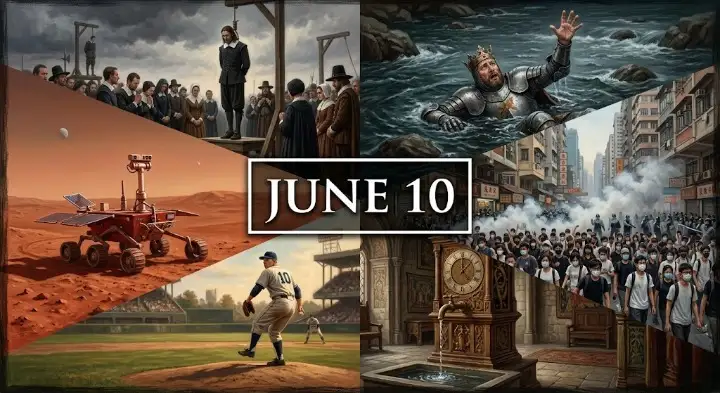
Bridget Bishop stood atop a makeshift gallows on Gallows Hill, feeling the damp Massachusetts breeze cut through her layers of heavy wool. Around her, neighbors she had known for decades watched in stony, terrified silence as the noose was placed over her neck. Accused of casting spells and tormenting young girls, she pleaded her innocence to a court blinded by religious hysteria. The drop fell, and her death initiated the bloodiest judicial panic in early American history. This defining moment anchors our understanding of what happened on June 10 in history across the centuries.
👶 Quick Facts — June 10 in History
| 📌 Category | 📖 Event / Detail |
|---|---|
| 🌟 Most Significant Event | The execution of Bridget Bishop during the Salem Witch Trials (1692) |
| 🏆 Top 10 Key Events | • Water clock introduced in Japan (671) • Holy Roman Emperor Frederick I Barbarossa drowns (1190) • The last major Byzantine defense in Asia Minor fails at Pelekanon (1329) • Jacquerie peasant rebellion crushed at Mello (1358) • Salem Witch Trials claim their first hanging victim (1692) • Landslide dam on the Dadu River collapses in China (1786) • Oxford and Cambridge face off in the first Thames Boat Race (1829) • Mount Tarawera erupts in New Zealand (1886) • Alcoholics Anonymous is founded in Ohio (1935) • Massive pro-democracy protests erupt in South Korea (1987) |
| ⚔️ Key Battles | Battle of Pelekanon (1329), Battle of Mello (1358), Battle of Záblatí (1619), Battle of Glen Shiel (1719), Battle of Big Bethel (1861), Battle of Brice’s Crossroads (1864), Battle of Guantánamo Bay (1898), Battle of Sultan Yacoub (1882) |
| 👤 Key Figures | Bridget Bishop, Emperor Frederick I Barbarossa, Dr. Robert Smith, John Diefenbaker |
| 🌍 Observances | Portugal Day (Day of Camões), World Art Nouveau Day |
Story of the Day: The Drowning of the Red Beard
Emperor Frederick I Barbarossa rode at the head of a massive crusader army, his long red beard catching the fierce Mediterranean sun as they approached the Saleph River in modern-day Turkey. He was the secular spearhead of the Third Crusade, leading a force so vast it promised to retake Jerusalem by sheer weight of numbers. Impatient with the slow pace of the river crossing on the narrow bridge, the armored monarch plunged his warhorse directly into the swift, icy alpine waters.
The heavy chainmail that protected him from Muslim arrows became a watery anchor the moment he lost his footing. Weighted down by iron and fighting the current, the elderly emperor vanished beneath the muddy torrent before his bodyguard could react. His sudden death shattered the German crusader force, sending thousands of panicked soldiers returning home and altering the balance of power in the Holy Land before they ever faced Saladin in battle.
Important Events That Happened On June 10 In History
671 – Rokoku Water Clock Built
Emperor Tenji stood inside his capital at Ōtsu and unveiled a massive wooden structure designed to capture the flow of time itself. Water dripped from carefully measured bronze vessels to raise an indicator, sounding bells and drums to notify his subjects of the shifting hours. This introduction of the Rokoku clepsydra standardized daily life across early Japan for the first time. The ruling court established a rigid administrative schedule that transformed tribal customs into a synchronized imperial state.
1190 – Barbarossa Perishes in Crusade
Emperor Frederick I Barbarossa weighed his chances against the rushing currents of the Saleph River and plunged forward in full battle armor. The freezing alpine waters proved too strong for his mount, pulling the heavily armored Holy Roman Emperor beneath the surface. Soldiers watched in absolute horror as their undisputed leader drowned within sight of the riverbank. The grand German crusader army disintegrated in the aftermath, leaving Richard the Lionheart to face the forces of Islam without his strongest ally.
1225 – Dominican Mission Enters Morocco
Pope Honorius III signed his name to the papal bull Vineae Domini custodes, sending a wave of Dominican friars across the Mediterranean into North Africa. These mendicant preachers carried strict instructions to plant the Catholic Church firmly within the borders of Islamic Morocco. Traveling with little more than their robes, the friars faced immediate suspicion from local Muslim rulers who viewed them as ideological invaders. This decree marked a major escalation in Europe’s spiritual campaign to challenge Islamic dominance beyond the borders of Spain.
1329 – Byzantine Defense Breaks at Pelekanon
Emperor Andronikos III Palaiologos led his veteran guards into a desperate clash against the advancing Ottoman forces of Sultan Orhan at Pelekanon. The imperial army fought to break the strangling siege of Nicaea, but disciplined Turkish cavalry ambushed the Greek flanks. Wounded in the melee, the emperor fled back toward Constantinople as his lines broke into total panic. This crushing tactical defeat ended the last major attempt by the Byzantine Empire to defend its ancient cities in Asia Minor.
1358 – Peasant Hordes Slaughtered at Mello
Guillaume Cale stood before his desperate peasant army at Mello, watching the heavily armored cavalry of the French nobility line up across the field. The Jacquerie rebellion had burned manor houses for weeks, but untrained farm hands were no match for professional knights. Charles the Bad of Navarre broke his truce, captured Cale by treachery, and ordered a merciless frontal charge. Over twenty thousand peasants were cut down where they stood, ending the rural uprising in a sea of retaliatory blood.
1422 – Murad II Besieges Constantinople
Sultan Murad II ordered his cannons to fire upon the ancient stone walls of Constantinople, initiating a fierce siege to punish the Byzantines for backing rival royal claimants. Ottoman engineers dug tunnels under the ramparts while archers rained continuous fire on the defenders inside. The city’s massive double walls held firm through weeks of brutal assaults, draining the resources of the young Turkish ruler. Internal rebellions forced the Sultan to lift his blockade, granting the dying Byzantine capital a brief, final reprieve.
1523 – Copenhagen Surrounded by Usurper
King Frederick I of Denmark deployed his mercenary divisions around the fortified walls of Copenhagen, cutting off all trade and food to the stubborn capital. The citizens refused to accept the new monarch, remaining fiercely loyal to the recently deposed Christian II. Cannonballs battered the timber houses as the civilian population faced starvation behind their barricades. The siege ground on for months, eventually forcing the starving defenders to surrender and solidifying a new royal dynasty.
1539 – Council of Trent Delayed by War
Pope Paul III dispatched urgent letters to his bishops across Europe, officially halting the long-awaited Council of Trent before it could even begin. The escalating warfare between France and the Holy Roman Empire made alpine mountain passes deadly for traveling church leaders. Protestant reformers mocked the delay, using the administrative paralysis to convert entire German principalities to their cause. This postponement pushed back the Catholic Counter-Reformation by years, allowing Protestantism to plant deep, permanent roots across the continent.
1596 – Bear Island Entered by Barents
Willem Barents stood on the deck of his wooden merchant vessel, peering through the Arctic fog at a jagged peak rising from the northern seas. His crew rowed ashore and immediately encountered a massive polar bear swimming toward their small longboat. After a brutal, multi-hour fight to kill the beast, the Dutch explorers named the isolated rock Bear Island. This landing gave European mapmakers a vital anchoring point for the lucrative and deadly Arctic whaling trade that followed.
1619 – Imperial Rout at Záblatí
Count Bucquoy ordered his Catholic imperial cavalry to charge the fortified positions of the Protestant forces near the Bohemian village of Záblatí. The surprise assault caught Count Mansfeld’s troops completely unprepared, trapping them within the burning streets of the town. Protestant supply lines were utterly destroyed, forcing their main army into an undignified, chaotic retreat. This early victory turned the tide of the Bohemian Revolt, trapping Protestant forces in Prague and setting the stage for the Thirty Years’ War.
1624 – Treaty of Compiègne Signed
Cardinal Richelieu guided his quill across the parchment at Compiègne, tying Catholic France to the Protestant Republic of the Netherlands in a mutual military alliance. The French crown agreed to fund the Dutch rebellion against Spanish rule with massive annual gold subsidies. This diplomatic maneuvering prioritized national self-interest over shared religious faith, angering conservative Catholic factions inside Paris. The treaty successfully forced Spain onto the defensive, dragging the major European powers deeper into a continental conflict.
1692 – Bridget Bishop Hanged at Salem
Bridget Bishop stood atop a cart on Gallows Hill, looking out over a crowd of hostile neighbors who believed she possessed malicious spiritual powers. The court had condemned her based on spectral evidence, claiming her ghost pinched and tormented local Puritan children. The executioner pulled away the support, making her the very first casualty of the Salem witch trials. Her public hanging unleashed a wave of paranoia that filled Massachusetts jails with hundreds of innocent citizens.
1719 – Glen Shiel Mountain Fight
General Joseph Wightman directed his government mortar batteries to fire up the rocky slopes of Glen Shiel at the entrenched Jacobite clansmen. The Scottish rebels, backed by a elite battalion of Spanish regular soldiers, struggled to hold their high positions against the explosive bombardment. Royal troops advanced through the thick heather, scattering the clansmen into the mountain mists and capturing the Spanish force. This decisive defeat crushed the 1719 Jacobite rising, leaving the Stuart claimants exiled in Europe.
1782 – King Rama I Crowned in Siam
Buddha Yodfa Chulaloke climbed the golden throne in Bangkok, officially crowning himself as King Rama I and establishing the Chakri Dynasty. He moved the national capital across the Chao Phraya River, constructing a magnificent grand palace to secure his new regime. His administration quickly rewrote the kingdom’s legal codes and gathered ancient Buddhist texts scattered by recent wars. This coronation initiated an era of cultural revitalization that shaped modern Thailand’s borders and cultural identity.
1786 – Dadu River Dam Bursts
A roaring wall of water tore through the mountain gorges of Sichuan province as a massive landslide dam on the Dadu River collapsed. The natural barrier, formed by an earthquake ten days prior, shattered under the immense weight of the backed-up river water. Over one hundred thousand people living in the low-lying valleys downstream were swept away in a matter of hours. This event ranks among the deadliest structural and natural disasters in Chinese history, wiping entire agricultural communities off the map.
1793 – Jardin des Plantes Opens
Jean-Baptiste Lamarck walked through the gates of the newly reorganized Jardin des Plantes in Paris, welcoming citizens into a state-run museum of natural history. Revolutionary leaders seized the royal gardens, transforming them into an educational sanctuary dedicated to public enlightenment rather than aristocratic privilege. Within twelve months, administrators added wild animals from abandoned private estates, creating the world’s first modern public zoo. This institutional shift democratized scientific study, opening exotic botanical and zoological research to common citizens.
1793 – Jacobins Seize French Revolution
Maximilien Robespierre and his radical Jacobin allies surrounded the national convention, ordering the immediate arrest of moderate Girondin leaders. Backed by armed Parisian workers, the Jacobins successfully seized complete control of the Committee of Public Safety. They immediately suspended constitutional rights to protect the young republic from foreign invaders and internal counter-revolutionaries. This political coup initiated the Reign of Terror, a bloody period marked by near-daily executions across France.
1805 – First Barbary War Concluded
Yusuf Karamanli sat inside his palace at Tripoli and signed a peace treaty with American diplomat Tobias Lear, ending years of naval warfare. The Pasha agreed to release the captured crew of the USS Philadelphia in exchange for a massive sixty-thousand-dollar ransom payment. This agreement halted the state-sponsored piracy that had plagued American merchant shipping in the Mediterranean Sea for decades. The treaty proved the young United States Navy could successfully project military power far across the Atlantic Ocean.
1829 – Thames Boat Race Formed
Eight rowers from Oxford University dug their wooden oars into the waters of the Thames at Henley, racing against a rival crew from Cambridge. Thousands of spectators lined the muddy riverbanks, cheering wildly as the Oxford boat pulled ahead to claim a decisive victory. This friendly challenge between university friends quickly evolved into a fierce, iconic British sporting tradition. The annual competition institutionalized amateur rowing, transforming it from an elite pastime into a massive public event.
1838 – Myall Creek Massacre
A gang of eleven armed white stockmen rode into the peaceful encampment at Myall Creek, rounding up twenty-eight defenseless Aboriginal Australians. The stockmen tied the victims together, dragged them into the bush, and murdered them before burning their remains. Colonial authorities took the unprecedented step of arresting, trying, and hanging seven of the white perpetrators for the killings. This landmark judicial verdict outraged the white settler population but established a critical legal precedent for indigenous rights.
1854 – Naval Academy Graduates First Class
Six young midshipmen stood on the parade grounds at Annapolis, Maryland, receiving the very first official graduation certificates from the United States Naval Academy. The school had replaced the chaotic old system of training officers entirely at sea with a rigorous four-year academic curriculum. These new officers entered the fleet trained in advanced mathematics, steam engineering, and international law. This milestone professionalized the American naval officer corps just in time for the steamship revolution.
1861 – Union Retreat at Big Bethel
General Ebenezer W. Pierce ordered his Union regiments to advance through the thick Virginia woods, launching a poorly coordinated assault on Confederate earthworks at Big Bethel. Friendly fire incidents broke out in the morning fog, alerting the southern defenders under Colonel John B. Magruder. Well-placed Confederate artillery pieces easily repelled the fragmented northern charges, forcing the Union troops into a messy retreat. This engagement was the first real land battle of the American Civil War, destroying northern hopes for a quick victory.
1863 – French Army Captures Mexico City
General Élie Frédéric Forey led his victorious French columns into the heart of Mexico City, forcing the republican government of Benito Juárez into exile. Emperor Napoleon III ordered the invasion to establish a client monarchy and collect outstanding foreign debts. Conservative Mexican elites welcomed the foreign troops, hoping to restore the old social order with European military backing. This occupation sparked a brutal guerrilla war, ending years later when the French army abandoned the country.
1864 – Nathan Bedford Forrest Wins at Brice’s Crossroads
Confederate General Nathan Bedford Forrest directed his cavalry regiments to charge a much larger Union force at Brice’s Crossroads in Mississippi. Forrest utilized the muddy roads and thick brush to isolate and destroy the advancing northern infantry columns one by one. General Samuel D. Sturgis panicked as his supply wagons jammed the escape route, turning the Union retreat into a rout. This tactical masterpiece secured Confederate supply lines and cemented Forrest’s reputation as a dangerous cavalry commander.
1868 – Prince Mihailo Assassinated
Prince Mihailo Obrenović III walked through the quiet paths of Košutnjak park in Belgrade when three armed conspirators stepped from the shadows and opened fire. The Serbian ruler fell mortally wounded, targeted by political radicals who opposed his autocratic style and his plans for a Balkan alliance. The assassins fled into the surrounding woods, plunging the young Serbian state into an immediate constitutional crisis. The government arrested the killers, but the murder permanently fractured Serbian political life for a generation.
1871 – US Marines Storm Han River Forts
Captain McLane Tilton led a wave of 109 heavily armed US Marines onto the muddy shores of Kanghwa Island, launching an assault on Korean coastal strongholds. The military operation aimed to punish the isolationist Joseon Kingdom for destroying an American merchant ship years earlier. Marines scaled the steep stone ramparts under heavy fire, killing hundreds of poorly armed Korean defenders in hand-to-hand combat. This engagement, known as the Sinmiyangyo, marked the first major military action by American forces on the Korean peninsula.
1873 – Russian Troops Capture Khiva
General Konstantin von Kaufmann directed his imperial artillery units to shell the mud-brick walls of Khiva, forcing the Khanate into a total surrender. The Russian expeditionary force had marched across hundreds of miles of hostile desert to crush the notorious slave-trading kingdom. The fall of the city brought vast Central Asian territories under the direct administrative control of the Russian Empire. This expansion intensified the “Great Game,” a tense geopolitical rivalry between Russia and Great Britain for dominance in Asia.
1878 – League of Prizren Established
Albanian delegates from across the Balkans gathered inside a mosque in Prizren, signing an agreement to form a unified political league. The assembly organized a national resistance movement to oppose European plans to partition their ancestral lands among neighboring Christian states. This meeting marked the birth of modern Albanian nationalism, shifting local loyalty from the Ottoman Sultan to a shared ethnic identity. The league raised an independent army to defend its borders, challenging Western diplomacy in the region.
1886 – Mount Tarawera Obliterates Terraces
A series of violent explosions rocked the North Island of New Zealand as Mount Tarawera tore itself open in a massive midnight volcanic eruption. The blast buried native Māori villages under hot ash and mud, claiming the lives of 153 people. The eruption completely destroyed the famous Pink and White Terraces, ancient silica formations celebrated as a natural wonder of the world. A massive seventeen-kilometer fissure split the mountain peak, permanently altering the volcanic landscape of the region.
1898 – US Marines Invade Cuba
Battalion Commander Robert W. Huntington led his force of five hundred US Marines onto the beaches of Guantánamo Bay, establishing a vital naval base under the guns of Spanish shore batteries. The landing party quickly dug trenches on the hillsides, facing immediate night attacks from hidden Spanish regular troops. This assault marked the first major American ground intervention on Cuban soil during the Spanish-American War. The base secured a harbor for the Atlantic Fleet, trapping the Spanish navy inside Caribbean waters.
1916 – Arab Revolt Proclaimed in Mecca
Sharif Hussein bin Ali climbed onto his balcony in the holy city of Mecca, raised a rifle, and fired a single symbolic shot toward the Ottoman barracks. This action signaled the official start of the Great Arab Revolt against the centuries-old rule of the Ottoman Empire. Backed by British gold and military advisors, Arab tribal armies launched a fast guerrilla campaign along the desert railways. This uprising dismantled Islamic imperial unity, reshaping the modern political borders of the Middle East.
1918 – Austro-Hungarian Battleship Torpedoed
Commander Luigi Rizzo steered his small Italian MAS motorboat through the morning mist off the Croatian coast, launching two torpedoes at the massive SMS Szent István. The steel projectiles ripped open the hull of the giant Austro-Hungarian battleship, causing it to list heavily to starboard. Onboard cameras from a nearby vessel captured the terrifying final moments as the ship capsized, throwing hundreds of sailors into the sea. This sinking broke the morale of the imperial navy, keeping their fleet trapped in port for the rest of the war.
1924 – Matteotti Assassinated by Fascists
Giacomo Matteotti stepped out of his Rome apartment when five fascist thugs bundled him into a speeding car and stabbed him to death. The Socialist deputy had recently stood before parliament, courageously detailing widespread electoral fraud carried out by Benito Mussolini’s party. His sudden disappearance sparked a massive wave of public outrage that nearly brought down the young dictatorship. Mussolini survived the political crisis by taking full responsibility, ending democratic government in Italy once and for all.
1935 – Alcoholics Anonymous Formed
Dr. Robert Smith took his final drink of alcohol in Akron, Ohio, and sat down with fellow alcoholic Bill Wilson to develop a new approach to sobriety. The two men realized that shared personal stories and mutual accountability could help people stay sober where medicine and religion failed. Their meeting led directly to the creation of Alcoholics Anonymous and the development of the famous Twelve-Step program. This partnership transformed global addiction treatment, saving millions of lives through peer-led support groups.
1935 – Chaco War Truce Called
Military commanders from Bolivia and Paraguay signed a formal ceasefire agreement in Buenos Aires, halting the bloody three-year Chaco War. The conflict over a desolate, malaria-ridden border region had cost the lives of over one hundred thousand soldiers and bankrupt both nations. Paraguay secured control over most of the disputed territory, though promised oil reserves proved largely nonexistent. This truce ended the deadliest international conflict fought in South America during the twentieth century.
1940 – Italy Invades France
Benito Mussolini stepped onto his Rome balcony and announced that Fascist Italy had officially declared war on France and Great Britain. Italian mountain divisions immediately pushed across the alpine borders into southern France, attempting to seize territory before the French army collapsed completely under German pressure. This declaration dragged the Mediterranean basin directly into World War II, opening dangerous new fronts across North Africa and the Middle East.
1940 – Roosevelt Slams Italy’s Attack
President Franklin D. Roosevelt stood before graduating students at the University of Virginia and delivered his famous “Stab in the Back” address. He abandoned traditional diplomatic neutrality, openly condemning Italy’s sudden invasion of a dying France as a cowardly act of aggression. Roosevelt pledged to send the full material resources of American factories to aid the European democracies fighting against Nazi tyranny. This speech signaled a major shift in American foreign policy, preparing the public for inevitable entry into the war.
1940 – Norwegian Military Resistance Fails
General Otto Ruge ordered the remaining units of the Norwegian army to lay down their weapons, ending sixty-two days of conventional resistance against Nazi forces. King Haakon VII and his cabinet escaped on a British cruiser to establish a government-in-exile in London. German troops secured full control over the country’s strategic northern ports and vast iron ore shipping routes. This conquest provided the German navy with ideal bases for attacking Allied supply convoys heading across the Arctic Ocean.
1942 – Lidice Massacre Perpetrated
German SS units surrounded the mining village of Lidice in Bohemia, rounding up the entire population on direct orders from Adolf Hitler. Nazi commanders executed all 173 men on the spot, while deporting the women and children to concentration camps before burning every house to the ground. This horrific reprisal was carried out to punish the nation for the assassination of high-ranking Nazi official Reinhard Heydrich. The massacre shocked the global public, turning the name of the destroyed village into a symbol of anti-nazi resistance.
1944 – Oradour-sur-Glane Destroyed
Soldiers of the Der Führer Regiment of the Waffen-SS sealed off the quiet French village of Oradour-sur-Glane on a warm afternoon. The troops locked the women and children inside the town church, set the building on fire, and shot anyone attempting to escape through the windows. Machine gun teams simultaneously slaughtered the men in nearby barns, killing 643 civilians in a few hours. This unprovoked atrocity remains the largest single massacre of civilians carried out by German forces on French soil.
1944 – Distomo Massacre in Greece
Fritz Lautenbach led his company of the 4th SS Polizei Panzergrenadier Division into the Greek village of Distomo, launching a multi-hour killing spree against the civilian population. German troops door-to-door slaughtered 228 men, women, and babies as a collective punishment for local guerrilla attacks on their supply lines. The soldiers burned the entire settlement to the ground before retreating toward their regional headquarters. This war crime stands as one of the most brutal anti-partisan reprisals carried out in occupied Greece.
1944 – Joe Nuxhall Makes Baseball History
Fifteen-year-old left-handed pitcher Joe Nuxhall stepped onto the mound for the Cincinnati Reds during a game against the St. Louis Cardinals. World War II had depleted the rosters of major league teams, forcing managers to look to high school prospects to fill open spots. Nuxhall struggled with his control, giving up five walks and two hits before being pulled from the game. This appearance made him the youngest person to ever play in a Major League Baseball game, a record that stands to this day.
1945 – Australian Forces Land in Brunei
Soldiers of the Australian 9th Division rushed from landing craft onto the sandy beaches of Brunei Bay, initiating a major campaign to liberate Borneo from Japanese occupation. Backed by heavy naval bombardment, the troops quickly secured the beachhead and advanced toward strategic oil fields inland. Japanese forces offered stiff resistance from the dense jungle ridges, dragging the operation into weeks of intense infantry fighting. This successful landing restored Allied control over vital Southeast Asian energy reserves.
1947 – Saab Builds First Automobile
Engineers at the Svenska Aeroplan Aktiebolaget aerospace factory in Sweden unveiled the Saab 92, the company’s very first production automobile. Utilizing their extensive wartime experience building fighter planes, the design team created a car with an aerodynamic, single-piece steel body shell. The vehicle featured a two-stroke engine and front-wheel drive, a highly unusual configuration for the post-war European market. This launch transformed the aircraft manufacturer into an innovative and iconic global automotive brand.
1957 – Diefenbaker Wins Canadian Election
John Diefenbaker took the stage in Ottawa to celebrate a stunning upset victory in the Canadian federal election, ending twenty-two years of continuous rule by the Liberal Party. His Progressive Conservatives swept through the western provinces, capturing a minority government that shattered old voting patterns. Diefenbaker’s powerful, emotional speaking style resonated with working-class voters who felt ignored by the political establishment. This historic win transformed Canadian politics, ushering in a decade of intense electoral competition.
1960 – Flight 538 Crashes in Queensland
Captain John R. Pollard guided his Trans Australia Airlines Fokker Friendship toward Mackay Airport, struggling against a thick, low-lying evening fog blanketing the coastline. The aircraft vanished from radar screens during its final approach, plunging directly into the dark waters of the Pacific Ocean just off the coast. Search teams recovered debris the following morning, confirming that all twenty-nine passengers and crew onboard had died on impact. This tragedy remains the deadliest civilian aviation disaster in Australian history, prompting the mandatory installation of flight data recorders in all commercial planes.
1963 – Kennedy Signs Equal Pay Act
President John F. Kennedy sat at his desk in the Oval Office and signed the Equal Pay Act of 1963, making it illegal to pay women less than men for equal work. The law was a key legislative victory for his New Frontier program, aiming to dismantle institutionalized wage disparities across American businesses. Kennedy acknowledged the bill was simply a first step, as millions of working women remained trapped in low-paying employment sectors. This legislation laid the legal foundation for the modern women’s rights movement in the workplace.
1964 – Senate Breaks Civil Rights Filibuster
Senator Hubert Humphrey cheered on the floor of the United States Senate as a bipartisan coalition secured a historic vote to end a seventy-five-day southern filibuster against the Civil Rights Act. This successful cloture vote marked the first time in American history that the Senate broke a civil rights filibuster by southern segregationists. The legislative roadblock collapsed, clearing the way for the bill’s final passage and the legal dismantling of Jim Crow laws.
1967 – Six-Day War Ends
Israeli and Syrian military commanders agreed to a UN-brokered ceasefire, bringing an abrupt end to the lightning-fast Six-Day War. Within less than a week, Israel’s military had routed the combined armies of Egypt, Jordan, and Syria, capturing vast territories including the Sinai Peninsula, the West Bank, and the Golan Heights. The brief conflict radically altered the geopolitical landscape of the Middle East, initiating decades of territorial disputes and military occupation that continue to shape regional politics today.
1977 – James Earl Ray Escapes Prison
James Earl Ray scaled a high, barbed-wire fence at Brushy Mountain State Penitentiary in Tennessee, escaping into the rugged mountain country along with six fellow inmates. The convicted assassin of Dr. Martin Luther King Jr. triggered a massive, multi-state manhunt involving hundreds of state troopers and tracking dogs. Ray’s brief taste of freedom lasted only three days before FBI agents cornered him in the thick brush just miles from the prison walls.
1980 – Mandela’s Fight Call Published
Activists across South Africa distributed copies of a secret message smuggled out of Robben Island prison, written by African National Congress leader Nelson Mandela. The published text urged the black majority to unite and take up arms against the brutal apartheid regime, declaring that the struggle had reached a point of no return. This call to action re-energized the internal anti-apartheid movement, sparking a fresh wave of student strikes and labor protests across the nation.
1982 – Syrian Army Wins at Sultan Yacoub
Syrian anti-tank units launched a fierce ambush against an advancing Israeli armored column in the narrow mountain passes near the Lebanese village of Sultan Yacoub. The Israeli forces found themselves trapped in a deadly crossfire, losing several tanks and suffering dozens of casualties before launching a chaotic night retreat under heavy artillery cover. This engagement was one of the few significant tactical defeats suffered by Israel during the Lebanon War, preventing their forces from cutting off the strategic Beirut-Damascus highway.
1987 – June Democratic Struggle Begins
Thousands of university students poured into the streets of Seoul, launching the historic June Democratic Struggle against the military dictatorship of President Chun Doo-hwan. The public was outraged by the recent torture and murder of a student activist and the government’s refusal to hold direct democratic elections. Riots quickly spread to every major city, forcing police forces to retreat behind walls of tear gas. These historic protests eventually forced the regime to accept democratic reforms, ending decades of military rule in South Korea.
1990 – British Airways Captain Sucked from Cockpit
A loud bang echoed through British Airways Flight 5390 as a poorly fitted windshield panel blew out at seventeen thousand feet over Oxfordshire. The sudden decompression violently sucked Captain Tim Lancaster halfway out of the cockpit window, trapping his torso against the exterior hull of the aircraft. Flight attendants rushed forward, gripping his legs for twenty terrifying minutes while the co-pilot executed an emergency landing at Southampton. Lancaster miraculously survived the sub-zero winds, suffering only frostbite and minor fractures.
1991 – Jaycee Dugard Kidnapped
Eleven-year-old Jaycee Lee Dugard walked toward her school bus stop in South Lake Tahoe, California, when a strange sedan pulled alongside her. Phillip Garrido stepped from the vehicle, shocked the young girl with a stun gun, and bundled her into the back seat before speeding away. Her stepfather chased the car on a bicycle but lost sight of the kidnappers at a nearby intersection. This abduction initiated a tragic, eighteen-year captivity in a backyard compound before Dugard was discovered alive in 2009.
1994 – China Tests DF-31 Warhead
Seismologists worldwide detected a sharp, artificial tremor originating from the isolated Lop Nur testing grounds in western China. The Chinese military conducted a successful underground nuclear detonation to test a new, lightweight warhead designed for the DF-31 intercontinental ballistic missile. The timing of the test drew sharp criticism from Western nations who were actively negotiating a global comprehensive test ban treaty. This blast confirmed China’s determination to modernize its nuclear deterrent capabilities.
1996 – Northern Ireland Peace Talks Begin
Delegates from Britain, Ireland, and major political factions gathered around a large conference table in Belfast, initiating formal peace talks to end decades of sectarian violence. The historic negotiations opened without the participation of Sinn Féin, who were barred due to a recent breakdown in the IRA ceasefire. Former US Senator George Mitchell took the chair, establishing a strict set of democratic principles to guide the difficult discussions. These meetings laid the fragile foundation for the historic Good Friday Agreement.
1997 – Pol Pot Orders Son Sen Murdered
Khmer Rouge leader Pol Pot, hiding out in his crumbling jungle stronghold of Anlong Veng, ordered his bodyguards to execute his lifelong defense chief Son Sen. The paranoid dictator believed his general was secretly negotiating a surrender deal with the Cambodian government. Executioners shot Son Sen and eleven of his family members before driving a truck over their remains. This final act of internal betrayal outraged Pol Pot’s remaining loyalists, prompting them to mutiny and place the aging tyrant under permanent house arrest.
1999 – NATO Suspends Kosovo Airstrikes
NATO Secretary General Javier Solana ordered an immediate halt to the seventy-four-day bombing campaign against the Federal Republic of Yugoslavia. The suspension came after Serbian military leaders officially signed an agreement to withdraw their security forces from the war-torn province of Kosovo. International peacekeepers prepared to enter the region to protect displaced Albanian civilians and restore civil order. This agreement brought an end to the last major military conflict fought in Europe during the twentieth century.
2001 – Saint Rafqa Canonized by Pope
Pope John Paul II stood before a massive crowd in St. Peter’s Square, officially canonizing Rafqa Pietra Choboq Ar-Rayès as Lebanon’s very first female saint. The nineteenth-century Maronite nun had spent her final years in severe physical blindness and paralysis, offering her intense suffering up as a quiet prayer for her community. Lebanese Christians traveled to Rome by the thousands, waving national flags to celebrate the historic elevation of their compatriot. Her canonization provided a powerful symbol of spiritual resilience for the war-weary nation.
2002 – First Human Nervous System Link
Professor Kevin Warwick sat inside a clean room at the University of Reading, watching a monitor as his nervous system established a direct electronic link with his wife’s arm. Engineers had surgically implanted specialized microelectrode arrays into the median nerves of both individuals, translating their neural impulses into digital data. When Warwick flexed his hand, his wife’s brain received a distinct, measurable electronic pulse. This pioneering experiment marked the first successful direct electronic communication between two human nervous systems.
2003 – Spirit Rover Launches to Mars
A powerful Delta II rocket roared off the launch pad at Cape Canaveral, carrying NASA’s Spirit rover on a six-month voyage toward the surface of Mars. The robotic geologist was designed to explore the Martian terrain, search for ancient signs of liquid water, and analyze local rock compositions. Spirit successfully survived the dangerous landing, operating for years beyond its original design lifetime. This mission transformed our understanding of the Red Planet’s wet, geological past.
2008 – Sudan Airways Flight 109 Crashes
Captain Mohammad Abdel-Aziz struggled to bring his Sudan Airways Airbus A310 to a halt on the rain-slicked runway at Khartoum International Airport. The aircraft overshot the tarmac, crashing into a drainage ditch before a ruptured fuel line triggered a massive explosion along the fuselage. Rescue teams rushed through the darkness, pulling survivors from the burning wreckage as thick smoke filled the cabin. Thirty passengers trapped in the rear sections of the plane died before they could reach the emergency exits.
2009 – Museum Guard Shot at Holocaust Memorial
Eighty-eight-year-old white supremacist James Wenneker von Brunn walked into the United States Holocaust Memorial Museum in Washington, D.C., and pulled a rifle from his coat. He immediately shot Special Police Officer Stephen Tyrone Johns at point-blank range as the guard opened the door for him. Other museum security officers opened fire, wounding the gunman before pinning him to the marble floor. This attack shocked the nation’s capital, highlighting the growing domestic threat of radical right-wing extremism.
2018 – Opportunity Rover Sends Final Message
A raging, planet-wide dust storm blotted out the sun over Perseverance Valley on Mars, draining the batteries of NASA’s Opportunity rover to critical levels. The robotic explorer sent a final, poetic telemetry transmission back to engineers on Earth: “My battery is low and it’s getting dark.” The solar-powered rover entered a permanent sleep state, unable to survive the freezing Martian night without its internal heaters. This transmission brought an end to a historic fourteen-year mission that redefined interplanetary exploration.
2024 – Malawi Vice President Killed in Crash
A military transport aircraft carrying Malawian Vice President Saulos Chilima and nine other passengers encountered severe, low-lying fog over the rugged Viphya Mountains. The plane lost contact with aviation controllers and plunged into the dense forest terrain, killing everyone onboard on impact. Search teams spent over twenty-four hours hacking through the thick jungle before locating the scattered wreckage of the twin-propeller aircraft. This sudden tragedy threw the southern African nation into an immediate period of national mourning and political uncertainty.
2025 – Graz School Mass Shooting
An armed perpetrator walked through the main doors of a secondary school in Graz, Austria, opening fire on students and staff members in the crowded hallways. The gunman killed ten innocent individuals and injured eleven others before turning his weapon on himself as police tactical units breached the building. Terrified students barricaded themselves inside classrooms, using their mobile phones to alert emergency services. This unprecedented act of violence shocked the European nation, prompting immediate public demands for stricter national gun control measures.
Click here for a complete list of our previous daily features.
Famous People Born On June 10
| Name | Description | Date |
|---|---|---|
| Abu al-Wafa’ Buzjani | Persian mathematician and astronomer, known for his contributions to trigonometry and the development of the tangent function | 940 – 998 |
| James Francis Edward Stuart | Claimant to the English and Scottish thrones, known as the “Old Pretender,” son of King James II | 1688 – 1766 |
| Gustave Courbet | French-Swiss painter and sculptor, a leading figure in the Realist movement of 19th-century art | 1819 – 1877 |
| Nicolaus Otto | German engineer, inventor of the four-stroke internal combustion engine, the basis of modern automobile engines | 1832 – 1891 |
| Rebecca Latimer Felton | American educator and politician, the first woman to serve in the United States Senate | 1835 – 1930 |
| André Derain | French painter and sculptor, a co-founder of Fauvism alongside Henri Matisse | 1880 – 1954 |
| Sessue Hayakawa | Japanese actor and producer, one of the first Asian actors to achieve major stardom in Hollywood | 1886 – 1973 |
| Hattie McDaniel | American actress, the first African American to win an Academy Award, for her role in Gone with the Wind | 1893 – 1952 |
| Grand Duchess Tatiana Nikolaevna of Russia | Second daughter of Tsar Nicholas II, executed with her family during the Russian Revolution | 1897 – 1918 |
| Frederick Loewe | Austrian-American composer, part of the legendary Lerner and Loewe duo, known for My Fair Lady and Camelot | 1901 – 1988 |
| Lin Huiyin | Chinese architect and poet, the first woman architect in modern China and a key figure in Chinese architectural history | 1904 – 1955 |
| Howlin’ Wolf | American singer-songwriter and guitarist, one of the most influential blues musicians of all time | 1910 – 1976 |
| Terence Rattigan | English playwright and screenwriter, one of the most popular British dramatists of the mid-20th century | 1911 – 1977 |
| Jean Lesage | Canadian lawyer and politician, 11th Premier of Quebec, key figure in the Quiet Revolution | 1912 – 1980 |
| Saul Bellow | Canadian-American novelist and essayist, Nobel Prize laureate in Literature, author of The Adventures of Augie March | 1915 – 2005 |
| Prince Philip, Duke of Edinburgh | Husband of Queen Elizabeth II, consort of the British monarch for over 69 years | 1921 – 2021 |
| Judy Garland | American actress and singer, iconic star of The Wizard of Oz and one of the greatest entertainers of the 20th century | 1922 – 1969 |
| Maurice Sendak | American author and illustrator, creator of the beloved children’s book Where the Wild Things Are | 1928 – 2012 |
| James McDivitt | American general, pilot, and NASA astronaut, commander of Gemini 4 and Apollo 9 missions | 1929 – 2022 |
| E. O. Wilson | American biologist, author, and academic, known as the “father of sociobiology” and a leading expert on ants | 1929 – 2021 |
| João Gilberto | Brazilian singer-songwriter and guitarist, one of the pioneers of bossa nova music | 1931 – 2019 |
| F. Lee Bailey | American criminal defense attorney, known for representing high-profile clients including O.J. Simpson | 1933 – 2021 |
| Jürgen Prochnow | German actor, best known for his role as the captain in the film Das Boot | 1941 – Present |
| Dan Fouts | American football player and sportscaster, Hall of Fame quarterback for the San Diego Chargers | 1951 – Present |
| Carlo Ancelotti | Italian footballer and manager, one of the most successful football managers in history, winning multiple Champions League titles | 1959 – Present |
| Eliot Spitzer | American lawyer and politician, 54th Governor of New York, known for his aggressive prosecution of financial crimes | 1959 – Present |
| Kim Deal | American singer-songwriter and musician, bassist and vocalist for the Pixies and The Breeders, a key figure in alternative rock | 1961 – Present |
| Bobby Jindal | American journalist and politician, 55th Governor of Louisiana, the first Indian American to serve as a governor | 1971 – Present |
| Sundar Pichai | Indian-American businessman, CEO of Google and its parent company Alphabet Inc. | 1972 – Present |
| Tara Lipinski | American figure skater, 1998 Olympic gold medalist and youngest Olympic champion in the sport’s history | 1982 – Present |
Famous People Died On June 10
| Name | Description | Date |
|---|---|---|
| Liu Bei | Chinese emperor, founder of the Shu Han state during the Three Kingdoms period | 161 – 223 |
| Frederick I, Holy Roman Emperor | Holy Roman Emperor, also known as Frederick Barbarossa, one of the most prominent medieval rulers | 1122 – 1190 |
| Luís de Camões | Portuguese poet, author of The Lusiads, considered Portugal’s greatest poet | 1524 – 1580 |
| Bridget Bishop | Colonial Massachusetts woman, the first person executed in the Salem witch trials | 1632 – 1692 |
| André-Marie Ampère | French physicist and mathematician, one of the founders of electromagnetism, after whom the unit of electric current is named | 1775 – 1836 |
| Robert Brown | Scottish botanist, discovered Brownian motion and the cell nucleus | 1773 – 1858 |
| Ernest Chausson | French composer, a major figure in late Romantic music | 1855 – 1899 |
| Richard Seddon | English-New Zealand politician, 15th Prime Minister of New Zealand, known as “King Dick” | 1845 – 1906 |
| Edward Everett Hale | American minister, historian, and author, known for his patriotic short story “The Man Without a Country” | 1822 – 1909 |
| Arrigo Boito | Italian author, poet, and composer, known for his libretti for Verdi’s Otello and Falstaff | 1842 – 1918 |
| Giacomo Matteotti | Italian lawyer and politician, assassinated by Mussolini’s fascists, exposing the regime’s brutality | 1885 – 1924 |
| Antoni Gaudí | Spanish architect, the master of Catalan Modernism, designer of the Sagrada Família and Park Güell | 1852 – 1926 |
| Frederick Delius | English composer and educator, known for his orchestral works inspired by nature | 1862 – 1934 |
| Robert Borden | Canadian lawyer and politician, 8th Prime Minister of Canada, led the country during World War I | 1854 – 1937 |
| Marcus Garvey | Jamaican journalist and activist, founder of the Black Star Line, a key figure in the Pan-Africanism movement | 1887 – 1940 |
| Jack Johnson | American boxer, the first African American to win the world heavyweight boxing championship | 1878 – 1946 |
| Sigrid Undset | Danish-Norwegian novelist, Nobel Prize laureate in Literature, author of the medieval trilogy Kristin Lavransdatter | 1882 – 1949 |
| Spencer Tracy | American actor, one of the greatest actors of Hollywood’s Golden Age, winner of two Academy Awards | 1900 – 1967 |
| William Inge | American playwright and novelist, Pulitzer Prize winner for Picnic, known for his depictions of Midwestern life | 1913 – 1973 |
| Adolph Zukor | American film producer, co-founder of Paramount Pictures, a pioneer of the Hollywood studio system | 1873 – 1976 |
| Rainer Werner Fassbinder | German actor, director, and screenwriter, a prolific and influential figure in New German Cinema | 1945 – 1982 |
| Louis L’Amour | American novelist and short story writer, one of the most popular and prolific Western authors | 1908 – 1988 |
| Hafez al-Assad | Syrian general and politician, 18th President of Syria, who ruled for 30 years and founded a dynastic regime | 1930 – 2000 |
| John Gotti | American mobster, head of the Gambino crime family, known as the “Dapper Don” | 1940 – 2002 |
| Ray Charles | American singer-songwriter, pianist, and actor, a pioneer of soul music and one of the most influential musicians of all time | 1930 – 2004 |
| Chinghiz Aitmatov | Kyrgyzstani author and diplomat, a major figure in Soviet and world literature | 1928 – 2008 |
| Georges Mathieu | French painter and academic, a pioneer of lyrical abstraction and “action painting” | 1921 – 2012 |
| Gordie Howe | Canadian ice hockey player, a legendary forward who is considered one of the greatest hockey players of all time | 1928 – 2016 |
| Christina Grimmie | American singer-songwriter and YouTuber, known for her powerful vocals and tragic murder | 1994 – 2016 |
| Ted Kaczynski | American mathematician and domestic terrorist, known as the “Unabomber” | 1942 – 2023 |
Observances on June 10
- Portugal Day (Day of Camões): Portugal and its global communities celebrate their national identity, culture, and history on this date. The holiday commemorates the death of Luís de Camões, the revered national poet who authored The Lusiads, Portugal’s defining epic poem.
- World Art Nouveau Day: This worldwide observance celebrates the artistic style that dominated architecture and design at the turn of the twentieth century. Museums and historical preservation societies organize specialized tours and exhibitions to honor iconic creators like Antoni Gaudí and Alphonse Mucha.
🧙♀️ Frequently Asked Questions — June 10 in History
On June 10, 1692, Bridget Bishop became the first person executed during the Salem Witch Trials when she was hanged on Gallows Hill. Her death marked the beginning of a bloody judicial panic that eventually led to the executions of nineteen other innocent citizens.
The most significant event on June 10 is the drowning of Holy Roman Emperor Frederick I Barbarossa during the Third Crusade in 1190. His sudden death caused his massive German army to disintegrate, reshaping the geopolitical outcome of the Crusades in the Holy Land.
While June 10 is famous for major political shifts, it also marks the birth of Prince Philip, Duke of Edinburgh, born on this day in 1921. He would go on to serve as the longest-lived consort of a reigning British monarch.
On June 10, 1940, Fascist Italy officially declared war on France and Great Britain, initiating an invasion of southern France. This action dragged the entire Mediterranean basin directly into the widening theater of World War II.
Portugal Day celebrates the cultural heritage and national identity of the Portuguese people worldwide on June 10. It marks the anniversary of the death of Luís de Camões, a legendary poet whose writing captured the spirit of Portuguese exploration.
On June 10, 2024, a devastating military plane crash in the fog-covered Viphya Mountains killed Malawian Vice President Saulos Chilima and nine other passengers. The tragedy initiated a deep period of national mourning across the African nation.