📅 Quick Facts — June 26 in History
| 📌 Category | 📖 Event / Detail |
|---|---|
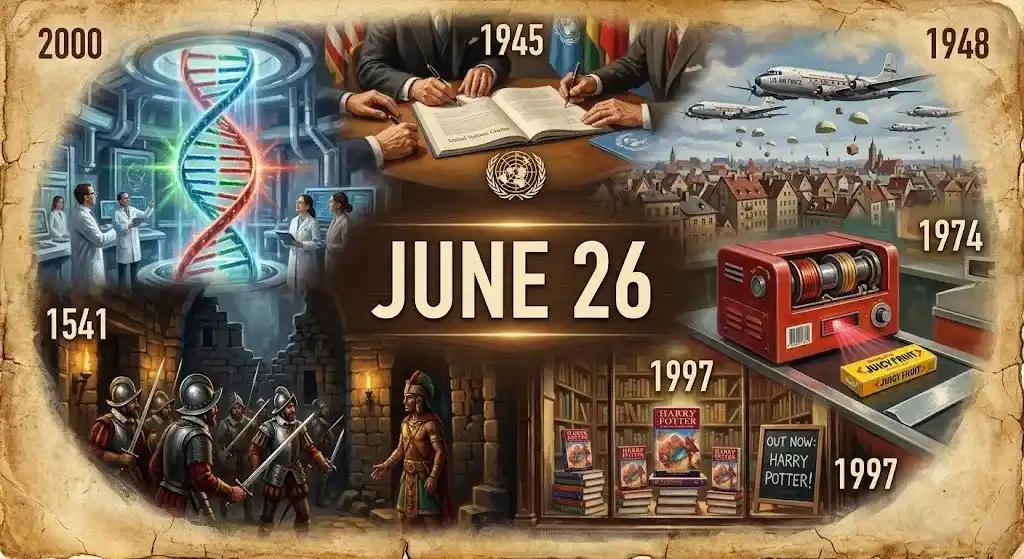
| 🌟 Most Significant Event | The United Nations Charter is signed by 50 Allied nations in San Francisco (1945) |
| 🏆 Top 10 Key Events | • Augustus adopts Tiberius as his official heir (4) • King Richard III ascends the English throne (1483) • Francisco Pizarro is assassinated in Peru (1541) • French military launches the first reconnaissance balloon at Fleurus (1794) • Great Britain officially hooks Hong Kong under the Treaty of Nanking (1843) • Cold War pilots launch the massive Berlin Airlift relief operation (1948) • President John F. Kennedy delivers his historic speech in West Berlin (1963) • Grocery clerk scans the first commercial barcode in Ohio (1974) • British bookstores release the very first Harry Potter novel (1997) • Human Genome Project completes its first rough draft sequence (2000) |
| ⚔️ Key Battles | Battle of Köse Dağ (1243), Battle of Chausa (1539), Battle of Fleurus (1794), Battle of Belleau Wood (1918), Battle of Osuchy (1944) |
| 👤 Key Figures | William Shockley, J.K. Rowling, John F. Kennedy, Richard III, Francisco Pizarro |
| 🌍 Observances | International Day in Support of Victims of Torture, International Day against Drug Abuse and Illicit Trafficking, World Refrigeration Day, Somaliland Independence Day, Azerbaijan Armed Forces Day |
Story of the Day: The Birth of the United Nations
Fifty nations gathered in the ruins of global conflict on June 26, 1945, to sign a document born from the ashes of World War II. Meeting in the Veterans War Memorial Auditorium in San Francisco, delegates took turns putting pen to paper to ratify the United Nations Charter. The mood was heavy with the memory of the failed League of Nations, yet fueled by a desperate, collective determination to ensure a total war never happened again. China signed first, having endured the longest conflict against the Axis powers, followed by the remaining 49 countries. This massive diplomatic experiment established a new global framework for international law, human rights, and shared security that still governs global politics today.
Important Events That Happened On June 26 In History
4 – Augustus Adopts Tiberius
Augustus Caesar stood before the Roman senate to formally name his stepson Tiberius as his legal heir and successor. Multiple preferred choices had died unexpectedly, forcing the emperor to settle on a brilliant but deeply brooding military commander. This legal transfer of authority secured the political stability of the young Roman Empire during its first critical leadership transition. Tiberius would rule Rome for twenty-three years, cementing the autocratic imperial system that Augustus spent his life building.
221 – Elagabalus Adopts Alexander Severus
Seventeen-year-old Roman Emperor Elagabalus bowed to immense political and military pressure by adopting his popular thirteen-year-old cousin as his official successor. Imperial bodyguards, furious at Elagabalus’s eccentric religious practices and erratic behavior, forced the Syrian-born ruler to elevate the young boy to the rank of Caesar. The desperate move failed to save the young emperor’s life for long. Within a year, elite Praetorian guards murdered Elagabalus in his palace, immediately clearing the path for Alexander Severus to take the throne.
363 – Emperor Julian Fatally Wounded
Roman Emperor Julian collapsed inside his tent near Samarra after a Sassanid cavalry spear pierced his side during a chaotic desert skirmish. The intellectual ruler had led his legions into a disastrous retreat across the scorching Mesopotamian plains after failing to capture the capital city of Ctesiphon. Royal physicians tried to stop the internal bleeding, but the wound proved mortal. His sudden death ended Rome’s aggressive eastern offensive and marked the final end of the pagan revival within the imperial elite.
684 – Pope Benedict II Consecrated
Pope Benedict II assumed the papal throne in Rome after waiting nearly a year for official confirmation from Byzantine Emperor Constantine IV. This lengthy, frustrating delay highlighted the deep political control that distant Constantinople held over the Western Christian church. Benedict used his short reign to successfully negotiate a major structural shift in church politics. Future papal elections would only require validation from the nearby Exarch of Ravenna, cutting months off the transition process.
699 – En no Ozuno Banished
Imperial soldiers marched Japanese mystic and healer En no Ozuno down to the coast to begin his forced exile on the remote island of Izu Ōshima. Local rivals had accused the hermit of using sorcery to manipulate mountain spirits and incite public panic against the imperial court. Ozuno spent years living wild in the volcanic landscape, practicing rigorous ascetic rituals and studying herbal medicines. His followers eventually preserved his teachings, honoring him as the legendary founder of Shugendō, a distinct folk religion.
1243 – Battle of Köse Dağ
Mongol horse archers under commander Baiju Noyan smashed through the lines of the Seljuk Turks in the mountain passes of northeastern Turkey. Sultan Kaykhusraw II panicked as his vanguard collapsed, abandoning his massive army and fleeing into the night with the royal treasury. Mongol forces swept through the undefended region, extracting immense tribute and stripping the state of its independence. The devastating defeat permanently broken Seljuk power, forcing the Sultanate of Rum to become a submissive vassal state.
1243 – Pope Innocent IV Elected
Cardinals gathered inside a secure cathedral in Anagni to elect Pope Innocent IV, finally ending a bitter, two-year vacancy on the papal throne. The Catholic Church had been completely paralyzed since the death of Celestine IV in 1241 due to fierce political interference from Holy Roman Emperor Frederick II. Innocent immediately took up the fight against the secular empire, fleeing to France to preserve his independence. His dramatic election intensified the generational struggle for supreme authority between medieval popes and European kings.
1295 – Przemysł II Crowned King
Przemysł II walked into Gniezno Cathedral to receive the crown of Poland, ending a fractured two-century period of regional ducal rule. The ambitious ruler managed to unite several warring provinces under a single, centralized throne despite intense opposition from rival noble houses. He adopted a striking white eagle on a red shield as his personal royal standard during the coronation ceremony. This bold visual symbol stuck, transforming into the permanent coat of arms that represents the Polish nation to this day.
1407 – Ulrich von Jungingen Becomes Grand Master
Teutonic Knights gathered in Marienburg Castle to select Ulrich von Jungingen as the new Grand Master of their powerful military order. Jungingen favored an aggressive, uncompromising foreign policy, immediately escalating border tensions with Poland and Lithuania over valuable Baltic territories. His confrontational approach pushed the monastic state into an all-out regional war that its knights were unprepared to win. The fateful decision led directly to the catastrophic Battle of Grunwald, where the order’s military dominance was broken forever.
1409 – Council of Pisa Crowns Alexander V
Petros Philargos walked out of the Council of Pisa wearing the papal crown as Pope Alexander V, accidentally fracturing Western Christianity even further. European church leaders had organized the council to end the infamous Western Schism by deposing the rival popes of Rome and Avignon. Both existing pontiffs flatly refused to recognize the council’s authority, leaving Europe with three competing popes at the same time. The failed diplomatic compromise deepened the spiritual crisis, forcing ordinary peasants to choose between three different paths to salvation.
1460 – Earl of Warwick Lands in England
Richard Neville, the powerful Earl of Warwick, stepped onto the beaches of Kent alongside a battle-hardened rebel army to march directly on London. This bold military invasion breathed fresh life into the Wars of the Roses, targeting the weak regime of Lancaster King Henry VI. Ordinary citizens and local militias flooded the streets to support the Yorkist invaders as they moved through the city gates. The successful landing shifted the balance of power, leading to the capture of the king just weeks later.
1483 – Richard III Becomes King
Richard III officially assumed the English throne after an assembled group of lords and commoners declared his young nephews illegitimate. The ambitious royal had spent weeks holding twelve-year-old King Edward V inside the Tower of London under the guise of preparing for a coronation. Parliament accepted the controversial claim that Edward’s parents were never legally married, invalidating the boy’s right to rule. Richard’s swift political takeover ignited a wave of rebellion that would end his life at Bosworth Field two years later.
1522 – Second Siege of Rhodes Begins
Sultan Suleiman the Magnificent watched from his command tent as hundreds of Ottoman warships dropped anchor off the rocky coast of Rhodes. Over one hundred thousand Turkish soldiers swarmed the beaches, bringing heavy siege cannons to blast through the thick stone walls of the island fortress. A tiny force of Knights Hospitaller prepared for a brutal, six-month defensive struggle against impossible odds. The massive military operation aimed to eliminate the Christian pirates who routinely disrupted Islamic trade routes across the Mediterranean.
1539 – Battle of Chausa
Afghan commander Sher Shah Suri launched a surprise pre-dawn raid on the mud-slicked banks of the Ganges, completely routing the imperial army of Humayun. The Mughal Emperor barely escaped with his life, plunging his horse directly into the swollen river and relying on a water-carrier to keep from drowning. Sher Shah’s brilliant tactical ambush stripped the Mughals of their control over the wealthy plains of Bengal. The victory allowed the Afghan leader to crown himself king, establishing the short-lived Sur Empire in northern India.
1541 – Francisco Pizarro Assassinated
A dozen armed conspirators stormed into the government palace in Lima, hacking Spanish conquistador Francisco Pizarro to death in his own dining room. The assassins were loyal to Diego de Almagro the Younger, seeking bloody revenge for Pizarro’s execution of his father during a bitter dispute over Peruvian gold. Pizarro fought back fiercely, drawing his sword and painting a cross on the floor with his own blood as he fell. The brutal assassination threw the Spanish colony into a destructive civil war over who would control the Incan Empire’s riches.
1579 – Livonian Campaign Begins
King Stephen Báthory of Poland reviewed his massed lines of infantry and heavy cavalry to launch his long-awaited campaign against the Russian Empire. Tsar Ivan the Terrible had invaded the Baltic region of Livonia, threatening Polish trade access to northern European shipping lanes. Báthory’s disciplined forces launched a series of lightning strikes, using advanced siege tactics to recapture vital border fortresses. The aggressive military push checked Russian expansionism, forcing Ivan to sign a humiliating peace treaty three years later.
1656 – Battle of the Dardanelles
A combined fleet of Venetian and Hospitaller sailing ships blocked the narrow mouth of the Dardanelles, destroying a massive Ottoman naval force trying to supply Crete. Venetian commander Lorenzo Marcello navigated his vessels through heavy cannon fire, sinking or capturing over eighty Turkish warships in a brutal, day-long engagement. The stunning naval victory cut off the primary supply route for the Ottoman army besieging Candia. The tactical triumph gave Christian forces temporary control over the Aegean Sea during the long Cretan War.
1718 – Tsarevich Alexei Petrovich Dies
Twenty-eight-year-old Alexei Petrovich, heir to the Russian throne, died mysteriously inside a cold cell in the Peter and Paul Fortress. His father, Peter the Great, had personally ordered his arrest and torture after the young prince fled abroad to escape his father’s brutal modernization policies. A court of high officials had sentenced Alexei to death for plotting to overthrow the crown with foreign assistance. The tragic palace death showed the world that Peter valued his radical imperial reforms far more than his own flesh and blood.
1723 – Baku Surrenders to Russia
Russian artillery batteries ceased fire as the garrison of Baku opened its city gates, surrendering the strategic Caspian port to Peter the Great’s army. The siege formed the centerpiece of Russia’s aggressive campaign to exploit the sudden collapse of the Persian Safavid Dynasty. Czarist troops occupied the city’s stone fortifications, securing a permanent foothold along lucrative eastern silk and spice overland trade routes. The capture expanded Russian imperial influence into the Caucasus, alarming both the Persian court and the Ottoman Empire.
1740 – Siege of Fort Mose
A combined force of Spanish regulars, free Black militia, and Yamasee Indians launched a fierce pre-dawn ambush on a British garrison camped at Fort Mose. The British troops had occupied the abandoned settlement, which served as the first legally sanctioned free Black town in North America. Spanish forces caught the British soldiers completely by surprise, killing over seventy men in a brutal, close-quarters bayonet charge. The decisive victory saved St. Augustine from invasion and preserved Florida as a safe haven for escaped British slaves.
1794 – Battle of Fleurus
French General Jean-Baptiste Jourdan used a hydrogen reconnaissance balloon named L’Entreprenant to monitor Austrian troop movements across the rolling fields of Belgium. This marked the first successful use of an aircraft in military history, allowing French commanders to coordinate their infantry lines with unprecedented accuracy. The disciplined French republican forces shattered the coalition army, turning the tide of the War of the First Coalition. The landmark victory forced Austria to abandon the Netherlands, opening the region to French revolutionary control.
1830 – William IV Becomes King
Sixty-four-year-old William IV ascended the British throne following the death of his older brother, King George IV, who left no surviving legitimate children. The new monarch had spent his youth serving in the Royal Navy, earning him the public nickname of the “Sailor King” among ordinary citizens. His unexpected rise to power brought a simpler, less extravagant style of leadership to a monarchy tarnished by his brother’s wild financial waste. His reign would witness the passage of the Great Reform Act, reshaping British democracy forever.
1843 – Treaty of Nanking Takes Effect
British officials and Qing Dynasty diplomats exchanged ratified copies of the Treaty of Nanking in a formal ceremony on Hong Kong Island, officially ceding the territory to Great Britain. The lopsided agreement ended the First Opium War, forcing a defeated China to open five major ports to European merchants. British traders secured total legal immunity and absolute control over the deep-water harbor “in perpetuity.” This fateful political transfer established Hong Kong as a powerful global merchant outpost, transforming a quiet fishing community into a center of international commerce.
1848 – June Days Uprising Ends
General Louis-Eugène Cavaignac led thousands of government troops through the blood-stained streets of Paris, crushing the final working-class barricades of the June Days Uprising. Tens of thousands of desperate laborers had revolted after the French government shut down national workshops that provided essential unemployment relief. The army responded with overwhelming force, killing thousands of protestors and arresting over eleven thousand citizens. The brutal suppression of the working-class revolt destroyed the radical democratic dreams of the Second French Republic.
1857 – First Victoria Cross Investiture
Queen Victoria stood before a cheering crowd of over one hundred thousand people in Hyde Park to pin the very first Victoria Cross medals onto sixty-two heroes of the Crimean War. The new award was forged from the bronze metal of captured Russian cannons, specifically designed to honor acts of extreme bravery without regarding a soldier’s military rank. Officers and ordinary seamen stood shoulder to shoulder in the mud to receive the identical decoration. This historic ceremony transformed the simple bronze cross into Britain’s ultimate symbol of military valor.
1886 – Henri Moissan Isolates Fluorine
French chemist Henri Moissan stood inside his laboratory, watching a pale-yellow gas bubble out of a platinum apparatus cooled to minus twenty-three degrees. By passing an electric current through hydrofluoric acid, Moissan had successfully isolated elemental fluorine, a highly toxic gas that had crippled or killed multiple scientists who previously tried to extract it. His brilliant handling of the incredibly reactive element earned him international acclaim and laid the foundation for modern industrial chemistry. This breakthrough would eventually win Moissan the 1906 Nobel Prize in Chemistry.
1889 – Bangui Founded
French explorers Albert Dolisie and Alfred Uzac ordered their steam launch to drop anchor along the northern rapids of the Ubangi River to establish a permanent military post. They named the small settlement Bangui, selecting the site to secure French colonial claims against Belgian expansion on the opposite bank. The remote outpost quickly grew into a bustling trading hub for ivory, rubber, and timber extracted from the deep equatorial rainforests. This river station eventually evolved into the modern capital city of the Central African Republic.
1906 – First Grand Prix Held
Thirty-two drivers fired up their roaring engines at Le Mans to compete in the world’s very first international Grand Prix motor race. The French Automobile Club organized the grueling two-day event, mapping out an open-road triangular course that stretched across sixty-four miles of public country roads. Hungarian driver Ferenc Szisz dominated the competition in his red Renault, averaging sixty-three miles per hour despite dealing with choking dust and melting tar. The successful race shifted focus away from illegal city-to-city sprints toward controlled, professional circuit racing.
1909 – Science Museum Born
The Science Museum in London officially broke away from the South Kensington Museum to become an independent national institution dedicated to human innovation. The new museum took custody of a world-class collection of industrial machinery, engineering blueprints, and historic scientific instruments, including James Watt’s original steam engines. This administrative separation recognized that the rapid pace of technological progress required its own dedicated space for public education. The gallery evolved into a global center for inspiring future generations of scientists and engineers.
1917 – American Troops Arrive in France
The first heavy transports of the American Expeditionary Forces glided into the port of Saint-Nazaire, landing fourteen thousand soldiers on French soil. General John J. Pershing’s arrival provided a massive psychological boost to the exhausted, mutiny-plagued French armies holding the Western Front trenches. The green American troops required months of intensive training before they could enter active combat against Imperial German forces. Their arrival signaled the entry of the United States’ massive industrial and manpower reserves into World War I.
1918 – Battle of Belleau Wood Ends
U.S. Marines launched a final, desperate infantry assault through the shattered trees of Belleau Wood, completely clearing the strategic forest of German forces. Major Maurice Shearer sent a brief, triumphant message to headquarters: “Woods now entirely US Marine Corps.” The brutal, month-long battle cost thousands of American lives, forcing troops to fight through intense mustard gas and hidden machine-gun nests. The hard-fought victory stopped Germany’s final spring offensive toward Paris and established the fierce global fighting reputation of the modern Marine Corps.
1924 – American Occupation of Dominican Republic Ends
United States Marines marched down to the docks of Santo Domingo, boarding ships to end an eight-year military occupation of the Dominican Republic. The American government had invaded the Caribbean nation in 1916 to protect foreign business interests and restore financial order during a period of intense political instability. Control of the government returned to Horacio Vásquez, who won a democratic election monitored by international observers. The departing troops left behind a newly trained national constabulary that would later pave the way for dictatorship.
1927 – Cyclone Roller Coaster Opens
The Cyclone roller coaster sent its first carload of screaming passengers plunging down an eighty-five-foot drop at Coney Island, New York. Inventors Harry Baker and Vernon Keenan designed the twisting wood-and-steel thriller, charging adventurous riders twenty-five cents per ticket. The coaster’s tight, high-speed turns and intense drops instantly made it a cultural icon of the Roaring Twenties amusement park boom. It remains a historic operating landmark, surviving decades of urban change and serving as the blueprint for modern roller coaster design.
1934 – Federal Credit Union Act Signed
President Franklin D. Roosevelt signed the Federal Credit Union Act into law, creating a national system of member-owned, cooperative financial institutions. The New Deal legislation aimed to provide ordinary working-class families with safe access to affordable credit during the worst years of the Great Depression. By pooling their savings, community members could borrow money without relying on predatory loan sharks or traditional commercial banks. The act fundamentally democratized American personal banking, allowing millions of citizens to secure personal loans and build financial stability.
1936 – First Practical Helicopter Flies
Test pilot Ewald Rohlfs climbed inside the cockpit of the Focke-Wulf Fw 61, gently lifting off the ground to complete the world’s first fully controllable helicopter flight. The experimental aircraft featured two massive counter-rotating rotors mounted on outriggers, allowing it to hover stationary in mid-air, fly backward, and transition into forward flight. This successful aviation test solved the complex stability problems that had grounded previous vertical-flight designs for decades. The historic flight proved that helicopters were practical machines capable of revolutionizing search, rescue, and military transport.
1940 – Soviet Ultimatum to Romania
Soviet Foreign Minister Vyacheslav Molotov handed a harsh, late-night ultimatum to the Romanian ambassador in Moscow, demanding the immediate surrender of Bessarabia and northern Bukovina. Backed by a secret agreement inside the Nazi-Soviet Pact, Stalin threatened an all-out military invasion if Romania did not withdraw its troops within twenty-four hours. Isolated and lacking foreign support, the Romanian government gave in to the pressure, surrendering the territory without firing a single shot. The forced land transfer permanently redrew the borders of Eastern Europe.
1941 – Hungary Bombed
Unidentified military aircraft swept out of the morning clouds to drop bombs on the Hungarian-controlled city of Kassa, killing dozens of civilians. While the origin of the planes remained a mystery, the Hungarian government blamed the Soviet Union for launching an unprovoked attack on their territory. The dramatic incident provided the pro-German regime in Budapest with the political excuse it needed to abandon its official neutrality. The next morning, Hungary declared war on the Soviet Union, plunging the country into World War II.
1942 – Grumman F6F Hellcat First Flight
Test pilot Selden Converse fired up the powerful radial engine of the prototype Grumman F6F Hellcat, lifting off from a runway in New York for its maiden flight. Designed specifically to counter the agile Japanese Mitsubishi Zero, the rugged fighter featured heavy armor plating, self-sealing fuel tanks, and six devastating machine guns. The aircraft excelled in carrier operations across the vast Pacific theater. The Hellcat went on to destroy over five thousand enemy aircraft, securing total air superiority for the U.S. Navy.
1944 – RAF Mistakes San Marino
British Royal Air Force bombers flew over the neutral microstate of San Marino, dropping hundreds of high-explosive bombs on the historic hillside community. Faulty military intelligence had led British commanders to believe that retreating German forces were using the independent republic’s railway system to move troops. The unprovoked air raid killed thirty-five innocent civilians and damaged ancient architectural landmarks, despite San Marino’s strict neutrality during World War II. The tragic error highlighted the chaotic, destructive nature of the Italian campaign.
1944 – Battle of Osuchy Ends
German infantry and armored units squeezed their ring of iron around the Tanew forests, completely defeating the largest concentration of Polish resistance forces at the Battle of Osuchy. Over twelve hundred partisan fighters had been surrounded during a massive Nazi anti-guerrilla sweep code-named Sturmwind II. The underground soldiers fought bravely with limited ammunition, trying desperately to break through the German machine-gun lines. The brutal defeat resulted in heavy partisan casualties, followed by immediate, mass executions of captured Polish resistance members.
1948 – Berlin Airlift Begins
A fleet of American C-47 transport planes touched down on the runways of Tempelhof Airport, delivering the first cargo loads of milk, flour, and medicine to a starving city. The Soviet Union had blocked all roads, railways, and canals into West Berlin, aiming to starve the democratic enclave into political submission. Western allies responded by launching a massive, round-the-clock aerial supply bridge through narrow air corridors. This historic operation kept over two million citizens alive, turning the blockade into a massive propaganda defeat for the Soviet Union.
1948 – Transistor Patent Filed
Physicist William Shockley sat at his desk at Bell Labs, filling out the original patent application for his groundbreaking grown-junction transistor. His new solid-state device could amplify electrical signals using solid semiconductors rather than fragile, hot, and power-hungry glass vacuum tubes. This quiet legal filing marked the true birth of modern microelectronics. Shockley’s revolutionary architecture allowed engineers to shrink electronic components down to microscopic scales, paving the way for the invention of microprocessors and computer chips.
1948 – “The Lottery” Published
Readers across America opened their copies of The New Yorker magazine to discover Shirley Jackson’s dark short story, “The Lottery.” The unsettling tale described a fictional, ordinary New England village that gathered every summer to select a human sacrifice via a simple drawing of slips of paper. The story’s calm, matter-of-fact tone contrasted sharply with its horrific conclusion, sparking an unprecedented wave of angry subscription cancellations and hate mail. It quickly became one of the most famous and debated pieces of literature in American history.
1952 – Pan-Malayan Labour Party Founded
Labor delegates from across the Malay Peninsula met in a crowded hall to merge their state-level organizations into the Pan-Malayan Labour Party. The new political alliance united urban trade unions and rural workers under a shared democratic socialist platform, openly challenging British colonial policies. They advocated for immediate national independence, fair wealth distribution, and strong constitutional protections for the working class. The party’s founding marked a major step forward in organizing a secular, multi-ethnic political opposition in pre-independence Malaysia.
1953 – Lavrentiy Beria Arrested
Nikita Khrushchev and a group of high-ranking Soviet officials trapped Lavrentiy Beria inside the Kremlin, arresting the feared chief of the secret police during a routine Politburo meeting. Following the death of Joseph Stalin, Beria had moved quickly to secure absolute power, using his control over the security apparatus to intimidate his political rivals. Khrushchev secretly brought armed army officers into the building to bypass Beria’s personal guards. The dramatic arrest stripped the secret police of their political dominance and triggered a bloody purge of Beria’s loyalists.
1955 – Freedom Charter Adopted
Thousands of South Africans of all races gathered at a mass meeting in Kliptown to officially adopt the historic Freedom Charter. The document opened with the bold declaration that “South Africa belongs to all who live in it, black and white,” demanding equal rights, democratic voting privileges, and a fair distribution of land. Apartheid police forces surrounded the peaceful gathering, arresting key leaders and confiscating documents. The charter became the core political manifesto of the African National Congress in its decades-long struggle against racial segregation.
1959 – Ingemar Johansson Wins Title
Swedish boxer Ingemar Johansson caught reigning world champion Floyd Patterson with a devastating right hand, knocking him to the canvas at Yankee Stadium. Johansson dominated the third round, flooring the American fighter seven times in less than three minutes before the referee stepped in to stop the bout. The shocking technical knockout made Johansson only the fifth European in history to capture the world heavyweight crown. His victory triggered massive celebrations across Sweden, transforming the fighter into an instant national hero.
1960 – Somaliland Gains Independence
Crowds flooded the streets of Hargeisa to celebrate as the former British Protectorate of British Somaliland officially gained its independence from Great Britain. The new nation hoisted its flag as a sovereign state, enjoying five days of absolute independence before voluntarily merging with neighboring Italian Somaliland to form the Somali Republic. This historic decolonization event marked a critical milestone in Africa’s post-colonial era, though the region would later reclaim its independent status in 1991 following a brutal civil war.
1960 – Madagascar Becomes Independent
President Philibert Tsiranana stood before a jubilant crowd in Antananarivo to declare Madagascar’s absolute independence after sixty-four years of French colonial rule. The island nation had endured decades of political suppression, including a brutally crushed nationalist uprising in 1947 that cost tens of thousands of lives. The peaceful transfer of power ended direct French administration while establishing the Malagasy Republic. The historic celebration marked the arrival of a new African nation on the global diplomatic stage.
1963 – John F. Kennedy’s Berlin Speech
President John F. Kennedy stepped onto a podium in front of the West Berlin city hall, looking out over a sea of hundreds of thousands of cheering citizens. Speaking just steps away from the newly erected Berlin Wall, Kennedy delivered his iconic line: “Ich bin ein Berliner.” The bold declaration signaled America’s absolute commitment to defending democratic West Germany against Soviet intimidation. The powerful speech galvanized the city’s population, transforming the wall into a global symbol of the fight for human freedom.
1967 – Karol Wojtyła Made Cardinal
Pope Paul VI placed the red biretta onto the head of Kraków Archbishop Karol Wojtyła inside the Sistine Chapel, officially elevating him to the College of Cardinals. The forty-seven-year-old Polish prelate had earned deep respect within the Vatican for his brilliant intellectual contributions to the Second Vatican Council and his quiet resistance against Poland’s communist regime. His elevation expanded his political influence within the global church hierarchy. Just eleven years later, Wojtyła would emerge from the conclave as Pope John Paul II.
1974 – First Barcode Scanned
A grocery clerk picked up a ten-pack of Wrigley’s Juicy Fruit chewing gum, sliding it across a glass laser scanner at the Marsh Supermarket checkout counter in Troy, Ohio. The electronic cash register instantly chimed, reading the newly invented Universal Product Code printed on the paper wrapper and displaying the price of sixty-seven cents. This marked the world’s very first commercial use of a barcode scanner. The successful test completely revolutionized global retail logistics, inventory management, and supply chain tracking.
1975 – Pine Ridge Shootout
Two FBI agents, Jack Coler and Ronald Williams, drove unmarked cars into a remote ranch on the Pine Ridge Indian Reservation, instantly triggering a chaotic, high-powered shootout with members of the American Indian Movement. Both agents and one Native American activist were killed in the intense exchange of gunfire. The violent incident followed months of rising political tensions and civil unrest over tribal leadership and civil rights on the reservation. Activist Leonard Peltier was later convicted of the murders in a deeply controversial trial that drew global scrutiny.
1977 – Elvis Presley’s Final Concert
Elvis Presley walked onto the stage at the Market Square Arena in Indianapolis, performing a passionate, sold-out concert before nearly eighteen thousand adoring fans. The King of Rock ‘n’ Roll closed the show with a performance of “Can’t Help Falling in Love,” thanking the audience for their years of loyalty. He looked visibly exhausted and struggled with serious health issues throughout the tour, yet his powerful voice remained intact. No one in the stadium knew that this energetic performance would prove to be his final concert before his death less than two months later.
1978 – Air Canada Flight 189 Crashes
Air Canada Flight 189 accelerated down the runway at Toronto International Airport when a tire suddenly blew apart, sending shreds of rubber into the aircraft’s landing gear mechanism. The pilots aborted the takeoff but could not stop the heavily fueled McDonnell Douglas DC-9 before it ran off the tarmac, plunging into the deep Etobicoke Creek ravine. The impact split the fuselage completely in half. While over a hundred passengers were miraculously rescued by emergency crews, two people lost their lives in the twisted wreckage.
1981 – Dan-Air Flight 240 Crashes
A Dan-Air Hawker Siddeley 748 turboprop cargo plane suddenly lost a rear cabin door while cruising over the rolling hills of Leicestershire, England. The loose door struck the tailplane, jamming the control surfaces and sending the aircraft into an uncontrollable dive that tore the wings off. The plane crashed into a field near the quiet village of Nailstone, killing all three crew members on board instantly. The tragic accident forced international aviation authorities to completely redesign aircraft door locking mechanisms to prevent explosive decompressions.
1888 – Air France Flight 296Q Crashes
A brand-new Airbus A320 flew low over the tree line at Mulhouse-Habsheim Airfield, clipping the forest canopy and crashing into the woods during a crowded promotional air show. The low-altitude flyover was designed to showcase the automated flight-protection systems of the world’s first fly-by-wire passenger jet. The aircraft burst into flames as it hit the ground, resulting in the tragic deaths of three passengers on board. The controversial crash triggered a fierce, years-long debate between pilots and engineers over computer control versus human instinct in modern aviation.
1991 – Ten-Day War Begins
The Yugoslav People’s Army ordered its tanks and armored columns to cross the border into Slovenia, officially launching the Ten-Day War just hours after the republic declared its independence. Slovenian territorial defense units responded quickly, blocking main roads with trucks and surrounding federal army barracks. The sharp, localized clashes marked the violent opening chapter of the bloody Yugoslav Wars that would tear the Balkan region apart throughout the decade. The brief conflict ended with a negotiated ceasefire and the recognition of Slovenia’s sovereignty.
1995 – Emir of Qatar Deposed
Crown Prince Hamad bin Khalifa Al Thani executed a swift, bloodless palace coup, seizing absolute control of Qatar while his father, Emir Khalifa, was vacationing in Switzerland. The Swiss bank accounts of the state were frozen overnight, and key military units took up strategic positions across Doha without firing a single shot. The ambitious new ruler had grown deeply frustrated by his father’s conservative financial policies and slow approach to modernization. The coup launched a dramatic transformation, turning Qatar into a major global natural gas exporter and media powerhouse.
1997 – Communications Decency Act Struck Down
The United States Supreme Court ruled unanimously in Reno v. American Civil Liberties Union that the Communications Decency Act violated the First Amendment. The federal law had attempted to protect minors by criminalizing the transmission of “indecent” materials online. The justices declared that the internet deserved the highest level of free-speech protection, comparable to traditional print media. This landmark legal ruling prevented government censorship of the web, establishing the foundational legal framework for the modern open internet.
1997 – Harry Potter Published
Bloomsbury publishing house distributed five hundred initial hardback copies of a debut children’s fantasy novel titled Harry Potter and the Philosopher’s Stone to British bookstores. The author, J.K. Rowling, had spent years writing the story in quiet Edinburgh cafes while surviving on welfare benefits. Publishers kept the initial print run tiny, completely unaware that the tale of an orphaned boy wizard would spark an unprecedented global cultural phenomenon. The book laid the foundation for a multi-billion-dollar franchise that changed modern reading habits forever.
2000 – Human Genome Project Draft Completed
President Bill Clinton and British Prime Minister Tony Blair appeared on a joint television broadcast to announce the completion of the first rough draft sequence of the human genome. Scientists working on the international public project had successfully mapped out over three billion chemical letters that make up human DNA. This massive biological breakthrough provided researchers with the ultimate instruction manual for human life. The achievement revolutionized medicine, opening the door to targeted gene therapies and a deeper understanding of hereditary diseases.
2003 – Lawrence v. Texas Supreme Court Ruling
The U.S. Supreme Court struck down all remaining state sodomy laws with its landmark 6-3 decision in Lawrence v. Texas. The justices ruled that the government had no right to criminalize private, consensual sexual conduct between adults of the same sex, explicitly overturning their own 1986 precedent. Justice Anthony Kennedy wrote that intimacy falls within the protected zone of personal liberty under the Fourteenth Amendment. The historic ruling represented a major civil rights victory for the LGBTQ+ movement, laying the constitutional foundation for future marriage equality.
2006 – East Timor Prime Minister Resigns
Mari Alkatiri stepped down as the first Prime Minister of East Timor, bowing to weeks of intense public protests and intense political pressure from President Xanana Gusmão. The young nation had plunged into violent civil unrest after Alkatiri dismissed nearly half of the national army, triggering clashes between rival military factions and police forces in Dili. His resignation aimed to defuse the growing political crisis and prevent the fragile democratic state from collapsing into an all-out civil war just four years after gaining independence.
2007 – Papal Election Laws Reinstated
Pope Benedict XVI issued a formal decree reinstating traditional Catholic laws governing papal elections, requiring a strict two-thirds majority vote to select a new pontiff. This papal document repealed a 1996 reform by Pope John Paul II that had allowed cardinals to switch to a simple majority vote if an election became deadlocked after thirty rounds. Benedict made the structural change to ensure that any future pope would command deep, widespread institutional support across the entire College of Cardinals, preventing polarizing political splits.
2008 – Anbar Province Suicide Bombing
A suicide bomber wearing an Iraqi police uniform infiltrated a high-level security meeting in the city of Karmah, detonating an explosive vest that killed twenty-five people. The deadly blast claimed the lives of several key Sunni tribal leaders and three American Marines who were preparing to transition local security control to Iraqi forces. The tragic attack highlighted the extreme danger of insurgent infiltration within the newly formed local security units. Despite the horrific violence, local authorities proceeded with the historic security transfer weeks later.
2012 – Waldo Canyon Fire Devastates Colorado Springs
Gale-force winds pushed the Waldo Canyon fire down the steep slopes of the Rocky Mountains, sending a wall of flame directly into the Mountain Shadows neighborhood of Colorado Springs. The historic wildfire jumped containment lines, incinerating three hundred and forty-seven suburban homes in a matter of hours and claiming two lives. Thousands of terrified residents fled down choked evacuation routes as ash rained over the city. It stood as the most destructive wildfire in Colorado history, forcing a major rewrite of national forest management and urban planning policies.
2013 – Xinjiang Riots
A crowd of armed rioters attacked local police stations, government offices, and a busy construction site in the remote township of Lukqun, triggering violent clashes that left thirty-six people dead. Chinese security forces responded with overwhelming force, cordoning off the troubled region in the Xinjiang province and launching mass arrests. The government blamed religious extremists for organizing the deadly knife attacks, while human rights groups pointed to deep-seated ethnic and economic tensions. The tragic incident led to an immediate, permanent expansion of state surveillance across the region.
2013 – Defense of Marriage Act Struck Down
The U.S. Supreme Court declared Section 3 of the Defense of Marriage Act unconstitutional in a landmark 5-4 ruling in United States v. Windsor. The historic decision meant that the federal government could no longer deny federal benefits, tax protections, and legal recognition to legally married same-sex couples. Eighty-three-year-old Edith Windsor had filed the lawsuit after being forced to pay hundreds of thousands of dollars in estate taxes when her wife passed away. The ruling marked a major legal breakthrough, shifting federal policy toward full marriage equality.
2015 – Bloody Friday Terrorist Attacks
Terrorist operatives launched five uncoordinated strikes across France, Tunisia, Somalia, Kuwait, and Syria, killing over seven hundred and fifty people on a single day dubbed “Bloody Friday.” The horrific acts included a mass shooting at a beach resort in Sousse and a suicide bombing inside a packed Shia mosque in Kuwait City. Islamic State leadership claimed responsibility for organizing the global wave of violence, which targeted civilian populations during the holy month of Ramadan. The coordinated tragedy forced nations worldwide to instantly elevate their counter-terrorism security alerts.
2015 – Same-Sex Marriage Legalized Nationwide
The U.S. Supreme Court ruled 5-4 in Obergefell v. Hodges that the Fourteenth Amendment guarantees same-sex couples the constitutional right to marry in all fifty states. The historic decision instantly struck down all remaining state-level bans on gay marriage, forcing local officials to issue licenses and recognize out-of-state marriages. Justice Anthony Kennedy delivered the majority opinion, writing that marriage embodies the highest ideals of love, fidelity, and devotion. The ruling marked the ultimate culmination of a decades-long civil rights struggle for American marriage equality.
2024 – Julian Assange Returns to Australia
WikiLeaks founder Julian Assange stepped off a private jet onto the tarmac of an airport in Canberra, officially returning to his home country as a free man. His arrival followed a dramatic court appearance on the remote Pacific island of Saipan, where he pleaded guilty to a single charge of conspiring to obtain and disclose classified American national defense documents. The negotiated plea deal with the United States Department of Justice credited him for time served in a British maximum-security prison, ending a grueling fourteen-year international legal standoff over global press freedom.
Wondering what came before today? Find out here.
Famous People Born On June 26
| Name | Description | Date |
|---|---|---|
| Ariana Grande | American singer, actress, and global pop superstar | 1993 – Present |
| Paolo Maldini | Italian football legend and AC Milan icon | 1968 – Present |
| Derek Jeter | American baseball Hall of Famer and New York Yankees captain | 1974 – Present |
| Lord Kelvin (William Thomson) | Physicist who developed the Kelvin temperature scale | 1824 – 1907 |
| Pearl S. Buck | American novelist and Nobel Prize-winning author | 1892 – 1973 |
| Greg LeMond | American cyclist and three-time Tour de France winner | 1961 – Present |
| Paul Thomas Anderson | Acclaimed American film director and screenwriter | 1970 – Present |
| Salvador Allende | 29th President of Chile | 1908 – 1973 |
| Peter Lorre | Hungarian-American actor known for classic Hollywood films | 1904 – 1964 |
| Charles Messier | French astronomer who created the Messier Catalogue | 1730 – 1817 |
| Gilberto Gil | Brazilian singer-songwriter and cultural icon | 1942 – Present |
| Chris Isaak | American singer-songwriter and actor | 1956 – Present |
| Aimé Césaire | French poet, author, and anti-colonial thinker | 1913 – 2008 |
| Maurice Wilkes | Computing pioneer and creator of EDSAC | 1913 – 2010 |
| Babe Didrikson Zaharias | American sports legend and Olympic champion | 1911 – 1956 |
| Milton Glaser | Graphic designer who created the “I ♥ NY” logo | 1929 – 2020 |
| Claudio Abbado | World-renowned Italian conductor | 1933 – 2014 |
| Mick Jones | British musician and co-founder of Foreigner | 1955 – Present |
| Ryan Tedder | American singer-songwriter and OneRepublic frontman | 1979 – Present |
| Michael Vick | American NFL quarterback | 1980 – Present |
| Nick Offerman | American actor and comedian | 1970 – Present |
| Sean Hayes | American actor and comedian | 1970 – Present |
| Rudy Gobert | French NBA basketball star | 1992 – Present |
| Jennette McCurdy | American actress and bestselling author | 1992 – Present |
| Aubrey Plaza | American actress and comedian | 1984 – Present |
| Jason Schwartzman | American actor and musician | 1980 – Present |
| Samir Nasri | French international footballer | 1987 – Present |
| King Bach | Canadian-American actor and internet personality | 1988 – Present |
| Jacob Elordi | Australian actor known for Euphoria and Priscilla | 1997 – Present |
| Princess Alexia of the Netherlands | Dutch royal family member | 2005 – Present |
Famous People Died On June 26
| Name | Description | Date |
|---|---|---|
| Francisco Pizarro | Spanish conquistador who conquered the Inca Empire | c.1471 – 1541 |
| George IV | King of the United Kingdom | 1762 – 1830 |
| Nora Ephron | American filmmaker, writer, and creator of Sleepless in Seattle | 1941 – 2012 |
| Karl Landsteiner | Nobel Prize-winning scientist who discovered blood groups | 1868 – 1943 |
| Yevgeny Primakov | Russian Prime Minister and statesman | 1929 – 2015 |
| Howard Baker | American senator and White House Chief of Staff | 1925 – 2014 |
| Roy Campanella | Baseball Hall of Fame catcher | 1921 – 1993 |
| Marc-Vivien Foé | Cameroonian football star | 1975 – 2003 |
| Strom Thurmond | Long-serving American politician and governor | 1902 – 2003 |
| Liz Claiborne | Fashion designer and founder of a global clothing brand | 1929 – 2007 |
| Josemaría Escrivá | Spanish priest and founder of Opus Dei | 1902 – 1975 |
| Malcolm Lowry | English novelist, author of Under the Volcano | 1909 – 1957 |
| Alfred Döblin | German novelist, author of Berlin Alexanderplatz | 1878 – 1957 |
| Clifford Brown | Influential American jazz trumpeter | 1930 – 1956 |
| Kim Koo | Korean independence leader and politician | 1876 – 1949 |
| Albert I, Prince of Monaco | Oceanographer and ruler of Monaco | 1848 – 1922 |
| James Weldon Johnson | American poet, civil rights leader, and diplomat | 1871 – 1938 |
| Ford Madox Ford | English novelist and literary critic | 1873 – 1939 |
| Max Stirner | German philosopher and author | 1806 – 1856 |
| Joseph-Michel Montgolfier | Co-inventor of the hot-air balloon | 1740 – 1810 |
| Nasir al-Din al-Tusi | Persian polymath, astronomer, and mathematician | 1201 – 1274 |
| Julian the Apostate | Roman Emperor | 332 – 363 |
| Veronica Guerin | Irish investigative journalist | 1958 – 1996 |
| Denis Thatcher | British businessman and husband of Margaret Thatcher | 1915 – 2003 |
| Algirdas Brazauskas | 4th President of Lithuania | 1932 – 2010 |
| Marc Rich | International commodities trader and businessman | 1934 – 2013 |
| Mike Gravel | American politician and U.S. Senator | 1930 – 2021 |
| Margaret Keane | American artist known for “Big Eyes” paintings | 1927 – 2022 |
| Bill Moyers | American journalist and political commentator | 1934 – 2025 |
| Lalo Schifrin | Argentine composer of the Mission: Impossible theme | 1932 – 2025 |
Observances on June 26
- Somaliland Independence Day: Citizens across the region host colorful street parades and raise the national flag to commemorate their official separation from British colonial rule in 1960.
- International Day in Support of Victims of Torture: The United Nations organizes global human rights vigils and educational workshops to advocate for the total eradication of cruel, inhuman punishment.
- International Day against Drug Abuse and Illicit Trafficking: Global health agencies launch community-led public awareness campaigns to combat substance abuse and strengthen international drug enforcement cooperation.
- World Refrigeration Day: Engineering institutions host educational webinars to highlight the essential role that modern cooling technology plays in global food preservation and medical distribution.
- Day of the Armed Forces of Azerbaijan: Elite military regiments march through Baku in a massive display of hardware to celebrate the founding of the nation’s first unified military defense units.
✈️ Frequently Asked Questions — June 26 in History
The Western Allies launched the historic Berlin Airlift on June 26, 1948, flying cargo planes over Soviet blockades to deliver food and fuel to over two million stranded citizens. That same morning, physicist William Shockley filed his original patent for the grown-junction transistor at Bell Labs, introducing the solid-state component that would eventually replace glass vacuum tubes and power the modern digital age.
The most significant event on June 26 occurred in 1945, when delegates from 50 Allied nations officially signed the United Nations Charter in San Francisco. This massive diplomatic achievement established a brand-new global framework for international law, security, and human rights, replacing the failed League of Nations to prevent future global conflicts.
Legendary American singer-songwriter Chris Isaak was born on June 26, 1956, going on to achieve global fame with his haunting rockabilly hit “Wicked Game.” The date also marks the birth of innovative aircraft designer William Lear in 1902, who revolutionized aviation by developing the iconic Learjet, the world’s first mass-produced private corporate aircraft.
French forces deployed the hydrogen reconnaissance balloon L’Entreprenant during the Battle of Fleurus on June 26, 1794, marking the first successful use of an aircraft in military history. This pioneering aerial observation allowed French commanders to track Austrian troop movements across Belgium and secure a decisive victory during the War of the First Coalition.
Somaliland Independence Day is celebrated on June 26 to mark the historic moment in 1960 when the British Protectorate of Somaliland officially gained sovereign freedom. The date is remembered because the territory enjoyed five days of absolute independence before voluntarily joining Italian Somaliland, a union that later dissolved when Somaliland reclaimed its borders in 1991.
WikiLeaks founder Julian Assange landed safely in Australia on June 26, 2024, after securing his absolute freedom through a negotiated plea deal with the United States Department of Justice. Assange pleaded guilty to a single charge of espionage during a brief federal court hearing in Saipan, officially ending a bitter fourteen-year international legal battle over classified leaks.