The narrative of global progress is often defined by moments of immense pressure and profound resolve, and looking back at this day in history April 17 unveils a series of events where human endurance took center stage. From the tense, successful recovery of the Apollo 13 crew to pivotal shifts in civil rights advocacy, these milestones demonstrate how courage in the face of adversity can fundamentally reshape legal frameworks and international relations for generations to come.
Important Events That Happened On April 17 In History
1080 – Death of Harald III
Harald III of Denmark passed away and was immediately succeeded by Canute IV, a leader known for his intense dedication to the church. Canute IV implemented strong centralizing reforms and sought to assert the authority of the Danish monarchy throughout the northern regions. His commitment to religious institutions eventually led to him becoming the first Dane to receive formal canonization as a saint. This transition of power significantly influenced the early development of the Danish state and its lasting ties to Christian traditions.
1349 – End of Bavand Dynasty
The long-standing rule of the Bavand dynasty in the Mazandaran region was brought to a sudden end following the murder of Hasan II. This event disrupted the local political order and signaled the collapse of a family that had governed for several centuries. The power vacuum created by the assassination led to a period of instability as rival factions competed for control over the northern Iranian territories. It remains a notable turning point in the medieval history of the Caspian region and its regional leadership.
1362 – Fall of Kaunas Castle
Kaunas Castle fell into the hands of the Teutonic Order after the crusading forces conducted a month-long and grueling military siege. The defenders fought stubbornly to hold the strategic fortification, which sat at the confluence of two major rivers in Lithuania. Its capture allowed the Teutonic knights to exert greater pressure on the pagan Grand Duchy and expand their influence into the Baltic interior. The loss of the castle was a significant setback for the local resistance against the advancing Germanic military orders.
1492 – Capitulations of Santa Fe
Spain and Christopher Columbus signed the Capitulations of Santa Fe, a formal contract outlining the terms for his planned voyage to Asia. The agreement granted Columbus significant titles and a percentage of any riches acquired during his search for a new spice route. Queen Isabella and King Ferdinand agreed to back the venture, hoping to gain a competitive edge in global trade over their European rivals. This legal document served as the official authorization for the expedition that would eventually lead to the Caribbean islands.
1521 – Trial of Martin Luther Begins
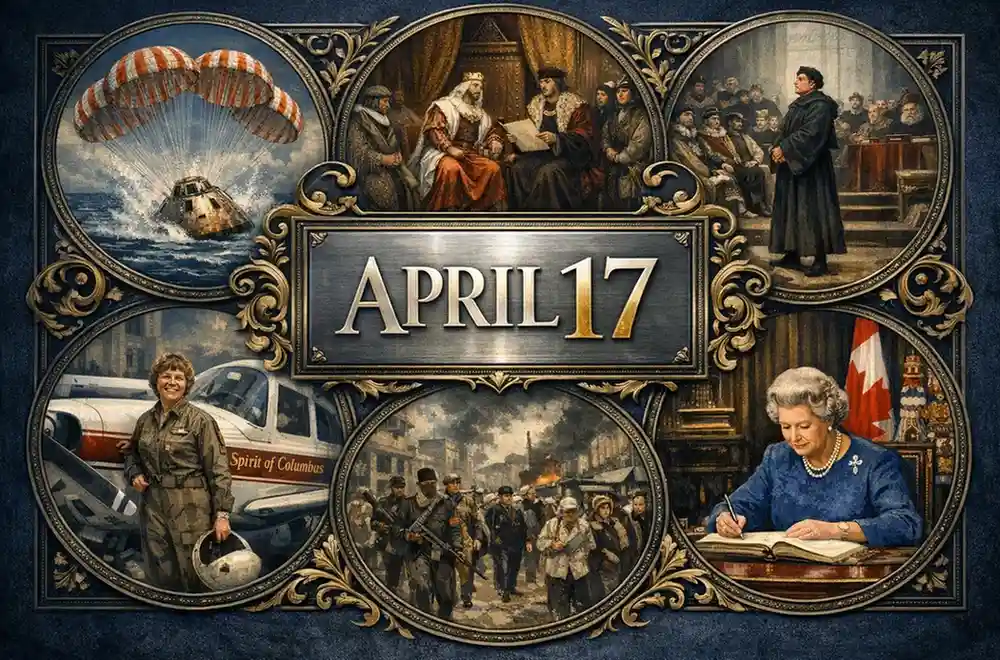
The formal trial of Martin Luther regarding his controversial religious teachings began before the gathered assembly of the Diet of Worms. Faced with the demand to recant his writings, Luther appeared initially intimidated by the gathered imperial and ecclesiastical authorities. He requested additional time to reflect on his response, and the presiding officials granted him a stay of exactly one day. This brief pause in the proceedings set the stage for his famous “Here I Stand” speech that would follow shortly after.
1524 – Verrazzano Reaches New York
The Italian navigator Giovanni da Verrazzano reached the entrance of New York harbor while sailing under the commission of the French king. He was the first European of the modern era to enter the bay, describing the surrounding land and the local indigenous people. His arrival provided France with a territorial claim in the New World and expanded European knowledge of the North American coastline. The bridge spanning the harbor entrance today serves as a lasting tribute to his maritime journey and his nautical skills.
1783 – Colbert’s Raid
During the American Revolutionary War, a Spanish garrison under Captain Jacobo du Breuil successfully defeated a group of British irregulars at Arkansas Post. This engagement, known as Colbert’s Raid, was a rare instance of direct military conflict occurring in the western frontier regions during the war. The Spanish victory helped secure the lower Mississippi River valley from British influence and protected vital supply lines for the colonial cause. It demonstrated the importance of international alliances in the broader struggle for control over the North American continent.
1797 – Abercromby Attacks San Juan
Sir Ralph Abercromby launched a massive naval and land attack on San Juan, Puerto Rico, representing one of the largest invasions of Spanish territory. The British forces sought to capture the strategic port to disrupt Spanish trade and expand their own holdings in the Caribbean. Despite the overwhelming size of the invading fleet, the local Spanish defenders and militias managed to successfully repel the British assault. This victory remains a point of historical pride for the island, symbolizing the effective defense of its coastal fortifications.
1797 – Rebellion in Verona
The citizens of Verona began an unsuccessful eight-day rebellion against the French military forces that were currently occupying their historic city. The uprising was sparked by growing resentment toward French administrative policies and the perceived mistreatment of the local population. While the insurgents initially gained control of several areas, the French eventually suppressed the revolt with superior military force and heavy reinforcements. The event highlighted the widespread tension and resistance that accompanied Napoleon’s expansive military campaigns throughout the Italian peninsula.
1861 – Virginia Votes to Secede
The state convention of Virginia voted to officially secede from the United States, a move that significantly bolstered the strength of the Southern cause. Virginia eventually became the eighth state to join the Confederate States of America, providing a massive industrial and military base for the rebellion. This decision was a major blow to the Union, as it brought the conflict directly to the doorstep of the national capital. The state’s move toward secession guaranteed that some of the war’s most brutal battles would occur on its soil.
1863 – Grierson’s Raid Begins
Union Army Colonel Benjamin Grierson led his cavalry troops on a daring raid into central Mississippi to disrupt Confederate supply and communication lines. This military operation was designed to draw attention away from General Grant’s planned maneuvers against the strategic stronghold of Vicksburg. Grierson’s men traveled over 600 miles through enemy territory, tearing up railroad tracks and destroying vital war supplies along the way. The success of the raid provided a critical distraction that facilitated the eventual Union victory in the Western Theater.
1864 – Battle of Plymouth Begins
Confederate forces launched a determined attack on the town of Plymouth, North Carolina, beginning a battle to regain control of the strategic port. The engagement involved a coordinated effort between land troops and the powerful ironclad ram CSS Albemarle, which challenged Union naval dominance. The fall of Plymouth would represent one of the few significant Confederate victories during the final stages of the Civil War in the region. This battle demonstrated the ongoing volatility of coastal control and the impact of armored naval technology on river warfare.
1869 – Morelos Becomes a State
The territory of Morelos was officially admitted as the 27th state of Mexico, named in honor of the revolutionary leader José María Morelos. This administrative move aimed to improve the governance of the region and recognize its historical importance during the struggle for independence. The state’s fertile lands and strategic position near the capital made it a vital component of the nation’s agricultural and political life. Its establishment helped stabilize the federal structure of Mexico during a period of significant national reorganization and growth.
1876 – Catalpa Rescue
In a daring maritime operation, a group of six Fenian prisoners were successfully rescued from the Fremantle Prison in Western Australia. The escape was orchestrated by Irish-American sympathizers who utilized the whaling ship Catalpa to spirit the men away from the remote penal colony. The rescue made international headlines and embarrassed the British colonial authorities, who were unable to intercept the vessel before it reached international waters. This event became a legendary symbol of Irish resistance and the far-reaching network of the Fenian movement.
1895 – Treaty of Shimonoseki
The Treaty of Shimonoseki was signed between China and Japan, officially bringing the First Sino-Japanese War to a definitive conclusion. The defeated Qing Empire was forced to recognize the independence of Korea and concede significant territories, including Taiwan and the Penghu Islands. This agreement marked the emergence of Japan as a major imperial power in East Asia and a significant decline for the Qing dynasty. The terms of the treaty fundamentally altered the geopolitical balance of the region for the following several decades.
1905 – Lochner v. New York
The Supreme Court issued its decision in Lochner v. New York, striking down a state law that limited the working hours of bakers. The court held that the “right to free contract” was an implicit protection under the due process clause of the Fourteenth Amendment. This ruling inaugurated an era of judicial history where many labor regulations were viewed as unconstitutional infringements on individual business liberty. It remains one of the most debated cases in American law, highlighting the tension between worker protections and economic freedom.
1907 – Record Day at Ellis Island
The Ellis Island immigration center processed 11,747 individuals in a single day, the highest number recorded in the facility’s entire history. Thousands of hopeful immigrants from across Europe arrived in New York harbor seeking new lives and opportunities in the United States. Staff worked tirelessly to perform the required medical and legal inspections as the massive wave of humanity passed through the Great Hall. This record day highlighted the peak of the Great Migration and the central role of Ellis Island in American history.
1912 – Lena Goldfields Massacre
Russian imperial troops opened fire on striking goldfield workers in northeast Siberia, resulting in the deaths of at least 150 individuals. The workers had been protesting inhumane living conditions, low wages, and the 16-hour workdays imposed by the mine’s management. The brutality of the state’s response shocked the Russian public and sparked a massive wave of sympathy strikes and protests across the empire. This tragic event significantly radicalized the labor movement and weakened the perceived legitimacy of the Tsarist government in its final years.
1925 – Communist Party of Korea Founded
The Communist Party of Korea was officially founded during a secret meeting in the city of Keijō, which is now known as modern Seoul. The organization was established under Japanese colonial rule by revolutionary leaders including Kim Yong-bom and Pak Hon-yong. Its members sought to organize labor movements and advocate for national independence through a Marxist-Leninist ideological framework. The party’s early years were characterized by underground operations and intense repression from the Japanese authorities, shaping the future of Korean political thought.
1931 – Proclamation of Generalitat
After intense negotiations between the provisional governments of Spain and Catalonia, the recently proclaimed Catalan Republic was transitioned into the Generalitat de Catalunya. This new body served as the autonomous government of Catalonia within the framework of the Spanish Republic, granting the region significant self-rule. The agreement sought to balance the demands for regional identity with the need for national unity during a period of revolutionary change. This institutional structure remains a foundational element of the modern political identity and governance of the Catalan people.
1941 – Invasion of Yugoslavia Ends
The Axis invasion of Yugoslavia was officially completed as the nation’s military leaders signed an armistice agreement with Germany and Italy. The rapid campaign resulted in the total collapse of the Yugoslav royal government and the subsequent occupation and dismemberment of its territories. Large portions of the country were annexed or placed under the control of puppet regimes established by the occupying powers. This surrender marked the beginning of a brutal period of resistance and internal conflict that would last for the rest of the war.
1942 – Giraud Escapes Königstein
French General Henri Giraud successfully escaped from his high-security castle prison at Königstein Fortress by rappelling down a sheer cliff side. He utilized a homemade rope and disguised himself to travel across Germany and eventually reach unoccupied territory in Vichy France. His daring flight from captivity made him a hero to the French public and a significant figure for the Allied military leadership. Giraud’s escape was an embarrassing blow to the German high command, who had considered the fortress to be entirely inescapable.
1944 – Attack on EKKA Resistance
Forces of the Communist-controlled Greek People’s Liberation Army launched a surprise attack on the smaller National and Social Liberation (EKKA) resistance group. The EKKA forces were overwhelmed and forced to surrender, signaling a consolidation of power by the communist factions during the occupation. Following the surrender, the EKKA leader Dimitrios Psarros was murdered, an act that deeply embittered relations between different wings of the Greek resistance. This internal conflict was a tragic precursor to the civil war that would devastate Greece after the war’s end.
1945 – Liberation of Montese
Allied forces, including members of the Brazilian Expeditionary Force, officially liberated the Italian town of Montese from entrenched Nazi military units. The battle for the town was a brutal part of the final offensive to break the German defensive lines in Northern Italy. The success at Montese helped clear the path for the Allied advance toward the Po Valley and the eventual collapse of German resistance. The liberation brought an end to years of occupation for the local population and remains a celebrated victory in Brazilian military history.
1945 – Prime Minister Tran Trong Kim
Historian Tran Trong Kim was officially appointed as the Prime Minister of the Empire of Vietnam during the final months of World War II. His government was established under Japanese influence following the removal of the French colonial administration from the region. While the administration faced immense challenges including a massive famine, it attempted to implement educational and administrative reforms. The tenure of his government was brief, as the shifting tides of the war soon led to the rise of the Viet Minh.
1946 – French Withdrawal from Syria
The last remaining French military troops were officially withdrawn from Syria, marking the end of the French mandate in the Middle Eastern nation. This departure followed years of diplomatic pressure and local resistance aimed at securing full national sovereignty. The withdrawal allowed Syria to establish its first fully independent government and begin its life as a sovereign republic. This date is now celebrated annually as Evacuation Day, serving as a primary national holiday that honors the country’s freedom from colonial rule.
1951 – Peak District National Park
The Peak District was officially designated as the first National Park in the United Kingdom, protecting a vast area of natural beauty in central England. This establishment followed decades of advocacy from outdoor enthusiasts and conservationists who sought to preserve the landscape for public enjoyment. The park features a diverse terrain of limestone valleys and gritstone ridges, attracting millions of visitors for hiking and climbing. Its creation set a precedent for the protection of open spaces and the promotion of environmental stewardship throughout Britain.
1961 – Bay of Pigs Invasion Begins
A group of approximately 1,400 Cuban exiles, trained and financed by the CIA, landed at the Bay of Pigs with the intent to overthrow Fidel Castro. The invasion was a poorly executed military operation that failed to trigger the expected popular uprising against the Cuban government. Within three days, the exile brigade was defeated by Castro’s forces, resulting in hundreds of casualties and the capture of over 1,000 prisoners. This failure was a major embarrassment for the Kennedy administration and pushed Cuba closer to the Soviet Union.
1964 – Jerrie Mock Completes Solo Flight
Jerrie Mock successfully landed her plane, the Spirit of Columbus, becoming the first woman to complete a solo flight around the world. Her journey took 29 and a half days and covered more than 23,000 miles across multiple continents and oceans. She faced numerous mechanical issues and difficult weather conditions but persevered to achieve her goal and set several aviation records. Mock’s achievement was a major milestone for women in aviation, proving that the skies were open to anyone with the skill and determination to fly.
1969 – Conviction of Sirhan Sirhan
Sirhan Sirhan was officially convicted of the assassination of Robert F. Kennedy following a lengthy trial in Los Angeles. The jury found him guilty of first-degree murder for the shooting that had occurred in the Ambassador Hotel the previous year. While he was initially sentenced to death, his punishment was later commuted to life in prison after California abolished the death penalty. The conviction brought a legal conclusion to one of the most shocking and transformative political tragedies of the 1960s in the United States.
1969 – Dubček Deposed in Czechoslovakia
Alexander Dubček was officially deposed as the chairman of the Communist Party of Czechoslovakia, signaling the end of the “Prague Spring” reforms. He was replaced by Gustáv Husák, who was favored by the Soviet Union to lead a process of “normalization” and reassert orthodox communist control. This leadership change followed the military invasion of the country by Warsaw Pact forces the previous year. Dubček’s removal marked a return to a more repressive political environment and the suppression of the democratic aspirations of the Czechoslovak people.
1970 – Apollo 13 Returns Safely
The damaged Apollo 13 spacecraft successfully returned to Earth, splashing down in the South Pacific after a harrowing six-day mission. The crew—Jim Lovell, Jack Swigert, and Fred Haise—survived a catastrophic oxygen tank explosion by utilizing the Lunar Module as a lifeboat. NASA flight controllers worked around the clock to develop emergency procedures that allowed the astronauts to navigate back to Earth with limited power and water. The successful recovery is considered one of the greatest achievements of teamwork and engineering in space history.
1971 – Provisional Government of Bangladesh
The Provisional Government of Bangladesh was formally established in the town of Mujibnagar during the nation’s struggle for independence from Pakistan. This body was created to provide political leadership and international representation for the burgeoning liberation movement. Led by figures like Tajuddin Ahmad, the government organized the armed resistance and sought diplomatic recognition from countries around the world. The formation of this administration was a critical step in the transition of Bangladesh from a revolutionary movement to a sovereign national state.
1975 – Fall of Phnom Penh
The Cambodian Civil War ended as the Khmer Rouge captured the capital city of Phnom Penh, leading to the total surrender of government forces. Thousands of residents initially cheered the arrival of the soldiers, hoping for peace after years of brutal conflict. However, the Khmer Rouge immediately began the forced evacuation of the city’s population to the countryside, marking the start of the Cambodian Genocide. This takeover inaugurated a period of extreme violence and social engineering that would result in the deaths of millions.
1978 – Assassination of Mir Akbar Khyber
Mir Akbar Khyber, a prominent leader of the People’s Democratic Party of Afghanistan, was assassinated in Kabul by unknown gunmen. His death provoked massive public protests against the government of President Daoud Khan, who was blamed for the killing. These demonstrations quickly escalated into the Saur Revolution, a military coup that brought the communist party to power and fundamentally changed the nation’s political trajectory. This event served as the immediate catalyst for decades of conflict and foreign intervention in Afghanistan.
1982 – Patriation of Canadian Constitution
Queen Elizabeth II signed the Proclamation of the Constitution Act in Ottawa, officially completing the patriation of the Canadian constitution. This historic act allowed Canada to amend its own constitution without the approval of the British Parliament for the first time. The new constitution also included the Canadian Charter of Rights and Freedoms, which provided entrenched legal protections for the citizens of the nation. This event marked the final step in Canada’s journey toward full legal sovereignty and national independence from the United Kingdom.
1986 – End of the 335 Years’ War
An alleged state of war that had lasted for 335 years between the Netherlands and the Isles of Scilly was officially brought to an end with a peace treaty. The “war” had legally existed since 1651 when a Dutch admiral declared conflict against the islands during the English Civil War, but no shots were ever fired. A local historian’s research led to the discovery of the forgotten legal status, prompting the Dutch ambassador to visit the islands for a ceremonial peace signing. The event serves as a curious and peaceful footnote in the history of international law.
1992 – Katina P Oil Spill
The tanker Katina P was deliberately run aground off the coast of Maputo, Mozambique, resulting in a massive spill of 60,000 tons of crude oil. The vessel had sustained structural damage during a storm, and the crew chose to beach the ship to prevent it from sinking in deep water. The resulting spill caused extensive environmental damage to the local coastline, devastating the fishing industry and sensitive mangrove ecosystems. This disaster highlighted the ongoing risks of oil transportation and the need for improved maritime safety and environmental protection measures.
1998 – Launch of STS-90
The Space Shuttle Columbia was successfully launched on mission STS-90, representing the final dedicated flight for the Spacelab module. The crew spent sixteen days in orbit conducting a variety of neuroscience experiments designed to study the effects of microgravity on the brain and nervous system. This mission provided essential data for understanding how living organisms adapt to spaceflight and helped prepare for long-duration stays on the International Space Station. The conclusion of the Spacelab program marked the end of a successful era of shuttle-based scientific research.
2003 – First Female PM in Finland
Anneli Jäätteenmäki officially took office as the first female prime minister of Finland, leading a new coalition government. Her appointment was a major milestone for gender equality in Finnish politics, making Finland the first European country to have both a female president and a female prime minister simultaneously. While her tenure was brief due to a political controversy involving leaked documents, her election remains a significant historical event. This breakthrough paved the way for future generations of women to lead at the highest levels of the Finnish state.
2006 – Tel Aviv Restaurant Bombing
A Palestinian suicide bomber detonated an explosive device at a crowded restaurant in Tel Aviv, killing 11 people and injuring 70 others. The attack occurred during the Passover holiday and targeted a popular local eatery, causing widespread shock and international condemnation. The extremist group Islamic Jihad claimed responsibility for the bombing, which disrupted ongoing efforts to maintain a ceasefire in the region. This tragic event highlighted the persistent threat of violence and the challenges of achieving a lasting peace in the Israeli-Palestinian conflict.
2013 – West Texas Fertilizer Explosion
A massive explosion occurred at a fertilizer storage facility in the city of West, Texas, resulting in the deaths of 15 people and injuring 160. The blast was so powerful that it damaged or destroyed dozens of nearby homes, schools, and a nursing home. Most of the fatalities were first responders who had rushed to the scene to fight a fire at the plant before the detonation occurred. The disaster led to a major investigation and sparked a national conversation about industrial safety regulations and the storage of hazardous materials in residential areas.
2014 – First Earth-Size Habitable Planet
NASA’s Kepler space telescope provided data that confirmed the discovery of the first Earth-size planet located in the habitable zone of another star. Known as Kepler-186f, the planet is located approximately 500 light-years from Earth and orbits a red dwarf star. The “habitable zone” is the region where liquid water could potentially exist on the surface of a planet, a key requirement for life as we know it. This discovery was a major milestone in the search for other worlds that might be capable of supporting biological life.
2021 – Funeral of Prince Philip
The funeral of Prince Philip, the Duke of Edinburgh, took place at St George’s Chapel within the grounds of Windsor Castle. Due to the ongoing global health crisis, the ceremony was small and followed strict social distancing protocols, with the Queen sitting alone. The service honored his decades of service to the British monarchy and his role as the longest-serving royal consort in history. His passing marked the end of an era for the Royal Family and was watched by millions of people around the world in a display of national mourning.
Famous People Born On April 17
| Name | Description | Date |
|---|---|---|
| Henry Vaughan | Anglo-Welsh poet and mystic | April 17, 1622 – April 23, 1695 |
| Frederick | King of Sweden (1720–51), first of the Age of Freedom | April 17, 1676 – March 25, 1751 |
| Taksin | King of Siam who reunited Thailand after Burmese defeat | April 17, 1734 – April 6, 1782 |
| Karl Friedrich Philipp von Martius | German botanist, expert on Brazilian flora | April 17, 1794 – December 13, 1868 |
| William Gilmore Simms | American novelist, outstanding Southern writer | April 17, 1806 – June 11, 1870 |
| Alexander Joy Cartwright | American sportsman, codifier of modern baseball rules | April 17, 1820 – July 12, 1892 |
| Hakushaku Itagaki Taisuke | Japanese politician, founder of first political party | April 17, 1837 – July 11, 1919 |
| Camillo Sitte | Austrian architect and town planner | April 17, 1843 – November 16, 1903 |
| William R. Day | U.S. Supreme Court associate justice (1903–22) | April 17, 1849 – July 9, 1923 |
| Willis Van Devanter | U.S. Supreme Court associate justice (1910–37) | April 17, 1859 – February 8, 1941 |
| Augustus Edward Hough Love | British geophysicist, discovered Love waves | April 17, 1863 – June 5, 1940 |
| Ernest Henry Starling | British physiologist, Starling’s law of the heart | April 17, 1866 – May 2, 1927 |
| Ray Stannard Baker | American journalist, biographer of Woodrow Wilson | April 17, 1870 – July 12, 1946 |
| Max Berg | German Expressionist architect, Centennial Hall in Breslau | April 17, 1870 – January 22, 1947 |
| Clarence Hungerford Mackay | American communications executive and philanthropist | April 17, 1874 – November 12, 1938 |
| Artur Schnabel | Austrian pianist, legendary interpreter of Beethoven | April 17, 1882 – August 15, 1951 |
| Robert Morrison MacIver | Scottish-born sociologist and political scientist | April 17, 1882 – June 15, 1970 |
| Marcel Boussac | French industrialist, brought colour to clothing | April 17, 1889 – March 21, 1980 |
| Nikita Khrushchev | Soviet premier, leader during de-Stalinization and Cold War | April 17, 1894 – September 11, 1971 |
| Thornton Wilder | American writer, Our Town and The Bridge of San Luis Rey | April 17, 1897 – December 7, 1975 |
| Sir Vincent Wigglesworth | English entomologist, pioneer of insect physiology | April 17, 1899 – February 11, 1994 |
| Raúl Prebisch | Argentine economist, dependency theory pioneer | April 17, 1901 – April 29, 1986 |
| Jaime Torres Bodet | Mexican poet, novelist, and statesman | April 17, 1902 – May 13, 1974 |
| Hervé Bazin | French author of satirical family novels | April 17, 1911 – February 17, 1996 |
| Dovey Johnson Roundtree | American lawyer, civil rights activist, military officer | April 17, 1914 – May 21, 2018 |
| Sirimavo Bandaranaike | First woman prime minister in the world (Sri Lanka) | April 17, 1916 – October 10, 2000 |
| William Holden | American film star, Oscar winner for Stalag 17 | April 17, 1918 – November 16, 1981 |
| Chavela Vargas | Costa Rican-born Mexican ranchera singer | April 17, 1919 – August 5, 2012 |
| Lindsay Anderson | English stage and film director, Free Cinema movement | April 17, 1923 – August 30, 1994 |
| Cynthia Ozick | American novelist and essayist on Jewish identity | April 17, 1928 – Present |
Famous People Died On April 17
| Name | Description | Date |
|---|---|---|
| Benedict III | Pope (855–858) | Unknown – April 17, 858 |
| Marin Falier | Doge of Venice, executed for leading a plot | 1274 – April 17, 1355 |
| Joachim Camerarius | German classical scholar and Lutheran theologian | April 12, 1500 – April 17, 1574 |
| Marie de Rabutin-Chantal, marquise de Sévigné | French writer, famous for her letters | February 5, 1626 – April 17, 1696 |
| Joseph I | Holy Roman Emperor (1705–11) | July 26, 1678 – April 17, 1711 |
| Arvid Bernhard, Count Horn | Swedish statesman, began Age of Freedom | April 6, 1664 – April 17, 1742 |
| Thomas Bayes | English theologian and mathematician, Bayes’ theorem | 1702 – April 17, 1761 |
| Johann Mattheson | German composer and music scholar | September 28, 1681 – April 17, 1764 |
| Louise-Florence-Pétronille Tardieu d’Esclavelles, dame de la Live d’Épinay | French literary figure and salonnière | March 11, 1726 – April 17, 1783 |
| Alexander Bezborodko | Russian foreign minister under Catherine the Great | March 25, 1747 – April 17, 1799 |
| William-Henry Ireland | English forger of Shakespearean works | August 2, 1775 – April 17, 1835 |
| Samuel Morey | American inventor, pioneer of steamboats | October 23, 1762 – April 17, 1843 |
| Orestes Augustus Brownson | American theological and philosophical writer | September 16, 1803 – April 17, 1876 |
| E. G. Squier | American archaeologist, studied pre-Columbian remains | June 17, 1821 – April 17, 1888 |
| Alexander Mackenzie | First Liberal prime minister of Canada (1873–78) | January 28, 1822 – April 17, 1892 |
| Jorge Isaacs | Colombian poet and novelist, author of María | April 1, 1837 – April 17, 1895 |
| Sir Patrick Geddes | Scottish biologist and town planning pioneer | October 2, 1854 – April 17, 1932 |
| Srinivasa Sastri | Indian statesman, founder of Indian Liberal Federation | September 22, 1869 – April 17, 1946 |
| Juan Bautista Sacasa | President of Nicaragua (1932–36) | December 21, 1874 – April 17, 1946 |
| Berthe Weill | French art dealer, championed avant-garde artists | November 20, 1865 – April 17, 1951 |
| Theodore Komisarjevsky | Russian theatrical director and designer | May 23, 1882 – April 17, 1954 |
| Eddie Cochran | American rock-and-roll singer and guitarist | October 3, 1938 – April 17, 1960 |
| Elda Emma Anderson | American physicist, pioneer of health physics | October 5, 1899 – April 17, 1961 |
| Henry Allen | American jazz trumpeter of the swing era | January 7, 1908 – April 17, 1967 |
| Alexis I | Russian Orthodox Patriarch of Moscow and All Russia | November 8, 1877 – April 17, 1970 |
| Richard Dagobert Brauer | German-born American mathematician | February 10, 1901 – April 17, 1977 |
| Alf Sjöberg | Swedish film director, post-WWII Swedish revival | June 21, 1903 – April 17, 1980 |
| Mark Clark | U.S. Army officer, commander in Italian campaign | May 1, 1896 – April 17, 1984 |
| Bessie Emery Head | South African novelist, pre- and postcolonial themes | July 6, 1937 – April 17, 1986 |
| Louise Nevelson | American sculptor, large monochromatic wood sculptures | September 23, 1899? – April 17, 1988 |
Observances & Institutional Dates
- Evacuation Day (Syria): A primary national holiday celebrating the final withdrawal of French colonial troops and the recognition of Syrian independence in 1946.
- World Hemophilia Day: An international awareness day dedicated to increasing the understanding of hemophilia and other inherited bleeding disorders.
- Malbec World Day: A global celebration of the Malbec grape variety and its importance to the wine industry, particularly in Argentina.
- Flag Day (American Samoa): A territorial holiday commemorating the first raising of the American flag on the islands in 1900.
Frequently Asked Questions
- When did Apollo 13 return to Earth? The spacecraft successfully splashed down in the South Pacific on April 17, 1970, after a critical mission failure.
- Who was the first female prime minister of Finland? Anneli Jäätteenmäki took office as the nation’s first woman to hold the position on April 17, 2003.
- What is celebrated on Syria’s Evacuation Day? It honors the departure of the last French troops from the country on April 17, 1946, marking full independence.
- What did the Treaty of Shimonoseki do? Signed on April 17, 1895, it ended the First Sino-Japanese War and forced China to cede Taiwan and other territories to Japan.