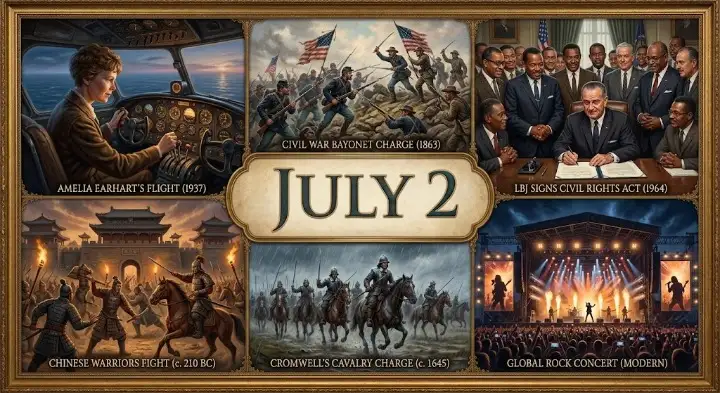
On a humid Washington morning, Lyndon B. Johnson picked up a handful of gold-plated pens and permanently altered the fabric of American society. Black leaders, activists, and television cameras packed tight into the East Room of the White House to watch the President pen the Civil Rights Act of 1964 into law. Segregation in public spaces collapsed on paper at that exact moment. Decades of brutal street battles, marches, and systemic oppression had led to this single desktop pen stroke, setting a new baseline for legal equality in the United States.
Story of the Day: The Final Radio Crackle of Amelia Earhart
Fred Noonan checked his navigation charts while Amelia Earhart fought the controls of their twin-engine Lockheed Electra, somewhere over the vast, empty expanse of the Pacific Ocean. They were hunting for Howland Island, a tiny speck of dirt in a massive sea, running dangerously low on fuel during their ambitious flight around the globe. United States Coast Guard cutters listened intently to the static-heavy radio frequencies, waiting for coordinates that never came clearly. Earhart’s voice broke through the speaker one last time, reporting that she was flying on a specific line of position but could not see the island.
The radio went dead, launching the largest maritime rescue search in naval memory that yielded absolutely nothing. Her total disappearance created an enduring maritime mystery that fundamentally changed aviation safety rules, search protocols, and the legend of early female flight.
Important Events That Happened On July 2 In History
311 – Papacy of Pope Miltiades Begins
Emperor Maxentius permitted a new leader to ascend the papal chair in Rome during a period of intense theological division. Pope Miltiades took control of a fractured church just as the Roman empire began pivoting away from Christian persecutions. His administration organized the return of confiscated church properties and prepared Rome for the massive cultural shifts under Emperor Constantine. This quiet administrative transition laid the groundwork for the legal recognition of Christianity across the Western world.
626 – The Xuanwu Gate Incident
Li Shimin led a group of heavily armed soldiers to the northern gate of the imperial palace in Chang’an with a deadly plan. The young prince ambushed and killed his older brothers, Li Jiancheng and Li Yuanji, in a cold-blooded coup for the royal succession. Emperor Gaozu sat powerless inside his palace while his son secured absolute control over the dynasty. This bloody morning forced the old emperor to abdicate, making Li Shimin the master of the Tang Dynasty under the name Emperor Taizong.
866 – Battle of Brissarthe
Robert the Strong gathered his Frankish warriors near the town of Brissarthe to intercept a combined force of Bretons and Viking raiders. The combatants clashed near a stone church where the defenders attempted to withstand the brutal northern onslaught. Viking axes broke the Frankish lines, killing Robert during the chaotic hand-to-hand melee. This decisive victory secured Viking dominance along the Loire River and forced regional rulers to build heavier fortifications to survive future raids.
1298 – Battle of Göllheim
Albert I of Habsburg rode down his bitter rival Adolf of Nassau-Weilburg on a muddy battlefield in southwestern Germany. The two noblemen fought hand-to-hand for the crown of the King of the Romans, surrounded by thousands of clashing knights. Albert’s forces broke the royal lines, leaving Adolf dead on the field before the sun set. The sudden death of the reigning king allowed Albert to claim the crown and secure the dominance of the Habsburg lineage for centuries to come.
1494 – Spain Ratifies Treaty of Tordesillas
Spanish monarchs Ferdinand and Isabella signed a royal document that divided the entire non-Christian world like an apple. The Treaty of Tordesillas established a specific line in the Atlantic Ocean, giving Spain everything to the west and Portugal everything to the east. Cartographers drew lines across lands they had never seen, completely ignoring the millions of indigenous people living there. This paper division dictated the language, boundaries, and colonial tragedies of South America for generations.
1582 – Battle of Yamazaki
Toyotomi Hideyoshi marched his army at blistering speed to confront the treacherous general Akechi Mitsuhide near Kyoto. Mitsuhide had just betrayed and forced the suicide of his own lord, Oda Nobunaga, expecting to seize imperial power for himself. Hideyoshi’s massive numbers overwhelmed the traitorous forces in a rainy, muddy valley within a matter of hours. This swift victory positioned Hideyoshi as the undisputed leader of Japan, continuing the long process of national unification.
1644 – Battle of Marston Moor
Oliver Cromwell led his cavalry through the rain to smash the Royalist army on a wild moor outside York. The English Civil War reached its bloodiest peak as over forty thousand men hacked at each other in the twilight. Parliament’s forces shattered the cavalry of Prince Rupert, destroying the King’s main army in the north of England. This massive defeat stripped King Charles I of his northern strongholds and proved that the roundhead army could win the war.
1645 – Battle of Alford
James Graham, the Marquess of Montrose, deployed his royalist clansmen along a steep ridge near the village of Alford. Covenanter forces advanced across marshy ground, expecting an easy victory against the smaller royalist army. Montrose launched a sudden downhill cavalry charge that broke the enemy center and routed the infantry. This victory kept the royalist cause alive in Scotland, showing that tactical positioning could overcome superior enemy numbers.
1776 – The Lee Resolution Passes
Delegates inside the Pennsylvania State House voted to permanently sever political ties with Great Britain. Richard Henry Lee’s resolution declared the colonies free and independent states, legally ending British rule two days before anyone signed the formal declaration. John Adams wrote to his wife that this specific date would be celebrated by future generations with fireworks and parades. The legal act of separation happened here, setting up the political framework for a brand new nation.
1823 – Bahia Independence Day
Brazilian soldiers entered the city of Salvador as the final Portuguese imperial garrison boarded transport ships to flee the province of Bahia. The long, bloody Siege of Salvador ended with the total collapse of European royal loyalists in northern Brazil. Local populations celebrated in the streets after months of starvation and intense urban combat. This departure guaranteed the territorial integrity of the newly declared independent Empire of Brazil.
1840 – Mount Ararat Eruption and Earthquake
A massive tectonic shift ruptured the earth beneath Mount Ararat, triggering a violent volcanic blast in eastern Turkey. Boulders, mudslides, and pyroclastic debris rained down on the Saint James Monastery and nearby Armenian villages. The combined forces of the tremor and landslide buried entire communities alive, killing ten thousand people in a matter of minutes. This natural disaster permanently altered the topography of the mountain and erased ancient settlements from the geographic landscape.
1863 – Battle of Little Round Top
Colonel Joshua Chamberlain ordered his thin line of Maine soldiers to fix bayonets and charge down a rocky hill in Pennsylvania. Confederate troops had repeatedly assaulted the extreme left flank of the Union army on the second day of Gettysburg, nearly breaking the line. The desperate, sweeping downhill charge surprised the exhausted southern troops, forcing hundreds to surrender on the spot. This critical defense saved the Union position on the battlefield, turning the tide of the entire American Civil War.
1881 – President Garfield Shot
Charles J. Guiteau stepped up behind United States President James A. Garfield at a Washington train station and fired two bullets into his back. The mentally unstable assassin shouted that he was a stalwart supporter and demanded a political appointment from the new administration. Garfield collapsed onto the platform, surviving the initial shooting only to face months of agonizing, unhygienic medical treatment. The assassination attempt shocked the public and forced a massive overhaul of the civil service system.
1890 – Sherman Antitrust Act Enacted
The United States Congress passed a sweeping federal statute aimed at destroying the massive corporate monopolies dominating American industry. Senator John Sherman authored the legislation to prevent massive railroad, oil, and sugar trusts from fixing prices and crushing small competitors. Corporate lawyers immediately looked for loopholes, but the law gave federal prosecutors their first real weapon against corporate greed. This legislative act changed the relationship between big business and the federal government forever.
1917 – Battle of Abu al-Lissan
T.E. Lawrence and his tribal Arab fighters charged across the desert sands to ambush an Ottoman battalion near Aqaba. The sudden, chaotic assault caught the Turkish defenders completely by surprise outside the mountain passes. Lawrence’s victory cleared the main road toward the strategic port city, proving that irregular desert forces could beat a regular army. This victory secured the northern advance of the Arab Revolt during the First World War.
1921 – Knox–Porter Resolution Signed
President Warren G. Harding signed a joint congressional resolution at a private estate in New Jersey to formally end America’s involvement in World War I. The United States had never ratified the Treaty of Versailles, leaving the country technically at war with Germany for years after the armistice. This simple domestic document restored normal diplomatic relations and allowed trade to resume without adopting European league obligations. The signing closed the final legal chapter of the war for American citizens.
1934 – Night of the Long Knives Ends
Adolf Hitler concluded a three-day campaign of extrajudicial executions that completely purged the leadership of his own paramilitary stormtroopers. SS executioners shot Ernst Röhm and dozens of senior SA leaders inside prisons and hotels across Germany under the guise of stopping a coup. The regime used the chaos to liquidate conservative politicians and old rivals who knew too much about the party’s rise. This bloody weekend eliminated all internal opposition, leaving the German military subservient to the Nazi state.
1966 – France Begins Pacific Nuclear Tests
Military technicians detonated a nuclear warhead on the remote Moruroa Atoll, launching France’s atmospheric test program in the Pacific Ocean. The blast sent a massive mushroom cloud into the sky, polluting the surrounding marine environment with radioactive fallout. International protests erupted across New Zealand, Chile, and the Pacific islands against European colonial militarism. This initial explosion began decades of controversial weapons testing that caused long-term health crises for local populations.
1976 – Vietnam Reunified
Communist officials in Hanoi officially dissolved the government of South Vietnam and annexed the territory into a single state. The creation of the Socialist Republic of Vietnam marked the formal administrative end to decades of civil war and foreign intervention. Saigon received a new name honoring Ho Chi Minh as the party centralized economic and social control over the entire country. This administrative merger forced hundreds of thousands of southerners into re-education camps or hazardous sea escapes.
1986 – The Quemados Case in Chile
Military dictatorial patrol officers cornered two young street protestors, Rodrigo Rojas and Carmen Gloria Quintana, during a demonstration in Santiago. Soldiers doused both teenagers in gasoline, set them on fire, and dumped their bodies in a rural ditch outside the city. Rodrigo Rojas succumbed to his horrific burns days later, sparking massive international outrage against the regime of General Augusto Pinochet. This brutal crime became a rallying cry for the underground democratic movement fighting to end military rule.
1886 – Aeroflot Flight 2306 Crashes
A twin-engine Soviet airliner filled with fifty-four passengers developed a thick smoke leak inside the cabin shortly after taking off from Vorkuta. The pilots attempted an emergency landing in dense forests near Syktyvkar while toxic fumes filled the cockpit. The aircraft clipped treetops, broke apart, and caught fire in the remote wilderness, killing everyone on board. Soviet aviation authorities buried the accident reports, keeping the systemic mechanical failures hidden from the public eye.
1990 – Mecca Tunnel Tragedy
Thousands of Muslim pilgrims packed into the pedestrian Al-Ma’aisim tunnel during the final days of the Hajj pilgrimage in Saudi Arabia. The ventilation system suddenly failed in the scorching hundred-and-twelve-degree heat, causing instant panic inside the crowded, unlit space. A massive stampede erupted as people suffocated and trampled one another trying to reach the exits, leaving fourteen hundred dead. This catastrophic failure forced the Saudi government to rebuild the holy site’s infrastructure completely.
1993 – Sivas Massacre at Hotel Madımak
An angry mob of radical fundamentalists surrounded the Hotel Madımak in Sivas where an Alevi cultural festival was taking place. The rioters set fire to the building to target writer Aziz Nesin, who had translated controversial literature into Turkish. Police forces stood by for hours while thirty-seven artists, poets, and hotel staff suffocated inside the burning structure. This tragedy exposed the deep sectarian divides and security failures within modern Turkish society.
1994 – USAir Flight 1016 Accident
A commercial DC-9 aircraft encountered a severe, unpredictable wind shear microburst while attempting a landing during a heavy thunderstorm in Charlotte. The sudden downward blast of air slammed the plane into trees and a brick house just outside the runway perimeter. Thirty-seven passengers died instantly as the fuselage broke into three distinct pieces on impact. The disaster forced the aviation industry to install advanced Doppler weather radar at all major commercial airports.
1997 – Asian Financial Crisis Triggers
The Bank of Thailand ran out of foreign currency reserves and floated the national currency, the baht, after months of aggressive speculative attacks. The baht lost over half its value in a single afternoon, wiping out billions in domestic wealth and investments. This sudden devaluation triggered a massive economic domino effect that collapsed banks and real estate markets across Indonesia, South Korea, and Southeast Asia. The financial shock forced massive international bailouts and changed global investment strategies.
2000 – Vicente Fox Wins Mexican Election
Vicente Fox Quesada secured the presidency of Mexico after a historic election that broke more than seventy years of continuous political monopoly. The victory of the National Action Party defeated the long-ruling Institutional Revolutionary Party without triggering widespread civil violence. Millions of citizens celebrated in the streets of Mexico City, viewing the vote as the true birth of competitive democracy in their nation. This peaceful transition of power altered the political landscape of North America permanently.
2005 – Live 8 Concerts Held Globally
More than one thousand musicians took to outdoor stages in major G8 nations and South Africa to pressure world leaders regarding African debt relief. The synchronized global broadcast reached hundreds of millions of televisions, mixing pop culture with international economic policy on a massive scale. Organizers demanded that wealthy nations double foreign aid and drop historical debts holding back developing economies. The event showed the power of satellite media to create a single, global political conversation.
2013 – Aceh Province Earthquake
A shallow magnitude 6.1 earthquake ripped through the mountainous interior of Sumatra island in Indonesia. The intense shaking collapsed thousands of poorly constructed concrete homes and triggered massive landslides that buried rural roads. At least forty-two villagers lost their lives while hundreds of injured survivors waited days for medical rescue teams to clear the debris. This disaster highlighted the ongoing vulnerability of remote island communities to sudden seismic activity.
2024 – Hathras Stampede in India
A massive crowd of over two hundred thousand people rushed to touch the dust at the feet of a religious preacher leaving an event in Uttar Pradesh. The sudden surge on a slippery slope caused women and children to fall into a roadside drainage ditch, creating a deadly crush. At least one hundred and twenty-one people lost their lives while local medical clinics struggled to handle the massive influx of casualties. The tragedy exposed severe regulatory failures in managing large crowd setups at religious gatherings.
Keep the timeline turning—see yesterday’s facts here.
Famous People Born On July 2
| Name | Description | Date |
|---|---|---|
| Thomas Cranmer | Archbishop of Canterbury and key figure in the English Reformation | 1489 – 1556 |
| Christoph Willibald Gluck | Influential classical composer and opera reformer | 1714 – 1787 |
| William Henry Bragg | Nobel Prize-winning physicist; pioneer of X-ray crystallography | 1862 – 1942 |
| Hermann Hesse | Nobel Prize-winning novelist, author of Siddhartha | 1877 – 1962 |
| René Lacoste | Tennis champion and founder of the Lacoste brand | 1904 – 1996 |
| Hans Bethe | Nobel Prize-winning theoretical physicist | 1906 – 2005 |
| Thurgood Marshall | First African American U.S. Supreme Court Justice | 1908 – 1993 |
| Pierre Cardin | Legendary fashion designer | 1922 – 2020 |
| Wisława Szymborska | Nobel Prize-winning poet | 1923 – 2012 |
| Medgar Evers | Civil rights leader | 1925 – 1963 |
| Patrice Lumumba | First Prime Minister of independent Congo | 1925 – 1961 |
| Imelda Marcos | Former First Lady of the Philippines | Born 1929 |
| Ahmad Jamal | Influential jazz pianist and composer | 1930 – 2023 |
| Dave Thomas | Founder of Wendy’s | 1932 – 2002 |
| Richard Petty | NASCAR legend | Born 1937 |
| Larry David | Co-creator of Seinfeld and creator of Curb Your Enthusiasm | Born 1947 |
| Jerry Hall | Model and actress | Born 1956 |
| Bret Hart | WWE Hall of Fame wrestler | Born 1957 |
| Ashley Tisdale | Actress and singer | Born 1985 |
| Lindsay Lohan | Actress and singer | Born 1986 |
| Alex Morgan | World Cup-winning soccer player | Born 1989 |
| Margot Robbie | Actress and producer | Born 1990 |
| Saweetie | Rapper | Born 1993 |
Famous People Died On July 2
| Name | Description | Date |
|---|---|---|
| Nostradamus | Astrologer and author | 1503 – 1566 |
| Jean-Jacques Rousseau | Enlightenment philosopher | 1712 – 1778 |
| Samuel Hahnemann | Founder of homeopathy | 1755 – 1843 |
| Robert Peel | Former Prime Minister of the United Kingdom | 1788 – 1850 |
| Porfirio Díaz | Long-serving President of Mexico | 1830 – 1915 |
| Ernest Hemingway | Nobel Prize-winning novelist | 1899 – 1961 |
| Betty Grable | Hollywood actress and pin-up icon | 1916 – 1973 |
| Vladimir Nabokov | Author of Lolita | 1899 – 1977 |
| James Stewart | Academy Award-winning actor | 1908 – 1997 |
| Mario Puzo | Author of The Godfather | 1920 – 1999 |
| Douglas Engelbart | Inventor of the computer mouse | 1925 – 2013 |
| Louis Zamperini | Olympic athlete and WWII survivor | 1917 – 2014 |
| Elie Wiesel | Holocaust survivor and Nobel Peace Prize laureate | 1928 – 2016 |
| Lee Iacocca | Former CEO of Chrysler | 1924 – 2019 |
| Byron Bernstein | Twitch streamer and gaming personality | 1989 – 2020 |
Observances on July 2
Palio di Provenzano (Siena, Italy)
Bareback riders race horses around the dirt-covered Piazza del Campo in Siena to honor the Madonna of Provenzano. This ancient medieval competition pits traditional city wards against each other in a dangerous, fast-paced display of regional pride and historical pageantry.
Flag Day (Curaçao)
Citizens across the Caribbean island of Curaçao celebrate their official flag day with official ceremonies, folk dances, and cultural events in Willemstad. This holiday marks the first meeting of the island’s elected island council, celebrating their local autonomy and cultural heritage.
Police Day (Azerbaijan)
State officials and security forces in Azerbaijan mark the establishment of the country’s first national police units during the democratic republic era of 1918. The day features military parades, professional awards, and memorial services for fallen officers in Baku.
🇺🇸 Frequently Asked Questions — July 2 in History
Union forces successfully defended the critical hill position of Little Round Top on the second day of the Battle of Gettysburg. Colonel Joshua Chamberlain led a legendary bayonet charge that broke the Confederate assault and saved the Union army’s left flank.
President Lyndon B. Johnson signed the landmark Civil Rights Act of 1964 on this date. The sweeping federal law legally ended racial segregation in public spaces and prohibited employment discrimination across the United States.
Civil rights icon and Supreme Court Justice Thurgood Marshall was born on this date in 1908. He spent his life dismantling segregation through the legal system before becoming the first Black justice on the nation’s highest court.
Oliver Cromwell led Parliamentary forces to a crushing victory over the Royalist army at the Battle of Marston Moor in 1644. This bloody clash destroyed King Charles I’s power base in northern England during the English Civil War.
The Palio di Provenzano is a historic bareback horse race held in Siena, Italy, to honor a miraculous image of the Virgin Mary. It is remembered because it preserves century-old neighborhood rivalries and medieval Italian traditions.
A massive religious gathering in Hathras, India, ended in a catastrophic stampede on this date in 2024. Overcrowding and a sudden rush to see a spiritual preacher left at least one hundred and twenty-one people dead.