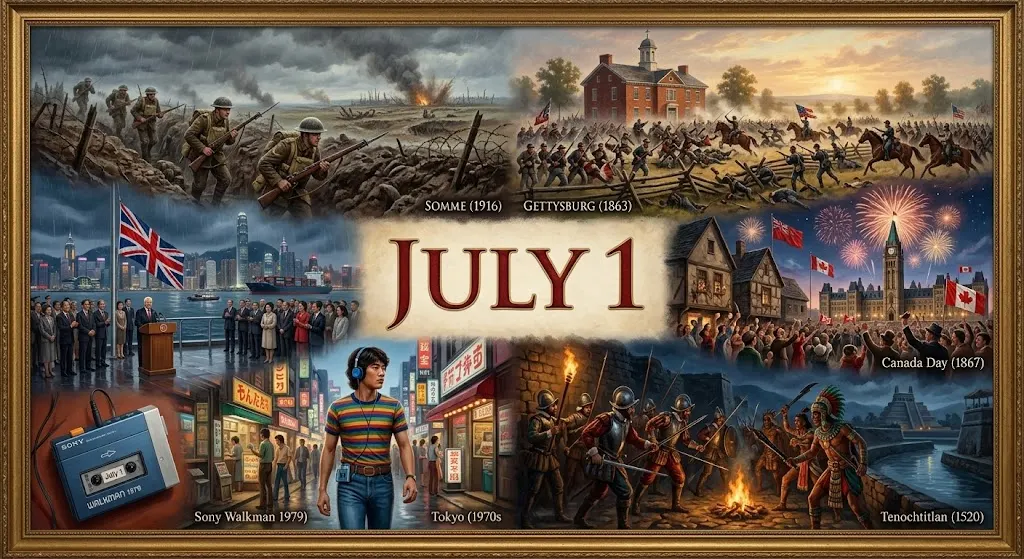
Thick gray smoke hung over the dry mud of Tenochtitlan on the night of July 1, 1520, as Hernán Cortés ordered his Spanish conquistadors to slip out of the Aztec capital under the cover of a midnight rainstorm. Discovered by Aztec scouts, the retreating soldiers were quickly swarmed by thousands of warriors in canoes, turning the causeways into a chaotic slaughterhouse later remembered as La Noche Triste (The Night of Sorrows). This desperate struggle for survival is just one of the defining moments embedded in this day in history July 1, a date that repeatedly altered the map of the world.
Quick Facts — July 1 in History
| 📌 Category | 📖 Event / Detail |
|---|---|
| 🌟 Most Significant Event | First Day on the Somme (1916) |
| 🏆 Top 10 Key Events | • Spanish retreat from Tenochtitlan (1520) • Union of Lublin creates Polish-Lithuanian Commonwealth (1569) • Battle of the Boyne begins (1690) • Central American nations declare independence (1823) • Battle of Gettysburg opens (1863) • British North America Act creates Canada (1867) • First Tour de France begins (1903) • Sony introduces the Walkman (1979) • Warsaw Pact dissolves (1991) • Britain hands Hong Kong to China (1997) |
| ⚔️ Key Battles | Battle of Taginae (552), Battle of Dorylaeum (1097), Battle of Fleurus (1690), Battle of Malvern Hill (1862), Battle of San Juan Hill (1898), First Battle of El Alamein (1942) |
| 👤 Key Figures | General George B. McClellan, King Leopold II, Chen Duxiu, Prime Minister Tony Blair |
| 🌍 Observances | Canada Day, Keti Koti (Suriname), Children’s Day (Pakistan), Independence Day (Rwanda/Burundi/Somalia) |
Story of the Day: The Bloodiest Morning in British Military History
At precisely 7:30 AM on July 1, 1916, thousands of British soldiers climbed out of their trenches in northern France, walking directly into a wall of German machine-gun fire. Commanders believed a week-long artillery bombardment had completely destroyed the enemy defenses, but the German troops had simply waited out the shellfire deep inside reinforced underground bunkers. As the British advanced across the open landscape of No Man’s Land, they were cut down by the thousands in a matter of minutes.
By the time darkness fell, 19,000 British troops lay dead and another 40,000 were wounded, making it the most disastrous single day in the history of the British Army. The scale of the slaughter devastated entire communities across Britain, where local towns had sent their young men to fight together in closely-knit neighborhood units.
Important Events That Happened On July 1 In History
69 – Roman Legions Swear Allegiance to Vespasian
Tiberius Julius Alexander stood before his assembled Roman legions in the Mediterranean port of Alexandria and commanded them to take a solemn oath of loyalty to Vespasian. This open act of defiance directly challenged the sitting emperor, Vitellius, in the capital, plunging Rome deeper into a chaotic civil war. The Egyptian legions held the vital key to Rome’s food supply, effectively choking off grain shipments to the imperial capital. Within months, Vespasian emerged victorious from the turmoil, establishing the Flavian dynasty and securing his place at the head of the empire.
552 – General Narses Crushes the Ostrogoths
Byzantine forces under the command of General Narses locked shields against an oncoming charge of Ostrogoth cavalry at the Battle of Taginae in the Apennine Mountains of Italy. The Byzantine archers decimated the advancing horsemen before the infantry moved forward to shatter the remaining lines. King Totila, the charismatic leader who had spent a decade fighting to keep Italy free of Byzantine control, was mortally wounded during the chaotic retreat. This decisive clash broke the back of Gothic resistance, allowing Emperor Justinian to temporarily reclaim the Italian peninsula for the Roman world.
1097 – Crusaders Defeat the Seljuk Army
Bohemond of Taranto rallied his heavily armored knights on the plains of Anatolia as thousands of swift Seljuk horse archers surrounded his camp during the Battle of Dorylaeum. The European forces held a defensive perimeter for hours under a relentless rain of arrows until a second crusader column led by Godfrey of Bouillon struck the Turkish flank. Sultan Kilij Arslan I was forced to abandon his treasury and flee into the mountains as his army disintegrated. This hard-fought victory cleared the path across Asia Minor, ensuring the continuation of the First Crusade toward Jerusalem.
1431 – Castile Advances at La Higueruela
King John II of Castile led his Christian knights onto the plains outside Granada to confront the Moorish defenders of the Nasrid Kingdom in the Battle of La Higueruela. The battlefield sat in the shadow of the Sierra Nevada mountains, where the heavy Castilian cavalry successfully forced the tactical retreat of the Muslim forces. While the victory did not result in the immediate fall of Granada, it marked a significant tactical territorial advance for Castile during the centuries-long Reconquista. The internal political instability caused by the defeat weakened the Moorish kingdom, setting the stage for its ultimate collapse decades later.
1520 – Conquistadors Flee Tenochtitlan in the Dark
Hernán Cortés ordered his Spanish troops to pack stolen gold into their pockets and attempt a silent midnight escape across the causeways of the Aztec capital. Aztec warriors spotted the retreating column and launched a massive attack from canoes, pulling hundreds of heavily armored Spaniards into the deep water to drown. The disastrous retreat cost Cortés over half of his men and nearly all of his artillery during what became known as the Night of Sorrows. Despite the catastrophic losses, Cortés escaped to the mainland, where he immediately began rebuilding his alliance to return and destroy the city.
1523 – First Lutheran Martyrs Burned in Brussels
Jan van Essen and Hendrik Vos stood bound to wooden stakes in the public marketplace of Brussels as Roman Catholic authorities lit the fires beneath their feet. The two Augustinian monks had refused to recant their Lutheran beliefs, choosing death over a rejection of the early Protestant Reformation. Their public execution drew gasps from the watching crowd and marked the first state-sanctioned killings of Protestant reformists in Europe. Martin Luther wrote a popular hymn commemorating their deaths, which helped spread the religious movement rapidly across Germany and the Netherlands.
1543 – Scotland and England Sign the Treaty of Greenwich
Scottish diplomats concluded weeks of intense negotiations with English officials to finalize the Treaty of Greenwich following Scotland’s crushing military defeat at Solway Moss. The peace agreement attempted to unite the warring kingdoms by arranging a future marriage between the infant Mary, Queen of Scots, and Prince Edward, the young son of King Henry VIII. Henry believed this document gave him ultimate political control over his northern neighbor. The Scottish Parliament rejected the treaty just months later, sparking a brutal era of English military cross-border raids known as the Rough Wooing.
1569 – The Union of Lublin Creates a Commonwealth
Polish nobles and Lithuanian delegates gathered in the city of Lublin to sign a constitutional treaty that formally fused the Kingdom of Poland and the Grand Duchy of Lithuania into a single country. The newly formed Polish-Lithuanian Commonwealth featured a unique political system where a single king was elected by the nobility, ruling alongside a shared parliament. This massive new state covered a vast area of Central and Eastern Europe, establishing a major military counterweight to Russian and Ottoman ambitions. The alliance lasted over two centuries, creating a multicultural empire before its eventual partition by neighboring powers.
1643 – The Westminster Assembly Convenes in London
A group of 121 Puritan theologians and 30 members of the English Parliament gathered inside the chilly stone walls of Westminster Abbey to begin restructuring the Church of England. Commissioned during the height of the English Civil War, these religious scholars aimed to strip away the remaining Catholic-style rituals favored by King Charles I. The assembly met for several years, debating fine points of doctrine while the war raged outside the abbey walls. Their work produced the Westminster Confession of Faith, which became the foundational theological document for Presbyterian churches across the globe.
1690 – Marshal de Luxembourg Triumphs at Fleurus
Marshal de Luxembourg executed a daring tactical maneuver by splitting his French army into two columns to catch an Anglo-Dutch force completely by surprise at the Battle of Fleurus. The French commander marched one wing of his troops through deep valleys around the allied flank while his artillery pinned the enemy in place. The resulting double envelopment shattered the allied lines, forcing them into a chaotic retreat that left 6,000 dead. This victory established French dominance in the Low Countries during the opening stages of the War of the Grand Alliance.
1690 – The Battle of the Boyne Begins in Ireland
King William III deployed his Protestant troops along the banks of the River Boyne to face the Catholic forces of the deposed King James II. Cannon fire echoed across the water as William’s men waded across the river under the Julian calendar to break the Jacobite defensive lines. James fled the field toward the coast, abandoning his loyal Irish supporters and marking the end of his hopes to reclaim the British crown. The victory secured Protestant political ascendancy in Ireland, establishing a deep sectarian divide that shaped Irish politics for centuries.
1766 – François-Jean de la Barre Executed for Blasphemy
François-Jean de la Barre, a nineteen-year-old French nobleman, knelt before a public executioner in Abbeville to be beheaded after enduring hours of state-sanctioned torture. Church authorities had convicted him of blasphemy because he refused to remove his hat during a passing Roman Catholic religious procession. Executioners threw his lifeless body onto a bonfire alongside a copy of Voltaire’s radical philosophical dictionary, which had been nailed to his torso. The brutal execution sparked outrage across Europe, turning the young man into a symbol of religious intolerance that fueled the French Enlightenment.
1770 – Lexell’s Comet Sweeps Unprecedentedly Close to Earth
Astronomer Charles Messier looked through his telescope in Paris and noted a bright, hazy object that would become known as Lexell’s Comet, which approached Earth closer than any other comet in written history. The cosmic iceball passed within 1.3 million miles of the planet, appearing in the night sky with a massive glowing halo that expanded to four times the size of the full moon. Calculations showed that the comet had been pulled into this dangerously close orbital path by the gravity of Jupiter. It made its brief, spectacular appearance before hurtling back into the outer solar system, never to be seen by humans again.
1782 – American Privateers Raid Lunenburg
American privateers dropped anchor in the harbor of Lunenburg, Nova Scotia, and stormed ashore to launch a surprise attack on the defenseless British settlement. The raiders quickly overran the local garrison, burning the blockhouse to the ground before plundering homes and warehouses for valuable supplies. They forced the town leaders to sign a hefty ransom agreement before sailing away with their ships packed with stolen loot. This bold maritime raid brought the realities of the American Revolutionary War directly to the remote northern settlements of British Canada.
1819 – Johann Georg Tralles Discovers the Great Comet of 1819
Johann Georg Tralles scanned the night sky from his observatory in Berlin and spotted a brilliant new celestial body rushing toward the sun. This cosmic visitor, later named the Great Comet of 1819, grew so intense that stargazers could easily see its glowing tail in broad daylight. French physicist François Arago used this specific comet to perform the first-ever polarimetry analysis on a celestial object, proving that comets reflect light from the sun rather than generating their own illumination. The discovery transformed comet tracking from basic visual mapping into a rigorous chemical science.
1823 – Central American Nations Declare Absolute Independence
Delegates from Guatemala, El Salvador, Honduras, Nicaragua, and Costa Rica met in Guatemala City to formally declare themselves completely independent from the crumbling Mexican Empire. The leaders signed a historic document creating the Federal Republic of Central America, a new democratic nation inspired by the United States constitution. The union sought to protect these small states from foreign recolonization while fostering free trade across the region. Internal civil wars and regional rivalries tore the federation apart within fifteen years, breaking it into five separate countries.
1837 – Civil Registration Begins in England and Wales
Government clerks across England and Wales opened the very first official civil registration registries to document every single birth, marriage, and death outside of church control. Prior to this morning, tracking the population depended entirely on local parish priests recording baptisms and burials in church books. The new law created a centralized system run by the state, giving the government accurate data on public health, mortality rates, and population growth for the first time. This administrative shift laid the groundwork for modern social statistics and transformed family genealogy tracking.
1841 – Scientists Carve a Sea-Level Benchmark in Tasmania
Thomas Lempriere and polar explorer James Clark Ross walked out onto the rocky shoreline of the Isle of the Dead in Tasmania to chisel a precise horizontal mark into the stone cliff face. They placed this benchmark exactly at the average line of the island’s daily tidal variations to establish a long-term reference point for ocean movements. Their calculated mark survived the decades to become one of the oldest physical data points for measuring global sea-level rise on Earth. Modern oceanographers still reference this stone carving to track changing climate patterns across the southern oceans.
1855 – The Quinault Treaty Strips Native Lands
Tribal leaders representing the Quinault and Quileute nations affixed their marks to the Quinault Treaty, ceding vast tracts of ancient timberland in the Washington Territory to the United States government. Territorial Governor Isaac Stevens pushed the agreement through to clear the way for white settlers, forcing the native populations onto a small, isolated reservation along the Pacific coast. The treaty promised the tribes continued fishing and hunting rights in exchange for their ancestral lands. Decades of legal battles followed as the United States government repeatedly violated the resource access guarantees made to the tribes.
1858 – Darwin and Wallace Present the Theory of Evolution
Secretary Charles Lyell stood before a quiet meeting of the Linnean Society in London to read aloud joint scientific papers authored by Charles Darwin and Alfred Russel Wallace. The historical documents outlined the radical concept of natural selection, explaining how species slowly adapt and change over generations to survive. Neither Darwin nor Wallace attended the meeting, as Darwin was burying his infant son and Wallace was collecting biological specimens in the remote jungles of Malaysia. The reading caused barely a ripple of interest that evening, yet it laid the foundation for modern evolutionary biology.
1862 – The Russian State Library Opens in Moscow
Curators in Moscow threw open the doors of the Pashkov House to welcome the public into the newly established Library of the Moscow Public Museum. Founded as Russia’s premier public repository, the institution began housing thousands of rare manuscripts, imperial books, and scientific journals. The collection grew rapidly after the government mandated that a copy of every book printed in the Russian Empire must be sent to the facility. This library eventually transformed into the modern Russian State Library, holding tens of millions of items as one of the largest literary archives in the world.
1862 – Princess Alice Marries Prince Louis of Hesse
Princess Alice, the second daughter of Queen Victoria, walked down the aisle at Osborne House to marry Prince Louis of Hesse in a quiet, somber ceremony. The British royal court remained deep in official mourning following the recent death of Prince Albert, forcing the family to hold the wedding away from the public eye in London. Victoria described the event as more of a funeral than a wedding because of the heavy grief hanging over the household. Despite the sad start, the union connected the British royal line to the grand houses of Germany, shaping European diplomacy.
1862 – The Battle of Malvern Hill Ends the Seven Days
General Robert E. Lee ordered a series of desperate, uncoordinated infantry assaults against fortified Union artillery lines dug in atop Malvern Hill in Virginia. Wave after wave of Confederate soldiers marched up the open slopes only to be torn apart by federal cannon fire directed by General George B. McClellan. The bloody repulse cost Lee over 5,000 casualties in a single afternoon, bringing a dramatic end to the famous Seven Days Battles. Although the Union won the tactical fight, McClellan chose to retreat down the James River, abandoning his campaign to capture Richmond.
1863 – Slavery Abolished in Surinam
Dutch colonial authorities officially enacted a law abolishing slavery across the South American colony of Surinam, freeing over 33,000 enslaved plantation laborers. The newly emancipated individuals were legally forced to continue working on the sugar plantations for a mandatory ten-year transition period in exchange for minimal wages. This day became a celebrated national holiday known as Ketikoti (The Chain is Broken), marking the long-awaited end of brutal colonial exploitation. The conclusion of the system forced the Dutch to bring in thousands of indentured workers from India and Indonesia, transforming Surinam’s cultural landscape.
1863 – The Battle of Gettysburg Begins
Confederate infantrymen marching toward the crossroads town of Gettysburg, Pennsylvania, in search of shoes ran headlong into Union cavalry pickets, igniting the largest battle of the American Civil War. General John Buford’s Union horsemen desperately held the high ground west of town until federal infantry arrived to reinforce the lines against a furious southern assault. By evening, the defeated northern troops retreated through the town streets, reforming their lines on the formidable hills of Cemetery Ridge. This opening day of fighting drew over 160,000 soldiers into a three-day clash that turned the tide of the war.
1867 – The British North America Act Creates Canada Day
John A. Macdonald stood in Ottawa to be sworn in as the first Prime Minister of Canada as the British North America Act officially took effect across the continent. The historic legislation joined the Province of Canada, New Brunswick, and Nova Scotia into a single, unified nation under British dominion status. Church bells pealed and military cannons fired salvos across the land to celebrate the birth of the modern Canadian confederation. This historic date is commemorated annually across the country as Canada Day, marking the peaceful political evolution of a continent-spanning nation.
1870 – The United States Department of Justice is Born
Attorney General Amos T. Akerman took charge of the newly created United States Department of Justice as the federal law formally establishing the department went into effect. Congress created the centralized agency to handle the overwhelming wave of legal cases arising from the aftermath of the Civil War and the Reconstruction era. The department’s immediate priority became the aggressive prosecution of the Ku Klux Klan across the southern states, using federal troops to enforce civil rights laws. This administrative move established a unified federal law enforcement apparatus under the control of the president.
1873 – Prince Edward Island Joins Canada
Local politicians and citizens gathered at the colonial government house in Charlottetown to officially celebrate Prince Edward Island joining the Canadian Confederation. The tiny island nation had initially rejected the union six years earlier, but crippling debts from building a massive railway network forced leaders back to the negotiating table. The Canadian government agreed to assume all of the island’s railway debts and establish a permanent year-round steamship ferry link to the mainland. This political agreement secured the eastern maritime border of the expanding Canadian nation.
1874 – The First Commercial Typewriter Goes on Sale
Store owners across the United States put the Sholes and Glidden typewriter on retail shelves, introducing the very first commercially successful mechanical writing machine to the public. Manufactured by the Remington arms company, the innovative device featured the revolutionary QWERTY keyboard layout, designed to prevent the mechanical metal keys from jamming together during fast typing. The machine only printed capital letters and required users to type blindly on the underside of the roller. Despite slow initial sales, it transformed office environments and opened up widespread clerical employment opportunities for women.
1878 – Canada Joins the Universal Postal Union
Canadian postal officials finalized terms to officially join the Universal Postal Union, standardizing international mail delivery across the Atlantic. Before this agreement, sending a letter from Canada to Europe required complicated, expensive calculations based on different shipping rates charged by individual countries along the route. The treaty established a flat international mailing fee and guaranteed that Canadian mail would receive equal treatment in foreign countries. This early globalization initiative allowed Canadians to communicate reliably and cheaply with relatives across the world.
1879 – Charles Taze Russell Publishes Zion’s Watch Tower
Charles Taze Russell distributed the very first printed copies of a new monthly religious journal titled Zion’s Watch Tower and Herald of Christ’s Presence to readers across Pennsylvania. Russell used the small magazine to spread his unique interpretations of biblical prophecy, arguing that the end of the world was rapidly approaching. The publication started with a tiny print run of just 6,000 copies but grew steadily into a massive global operation. This magazine served as the organizational foundation for what eventually became the global Jehovah’s Witnesses denomination.
1881 – First International Telephone Call Connects North America
An operator in the border town of St. Stephen, New Brunswick, cleared the line to successfully connect the world’s first international telephone call to a recipient in Calais, Maine. The historic conversation traveled over a simple iron wire strung across the international river boundary separating Canada and the United States. Local business owners used the new connection to instantly share trade information without waiting for mail couriers or telegraph operators. This successful short-range link proved that voice communication could cross national borders, sparking an international telecommunications boom.
1881 – General Order 70 Reforms the British Army
The British War Office officially enacted General Order 70, completing a sweeping series of military reorganizations known as the Cardwell and Childers reforms. The new regulations abolished the historic system of numbering infantry regiments, replacing them with localized names tied directly to specific counties and towns. The army linked battalions together so that one fought overseas while the other remained at home to recruit and train young soldiers. This modernization program created a more professional, efficient fighting force capable of garrisoning the expanding British Empire.
1885 – The United States Ends Canadian Fishery Agreements
American customs officials officially terminated the long-standing reciprocity and fishery agreement that allowed Canadian fishermen to sell their catches in American ports tax-free. The cancellation came after intense lobbying from New England fishing syndicates who wanted to protect their domestic markets from cheap Canadian imports. The sudden end of the treaty sparked immediate border tensions, with Canadian authorities seizing American vessels caught fishing illegally inside Canadian territorial waters. This economic dispute forced Canada to search for new trading partners outside of North America.
1885 – King Leopold II Establishes the Congo Free State
King Leopold II of Belgium officially issued a royal decree establishing the Congo Free State, claiming absolute personal ownership over millions of square miles of land in Central Africa. Leopold bypassed the Belgian parliament entirely, running the massive colony as a private corporate venture designed to extract valuable rubber and ivory. The territory became the site of unprecedented colonial atrocities, as Leopold’s private mercenary army enforced impossible production quotas through terror and forced labor. The brutal regime resulted in the deaths of millions of Congolese people before the state intervened.
1890 – Telegraph Cable Links Canada and Bermuda
Engineers on a specialized cable-laying ship dropped the final section of a heavy copper telegraph line into the Atlantic Ocean, connecting Halifax, Nova Scotia, directly to Bermuda. The underwater cable allowed Britain to communicate securely with its vital naval base in the Caribbean without relying on overland telegraph lines running through the United States. The connection reduced transmission times for military messages from several days to a few seconds. This technological achievement strengthened British imperial defense networks across the western Atlantic.
1898 – Teddy Roosevelt Charges Up San Juan Hill
Colonel Theodore Roosevelt led his volunteer cavalry regiment, the Rough Riders, in a daring charge across open fields under intense fire during the Battle of San Juan Hill in Cuba. The American forces, alongside seasoned African American Buffalo Soldiers, rushed the fortified Spanish positions atop the heights overlooking Santiago. Hand-to-hand combat erupted inside the Spanish trenches before the defenders were forced to abandon the crest of the hill. The bloody victory gave the United States military control of the high ground, forcing the eventual surrender of the city and launching Roosevelt into national political stardom.
1901 – France Passes the Anti-Clerical Law of Association
French Prime Minister René Waldeck-Rousseau signed the Law of Association into effect, placing strict secular government controls on all religious organizations across France. The new legislation prohibited the formation of any new Catholic monastic orders without direct approval from the state parliament. The government used the law to shut down thousands of unauthorized religious schools and seize church properties, driving thousands of monks and nuns out of the country. This administrative crack-down marked a major milestone in France’s political shift toward complete state secularism.
1903 – The First Tour de France Bicycles Roll
Sixty professional cyclists gathered outside the Café au Réveil-Matin in a suburb of Paris to peddle into the first stage of the inaugural Tour de France bicycle race. The ambitious six-stage endurance race covered over 1,500 miles of unpaved roads around the perimeter of France, with competitors riding through the night to reach the finish lines. The sports newspaper L’Auto created the event as a bold marketing stunt to boost its daily circulation numbers over its rivals. Maurice Garin won the grueling event, capturing the public’s imagination and establishing a legendary annual sporting tradition.
1908 – SOS Becomes the Global Distress Signal
Maritime authorities officially adopted the letters “SOS” as the unified international radio distress signal, replacing the older, confusing “CQD” code used by British operators. The three letters were chosen because their Morse code sequence—three short taps, three long dashes, three short taps—was incredibly distinctive and easy to transmit clearly through heavy radio static. The new law required all ocean-going vessels to monitor their radios for this specific distress sequence to assist ships in danger. This safety agreement saved thousands of lives at sea during the golden age of ocean liners.
1911 – Germany Sparks the Agadir Crisis
The German navy ordered the gunboat SMS Panther to drop anchor in the Moroccan port of Agadir, triggering an explosive diplomatic showdown with France known as the Agadir Crisis. Germany sent the warship to protest French military expansion in North Africa and demand territorial compensation in the Congo. The sudden deployment alarmed Great Britain, which immediately mobilized its fleet in preparation for a potential European war. The tense standoff ended after months of frantic negotiations, with Germany accepting minor colonial lands in exchange for recognizing France’s protectorate over Morocco.
1915 – Kurt Wintgens Achieves First Synchronized Aerial Victory
German fighter pilot Kurt Wintgens looked through his gunsight and squeezed the trigger of his Fokker monoplane, firing his machine gun directly through his spinning propeller blades to shoot down a French observation plane. This engagement marked the first time a pilot used a synchronization gear in combat, an invention that timed gunfire to pass between moving rotor blades without hitting them. Before this morning, pilots had to mount guns at awkward angles to avoid destroying their own propellers. This technological jump transformed airplanes from scouts into deadly aerial predators.
1917 – Russia Launches the Disastrous Kerensky Offensive
General Aleksei Brusilov ordered Russian revolutionary troops to launch a massive artillery bombardment against Austro-Hungarian lines in Galicia, opening Russia’s final offensive of World War I. The attack was pushed forward by Alexander Kerensky’s provisional government in a desperate bid to boost national morale and honor treaties with western allies. While initial assaults gained ground against surprised defenses, the offensive collapsed within days as war-weary Russian soldiers refused to obey orders and deserted en masse. The catastrophic failure sparked widespread riots in St. Petersburg, paving the way for the Bolshevik revolution.
1917 – Qing Monarchy Restored for Less Than Two Weeks
General Zhang Xun marched his royalist troops into Beijing under the cover of night, seizing control of government buildings and declaring the restoration of the young Puyi as Emperor of China. The general used a political dispute between republican leaders to dissolve the national parliament and strip power away from the young Republic of China. The coup sparked immediate outrage across the country, with rival republican generals organizing an army to march on the capital. The restoration collapsed just twelve days later when republican troops bombarded the imperial palace, forcing Puyi to abdicate for a second time.
1921 – The Chinese Communist Party is Secretly Founded
Chen Duxiu and Li Dazhao gathered with a small group of twelve delegates inside a locked brick townhouse in Shanghai’s French Concession to secretly hold the founding meeting of the Chinese Communist Party. Operating with tactical advice from agents sent by the Russian Comintern, the founders mapped out a radical plan to organize industrial workers and launch a socialist revolution across China. A young schoolteacher named Mao Zedong attended the meeting as a representative from Hunan province. The secret gathering established a highly organized political movement that spent decades fighting a civil war to seize control of the nation.
1922 – The Great Railroad Strike Paralyses America
Over 400,000 railroad shopmen walked off their jobs across the United States, launching the Great Railroad Strike of 1922 to protest sudden wage cuts ordered by the Railroad Labor Board. The massive walkout brought freight and passenger train traffic to a grinding halt, stranding thousands of travelers and cutting off coal shipments to factories. Railroad companies immediately hired thousands of armed strikebreakers to keep the trains moving, sparking violent clashes in rail yards from coast to coast. The federal government eventually intervened with a sweeping court injunction that crushed the strike.
1923 – Canada Closes Doors to Chinese Immigrants
Canadian customs officials began enforcing the Chinese Immigration Act of 1923, completely banning nearly all forms of entry into the country for people of Chinese origin. The restrictive law was enacted on Canada Day, leading the Chinese-Canadian community to refer to the holiday as Humiliation Day. The legislation forced all existing Chinese residents to register with the government or face severe fines and deportation. The ban remained in place for over two decades, tearing thousands of families apart and halting the growth of Chinese communities across Canada.
1924 – Newfoundland Unveils Its National War Memorial
Field Marshal Douglas Haig pulled away a ceremonial flag to officially unveil the National War Memorial in St. John’s, Newfoundland, before an emotional crowd of thousands. The monument was inaugurated on the anniversary of the first day of the Battle of the Somme, where the Royal Newfoundland Regiment was nearly wiped out at Beaumont-Hamel. Of the 801 soldiers who attacked that morning, only 68 answered roll call the next day. The dedication honored the massive sacrifice of the small island dominion during the Great War.
1931 – United Airlines Commences National Commercial Service
A fleet of multi-engined passenger aircraft took off from runways across the United States as United Airlines officially launched its integrated national commercial air service. Formed through the merger of Boeing Air Transport and several smaller regional mail carriers, the new mega-airline established a reliable transcontinental air route connecting New York to San Francisco. The company hired registered nurses to serve as the world’s first flight attendants, aiming to ease passengers’ fears of flying. This corporate consolidation transformed commercial aviation from an experimental hobby into a major transport network.
1931 – Post and Gatty Shatter Round-the-World Flight Record
Pilot Wiley Post and navigator Harold Gatty taxied their single-engined monoplane, the Winnie Mae, onto the tarmac at Roosevelt Field, New York, to complete the first circumnavigation of the globe in a single-engine aircraft. The duo flew through blinding storms and thick fog across Siberia, Alaska, and Europe, completing the journey in a record-breaking eight days, fifteen hours, and fifty-one minutes. Gatty used an experimental drift indicator he invented to navigate across trackless oceans without radio signals. Their triumph proved the incredible reliability of modern aircraft engines over long distances.
1932 – The Australian Broadcasting Commission is Formed
Prime Minister Joseph Lyons signed the legislation formally establishing the Australian Broadcasting Commission (ABC), creating the nation’s first unified public radio network. The new state broadcaster took control of twelve existing commercial stations, launching a daily schedule of news, educational lectures, and live classical music performances. The network aimed to provide a reliable source of information to remote rural communities in the outback that lacked access to newspapers. The ABC grew into a crucial national institution, shaping Australia’s cultural identity through independent journalism.
1935 – Police Ambush the On-to-Ottawa Trek in Regina
Dozens of plainclothes detectives and Royal Canadian Mounted Police officers rushed out of hidden railway cars to ambush a peaceful meeting of striking workers in Regina, Saskatchewan. The workers were participating in the On-to-Ottawa Trek, riding on top of freight cars toward the capital to demand fair wages and better living conditions in government relief camps. The sudden police charge sparked a hours-long riot that spilled into the city streets, resulting in the death of one local detective and dozens of injuries. The violent crackdown shattered the protest movement but forced the government to reform the camp system.
1942 – The First Battle of El Alamein Halts Axis Advance
General Erwin Rommel ordered his battle-weary German and Italian tank divisions to launch a direct assault against British defensive lines near the small railway station of El Alamein in Egypt. The Axis forces aimed to break through to Alexandria and seize the vital Suez Canal, which would cut off Britain’s supply lines to Asia. General Claude Auchinleck’s British Eighth Army held their ground, using heavy artillery and entrenched infantry positions to absorb the furious armored attacks. The month-long battle ended in a tactical stalemate, successfully halting Rommel’s eastward advance into Egypt.
1942 – Australia Abolishes State Income Taxes
The Australian Federal Government became the sole collector of income tax across the nation as emergency wartime legislation officially abolished individual state income taxes. Prime Minister John Curtin pushed the drastic measure through parliament to raise urgent funds for defending the country against advancing Japanese forces in the Pacific. The federal government promised to redistribute a portion of the tax revenue back to the states to cover their administrative costs. This structural shift permanently transferred financial power from state capitals to the federal government in Canberra.
1943 – Tokyo Metropolis Created During Wartime Reorganization
Imperial government officials officially dissolved the separate administrations of the City of Tokyo and the Prefecture of Tokyo, merging them into a single administrative unit called the Tokyo Metropolis. The wartime reorganization allowed the central military government to take direct control of the capital’s infrastructure, police force, and utilities during World War II. The change was implemented to streamline emergency civil defense measures and manage food rationing as allied bombing raids threatened the home islands. The metropolitan structure survived the war to become the framework for managing modern Tokyo.
1946 – Operation Crossroads Unleashes Atomic Test on Bikini Atoll
A United States B-29 bomber dropped an atomic bomb named Gilda over a fleet of 73 decommissioned warships anchored inside the lagoon of Bikini Atoll, detonating the weapon in the sky for the Crossroads Able nuclear test. The explosion generated a massive fireball and a shockwave that crushed the superstructures of nearby battleships, sinking five vessels within minutes. The military conducted the post-war test to study the physical effects of nuclear weapons on naval fleets and equipment. The test forced the permanent relocation of the indigenous islanders, contaminating the tropical paradise with deadly radiation.
1947 – The Philippine Air Force is Formed
President Manuel Roxas signed an executive order formally establishing the Philippine Air Force, separating the aviation branch from the regular army to create an independent military service. The new air force began operations with a small fleet of surplus American fighter planes and transports left behind after World War II. The primary mission of the young service was to secure the nation’s sprawling island borders and combat communist insurgencies in rural provinces. This military reorganization marked a major step in the defense modernization of the young republic.
1948 – Jinnah Inaugurates the State Bank of Pakistan
Muhammad Ali Jinnah walked into a newly decorated government building in Karachi to officially inaugurate the State Bank of Pakistan, establishing the nation’s independent financial system. The founder of Pakistan declared that the opening of the central bank symbolized the country’s complete economic sovereignty following the bloody partition of British India. Prior to this morning, Pakistan had relied on the Reserve Bank of India to manage its currency and monetary policy. The bank immediately began printing Pakistan’s first official banknotes, securing financial independence for the new Muslim state.
1949 – Princely Rule Ends in Cochin and Travancore
The maharajahs of Cochin and Travancore officially signed instruments of accession, merging their historic princely states into the unified Indian state of Thiru-Kochi. This administrative merger brought an end to over a thousand years of autonomous hereditary rule by the Cochin royal family. The rulers surrendered their private armies, palaces, and tax revenues to the newly formed democratic government of the Indian Union. The region was later reorganized into the modern state of Kerala, transforming an ancient feudal system into a democratic electorate.
1957 – The International Geophysical Year Begins
Thousands of scientists representing sixty-seven nations launched coordinated research projects across the globe to mark the opening of the International Geophysical Year. The eighteen-month scientific effort aimed to study Earth’s magnetic fields, cosmic rays, and upper atmosphere using advanced technology developed during World War II. Both the United States and the Soviet Union pledged to launch artificial satellites into orbit as part of the global project. This unprecedented scientific cooperation broke through heavy Cold War political barriers, leading directly to the signing of the Antarctic Treaty.
1958 – CBC Microwave Network Unites Canadian Television
Technicians at the Canadian Broadcasting Corporation flipped a series of synchronized switches to link television broadcasting stations across Canada via a brand-new, continent-spanning microwave relay network. Before this technological achievement, television programs had to be recorded on film reels and physically shipped via airplane to stations in different cities, causing long delays. The new microwave network allowed Canadians from the Atlantic coast to the Pacific to watch the exact same live news and sporting events simultaneously. This engineering marvel helped forge a unified national popular culture.
1958 – Flooding of the Saint Lawrence Seaway Begins
Engineers detonated thirty tons of dynamite to breach a massive cofferdam, intentionally flooding a vast valley along the Canada-United States border to fill the newly constructed Saint Lawrence Seaway. The rising waters created Lake St. Lawrence, submerging nine historic Canadian villages and forcing the relocation of over 6,500 residents to newly built towns. The massive infrastructure project created a deep-water shipping channel that allowed large ocean-going vessels to sail from the Atlantic Ocean directly into the heart of the Great Lakes. The seaway transformed inland industrial cities into international ports.
1959 – International Standards for Yard and Pound Adopted
Government scientists and trade officials from the United States, the United Kingdom, and Canada signed an international agreement to adopt precise, uniform values for the yard and the avoirdupois pound. Before this standardization, subtle differences between the standard measurements used by each country caused costly errors in international manufacturing and trade. The treaty legally defined the international inch as exactly 25.4 millimeters and the pound as exactly 0.45359237 kilograms. This administrative alignment created a unified measurement framework for global science and industry.
1960 – The Somali Republic Formed via Unification
Crowds cheered in the streets of Mogadishu as the Trust Territory of Somaliland gained its independence from Italian administration and immediately united with the five-day-old State of Somaliland to form the independent Somali Republic. Leaders from both former British and Italian colonies took oaths of office in a joint parliament, establishing the first unified independent government for the Somali people. The unification marked the end of decades of European colonial division in the Horn of Africa. The new nation faced immediate challenges in integrating different legal, educational, and administrative systems.
1960 – Ghana Becomes a Sovereign Republic
Kwame Nkrumah took the solemn oath of office in Accra to become the first President of Ghana as the nation officially declared itself a sovereign republic, cutting its final colonial ties to Great Britain. Queen Elizabeth II ceased to be the head of state, and the British Governor-General left the country, marking the complete removal of British imperial administration. Nkrumah used his inaugural address to call for the total liberation of the African continent from foreign rule and promote pan-African unity. The political transition solidified Ghana’s position as a pioneer of African independence.
1962 – Rwanda and Burundi Gain Independence from Belgium
Citizens across the Central African territories of Rwanda and Burundi woke to celebrate their first morning of complete independence as Belgian colonial administration came to an end. The United Nations terminated the Belgian trusteeship that had governed the region since World War I, breaking the territory into two separate sovereign nations. Both countries faced immediate political instability, as decades of Belgian colonial policies had deeply intensified ethnic tensions between the Tutsi and Hutu populations. The withdrawal of colonial troops marked the beginning of a complex, difficult era of self-governance.
1963 – ZIP Codes Introduced to American Mail
The United States Post Office Department officially introduced the Zone Improvement Plan (ZIP) code system across the country, assigning a unique five-digit number to every neighborhood and town. Postmasters launched the system to help automated sorting machines handle the exploding volume of commercial mail, which was overwhelming the old manual system. The first digit identified a broad national region, while the last two digits specified a local delivery post office. A major advertising campaign featuring a cartoon character named Mr. ZIP successfully persuaded the public to adopt the numbers.
1963 – Britain Admits Kim Philby Was a Soviet Agent
Foreign Secretary Alec Douglas-Home stood before a stunned House of Commons to officially admit that former British diplomat and intelligence officer Kim Philby had worked as a top Soviet double agent. Philby had spent decades inside the highest levels of MI6, leaking crucial Western intelligence secrets to Moscow before fleeing to Russia earlier that year. The dramatic admission confirmed long-standing rumors of a high-level communist mole operating inside British intelligence networks. The scandalous revelation shattered public trust in the security services and severely damaged intelligence sharing between Britain and the United States.
1966 – Canada Transmits First Color Television Broadcast
Technicians inside the CBC studios in Toronto activated a new array of electronic transmitters to send out the very first color television broadcast in Canadian history. The historic broadcast opened with a colorful animated logo before showing a live variety show to a small audience of viewers who owned expensive color-capable television sets. Stations across the country quickly upgraded their cameras and broadcasting equipment to meet the overwhelming public demand for color programming. This technological leap transformed the domestic entertainment industry and changed how Canadians experienced news and advertising.
1966 – China Secretly Founds the Second Artillery Corps
Premier Zhou Enlai signed a top-secret military decree establishing the Second Artillery Corps of the People’s Liberation Army, creating China’s independent strategic missile force. Operating under intense secrecy to avoid detection by Western spy planes, the new military branch was tasked with managing China’s young nuclear arsenal and developing long-range ballistic missiles. The force began operations with a tiny handful of primitive missiles inside hidden underground bases. This strategic command eventually transformed into the modern PLA Rocket Force, managing one of the world’s most powerful missile arsenals.
1967 – Merger Treaty Formally Creates the European Community
The historic Merger Treaty went into full effect across Western Europe, combining the separate leadership structures of the Common Market, the European Coal and Steel Community, and the European Atomic Energy Commission into a single unified administration. This administrative merger created the European Community (EC), establishing a single council of ministers and a unified executive commission based in Brussels. The treaty aimed to streamline economic decision-making and accelerate trade integration between the six founding nations. This structural integration laid the institutional foundation for what eventually became the European Union.
1968 – CIA Officially Establishes the Phoenix Program
The United States Central Intelligence Agency issued a formal directive establishing the Phoenix Program in South Vietnam, creating a highly controversial counterinsurgency operation during the Vietnam War. The secret program was designed to identify, capture, and assassinate members of the Viet Cong’s underground political infrastructure that controlled local villages. CIA officers worked alongside South Vietnamese military units, using controversial interrogation tactics inside secret detention centers to gather intelligence. The operation succeeded in disrupting enemy networks but drew intense public condemnation when details of widespread extrajudicial killings leaked.
1968 – Sixty-Two Nations Sign the Nuclear Non-Proliferation Treaty
Diplomats representing sixty-two nations gathered at simultaneous signing ceremonies in Washington, London, and Moscow to affix their signatures to the Treaty on the Non-Proliferation of Nuclear Weapons. The historic agreement prohibited non-nuclear states from developing atomic weapons, while the existing nuclear powers pledged to work toward complete disarmament. The treaty established a global inspection framework run by the International Atomic Energy Agency to monitor civilian nuclear power plants. This landmark diplomatic agreement became the cornerstone of international efforts to prevent global nuclear war.
1968 – United Auto Workers Break from the AFL-CIO
UAW President Walter Reuther officially severed ties between his massive United Auto Workers union and the AFL-CIO federation, fracturing the American labor movement. Reuther pulled his one and a half million members out of the national organization following a bitter, years-long ideological dispute with AFL-CIO leader George Meany over civil rights, anti-poverty programs, and the Vietnam War. Reuther accused the federation leadership of being too conservative and out of touch with younger industrial workers. The split weakened the political influence of organized labor during a critical decade of shifting economic policies.
1972 – First Gay Pride March Sparks Movement in England
Over two hundred activists gathered at Trafalgar Square to launch the first official Gay Pride march in the history of England, marching through the streets of London toward Hyde Park. The protestors chose the date to coincide with the anniversary of the Stonewall Riots in New York, demanding full legal equality and an end to widespread police harassment. Participants held hands and kissed in public view, deliberately challenging the intense social taboos of the era while facing jeers from onlookers. The historic demonstration established an annual tradition that grew into a massive national movement for LGBTQ rights.
1976 – Portugal Grants Political Autonomy to Madeira
Portuguese officials officially enacted a new regional constitution granting political autonomy to the island archipelago of Madeira, ending centuries of direct colonial-style administration from Lisbon. The new law created a locally elected regional parliament and a sovereign government with the power to manage its own budget, taxes, and economic development. The grant of autonomy came in the wake of Portugal’s Carnation Revolution, which dismantled the old dictatorial regime and reformed the nation’s territorial governance. This constitutional shift allowed the islanders to develop a thriving tourism-based economy.
1978 – Northern Territory Obtains Self-Government in Australia
The Australian Federal Parliament officially enacted the Northern Territory (Self-Government) Act, granting legislative independence to the vast, sparsely populated region. The law established a fully independent Legislative Assembly in Darwin with the executive power to govern local affairs, manage land development, and collect taxes. Prior to this morning, the territory had been administered directly by federal bureaucrats based in Canberra. While the territory obtained nearly all the powers of an Australian state, the federal government retained a constitutional veto over local laws.
1979 – Sony Launches the Walkman and Transforms Music
Sony store shelves across Tokyo displayed a compact, blue-and-silver portable cassette player called the Walkman, introducing a device that permanently changed how humans experienced music. Company engineers designed the lightweight device with small headphones so that users could listen to their favorite albums on the go without disturbing people around them. Music industry executives initially predicted the product would fail because it lacked a recording feature, but it became an instant global phenomenon. The Walkman transformed listening to music from a shared household activity into an intensely personal, mobile experience.
1980 – “O Canada” Becomes Official National Anthem
Governor General Edward Schreyer signed the National Anthem Act into law, making “O Canada” the official national anthem of Canada ninety years after it was first composed. The legislation settled a long-standing debate over the song’s official status, formalizing the English and French lyrics and establishing rules for its performance at public events. Prior to this law, Canadians had used “God Save the Queen” or various unapproved versions of “O Canada” at sporting matches and school assemblies. The official designation provided a unified patriotic symbol during an era of intense regional debate.
1983 – North Korean Jet Crashes into Guinea Mountains
A North Korean Ilyushin Il-62M jet airliner flying through heavy fog slammed into the rugged Fouta Djallon mountains in Guinea-Bissau, killing all twenty-three people on board. The state-run flight was carrying military technicians and construction equipment from Pyongyang to Conakry to assist the Guinean government with building public infrastructure projects. Rescue teams spent days trekking through dense jungle terrain to reach the remote crash site, finding no survivors among the wreckage. The disaster highlighted the secret military and economic cooperation between North Korea and socialist African regimes during the late Cold War.
1983 – China Establishes the Ministry of State Security
The National People’s Congress officially opened the doors of the Ministry of State Security (MSS), creating China’s premier civilian intelligence and counterespionage agency. The government combined the investigative branches of the Communist Party and the Ministry of Public Security to form a single agency modeled after the Soviet Union’s KGB. The primary mission of the new ministry was to track down foreign spies, prevent political subversion, and gather intelligence on international adversaries. The agency operated with sweeping domestic police powers, maintaining deep operational secrecy.
1984 – PG-13 Rating Introduced to American Cinemas
The Motion Picture Association of America (MPAA) officially introduced the “PG-13” rating category to the film classification system, warning parents that some movie content might be inappropriate for children under thirteen. MPAA President Jack Valenti created the new rating after directors Steven Spielberg and John Landis complained that films like Indiana Jones and the Temple of Doom were too violent for a PG rating but did not deserve an adult R rating. The movie Red Dawn became the first film released with the new classification, transforming how Hollywood marketed action films to teenage audiences.
1987 – WFAN Launches as World’s First All-Sports Radio Station
Radio hosts in New York City turned on the microphones at WFAN, launching the world’s very first 24-hour all-sports radio station. Industry analysts confidently predicted the station would quickly go bankrupt, arguing that there was not enough sports news to fill a daily broadcast without playing music. The station proved the skeptics wrong by introducing a format packed with live phone-in talk shows, aggressive sports updates, and opinionated hosts who engaged with passionate local fans. The massive commercial success of the station sparked a sports-talk radio boom across the globe.
1990 – East Germany Adopts the West German Deutsche Mark
Bank tellers across East Germany opened their vault doors to begin distributing the West German Deutsche Mark to citizens, completing a sweeping monetary union between the two countries. The East German Mark was instantly abolished, and the West German central bank took absolute control of the unified economic zone. Millions of East Germans queued outside banks overnight to exchange their worthless communist savings for the powerful western currency at a highly favorable one-to-one rate. This historic economic merger effectively dismantled the remaining structures of the East German state.
1991 – The Warsaw Pact Formally Dissolves in Prague
President Václav Havel gathered with eastern European leaders inside a historic hall in Prague to sign an official protocol declaring the Warsaw Pact permanently dissolved. Founded in 1955 as a military alliance to counter NATO, the pact had allowed the Soviet Union to station hundreds of thousands of troops across Eastern Europe and crush democratic uprisings. The dissolution came after communist regimes collapsed across the Eastern Bloc, ending thirty-six years of enforced military alignment. The event marked the official end of the Cold War military division of Europe.
1991 – Radiolinja Launches World’s First GSM Network
An engineer in Finland cleared a digital connection to successfully complete the world’s first commercial mobile phone call over a standardized Global System for Mobile Communications (GSM) network. The call was placed using a prototype Nokia handset over a digital network constructed by the Finnish operator Radiolinja. This technological jump replaced the old, insecure analog networks with an encrypted digital system that allowed users to send text messages and make secure calls across national borders for the first time. The launch established the technical foundation for the modern smartphone revolution.
1997 – Britain Hands Hong Kong Over to Chinese Sovereignty
British Prime Minister Tony Blair and Prince Charles stood alongside Chinese President Jiang Zemin in a rain-slicked convention center to watch the Union Jack lowered, ending 156 years of British colonial rule over Hong Kong. At the stroke of midnight, the territory’s sovereignty officially transferred back to the People’s Republic of China under a diplomatic framework known as “one country, two systems.” The agreement promised that the global financial hub would retain its capitalist economy, independent legal system, and civil liberties for a mandatory fifty-year period.
1997 – Space Shuttle Columbia Launches on STS-94 Re-Flight
Commanders inside the firing room at the Kennedy Space Center activated the ignition sequence to launch Space Shuttle Columbia on the historic STS-94 mission into orbit. NASA managers took the unprecedented step of scheduling the flight as a direct re-flight of the STS-83 mission, which had been forced to land prematurely just three months earlier due to a dangerous fuel cell malfunction. The exact same seven-member crew returned to space to complete their interrupted microgravity experiments inside the Spacelab module. The successful flight proved NASA’s ability to safely and quickly turn around a shuttle mission.
1999 – Scottish Parliament Opens After Devolution
Queen Elizabeth II walked into the general assembly hall in Edinburgh to officially open the new devolved Scottish Parliament, marking the first time a legislative body met in Scotland in nearly three centuries. The historic ceremony followed a successful national referendum that transferred wide-ranging legislative powers over education, health, and law from the old Scottish Office in London to the new devolved executive. Across the border, similar administrative powers were formally transferred to the new National Assembly for Wales in Cardiff. This massive constitutional shift reshaped the political landscape of the United Kingdom.
2002 – The International Criminal Court is Established
The Rome Statute officially entered into full legal force, formally establishing the International Criminal Court (ICC) in The Hague as the world’s first permanent tribunal tasked with prosecuting individuals for genocide and war crimes. Sixty countries ratified the treaty to create a court of last resort that could intervene when national judiciaries were unable or unwilling to prosecute human rights atrocities. The court operated independently of the United Nations, though major global powers including the United States, Russia, and China refused to join the treaty. The establishment marked a major milestone for international humanitarian law.
2002 – Tu-154 and Boeing 757 Collide Over Überlingen
Air traffic control screens in Switzerland flickered as Bashkirian Airlines Flight 2937, a Tupolev Tu-154 passenger jet, and a DHL Boeing 757 cargo plane collided at 36,000 feet in the night sky over the town of Überlingen, Germany. The tail fin of the cargo plane sliced through the fuselage of the Russian airliner, causing both aircraft to break apart and scatter flaming wreckage across miles of farmland. All seventy-one passengers and crew on board both aircraft were killed, including dozens of Russian schoolchildren on vacation. Investigators blamed conflicting instructions given by a single air traffic controller and the automated cockpit collision-avoidance systems.
2003 – Half a Million Protest Anti-Sedition Laws in Hong Kong
Over 500,000 citizens marched through the sweltering streets of Hong Kong to launch a massive pro-democracy protest against the government’s attempts to pass a controversial anti-sedition law known as Article 23. The proposed legislation would have given the local police sweeping powers to ban political organizations, seize property, and jail journalists for criticizing the central Chinese government. The massive turnout caught city administrators completely by surprise, triggering high-level political resignations and forcing the chief executive to indefinitely shelf the bill. The demonstration marked the birth of a powerful modern civil rights movement in the territory.
2004 – Cassini-Huygens Enters Orbit Around Saturn
Engineers at the Jet Propulsion Laboratory held their breath as the Cassini-Huygens spacecraft fired its main braking engine for ninety-six minutes to successfully slow down and slip into orbit around the planet Saturn. The delicate maneuver brought a seven-year interplanetary journey to a triumphant conclusion, placing the probe in position to begin the first long-term scientific study of the ringed gas giant and its numerous icy moons. The spacecraft immediately began transmitting high-resolution images showing intricate details of Saturn’s ring structures. The mission transformed our understanding of the outer solar system over the following decade.
2006 – Qinghai-Tibet Railway Opens High-Altitude Travel
Engineers in Lhasa flagged down the very first passenger train arriving from Beijing to mark the official opening of the Qinghai-Tibet Railway, the highest railway line in the world. The engineering marvel climbed across treacherous mountain passes over 16,000 feet above sea level, requiring custom-built passenger carriages equipped with integrated oxygen enrichment systems to prevent altitude sickness. The construction teams had to invent specialized building techniques to lay tracks across thousands of miles of unstable, permanently frozen permafrost. The rail link connected remote Tibet directly to China’s national economy, transforming regional trade.
2007 – Smoking Banned in All Public Indoor Spaces in England
Government health inspectors began enforcing a sweeping new ban on smoking inside all public indoor spaces, workplaces, pubs, and restaurants across England. The law aimed to protect workers and the general public from the documented dangers of secondhand smoke, transforming the traditional social environment of the English pub overnight. Bar owners constructed outdoor smoking shelters and beer gardens to accommodate patrons who wanted to smoke outside. Despite initial concerns from the hospitality industry regarding dropping revenues, the ban was widely accepted and led to a permanent decline in national smoking rates.
2008 – Riots Erupt Over Election Fraud Allegations in Mongolia
Thousands of angry protestors stormed the headquarters of the ruling Mongolian People’s Revolutionary Party in Ulaanbaatar, setting the building on fire to protest widespread allegations of fraud during the recent legislative elections. The demonstrations quickly escalated into violent clashes with riot police, forcing President Nambaryn Enkhbayar to declare a state of emergency and deploy military troops to clear the streets. The violence resulted in five deaths and hundreds of arrests, marking the most severe political unrest in Mongolia since its peaceful transition to democracy two decades earlier.
2013 – Croatia Becomes the 28th Member of the European Union
Customs officers at borders across Croatia removed international checkpoints at midnight to celebrate the nation officially becoming the twenty-eighth member state of the European Union. President Ivo Josipović welcomed EU dignitaries to a massive celebration in Zagreb, declaring that the entry marked a historic return to the European cultural fold after a decade of intense legal and economic reforms. The accession came twenty-two years after Croatia fought a bloody war of independence to break away from Yugoslavia. The membership opened the country’s borders to free trade and European investment.
2020 – USMCA Replaces NAFTA Trade Agreement
Customs agents and trade officials along the borders of North America began enforcing the United States-Mexico-Canada Agreement (USMCA), which officially replaced the twenty-six-year-old North American Free Trade Agreement (NAFTA). The modernized trade treaty introduced strict new regulations requiring a higher percentage of automobile components to be manufactured within North America to qualify for tariff-free treatment. It also expanded intellectual property protections for digital technology and granted American farmers greater access to the Canadian dairy market. The agreement stabilized trade relations across the continent following years of intense political renegotiations.
2024 – Second Tomb of the Unknown Soldier Dedicated in Newfoundland
Military honor guards slow-marched a cedar casket containing the remains of an unidentified World War I soldier into a newly constructed granite tomb at the National War Memorial in St. John’s, Newfoundland. The historic centennial ceremony marked a rare decision by the Commonwealth War Graves Commission to permit a second Canadian Tomb of the Unknown Soldier, honoring the unique military history of the Royal Newfoundland Regiment. The soldier’s remains had been recovered from an old battlefield in France, where hundreds of young Newfoundlanders fell on the opening morning of the Somme.
Go further back: read the story from yesterday right here.
Famous People Born On July 1
| Name | Description | Date |
|---|---|---|
| Liu Bowen | Chinese military strategist and statesman | 1311 – 1375 |
| Christian II of Denmark | King of Denmark, Norway and Sweden | 1481 – 1559 |
| Frederick II of Denmark | King of Denmark and Norway | 1534 – 1588 |
| Gottfried Wilhelm Leibniz | German mathematician and philosopher | 1646 – 1716 |
| Jean-Baptiste de Rochambeau | French general | 1725 – 1807 |
| Adam Duncan | British admiral | 1731 – 1804 |
| George Sand | French novelist | 1804 – 1876 |
| Ignaz Semmelweis | Hungarian physician, pioneer of antiseptic procedures | 1818 – 1865 |
| Louis Blériot | French aviation pioneer | 1872 – 1936 |
| Alice Guy-Blaché | French film director and producer | 1873 – 1968 |
| Bidhan Chandra Roy | Indian physician and politician | 1882 – 1962 |
| James M. Cain | American novelist | 1892 – 1977 |
| Charles Laughton | English-American actor | 1899 – 1962 |
| Estée Lauder | American businesswoman and entrepreneur | 1906 – 2004 |
| Olivia de Havilland | British-American actress | 1916 – 2020 |
| Seretse Khama | First President of Botswana | 1921 – 1980 |
| Farley Granger | American actor | 1925 – 2011 |
| Robert Fogel | American economist, Nobel Prize winner | 1926 – 2013 |
| Leslie Caron | French actress and dancer | 1931 – Present |
| Jamie Farr | American actor | 1934 – Present |
| Debbie Harry | American singer-songwriter | 1945 – Present |
| John Farnham | Australian singer | 1949 – Present |
| Dan Aykroyd | Canadian actor and comedian | 1952 – Present |
| Carl Lewis | American Olympic sprinter and long jumper | 1961 – Present |
| Diana, Princess of Wales | British royal | 1961 – 1997 |
| Andre Braugher | American actor | 1962 – 2023 |
| Pamela Anderson | Canadian-American actress and model | 1967 – Present |
| Missy Elliott | American rapper and producer | 1971 – Present |
| Patrick Kluivert | Dutch footballer | 1976 – Present |
| Liv Tyler | American actress | 1977 – Present |
Famous People Died On July 1
| Name | Description | Date |
|---|---|---|
| Baibars | Mamluk Sultan of Egypt | 1223 – 1277 |
| Alfonso VI | King of León and Castile | 1040 – 1109 |
| Mahmud II | Ottoman Sultan | 1785 – 1839 |
| Charles Goodyear | American inventor of vulcanized rubber | 1800 – 1860 |
| Harriet Beecher Stowe | American author | 1811 – 1896 |
| John Hay | American statesman | 1838 – 1905 |
| Harriet Quimby | First licensed female U.S. pilot | 1875 – 1912 |
| Erik Satie | French composer | 1866 – 1925 |
| Ernst Röhm | German military leader | 1887 – 1934 |
| Achille Varzi | Italian racing driver | 1904 – 1948 |
| Eliel Saarinen | Finnish-American architect | 1873 – 1950 |
| Louis-Ferdinand Céline | French novelist | 1894 – 1961 |
| Pierre Monteux | French-American conductor | 1875 – 1964 |
| William Lawrence Bragg | Nobel Prize-winning physicist | 1890 – 1971 |
| Juan Perón | President of Argentina | 1895 – 1974 |
| Buckminster Fuller | American architect and inventor | 1895 – 1983 |
| Michael Landon | American actor | 1936 – 1991 |
| Robert Mitchum | American actor | 1917 – 1997 |
| Walter Matthau | American actor | 1920 – 2000 |
| Nikolay Basov | Soviet physicist, Nobel Prize winner | 1922 – 2001 |
| Marlon Brando | American actor | 1924 – 2004 |
| Luther Vandross | American singer-songwriter | 1951 – 2005 |
| Ryutaro Hashimoto | Prime Minister of Japan | 1937 – 2006 |
| Karl Malden | American actor | 1912 – 2009 |
| Don Coryell | American football coach | 1924 – 2010 |
| Alan G. Poindexter | American astronaut | 1961 – 2012 |
| Walter Dean Myers | American author | 1937 – 2014 |
| Nicholas Winton | British humanitarian | 1909 – 2015 |
| Ismail Kadare | Albanian novelist | 1936 – 2024 |
| Robert Towne | American screenwriter | 1934 – 2024 |
Observances on July 1
- Canada Day (Canada): A national holiday celebrating the 1867 confederation that created the modern Canadian nation.
- Keti Koti (Suriname): Meaning “The Chain is Broken,” this holiday marks the formal abolition of slavery by the Dutch in 1863.
- Independence Day (Rwanda, Burundi, Somalia): Commemorating the historical end of European colonial rule for three distinct African nations on this exact calendar date in 1960 and 1962.
- Children’s Day (Pakistan): A national date dedicated to promoting child welfare and educational access.
- Chinese Communist Party Founding Day (China): Commemorating the secretive 1921 meeting of delegates in Shanghai that established the party organization.
🪖 Frequently Asked Questions — July 1 in History
On the morning of July 1, 1916, the British Army suffered its worst single-day disaster during the opening of the Battle of the Somme in France. More than 19,000 British soldiers were killed in action within a matter of hours as they advanced into entrenched German machine-gun positions. The staggering losses devastated entire generations of young men across towns in the United Kingdom.
The opening day of the Battle of the Somme in 1916 stands out as the most significant event on this date due to its massive impact on global military tactics and the course of World War I. The scale of human casualties on this single morning permanently transformed how modern nations approached industrialized warfare.
Princess Diana, the iconic Princess of Wales and global humanitarian worker, was born on July 1, 1961. Her public life and tragic death profoundly altered the modern British monarchy and drew unprecedented global attention to charitable causes like landmine clearance.
The Battle of Gettysburg, the bloodiest and most decisive clash of the American Civil War, began on July 1, 1863, in Pennsylvania. The three-day conflict halted the Confederate invasion of the North and marked the ultimate turning point of the war.
Keti Koti is a national holiday celebrated in Suriname to mark the formal abolition of slavery by Dutch colonial authorities on July 1, 1863. The name translates to “The Chain is Broken,” and the date serves to honor the memory and resilience of the thousands of emancipated plantation laborers.
On July 1, 2024, the province of Newfoundland and Labrador dedicated a unique second Canadian Tomb of the Unknown Soldier at its National War Memorial in St. John’s. The solemn centennial ceremony honored the unidentified remains of a soldier brought home from a World War I battlefield in France.